open bonnet SKODA FABIA 2006 2.G / 5J Owner's Manual
[x] Cancel search | Manufacturer: SKODA, Model Year: 2006, Model line: FABIA, Model: SKODA FABIA 2006 2.G / 5JPages: 258, PDF Size: 44.86 MB
Page 15 of 258
Instruments and Indicator/Warning Lights14
Engine revolutions counter
The start of the red zone in the revolutions counter ⇒page 13, fig. 2 indi- cates the maximum permissible engine speed for all gears for an engine which has been run in and operating at a normal temperature. You should shift into the next higher gear before this red zone is reached, or move the selector lever into position D if your car is fitted with an automatic gearbox.
One should shift to the next lower gear at the latest when the engine is no longer running “smoothly”.
Avoid high engine speeds du ring the running-in period ⇒page 173.
Caution
The needle of the revolutions counter must on no account move into the red zone of the scale - risk of engine damage!
For the sake of the environment
Shifting up early helps yo u save fuel and reduce the operating noise of your vehicle.
Coolant temperature gauge*
The coolant temperature gauge ⇒page 13, fig. 2 operates only when the ignition is switched on.
Please pay attention to the following gu idelines regarding temperature ranges in order to avoid damage to the engine.
Cold range
If the pointer is in the left-hand area of the scale* it means that the engine has not yet reached its operating temperature. Avoid running at high engine speeds, at full throttle and at severe engine loads.
The operating range
The engine has reached its operating temp erature as soon as the pointer moves into the mid-range of the scale*. The pointer may also move further to the right at high engine loads and high outside temp eratures. This is not critical provided the warning symbol in the instrument cluster does not flash.
If the symbol in the instrument cluster flashes it means that either the coolant temperature is too high or the coolant level is too low. Please refer to the guidelines ⇒page 30, “Coolant temperature/coolant level ”.
WARNING
Pay attention to the warning notes ⇒page 198, “Working in the engine compartment” before opening the bonnet and inspecting the coolant level.
Caution
Additional headlights and other attached components in front of the fresh air inlet impair the cooling efficiency of th e coolant. There is then a risk of the engine overheating at hi gh outside temperatures and high engine loads!
Fuel gauge*
The fuel gauge ⇒page 13, fig. 2 only operates when the ignition is switched on.
A1
A4
A7
NKO A05Fabia 20.book Page 14 Tuesday, September 26, 2006 8:38 AM
Page 24 of 258
Instruments and Indicator/Warning Lights23
Using the systemSafetyDriving TipsGeneral MaintenanceBreakdown assistanceTechnical Data
After selecting the menu DISPLAY OFF the display is switched off. Press rocker switch for at least 1 second to switch the display on again.
The Information VEH. STATUSflashes in the menu if there is something which is not in proper order on the vehicle (e.g . warning of a low fuel level). The first warning will be displayed after switching over to VEH. STATUS. You can then display other operating conditions afterw ards using the rocker switch function (such as water level low).
Door, tailgate and bonnet ajar warning
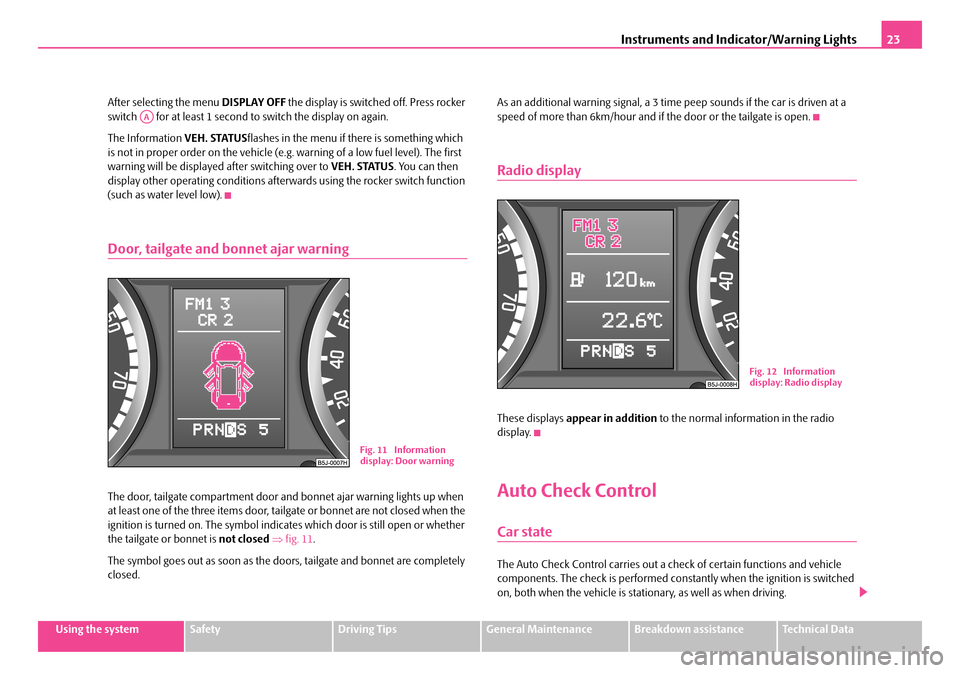
The door, tailgate compartment door an d bonnet ajar warning lights up when at least one of the three items door, tai lgate or bonnet are not closed when the ignition is turned on. The symbol indica tes which door is still open or whether the tailgate or bonnet is not closed ⇒fig. 11.
The symbol goes out as soon as the d oors, tailgate and bonnet are completely closed.
As an additional warning signal, a 3 time peep sounds if the car is driven at a speed of more than 6km/hour and if the door or the tailgate is open.
Radio display
These displays appear in addition to the normal information in the radio display.
Auto Check Control
Car state
The Auto Check Control carries out a ch eck of certain functions and vehicle components. The check is performed consta ntly when the ignition is switched on, both when the vehicle is stat ionary, as well as when driving.
AA
Fig. 11 Information display: Door warning
Fig. 12 Information display: Radio display
NKO A05Fabia 20.book Page 23 Tuesday, September 26, 2006 8:38 AM
Page 31 of 258
Instruments and Indicator/Warning Lights30
gency programme which enables you to drive to the nearest specialist garage by adopting a gentle style of driving.
The following text will be displayed in the information display*:
ENGINE FAULT WORKSHOP!
Turn signal system for ve hicles towing a trailer*
The indicator light on vehicles towing a trailer flashes together with the respective indicator light for the turn signal system.
The indicator light does not flash if a turn signal light on the trailer or on the vehicle is not operating.
Coolant temperature/coolant level
The warning light comes on for a few seconds 1) when the ignition is switched on.
The coolant temperature is too high or the coolant level too low if the warning light does not go out after the engine is started or flashes while driving.
3 peeps sound as an additional warning signal.
In this case stop and switch the engine off and check the coolant level; top up the coolant as necessary ⇒page 204, “Replenishing the coolant”.
Do not continue your journey if for some reason it is not possible under the conditions prevailing to top up with coolant. Keep the engine switched off and
obtain professional assistance from a specialist garage, otherwise it could lead to severe engine damage.
If the coolant is within the specified range, the increased temperature may be caused by an operating problem at the coolant fan. Check the fuse for the coolant fan, replace it if necessary ⇒page 239, “Fuse assignment at battery”.
Do not continue driving if the warning light does not go off although the fluid is at the correct level and also the fuse of the fan is in proper order. Contact a specialist garage to obtain assistance.
Please also refer to the additional instructions ⇒page 203, “Cooling system”.
The following text will be displayed in the information display*:
STOP CHECK COOLANT OWNER'S MANUAL!
WARNING
•If you must stop for technical reasons, then park the vehicle at a safe distance from the traffic and switch off the engine and switch on the hazard warning light system ⇒page 59, “Switch for hazard warning lights ”.
•Pay attention to the following instructions ⇒page 198, “Working in the engine compartment” before ch ecking the coolant fluid level and opening the bonnet.
•Take care when opening the coolant expansion bottle. If the engine is hot, the cooling system is pressurized - risk of scalding. It is best to allow the engine to cool down before removing the cap.
•Do not touch the coolant fan! The coolant fan may switch on auto- matically even if the ignition is off.
1)The warning light on vehicles fitted with information display does not come on after switching the ignition on, but only if the cool ant temperature is too high or the coolant level is too low.
NKO A05Fabia 20.book Page 30 Tuesday, September 26, 2006 8:38 AM
Page 32 of 258
Instruments and Indicator/Warning Lights31
Using the systemSafetyDriving TipsGeneral MaintenanceBreakdown assistanceTechnical Data
Electronic immobiliser
Data is compared between the ignition key and the control unit when switching on the ignition. The indicator light will light up for a few seconds when igni- tion key authorisation is confirmed.
The warning light will start flashing cont inuously if a non-authorised ignition key (for example the wrong ignition key) has been used. The engine cannot be started ⇒page 40.
It is only possible to start the engine of your car with a Genuine Škoda key with the matching code.
Fuel reserve
The warning light comes on, if the fuel level is still about 7 litres.
A peep sounds as an additional warning signal.
The following text will be displayed in the information display*:
PLEASE REFUEL
Engine oil
The warning light lights up red (low oil pressure)
The warning light comes on for a few seconds 2) when the ignition is switched on.
Stop the vehicle and switch the engine off if the warning light does not go off after the engine has started or flashes while driving. Check the oil level and top up with oil as necessary ⇒page 201.
3 peeps sound as an additional warning signal.
Do not continue your journey if for some reason it is not possible under the conditions prevailing to top up with oil. Keep the engine switched off and obtain professional assistance from a specialist garage, otherwise it could lead to severe engine damage.
Do not drive any further if the warning light flashes even if the oil is at the correct level. Do not run the engine no t at idling speed either. Contact the nearest specialist garage to obtain professional assistance.
The following text will be displayed in the information display*:
STOP OIL PRESS. ENGINE OFF! OWNER'S MANUAL!
The warning light lights up yellow* (oil quantity too low)
If the warning light lights up yellow, the qu antity of oil in the engine is probably too low. Check as soon as pos sible the oil level or top up ⇒page 201 with engine oil.
A peep sounds as an additional warning signal.
The following text will be displayed in the information display*:
CHECK OIL LEVEL
The warning light will go out if the bonnet is left open for more than 30 seconds. If no engine oil has been replenished, th e warning light will come on again after driving about 100 km.
The warning light flashes yellow* (engine oil level sensor faulty)
A fault on the engine oil level sensor is indicated additionally by an audible signal and the warning light coming on se veral times after the ignition has been switched on.
In this case have the engine inspecte d without delay by a specialist garage.2)The warning light on vehicles fitted with information display does not come on after switching the ignition on, but only if a fault exists or the engine oil level is too low.
NKO A05Fabia 20.book Page 31 Tuesday, September 26, 2006 8:38 AM
Page 33 of 258
Instruments and Indicator/Warning Lights32
The following text will be displayed in the information display*:
OIL SENSOR WORKSHOP!
WARNING
•If you must stop for technical reasons, then park the vehicle at a safe distance from the traffic and switch off the engine and switch on the hazard warning light system ⇒page 59.
•The red oil pressure light is not an oil level indicator! One should therefore check the oil level at regular intervals, preferably after every refueling stop.
•Pay attention to the following instructions ⇒page 198, “Working in the engine compartment” before checking the coolant fluid level and opening the bonnet.
Thickness of the brake pads*
If the warning light comes on, contact a specialist garage immediately and have the brake pads on all of the wheels inspected.
A peep sounds as an additional warning signal.
The following text will be displayed in the information display*:
CHECK BRAKE PAD
Open door*
The warning light comes on if one or several doors, the bonnet or tailgate is opened.
The warning light comes on even when the ignition is switched off. The warning light goes out 5 minutes after switching off the ignition if one or several doors, the bonnet or tailgate is opened. The warning light goes out after closing the doors.
Windshield washer fluid level*
The warning light comes on when the ignition is switched on if there is insuf-ficient fluid in the windshield washer system. Top up with liquid ⇒page 211.
A peep sounds as an additional warning signal.
The following text will be displayed in the information display*:
REFILL WASHER LIQUID
Control system for exhaust
The warning light comes on after the ignition has been switched on.
If the warning light does not go out after starting the engine or it lights up or flashes when driving, a fault exists in an exhaust relevant component. The engine management system selects an emergency programme which enables you to drive to the nearest specialist gara ge by adopting a gentle style of driving.
The following text will be displayed in the information display*:
EXHAUST WORKSHOP!
NKO A05Fabia 20.book Page 32 Tuesday, September 26, 2006 8:38 AM
Page 35 of 258
Instruments and Indicator/Warning Lights34
Components of the ESP system also include the Traction Control System (TCS), Electronic Differential Lock (EDL), and the Antilock Brake System ABS (ABS).
The warning light comes on when drivin g when a control cycle is activated.
The warning light will come on and remains on if the ESP is switched off or if there is a fault in the system.
The fact that the ESP system operates together with the ABS means that the ESP warning light will also come on if the ABS system is not operating properly.
Further information on the ESP ⇒page 165, “Electronic stability programme (ESP)*”.
Electronic Differential Lock (EDL)*
The EDL is a part of the ESP. A fault in the EDL is indicated by the ESP warning light in the instrument cluster. Have the vehicle inspected immediately by your specialist garage. Further information on the EDL ⇒page 167.
Antilock brake system (ABS)*
The warning light shows the functionality of the ABS.
The warning light comes on for a few seconds after the ignition has been switched on or when starting the engine. The warning light goes out after an automatic check sequence has been completed.
A fault in the ABS
The system is not functioning properly if the ABS warning light does not go out within a few seconds after switching on the ignition, does not light up at all or lights up while driving. The vehicle wi ll only be braked by the normal brake system. Visit a specialist garage as quickly as possible and adjust your style of driving in the meantime since you will not know how great the damage is.
Three additional warning tones will sound if there is a major fault in the ABS.
Further information about ABS ⇒page 169, “Antilock brake system (ABS)*”.
A fault in the entire brake system
If the ABS warning light comes on together with the brake system warning light (handbrake must be released), ther e is a fault not only in the ABS but also in another part of the brake system ⇒.
The following text will be displayed in the information display*:
STOP BRAKE FAULT OWNER'S MANUAL!
WARNING
•If the brake system warning light comes on together with the ABS warning light stop the vehicle immediatel y and check the brake fluid level in the reservoir ⇒page 206, “Brake fluid”. If the fluid level has dropped below the MIN marking, do not drive any further - risk of acci- dent! Contact a Škoda dealer to obtain professional assistance.
•Pay attention to the following instructions ⇒page 198, “Working in the engine compartment” before checking the brake fluid level and opening the bonnet.
•If the brake fluid is at the correct level, the ABS control function has failed. The rear wheels may then bloc k very rapidly when braking. In certain circumstances, this can result in the rear end of the car breaking away - risk of skidding! Drive carefu lly to the nearest specialist garage and have the fault rectified.
Brake system
The warning light flashes or comes on if the brake fluid level is too low, if there is a fault in the ABS or if the handbrake is applied.
If the warning light flashes (handbrake is not applied), stop and check the brake fluid level ⇒.
NKO A05Fabia 20.book Page 34 Tuesday, September 26, 2006 8:38 AM
Page 36 of 258
Instruments and Indicator/Warning Lights35
Using the systemSafetyDriving TipsGeneral MaintenanceBreakdown assistanceTechnical Data
The following text will be displayed in the information display*:
STOP BRAKE FLUID SERVICE MANUAL
If there is a fault in the ABS which also influences the function of the normal brake system (e.g. distribution of br ake pressure), the ABS warning light comes on together with the brake system warning light . Be aware that not only the ABS but also another part of th brake system is defective ⇒.
3 peeps sound as an additional warning signal.
One should get used to high pedal forces, long braking distances and long free play of the brake pedal when drivin g to the next specialist garage.
The following text will be displayed in the information display*:
STOP BRAKE FAULT OWNER'S MANUAL!
For further information on the brake system ⇒page 168, “Brakes”.
Handbrake applied
The warning light also comes on if the handbrake is applied. An audible warning is also given if you drive the vehicle for at least 3 seconds at a speed of more than 6 km/h.
The following text will be displayed in the information display*:
HANDBRAKE ON
WARNING
•Pay attention to the following instructions ⇒page 198, “Working in the engine compartment” before ch ecking the brake fluid level and opening the bonnet.
•If the brake system warning light does not go out a few seconds after switching on the ignition or comes on when driving, stop immedi- ately and check the brake fluid in the reservoir ⇒page 206, “Brake fluid”. If the fluid level has dropped below the MIN marking, do not drive any
further - risk of accident! Contact a Škoda dealer to obtain professional assistance.
Airbag system
Monitoring the airbag system
The warning light comes on for a few seconds when the ignition is switched on.
There is a fault in the system if the warning light does not go out or comes on or flashes while driving ⇒. This also applies if the warning light does not come on after the ignition is switched on.
The following text will be displayed in the information display*:
AIRBAG FAULT
The functionality of the airbag system is also monitored electronically, when one airbag has been switched off
The passenger front airbag and also possibly the passenger side airbag which have been switched off us ing the vehicle system tester:
•The warning light lights up for 3 seconds after switching on the ignition and then flashes for 12 seconds afterwards in 2 second intervals.
The passenger front airbag and also possibly the passenger side airbag which have been switched off using the switch (for switching off airbags)* in the end face of the dash panel on the front passenger side:
•The warning light comes on for 3 seconds after the ignition has been switched on.
•Switching off airbags is indicated in the middle of the dash panel by the lighting up of the indicator light (airbag switched off) ⇒ page 153.
WARNING (continued)
NKO A05Fabia 20.book Page 35 Tuesday, September 26, 2006 8:38 AM
Page 49 of 258
Unlocking and locking48
Folding out of the key
– Press button .
Folding up of the key
– Press button and collapse the key bit in the housing.
The turn signal lights flash twice as confirmation that the vehicle has been unlocked. The vehicle will lock again au tomatically if you unlock the vehicle using button but do not open a door or the tailgate within the next 30 seconds. This function is intended to prevent the car being unlocked uninten- tionally.
The safe securing system along with the anti-theft alarm system* are, however, deactivated during these 30 seconds.
When the vehicle is unlocked or locked, th e interior lights in the door contact are automatically switched on or off.
The turn signal lights flas h once to confirm that the vehicle has been correctly locked.
If the turn signal lights do not flash, check the doors, bonnet and tailgate again to ensure that they are closed. If the doors, the bonnet or the tailgate remain open when the anti-theft alarm system* is activated, the turn signal lights do not flash until after th ey have been closed.
WARNING
If the vehicle is locked from the outside and the safe securing system is activated, there must not be any person in the vehicle as it is then not possible to open either a door or a window from the inside. The locked doors make it more difficult for rescuers to get into the vehicle in an emergency - hazard!
Note
•Operate the radio remote control only when the doors and tailgate are closed and you have visual contact with the vehicle.
•Once in the car, you must not press the lock button of the master key before inserting the key into the ignition lock in order to avoid the car being inadvertently locked and, in addition , the anti-theft alarm system* being switched on. Should this happe n, press the unlock button of the master key.
Synchonisation of the remote control
If the vehicle cannot be unlocked by actuating the remote control system then it is possible that the code in the key and the control unit in the vehicle are no longer synchronised. This can occur when the buttons on the radio-operated key are actuated a number of times outsid e of the operative range of the equip- ment or the battery on the remote control was replaced.
This means it is necessary to synchronise the code as follows:
•Press any button on the remote control.
•pressing of the button means that the door will unlock with the key within 1 minute.
Anti-theft alarm system*
The anti-theft alarm system increases the level of protection against people seeking to break into the vehicle. The system triggers audible and visual warning signals if an attempt is made to break into the vehicle.
A3
A3
A1
NKO A05Fabia 20.book Page 48 Tuesday, September 26, 2006 8:38 AM
Page 50 of 258
Unlocking and locking49
Using the systemSafetyDriving TipsGeneral MaintenanceBreakdown assistanceTechnical Data
How is the alarm system switched on?
The anti-theft alarm system is activated automatically when the vehicle is locked with the key on the closed driver's door or by using the remote control. It is activated 30 seconds after closing the door.
How is the alarm sy stem switched off?
The anti-theft alarm system is switched off if the vehicle is unlocked by only using the remote control. The vehicle is automatically locked again if the vehicle is not opened within 30 seconds after reactivating the anti-theft alarm system.
Once you unlock the vehicle by inserting the key into the driver door you then have to insert the key into the ignition lock and switch the ignition on within 15 seconds after unlocking the door in order to deactivate the anti-theft alarm system. The alarm will be triggered if you do not switch on the ignition within 15 seconds.
When is the alarm triggered?
The following security areas of the locked vehicle are monitored:
•Bonnet,
•Tailgate,
•Doors,
•Ignition lock,
•Vehicle interior* ⇒page 49,
•Angle of the vehicle*,
•A drop in voltage of the on-board power supply.
An alarm is immediately triggered if either of the two battery terminals is disconnected while the anti-theft alarm system is activated.
How is the alarm switched off?
You switch the alarm off if you unlock th e car with the radio remote control in the key or if you switch the ignition on.
Note
•The working life of the alarm siren is 5 years. More detailed information is available from your Škoda Service Partner.
•Before leaving the car, check that all the doors, windows and the electric sliding/tilting roof* are properly closed in order to ensure that the anti-theft alarm system is fully operational.
•Coding of the radio remote control and the receptor part precludes the use of the radio remote control from other vehicles.
Interior monitor* and Towing
protection*
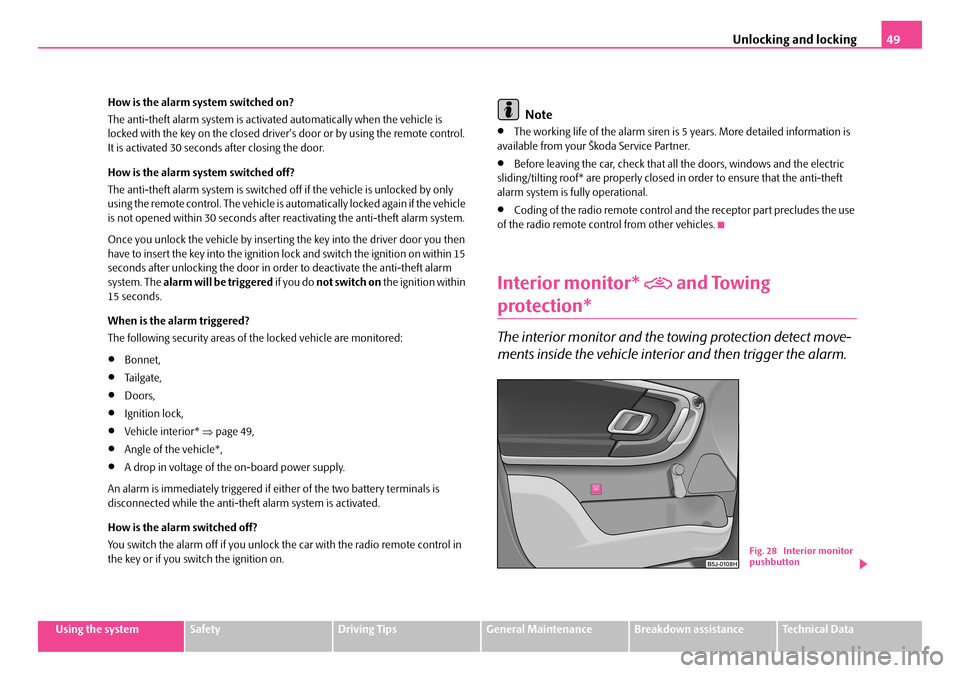
The interior monitor and the to wing protection detect move-
ments inside the vehicle interi or and then trigger the alarm.
Fig. 28 Interior monitor pushbutton
NKO A05Fabia 20.book Page 49 Tuesday, September 26, 2006 8:38 AM
Page 115 of 258
Automatic gearbox114
When the ignition is switched on and the selector lever is in position R, the reverse lights will come on.
N - Neutral
The transmission is in Neutral in this position.
The brake pedal must be depressed (if the lever is in its position for longer than 2 seconds) in order to move the se lector lever out of the position N into the position D, with the ignition switched on, on a vehicle travelling at less than 5 km/hour or on a stationary vehicle.
The brake pedal must be depressed (if the lever is in its position for longer than 2 seconds) in order to move the se lector lever out of the position N into the position R, with the ignition switched on, on a vehicle travelling at less than 5 km/hour or on a stationary vehicle.
D - Drive, position for driving forward
When the selector lever is in this position, the forward gears are shifted up and down automatically in line with engi ne load, vehicle speed and the dynamic shift programme.
You must depress the brake pedal ⇒ if you wish to move the selector lever into position D from N when the vehicle is travelling at less than 5 km/hour or is stationary.
In certain circumstances (e.g. when driving in mountainous regions or when towing a trailer) it may be beneficial to select the manual shift programme ⇒ page 116 for a short time in order to adapt the gearbox ratios manually to the driving situations.
S - Position for sporty style of driving
Shifting up later into a higher gear make s it possible to fully exploit the power potential of the engine. The gearbox also then shifts down at higher engine speeds as in the position D.
The gearbox does not shift into the 6th gear in the position S, because the maximum speed is achieved with the 5th gear.
The Shiftlock on the selector lever grip must be pressed when moving the selector lever out of the position D into the position S.
WARNING
•Never move the selector lever into position R or P when driving - risk of an accident!
•When the engine is running and the vehicle is stationary, it is neces- sary to hold the car with the brak e pedal in all the positions of the selector lever (except P and N) since the power transmission is never completely interrupted, also not when the engine is idling - the vehicle "creeps".
•You must on no account unintentionally operate the throttle (e.g. by hand from the engine compartment) if a drive position is engaged when the car is stationary. The vehicle wo uld otherwise immediately start off - also when the handbrake is firmly applied - risk of an accident!
•You must move the selector lever into position P and firmly apply the handbrake first before you or any other person opens the bonnet and starts working on the engine when it is running - risk of accident! It is also essential to observe all warnings ⇒page 198, “Working in the engine compartment”.
Selector lever lock
Automatic selector lever lock
With the ignition on, the selector lever is locked when it is in the positions P and N . You must first of all depress the brake pedal in order to move the selector lever out of this position. The warning light ⇒page 33 lights up in the instru- ment cluster as a reminder for the driver when the selector lever is in position P and N:
A time delay element ensures that the selector lever is not blocked when rapidly switching over the position N (e.g. from R to D). This does, for example, allow
NKO A05Fabia 20.book Page 114 Tuesday, September 26, 2006 8:38 AM