oil SKODA FABIA 2007 2.G / 5J Owner's Guide
[x] Cancel search | Manufacturer: SKODA, Model Year: 2007, Model line: FABIA, Model: SKODA FABIA 2007 2.G / 5JPages: 242, PDF Size: 48.29 MB
Page 178 of 242

Inspecting and Replenishing177
Using the systemSafetyDriving TipsGeneral MaintenanceBreakdown assistanceTechnical Data
Replenishing engine oil
– Inspect the oil level ⇒page 176.
– Unscrew the cap of the engine oil filler opening.
– Pour in a suitable grade of oil in portions of 0.5 litres ⇒page 175,
“Engine oil specifications”.
– Inspect the oil level ⇒page 176.
– Carefully screw on the cap of the filler opening and push the dipstick
in fully.
WARNING
•Avoid dripping oil onto hot parts of the engine when topping up will oil - a risk of fire!
•Read and observe the warning notes ⇒page 173, “Working in the engine compartment” before working in the engine compartment.
For the sake of the environment
The oil level must on no ac count be above the range ⇒page 176. Oil will other- wise be drawn in through the crankcase ventilation and may pass through the exhaust system to atmosphere. The oil ma y combust in the catalytic converter and damage it.
Changing engine oil
The engine oil must be changed at the intervals stated in the Service schedule or according to the service interval indicator ⇒page 11.
WARNING
•Only carry out the engine oil change, if you have the required profes- sional knowledge!
•Read and observe the warning notes ⇒page 173, “Working in the engine compartment” before working in the engine compartment.
•Let the engine cool down - risk of burning from hot oil.
•Wear an eye protection - risk of caustic burns due to oil splashes.
•Oil is toxic! Store old oil in a safe place out of the reach of children and unauthorized persons until you dispose of it properly.
Caution
You must not pour any additives into th e engine oil - risk of engine damage! Damage, which results from such produc t, are excluded from the warranty.
For the sake of the environment
•You must on no account pour oil into the ground or into the sewage system.
•In view of the problems involved in properly disposing of old oil, the material, equipment and the knowledge required fo r such work, we recommend that you have the oil and oil filter change carried out by your Škoda Service Partner.
Note
After your skin has come in contact with the oil, you must thoroughly wash your skin.
Cooling system
Coolant
The job of the coolant is to cool the engine.
The cooling system does not require any maintenance under normal operating conditions. The coolant consist s of water with a concentration of coolant additive of 40 %. This mixture not only provides antifreeze protection down to -25°C but
Aa
WARNING (continued)
NKO A05F 20 MR08.book Page 177 Thursday, April 19, 2007 11:34 AM
Page 179 of 242

Inspecting and Replenishing178
also protects the cooling and heating system from corrosion. It also prevents the formation of scale and significantly increases the boiling point of the coolant.
You must therefore not reduce the concentration of antifreeze agent in the coolant by adding water, also not during the su mmer months or in countries with a warm climate. The concentration of coolant additive in the coolant must be at least 40%.
You can increase the amount of antifreeze in the coolant if a higher concentration of antifreeze is necessary for climatic reasons but only up to 60% (antifreeze protection down to approx. -40°C). The an tifreeze protection tails off above that concentration.
Vehicles exported to countries with a co ld climate (e.g. Sweden, Norway, Finland) are already factory-filled with a coolant wh ich offers antifreeze protection down to about -35°C. In these countries the concentr ation of coolant additive should be at least 50 %.
Coolant
The cooling system is filled at the works with coolant (purple in colour), which complies with the specification TL-VW 774 F.
We recommend that you use the antifreeze agent - G12 PLUS (purple in colour).
We recommend that you contact your Škod a Service Partner if you have any ques- tions regarding the coolant or if you wish to fill up with a different coolant.
Your Škoda Service Partner can also suppl y you with the correct coolant additives.
Caution
•Other coolant additives may cause operational problems which, in partic- ular, involves significantly reducing the anticorrosion effect.
•Any faults or problems resulting from corrosion may cause a loss of coolant and, as a consequence of th is, result in major engine damage.
Inspecting the coolant level
The coolant expansion bottle is located in the engine compartment on
the right.
– Switch the engine off.
– Open the bonnet ⇒ in “Working in the engine compartment” on
page 173.
– Check the level of coolant in the coolant expansion bottle ⇒fig. 149.
The coolant level when the engine is cold must lie between the “MIN”
and “MAX” markings. The level may also rise slightly above the
“MAX” marking when the engine is warm.
If the coolant level in the reservoir is too low, this is indicated by the warning light in the instrument cluster ⇒page 24. We nevertheless recommend inspecting the coolant level directly at the reservoir from time to time.
Loss of coolant
A loss of coolant is first and foremost an indication of a leak in the system. You should not merely top up the coolant in the reservoir. It is also important to have the cooling system inspected without delay by a specialist garage.
Fig. 149 Engine compartment: Coolant expansion bottle
ABAA
NKO A05F 20 MR08.book Page 178 Thursday, April 19, 2007 11:34 AM
Page 180 of 242

Inspecting and Replenishing179
Using the systemSafetyDriving TipsGeneral MaintenanceBreakdown assistanceTechnical Data
Losses can only occur through the pressure relief in the cap of the coolant expan- sion bottle which is completely free of leak s if the coolant boils as a result of over- heating and is forced out of the cooling system.
WARNING
Read and observe the warning notes ⇒page 173, “Working in the engine compartment” before working in the engine compartment.
Caution
One should contact a specialist garage as soon as possible if the source of over-heating itself cannot be determined and removed, since there may be grave damage to the engine.
Replenishing the coolant
– Switch the engine off.
– Allow the engine to cool down.
– Place a cloth over the cap of the coolant expansion reservoir
⇒ page 178, fig. 149 and unscrew the cap carefully by turning it to the
left ⇒.
– Top up the coolant.
– Screw the cap tight until it is heard to lock.
The coolant which you use for replenishi ng the system, must comply with one specific specification ⇒page 177, “Coolant”. Do not use an alternative additive if the coolant additive G12 PLUS is not available in exceptional cases. Just top up the system with water and as soon as possible arrange adjustment to correct the mixing ratio of water and coolant additive again by a specialist garage.
Only use fresh coolant for topping up the system.
Do not fill up over the “MAX” marking! Ex cess coolant which is heated up is forced out of the cooling system through the pressu re relief valve in the cap of the coolant compensation bottle.
Wait until the engine has cooled down for a system which has suffered a major loss of coolant before pouring in coolant. Th is is necessary to avoid engine damage.
WARNING
•The cooling system is pressurized! Do not open the cap of the coolant expansion bottle if the engine is still hot - risk of scalding!
•The coolant additive and thus all of the coolant is harmful to your health. Avoid contact with the coolant. Coolant vapours are also harmful to the health. It is important, therefore, to always safely store any coolant additive in its original container out of the reach of children - risk of poisoning!
•If any splashes of coolant get into yo ur eyes, rinse out your eyes immedi- ately with clear water and contac t a doctor as soon as possible.
•You should also consult a doctor without delay if you have inadvertently swallowed coolant.
Caution
Do not continue your journey if for some reason it is not possible under the conditions prevailing to top up with coolant. Switch the engine off and obtain professional assistance from a specialist garage, otherwise it could lead to severe engine damage.
For the sake of the environment
Do not re-use coolant if it is necessary to drain the coolant in the system. It should be collected and disposed of in comp liance with environmental protection regulations.
NKO A05F 20 MR08.book Page 179 Thursday, April 19, 2007 11:34 AM
Page 181 of 242
Inspecting and Replenishing180
Radiator fan
The radiator fan may switch on suddenly.
The radiator fan is driven by an electr ic motor and controlled by a thermostat according to the coolant temperature.
The radiator fan may continue running fo r up to 10 minutes after the engine has been switched off - even if th e ignition is also off. It may also switch on suddenly after a certain time, if
•the coolant temperature has risen beca use of an accumulation of heat or
•the warm engine compartment is heated up additionally by strong sunlight.
WARNING
You must therefore be aware when working in the engine compartment that the fan may switch on suddenly - risk of injury!
Brake fluid
Inspecting the brake fluid level
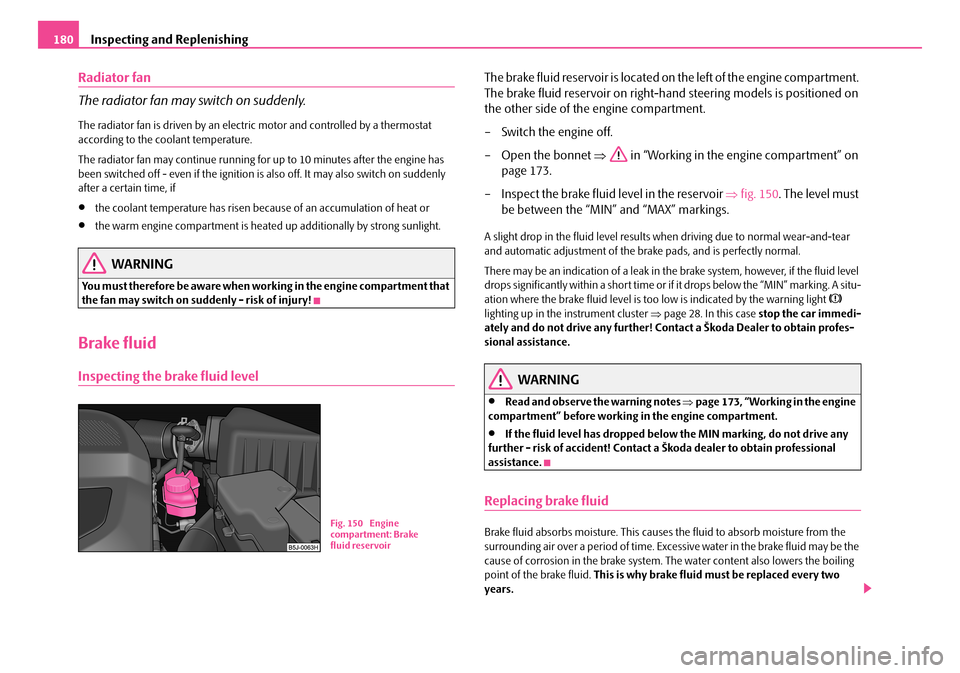
The brake fluid reservoir is located on the left of the engine compartment.
The brake fluid reservoir on right-hand steering models is positioned on
the other side of the engine compartment.
– Switch the engine off.
– Open the bonnet ⇒ in “Working in the engine compartment” on
page 173.
– Inspect the brake fluid level in the reservoir ⇒fig. 150. The level must
be between the “MIN” and “MAX” markings.
A slight drop in the fluid level results when driving due to normal wear-and-tear and automatic adjustment of the brake pads, and is perfectly normal.
There may be an indication of a leak in the brake system, however, if the fluid level drops significantly within a short time or if it drops below the “MIN” marking. A situ- ation where the brake fluid level is too low is indicated by the warning light lighting up in the instrument cluster ⇒page 28. In this case stop the car immedi- ately and do not drive any further! Contact a Škoda Dealer to obtain profes-sional assistance.
WARNING
•Read and observe the warning notes ⇒page 173, “Working in the engine compartment” before working in the engine compartment.
•If the fluid level has dropped below the MIN marking, do not drive any further - risk of accident! Contact a Škoda dealer to obtain professional assistance.
Replacing brake fluid
Brake fluid absorbs moisture. This causes the fluid to absorb moisture from the surrounding air over a period of time. Excessive water in the brake fluid may be the cause of corrosion in the brake system. Th e water content also lowers the boiling point of the brake fluid. This is why brake fluid must be replaced every two years.
Fig. 150 Engine compartment: Brake fluid reservoir
NKO A05F 20 MR08.book Page 180 Thursday, April 19, 2007 11:34 AM
Page 187 of 242
Wheels and Tyres186
Wheels and Tyres
Wheels
General comments
•New tyres do not offer optimal grip at first and should therefore be run in for about 500 km at a moderate speed and an appropriately cautious style of driving. You will also profit from longer tyre life.
•The tread depth of new tyres may differ because of design features and the configuration of the tread (d epending on the type of tyre and the manufacturer).
•Drive over curbs on the side of the road and other such obstacles slowly and, where possible, at a right angles in order to avoid damage to tyres and wheel trims.
•Inspect your tyres from time to time for damage (punctures, cuts, splits and bulges). Remove foreign bodi es from the tyre profile.
•Damage to tyres and wheels is frequently not visible. Unusual vibrations or pulling of the vehicle to one side could be a sign of tyre damage. Please reduce your speed immediately and stop if you suspect that a wheel is damaged. Inspect the tyres for signs of damage (bulges, splits, etc.) If no visible damage is present, please drive at an appropriately slow speed and carefully to the nearest specialist garage in order to have your vehicle inspected.
•Also protect your tyres from cont act with oil, grease and fuel.
•Immediately replace any dust caps of the valves which have got lost.
•Mark wheels before removing them so that their previous direction of running can be maintained when mounted them again.
•Always store wheels or tyres which been removed in a cool, dry and, where possible, dark place. Tyres which are not fixed to a wheel trim should be stored upright.
Unidirectional tyres*
The direction of rotation of the tyres is marked by arrows on the wall of the tyre. This indicates the direction of rotation of the tyre, and it is essential that the tyres are fitted on to run in this direction. Only then are the tyres able to provide the optimal properties in terms of grip, low no ise, wear-and-tear and aquaplaning.
Further information concerning the use of unidirectional tyres ⇒page 190.
WARNING
•New tyres during the first 500 km do not offer optimal grip and should therefore be run appropriately - risk of accident!
•Never drive with damaged tyres - risk of accident!
Note
Please observe the various differing legal requirements regarding tyres.
Tyre life
The life of your tyres very much depends on the following points:
Tyre pressure
The working life of tyres will be shortened co nsiderably if the tyres are insufficiently or over-inflated and this will have an advers e effect on the handling of your vehicle.
Correctly inflated tyres are of partic ular importance when travelling at high speeds. It is therefore good to check the pressure at least once a month and also before
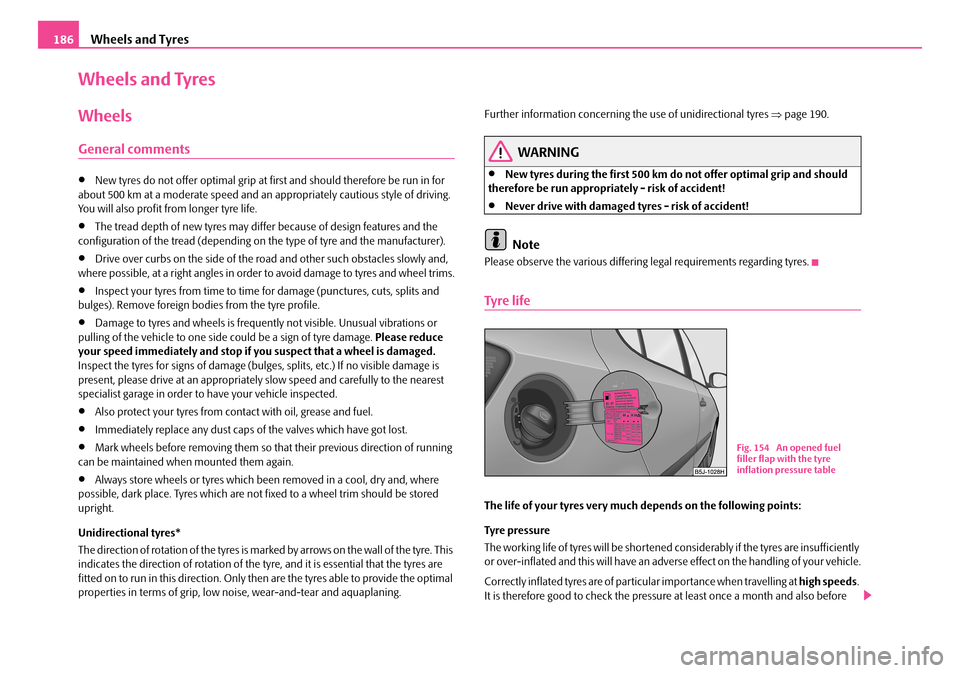
Fig. 154 An opened fuel filler flap with the tyre inflation pressure table
NKO A05F 20 MR08.book Page 186 Thursday, April 19, 2007 11:34 AM
Page 190 of 242
Wheels and Tyres189
Using the systemSafetyDriving TipsGeneral MaintenanceBreakdown assistanceTechnical Data
WARNING
•Only use those tyres or wheel rims which have been approved for your model of Škoda Auto a.s. vehicle. Failure to observe this instruction will adversely affect the road safety of your vehicle - risk of accident! Approval and licencing of your vehicle on publ ic roads may also become void as a result.
•You must on no account drive at a hi gher speed than is permissible for your tyres - risk of an accident resulting from tyre damage and loss of control over your vehicle.
•Tyres which are 6 years old or more should only be fitted in exceptional cases and when adopting an appropriately cautious style of driving.
•Never fit tyres which have already be en used without having adequate knowledge of their previous history. Tyres age even if they have not been used at all or only very little. A spare tyre must only be used in exceptional cases and only then when adopting an appropriately cautious style of driving.
•Do not, where possible, replace indivi dual tyres but at least replace them on both wheels of a given axle at the same time. Always fit the tyres with the deeper tread depth to the front wheels.
For the sake of the environment
Old tyres must be disposed of in conf ormity with the appropriate regulations.
Note
It is not normally possible to fit wheels from other models of cars for technical reasons. This may also apply in certain circumstances to the wheels of the same type of vehicle.
Wheel bolts
Wheels and wheel bolts are matched to each other in terms of design. Each time you fit other wheels - e.g. light alloy wheels or wheels with winter tyres - you must
therefore also use the matching wheel bolts of the correct length and shape of spherical cap. This is essent ial to ensure that the wheels are tightly fitted and that the brake system operates properly.
If you retrofit wheel trims (or have this done), please also ensure that an adequate flow of air remains assured for cooling the brake system.
The Škoda Service Partners are instructed in the technical possibilities which exist regarding converting or retrofitting wheels, tyres and wheel trim.
WARNING
•In case of incorrect treatment of th e wheel bolts, the wheel can loosen when the car is moving - risk of accident!
•The wheel bolts must be clean and must turn easily. However, they must never be treated with grease or oil.
•If the wheel bolts are tightened to a too low tightening torque, the rim can lossen when the car is moving - risk of accident! A tightening torque which is too high can damage the bolts and threads and this can result in permanent deformation of the contact surfaces on the rims.
Caution
The prescribed tightening torque of the wheel bolts for steel and light alloy wheels is 120 Nm.
Winter tyres
The handling of your vehicle will be significantly improved when driving on wintry roads if you fit winter tyres. Summer tyres do not offer the same grip on ice, snow and at temperatures below 7 °C because of their construction (width, rubber blend, tread pattern). This applies in particul ar to vehicles which are equipped with low- profile tyres or high-speed tyres (code index H, V or W on wall of tyre).
Winter tyres must be mounted on all four wheels to obtain the best handling char- acteristics.
NKO A05F 20 MR08.book Page 189 Thursday, April 19, 2007 11:34 AM
Page 193 of 242

Accessories, changes and replacement of parts192
Accessories, changes and replacement of parts
Accessories and replacement parts
Škoda vehicles have been built according to the latest discoveries in safety engi- neering. Thus one should not change the condition in which the vehicle was deliv- ered from the manufacturer without some thought.
The following guidelines should be observed when a vehicle is to be retrofitted with accessories, have technical chan ges made to it or a par t has to be replaced at some time in the future.
•Advise should always be obtained from a Škoda Service Partner before buying any accessories and before making any technical changes ⇒.
•This is particularly the case when accessories are bought in a foreign country.
•Škoda Genuine Accessories which have been released for use and Skoda orig- inal parts can be obtained from Škoda Service Partners. They will install them professionally and correctly.
•All Škoda original accessory which is listed in the catalogue such as tilting roofs, spoilers, wheels etc. must have an official stamp of approval.
•Radios, aerials and other electrical accessories should only be installed by an authorised workshop.
•The guidelines issued by Škoda Auto a.s. must be observed when making tech-nical changes.
•This is to ensure that no technical damage occurs to the vehicle, that travelling and operating safety are maintained and that the chnages are permissible. Škoda Service Partners undertake this work professionally or refer it to an specialist company in special cases.
Any damage which is done caused by technical changes made without consulting a Skoda a.s. dealer is excluded from the guarantee.
WARNING
•We advise you, in your own interest, to only use Škoda Genuine Accesso- ries and Škoda original parts which have been expressly approved for use on
your Škoda. Reliability, safety and suitabiliity have been established for these Škoda original parts.
•We cannot guarantee suitability of installation into your vehicle of other products despite keeping a constant ey e on market developments (also not in the case where there is an attest ation or permission can be produced).
Technical changes
Interference on the electronic components and their software can lead to opera- tional faults. This interference can also im pair not directly affected systems because of the networking of the electronic co mponents. This means that the operating safety of your vehicle can be considerably jeopardized, a greater wear of vehicle parts can occur and finally the vehi cle registration documents expire.
We trust that you will understand that your Škoda Service Partner cannot be liable for damage resulting from unprofessional work.
We therefore recommend that you have al l work carried out with Škoda original parts at your authorised Škoda Service Partners.
WARNING
Work or modifications on your vehicle, which have been carried out unpro-fessionally, can cause operational faults - risk of accident!
WARNING (continued)
NKO A05F 20 MR08.book Page 192 Thursday, April 19, 2007 11:34 AM
Page 197 of 242
Breakdown assistance196
– Fit on the spare wheel and tighten the wheel bolts slightly.
–Lower the car.
– Tighten the wheel bolts firmly, alternately and diagonally using the
wheel wrench ⇒page 198.
– Mount the full wheel trim/wheel trim cap or the caps.
Note
•All bolts must be clean and must turn easily.
•You must never grease or oil the wheel bolts!
•When fitting on unidirectional tyres, ensu re that the tyres rotate in the correct direction ⇒page 186.
Subsequent steps
After changing the wheel, you must perform the following steps.
– Stow and attach the replaced wheel in the spare wheel well.
– Stow the vehicle tool kit in the space provided.
– Check the tyre pressure on the spare wheel just mounted as soon as
possible.
– Have the tightening torque of the wheel bolts checked with a torque
wrench as soon as possible. The ti ghtening torque for steel and light
alloy wheels must be 120 Nm.
– Have the defective tyre repaired as soon as possible.
WARNING
It is necessary to observe the guidelines given on ⇒page 188, “New tyres and wheels” if the vehicle is subseq uently fitted with tyres which are different to those it was fitted with at the works.
Note
•If you find, when changing the wheel, that the wheel bolts are corroded and difficult to turn, the bolts must be replac ed before checking the tightening torque.
•Drive cautiously and only at a moderate speed to a workshop where the tight- ening torque can be checked.
Full wheel trim*
Pulling off
– Hook the clamp found in the vehicle tool kit into the reinforced edge
of the full wheel trim.
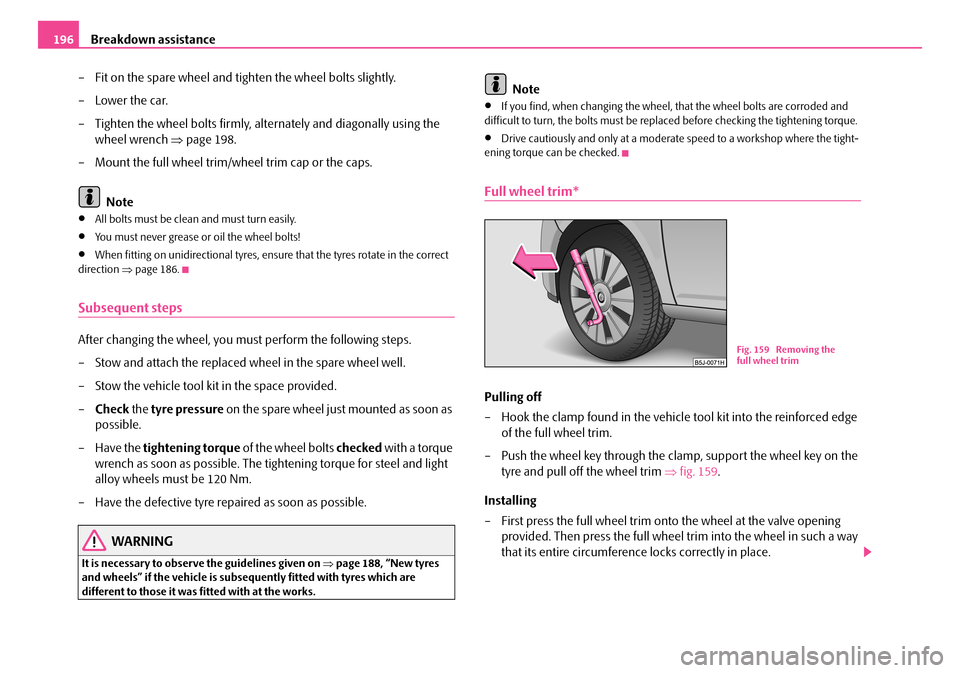
– Push the wheel key through the clamp, support the wheel key on the
tyre and pull off the wheel trim ⇒fig. 159.
Installing
– First press the full wheel trim onto the wheel at the valve opening
provided. Then press the full wheel trim into the wheel in such a way
that its entire circumference locks correctly in place.
Fig. 159 Removing the full wheel trim
NKO A05F 20 MR08.book Page 196 Thursday, April 19, 2007 11:34 AM
Page 203 of 242

Breakdown assistance202
Driving style
Towing another vehicle requires a certain amount of practice. Both drivers should be familiar with the particular points about towing a vehicle. Unskilled drivers should not attempt to tow in another vehicle or to be towed in.
One should be constantly vigilant not to allow impermissibly high towing forces or jerky loadings. There is always a risk of excessive stresses and damage resulting at the points to which you attach the tow ro pe or tow bar when you attempt to tow a vehicle which is not standing on a paved road.
Caution
If the gearbox of your vehicle no longer contains any oil because of a defect, your vehicle must only be towed in with the driven wheels raised clear of the ground, or on a special vehicle transporter or trailer.
Note
•Please comply with any legal requirements particularly regarding the switched on signal systems, when towing in or tow-starting another vehicle.
•The tow rope must not be twisted as it may in certain circumstances result in the front towing eye being unscrewed out of your vehicle.
Front towing eye
The towing eye is stored in th e box for the vehicle tool kit.
Installing the towing eye
– Grasp the protective grille at the point marked with the arrow and take
it out ⇒fig. 166.
– Screw in the towing eye by hand to the left up to the stop ⇒fig. 167.
– Tighten up the towing eye using the wheel wrench (push the wheel
wrench through eye).
Removal of the towing eye
– Unscrew the towing eye.
– Put the protective grille in place on the side opposite the marking.
– Press into place the protective grille onto the side facing the marking.
– The protective grille must engage firmly.
Fig. 166 Front bumper: Protective grille
Fig. 167 Front bumper: Installing the towing eye
NKO A05F 20 MR08.book Page 202 Thursday, April 19, 2007 11:34 AM
Page 204 of 242

Breakdown assistance203
Using the systemSafetyDriving TipsGeneral MaintenanceBreakdown assistanceTechnical Data
Rear towing eye
The rear towing eye is located below the rear bumper on the right ⇒fig. 168.
Tow-starting a vehicle
If the engine does not start, we generally do not recommend to tow-start
your vehicle. One should attempt to start the engine using jump start
cables ⇒page 200 or call on the services of the SERVICE mobile.
If your vehicle has to be towed:
– Engage 2nd or 3rd gear with the vehicle stationary.
– Depress the clutch pedal fully and keep it depressed.
– Switch on the ignition.
– Wait until both vehicles are moving then release the clutch pedal
slowly.
– Depress the clutch pedal fully when the engine fires and take the
vehicle out of gear.
WARNING
There is high risk of having an accide nt when tow-starting a vehicle, when for example the towed vehicle runs into the towing vehicle.
Caution
Vehicles which are fitted with a catalytic converter should not be tow-started over a distance of more than 50 metres. Unburn t fuel may get into the catalytic converter and damage it.
Towing in a vehicle fitted with a manual gearbox
Please refer to the notes ⇒page 201.
The car can be towed in with a tow bar or a tow rope or with the front or rear wheels raised. The maximum towing speed is 50 km/h.
Towing of a vehicle with an automatic gearbox
Please refer to the notes ⇒page 201.
The car can be towed in with a tow bar or a tow rope. Refer at the same time to the following guidelines:
•Move selector lever into N.
•The maximum towing speed is 50 km/h.
•The maximum permissible towing distance is 50 km. The gear oil pump does not operate when the engine is not runni ng; the gearbox would not be adequately lubricated at higher speeds and over longer towing distance.
Caution
If the vehicle is towed in by a recovery vehi cle, it should only be towed in with the front wheels raised. If the vehicle is raised at rear, the automatic gearbox is damaged!
Fig. 168 Rear towing eye
NKO A05F 20 MR08.book Page 203 Thursday, April 19, 2007 11:34 AM