trailer SKODA FABIA 2008 2.G / 5J User Guide
[x] Cancel search | Manufacturer: SKODA, Model Year: 2008, Model line: FABIA, Model: SKODA FABIA 2008 2.G / 5JPages: 252, PDF Size: 40.88 MB
Page 162 of 252

Driving and the Environment161
Using the systemSafetyDriving TipsGeneral MaintenanceBreakdown assistanceTechnical Data
The fuel consumption can naturally also be influenced by factors which are beyond the driver's control. It is, for example, normal for the fuel consumption to increase in winter and under worsened conditions such as poor road conditions, towing a trailer, etc.
The technical requirements for low fuel usage and economic efficiency of the vehicle have already been built into the vehicle at the works. Special attention has been given to minimising negative effects on the environment. It is necessary to take note of the guidelines given in this chapter in order to make best use of these characteristics and to maintain their effectiveness.
Looking ahead when driving
A vehicle's highest fuel consumption occurs it accelerates.
Avoid accelerating and braking unnecessarily. If you drive with forsight you will not need to brake so often and will also then not have to accelerate so much. Let your vehicle coast to a stop, for example, if this is possible, when you see that the next set of traffic lights is at red.
Shifting gears and saving energy
Shifting up early saves on fuel.
Manual gearbox
– Drive no more than about one length of your vehicle in first gear.
Always shift up into the next higher gear at approx. 2 000 to 2 500 revs.
Automatic gearbox
– Depress the accelerator pedal slowly. Do not depress it beyond the
kickdown position, however.
An effective way of achieving good fuel economy is to shift up early. You will consume more fuel if you drive at unnecessarily high revolutions in any given gear.
The ⇒fig. 162 shows the ratio of fuel consumption to the speed of your vehicle in the relevant gears. Fuel consumption in 1st gear is the highest and in 5th gear is the lowest.
Note
•The optimal engine speed should be obtained when accelerating, in order to avoid a high fuel consumption and resonance of the vehicle.
•Also use the information supplied by the multi-functional indicator* ⇒page 13.
Avoiding full throttle
Driving more slowly means saving fuel.
Fig. 162 Fuel consumption in litres/100 km. and speed in km/h.
Fig. 163 Fuel consumption in litres/100 km. and speed in km/h.
NKO A05F 20.book Page 161 Wednesday, April 2, 2008 1:02 PM
Page 167 of 252
Towing a trailer166
Towing a trailer
To w i n g a t r a i l e r
Technical requirements
The towing device must satisfy certain technical requirements.
Your vehicle is designed primarily for transporting persons and luggage. It can, however, also be used for towing a trailer - provided certain technical equipment is fitted.
If your vehicle has been equipped with a towing device from Škoda Original Acces-sories, then the towing device satisfies all technical and legal requirements.
Your vehicle is fitted with a 13-pin power socket for the electrical connection between the vehicle and trailer. If the trailer which you wish to tow has a 7-pin connector, you can use a suitable adapter 6) from Škoda original accessories.
This work must be carried out in accordance with the manufacturer's specifications if a towing device is retrofitted.
Škoda Service Partners are familiar with details relating to retrofitting a towing device and for any necessary modifications to the cooling system.
WARNING
We recommend that you have the towing device from Škoda original acces-sories installed by a Škoda Service Partner. He is familiar with all the relevant details relating to retrofitting such equipment. There is a risk of an accident if the towing device is not properly fitted!
General Maintenance
There are a number of points to pay attention to when towing a
trailer.
Trailer load
The permissible trailer load must on no account be exceeded.
You can negotiate appropriately steeper inclines and descents if you do not make full use of the permissible trailer load.
The trailer loads specified only apply for altitudes up to 1 000 metres above mean sea level. The fact that the engine power output drops with increasing height due to a lowering of air pressure and thus the ability to climb, means that the trailer load must be reduced by 10% for every further increase of 1 000 metres in height above sea level. The towed weight is the weight of the (laden) vehicle and the (laden) trailer together. One should take this into account before driving up to higher alti-tudes.
The trailer and drawbar load information on the type plate of the towing device are merely test data for the towing device The data relating to your vehicle, which is often less than this test data, can be found in your vehicle registration documents or in the brochure - Technical Data.
Distribution of the load
Distribute the load in the trailer in such a way that any heavy items are located as close as possible to the axle. Secure the items to prevent them slipping.
Tyre pressure
Correct the tyre inflation pressure on your vehicle for that of “fully laden”, ⇒page 194. The inflation pressure of the tyres fitted to the trailer adjust in accord-ance with the manufacturer's recommendation.
Exterior mirrors
You have to have additional exterior mirrors fitted if you are not able to see the traffic behind the trailer with the standard rear-view mirrors. Both exterior mirrors 6)In some countries the adapter is supplied with the towing device.
NKO A05F 20.book Page 166 Wednesday, April 2, 2008 1:02 PM
Page 168 of 252
Towing a trailer167
Using the systemSafetyDriving TipsGeneral MaintenanceBreakdown assistanceTechnical Data
should be attached to folding arms. Adjust the mirrors so that they provide you with an adequate field of view to the rear.
Headlights
Before starting off with a hitched trailer, also check the setting of the headlights. Alter the setting as necessary with the aid of the headlight beam adjuster ⇒page 47.
Detachable ball head
The ball rod is detachable on vehicles with towing device and suppliable from Škoda original accessories. It is stowed together with separate fitting instructions in the spare wheel well in the luggage compartment of the vehicle.
Note
•We recommend that you also have your vehicle inspected between service intervals if you tow a trailer frequently.
•The handbrake on the towing vehicle must be put on when coupling and decoupling the trailer.
•Keep the mechanism of the ball head of the towing device clean and take proper care of it with a suitable preservative.
Driving Tips
Particular caution is required when towing a trailer.
– Do not, as far as possible, drive with your vehicle unladen and the
trailer laden.
– Do not make full use of the legal maximum speeds. This applies in
particular to downhill sections.
– Apply the brakes in good time.
– Keep a check on the coolant temperature gauge if the outside temper-
ature is high.
Distribution of weight
The distribution of the weight is very poor if your vehicle is unladen and the trailer is laden. Maintain a particularly low speed if you cannot avoid driving with this combination.
Driving speed
Do not drive faster than 80 km/hour for safety reasons. This also applies for coun-tries in which higher speeds are allowed.
The fact that the driving stability of the vehicle + trailer combination reduces with increasing speed means that the legally allowed speed should not be used when there are unfavourable road, weather or wind conditions, particularly near accident black spots.
You must always reduce your speed immediately as soon as you detect even just the slightest swaying of the trailer. On no account attempt to stop the trailer from “swaying” by accelerating.
Apply the brakes in good time! If the trailer is fitted with a trailer brake, apply the brakes gently at first and then brake firmly. This will avoid brake jolts resulting from the trailer wheels locking. Shift down gears in good time before negotiating a down-hill section to allow the engine to also act as a brake.
Engine overheating
Please keep a check on the coolant temperature gauge if you have to negotiate a lengthy slope in a low gear at a high engine speed when the outside temperature is very high ⇒page 10.
If the needle of the coolant temperature gauge moves into the right-hand area or even the red area of the scale, reduce your speed immediately. Stop and switch off the engine if the warning light in the instrument cluster begins flashing. Wait a few minutes and check the level of coolant in the coolant expansion bottle ⇒page 186, “Inspecting the coolant level”.
Please refer to the following guidelines ⇒page 24, “Coolant temperature/coolant level ”.
The coolant temperature can be reduced by switching on the heating.
Any increase in the cooling effect of the coolant fan through shifting down a gear and increasing the engine speed is not possible since the fan speed is independent
NKO A05F 20.book Page 167 Wednesday, April 2, 2008 1:02 PM
Page 169 of 252
Towing a trailer168
of the engine speed. One should also not drop a gear for this reason when towing a trailer as long as the engine can manage the slope without any drop in speed.
NKO A05F 20.book Page 168 Wednesday, April 2, 2008 1:02 PM
Page 185 of 252
Inspecting and Replenishing184
Check engine oil level
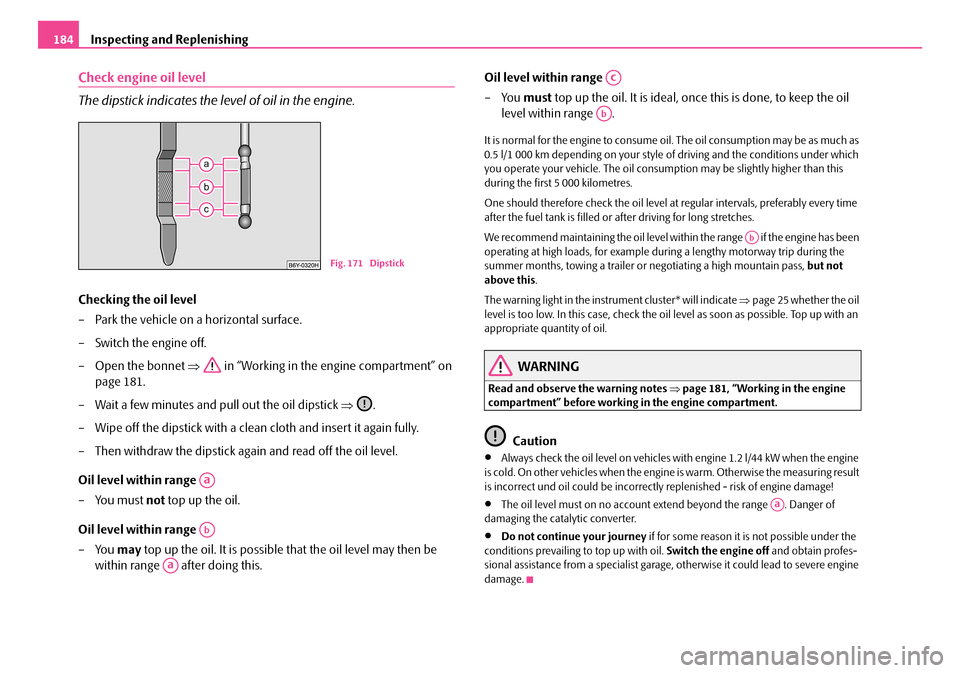
The dipstick indicates the level of oil in the engine.
Checking the oil level
– Park the vehicle on a horizontal surface.
– Switch the engine off.
– Open the bonnet ⇒ in “Working in the engine compartment” on
page 181.
– Wait a few minutes and pull out the oil dipstick ⇒.
– Wipe off the dipstick with a clean cloth and insert it again fully.
– Then withdraw the dipstick again and read off the oil level.
Oil level within range
–You must not top up the oil.
Oil level within range
–You may top up the oil. It is possible that the oil level may then be
within range after doing this.
Oil level within range
– You must top up the oil. It is ideal, once this is done, to keep the oil
level within range .
It is normal for the engine to consume oil. The oil consumption may be as much as 0.5 l/1 000 km depending on your style of driving and the conditions under which you operate your vehicle. The oil consumption may be slightly higher than this during the first 5 000 kilometres.
One should therefore check the oil level at regular intervals, preferably every time after the fuel tank is filled or after driving for long stretches.
We recommend maintaining the oil level within the range if the engine has been operating at high loads, for example during a lengthy motorway trip during the summer months, towing a trailer or negotiating a high mountain pass, but not above this.
The warning light in the instrument cluster* will indicate ⇒page 25 whether the oil level is too low. In this case, check the oil level as soon as possible. Top up with an appropriate quantity of oil.
WARNING
Read and observe the warning notes ⇒page 181, “Working in the engine compartment” before working in the engine compartment.
Caution
•Always check the oil level on vehicles with engine 1.2 l/44 kW when the engine is cold. On other vehicles when the engine is warm. Otherwise the measuring result is incorrect und oil could be incorrectly replenished - risk of engine damage!
•The oil level must on no account extend beyond the range . Danger of damaging the catalytic converter.
•Do not continue your journey if for some reason it is not possible under the conditions prevailing to top up with oil. Switch the engine off and obtain profes-sional assistance from a specialist garage, otherwise it could lead to severe engine damage.
Fig. 171 Dipstick
Aa
Ab
Aa
Ac
Ab
Ab
Aa
NKO A05F 20.book Page 184 Wednesday, April 2, 2008 1:02 PM
Page 203 of 252
Breakdown assistance202
Vehicle tool kit
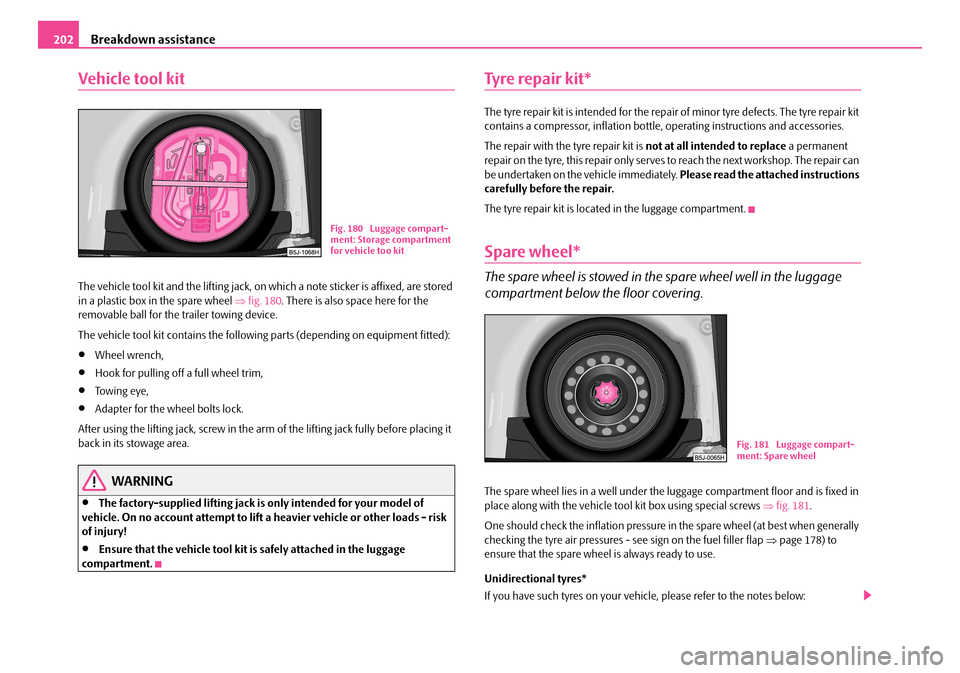
The vehicle tool kit and the lifting jack, on which a note sticker is affixed, are stored in a plastic box in the spare wheel ⇒fig. 180. There is also space here for the removable ball for the trailer towing device.
The vehicle tool kit contains the following parts (depending on equipment fitted):
•Wheel wrench,
•Hook for pulling off a full wheel trim,
•Towing eye,
•Adapter for the wheel bolts lock.
After using the lifting jack, screw in the arm of the lifting jack fully before placing it back in its stowage area.
WARNING
•The factory-supplied lifting jack is only intended for your model of vehicle. On no account attempt to lift a heavier vehicle or other loads - risk of injury!
•Ensure that the vehicle tool kit is safely attached in the luggage compartment.
Tyre repair kit*
The tyre repair kit is intended for the repair of minor tyre defects. The tyre repair kit contains a compressor, inflation bottle, operating instructions and accessories.
The repair with the tyre repair kit is not at all intended to replace a permanent re pair on the tyre, this repai r only s er v es to reach the next w orks hop. T he re pa ir can be undertaken on the vehicle immediately. Please read the attached instructions carefully before the repair.
The tyre repair kit is located in the luggage compartment.
Spare wheel*
The spare wheel is stowed in the spare wheel well in the luggage
compartment below the floor covering.
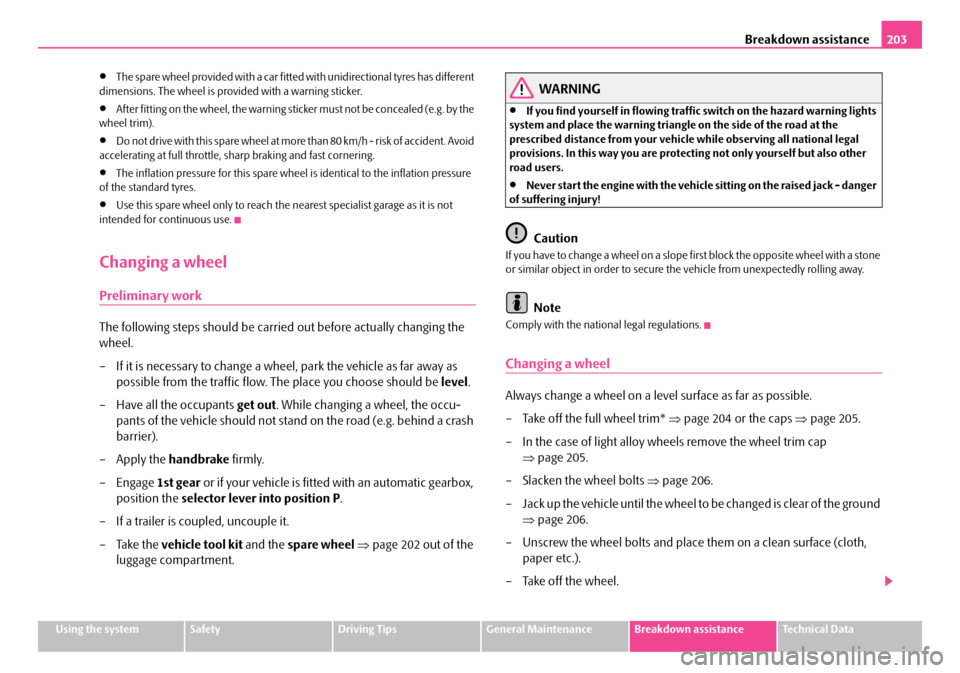
The spare wheel lies in a well under the luggage compartment floor and is fixed in place along with the vehicle tool kit box using special screws ⇒fig. 181.
One should check the inflation pressure in the spare wheel (at best when generally checking the tyre air pressures - see sign on the fuel filler flap ⇒page 178) to ensure that the spare wheel is always ready to use.
Unidirectional tyres*
If you have such tyres on your vehicle, please refer to the notes below:
Fig. 180 Luggage compart-ment: Storage compartment for vehicle too kit
Fig. 181 Luggage compart-ment: Spare wheel
NKO A05F 20.book Page 202 Wednesday, April 2, 2008 1:02 PM
Page 204 of 252
Breakdown assistance203
Using the systemSafetyDriving TipsGeneral MaintenanceBreakdown assistanceTechnical Data
•The spare wheel provided with a car fitted with unidirectional tyres has different dimensions. The wheel is provided with a warning sticker.
•After fitting on the wheel, the warning sticker must not be concealed (e.g. by the wheel trim).
•Do not drive with this spare wheel at more than 80 km/h - risk of accident. Avoid accelerating at full throttle, sharp braking and fast cornering.
•The inflation pressure for this spare wheel is identical to the inflation pressure of the standard tyres.
•Use this spare wheel only to reach the nearest specialist garage as it is not intended for continuous use.
Changing a wheel
Preliminary work
The following steps should be carried out before actually changing the
wheel.
– If it is necessary to change a wheel, park the vehicle as far away as
possible from the traffic flow. The place you choose should be level.
– Have all the occupants get out. While changing a wheel, the occu-
pants of the vehicle should not stand on the road (e.g. behind a crash
barrier).
– Apply the handbrake firmly.
–Engage 1st gear or if your vehicle is fitted with an automatic gearbox,
position the selector lever into position P.
– If a trailer is coupled, uncouple it.
– Take the vehicle tool kit and the spare wheel ⇒page 202 out of the
luggage compartment.
WARNING
•If you find yourself in flowing traffic switch on the hazard warning lights system and place the warning triangle on the side of the road at the prescribed distance from your vehicle while observing all national legal provisions. In this way you are protecting not only yourself but also other road users.
•Never start the engine with the vehicle sitting on the raised jack - danger of suffering injury!
Caution
If you have to change a wheel on a slope first block the opposite wheel with a stone or similar object in order to secure the vehicle from unexpectedly rolling away.
Note
Comply with the national legal regulations.
Changing a wheel
Always change a wheel on a level surface as far as possible.
– Take off the full wheel trim* ⇒page 204 or the caps ⇒page 205.
– In the case of light alloy wheels remove the wheel trim cap
⇒page 205.
– Slacken the wheel bolts ⇒page 206.
– Jack up the vehicle until the wheel to be changed is clear of the ground
⇒page 206.
– Unscrew the wheel bolts and place them on a clean surface (cloth,
paper etc.).
– Take off the wheel.
NKO A05F 20.book Page 203 Wednesday, April 2, 2008 1:02 PM
Page 211 of 252
Breakdown assistance210
Driving style
Towing another vehicle requires a certain amount of practice. Both drivers should be familiar with the particular points about towing a vehicle. Unskilled drivers should not attempt to tow in another vehicle or to be towed in.
One should be constantly vigilant not to allow impermissibly high towing forces or jerky loadings. There is always a risk of excessive stresses and damage resulting at the points to which you attach the tow rope or tow bar when you attempt to tow a vehicle which is not standing on a paved road.
Caution
If the gearbox of your vehicle no longer contains any oil because of a defect, your vehicle must only be towed in with the driven wheels raised clear of the ground, or on a special vehicle transporter or trailer.
Note
•Please comply with any legal requirements particularly regarding the switched on signal systems, when towing in or tow-starting another vehicle.
•The tow rope must not be twisted as it may in certain circumstances result in the front towing eye being unscrewed out of your vehicle.
Front towing eye
The towing eye is stored in the box for the vehicle tool kit.
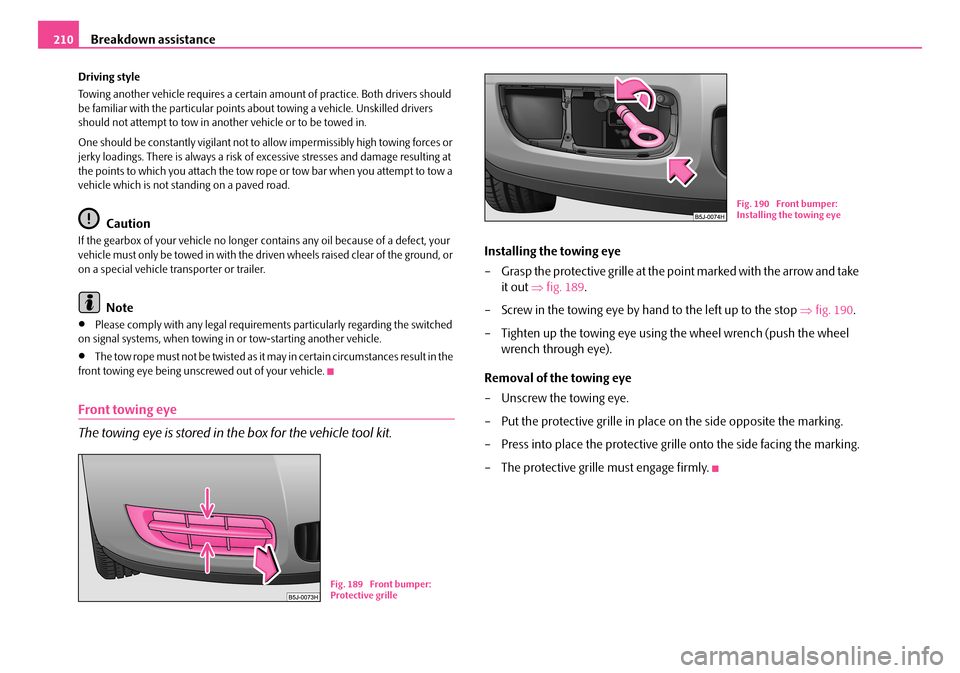
Installing the towing eye
– Grasp the protective grille at the point marked with the arrow and take
it out ⇒fig. 189.
– Screw in the towing eye by hand to the left up to the stop ⇒fig. 190.
– Tighten up the towing eye using the wheel wrench (push the wheel
wrench through eye).
Removal of the towing eye
– Unscrew the towing eye.
– Put the protective grille in place on the side opposite the marking.
– Press into place the protective grille onto the side facing the marking.
– The protective grille must engage firmly.
Fig. 189 Front bumper: Protective grille
Fig. 190 Front bumper: Installing the towing eye
NKO A05F 20.book Page 210 Wednesday, April 2, 2008 1:02 PM
Page 213 of 252
Breakdown assistance212
Note
The vehicle must be transported on a special vehicle or trailer if it is not possible to tow in the vehicle in the way described or if the towing distance is greater than 50 km.
NKO A05F 20.book Page 212 Wednesday, April 2, 2008 1:02 PM
Page 228 of 252
Technical Data227
Using the systemSafetyDriving TipsGeneral MaintenanceBreakdown assistanceTechnical Data
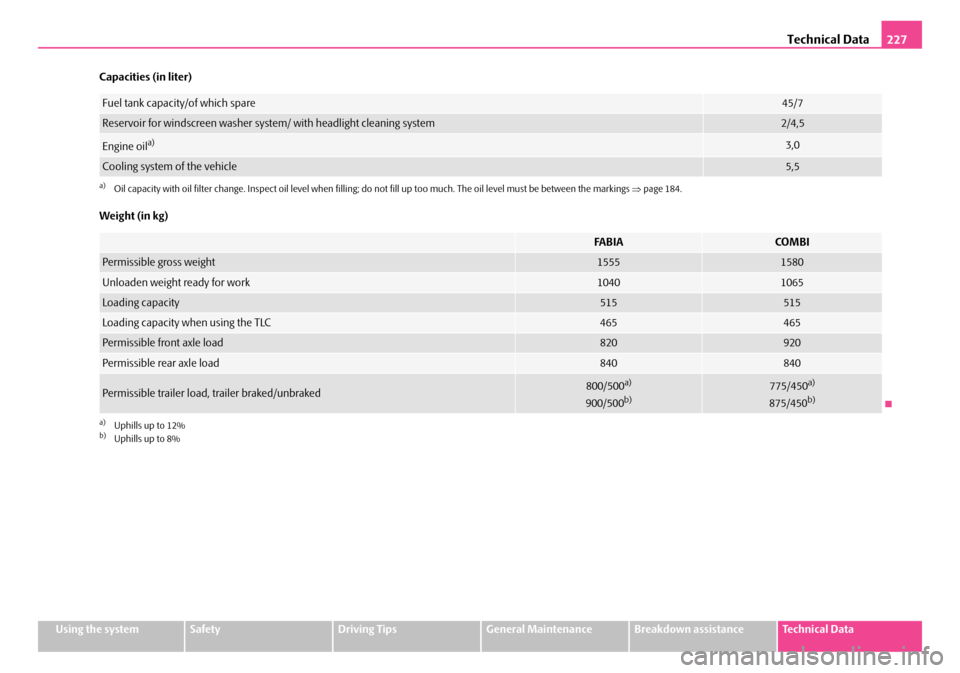
Capacities (in liter)
Weight (in kg)
Fuel tank capacity/of which spare45/7
Reservoir for windscreen washer system/ with headlight cleaning system2/4,5
Engine oila)
a)Oil capacity with oil filter change. Inspect oil level when filling; do not fill up too much. The oil level must be between the markings ⇒page 184.
3,0
Cooling system of the vehicle5,5
FA B I ACOMBI
Permissible gross weight15551580
Unloaden weight ready for work10401065
Loading capacity515515
Loading capacity when using the TLC465465
Permissible front axle load820920
Permissible rear axle load840840
Permissible trailer load, trailer braked/unbraked800/500a)
900/500b)
a)Uphills up to 12%b)Uphills up to 8%
775/450a)
875/450b)
NKO A05F 20.book Page 227 Wednesday, April 2, 2008 1:02 PM