Windows SKODA FABIA 2008 2.G / 5J Owner's Guide
[x] Cancel search | Manufacturer: SKODA, Model Year: 2008, Model line: FABIA, Model: SKODA FABIA 2008 2.G / 5JPages: 252, PDF Size: 40.88 MB
Page 94 of 252

Heating and air conditioning system93
Using the systemSafetyDriving TipsGeneral MaintenanceBreakdown assistanceTechnical Data
– Turn the control dial ⇒page 90, fig. 109 to the left (reduce blower
speed) or right (increase blower speed).
Switch off the blowers, the Climatronic is switched off and in the display shows OFF.
The set blower speed is displayed next to the control dial when the respective number of warning lights come on.
WARNING
•“Stale air” may result in fatigue in the driver and occupants, reduce attention levels and also cause the windows to mist up. The risk of having an accident increases.
•Do not switch the Climatronic system off for longer than necessary.
•Switch the Climatronic system on as soon as the windows mist up.
Air outlet vents
Fig. 110 Air outlet vents
Open air outlet vents
– Turn the rotary knob into the upper position.
Close air outlet vents
– Turn the rotary knob into the lower position.
Redirecting air flow
– The horizontal as well as the vertical direction of the air flow is set with
the handle in the middle of the air outlet vents.
You can control the air distribution to the air outlet vents via the buttons of the operating part of the Climatronic ⇒page 90. Air outlet vents 3 and 4 ⇒fig. 110 can also be opened or closed individually.
A1
A1
NKO A05F 20.book Page 93 Wednesday, April 2, 2008 1:02 PM
Page 96 of 252
Starting-off and Driving95
Using the systemSafetyDriving TipsGeneral MaintenanceBreakdown assistanceTechnical Data
Ignition lock
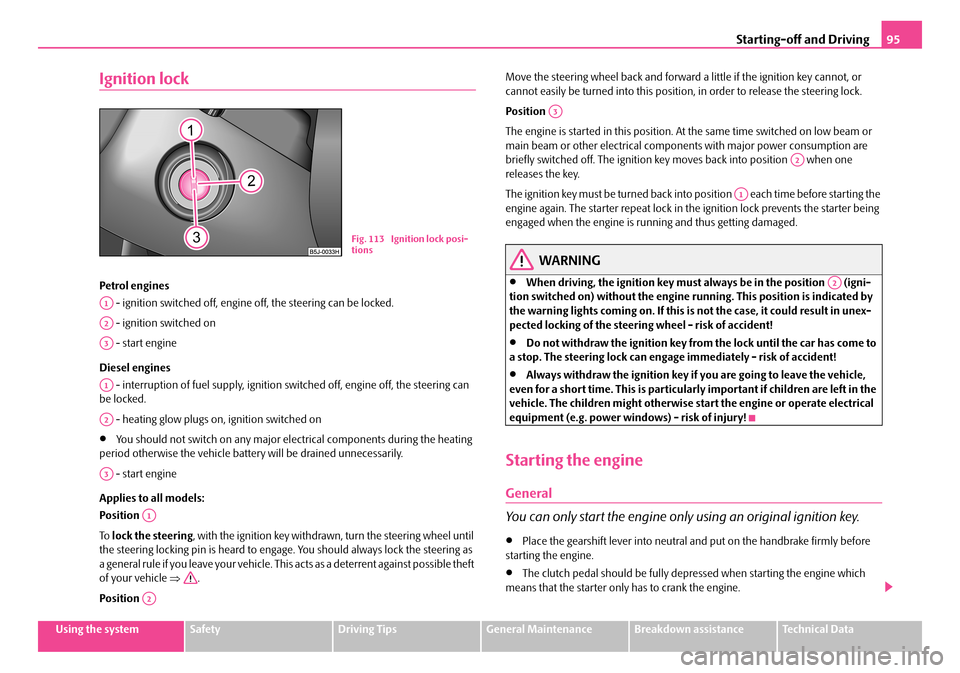
Petrol engines
- ignition switched off, engine off, the steering can be locked.
- ignition switched on
- start engine
Diesel engines
- interruption of fuel supply, ignition switched off, engine off, the steering can be locked.
- heating glow plugs on, ignition switched on
•You should not switch on any major electrical components during the heating period otherwise the vehicle battery will be drained unnecessarily.
- start engine
Applies to all models:
Position
To lock the steering, with the ignition key withdrawn, turn the steering wheel until the steering locking pin is heard to engage. You should always lock the steering as a general rule if you leave your vehicle. This acts as a deterrent against possible theft of your vehicle ⇒.
Position
Move the steering wheel back and forward a little if the ignition key cannot, or cannot easily be turned into this position, in order to release the steering lock.
Position
The engine is started in this position. At the same time switched on low beam or main beam or other electrical components with major power consumption are briefly switched off. The ignition key moves back into position when one releases the key.
The ignition key must be turned back into position each time before starting the engine again. The starter repeat lock in the ignition lock prevents the starter being engaged when the engine is running and thus getting damaged.
WARNING
•When driving, the ignition key must always be in the position (igni-tion switched on) without the engine running. This position is indicated by the warning lights coming on. If this is not the case, it could result in unex-pected locking of the steering wheel - risk of accident!
•Do not withdraw the ignition key from the lock until the car has come to a stop. The steering lock can engage immediately - risk of accident!
•Always withdraw the ignition key if you are going to leave the vehicle, even for a short time. This is particularly important if children are left in the vehicle. The children might otherwise start the engine or operate electrical equipment (e.g. power windows) - risk of injury!
Starting the engine
General
You can only start the engine only using an original ignition key.
•Place the gearshift lever into neutral and put on the handbrake firmly before starting the engine.
•The clutch pedal should be fully depressed when starting the engine which means that the starter only has to crank the engine.
Fig. 113 Ignition lock posi-tions
A1
A2
A3
A1
A2
A3
A1
A2
A3
A2
A1
A2
NKO A05F 20.book Page 95 Wednesday, April 2, 2008 1:02 PM
Page 110 of 252
Communication109
Using the systemSafetyDriving TipsGeneral MaintenanceBreakdown assistanceTechnical Data
Universal telephone preinstallation with voice
control*
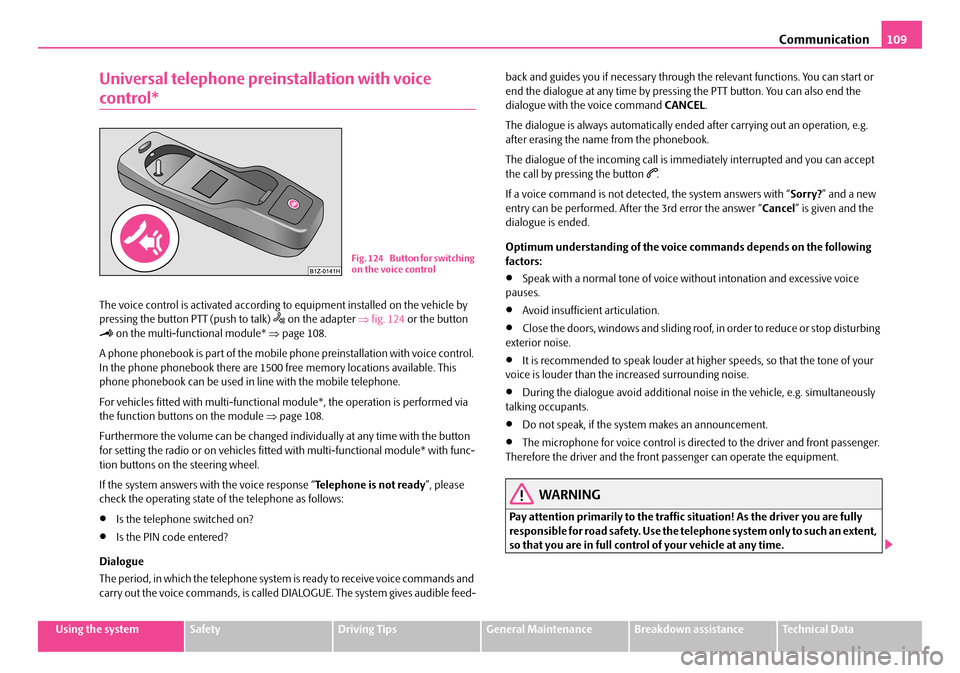
The voice control is activated according to equipment installed on the vehicle by pressing the button PTT (push to talk) on the adapter ⇒fig. 124 or the button on the multi-functional module* ⇒page 108.
A phone phonebook is part of the mobile phone preinstallation with voice control. In the phone phonebook there are 1500 free memory locations available. This phone phonebook can be used in line with the mobile telephone.
For vehicles fitted with multi-functional module*, the operation is performed via the function buttons on the module ⇒page 108.
Furthermore the volume can be changed individually at any time with the button for setting the radio or on vehicles fitted with multi-functional module* with func-tion buttons on the steering wheel.
If the system answers with the voice response “Telephone is not ready”, please check the operating state of the telephone as follows:
•Is the telephone switched on?
•Is the PIN code entered?
Dialogue
The period, in which the telephone system is ready to receive voice commands and carry out the voice commands, is called DIALOGUE. The system gives audible feed-
back and guides you if necessary through the relevant functions. You can start or end the dialogue at any time by pressing the PTT button. You can also end the dialogue with the voice command CANCEL.
The dialogue is always automatically ended after carrying out an operation, e.g. after erasing the name from the phonebook.
The dialogue of the incoming call is immediately interrupted and you can accept the call by pressing the button .
If a voice command is not detected, the system answers with “Sorry?” and a new entry can be performed. After the 3rd error the answer “Cancel” is given and the dialogue is ended.
Optimum understanding of the voice commands depends on the following factors:
•Speak with a normal tone of voice without intonation and excessive voice pauses.
•Avoid insufficient articulation.
•Close the doors, windows and sliding roof, in order to reduce or stop disturbing exterior noise.
•It is recommended to speak louder at higher speeds, so that the tone of your voice is louder than the increased surrounding noise.
•During the dialogue avoid additional noise in the vehicle, e.g. simultaneously talking occupants.
•Do not speak, if the system makes an announcement.
•The microphone for voice control is directed to the driver and front passenger. Therefore the driver and the front passenger can operate the equipment.
WARNING
Pay attention primarily to the traffic situation! As the driver you are fully responsible for road safety. Use the telephone system only to such an extent, so that you are in full control of your vehicle at any time.
Fig. 124 Button for switching on the voice control
NKO A05F 20.book Page 109 Wednesday, April 2, 2008 1:02 PM
Page 123 of 252
Passive Safety122
Before setting off
The driver is always fully responsible for his occupants and for the
operating safety of the vehicle.
For your own safety and the safety of the people travelling with you, please pay attention to the following points before setting off.
•Ensure that the lighting and the turn signal system are functioning properly.
•Inspect the tyre inflation pressure.
•Ensure that all the windows offer a good visibility to the outside.
•Safely attach the items of luggage ⇒page 61, “Loading the luggage compart-ment”.
•Ensure that no objects can obstruct the pedal.
•Adjust the mirror, the front seat and the head restraint to match your body size.
•Point out to your occupants that the head restraints must be adjusted to match their body size.
•Protect the children in suitable child seats with correctly fastened seat belts ⇒page 142, “Transporting children safely”.
•Adopt the correct seated position. Also inform your occupants to adopt the correct seated position.
•Fasten the seat belt correctly. Also inform your occupants to properly fasten the seat belts ⇒page 128, “How are seat belts correctly fastened?”.
What influences the driving safety?
The driving safety is primarily determined by the style of driving and
the personal behaviour of all the occupants.
The driver is fully responsible for himself and his occupants. If your driving safety is effected, you place yourself and the oncoming traffic at risk. Please refer to the following guidelines.
•Do not get distracted from concentrating on the traffic situation, e.g. by your occupants or mobile phone calls.
•Never drive when your driving ability is impaired, e.g. through medication, alcohol, drugs.
•Keep to the traffic regulations and the permissible speed limit.
•Adjust the driving speed at all times to the road condition as well as to the traffic and weather conditions.
•Take regular breaks on long journeys - at the latest every two hours.
Correct seated position
Correct seated position for the driver
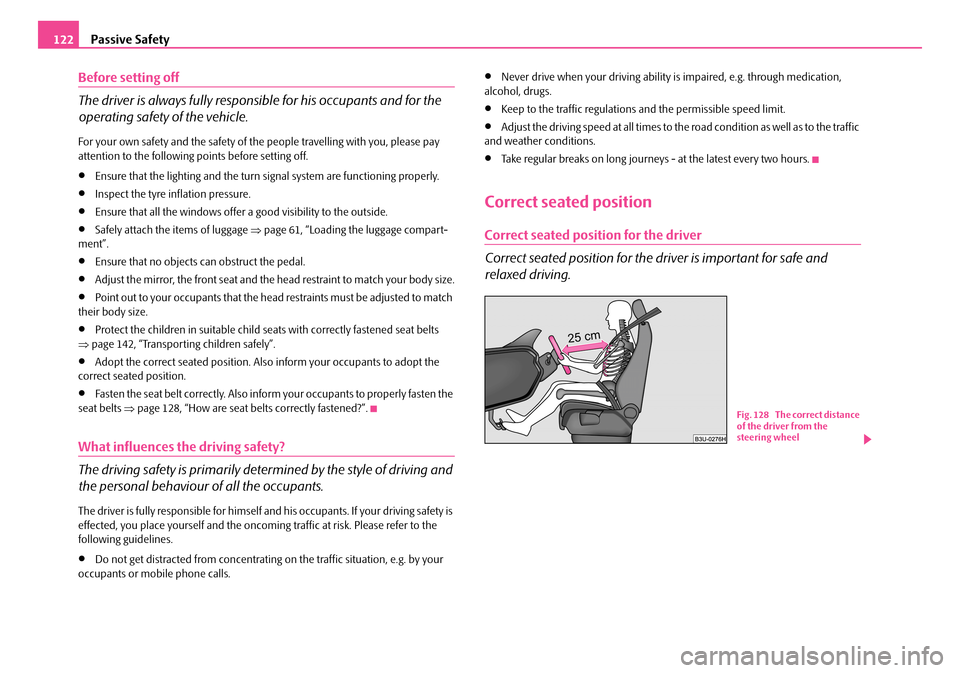
Correct seated position for the driver is important for safe and
relaxed driving.
Fig. 128 The correct distance of the driver from the steering wheel
NKO A05F 20.book Page 122 Wednesday, April 2, 2008 1:02 PM
Page 140 of 252
Airbag system139
Using the systemSafetyDriving TipsGeneral MaintenanceBreakdown assistanceTechnical Data
The airbags inflate in fractions of a second and at a high speed in order to be able to offer that additional protection in the event of an accident. A grey white, non harmful gas is released when airbag is inflated. This is perfectly normal and is not an indication of a fire in the vehicle.
Important safety information on the head airbag
Correct use of the airbag system considerably reduces the risk of
injury!
WARNING
•It is essential to always switch off ⇒page 139 the front passenger airbag when attaching a child safety seat on the front passenger seat where the child is seated with its back facing in direction of travel (in some countries also when the child is facing the direction of travel). If this is not done, there is a risk of the child suffering severe or even fatal injuries if the front passenger airbag is deployed. In certain countries national legal provisions also require that the side or head passenger airbags be deactivated. When transporting a child on the front passenger seat, please comply with the appropriate national regulations regarding the use of child safety seats.
•There must not be any objects in the deployment area of the head airbags which might prevent the airbags from inflating properly.
•Only hang light items of clothing on the clothes hooks to the vehicle. Never leave any heavy or sharp-edged objects in the pockets of the items of clothing. In addition, it is not permitted to use clothes hangers for hanging up items of clothing.
•There must not be any other persons (e.g. children) or animals between the car occupant and the deployment area of the head airbag. In addition, none of the occupants should lean their head out of the window when driving, or extend their arms and hands out of the window.
•The sun visors must not be swivelled to the side windows into the deployment area of the head airbags if any objects, such as ball-point pens etc. are attached to them. This might result in injuries to the occupants if the head airbag is deployed.
•Installing impermissible accessories in the area of the head airbags may considerably impair the protection offered by the head airbag in the event of it being deployed. When the deployed head airbag is inflated, parts of the accessories fitted may in certain circumstances be thrown into the interior of the car and cause injuries to the occupants ⇒page 200.
•Any work on the head airbag system including installing and removing system components because of other repair work (e.g. removing headliner) must only be carried out by a specialist garage.
Deactivating an airbag
Deactivating airbags
If any airbags have been deactivated, switch them on again as soon
as possible so that they are able to again provide their proper protec-
tion.
There is the technical means installed within your vehicle to switch off the front, side* or head airbag* (take out of commission).
This is why you should have the deactivation of the airbags carried out by a specialist garage.
On vehicles equipped with the switch for deactivation of the airbags, you can deac-tivate the front passenger airbag or passenger side airbag by means of this switch ⇒page 140.
Deactivation of airbags is envisaged only for particular instances, such as if:
•you must in exceptional cases use a child seat on the front passenger seat where the child has its back to the direction of travel of the vehicle (in some coun-tries this must be in the direction of travel due to other legal regulations applying) ⇒page 142, “Important safety information regarding the use of child safety seats”
•you are not able to maintain the distance of at least 25 cm between middle of steering wheel and chest, despite the driver seat being correctly adjusted,
WARNING (continued)
NKO A05F 20.book Page 139 Wednesday, April 2, 2008 1:02 PM
Page 171 of 252
Taking care of your vehicle and cleaning the vehicle170
Automatic vehicle wash systems
The paintwork of the vehicle is sufficiently resistant that the vehicle can be washed normally in automatic vehicle wash plants without any problem. The actual stress to which the paintwork is subjected, however, depends primarily on the design of the vehicle wash system, the filtering of the water and the type of washing and care products used. If the paintwork of your vehicle appears mat after being washed or even has scratches, point this out to the operator of the vehicle wash plant. Use a different vehicle wash plant, if necessary.
There are no particular points to note before washing your vehicle in such a plant other than the usual precautionary measures (closing windows, moving any factory-fitted aerials down flat against the bodywork, etc.).
If you have any particular attach e d p a r t s f i t te d t o y o u r c a r - s u ch a s s p o i l e r, ro o f ra ck system, two-way radio aerial - it is best to first of all consult the operator of the car wash plant.
It is important to degrease the lips of the windscreen wiper rubbers after passing through the automatic vehicle wash system.
Caution
Do not screw the swivelling down roof aerial tight before washing the vehicle in an automatic vehicle wash system - risk of damage!
Washing vehicle by hand
It is important to first soften the dirt with plenty of water and rinse it off as thor-oughly as possible before washing your vehicle by hand.
One should then clean the vehicle using a soft washing sponge, washing glove or a washing brush and only slight pressure. Work from the top to the bottom - beginning with the roof. Only place slight pressure on the vehicle paintwork during cleaning Only use a car shampoo for stubborn dirt.
Wash out the sponge or washing glove thoroughly at short intervals.
Clean wheels, door sills and similar parts last. Use a second sponge for such areas.
Rinse off the vehicle well after giving it a wash and dry it off using a chamois leather.
WARNING
•The ignition should always be switched off when you wash your vehicle - risk of accident!
•Protect your hands and arms from sharp-edged metal parts when you are cleaning the underfloor, the inside of the wheel housings or the wheel trims - risk of cuts.
Caution
•Do not wash your vehicle in bright sunlight - risk of paint damage.
•Ensure that the jet of water is not aimed directly at the locks or at the door and panel joints if you spray your vehicle in winter down with a hose - risk of freezing.
•Do not use any insect sponges, rough kitchen sponges or similar cleaning prod-ucts - risk of damage to the surface of paintwork.
For the sake of the environment
Only wash your vehicle at washing bays specifically reserved for this purpose. This ensures that no water which may be contaminated by oil flows into the sewage system. It is not even permitted to wash your vehicle in certain areas except at such specific washing bays.
Washing with a high-pressure cleaner
When you wash your vehicle with a high-pressure cleaner, it is essential to comply with the instructions for use of the cleaning equipment. This applies in particular to the pressure used and to the spraying distance. Maintain a sufficiently large distance to soft materials such as rubber hoses or insulation material.
On no account use circular spray nozzles or so-called dirt cutters!
NKO A05F 20.book Page 170 Wednesday, April 2, 2008 1:02 PM
Page 172 of 252
Taking care of your vehicle and cleaning the vehicle171
Using the systemSafetyDriving TipsGeneral MaintenanceBreakdown assistanceTechnical Data
WARNING
It is particularly important that you do not clean tyres with circular spray jets. Damage may occur even at a relatively large spraying distance and if sprayed only for a short time.
Caution
The water containing wax must be no hotter than 60°C, otherwise the vehicle can be damaged.
Wax treatment
Good wax treatment is an effective way of protecting the paintwork from harmful environmental influences and minor mechanical damage.
The vehicle must be treated with a high-quality hard wax polish at the latest, when no more drops form on the clean paintwork.
A new layer of a high-quality hard wax polish can be applied to the clean bodywork after it has dried thoroughly. Even if you use a wax preserver regularly we still recommend that you treat the paintwork of the vehicle at least twice a year with hard wax.
Caution
Never apply wax to the windows.
Polishing
Polishing is only necessary if the paintwork of your vehicle has become unattractive and if it is no longer possible to achieve a gloss with wax preservers.
You must treat the paintwork with a wax preserver if the polish you use does not contain any preserving elements ⇒page 171, “Wax treatment”.
We recommend using a preservative from Škoda genuine accessories offered by your Škoda dealer.
Caution
•You must not treat mat painted parts or plastic with polishing products or hard wax.
•Do not polish the paintwork of the vehicle in a dusty environment, otherwise the paintwork can be scratched.
Chrome parts
First clean the chrome parts with a damp clotch and then polish them with a soft, dry cloth. If it does not prove to be adequate, use a chrome care product from Škoda original accessories.
Caution
Do not polish the chrome parts in a dusty environment, otherwise they can be scratched.
Paint damage
Slight damage to paintwork such as scratches, scuffs or traces of chip damage must be treated immediately before any corrosion can result. You can of course have this work carried out by a Škoda Service Partner.
Škoda Service Partners have a range of matching touch-up pens or spray cans available in the colour of your vehicle.
The paint number of the original paintwork of your vehicle is indicated on the vehicle data sticker ⇒page 223.
Any corrosion which has already have formed must be removed thoroughly. Apply a corrosion protection primer and then the paint to the affected point. You can of course have this work carried out by a Škoda Service Partner.
NKO A05F 20.book Page 171 Wednesday, April 2, 2008 1:02 PM
Page 173 of 252
Taking care of your vehicle and cleaning the vehicle172
Plastic parts
External plastic parts are cleaned by normal washing. Plastic parts and synthetic leather can also be treated with special solvent-free plastic cleaning agents if a damp cloth is not sufficient. Paint care products are not suitable for plastic parts.
Caution
Solvent-free cleaners attack the material and can damage it.
Windows
Only use a plastic ice scraper for removing snow and ice from the windows and mirrors. You should not move the ice scraper forward and backward but in one direction on the window which you are cleaning in order to avoid any damage to the surface of the glass.
You can best remove residues of rubber, oil, grease, wax or silicone by using a special window cleaner or a special silicone remover.
You should also clean the windows regularly from the inside.
Do not use window leathers which you have used to polish the vehicle body to dry off the windows. Residues of preservatives in the window leather can dirty the window and reduce visibility.
Do not affix any stickers over the inside of the rear window to avoid damage to the heating elements of the rear window heater.
We recommend using a preservative from Škoda genuine accessories offered by your Škoda dealer.
Caution
•Never remove snow or ice from the glass parts with warm or hot water - risk of formation of cracks in the glass!
•When removing snow or ice from the windows and mirror lenses make sure not to damage the paintwork of the vehicle.
The headlight lenses
Please do not use any aggressive cleaning or chemical solvent products - risk of damage to the plastic lenses Please use soap and clean warm water.
Caution
Never wipe the headlights dry and do not use any sharp objects for cleaning the plastic lenses, this may result in damage to the protective paintwork and conse-quently in formation of cracks on the headlight lenses, e.g through effect of chem-ical products.
Door and window seals
The rubber seals on the doors, boot lid, bonnet and windows remain supple and last longer if you treat them from time to time with a rubber care product (e.g. with a spray with silicone-free oil). You also avoid premature wear of the seals and prevent leakages in this way. It is also easier to open the doors. Rubber seals which are well cared for also do not stick together in cold winter weather.
Locks
We recommend that you use the spray from Škoda original accessories with regreasing and anticorrosive effect for de-icing locks.
Note
When washing your vehicle, ensure that as little water as possible gets into the locks.
NKO A05F 20.book Page 172 Wednesday, April 2, 2008 1:02 PM
Page 215 of 252
Fuses and light bulbs214
Note
We recommend that you have these fuses replaced by a specialist garage.
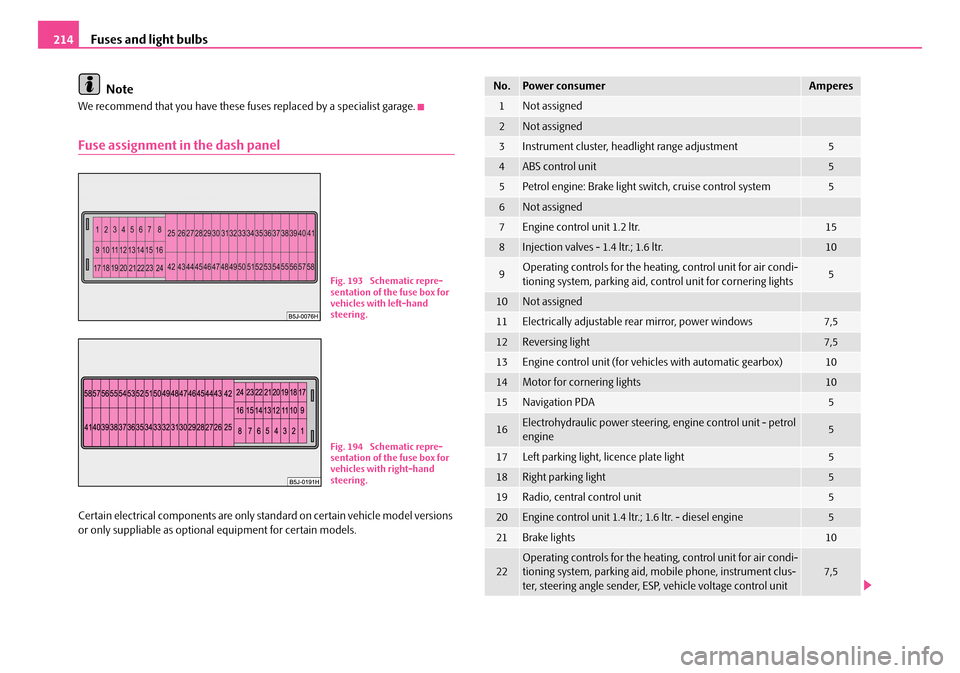
Fuse assignment in the dash panel
Certain electrical components are only standard on certain vehicle model versions or only suppliable as optional equipment for certain models.
Fig. 193 Schematic repre-sentation of the fuse box for vehicles with left-hand steering.
Fig. 194 Schematic repre-sentation of the fuse box for vehicles with right-hand steering.
No.Power consumerAmperes
1Not assigned
2Not assigned
3Instrument cluster, headlight range adjustment5
4ABS control unit5
5Petrol engine: Brake light switch, cruise control system5
6Not assigned
7Engine control unit 1.2 ltr.15
8Injection valves - 1.4 ltr.; 1.6 ltr.10
9Operating controls for the heating, control unit for air condi-tioning system, parking aid, control unit for cornering lights5
10Not assigned
11Electrically adjustable rear mirror, power windows7,5
12Reversing light7,5
13Engine control unit (for vehicles with automatic gearbox)10
14Motor for cornering lights10
15Navigation PDA5
16Electrohydraulic power steering, engine control unit - petrol engine5
17Left parking light, licence plate light5
18Right parking light5
19Radio, central control unit5
20Engine control unit 1.4 ltr.; 1.6 ltr. - diesel engine5
21Brake lights10
22Operating controls for the heating, control unit for air condi-tioning system, parking aid, mobile phone, instrument clus-ter, steering angle sender, ESP, vehicle voltage control unit7,5
NKO A05F 20.book Page 214 Wednesday, April 2, 2008 1:02 PM
Page 245 of 252
Index244
Child safety seat
on the front passenger seat . . . . . . . . . . . . . . . 143
Safety information . . . . . . . . . . . . . . . . . . . . . . . 142
Child seat . . . . . . . . . . . . . . . . . . . . . . . . . . . . . . . . . . . 145
Classification into groups . . . . . . . . . . . . . . . . . 145
ISOFIX system . . . . . . . . . . . . . . . . . . . . . . . . . . . . 148
Children and safety . . . . . . . . . . . . . . . . . . . . . . . . . . 142
Chrome parts . . . . . . . . . . . . . . . . . . . . . . . . . . . . . . . 171
Cigarette lighter . . . . . . . . . . . . . . . . . . . . . . . . . . . . . . 76
Cleaning . . . . . . . . . . . . . . . . . . . . . . . . . . . . . . . . . . . . 169
Climatronic
Air outlet vents . . . . . . . . . . . . . . . . . . . . . . . . . . . . 93
Defrosting windows . . . . . . . . . . . . . . . . . . . . . . . 92
Recirculated air mode . . . . . . . . . . . . . . . . . . . . . 92
Setting temperature . . . . . . . . . . . . . . . . . . . . . . . 92
Clock . . . . . . . . . . . . . . . . . . . . . . . . . . . . . . . . . . . . . . . . 13
Clothes hooks . . . . . . . . . . . . . . . . . . . . . . . . . . . . . . . . 82
Cockpit
General view . . . . . . . . . . . . . . . . . . . . . . . . . . . . . . . 8
Compartments . . . . . . . . . . . . . . . . . . . . . . . . . . . . . . . 77
Computer . . . . . . . . . . . . . . . . . . . . . . . . . . . . . . . . . . . . 13
Convenience operation . . . . . . . . . . . . . . . . . . . . . . . 42
Converting/masking over headlights . . . . . . . . . . 164
Coolant . . . . . . . . . . . . . . . . . . . . . . . . . . . . . . . . . . . . . 186
replenishing . . . . . . . . . . . . . . . . . . . . . . . . . . . . . 187
Warning light . . . . . . . . . . . . . . . . . . . . . . . . . . . . . 24
Coolant level
Warning light . . . . . . . . . . . . . . . . . . . . . . . . . . . . . 24
Coolant temperature gauge . . . . . . . . . . . . . . . . . . . 10
Coolant temperature/coolant level
Warning light . . . . . . . . . . . . . . . . . . . . . . . . . . . . . 24
Cornering lights . . . . . . . . . . . . . . . . . . . . . . . . . . . . . . . 46
Warning light . . . . . . . . . . . . . . . . . . . . . . . . . . . . . . 22
Correct seated position . . . . . . . . . . . . . . . . . . . . . . 122
Counter for distance driven . . . . . . . . . . . . . . . . . . . . 11
Cruise control system . . . . . . . . . . . . . . . . . . . . . . . . . . 99
Cup holder
front . . . . . . . . . . . . . . . . . . . . . . . . . . . . . . . . . . . . . . 74
rear . . . . . . . . . . . . . . . . . . . . . . . . . . . . . . . . . . . . . . . 75
D
Deactivating an airbag . . . . . . . . . . . . . . . . . . . . . . . 139
Defrosting rear window . . . . . . . . . . . . . . . . . . . . . . . . 51
Defrosting windows . . . . . . . . . . . . . . . . . . . . . . . 84, 87
De-icing the windows . . . . . . . . . . . . . . . . . . . . . . . 172
Diesel . . . . . . . . . . . . . . . . . . . . . . . . . . . . . . . . . . . . . . 177
Diesel engines
Starting the engine . . . . . . . . . . . . . . . . . . . . . . . . . 96
Diesel particle filter . . . . . . . . . . . . . . . . . . . . . . . . . . 158
Warning light . . . . . . . . . . . . . . . . . . . . . . . . . . . . . . 29
Digital clock . . . . . . . . . . . . . . . . . . . . . . . . . . . . . . . . . . 13
Direction indicators . . . . . . . . . . . . . . . . . . . . . . . . . . . 48
Warning light . . . . . . . . . . . . . . . . . . . . . . . . . . . . . . 22
Display . . . . . . . . . . . . . . . . . . . . . . . . . . . . . . . . . . . . . . . 16
Distance driven . . . . . . . . . . . . . . . . . . . . . . . . . . . . . . . 11
Door
Child safety lock . . . . . . . . . . . . . . . . . . . . . . . . . . . 32
Warning light . . . . . . . . . . . . . . . . . . . . . . . . . . . . . . 25
Door, luggage compartment door and bonnet ajar warning . . . . . . . . . . . . . . . . . . . . . . . . . . . . . . . . . 18
Driving economically . . . . . . . . . . . . . . . . . . . . . . . . 160
Driving time . . . . . . . . . . . . . . . . . . . . . . . . . . . . . . . . . . 16
E
EDL . . . . . . . . . . . . . . . . . . . . . . . . . . . . . . . . . . . . . . . . . 153
Electric power-operated window
Operational faults . . . . . . . . . . . . . . . . . . . . . . . . . 42
Electric sliding/tilting roof . . . . . . . . . . . . . . . . . . . . . 43
Electrically adjustable rear mirror . . . . . . . . . . . . . . 54
Electronic Differential Lock . . . . . . . . . . . . . . . . . . . 153
Warning light . . . . . . . . . . . . . . . . . . . . . . . . . . . . . 27
Electronic Differential Lock (EDL) . . . . . . . . . . . . . 153
Electronic immobiliser . . . . . . . . . . . . . . . . . . . . . 24, 31
Warning light . . . . . . . . . . . . . . . . . . . . . . . . . . . . . 24
Electronic stability programme (ESP) . . . . . . . . . . 151
Warning light . . . . . . . . . . . . . . . . . . . . . . . . . . . . . 27
Emergency locking of the door . . . . . . . . . . . . . . . . . 36
Engine
starting . . . . . . . . . . . . . . . . . . . . . . . . . . . . . . . . . . . 95
switching off . . . . . . . . . . . . . . . . . . . . . . . . . . . . . . 97
Engine compartment
Safety information . . . . . . . . . . . . . . . . . . . . . . . . 181
Engine electronics
Warning light . . . . . . . . . . . . . . . . . . . . . . . . . . . . . 23
Engine oil . . . . . . . . . . . . . . . . . . . . . . . . . . . . . . . . . . . 183
change . . . . . . . . . . . . . . . . . . . . . . . . . . . . . . . . . . 185
check . . . . . . . . . . . . . . . . . . . . . . . . . . . . . . . . . . . . 184
replenishing . . . . . . . . . . . . . . . . . . . . . . . . . . . . . 185
Warning light . . . . . . . . . . . . . . . . . . . . . . . . . . . . . 25
Engine revolutions counter . . . . . . . . . . . . . . . . . . . . . 9
Environment . . . . . . . . . . . . . . . . . . . . . . . . . . . . . . . . 160
Environmental compatibility . . . . . . . . . . . . . 160, 163
ESP . . . . . . . . . . . . . . . . . . . . . . . . . . . . . . . . . . . . . . . . . 151
Warning light . . . . . . . . . . . . . . . . . . . . . . . . . . . . . 27
NKO A05F 20.book Page 244 Wednesday, April 2, 2008 1:02 PM