belt SKODA FABIA 2008 2.G / 5J Owner's Guide
[x] Cancel search | Manufacturer: SKODA, Model Year: 2008, Model line: FABIA, Model: SKODA FABIA 2008 2.G / 5JPages: 252, PDF Size: 40.88 MB
Page 133 of 252
Airbag system132
Airbag system
Description of the airbag system
General information on the airbag system
The front airbag system is complementary to the three-point seat belts and offers additional protection in the head and chest area of the driver and passenger in the event of a frontal collision.
In the event of a side collision, the side airbags reduce the risk of injury to the occu-pants to the part of their body facing the side of the accident.
The airbag system is only functional after the ignition has been switched on.
The operational readiness of the airbag system is monitored electronically. The airbag warning light comes on for a few seconds each time the ignition is switched on.
The airbag system (according to vehicle equipment) essentially consists of:
•an electronic control unit,
•the front airbags for the driver and front passenger ⇒page 133,
•the side airbags ⇒page 136,
•Head airbags ⇒page 138,
•an airbag warning light in the instrument cluster ⇒page 28,
•a front passenger airbag switch* ⇒page 140,
•an indicator light for a switched off front seat passenger airbag* in the middle of the dash panel ⇒page 140.
A fault in the airbag system exists if:
•the airbag indicator light does not light up when the ignition is switched on,
•the airbag indicator light does not go out after about 3 seconds after the ignition is switched on,
•the airbag indicator light goes out and comes on again after the ignition is switched on,
•the airbag indicator light comes on or flickers when driving,
•an airbag indicator light showing a switched-off front passenger airbag* in the middle of the dash panel flashes.
WARNING
•To enable the occupants of a car to be protected with the greatest possible effect when the airbag is deployed, the front seats must be ⇒page 122, “Correct seated position” correctly adjusted to match the body size of the occupant.
•If you do not fasten the seat belts when driving, lean too far forward or adopt an incorrect seated position, you are exposing yourself to increased risk of injury in the event of an accident.
•Have the airbag system checked immediately by a specialist garage if a fault exists. Otherwise, there is a risk of the airbag not being activated in the event of an accident.
•No modifications of any kind may be made to parts of the airbag system.
•It is prohibited to manipulate individual parts of the airbag system as this might result in the airbag being deployed.
•The protective function of the airbag system is sufficient for only one accident. The airbag system must then be replaced if the airbag has been deployed.
•The airbag system needs no maintenance during its working life.
•If you sell your car, please hand over the complete vehicle documenta-tion to the new owener. Please note that the documents relating to the possibility of deactivating the front passenger airbag are also part of the vehicle documents!
•If the vehicle or individual parts of the airbag system are scrapped, it is essential to observe the relevant safety precautions. Škoda Service Partners are familiar with these regulations.
•When disposing of vehicle or parts of the airbag system, it is important to comply with the national legal requirements.
NKO A05F 20.book Page 132 Wednesday, April 2, 2008 1:02 PM
Page 134 of 252
Airbag system133
Using the systemSafetyDriving TipsGeneral MaintenanceBreakdown assistanceTechnical Data
When are the airbags deployed?
The airbag system is designed in such a way that the driver and the front passenger airbag* are deployed in the event of a frontal collision of major severity.
In the case of a violent side crash, the side airbag* in the front seat and the head airbag* on the side of the car at which the collision occurs are deployed.
It is also possible under certain special accident situations that the front as well as the side airbags and head airbags* are deployed.
The airbags are not deployed in the case of minor frontal and side collisions, in the case of rear-end collisions and vehicle rollover.
Deployment factors
It is not possible to state globally which deployment conditions apply to the airbag system in every situation as the circumstances which exist in the case of accidents vary greatly. An important role in this case, for example, is played by factors such as the type of object against which the vehicle impacts (hard, soft), the angle of impact, the vehicle speed etc.
A decisive factor for the deployment of the airbags is the deceleration which occurs during a collision. The control unit analyses the nature of the collision and activates the relevant restraint system. If the vehicle deceleration which occurs and is meas-ured during the collision remains below the prescribed reference values specified in the control unit, the airbags are not deployed although the vehicle may well suffer severe damage to the bodywork as a consequence of the accident.
The airbags are not deployed if:
•ignition off,
•a minor frontal collision,
•a minor side collision,
•a rear-end collision,
•rollover.
Caution
The dash panel must be replaced after the front passenger airbag has been deployed.
Note
•A grey white or red, non harmful gas is released when airbag is inflated. This is perfectly normal and is not an indication of a fire in the vehicle.
•In the event of an accident in which the airbags are deployed:
−The interior lighting comes on (if the switch for the interior light is in the door contact position),
−The hazard warning light is switched on,
−All the doors are unlocked.
Front airbags
Description of the front airbags
The airbag system is not a substitute for the seat belt!
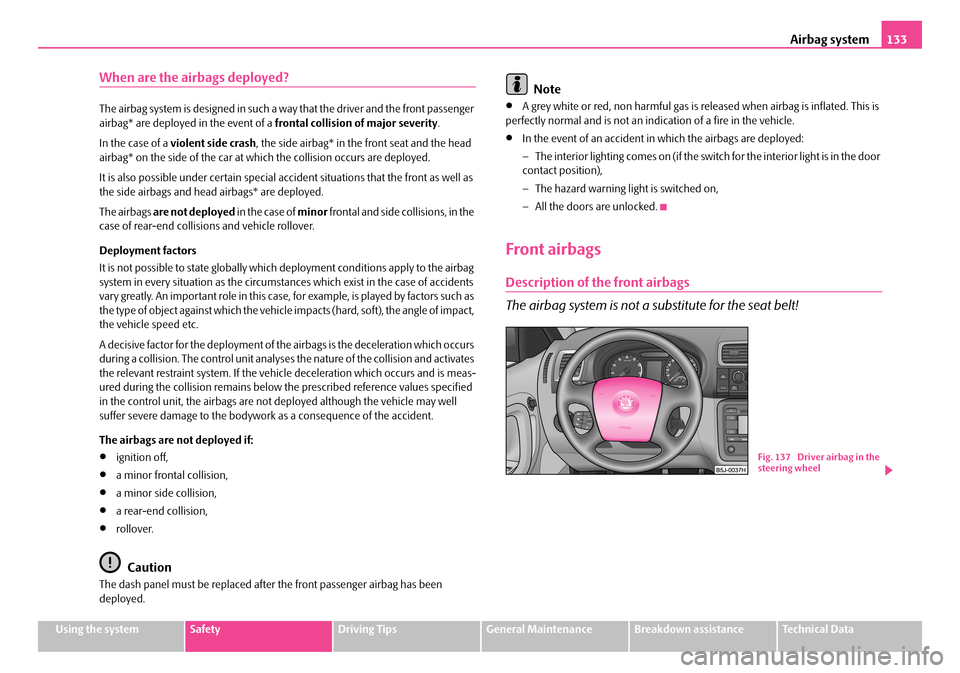
Fig. 137 Driver airbag in the steering wheel
NKO A05F 20.book Page 133 Wednesday, April 2, 2008 1:02 PM
Page 135 of 252
Airbag system134
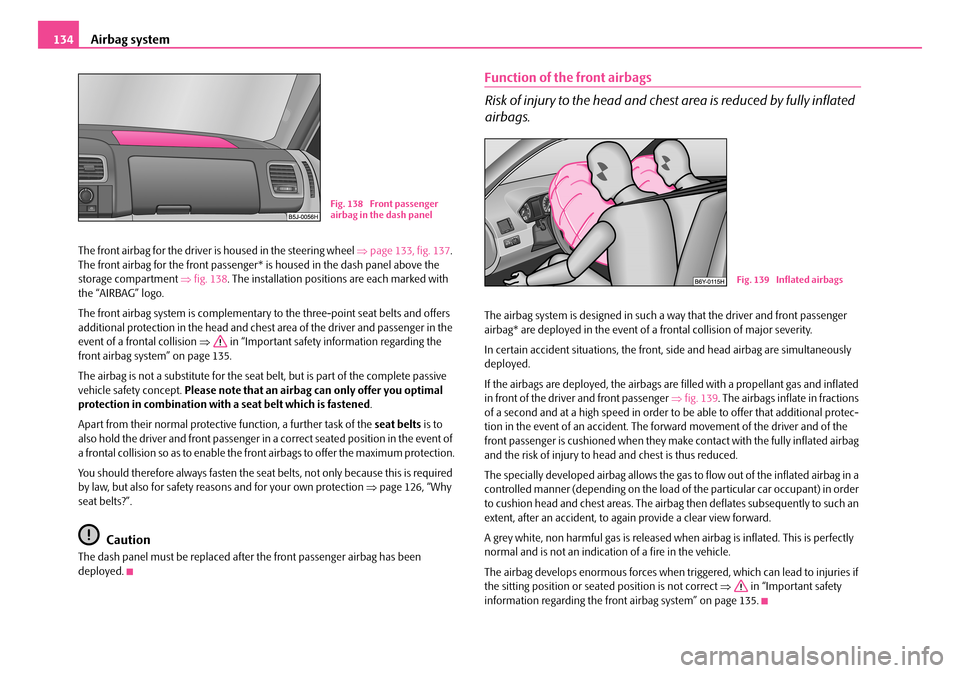
The front airbag for the driver is housed in the steering wheel ⇒page 133, fig. 137. The front airbag for the front passenger* is housed in the dash panel above the storage compartment ⇒fig. 138. The installation positions are each marked with the “AIRBAG” logo.
The front airbag system is complementary to the three-point seat belts and offers additional protection in the head and chest area of the driver and passenger in the event of a frontal collision ⇒ in “Important safety information regarding the front airbag system” on page 135.
The airbag is not a substitute for the seat belt, but is part of the complete passive vehicle safety concept. Please note that an airbag can only offer you optimal protection in combination with a seat belt which is fastened.
Apart from their normal protective function, a further task of the seat belts is to also hold the driver and front passenger in a correct seated position in the event of a frontal collision so as to enable the front airbags to offer the maximum protection.
You should therefore always fasten the seat belts, not only because this is required by law, but also for safety reasons and for your own protection ⇒page 126, “Why seat belts?”.
Caution
The dash panel must be replaced after the front passenger airbag has been deployed.
Function of the front airbags
Risk of injury to the head and chest area is reduced by fully inflated
airbags.
The airbag system is designed in such a way that the driver and front passenger airbag* are deployed in the event of a frontal collision of major severity.
In certain accident situations, the front, side and head airbag are simultaneously deployed.
If the airbags are deployed, the airbags are filled with a propellant gas and inflated in front of the driver and front passenger ⇒fig. 139. The airbags inflate in fractions of a second and at a high speed in order to be able to offer that additional protec-tion in the event of an accident. The forward movement of the driver and of the front passenger is cushioned when they make contact with the fully inflated airbag and the risk of injury to head and chest is thus reduced.
The specially developed airbag allows the gas to flow out of the inflated airbag in a controlled manner (depending on the load of the particular car occupant) in order to cushion head and chest areas. The airbag then deflates subsequently to such an extent, after an accident, to again provide a clear view forward.
A grey white, non harmful gas is released when airbag is inflated. This is perfectly normal and is not an indication of a fire in the vehicle.
The airbag develops enormous forces when triggered, which can lead to injuries if the sitting position or seated position is not correct ⇒ in “Important safety information regarding the front airbag system” on page 135.
Fig. 138 Front passenger airbag in the dash panel
Fig. 139 Inflated airbags
NKO A05F 20.book Page 134 Wednesday, April 2, 2008 1:02 PM
Page 137 of 252
Airbag system136
Side airbags*
Description of side airbags
The side airbag increases protection of the passenger concerned in
the case of a side impact.
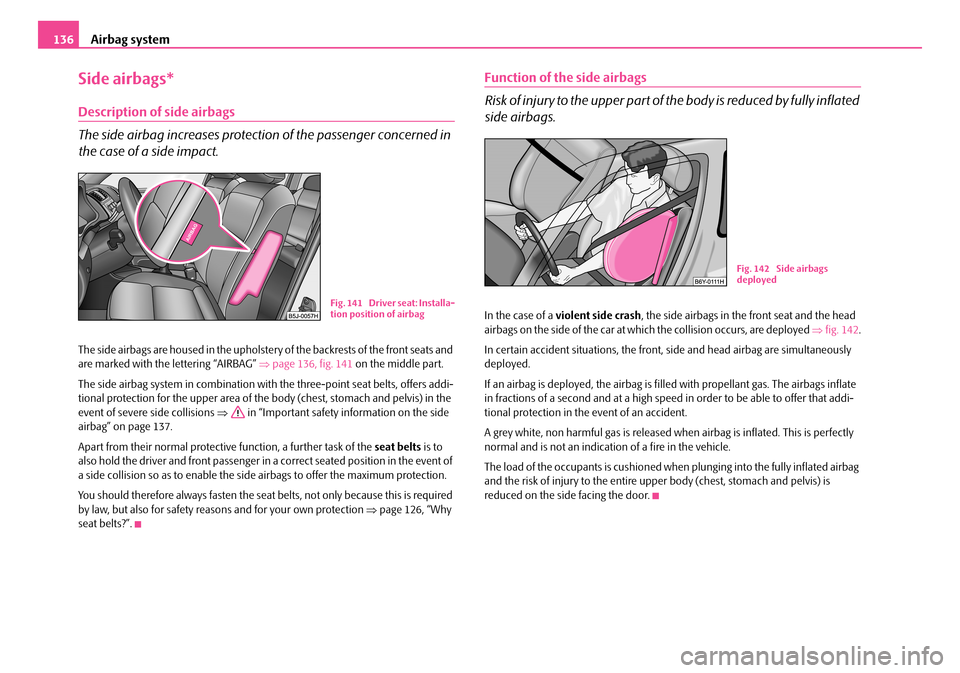
The side airbags are housed in the upholstery of the backrests of the front seats and are marked with the lettering “AIRBAG” ⇒page 136, fig. 141 on the middle part.
The side airbag system in combination with the three-point seat belts, offers addi-tional protection for the upper area of the body (chest, stomach and pelvis) in the event of severe side collisions ⇒ in “Important safety information on the side airbag” on page 137.
Apart from their normal protective function, a further task of the seat belts is to also hold the driver and front passenger in a correct seated position in the event of a side collision so as to enable the side airbags to offer the maximum protection.
You should therefore always fasten the seat belts, not only because this is required by law, but also for safety reasons and for your own protection ⇒page 126, “Why seat belts?”.
Function of the side airbags
Risk of injury to the upper part of the body is reduced by fully inflated
side airbags.
In the case of a violent side crash, the side airbags in the front seat and the head airbags on the side of the car at which the collision occurs, are deployed ⇒fig. 142.
In certain accident situations, the front, side and head airbag are simultaneously deployed.
If an airbag is deployed, the airbag is filled with propellant gas. The airbags inflate in fractions of a second and at a high speed in order to be able to offer that addi-tional protection in the event of an accident.
A grey white, non harmful gas is released when airbag is inflated. This is perfectly normal and is not an indication of a fire in the vehicle.
The load of the occupants is cushioned when plunging into the fully inflated airbag and the risk of injury to the entire upper body (chest, stomach and pelvis) is reduced on the side facing the door.
Fig. 141 Driver seat: Installa-tion position of airbag
Fig. 142 Side airbags deployed
NKO A05F 20.book Page 136 Wednesday, April 2, 2008 1:02 PM
Page 139 of 252
Airbag system138
Head airbags*
Description of the head airbags
The head airbag together with the side airbag offers enhanced occu-
pant protection in the event of a side collision.
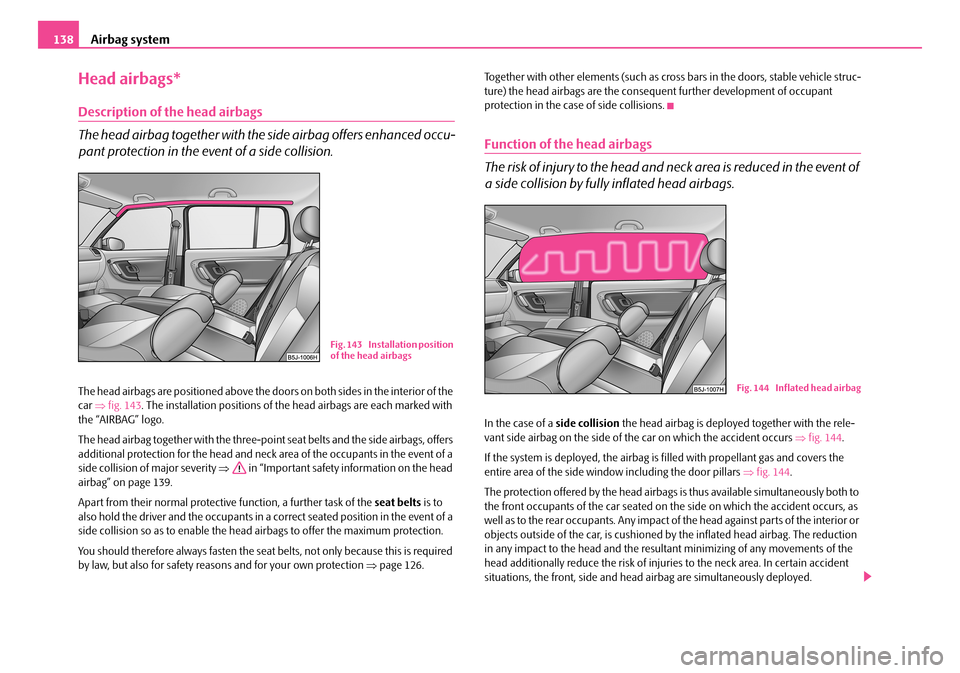
The head airbags are positioned above the doors on both sides in the interior of the car ⇒fig. 143. The installation positions of the head airbags are each marked with the “AIRBAG” logo.
The head airbag together with the three-point seat belts and the side airbags, offers additional protection for the head and neck area of the occupants in the event of a side collision of major severity ⇒ in “Important safety information on the head airbag” on page 139.
Apart from their normal protective function, a further task of the seat belts is to also hold the driver and the occupants in a correct seated position in the event of a side collision so as to enable the head airbags to offer the maximum protection.
You should therefore always fasten the seat belts, not only because this is required by law, but also for safety reasons and for your own protection ⇒page 126.
Together with other elements (such as cross bars in the doors, stable vehicle struc-ture) the head airbags are the consequent further development of occupant protection in the case of side collisions.
Function of the head airbags
The risk of injury to the head and neck area is reduced in the event of
a side collision by fully inflated head airbags.
In the case of a side collision the head airbag is deployed together with the rele-vant side airbag on the side of the car on which the accident occurs ⇒fig. 144.
If the system is deployed, the airbag is filled with propellant gas and covers the entire area of the side window including the door pillars ⇒fig. 144.
The protection offered by the head airbags is thus available simultaneously both to the front occupants of the car seated on the side on which the accident occurs, as well as to the rear occupants. Any impact of the head against par ts of the interior or objects outside of the car, is cushioned by the inflated head airbag. The reduction in any impact to the head and the resultant minimizing of any movements of the head additionally reduce the risk of injuries to the neck area. In certain accident situations, the front, side and head airbag are simultaneously deployed.
Fig. 143 Installation position of the head airbags
Fig. 144 Inflated head airbag
NKO A05F 20.book Page 138 Wednesday, April 2, 2008 1:02 PM
Page 143 of 252
Transporting children safely142
Transporting children safely
What you should know about transporting children!
An introduction to the subject
Accident statistics have revealed that children are generally more
safely transported on the rear seats than on the front passenger seat.
Children younger than 12 years of age should normally travel on the rear seat of the vehicle (take note of any national legal provisions which differ from this). They should be secured there by means of a child restraint system or by using the existing seat belts depending on their age, body size and weight. The child seat should be mounted behind the front passenger seat for safety reasons.
The physical principle of an accident does, of course, also apply to children ⇒page 127, “The physical principle of a frontal collision”. They differ from adults in that their muscles and bone structure of children are not yet fully developed. Thus children are exposed to increased risk of injury.
Children should be transported by using special child safety seats in order to reduce this risk of injury.
Only use child safety seats which are officially approved, suitable for children and which comply with the ECE-R 44 standard, which classifies child safety seats into 5 groups ⇒page 145, “Classification of child seats into groups”. Child restraint systems which have been tested for conformity with ECE-R 44 have a non-detach-able test seal (a large E within a circle and below this the test number) attached to the seat.
We recommend that you use child safety seats from the Škoda genuine accessories. These child seats were developed and also tested for use in Škoda vehicles. They fulfil the standard ECE-R 44.
WARNING
Always comply with national legal provisions and instructions from the rele-vant child safety seat manufacturer when installing and using a child seat
⇒ in “Important safety information regarding the use of child safety seats”.
Note
National legal provisions, which deviate from the information contained in these operating instructions, take precedence over the information contained in the operating instructions.
Important safety information regarding the use of child safety
seats
Correct use of child safety seats considerably reduces the risk of
injury!
WARNING
•All the occupants of the car - in particular children - must wear a seat belt when the car is moving!
•Children less than 1.50 m in height or younger than 12 years must not use a normal seat belt without a child restraint system otherwise this may result in injuries to the stomach and neck areas. Comply with the national legal requirements.
•One should never carry children, and also not babies! - on one's lap.
•You can transport a child safely in a suitable child safety seat ⇒page 145, “Child seat”!
•Only one child may be fastened with a seat belt into a child safety seat.
•Never leave the child sitting unattended in the seat.
•Certain outside climatic conditions can cause life-threatening tempera-tures in the vehicle.
WARNING (continued)
NKO A05F 20.book Page 142 Wednesday, April 2, 2008 1:02 PM
Page 144 of 252
Transporting children safely143
Using the systemSafetyDriving TipsGeneral MaintenanceBreakdown assistanceTechnical Data
•Never allow your child to be transported in a vehicle without the use of a suitable restraint system.
•Children should also never stand up in a vehicle or kneel on the seats when the vehicle is moving. In the event of an accident the child will be thrown through the vehicle and may as a result suffer fatal injuries, and also injure other occupants.
•Children are exposed to an increased risk of injury in the event of an acci-dent if they lean forward or adopt an incorrect seated position when the vehicle is moving. This particularly applies to children who are transported on the front passenger seat if the airbag system deploys in the event of an accident. This can result in severe or even fatal injuries.
•It is important that the belt webbing is properly routed if the seat belts are to offer their maximum protection ⇒page 128, “How are seat belts correctly fastened?”. Pay particular attention to the information provided by the manufacturer of the child safety seat regarding correct routing of the belt. Seat belts which are not correctly adjusted can themselves cause inju-ries even in minor accidents.
•Safety belts must be checked to ensure that they are running properly. One should also ensure that the belt is not damaged by sharp-edged fittings.
•It is essential to always switch off ⇒page 139 the front passenger airbag when attaching a child safety seat on the front passenger seat where the child is seated with its back facing in direction of travel (in some countries also when the child is facing the direction of travel). If this is not done, there is a risk of the child suffering severe or even fatal injuries if the front passenger airbag is deployed. In certain countries national legal provisions also require that the side or head passenger airbags be deactivated. When transporting a child on the front passenger seat, please comply with the appropriate national regulations regarding the use of child safety seats.
Use of child safety seats on the front passenger seat
Child safety seats should always be attached to the rear seats.
We recommend, for safety reasons, that you always mount a child restraint systems on the rear seats whenever possible. If you still decide, however, to use a child safety seat on the front passenger seat then you must pay attention to the following warnings in connection with the use of the airbag system on the front passenger seat.
WARNING
•Warning - particular hazard! Never use a child safety seat on the front passenger seat in which the child is seated with its back facing the direction of travel. This child safety seat is positioned in the deployment area of the front passenger airbag. The airbag may cause the child severe, or even fatal injuries, in the event of it being deployed.
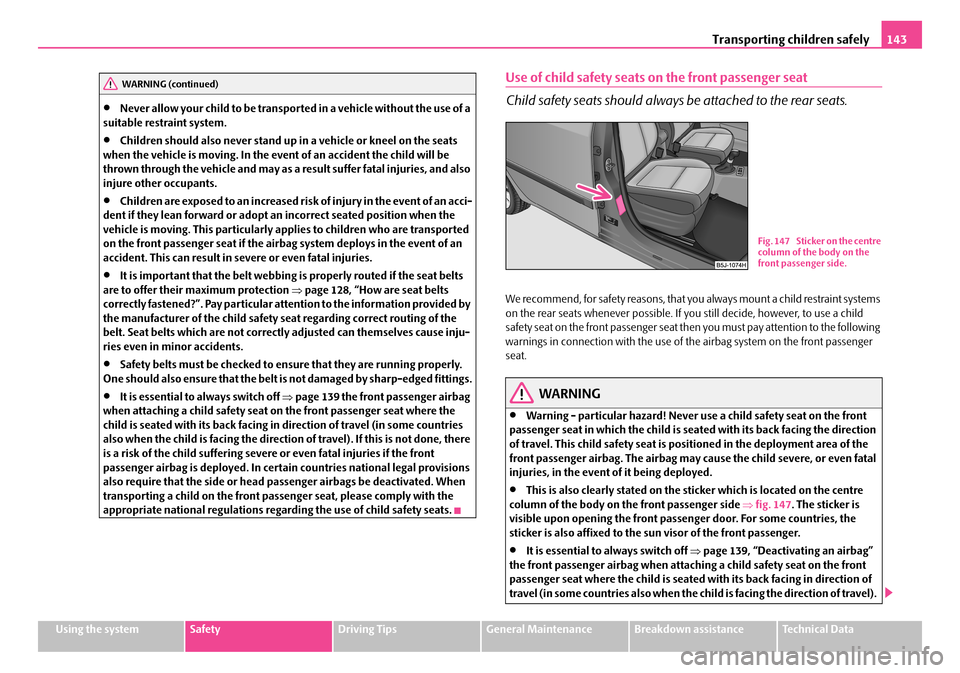
•This is also clearly stated on the sticker which is located on the centre column of the body on the front passenger side ⇒fig. 147. The sticker is visible upon opening the front passenger door. For some countries, the sticker is also affixed to the sun visor of the front passenger.
•It is essential to always switch off ⇒page 139, “Deactivating an airbag” the front passenger airbag when attaching a child safety seat on the front passenger seat where the child is seated with its back facing in direction of travel (in some countries also when the child is facing the direction of travel).
WARNING (continued)
Fig. 147 Sticker on the centre column of the body on the front passenger side.
NKO A05F 20.book Page 143 Wednesday, April 2, 2008 1:02 PM
Page 146 of 252

Transporting children safely145
Using the systemSafetyDriving TipsGeneral MaintenanceBreakdown assistanceTechnical Data
transporting a child on the front passenger seat, please comply with the appropriate national regulations regarding the use of child safety seats.
•When transporting a child on the front passenger seat, please comply with the appropriate national regulations regarding the use of child safety seats.
•Children must never be seated with their head in the deployment area of the side airbag - risk of injury!
•Do not place any objects within the deployment area of the side airbag - risk of injury!
Child seat
Classification of child seats into groups
Only child safety seats which have an official approval and are suit-
able for the child, may be used.
ECE-R 44 standard applies to child safety seats. ECE-R means: Economic Commis-sion of Europe - Regulation.
Child safety seats which have been tested for conformity with ECE-R 44 have a non-detachable test seal (a large E within a circle and below this the test number) attached to the seat.
Child safety seats are classified in 5 groups:
Children of more than 150 cm in height may use the seat belts fitted to the vehicle without a seat bolster.
Use of child seats
An overview of the usefulness of child seats on each of the seats according to the EG guidelines 77/541 and ECE 44 standard:
Universal category - seat is suitable for all approved types of child safety seats.
The seat can be fitted with fixing eyes for the “ISOFIX*”system.
The seat is equipped as standard with the fixing system “To p Te t h e r”.
Child seats of group 0/0+
GroupWeight
00 - 10 kg⇒page 145
0+up to 13 kg⇒page 145
19 - 18 kg⇒page 146
215 - 25 kg⇒page 147
322 - 36 kg⇒page 147
WARNING (continued)
Child seat groupsFront passenger seatRear seat outsideRear seat middle
0
0+
1
2 and 3
AUAUA+ATAU
AUAUA+ATAU
AUAUA+ATAU
AUAUAU
AU
A+
AT
Fig. 150 Child seats of group 0/0+
NKO A05F 20.book Page 145 Wednesday, April 2, 2008 1:02 PM
Page 148 of 252

Transporting children safely147
Using the systemSafetyDriving TipsGeneral MaintenanceBreakdown assistanceTechnical Data
•If this is not done, a child seated on the front passenger seat may suffer severe or even fatal injuries if the front passenger airbag or airbags are deployed.
•You should have the front passenger airbag (or airbags) reactivated just as soon as you no longer use a child safety seat on the front passenger seat.
Child safety seats in Group 2
For children up to about 7 years of age weighing between 15 and 25 kg the optimal solution is a child safety seat in combination with the three-point seat belt ⇒fig. 152.
WARNING
•When transporting a child on the front passenger seat, please comply with the appropriate national regulations regarding the use of child safety seats. Switch off the front passenger airbag if necessary at a specialist garage or switch it off with the switch for front passenger airbag* ⇒page 140.
•The shoulder part of the seat belt must run approximately across the middle of the shoulder and fit snugly against the chest. It must on no account run across the neck. The lap part of the seat belt must run across the pelvis
and fits snugly; it must not run over the belly. Tighten the belt webbing over your hip if necessary.
•Please comply with any differing national legal regulations regarding the use of child safety seats.
Child safety seats in Group 3
For children of about 7 years of age weighing between 22 and 36 kg and of a height of less than 150 cm, the optimal solution is a child safety seat (seat bolster) in combination with the three-point seat belt ⇒fig. 153.
Children of more than 150 cm in height may use the seat belts fitted to the vehicle without a seat bolster.
WARNING
•When transporting a child on the front passenger seat, please comply with the appropriate national regulations regarding the use of child safety seats. Switch off the front passenger airbag if necessary at a specialist garage or switch it off with the switch for front passenger airbag* ⇒page 140.
•The shoulder part of the seat belt must run approximately across the middle of the shoulder and fit snugly against the chest. It must on no account
WARNING (continued)
Fig. 152 Child seat in Group 2 installed on the rear seat facing the direction of travel
WARNING (continued)
Fig. 153 Child seat in Group 3 installed on the rear seat facing the direction of travel
NKO A05F 20.book Page 147 Wednesday, April 2, 2008 1:02 PM
Page 149 of 252
Transporting children safely148
run across the neck. The lap part of the seat belt must run across the pelvis and fits snugly; it must not run over the belly. Tighten the belt webbing over your hip if necessary.
•Please comply with any differing national legal regulations regarding the use of child safety seats.
Attaching a child seat using the “ISOFIX” system*
There are two fixing eyes between the backrest and the seat itself on both
of the outer rear seats for fixing the “ISOFIX” system child seat in place.
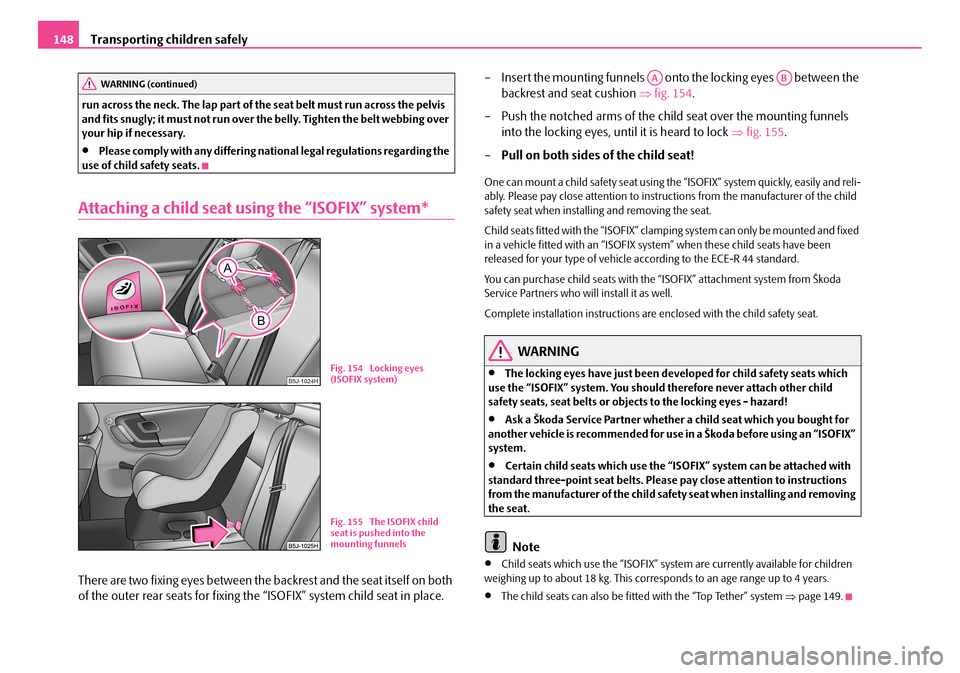
– Insert the mounting funnels onto the locking eyes between the
backrest and seat cushion ⇒fig. 154.
– Push the notched arms of the child seat over the mounting funnels
into the locking eyes, until it is heard to lock ⇒fig. 155.
–Pull on both sides of the child seat!
One can mount a child safety seat using the “ISOFIX” system quickly, easily and reli-ably. Please pay close attention to instructions from the manufacturer of the child safety seat when installing and removing the seat.
Child seats fitted with the “ISOFIX” clamping system can only be mounted and fixed in a vehicle fitted with an “ISOFIX system” when these child seats have been released for your type of vehicle according to the ECE-R 44 standard.
You can purchase child seats with the “ISOFIX” attachment system from Škoda Service Partners who will install it as well.
Complete installation instructions are enclosed with the child safety seat.
WARNING
•The locking eyes have just been developed for child safety seats which use the “ISOFIX” system. You should therefore never attach other child safety seats, seat belts or objects to the locking eyes - hazard!
•Ask a Škoda Service Partner whether a child seat which you bought for another vehicle is recommended for use in a Škoda before using an “ISOFIX” system.
•Certain child seats which use the “ISOFIX” system can be attached with standard three-point seat belts. Please pay close attention to instructions from the manufacturer of the child safety seat when installing and removing the seat.
Note
•Child seats which use the “ISOFIX” system are currently available for children weighing up to about 18 kg. This corresponds to an age range up to 4 years.
•The child seats can also be fitted with the “Top Tether” system ⇒page 149.
WARNING (continued)
B5J-1024HFig. 154 Locking eyes (ISOFIX system)
Fig. 155 The ISOFIX child seat is pushed into the mounting funnels
AAAB
NKO A05F 20.book Page 148 Wednesday, April 2, 2008 1:02 PM