seats SKODA FABIA 2008 2.G / 5J Owner's Guide
[x] Cancel search | Manufacturer: SKODA, Model Year: 2008, Model line: FABIA, Model: SKODA FABIA 2008 2.G / 5JPages: 252, PDF Size: 40.88 MB
Page 81 of 252
Seats and Stowage80
The storage compartment is foreseen for storing small objects of up to 1
kg. in weight.
– Tilt the lock to open the flap and pull out the flap ⇒fig. 98.
– Tilt the lock to close the flap and press flap close.
Front seat armrest with storage compartment*
Fold the armrest
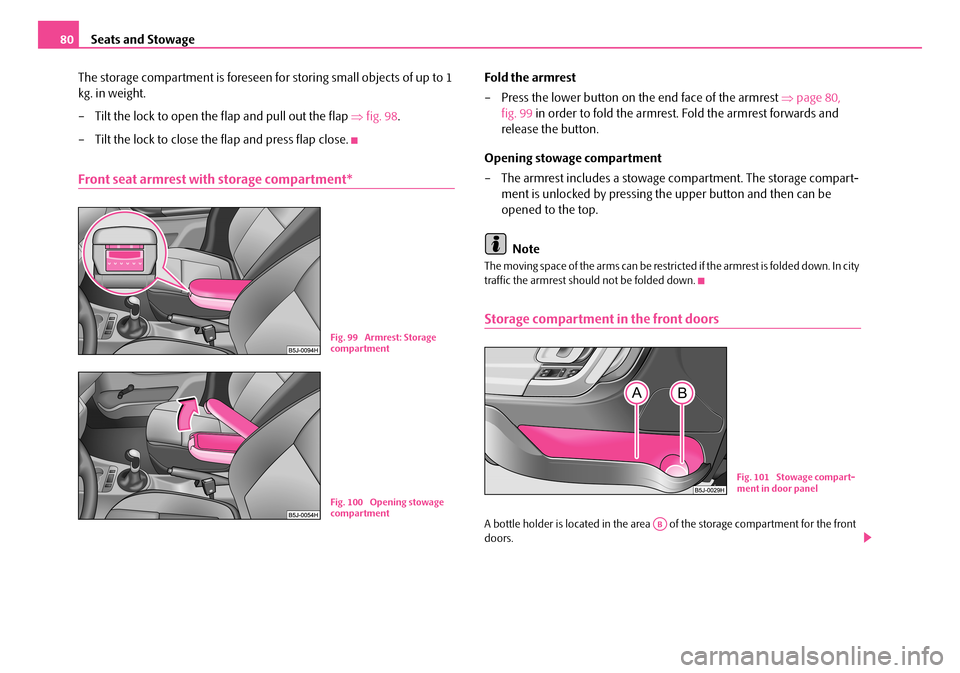
– Press the lower button on the end face of the armrest ⇒page 80,
fig. 99 in order to fold the armrest. Fold the armrest forwards and
release the button.
Opening stowage compartment
– The armrest includes a stowage compartment. The storage compart-
ment is unlocked by pressing the upper button and then can be
opened to the top.
Note
The moving space of the arms can be restricted if the armrest is folded down. In city traffic the armrest should not be folded down.
Storage compartment in the front doors
A bottle holder is located in the area of the storage compartment for the front doors.
Fig. 99 Armrest: Storage compartment
Fig. 100 Opening stowage compartment
Fig. 101 Stowage compart-ment in door panel
AB
NKO A05F 20.book Page 80 Wednesday, April 2, 2008 1:02 PM
Page 82 of 252

Seats and Stowage81
Using the systemSafetyDriving TipsGeneral MaintenanceBreakdown assistanceTechnical Data
WARNING
Use the area ⇒fig. 101 of the storage compartment only for storing objects which do not project so that the effectiveness of the side airbag is not impaired.
Removeable storage compartments in the luggage
compartment*
A removeable storage compartment*⇒fig. 102 is located on both sides in the side trim panel of the luggage compartment.
The removeable storage compartments* are intended for storing small objects of up to 2.5 kg in weight.
Flexible storage compartment*
A flexible storage compartment is located on the right side of the luggage
compartment. The flexible storage compartment is foreseen for storing
small objects of up to 8 kg. in weight.
Removing
– Take hold of the flexible storage compartment at both upper corners.
– Press the upper corners to the inside and release the storage compart-
ment by pulling upwards.
– Remove by pulling towards you.
Installing
– Insert both ends of the flexible storage compartment into the open-
ings of the right side trim panel of the luggage compartment and push
it downwards until it locks.
Note
If the variable loading floor* is installed ⇒page 66 in the luggage compartment, no flexible storage compartment can be installed.
AA
Fig. 102 Removeable storage compartments
Fig. 103 Flexible storage compartment
NKO A05F 20.book Page 81 Wednesday, April 2, 2008 1:02 PM
Page 83 of 252
Seats and Stowage82
Clothes hooks*
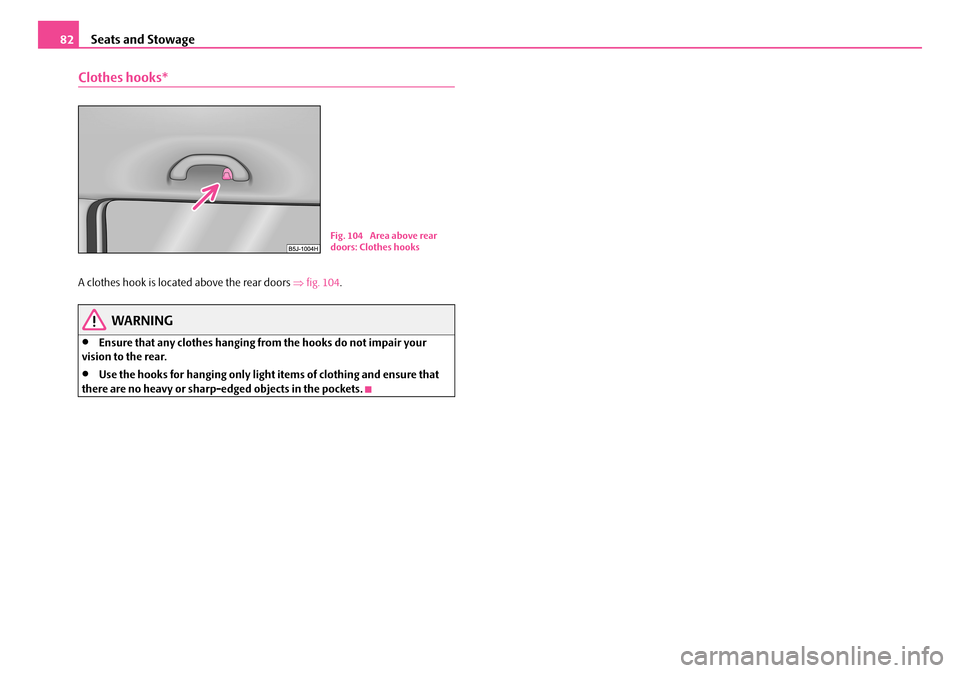
A clothes hook is located above the rear doors ⇒fig. 104.
WARNING
•Ensure that any clothes hanging from the hooks do not impair your vision to the rear.
•Use the hooks for hanging only light items of clothing and ensure that there are no heavy or sharp-edged objects in the pockets.
Fig. 104 Area above rear doors: Clothes hooks
NKO A05F 20.book Page 82 Wednesday, April 2, 2008 1:02 PM
Page 122 of 252
Passive Safety121
Using the systemSafetyDriving TipsGeneral MaintenanceBreakdown assistanceTechnical Data
Safety
Passive Safety
Basic information
Driving the safe way
Passive safety measures reduce the risk of injury in accident situa-
tions.
In this section you will find important information, tips and notes on the subject of passive safety in your vehicle. We have combined everything here which you should be familiar with, for example, regarding seat belts, airbags, child seats and safety of children. It is therefore important, in particular, to comply with the notes and warnings in this section for your own interest and in the interest of those trav-elling with you.
WARNING
•This chapter contains important information on how to use the vehicle for the driver and his occupants. You will find further information on safety, which concerns you and those travelling with you, in the following chapters of this Owner's Manual.
•The complete on-board literature should always be in the vehicle. This applies in particular, if you rent out or sell the vehicle.
Safety equipment
The safety equipment is part of the occupant protection and it can
reduce the risk of injuries in accident situations.
“Do not put at risk” your safety and the safety of those travelling with you . In the event of an accident, the safety equipment can reduce the risk of injuries. The following list contains part of the safety equipment in your vehicle:
•Three-point seat belts for all the seats,
•belt force limiter for front seats,
•belt tensioner for front seats,
•seat belt height adjuster for front seats,
•front airbag for the driver and the front seat passenger*
•Side airbags*,
•head airbags*,
•anchoring points for child seat using the “ISOFIX” system,
•anchoring points for child seat using the “Top Tether” system,
•head restraint adjustable for height,
•adjustable steering column.
The specified safety equipment works together, in order to optimally protect you and those travelling with you in accident situations. The safety equipment does not protect you or the people travelling with you, if you or your occupants adopt an incorrect seated position or the equipment is not correctly adjusted or used.
Fo r t h i s re a s o n y o u w i l l b e p ro v i d e d w i th i n fo rm a ti o n o n w hy t h i s e q u i p m e nt i s v e r y important, how it protects you and the occupants, what should be observed when using the equipment and how you and the people travelling with you can make full use of the existing safety equipment. This Owner's Manual contains important warning notes, which you and those travelling with you should pay attention to in order to reduce a risk of injury.
Safety concerns everybody!
NKO A05F 20.book Page 121 Wednesday, April 2, 2008 1:02 PM
Page 123 of 252
Passive Safety122
Before setting off
The driver is always fully responsible for his occupants and for the
operating safety of the vehicle.
For your own safety and the safety of the people travelling with you, please pay attention to the following points before setting off.
•Ensure that the lighting and the turn signal system are functioning properly.
•Inspect the tyre inflation pressure.
•Ensure that all the windows offer a good visibility to the outside.
•Safely attach the items of luggage ⇒page 61, “Loading the luggage compart-ment”.
•Ensure that no objects can obstruct the pedal.
•Adjust the mirror, the front seat and the head restraint to match your body size.
•Point out to your occupants that the head restraints must be adjusted to match their body size.
•Protect the children in suitable child seats with correctly fastened seat belts ⇒page 142, “Transporting children safely”.
•Adopt the correct seated position. Also inform your occupants to adopt the correct seated position.
•Fasten the seat belt correctly. Also inform your occupants to properly fasten the seat belts ⇒page 128, “How are seat belts correctly fastened?”.
What influences the driving safety?
The driving safety is primarily determined by the style of driving and
the personal behaviour of all the occupants.
The driver is fully responsible for himself and his occupants. If your driving safety is effected, you place yourself and the oncoming traffic at risk. Please refer to the following guidelines.
•Do not get distracted from concentrating on the traffic situation, e.g. by your occupants or mobile phone calls.
•Never drive when your driving ability is impaired, e.g. through medication, alcohol, drugs.
•Keep to the traffic regulations and the permissible speed limit.
•Adjust the driving speed at all times to the road condition as well as to the traffic and weather conditions.
•Take regular breaks on long journeys - at the latest every two hours.
Correct seated position
Correct seated position for the driver
Correct seated position for the driver is important for safe and
relaxed driving.
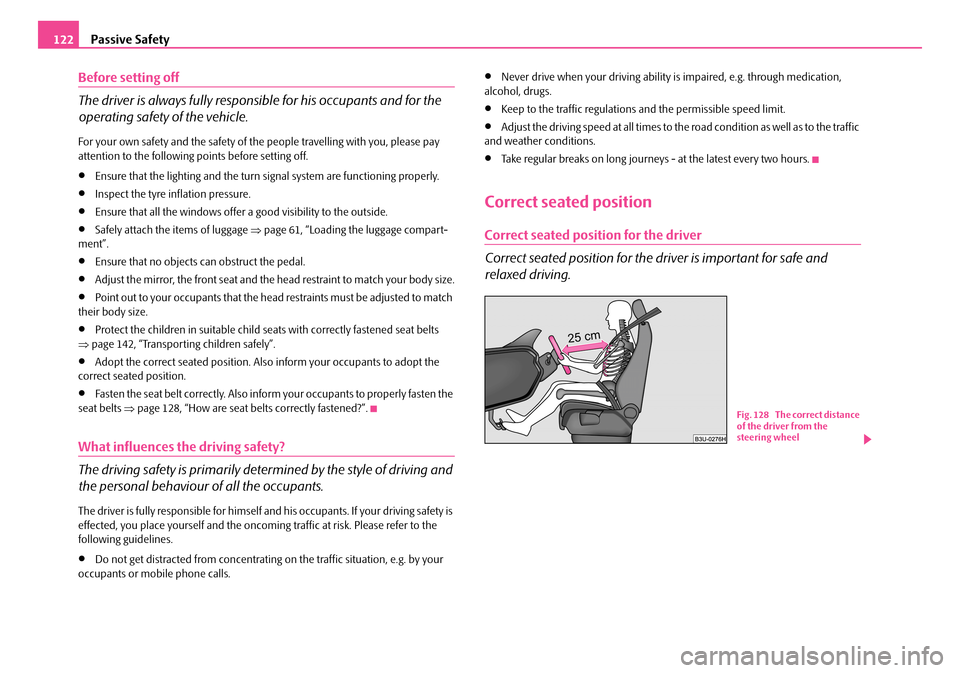
Fig. 128 The correct distance of the driver from the steering wheel
NKO A05F 20.book Page 122 Wednesday, April 2, 2008 1:02 PM
Page 124 of 252
Passive Safety123
Using the systemSafetyDriving TipsGeneral MaintenanceBreakdown assistanceTechnical Data
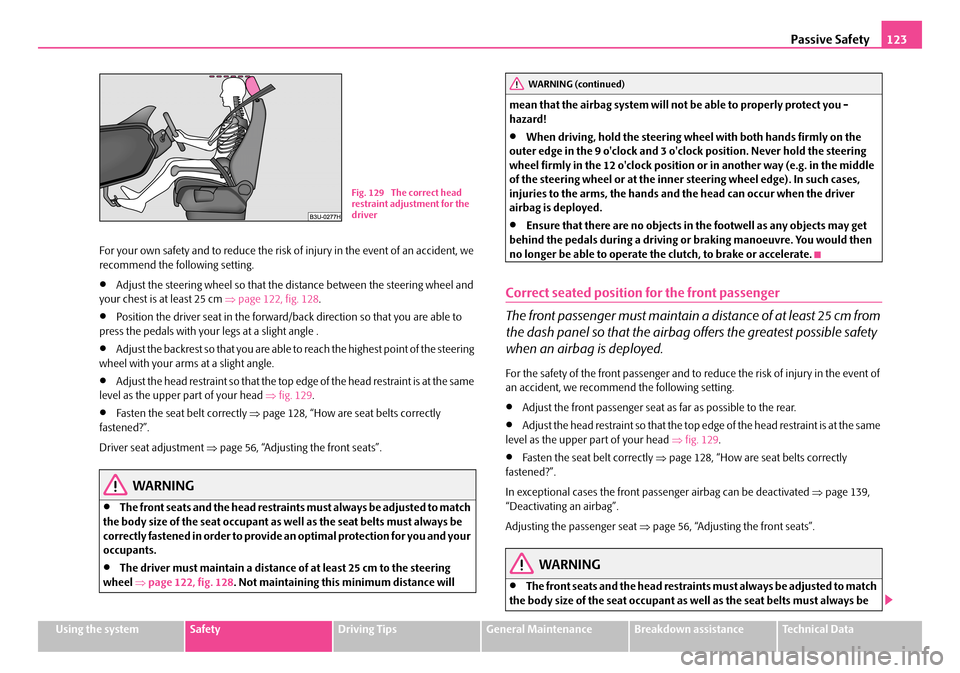
For your own safety and to reduce the risk of injury in the event of an accident, we recommend the following setting.
•Adjust the steering wheel so that the distance between the steering wheel and your chest is at least 25 cm ⇒page 122, fig. 128.
•Position the driver seat in the forward/back direction so that you are able to press the pedals with your legs at a slight angle .
•Adjust the backrest so that you are able to reach the highest point of the steering wheel with your arms at a slight angle.
•Adjust the head restraint so that the top edge of the head restraint is at the same level as the upper part of your head ⇒fig. 129.
•Fasten the seat belt correctly ⇒page 128, “How are seat belts correctly fastened?”.
Driver seat adjustment ⇒page 56, “Adjusting the front seats”.
WARNING
•The front seats and the head restraints must always be adjusted to match the body size of the seat occupant as well as the seat belts must always be correctly fastened in order to provide an optimal protection for you and your occupants.
•The driver must maintain a distance of at least 25 cm to the steering wheel ⇒page 122, fig. 128. Not maintaining this minimum distance will
mean that the airbag system will not be able to properly protect you - hazard!
•When driving, hold the steering wheel with both hands firmly on the outer edge in the 9 o'clock and 3 o'clock position. Never hold the steering wheel firmly in the 12 o'clock position or in another way (e.g. in the middle of the steering wheel or at the inner steering wheel edge). In such cases, injuries to the arms, the hands and the head can occur when the driver airbag is deployed.
•Ensure that there are no objects in the footwell as any objects may get behind the pedals during a driving or braking manoeuvre. You would then no longer be able to operate the clutch, to brake or accelerate.
Correct seated position for the front passenger
The front passenger must maintain a distance of at least 25 cm from
the dash panel so that the airbag offers the greatest possible safety
when an airbag is deployed.
For the safety of the front passenger and to reduce the risk of injury in the event of an accident, we recommend the following setting.
•Adjust the front passenger seat as far as possible to the rear.
•Adjust the head restraint so that the top edge of the head restraint is at the same level as the upper part of your head ⇒fig. 129.
•Fasten the seat belt correctly ⇒page 128, “How are seat belts correctly fastened?”.
In exceptional cases the front passenger airbag can be deactivated ⇒page 139, “Deactivating an airbag”.
Adjusting the passenger seat ⇒page 56, “Adjusting the front seats”.
WARNING
•The front seats and the head restraints must always be adjusted to match the body size of the seat occupant as well as the seat belts must always be
Fig. 129 The correct head restraint adjustment for the driver
WARNING (continued)
NKO A05F 20.book Page 123 Wednesday, April 2, 2008 1:02 PM
Page 125 of 252
Passive Safety124
correctly fastened in order to provide an optimal protection for you and your occupants.
•The front passenger must maintain a distance of at least 25 cm to the dash panel. Not maintaining this minimum distance will mean that the airbag system will not be able to properly protect you - hazard!
•Always keep your feet in the footwell when the car is being driven - never place your feet on the instrument panel, out of the window or on the surfaces of the seats. You will be exposed to increased risk of injury if it becomes necessary to apply the brake or in the event of an accident. If an airbag is deployed, you may suffer fatal injuries when adopting an incorrect seated position!
•The backrests must not be angled too far back when driving otherwise this will affect proper operation of the seat belts and of the airbag system - risk of injury!
Correct seated position for the occupants on the rear seats
Occupants on the rear seats must sit upright, keep the feet in the
footwell and must have their seat belts correctly fastened.
To reduce the risk of injury in the event of a sudden braking manoeuvre or an acci-dent, the occupants on the rear seats must observe the following.
•Adjust the head restraints so that the top edge of the head restraints are at the same level as the upper part of your head ⇒page 123, fig. 129.
•Fasten the seat belt correctly ⇒page 128, “How are seat belts correctly fastened?”.
•If you are transporting ⇒page 142, “Transporting children safely” children in the vehicle, please use a suitable child restraint system.
WARNING
•The head restraints must always be adjusted to match the body size, in order to offer an optimal protection for you and your occupants.
•Always keep your feet in the footwell when the car is being driven - never put your feet out of the window or on the surfaces of the seats. You will be exposed to increased risk of injury if it becomes necessary to apply the brake or in the event of an accident. If the head airbag* is deployed and when adopting an incorrect seated position, you are exposing yourself to an increased risk of injury and in the event of an accident you may suffer fatal injuries!
•If the occupants on the rear seats are not sitting upright, the risk of injury is increased due to incorrect routing of the seat belt.
Examples of an incorrect seated position
An incorrect seated position can lead to severe injuries or death for
the occupants.
Seat belts offer their optimum protection only if the webbing of the seat belts is properly routed. Incorrect seated positions considerably reduce the protective functions of the seat belts and therefore increase the risk of injury due to an incor-rect routing of the seat belt. The driver is fully responsible for himself and his occu-pants, in particular for the children. Do not permit an occupant to adopt an incor-rect seated position when the car is moving.
The following list contains the examples of seated positions which are dangerous for the occupants. This list is not complete, however we would like you to get inter-ested in this subject.
Therefore, while the car is moving never:
•stand up in the vehicle,
•stand up on the seats,
•kneel onto the seats,
•tilt the backrest fully to the back,
•lean against the dash panel,
•lie on the rear seats,
•only sit on the front area of the seat,
WARNING (continued)WARNING (continued)
NKO A05F 20.book Page 124 Wednesday, April 2, 2008 1:02 PM
Page 130 of 252
Seat belts129
Using the systemSafetyDriving TipsGeneral MaintenanceBreakdown assistanceTechnical Data
– Slowly pull the belt webbing at the tongue of the lock over your chest
and pelvis ⇒.
– Insert the tongue of the lock into the seat belt buckle belonging to the
seat until it is heard to lock in place.
– Pull on the belt to check that it has also reliably engaged in the lock.
Each three-point seat belt is equipped with an inertia reel. This inertia reel offers you complete freedom of movement if the belt is unreeled slowly. If the brakes are applied suddenly, the inertia reel will block. It also blocks the belts when the car accelerates, when driving downhill and when cornering.
Expectant mothers must also wear the seat belt ⇒.
WARNING
•The shoulder part of the seat belt must never run across your neck but must run approximately over the middle of the shoulder and fit snugly against the chest. The lap part of the belt must run across the hip and must never be routed across the stomach. It must always fit snugly ⇒page 128, fig. 133. Adjust the belt webbing as required.
•The lap part of the belt should be positioned as low as possible at the pelvis of an expectant mother in order to avoid exerting any pressure on the lower abdomen.
•Always ensure that the webbing of the seat belts is properly routed. Seat belts which are not correctly adjusted can themselves cause injuries even in minor accidents.
•A seat belt which is hanging too loose can result in injuries as your body is moved forward by the kinetic energy produced in an accident and is then suddenly held firm by the belt.
•Only insert the lock tongue into the lock which is the correct one for your seat. This will affect the protection which the belt offers and increase the risk of an injury.
Seat belt height adjuster on the front seats
The seat belt height adjuster makes it possible for you to adapt the
routing of the front three-point seat belt in the area of the shoulder to
match your body size.
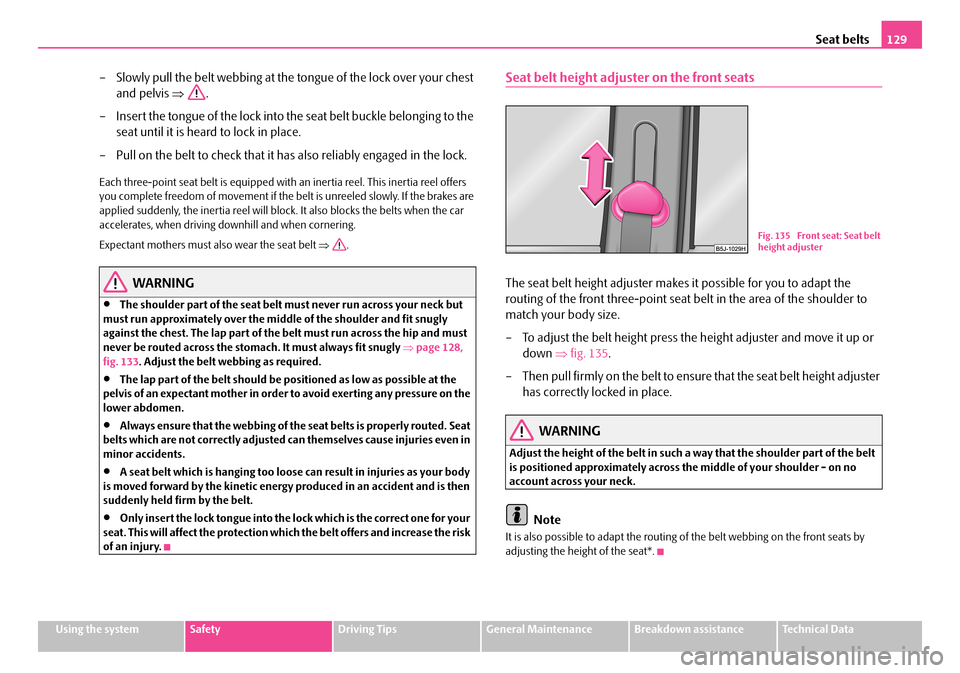
– To adjust the belt height press the height adjuster and move it up or
down ⇒fig. 135.
– Then pull firmly on the belt to ensure that the seat belt height adjuster
has correctly locked in place.
WARNING
Adjust the height of the belt in such a way that the shoulder part of the belt is positioned approximately across the middle of your shoulder - on no account across your neck.
Note
It is also possible to adapt the routing of the belt webbing on the front seats by adjusting the height of the seat*.
Fig. 135 Front seat: Seat belt height adjuster
NKO A05F 20.book Page 129 Wednesday, April 2, 2008 1:02 PM
Page 131 of 252
Seat belts130
Taking seat belts off
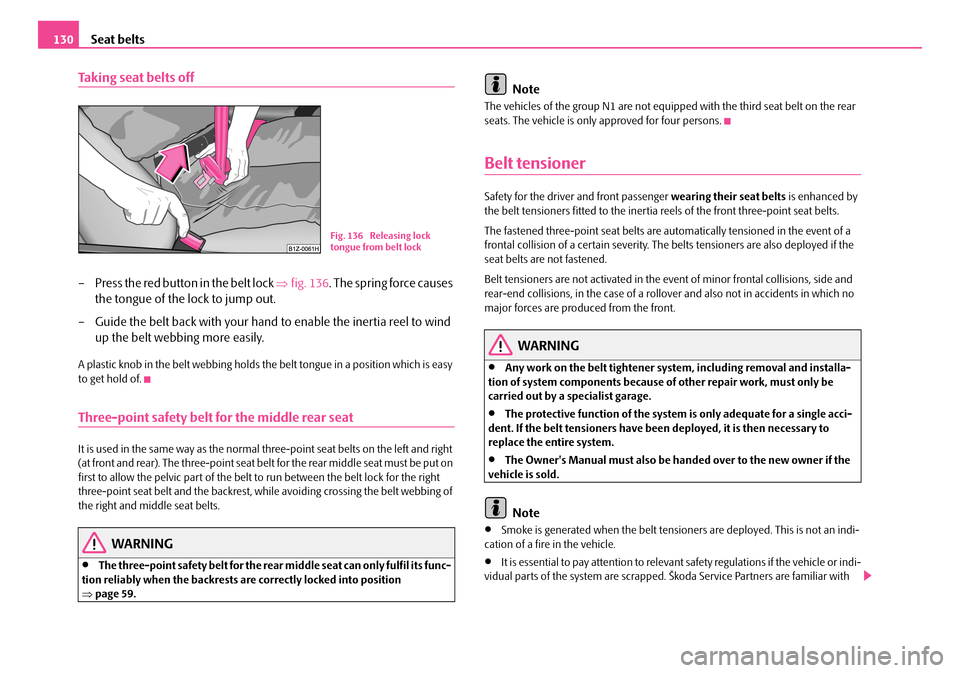
– Press the red button in the belt lock ⇒fig. 136. The spring force causes
the tongue of the lock to jump out.
– Guide the belt back with your hand to enable the inertia reel to wind
up the belt webbing more easily.
A plastic knob in the belt webbing holds the belt tongue in a position which is easy to get hold of.
Three-point safety belt for the middle rear seat
It is used in the same way as the normal three-point seat belts on the left and right (at front and rear). The three-point seat belt for the rear middle seat must be put on first to allow the pelvic part of the belt to run between the belt lock for the right three-point seat belt and the backrest, while avoiding crossing the belt webbing of the right and middle seat belts.
WARNING
•The three-point safety belt for the rear middle seat can only fulfil its func-tion reliably when the backrests are correctly locked into position ⇒page 59.
Note
The vehicles of the group N1 are not equipped with the third seat belt on the rear seats. The vehicle is only approved for four persons.
Belt tensioner
Safety for the driver and front passenger wearing their seat belts is enhanced by the belt tensioners fitted to the inertia reels of the front three-point seat belts.
The fastened three-point seat belts are automatically tensioned in the event of a frontal collision of a certain severity. The belts tensioners are also deployed if the seat belts are not fastened.
Belt tensioners are not activated in the event of minor frontal collisions, side and rear-end collisions, in the case of a rollover and also not in accidents in which no major forces are produced from the front.
WARNING
•Any work on the belt tightener system, including removal and installa-tion of system components because of other repair work, must only be carried out by a specialist garage.
•The protective function of the system is only adequate for a single acci-dent. If the belt tensioners have been deployed, it is then necessary to replace the entire system.
•The Owner's Manual must also be handed over to the new owner if the vehicle is sold.
Note
•Smoke is generated when the belt tensioners are deployed. This is not an indi-cation of a fire in the vehicle.
•It is essential to pay attention to relevant safety regulations if the vehicle or indi-vidual parts of the system are scrapped. Škoda Service Partners are familiar with
Fig. 136 Releasing lock tongue from belt lock
NKO A05F 20.book Page 130 Wednesday, April 2, 2008 1:02 PM
Page 133 of 252
Airbag system132
Airbag system
Description of the airbag system
General information on the airbag system
The front airbag system is complementary to the three-point seat belts and offers additional protection in the head and chest area of the driver and passenger in the event of a frontal collision.
In the event of a side collision, the side airbags reduce the risk of injury to the occu-pants to the part of their body facing the side of the accident.
The airbag system is only functional after the ignition has been switched on.
The operational readiness of the airbag system is monitored electronically. The airbag warning light comes on for a few seconds each time the ignition is switched on.
The airbag system (according to vehicle equipment) essentially consists of:
•an electronic control unit,
•the front airbags for the driver and front passenger ⇒page 133,
•the side airbags ⇒page 136,
•Head airbags ⇒page 138,
•an airbag warning light in the instrument cluster ⇒page 28,
•a front passenger airbag switch* ⇒page 140,
•an indicator light for a switched off front seat passenger airbag* in the middle of the dash panel ⇒page 140.
A fault in the airbag system exists if:
•the airbag indicator light does not light up when the ignition is switched on,
•the airbag indicator light does not go out after about 3 seconds after the ignition is switched on,
•the airbag indicator light goes out and comes on again after the ignition is switched on,
•the airbag indicator light comes on or flickers when driving,
•an airbag indicator light showing a switched-off front passenger airbag* in the middle of the dash panel flashes.
WARNING
•To enable the occupants of a car to be protected with the greatest possible effect when the airbag is deployed, the front seats must be ⇒page 122, “Correct seated position” correctly adjusted to match the body size of the occupant.
•If you do not fasten the seat belts when driving, lean too far forward or adopt an incorrect seated position, you are exposing yourself to increased risk of injury in the event of an accident.
•Have the airbag system checked immediately by a specialist garage if a fault exists. Otherwise, there is a risk of the airbag not being activated in the event of an accident.
•No modifications of any kind may be made to parts of the airbag system.
•It is prohibited to manipulate individual parts of the airbag system as this might result in the airbag being deployed.
•The protective function of the airbag system is sufficient for only one accident. The airbag system must then be replaced if the airbag has been deployed.
•The airbag system needs no maintenance during its working life.
•If you sell your car, please hand over the complete vehicle documenta-tion to the new owener. Please note that the documents relating to the possibility of deactivating the front passenger airbag are also part of the vehicle documents!
•If the vehicle or individual parts of the airbag system are scrapped, it is essential to observe the relevant safety precautions. Škoda Service Partners are familiar with these regulations.
•When disposing of vehicle or parts of the airbag system, it is important to comply with the national legal requirements.
NKO A05F 20.book Page 132 Wednesday, April 2, 2008 1:02 PM