engine SKODA FABIA 2008 2.G / 5J Workshop Manual
[x] Cancel search | Manufacturer: SKODA, Model Year: 2008, Model line: FABIA, Model: SKODA FABIA 2008 2.G / 5JPages: 252, PDF Size: 40.88 MB
Page 165 of 252
Driving and the Environment164
•Minimum fuel leakage during accidents
•Reduced noise
Choice of materials
•extensive use of recyclable material
•Air conditioning filled with CFC-free refrigerant
•no cadmium
•no asbestos
•Reduction in the “vaporisation” of plastics
Manufacture
•solvent-free cavity protection
•solvent-free protection of the vehicle for transportation from the production plant to the customer
•The use of solvent-free adhesives
•No CFCs used in the production process
•without use of mercury
•Use of water-soluble paints
•no use of hexavalent chromium
Trade-in and recycling of old cars
Škoda Auto meets the requirements of the brand and its products regarding envi-ronment and ressource protection. All new Škoda vehicles can be utilized up to 95 % and always 5) be returned. In a lot of countries sufficient trade-in networks have been created, where you can trade-in your vehicle. After you trade-in your vehicle, you will receive a confirmation stating the recycling in accordance with environmental regulations.
Vehicles with special built-on types
Technical documents regarding changes carried out on the vehicle must be kept by the vehicle user, in order to hand over later to the old car user. This ensures the recycling in accordance with environmental regulations.
Note
Detailed information about the trade-in and recycling of old cars is available from your Škoda Service Partner.
Motoring abroad
General
Other circumstances may exist abroad.
It is also possible, in certain countries, that the Škoda Service Partner network is limited or has not been established yet. This is the reason why obtaining certain spare parts may be somewhat complicated and specialist garage personnel may only be able to ma ke li mite d re pa irs. Škoda Auto a.s. i n the Czech Republic and rele -vant importers are happy to provide information about technical aspects of the vehicle, required maintenance work and possibilities for getting repairs done.
Unleaded petrol
A vehicle fitted with a petrol engine must always be refuelled with unleaded petrol ⇒page 160. The automobile associations can provide you with information regarding the locations of filling stations which offer unleaded petrol.
Headlights
The low beam of your headlights is set asymmetrically. It illuminates the side of the road on which you are driving to a greater extent. If you drive abroad on the other side of the road, you will dazzle oncoming traffic.
It is necessary in order to avoid dazzling oncoming traffic to stick a sticker over a certain part of the headlights.
Headlight stickers can be obtained as a spare part from the Skoda Service Partners.
Headlights with module are designed for driving in countries with traffic on the right or on the left. Have this done always at a Škoda Service Partner.5)subject to fulfilment of the national legal regulations
NKO A05F 20.book Page 164 Wednesday, April 2, 2008 1:02 PM
Page 167 of 252
Towing a trailer166
Towing a trailer
To w i n g a t r a i l e r
Technical requirements
The towing device must satisfy certain technical requirements.
Your vehicle is designed primarily for transporting persons and luggage. It can, however, also be used for towing a trailer - provided certain technical equipment is fitted.
If your vehicle has been equipped with a towing device from Škoda Original Acces-sories, then the towing device satisfies all technical and legal requirements.
Your vehicle is fitted with a 13-pin power socket for the electrical connection between the vehicle and trailer. If the trailer which you wish to tow has a 7-pin connector, you can use a suitable adapter 6) from Škoda original accessories.
This work must be carried out in accordance with the manufacturer's specifications if a towing device is retrofitted.
Škoda Service Partners are familiar with details relating to retrofitting a towing device and for any necessary modifications to the cooling system.
WARNING
We recommend that you have the towing device from Škoda original acces-sories installed by a Škoda Service Partner. He is familiar with all the relevant details relating to retrofitting such equipment. There is a risk of an accident if the towing device is not properly fitted!
General Maintenance
There are a number of points to pay attention to when towing a
trailer.
Trailer load
The permissible trailer load must on no account be exceeded.
You can negotiate appropriately steeper inclines and descents if you do not make full use of the permissible trailer load.
The trailer loads specified only apply for altitudes up to 1 000 metres above mean sea level. The fact that the engine power output drops with increasing height due to a lowering of air pressure and thus the ability to climb, means that the trailer load must be reduced by 10% for every further increase of 1 000 metres in height above sea level. The towed weight is the weight of the (laden) vehicle and the (laden) trailer together. One should take this into account before driving up to higher alti-tudes.
The trailer and drawbar load information on the type plate of the towing device are merely test data for the towing device The data relating to your vehicle, which is often less than this test data, can be found in your vehicle registration documents or in the brochure - Technical Data.
Distribution of the load
Distribute the load in the trailer in such a way that any heavy items are located as close as possible to the axle. Secure the items to prevent them slipping.
Tyre pressure
Correct the tyre inflation pressure on your vehicle for that of “fully laden”, ⇒page 194. The inflation pressure of the tyres fitted to the trailer adjust in accord-ance with the manufacturer's recommendation.
Exterior mirrors
You have to have additional exterior mirrors fitted if you are not able to see the traffic behind the trailer with the standard rear-view mirrors. Both exterior mirrors 6)In some countries the adapter is supplied with the towing device.
NKO A05F 20.book Page 166 Wednesday, April 2, 2008 1:02 PM
Page 168 of 252
Towing a trailer167
Using the systemSafetyDriving TipsGeneral MaintenanceBreakdown assistanceTechnical Data
should be attached to folding arms. Adjust the mirrors so that they provide you with an adequate field of view to the rear.
Headlights
Before starting off with a hitched trailer, also check the setting of the headlights. Alter the setting as necessary with the aid of the headlight beam adjuster ⇒page 47.
Detachable ball head
The ball rod is detachable on vehicles with towing device and suppliable from Škoda original accessories. It is stowed together with separate fitting instructions in the spare wheel well in the luggage compartment of the vehicle.
Note
•We recommend that you also have your vehicle inspected between service intervals if you tow a trailer frequently.
•The handbrake on the towing vehicle must be put on when coupling and decoupling the trailer.
•Keep the mechanism of the ball head of the towing device clean and take proper care of it with a suitable preservative.
Driving Tips
Particular caution is required when towing a trailer.
– Do not, as far as possible, drive with your vehicle unladen and the
trailer laden.
– Do not make full use of the legal maximum speeds. This applies in
particular to downhill sections.
– Apply the brakes in good time.
– Keep a check on the coolant temperature gauge if the outside temper-
ature is high.
Distribution of weight
The distribution of the weight is very poor if your vehicle is unladen and the trailer is laden. Maintain a particularly low speed if you cannot avoid driving with this combination.
Driving speed
Do not drive faster than 80 km/hour for safety reasons. This also applies for coun-tries in which higher speeds are allowed.
The fact that the driving stability of the vehicle + trailer combination reduces with increasing speed means that the legally allowed speed should not be used when there are unfavourable road, weather or wind conditions, particularly near accident black spots.
You must always reduce your speed immediately as soon as you detect even just the slightest swaying of the trailer. On no account attempt to stop the trailer from “swaying” by accelerating.
Apply the brakes in good time! If the trailer is fitted with a trailer brake, apply the brakes gently at first and then brake firmly. This will avoid brake jolts resulting from the trailer wheels locking. Shift down gears in good time before negotiating a down-hill section to allow the engine to also act as a brake.
Engine overheating
Please keep a check on the coolant temperature gauge if you have to negotiate a lengthy slope in a low gear at a high engine speed when the outside temperature is very high ⇒page 10.
If the needle of the coolant temperature gauge moves into the right-hand area or even the red area of the scale, reduce your speed immediately. Stop and switch off the engine if the warning light in the instrument cluster begins flashing. Wait a few minutes and check the level of coolant in the coolant expansion bottle ⇒page 186, “Inspecting the coolant level”.
Please refer to the following guidelines ⇒page 24, “Coolant temperature/coolant level ”.
The coolant temperature can be reduced by switching on the heating.
Any increase in the cooling effect of the coolant fan through shifting down a gear and increasing the engine speed is not possible since the fan speed is independent
NKO A05F 20.book Page 167 Wednesday, April 2, 2008 1:02 PM
Page 169 of 252

Towing a trailer168
of the engine speed. One should also not drop a gear for this reason when towing a trailer as long as the engine can manage the slope without any drop in speed.
NKO A05F 20.book Page 168 Wednesday, April 2, 2008 1:02 PM
Page 175 of 252
Taking care of your vehicle and cleaning the vehicle174
Engine compartment
Good corrosion protection is very important, particularly in winter when one often drives over its salt-strewn roads. One should therefore clean the entire engine compartment before and after the salt spreading period, in order to prevent the salt from being destructive.
Škoda Service Partners have the cleaning agents recommended by the manufac-turer and also the required equipment.
WARNING
•It is necessary to observe the guidelines given in the chapter before working on the engine compartment ⇒page 181.
•Let the engine cool down before cleaning the engine compartment.
Caution
•Engine cleaning may be only be undertaken when the ignition is off.
•It is recommended to cover the generator before washing the engine compart-ment.
For the sake of the environment
The dirty water produced by washing the engine has washed away petrol, and resi-dues of grease and oil and should therefore be cleaned by an oil separator. This is why engine washing should only be undertaken in a garage or at a fueling station (when these are fitted with the required equipment).
Care of the interior of vehicle
Plastic parts, artificial leather and cloths
You can clean plastic parts and artificial leather with a moist cloth. You should only treat such parts with special solvent-free plastic cleaning and care products it does prove to be adequate.
Upholstery cloth and cloth trim on the doors, luggage compartment cover, head-liner etc. are best treated with special cleaning products, using if necessary a dry foam and a soft sponge or brush.
We recommend using a cleaning product from Škoda genuine accessories offered by your Škoda dealer.
Caution
Solvent-free cleaners attack the material and can damage it.
Fabric covers of electrically heated seats
Do not clean the seat covers moist as this may result in damage to the seat heating system.
Clean such covers using special agents, for example dry foam.
We recommend using a cleaning product from Škoda genuine accessories offered by your Škoda dealer.
Natural leather
Natural leather requires quite particular care and attention.
Leather should be treated from time to time according the following
guidelines depending on how much it is used.
Normal cleaning
– Clean soiled areas of the leather with slightly moistened cotton or
woollen cloth.
Severe soiling
– Clean severely soiled areas with a cloth dipped in a mild soapy solu-
tion (2 spoonfuls of natural soap to 1 litre of water).
NKO A05F 20.book Page 174 Wednesday, April 2, 2008 1:02 PM
Page 178 of 252
Fuel177
Using the systemSafetyDriving TipsGeneral MaintenanceBreakdown assistanceTechnical Data
Fuel
Petrol
Grades of petrol
There are various grades of petrol. Please read the chapter Technical Data in order to know which grade of petrol your vehicle requires. You will also find the same information affixed to the inside of the fuel filler flap of your vehicle ⇒page 178, fig. 166.
A distinction is made between unleaded and leaded petrol. All Škoda vehicles with petrol engines are equipped with a catalytic converter and must therefore be only driven with unleaded petrol. Unleaded petrol complies with the standard EN 228.
The individual grades of petrol are distinguished by their octane number (RON). Please adopt the following procedure if the grade of petrol which you normally use is not be available in exceptional circumstances:
•Engines which need unleaded premium petrol 95 RON can also be run on unleaded regular petrol 91 RON. This does, however, result in a slight loss in performance.
If, in an emergency, the only fuel available is one which has a lower octane number than that required by the engine then only drive at medium engine speeds and lower engine loadings.
You can make unlimited use of fuel which has a higher octane number than that required by the engine. There will, however, be no advantages gained by this in terms of engine performance and fuel consumption!
The handling, performance and life of your engine are determined to a significant extent by the quality of the fuel. Do not use any petrol additives. Use a fuel complying with the standard.
You can find further information on refuelling ⇒page 178.
Caution
•Filling the tank even only once with leaded petrol will result in the catalytic converter being destroyed.
•Operating the engine with petrol of a low octane number than that required can result in engine damage at high revolutions or severe engine loading.
Diesel
Diesel fuel
Your vehicle can be operated with diesel fuel, which complies with the standard EN 590.
Fuel additives
You must not use fuel additives, so-called “flow improvers” (petrol and similar products) in diesel fuel.
If the quality of the diesel fuel is poor, it is then necessary to drain the fuel filter more often than stated in the Service schedule.
You can find information on refuelling ⇒page 178, “Refuelling”.
Caution
•Use a fuel which complies with the standard EN 590. Filling the tank even only once, which does not comply with this standard, can result in damage to the fuel system.
•Water which has collected in the fuel filter can result in engine problems.
•Your vehicle is not adapted for use of biofuel (RME), therefore this fuel must not be refuelled and driven. Using this fuel (RME) can lead to damage to the engine or the fuel system.
NKO A05F 20.book Page 177 Wednesday, April 2, 2008 1:02 PM
Page 180 of 252
Fuel179
Using the systemSafetyDriving TipsGeneral MaintenanceBreakdown assistanceTechnical Data
– Lock the fuel filler cap on the fuel filler tube to the right using the
vehicle key.
– Press the fuel tank flap closed.
The correct grades of fuel for your vehicle are stated on a sticker affixed to the inside of the fuel filler flap. Further information on fuel ⇒page 177.
The fuel tank has a capacity of about 45 litres.
WARNING
Pay attention to any legal requirements if you do carry a spare canister in the vehicle. We do not recommend carrying any fuel canisters in your vehicle for safety reasons. The canister can be damaged in the event of an accident and fuel may leak out.
Caution
•Remove any fuel which has spilled onto the paintwork of your vehicle immedi-ately - risk of paint damage!
•Vehicles fitted with catalytic converter should never be allowed to let the fuel tank to run completely empty. An irregular supply of fuel to the engine can result in misfiring and unburnt fuel may get into the exhaust system, which may result in overheating and damage to the catalytic converter.
•Make sure that the valve is not pressed into the filler tube when inserting the pump nozzle into the filler tube. Otherwise you are unintentionally filling up the volume, which in case of heat can cause an expansion of the fuel. This can lead to an overflow of fuel or damage to parts of the fuel reservoir.
•T h e f u e l t a n k i s f u l l j u s t a s s o o n a s t he pump nozzle switches off for the first time, provided the nozzle has been operated properly. Do not continue refuelling - otherwise the expansion volume is filled up.
NKO A05F 20.book Page 179 Wednesday, April 2, 2008 1:02 PM
Page 181 of 252
Inspecting and Replenishing180
Inspecting and Replenishing
Engine compartment
Bonnet remote release
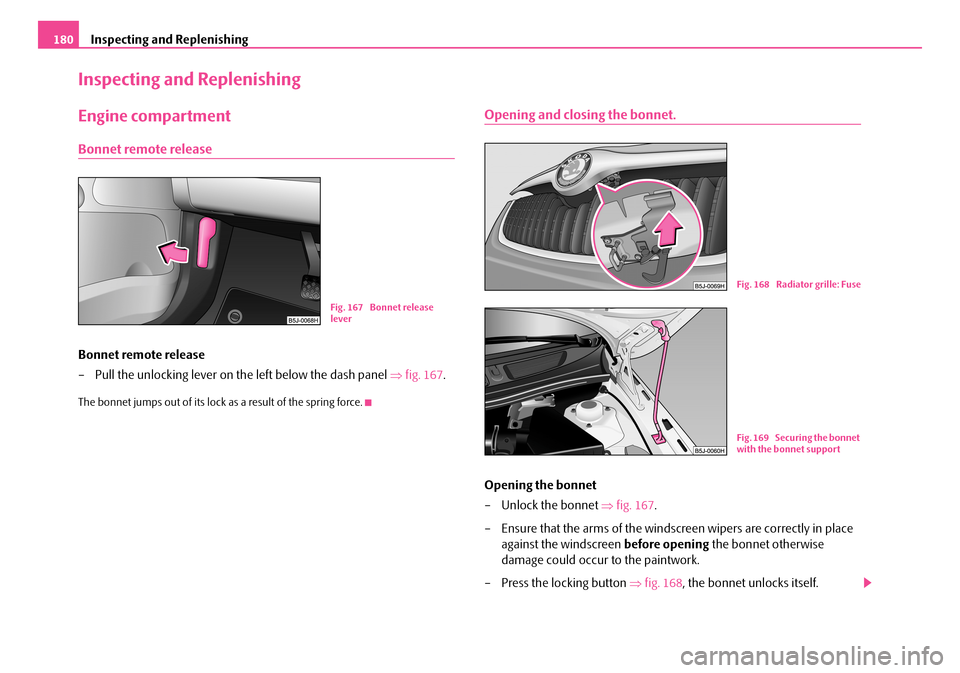
Bonnet remote release
– Pull the unlocking lever on the left below the dash panel ⇒fig. 167.
The bonnet jumps out of its lock as a result of the spring force.
Opening and closing the bonnet.
Opening the bonnet
– Unlock the bonnet ⇒fig. 167.
– Ensure that the arms of the windscreen wipers are correctly in place
against the windscreen before opening the bonnet otherwise
damage could occur to the paintwork.
– Press the locking button ⇒fig. 168, the bonnet unlocks itself.
Fig. 167 Bonnet release lever
Fig. 168 Radiator grille: Fuse
Fig. 169 Securing the bonnet with the bonnet support
NKO A05F 20.book Page 180 Wednesday, April 2, 2008 1:02 PM
Page 182 of 252
Inspecting and Replenishing181
Using the systemSafetyDriving TipsGeneral MaintenanceBreakdown assistanceTechnical Data
– Grip the bonnet and lift it up.
– Take the bonnet support out of its holder and set it in the opening
designed for it ⇒page 180, fig. 169.
Closing the bonnet
– Lift the bonnet slightly and unhook the bonnet support. Press the
bonnet support into the holder designed to hold it.
– Allow the bonnet to drop from a height of about 30 cm into the lock -
bonnet do not press down on it!
WARNING
•Never open the bonnet if you see that steam or coolant is flowing out of the engine compartment - risk of scalding! Wait long enough until the steam or coolant has stopped escaping.
•For safety reasons, the bonnet must always be properly closed when driving. One should therefore check that the lock has in fact engaged prop-erly after closing the bonnet.
•Stop your vehicle immediately while driving if you notice that the lock is not properly engaged and close the bonnet properly - risk of an accident!
Caution
•Before opening the bonnet, ensure that the arms of the windscreen wipers are correctly in place against the windscreen. Otherwise, there is a risk of damage to the paintwork.
Working in the engine compartment
Particular care is required when carrying out any work in the engine
compartment!
There is a risk of injuries, scalding, accidents and fire when working in the engine compartment, e.g. inspecting and replenishing oil and other fluids. For
this reason, it is essential to comply with the warning instructions stated below and with the general applicable rules of safety. The engine compart-ment of your car is a hazardous area ⇒.
WARNING
•Never open the bonnet if you see that steam or coolant is flowing out of the engine compartment - risk of scalding! Wait long enough until the steam or coolant has stopped escaping.
•Switch off the engine and pull out the ignition key.
•Apply the handbrake firmly.
•If your vehicle is fitted with a manual gearbox, move the gearshift lever into Neutral, or if it is fitted with automatic gearbox, move the selector lever into position P.
•Allow the engine to cool down.
•Keep children clear of the engine compartment.
•Do not touch any hot engine parts - risk of burns!
•Never spill oil and other fluids over the hot engine. Such fluids (e.g. the antifreeze contained in the wash liquid) may ignite!
•Avoid short circuits in the electrical system - particularly on the battery.
•Never place your hand into the radiator fan as long as the engine is still warm. The fan might suddenly start running!
•Never open the cap of the coolant expansion bottle as long as the engine is still warm. The cooling system is pressurized!
•Cover over the cap of the coolant expansion reservoir with a large cloth when opening it as protection for your face, hands and arms from hot steam or hot coolant.
•Do not let objects, such as e.g cleaning cloth or tools lie in the engine compartment.
•If you wish to work under the vehicle, you must secure the vehicle from rolling away and support it with suitable supporting blocks: the car jack is not sufficient for this - risk of injury!
•In cases where it be necessary to carry out inspection work when the engine is running there is an additional risk from rotating parts (e.g. the V-
NKO A05F 20.book Page 181 Wednesday, April 2, 2008 1:02 PM
Page 183 of 252
Inspecting and Replenishing182
ribbed belt, alternator, radiator fan) and from the high-voltage ignition system. Please observe in addition the following:
−Never touch the electrical cables of the ignition system.
−Absolutely avoid any jewellery, loose items of clothing or long hair from getting into the rotating parts of the engine - Hazard! Therefore remove any jewellery beforehand, tie up your hair and wear tight fitting clothing.
•Please also comply with the warning instructions stated below when carrying out any essential work on the fuel system or on the electrical system:
−Always separate the car battery from the electrical system.
−Do not smoke.
−Never carry out any work close to naked flames.
−Always keep a working fire extinguisher at hand.
Caution
When replenishing fluids in the engine, always ensure that the fluids are on no account mixed up. This may result in major operating problems and also vehicle damage!
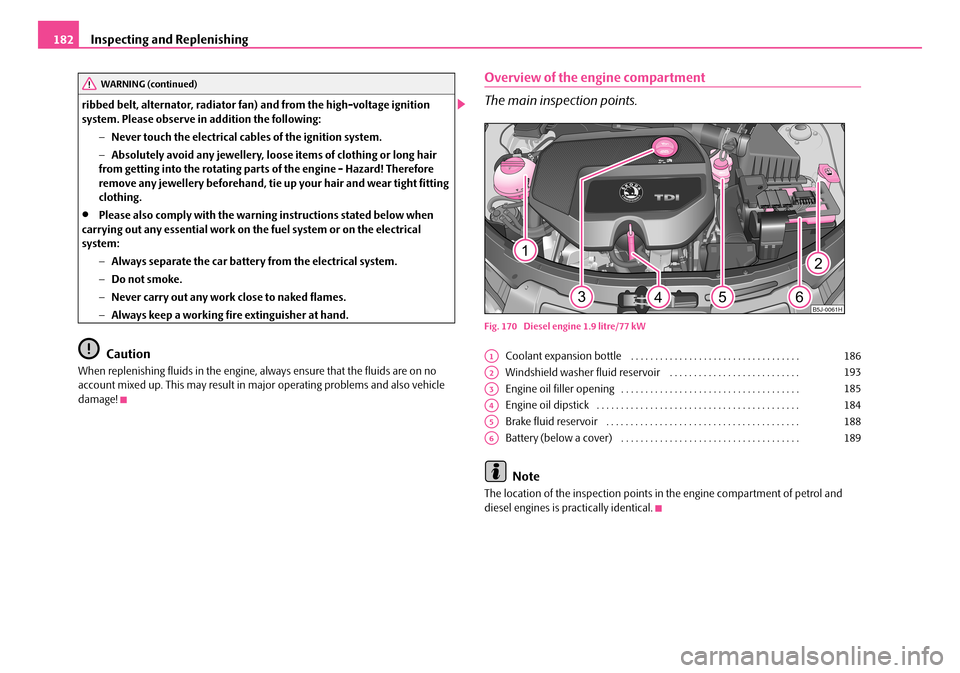
Overview of the engine compartment
The main inspection points.
Fig. 170 Diesel engine 1.9 litre/77 kW
Coolant expansion bottle . . . . . . . . . . . . . . . . . . . . . . . . . . . . . . . . . . .
Windshield washer fluid reservoir . . . . . . . . . . . . . . . . . . . . . . . . . . .
Engine oil filler opening . . . . . . . . . . . . . . . . . . . . . . . . . . . . . . . . . . . . .
Engine oil dipstick . . . . . . . . . . . . . . . . . . . . . . . . . . . . . . . . . . . . . . . . . .
Brake fluid reservoir . . . . . . . . . . . . . . . . . . . . . . . . . . . . . . . . . . . . . . . .
Battery (below a cover) . . . . . . . . . . . . . . . . . . . . . . . . . . . . . . . . . . . . .
Note
The location of the inspection points in the engine compartment of petrol and diesel engines is practically identical.
WARNING (continued)
B5J-0061H
A1186
A2193
A3185
A4184
A5188
A6189
NKO A05F 20.book Page 182 Wednesday, April 2, 2008 1:02 PM