boot SKODA FABIA 2012 2.G / 5J Owner's Guide
[x] Cancel search | Manufacturer: SKODA, Model Year: 2012, Model line: FABIA, Model: SKODA FABIA 2012 2.G / 5JPages: 196, PDF Size: 4.83 MB
Page 60 of 196
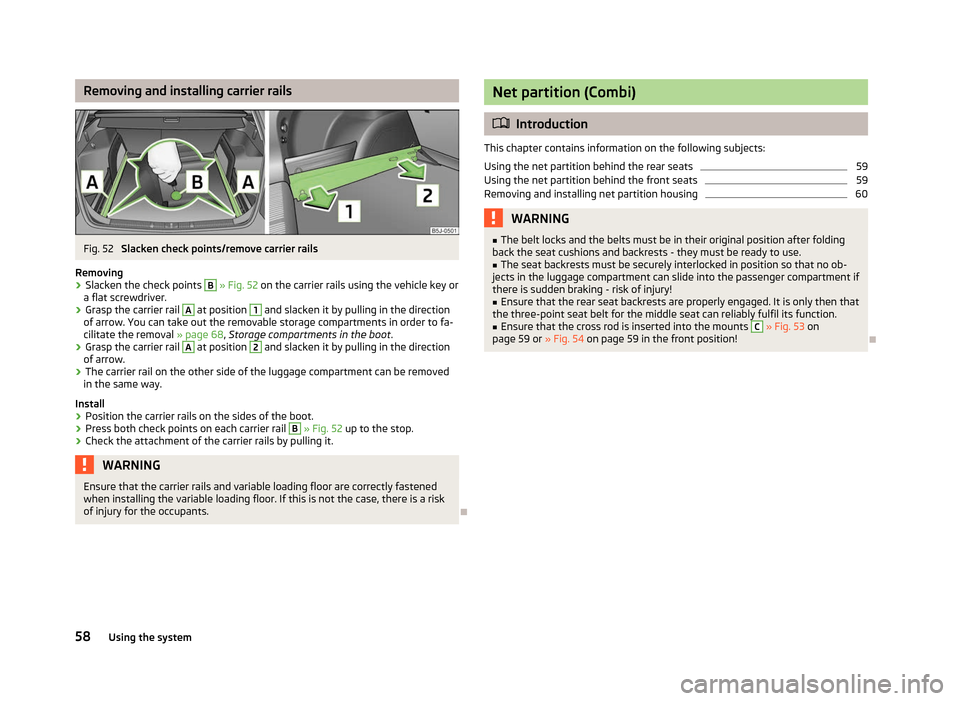
Removing and installing carrier rails
Fig. 52
Slacken check points/remove carrier rails
Removing
› Slacken the check points B
» Fig. 52
on the carrier rails using the vehicle key or
a flat screwdriver.
› Grasp the carrier rail A
at position 1
and slacken it by pulling in the direction
of arrow. You can take out the removable storage compartments in order to fa-
cilitate the removal » page 68 , Storage compartments in the boot .
› Grasp the carrier rail A
at position 2
and slacken it by pulling in the direction
of arrow.
› The carrier rail on the other side of the luggage compartment can be removed
in the same way.
Install
› Position the carrier rails on the sides of the boot.
› Press both check points on each carrier rail B
»
Fig. 52
up to the stop.
› Check the attachment of the carrier rails by pulling it. WARNING
Ensure that the carrier rails and variable loading floor are correctly fastened
when installing the variable loading floor. If this is not the case, there is a risk
of injury for the occupants. Ð Net partition (Combi)
ä
Introduction
This chapter contains information on the following subjects:
Using the net partition behind the rear seats 59
Using the net partition behind the front seats 59
Removing and installing net partition housing 60
WARNING
■ The belt locks and the belts must be in their original position after folding
back the seat cushions and backrests - they must be ready to use.
■ The seat backrests must be securely interlocked in position so that no ob-
jects in the luggage compartment can slide into the passenger compartment if
there is sudden braking - risk of injury!
■ Ensure that the rear seat backrests are properly engaged. It is only then that
the three-point seat belt for the middle seat can reliably fulfil its function. ■ Ensure that the cross rod is inserted into the mounts C
» Fig. 53 on
page 59
or » Fig. 54 on page 59 in the front position! Ð
58 Using the system
Page 61 of 196
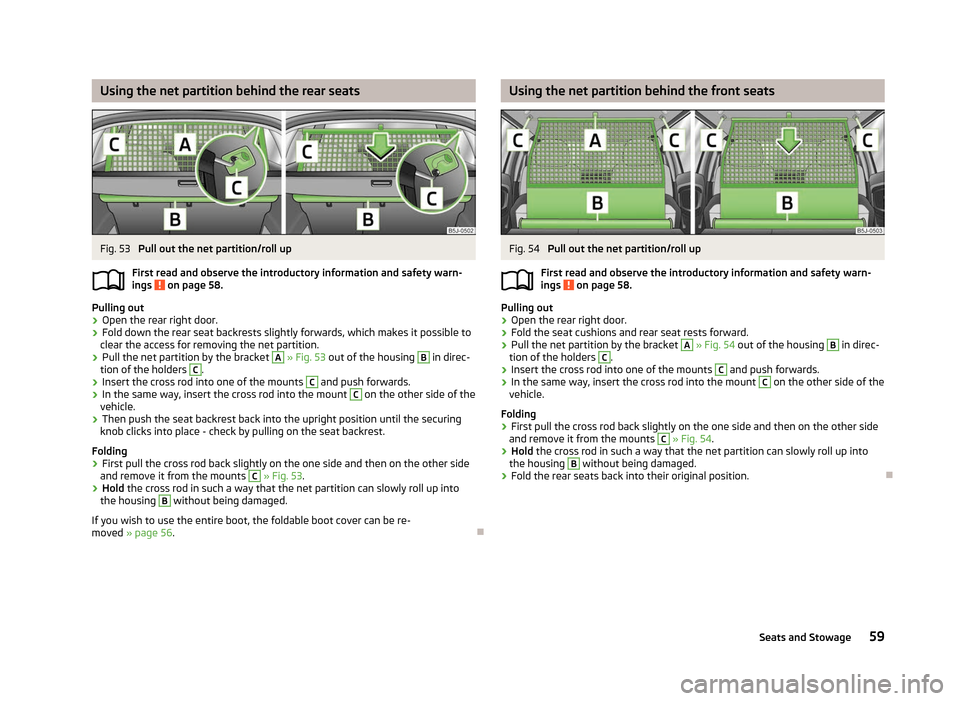
Using the net partition behind the rear seats
Fig. 53
Pull out the net partition/roll up
First read and observe the introductory information and safety warn-
ings on page 58.
Pulling out
› Open the rear right door.
› Fold down the rear seat backrests slightly forwards, which makes it possible to
clear the access for removing the net partition.
› Pull the net partition by the bracket A
» Fig. 53 out of the housing B
in direc-
tion of the holders C
.
› Insert the cross rod into one of the mounts C
and push forwards.
› In the same way, insert the cross rod into the mount C
on the other side of the
vehicle.
› Then push the seat backrest back into the upright position until the securing
knob clicks into place - check by pulling on the seat backrest.
Folding
› First pull the cross rod back slightly on the one side and then on the other side
and remove it from the mounts C
» Fig. 53.
› Hold the cross rod in such a way that the net partition can slowly roll up into
the housing B
without being damaged.
If you wish to use the entire boot, the foldable boot cover can be re-
moved » page 56 . Ð
ä Using the net partition behind the front seats
Fig. 54
Pull out the net partition/roll up
First read and observe the introductory information and safety warn-
ings on page 58.
Pulling out
› Open the rear right door.
› Fold the seat cushions and rear seat rests forward.
› Pull the net partition by the bracket A
» Fig. 54
out of the housing B
in direc-
tion of the holders C
.
› Insert the cross rod into one of the mounts C
and push forwards.
› In the same way, insert the cross rod into the mount C
on the other side of the
vehicle.
Folding
› First pull the cross rod back slightly on the one side and then on the other side
and remove it from the mounts C
» Fig. 54
.
› Hold the cross rod in such a way that the net partition can slowly roll up into
the housing B
without being damaged.
› Fold the rear seats back into their original position. Ð
ä
59
Seats and Stowage
Page 63 of 196
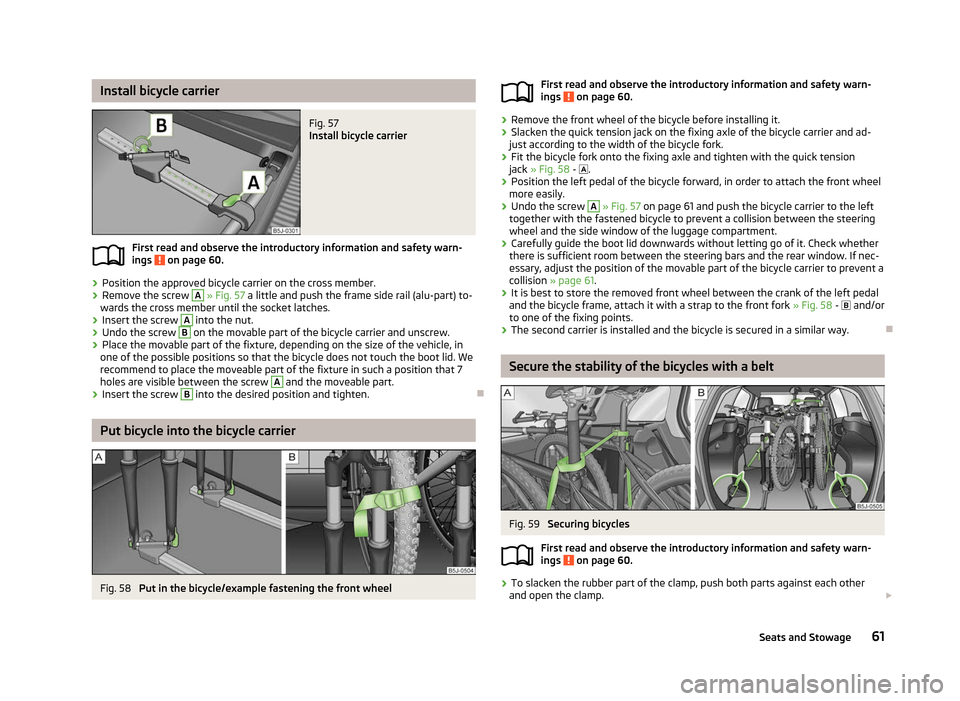
Install bicycle carrier
Fig. 57
Install bicycle carrier
First read and observe the introductory information and safety warn-
ings on page 60.
›
Position the approved bicycle carrier on the cross member.
› Remove the screw A
» Fig. 57 a little and push the frame side rail (alu-part) to-
wards the cross member until the socket latches.
› Insert the screw A
into the nut.
› Undo the screw B
on the movable part of the bicycle carrier and unscrew.
› Place the movable part of the fixture, depending on the size of the vehicle, in
one of the possible positions so that the bicycle does not touch the boot lid. We
recommend to place the moveable part of the fixture in such a position that 7
holes are visible between the screw A
and the moveable part.
› Insert the screw B
into the desired position and tighten.
ÐPut bicycle into the bicycle carrier
Fig. 58
Put in the bicycle/example fastening the front wheel
ä
First read and observe the introductory information and safety warn-
ings on page 60.
›
Remove the front wheel of the bicycle before installing it.
› Slacken the quick tension jack on the fixing axle of the bicycle carrier and ad-
just according to the width of the bicycle fork.
› Fit the bicycle fork onto the fixing axle and tighten with the quick tension
jack »
Fig. 58 - .
› Position the left pedal of the bicycle forward, in order to attach the front wheel
more easily.
› Undo the screw A
» Fig. 57 on page 61 and push the bicycle carrier to the left
together with the fastened bicycle to prevent a collision between the steering
wheel and the side window of the luggage compartment.
› Carefully guide the boot lid downwards without letting go of it. Check whether
there is sufficient room between the steering bars and the rear window. If nec-
essary, adjust the position of the movable part of the bicycle carrier to prevent a
collision » page 61.
› It is best to store the removed front wheel between the crank of the left pedal
and the bicycle frame, attach it with a strap to the front fork » Fig. 58 - and/or
to one of the fixing points.
› The second carrier is installed and the bicycle is secured in a similar way. Ð Secure the stability of the bicycles with a belt
Fig. 59
Securing bicycles
First read and observe the introductory information and safety warn-
ings on page 60.
›
To slacken the rubber part of the clamp, push both parts against each other
and open the clamp. £
ä
ä 61
Seats and Stowage
Page 64 of 196
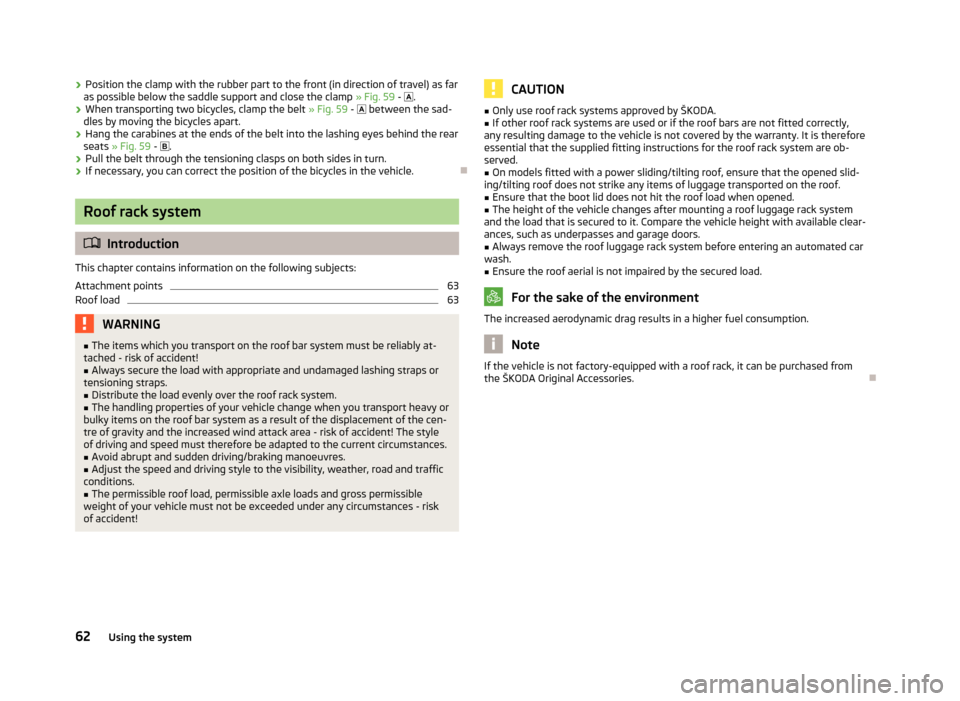
›
Position the clamp with the rubber part to the front (in direction of travel) as far
as possible below the saddle support and close the clamp » Fig. 59
- .
› When transporting two bicycles, clamp the belt
» Fig. 59 - between the sad-
dles by moving the bicycles apart.
› Hang the carabines at the ends of the belt into the lashing eyes behind the rear
seats » Fig. 59 - .
› Pull the belt through the tensioning clasps on both sides in turn.
› If necessary, you can correct the position of the bicycles in the vehicle. ÐRoof rack system
ä
Introduction
This chapter contains information on the following subjects:
Attachment points 63
Roof load 63
WARNING
■ The items which you transport on the roof bar system must be reliably at-
tached - risk of accident!
■ Always secure the load with appropriate and undamaged lashing straps or
tensioning straps. ■ Distribute the load evenly over the roof rack system.
■ The handling properties of your vehicle change when you transport heavy or
bulky items on the roof bar system as a result of the displacement of the cen-
tre of gravity and the increased wind attack area - risk of accident! The style
of driving and speed must therefore be adapted to the current circumstances. ■ Avoid abrupt and sudden driving/braking manoeuvres.
■ Adjust the speed and driving style to the visibility, weather, road and traffic
conditions. ■ The permissible roof load, permissible axle loads and gross permissible
weight of your vehicle must not be exceeded under any circumstances - risk
of accident! CAUTION
■ Only use roof rack systems approved by
ŠKODA.
■ If other roof rack systems are used or if the roof bars are not fitted correctly,
any resulting damage to the vehicle is not covered by the warranty. It is therefore
essential that the supplied fitting instructions for the roof rack system are ob-
served.
■ On models fitted with a power sliding/tilting roof, ensure that the opened slid-
ing/tilting roof does not strike any items of luggage transported on the roof. ■ Ensure that the boot lid does not hit the roof load when opened.
■ The height of the vehicle changes after mounting a roof luggage rack system
and the load that is secured to it. Compare the vehicle height with available clear-
ances, such as underpasses and garage doors.
■ Always remove the roof luggage rack system before entering an automated car
wash. ■ Ensure the roof aerial is not impaired by the secured load. For the sake of the environment
The increased aerodynamic drag results in a higher fuel consumption. Note
If the vehicle is not factory-equipped with a roof rack, it can be purchased from
the
ŠKODA Original Accessories. Ð
62 Using the system
Page 67 of 196
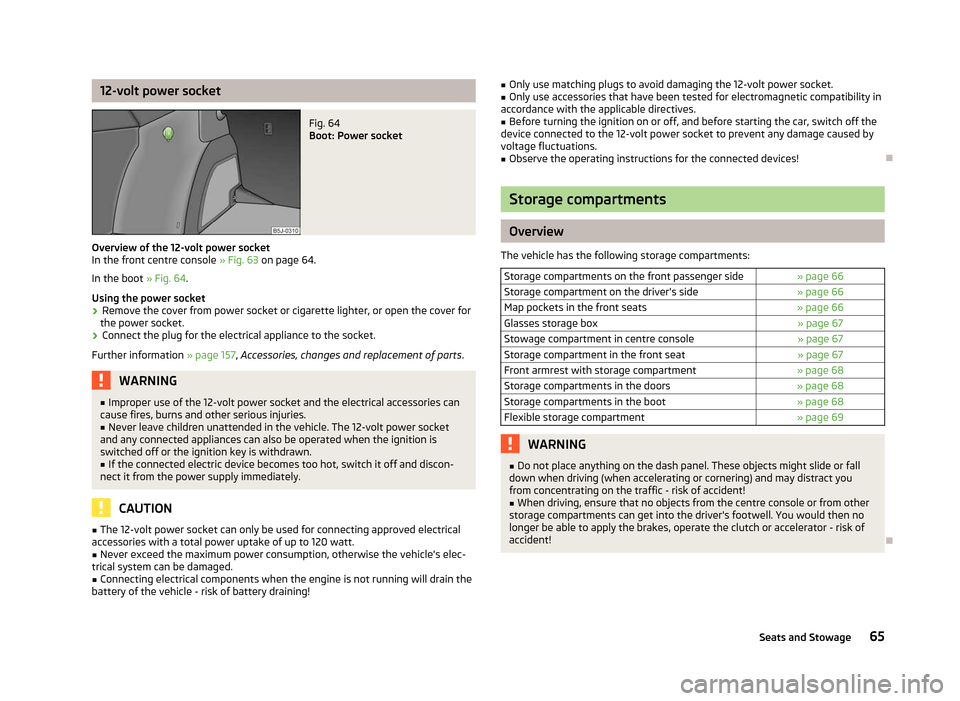
12-volt power socket
Fig. 64
Boot: Power socket
Overview of the 12-volt power socket
In the front centre console » Fig. 63 on page 64
.
In the boot » Fig. 64.
Using the power socket
› Remove the cover from power socket or cigarette lighter, or open the cover for
the power socket.
› Connect the plug for the electrical appliance to the socket.
Further information » page 157, Accessories, changes and replacement of parts .WARNING
■ Improper use of the 12-volt power socket and the electrical accessories can
cause fires, burns and other serious injuries.
■ Never leave children unattended in the vehicle. The 12-volt power socket
and any connected appliances can also be operated when the ignition is
switched off or the ignition key is withdrawn. ■ If the connected electric device becomes too hot, switch it off and discon-
nect it from the power supply immediately. CAUTION
■ The 12-volt power socket can only be used for connecting approved electrical
accessories with a total power uptake of up to 120
watt.
■ Never exceed the maximum power consumption, otherwise the vehicle's elec-
trical system can be damaged.
■ Connecting electrical components when the engine is not running will drain the
battery of the vehicle - risk of battery draining! ■
Only use matching plugs to avoid damaging the 12-volt power socket.
■ Only use accessories that have been tested for electromagnetic compatibility in
accordance with the applicable directives.
■ Before turning the ignition on or off, and before starting the car, switch off the
device connected to the 12-volt power socket to prevent any damage caused by
voltage fluctuations.
■ Observe the operating instructions for the connected devices! Ð Storage compartments
Overview
The vehicle has the following storage compartments: Storage compartments on the front passenger side » page 66
Storage compartment on the driver's side » page 66
Map pockets in the front seats » page 66
Glasses storage box » page 67
Stowage compartment in centre console » page 67
Storage compartment in the front seat » page 67
Front armrest with storage compartment » page 68
Storage compartments in the doors » page 68
Storage compartments in the boot » page 68
Flexible storage compartment » page 69 WARNING
■ Do not place anything on the dash panel. These objects might slide or fall
down when driving (when accelerating or cornering) and may distract you
from concentrating on the traffic - risk of accident!
■ When driving, ensure that no objects from the centre console or from other
storage compartments can get into the driver's footwell. You would then no
longer be able to apply the brakes, operate the clutch or accelerator - risk of
accident! Ð
65
Seats and Stowage
Page 70 of 196
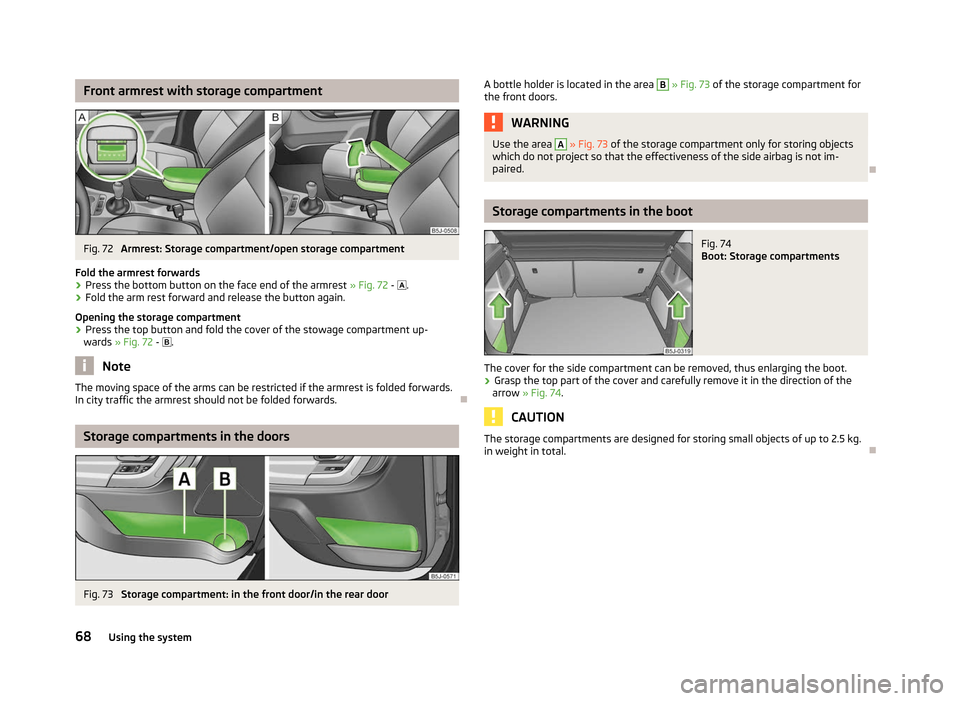
Front armrest with storage compartment
Fig. 72
Armrest: Storage compartment/open storage compartment
Fold the armrest forwards
› Press the bottom button on the face end of the armrest
» Fig. 72 - .
› Fold the arm rest forward and release the button again.
Opening the storage compartment
› Press the top button and fold the cover of the stowage compartment up-
wards » Fig. 72 - . Note
The moving space of the arms can be restricted if the armrest is folded forwards.
In city traffic the armrest should not be folded forwards. ÐStorage compartments in the doors
Fig. 73
Storage compartment: in the front door/in the rear door A bottle holder is located in the area B
» Fig. 73
of the storage compartment for
the front doors. WARNING
Use the area A
» Fig. 73
of the storage compartment only for storing objects
which do not project so that the effectiveness of the side airbag is not im-
paired. Ð Storage compartments in the boot
Fig. 74
Boot: Storage compartments
The cover for the side compartment can be removed, thus enlarging the boot. › Grasp the top part of the cover and carefully remove it in the direction of the
arrow » Fig. 74. CAUTION
The storage compartments are designed for storing small objects of up to 2.5 kg.
in weight in total. Ð
68 Using the system
Page 71 of 196
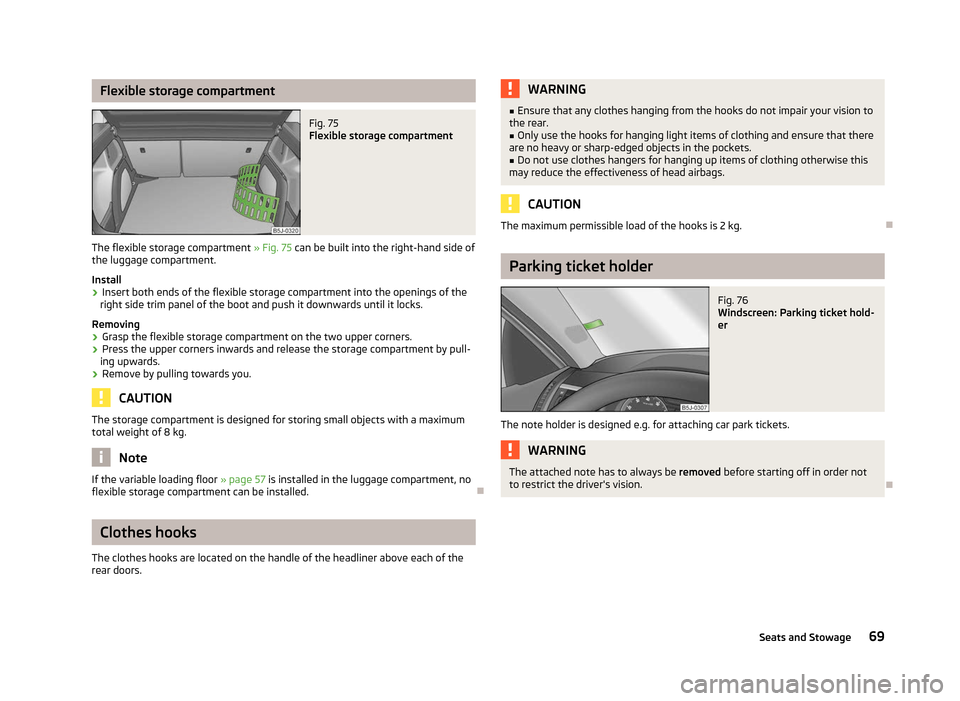
Flexible storage compartment
Fig. 75
Flexible storage compartment
The flexible storage compartment » Fig. 75 can be built into the right-hand side of
the luggage compartment.
Install
› Insert both ends of the flexible storage compartment into the openings of the
right side trim panel of the boot and push it downwards until it locks.
Removing
› Grasp the flexible storage compartment on the two upper corners.
› Press the upper corners inwards and release the storage compartment by pull-
ing upwards.
› Remove by pulling towards you. CAUTION
The storage compartment is designed for storing small objects with a maximum
total weight of 8 kg. Note
If the variable loading floor » page 57 is installed in the luggage compartment, no
flexible storage compartment can be installed. ÐClothes hooks
The clothes hooks are located on the handle of the headliner above each of the
rear doors. WARNING
■ Ensure that any clothes hanging from the hooks do not impair your vision to
the rear.
■ Only use the hooks for hanging light items of clothing and ensure that there
are no heavy or sharp-edged objects in the pockets.
■ Do not use clothes hangers for hanging up items of clothing otherwise this
may reduce the effectiveness of head airbags. CAUTION
The maximum permissible load of the hooks is 2 kg. Ð Parking ticket holder
Fig. 76
Windscreen: Parking ticket hold-
er
The note holder is designed e.g. for attaching car park tickets. WARNING
The attached note has to always be removed before starting off in order not
to restrict the driver's vision. Ð 69
Seats and Stowage
Page 72 of 196
Heating and air conditioning system
Heating and air conditioning system
Introductory information
The heating effect is dependent upon the coolant temperature, thus full heat
output only occurs when the engine has reached its operating temperature.
If the cooling system is switched on, the temperature and air humidity drops in
the vehicle. The well-being of the occupants of the car is enhanced as a result of
this particularly at high outside temperatures and a high air humidity. The system
prevents the windows misting up during the cold season of the year.
It is possible to briefly activate recirculated air mode to enhance the cooling ef-
fect.
Please refer to the information regarding recirculated air mode for the air-condi-
tioning system » page 75 or for Climatronic » page 77 .
The air inlet in front of the windscreen must be free of ice, snow or leaves to en-
sure that the heating and cooling system operates properly.
After switching on the cooling Condensation from the evaporator of the air condi-
tioning may drip down and form a puddle below the vehicle. This is quite normal
and not an indication of a leak! WARNING
■ For your own safety and that of other road users, ensure that all the win-
dows are free of ice, snow and misting. Please familiarize yourself about how
to correctly operate the heating and ventilation systems, how to demist and
defrost the windows, as well as with the cooling mode.
■ Do not leave recirculated air mode on over a longer period of time, as “stale”
air can cause fatigue of the driver and passengers, reduce attention levels and
also cause the windows to mist up. The risk of having an accident increases.
Switch off recirculated air mode as soon as the windows start to mist up. Note
■ The used air streams out through the vents in the boot.
■ We recommend that you do not smoke in the vehicle when the recirculating air
mode is operating since the smoke which is drawn at the evaporator from the in-
terior of the vehicle forms deposits in the evaporator of the air conditioning sys-
tem. This produces a permanent odour when the air conditioning system is oper-
ating which can only be eliminated through considerable effort and expense (re-
placement of compressor). ■ To ensure that the heating and air conditioning systems work properly, do not
block up the air outlet vents with any objects. Ð Using the air conditioning system economically
The compressor on the air conditioning system uses power from the engine when
in cooling mode which will effect the fuel consumption.
It recommended to open the windows or the doors of a vehicle for which the inte-
rior has been strongly heated through the effect of direct sunlight in order to al-
low the heated air to escape.
The cooling system should not be switched on while travelling when the window
is open.
If the desired interior temperature can also be achieved without activating the
cooling system, fresh air mode should be selected. For the sake of the environment
Pollutant emissions are also reduced when fuel is saved. Ð Operational problems
If the cooling system does not operate at outside temperatures higher than +5 °C,
there is a problem in the system. The reasons for this may be.
› One of the fuses has blown. Check the fuse and replace if necessa-
ry »
page 168 .
› The cooling system has switched off automatically for a short time because the
coolant temperature of the engine is too hot
» page 9.£
70 Using the system
Page 108 of 196
The following list contains examples of which seated positions can cause serious
injuries or death. This list is not complete, however we would like you to familiar-
ise yourself with this subject.
Therefore, while the car is moving never:
› stand up in the vehicle;
› stand up on the seats;
› kneel on the seats;
› tilt the seat backrest fully to the back;
› lean against the dash panel;
› lie on the rear seat bench;
› only sit on the front area of the seat;
› sit to the side;
› lean out of the window;
› put the feet out of the window;
› put the feet on the dash panel;
› put the feet on the seat upholstery;
› transport somebody in the footwell;
› have the seat belt not fastened when driving;
› be in the boot. Ð106
Safety
Page 126 of 196
Avoid short distances
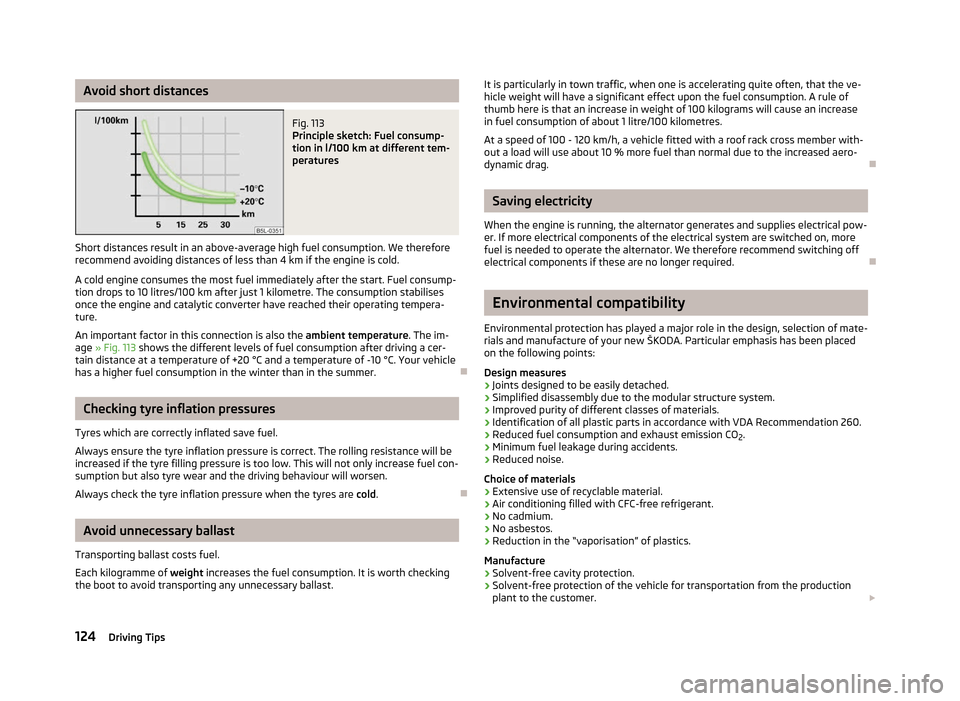
Fig. 113
Principle sketch: Fuel consump-
tion in l/100 km at different tem-
peratures
Short distances result in an above-average high fuel consumption. We therefore
recommend avoiding distances of less than 4
km if the engine is cold.
A cold engine consumes the most fuel immediately after the start. Fuel consump-
tion drops to 10 litres/100 km after just 1 kilometre. The consumption stabilises
once the engine and catalytic converter have reached their operating tempera-
ture.
An important factor in this connection is also the ambient temperature. The im-
age » Fig. 113 shows the different levels of fuel consumption after driving a cer-
tain distance at a temperature of +20 °C and a temperature of -10 °C. Your vehicle
has a higher fuel consumption in the winter than in the summer. ÐChecking tyre inflation pressures
Tyres which are correctly inflated save fuel.
Always ensure the tyre inflation pressure is correct. The rolling resistance will be
increased if the tyre filling pressure is too low. This will not only increase fuel con-
sumption but also tyre wear and the driving behaviour will worsen.
Always check the tyre inflation pressure when the tyres are cold. ÐAvoid unnecessary ballast
Transporting ballast costs fuel.
Each kilogramme of weight increases the fuel consumption. It is worth checking
the boot to avoid transporting any unnecessary ballast. It is particularly in town traffic, when one is accelerating quite often, that the ve-
hicle weight will have a significant effect upon the fuel consumption. A rule of
thumb here is that an increase in weight of 100 kilograms will cause an increase
in fuel consumption of about 1 litre/100 kilometres.
At a speed of 100 - 120 km/h, a vehicle fitted with a roof rack cross member with-
out a load will use about 10
% more fuel than normal due to the increased aero-
dynamic drag. Ð Saving electricity
When the engine is running, the alternator generates and supplies electrical pow-
er. If more electrical components of the electrical system are switched on, more
fuel is needed to operate the alternator. We therefore recommend switching off
electrical components if these are no longer required. Ð Environmental compatibility
Environmental protection has played a major role in the design, selection of mate-
rials and manufacture of your new
ŠKODA. Particular emphasis has been placed
on the following points:
Design measures
› Joints designed to be easily detached.
› Simplified disassembly due to the modular structure system.
› Improved purity of different classes of materials.
› Identification of all plastic parts in accordance with VDA Recommendation 260.
› Reduced fuel consumption and exhaust emission CO
2.
› Minimum fuel leakage during accidents.
› Reduced noise.
Choice of materials › Extensive use of recyclable material.
› Air conditioning filled with CFC-free refrigerant.
› No cadmium.
› No asbestos.
› Reduction in the “vaporisation” of plastics.
Manufacture › Solvent-free cavity protection.
› Solvent-free protection of the vehicle for transportation from the production
plant to the customer. £
124 Driving Tips