engine oil SKODA FABIA 2013 2.G / 5J User Guide
[x] Cancel search | Manufacturer: SKODA, Model Year: 2013, Model line: FABIA, Model: SKODA FABIA 2013 2.G / 5JPages: 223, PDF Size: 12.77 MB
Page 166 of 223
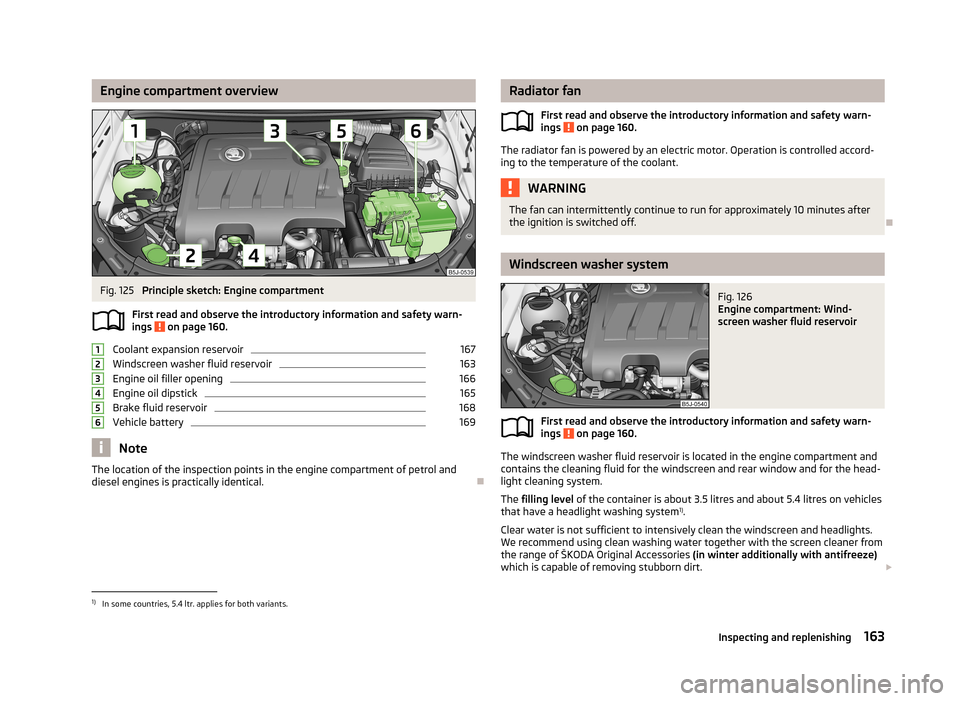
Engine compartment overviewFig. 125
Principle sketch: Engine compartment
First read and observe the introductory information and safety warn- ings
on page 160.
Coolant expansion reservoir
167
Windscreen washer fluid reservoir
163
Engine oil filler opening
166
Engine oil dipstick
165
Brake fluid reservoir
168
Vehicle battery
169
Note
The location of the inspection points in the engine compartment of petrol and
diesel engines is practically identical.
123456Radiator fan
First read and observe the introductory information and safety warn-
ings
on page 160.
The radiator fan is powered by an electric motor. Operation is controlled accord-
ing to the temperature of the coolant.
WARNINGThe fan can intermittently continue to run for approximately 10 minutes after
the ignition is switched off.
Windscreen washer system
Fig. 126
Engine compartment: Wind-
screen washer fluid reservoir
First read and observe the introductory information and safety warn- ings on page 160.
The windscreen washer fluid reservoir is located in the engine compartment and
contains the cleaning fluid for the windscreen and rear window and for the head- light cleaning system.
The filling level of the container is about 3.5 litres and about 5.4 litres on vehicles
that have a headlight washing system 1)
.
Clear water is not sufficient to intensively clean the windscreen and headlights. We recommend using clean washing water together with the screen cleaner from
the range of ŠKODA Original Accessories (in winter additionally with antifreeze)
which is capable of removing stubborn dirt.
1)
In some countries, 5.4 ltr. applies for both variants.
163Inspecting and replenishing
Page 167 of 223
The washing water should always be mixed with antifreeze in winter even if thevehicle has heated windscreen washer nozzles.
Under exceptional circumstances, methylated spirits can also be used if no screen
cleaner with antifreeze is available. The concentration of methylated spirits must
not be more than 15 %. The freeze protection at this concentration is sufficient only to -5 °C.
CAUTION
■ Under no circumstances must radiator antifreeze or other additives be added to
the windscreen washer fluid.■
If the vehicle is fitted with a headlight cleaning system, only cleaning products
which do not attack the polycarbonate coating of the headlights must be added
to the windscreen washer fluid.
■
Do not remove the filter from the windscreen washer fluid reservoir when re-
plenishing it with liquid otherwise the liquid transportation system can be conta-
minated, which can cause the windscreen washer system to malfunction.
Engine oil
Introduction
This chapter contains information on the following subjects:
Specifications and capacity
164
Checking the oil level
165
Replenishing
166
Changing
166
The engine has been factory-filled with a high-grade oil that can be use through-
out the year - except in extreme climate zones.
Engine oils are the subject of continuous further development. Thus the informa- tion stated in this Owner's Manual is only correct at the time of publication.
ŠKODA Service Partners are informed about the latest changes by the manufac-
turer. We therefore recommend that you have the oil changed by a ŠKODA Serv-
ice Partner.
The specifications (VW standards) stated in the following can be indicated sepa-
rately or together with other specifications on the bottle.
The oil capacities include oil filter change. Check the oil level when filling; do not
over fill. The oil level must be between the markings » page 165.WARNING■
The engine compartment of your car is a hazardous area. While working in
the engine compartment, be sure to observe the following warn-
ings » page 160 .■
Do not continue your journey if for some reason it is not possible to top
up the engine oil under the current conditions. Switch off the engine and seek
assistance from a specialist garage.
■
Do not drive on if the oil level is above range
A
» Fig. 127 on page 165.
Switch off the engine and seek assistance from a specialist garage.
CAUTION
Do not pour any additives into the engine oil – there is a risk of serious engine
damage.
Note
■ Before a long drive we recommend that you purchase and carry with you engine
oil which complies with the specification for your vehicle.■
We recommend that you use oils from ŠKODA Original Accessories.
■
You must wash yourself thoroughly if your skin has come into contact with oil.
Specifications and capacity
First read and observe the introductory information and safety warn-
ings
on page 164.
Specifications and capacity (in l) for vehicles with flexible service intervals
Petrol enginesSpecificationCapacity1.2 litres/44 kWVW 503 00, VW 504 002.81.2 litres/51 kWVW 503 00, VW 504 002.81.4 litres/63 kWVW 503 00, VW 504 003.21.4 litres/132 kW TSIVW 504 003.61.2 litres/63 kW TSIVW 504 003.91.2 litres/77 kW TSIVW 504 003.9 164General Maintenance
Page 168 of 223
Diesel enginesa)SpecificationCapacity1.2 litres/55 kW TDI CR DPFVW 507 004.31.6 litres/55 kW TDI CR DPFVW 507 004.31.6 litres/66 kW TDI CR DPFVW 507 004.31.6 litres/77 kW TDI CR DPFVW 507 004.3a)
Engine oil VW 505 01 can optionally be used in diesel engines
without a DPF.
Specifications and capacity (in l) for vehicles with fixed service intervals
Petrol enginesSpecificationCapacity1.2 litres/44 kWVW 501 01, VW 502 002.81.2 litres/51 kWVW 501 01, VW 502 002.81.4 litres/63 kWVW 501 01, VW 502 003.21.6 litres/77 kWVW 501 01, VW 502 003.61.4 litres/132 kW TSIVW 502 003.61.2 litres/63 kW TSIVW 502 003.91.2 litres/77 kW TSIVW 502 003.9
If the oils specified above are not available, oils according to ACEA A2 or ACEA A3
can be used once for refilling.
Diesel engines a)SpecificationCapacity1.2 litres/55 kW TDI CR DPFVW 507 004.31.6 litres/55 kW TDI CR DPFVW 507 004.31.6 litres/66 kW TDI CR DPFVW 507 004.31.6 litres/77 kW TDI CR DPFVW 507 004.3a)
Engine oil VW 505 01 can optionally be used in diesel engines
without DPF
If the oils specified above are not available, oils according to ACEA B3 or ACEA B4
can be used once for refilling.
CAUTION
Only the above-mentioned oils can be used on vehicles with flexible service inter- vals. We recommend always refilling with oil of the same specification since this
will maintain the properties of the oil. In exceptional cases, a maximum of 0.5 l ofspecification VW 502 00 (only for petrol engines) or specification VW 505 01 (only
for diesel engines) engine oil can be used to refill once. Other engine oils must not be used - there is risk of engine damage.
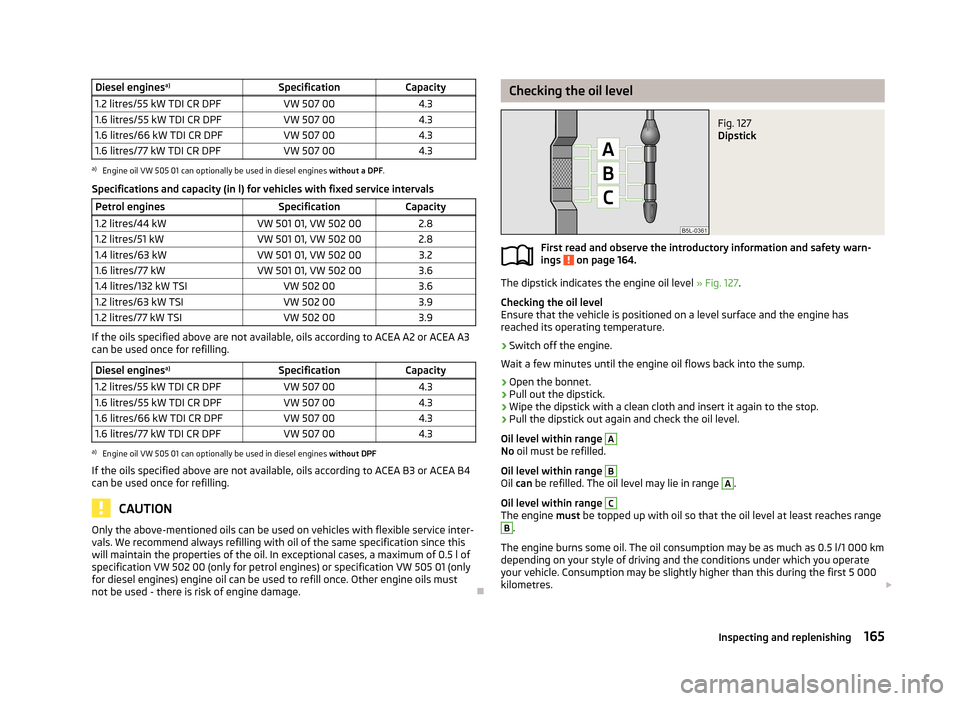
Checking the oil levelFig. 127
Dipstick
First read and observe the introductory information and safety warn-
ings on page 164.
The dipstick indicates the engine oil level » Fig. 127.
Checking the oil level
Ensure that the vehicle is positioned on a level surface and the engine has reached its operating temperature.
›
Switch off the engine.
Wait a few minutes until the engine oil flows back into the sump.
›
Open the bonnet.
›
Pull out the dipstick.
›
Wipe the dipstick with a clean cloth and insert it again to the stop.
›
Pull the dipstick out again and check the oil level.
Oil level within range
A
No oil must be refilled.
Oil level within range
B
Oil can be refilled. The oil level may lie in range
A
.
Oil level within range
C
The engine must be topped up with oil so that the oil level at least reaches range
B
.
The engine burns some oil. The oil consumption may be as much as 0.5 l/1 000 km depending on your style of driving and the conditions under which you operate
your vehicle. Consumption may be slightly higher than this during the first 5 000
kilometres.
165Inspecting and replenishing
Page 169 of 223
The oil level must be checked at regular intervals. We recommend it be checked
after each time you refuel or prior to making a long journey.
We recommend maintaining the oil level within the range A
, but not above , if
the engine has been operating at high loads, for example, during a lengthy motor-
way trip during the summer months, towing a trailer or negotiating a high moun- tain pass.
The warning light in the instrument cluster will indicate whether the oil level is too low » page 21 , Engine oil . Check the oil level using the dipstick as soon
as possible. Add oil accordingly.
CAUTION
■ Always check the oil level on vehicles with the 1.2 l/44 kW engine when the en-
gine is cold. Otherwise the measuring result is incorrect und oil could be incor-
rectly replenished - risk of engine damage!■
The oil level must never be above the
A
range » Fig. 127 – there is a risk of
damaging the exhaust system.
Note
Engine oil specifications » page 164.
Replenishing
First read and observe the introductory information and safety warn-
ings
on page 164.
›
Check the oil level » page 165.
›
Unscrew the cap of the engine oil filler opening.
›
Replenish the oil in portions of 0.5 litres in accordance with the correct specifi-
cations » page 164 .
›
Check the oil level » page 165.
›
Carefully screw on the oil filler opening cap and push the dipstick in fully.
Changing
First read and observe the introductory information and safety warn-ings
on page 164.
The engine oil must be changed at specified service intervals » page 145 or ac-
cording to the service interval display » page 16, Service Interval Display .
Coolant
Introduction
This chapter contains information on the following subjects:
Capacity
167
Checking the coolant level
167
Replenishing
168
The coolant consists of water with a concentration of coolant additive. This mix-
ture guarantees antifreeze protection, protects the cooling/heater system
against corrosion and prevents the formation of scale.
Vehicles exported to countries with a mild climate are already factory-filled with
a coolant which offers antifreeze protection down to about -25 ℃. In these coun-
tries the concentration of coolant additive should be at least 40 %.
Vehicles exported to countries with a cold climate are already factory-filled with a
coolant which offers antifreeze protection down to about -35 °C. In these coun-
tries the concentration of coolant additive should be at least 50 %.
If a higher concentration of antifreeze is required for climatic reasons, the amount
of coolant additive can only be increased up to a maximum of 60 % (antifreeze
protection down to approx. -40 °C).
When refilling, only use the same antifreeze identified on the coolant expansion vessel » Fig. 128 on page 167.
166General Maintenance
Page 185 of 223
WARNINGObserve the following instructions for raising the vehicle.■If the wheel has to be changed on a slope, first of all block the opposite
wheel with a stone or similar object to prevent the vehicle from unexpectedly
rolling away.■
Secure the base plate of the lifting jack with suitable means to prevent pos-
sible moving. A soft and slippery ground under the base plate may move the
lifting jack, causing the vehicle to fall down. It is therefore always necessary to
place the lifting jack on a solid surface or use a wide and stable base. Use a
non-slip base (e.g. a rubber foot mat) if the surface is smooth, such as cobbled
stones, tiled floor, etc.
■
Only attach the lifting jack to the attachment points provided for this pur-
pose.
■
Always raise the vehicle with the doors closed.
■
Never position any body parts, such as arms or legs under the vehicle, while
the vehicle is raised with a lifting jack.
■
Never start the engine with the vehicle sitting on the raised jack – there is a
risk of injury.
CAUTION
■ The tightening torque specified for the wheel bolts for steel and light alloy
wheels is 120 Nm.■
If the wheel bolts are fastened too tightly, this can cause damage to the anti-
theft wheel bolt or the adapter.
Note
■ The anti-theft wheel bolt set and adapter can be purchased from a ŠKODA Part-
ner.■
The national legal requirements must be observed when changing a wheel.
Preparation
First read and observe the introductory information and safety warn-
ings
on page 181.
Always change a wheel on a level surface as far as possible.
The following steps must be carried out before actually changing the wheel:
› Have
all the occupants get out. The passengers should not stand on the road
(instead they should remain behind a crash barrier, for instance) while the wheel is being changed.›
Switch off the engine.
›
Move the gearshift lever into Neutral or move the selector lever for the auto-
matic gearbox into position P.
›
Apply the handbrake firmly.
›
Uncouple any trailer.
›
Remove the vehicle tool kit » page 181 and the spare wheel » page 177 , Spare
wheel from the boot.
Changing a wheel
First read and observe the introductory information and safety warn-
ings
on page 181.
›
Remove the full wheel trim » page 178 or caps » page 178 .
›
In the case of light alloy wheel rims remove the wheel trim cap » page 178.
›
First of all slacken the anti-theft wheel bolt and then the other wheel
bolts » page 183 .
›
Jack up the vehicle until the wheel that needs changing is clear of the
ground » page 184 .
›
Unscrew the wheel bolts and place them on a clean surface (cloth, paper, etc.).
›
Remove the wheel carefully.
›
Attach the spare wheel and slightly screw on the wheel bolts.
›
Lower the vehicle.
›
Tighten the opposite wheel bolts alternately (cross-wise) with the wheel
wrench. Tighten the anti-theft wheel bolt last » page 183.
›
Reinstall the wheel trim/wheel trim cap or the caps.
Note
■
All bolts must be clean and must turn easily.■Under no circumstances grease or oil the wheel bolts!■
When fitting unidirectional tyres, ensure that the direction of rotation is cor-
rect » page 176 , Unidirectional tyres .
182Do-it-yourself
Page 192 of 223
Jump-starting in vehicles with the START-STOP systemFig. 147
Engine compartment: Earth
First read and observe the introductory information and safety warn-ings on page 187.
The jump-start cable must only be connected to the engine earthing point on ve-
hicles with the START-STOP system » Fig. 147.
Towing the vehicle
Introduction
This chapter contains information on the following subjects:
Front towing eye
190
Rear towing eye
190
Vehicles with a tow hitch
190
Vehicles with manual transmission may be towed in with a tow bar or a tow rope
or with the front or rear wheels raised.
Vehicles with automatic transmission may be towed in with a tow bar or a tow
rope or with the front wheels raised. If the vehicle is raised at rear, the automatic
gearbox is damaged!
A tow bar is the safest way of towing a vehicle and also minimises any shocks.
Only use a tow rope if a suitable tow bar is not available.
The following guidelines must be observed when towing.
Driver of the tow vehicle›Release the clutch particularly gently when starting off or depress the accelera-
tor particularly gently if the vehicle is fitted with an automatic gearbox.›
On vehicles with a manual transmission, only push down on the accelerator pedal once the rope is taught.
The maximum towing speed is 50 km/h.
Driver of the towed vehicle
›
Switch on the ignition so that the steering wheel is not locked and so that the turn signal lights, horn, windscreen wipers and windscreen washer system can
be used.
›
Take the vehicle out of gear or move the selector lever into position N if the ve-
hicle is fitted with an automatic gearbox.
Please note that the brake servo unit and power steering only operate if the en-
gine is running. If the engine is not running, significantly more physical force is re-
quired to depress the brake pedal and steer the vehicle.
If using a tow rope, ensure that it is always kept taught.
CAUTION
■ Do not tow start the engine – there is a risk of damaging the engine and the
catalytic converter. The battery from another vehicle can be used as a jump-start
aid » page 187 , Jump-starting .■
If the gearbox no longer contains any oil because of a defect, your vehicle must
only be towed with the driven wheels raised clear of the ground or on a special
breakdown vehicle or trailer.
■
The vehicle must be transported on a special breakdown vehicle or trailer if it is
not possible to tow in the vehicle in the way described or if the towing distance is
greater than 50 km.
■
To protect both vehicles when tow-starting or towing, the tow rope should be
elastic. Thus one should only use plastic fibre rope or a rope made out of a simi-
larly elastic material.
■
While towing, take care to avoid impermissibly high tensile forces or jerky loads.
There is always a risk of excessive stresses and damage resulting at the points to
which you attach the tow rope or tow bar when you attempt to tow a vehicle
which is not standing on a paved road.
■
Attach the tow rope or the tow bar to the towing eyes » page 190 , Front tow-
ing eye or » page 190 , Rear towing eye to the detachable ball head of the tow-
ing equipment » page 118 .
189Emergency equipment, and self-help
Page 214 of 223
Car computersee Multifunction display13
Caring for paintwork152
Car park ticket holder71
Carrier67
Central locking button33
Central locking system31
lock33
unlock33
Changing Brake fluid
169
Bulbs195
Bulbs in the rear light199
Engine oil166
Foglight bulb (Scout, RS)198
Foglights and daytime running lights bulbs198
Front parking light bulb197
Front turn signal bulb197
Fuses192
Fuses in the dash panel193
Fuses in the engine compartment194
High beam bulb - halogen projector headlights197
Licence plate light bulb199
Low beam and high beam bulb - halogen head-
lights
196
Low beam and high beam bulb - halogen projec-
tor headlights
197
Wheels181
Changing a wheel Preparation
182
Removing and fitting a wheel182
Subsequent steps183
Charging a vehicle battery171
Check Fit ball head properly
120
Checking Battery electrolyte level
171
Brake fluid168
Coolant level167
Engine oil165
Oil level165
Windscreen washer fluid163
Children and safety140
Child safety Side airbag
142
Child safety lock29
Child safety seat Use of child safety seats
142
Child seat Classification
142
ISOFIX143
on the front passenger seat141
TOP TETHER144
Use of ISOFIX child seats143
Chrome parts refer to Taking care of your vehicle
153
Cigarette lighter70
Cleaning145
Alcantara156
Covers on electrically heated seats157
Fabrics156
Headlight lenses154
Natural leather155
Plastic parts152
Synthetic leather156
Wheels154
Climatronic83
Automatic mode84
Control elements83
Controlling the blower85
Defrosting windscreen85
Recirculated air mode84
Setting the temperature84
Clock12
Clothes hook71
Cockpit 12-volt power outlet
70
Ashtray69
Cigarette lighter70
General view9
Lighting48
Storage compartments72
Compartments72
Computer see Multifunction display
13
Convenience turn signal45
Coolant166
Checking167
Display messages22
Replenishing168
Warning light22
Coolant temperature gauge display
11
Correct seated position125
Driver126
Front passenger126
Notes126
Rear seats126
Counter for distance driven12
Cruise control system114
Cupholders69
D
DAY LIGHT see Daylight running lights
44
Daylight running lights44
De-icing rear window50
Deactivating airbags138
Decorative films153
Delayed locking of the boot lid see Boot lid
37
Diesel refer to Fuel
160
Diesel fuel Operation in winter
160
Diesel particulate filter25
display messages25
Digital clock12
Dipstick165
211Index
Page 215 of 223
DisplayService interval16
Distance driven12
Door Child safety lock
29
Closing30
Door open warning light21
Opening30
Doors Emergency locking
31
Driving Abroad
109
Driving through water on streets109
Emissions201
Fuel consumption201
Maximum speed204
Driving economically Economical gear changing
105
Driving through water109
E
Economical and environmentally friendly driving 104
Economical driving Anticipation in driving
105
Ballast107
Driving at full throttle106
Idling106
Regular maintenance107
Saving energy107
Short distances106
Tyre pressure106
EDS112
Electrical power windows Button in the driver's door
38, 39
Button in the rear door39
Central locking system40
Electric power windows Operational faults
40
Electric sliding/tilting roof40
Electronic Differential Lock112
Electronic immobilizer97
Emergency Changing a wheel
181
Hazard warning light system47
Jump-starting187, 188
locking of the doors31
Selector lever-unlocking103
Sliding/tilting roof42
Towing the vehicle189
Towing the vehicle using the tow hitch190
Tyre repair185
Unlocking the boot lid38
Emergency equipment Fire extinguisher
180
First aid kit180
Jack181
Vehicle tool kit181
Warning triangle180
Emissions201
Engine Running in
104
Starting and stopping the engine96
Starting the engine97
Switching off the engine98
Engine compartment160
Brake fluid168
Coolant167
Overview163
Vehicle battery169
Engine oil164
Capacity164
Changing166
Checking165
Replenishing166
Specifications164
Warning light21
Engine revolutions counter11
Environment104
Environmental compatibility107
Environmentally friendly driving104
ESC Function111
warning light23
F
Films
153
Fire extinguisher180
First aid kit180
Flashers45
Fog lights46
Footmats100
see Footmats100
Front airbag135
Front seats54
Fuel158
Diesel160
Fuel gauge11
gauge11
refer to Fuel158
Refuelling158
Unleaded petrol159
Fuel consumption104
Fuses Assignment
192
Changing192
Colour coding192
G
Gear Recommended gear
13
Gearbox Display messages
19
Gear changing Gear stick
100
General view Cockpit
9
Glow plug system Warning light
24
GSM86
212Index
Page 217 of 223
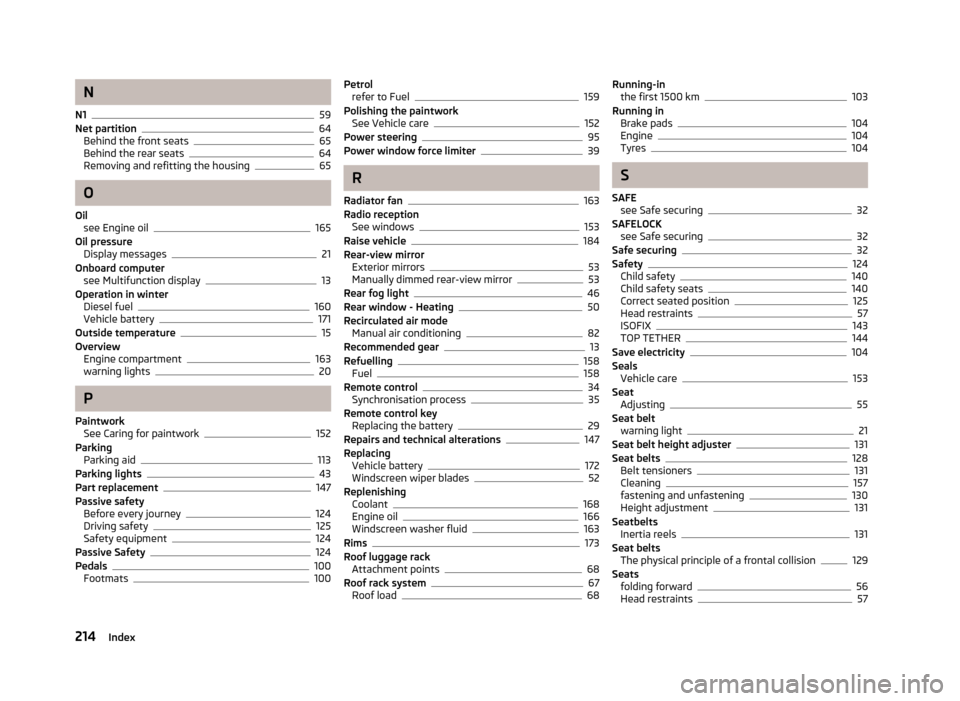
N
N1
59
Net partition64
Behind the front seats65
Behind the rear seats64
Removing and refitting the housing65
O
Oil see Engine oil
165
Oil pressure Display messages
21
Onboard computer see Multifunction display
13
Operation in winter Diesel fuel
160
Vehicle battery171
Outside temperature15
Overview Engine compartment
163
warning lights20
P
Paintwork See Caring for paintwork
152
Parking Parking aid
113
Parking lights43
Part replacement147
Passive safety Before every journey
124
Driving safety125
Safety equipment124
Passive Safety124
Pedals100
Footmats100
Petrol refer to Fuel159
Polishing the paintwork See Vehicle care
152
Power steering95
Power window force limiter39
R
Radiator fan
163
Radio reception See windows
153
Raise vehicle184
Rear-view mirror Exterior mirrors
53
Manually dimmed rear-view mirror53
Rear fog light46
Rear window - Heating50
Recirculated air mode Manual air conditioning
82
Recommended gear13
Refuelling158
Fuel158
Remote control34
Synchronisation process35
Remote control key Replacing the battery
29
Repairs and technical alterations147
Replacing Vehicle battery
172
Windscreen wiper blades52
Replenishing Coolant
168
Engine oil166
Windscreen washer fluid163
Rims173
Roof luggage rack Attachment points
68
Roof rack system67
Roof load68
Running-in the first 1500 km103
Running in Brake pads
104
Engine104
Tyres104
S
SAFE see Safe securing
32
SAFELOCK see Safe securing
32
Safe securing32
Safety124
Child safety140
Child safety seats140
Correct seated position125
Head restraints57
ISOFIX143
TOP TETHER144
Save electricity104
Seals Vehicle care
153
Seat Adjusting
55
Seat belt warning light
21
Seat belt height adjuster131
Seat belts128
Belt tensioners131
Cleaning157
fastening and unfastening130
Height adjustment131
Seatbelts Inertia reels
131
Seat belts The physical principle of a frontal collision
129
Seats folding forward
56
Head restraints57
214Index
Page 218 of 223
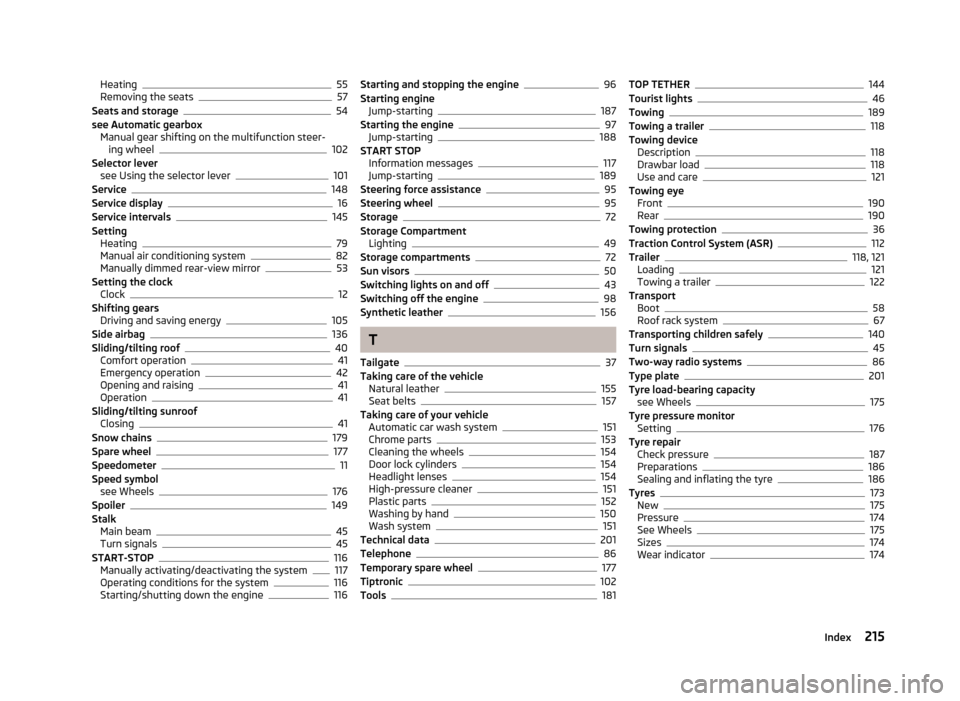
Heating55
Removing the seats57
Seats and storage54
see Automatic gearbox Manual gear shifting on the multifunction steer- ing wheel
102
Selector lever see Using the selector lever
101
Service148
Service display16
Service intervals145
Setting Heating
79
Manual air conditioning system82
Manually dimmed rear-view mirror53
Setting the clock Clock
12
Shifting gears Driving and saving energy
105
Side airbag136
Sliding/tilting roof40
Comfort operation41
Emergency operation42
Opening and raising41
Operation41
Sliding/tilting sunroof Closing
41
Snow chains179
Spare wheel177
Speedometer11
Speed symbol see Wheels
176
Spoiler149
Stalk Main beam
45
Turn signals45
START-STOP116
Manually activating/deactivating the system117
Operating conditions for the system116
Starting/shutting down the engine116
Starting and stopping the engine96
Starting engine Jump-starting
187
Starting the engine97
Jump-starting188
START STOP Information messages
117
Jump-starting189
Steering force assistance95
Steering wheel95
Storage72
Storage Compartment Lighting
49
Storage compartments72
Sun visors50
Switching lights on and off43
Switching off the engine98
Synthetic leather156
T
Tailgate
37
Taking care of the vehicle Natural leather
155
Seat belts157
Taking care of your vehicle Automatic car wash system
151
Chrome parts153
Cleaning the wheels154
Door lock cylinders154
Headlight lenses154
High-pressure cleaner151
Plastic parts152
Washing by hand150
Wash system151
Technical data201
Telephone86
Temporary spare wheel177
Tiptronic102
Tools181
TOP TETHER144
Tourist lights46
Towing189
Towing a trailer118
Towing device Description
118
Drawbar load118
Use and care121
Towing eye Front
190
Rear190
Towing protection36
Traction Control System (ASR)112
Trailer118, 121
Loading121
Towing a trailer122
Transport Boot
58
Roof rack system67
Transporting children safely140
Turn signals45
Two-way radio systems86
Type plate201
Tyre load-bearing capacity see Wheels
175
Tyre pressure monitor Setting
176
Tyre repair Check pressure
187
Preparations186
Sealing and inflating the tyre186
Tyres173
New175
Pressure174
See Wheels175
Sizes174
Wear indicator174
215Index