body SKODA FABIA 2013 2.G / 5J Owner's Manual
[x] Cancel search | Manufacturer: SKODA, Model Year: 2013, Model line: FABIA, Model: SKODA FABIA 2013 2.G / 5JPages: 223, PDF Size: 12.77 MB
Page 5 of 223
Terms used
The on-board literature contains the following terms relating to the service work for your vehicle.
› “Specialist garage” - a workshop that carries out specialist service tasks for
ŠKODA vehicles A specialist garage can be a ŠKODA partner, a ŠKODA service
partner or an independent workshop.
› “ŠKODA service partner” - A workshop that has been contractually authorized
by the manufacturer ŠKODA AUTO a.s. or its sales partner to perform service
tasks on ŠKODA vehicles and to sell ŠKODA Genuine Parts.
› “ŠKODA partner” - A company that has been authorized by the manufacturer
ŠKODA AUTO a.s. or its sales partner to sell new ŠKODA vehicles and, when ap-
plicable, to service them using ŠKODA Genuine Parts and sell ŠKODA Genuine
Parts.
Owner's Manual
These operating instructions apply to all body variants of the vehicle and all rela-
ted models.
The manual describes all possible equipment variants without identifying them
as special equipment, model variants or market-dependent equipment.
Consequently, this vehicle does not necessarily contain all of the equipment
components described in this Owner's Manual.
The scope of equipment of your vehicle relates to your purchase contract for the vehicle. More information is available from the ŠKODA Partner from whom you
bought the vehicle.
The illustrations can differ in minor details from your vehicle; they are only inten-
ded for general information.
Page 8 of 223
Materials defect liability and ŠKODAwarranty for new cars
Materials defect liability
Your ŠKODA partner, as a vendor, is liable to you for defects in your new ŠKODA
car, ŠKODA Genuine Parts or ŠKODA Genuine Accessories in accordance with stat-
utory regulations and the purchase agreement.
ŠKODA warranty for new cars
As well as the materials defect liability, ŠKODA AUTO a.s. grants you the ŠKODA warranty for new cars (hereafter referred to as “ŠKODA warranty),” according to
the terms described below.
As part of the ŠKODA warranty, ŠKODA AUTO a.s. will guarantee the following
services:
› Repair of damage to your vehicle that occurs within two years from the start of
the ŠKODA warranty;
› Repair of paint damage to your vehicle that occurs within three years from the
start of the ŠKODA warranty;
› Repair of rust perforation to the bodywork of your vehicle that occurs within
twelve years from the start of the warranty. Only rust perforation from the in- side to the outside of body panels is considered to be rust perforation of the
bodywork and is covered by the ŠKODA warranty.
The start of the warranty is the date on which the original purchaser acquires the vehicle upon purchasing it from the ŠKODA partner or the date of first registra-
tion. Whichever occurs first and is accordingly recorded by the ŠKODA partner in
the service schedule is the applicable date.
Defects may be remedied by replacement or repair of the defective part. Replacedparts become the property of the ŠKODA service partner.
There are no other entitlements arising from the ŠKODA warranty. In particular,
there are no entitlements to replacement, cancellation, provision of a courtesy
vehicle for the duration of repairs or compensation for loss.
If your ŠKODA vehicle was purchased from a ŠKODA partner in a country withinthe European Economic Area (i.e. the countries of the European Union, Norway,
Iceland and Liechtenstein) or in Switzerland, claims arising from the ŠKODA war-
ranty must also be made through a ŠKODA service partner in one of these coun-
tries.If your ŠKODA vehicle has been purchased from a ŠKODA partner outside the Eu-
ropean Economic Area and Switzerland, claims arising from the ŠKODA warranty
must also be made through a ŠKODA service partner outside the European Eco-
nomic Area and Switzerland.
One of the conditions for the assertion of the ŠKODA warranty is that all service operations have been carried out works in a timely and adequate manner and in
accordance with the manufacturer's provisions. You must prove that service oper-
ations have been carried out properly and in accordance with the manufacturer's
provisions when asserting a claim under the ŠKODA warranty. Where a service
has been missed or not carried out according to the manufacturer's provisions,
you may still be entitled to warranty claims as long as you can prove that the
missed service or the failure to carry out a service according to the manufactur-
er's provisions was not the cause of the defect.
Natural wear and tear of your vehicle is not covered by the ŠKODA warranty. The
ŠKODA warranty also does not cover defects to bodywork, installations and con-
versions provided by third-parties, nor vehicle defects caused by these. The same
is true for accessories which are not factory installed and/or supplied.
In addition, this warranty does not apply if the defect was caused by one of thefollowing:
› unauthorized use, improper handling (e.g. use in motorsport competitions or
overloading), improper care and maintenance, or unapproved modification to
your vehicle;
› non-compliance with provisions in the service schedule and the Owner's manual
or other factory-supplied instructions;
› external causes or influences (e.g. accidents, hail, flooding, etc.);
› parts fitted or installed on the vehicle the use of which is not approved by
ŠKODA AUTO a.s., or modification of the vehicle in a manner not approved by
ŠKODA AUTO a.s. (e.g. tuning);
› damage caused by you which was not immediately seen to by specialist garage
or was not fixed properly.
It is the customer's responsibility to prove that it was not the cause.
This ŠKODA warranty does not affect the purchaser's statutory rights arising from
liability for defects by the vehicle vendor and other potential claims under product liability laws.
5Materials defect liability and ŠKODA warranty for new cars
Page 41 of 223
The period after which the tailgate locks automatically can be extended by a spe-
cialist garage.
Delayed locking
If the tailgate was opened with the button on the remote control key, then it
is possible to open the lid within a limited period of it being closed.
There is a risk of unwanted entry into the vehicle before the boot lid is locked au-tomatically. Therefore always lock the vehicle with the button on the remote
control.
Delayed locking can be disabled by a specialist garage at any time.
Note
More detailed information is available from a ŠKODA Partner.
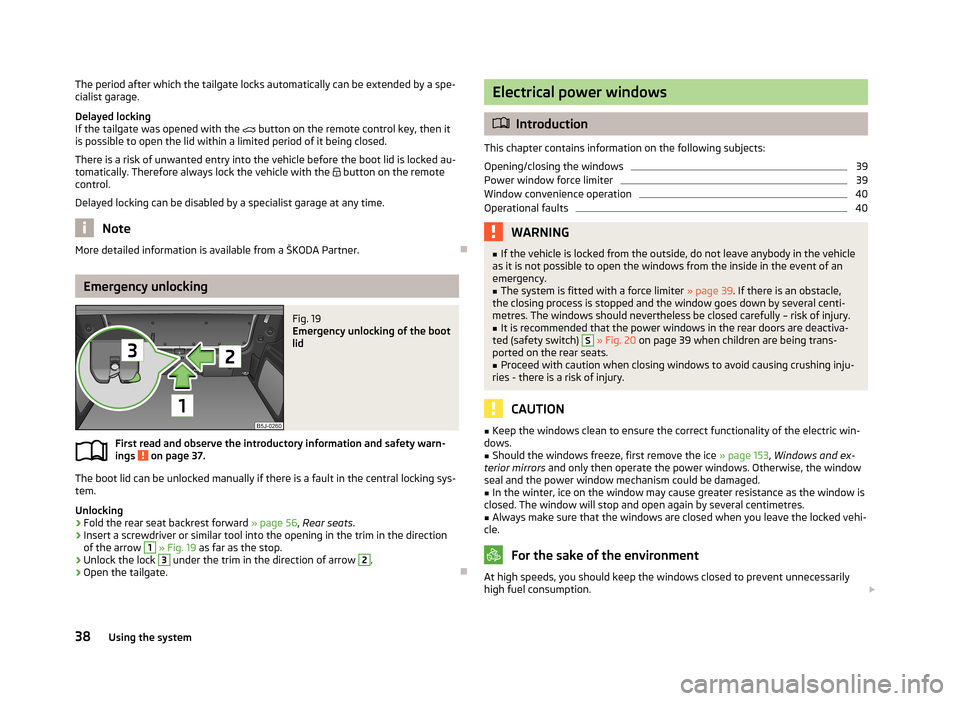
Emergency unlocking
Fig. 19
Emergency unlocking of the boot
lid
First read and observe the introductory information and safety warn-
ings on page 37.
The boot lid can be unlocked manually if there is a fault in the central locking sys-
tem.
Unlocking
›
Fold the rear seat backrest forward » page 56, Rear seats .
›
Insert a screwdriver or similar tool into the opening in the trim in the direction
of the arrow
1
» Fig. 19 as far as the stop.
›
Unlock the lock
3
under the trim in the direction of arrow
2
.
›
Open the tailgate.
Electrical power windows
Introduction
This chapter contains information on the following subjects:
Opening/closing the windows
39
Power window force limiter
39
Window convenience operation
40
Operational faults
40WARNING■ If the vehicle is locked from the outside, do not leave anybody in the vehicle
as it is not possible to open the windows from the inside in the event of an
emergency.■
The system is fitted with a force limiter » page 39. If there is an obstacle,
the closing process is stopped and the window goes down by several centi-
metres. The windows should nevertheless be closed carefully – risk of injury.
■
It is recommended that the power windows in the rear doors are deactiva-
ted (safety switch)
S
» Fig. 20 on page 39 when children are being trans-
ported on the rear seats.
■
Proceed with caution when closing windows to avoid causing crushing inju-
ries - there is a risk of injury.
CAUTION
■ Keep the windows clean to ensure the correct functionality of the electric win-
dows.■
Should the windows freeze, first remove the ice » page 153, Windows and ex-
terior mirrors and only then operate the power windows. Otherwise, the window
seal and the power window mechanism could be damaged.
■
In the winter, ice on the window may cause greater resistance as the window is
closed. The window will stop and open again by several centimetres.
■
Always make sure that the windows are closed when you leave the locked vehi-
cle.
For the sake of the environment
At high speeds, you should keep the windows closed to prevent unnecessarily
high fuel consumption. 38Using the system
Page 57 of 223
Seats and storage
Front seats
Introduction
This chapter contains information on the following subjects:
Adjusting the front seats - Version 1
55
Adjusting the front seats - Variant 2
55
Front seat heating
55
The driver's seat should be adjusted in such a way that the pedals can be fully
pressed to the floor with slightly bent legs.
The seat backrest on the driver's seat should be adjusted in such a way that the
upper point of the steering wheel can be easily reached with slightly bent arms.
Correct adjustment of the seats is particularly important:
› for reaching the controls safely and quickly;
› for a relaxed, fatigue-free body position;
› for achieving maximum protection from the seat belts and the airbag system.
WARNINGGeneral information■Caution when adjusting the seat! You may suffer injuries or bruises as a re-
sult of adjusting the seat without paying proper attention.■
The seat backrests must not be reclined too far when driving otherwise this
will affect proper operation of the seat belts and of the airbag system – risk of
injury.
■
Never carry more people than the number of seats in the vehicle.
■
Each occupant must correctly fasten the seat belt belonging to the seat.
Children must be fastened » page 140, Transporting children safely with a
suitable restraint system.
■
The front seats and head restraints must be adjusted to match the body
size at all times and the seat belt must always be fastened properly to provide the most effective levels of protection to the passengers.
■
Do not transport any objects on the front passenger seat other than objects
(e.g. child safety seat) intended for this purpose – there is the risk of an acci-
dent.
WARNINGInformation for the driver■Only adjust the driver's seat when the vehicle is stationary – there is the risk
of an accident.■
Keep a distance of at least 25 cm from the steering wheel. Not keeping to
this minimum distance will mean that the airbag system will not be able to
properly protect you – risk of death.
■
Ensure that there are no objects in the driver's footwell as they may get
caught behind the pedals while you are driving or under braking. You would
then no longer be able to operate the clutch, brake or accelerate.
WARNINGInformation for the front seat passenger■Maintain a distance of at least 25 cm from the dash panel. Not maintaining
this minimum distance will mean that the airbag system will not be able to
properly protect you - there is a risk that you could be killed.■
Always keep your feet in the footwell when the car is being driven - never
place your feet on the instrument panel, out of the window or on the seats.
You will be exposed to increased risk of injury if it becomes necessary to apply
the brakes or in the event of an accident. You may suffer fatal injuries when
an airbag is deployed if you have adopted an incorrect seating position.
Note
After a certain time, play can develop within the adjustment mechanism of the
backrest angle.
54Using the system
Page 59 of 223
WARNINGIf, as an occupant, you have a subdued pain and/or temperature sensitivity,
e.g. through medication, paralysis or because of chronic illness (e.g. diabetes),
we recommend not to use the seat heating. This can lead to burns on the
back, the posterior and the legs which are difficult to heal. If the seat heating
is used, we recommend to make regular breaks in your journey when driving
long distances, so that the body can recuperate from the stress of the jour- ney. Please consult your doctor, who can evaluate your specific condition.
CAUTION
■ Do not kneel on the seats or otherwise apply pressure at specific points to
avoid damaging the heating elements for the seat heaters.■
Do not turn on the seat heater if seats are not occupied.
■
Do not switch on the seat heating if the seats have objects attached to or
placed on them, for example a child seat, a bag, etc. A fault of the heating ele- ments in the seat heating can occur.
■
If additional seat covers or protective covers are attached to the seats, do not
turn on the seat heater - there is a risk of damaging the seat covers and seat
heating.
■
Do not clean the seats using moisture » page 157.
Note
■
The seat heating should only be switched on when the engine is running. This
has a significant effect of saving on the battery capacity.■
If the on-board voltage drops, the seat heating is switched off automatically, in
order to provide sufficient electrical energy for the engine control » page 172,
Automatic load deactivation .
Rear seats
Introduction
This chapter contains information on the following subjects:
Folding the seat backrest forwards
56
Folding the seat cushions forwards, removing
57
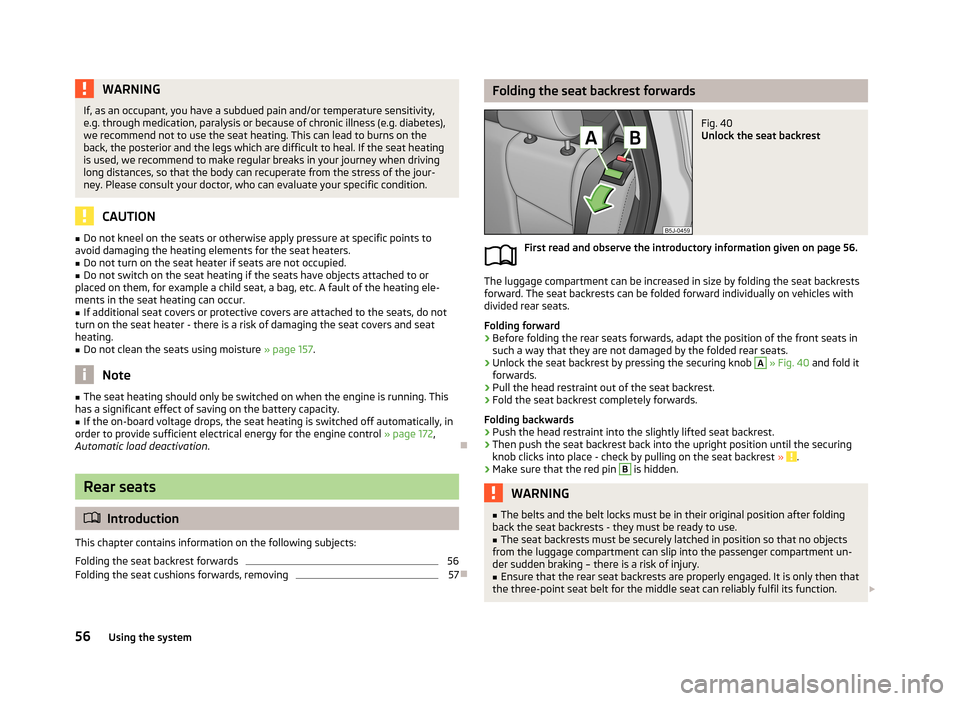
Folding the seat backrest forwardsFig. 40
Unlock the seat backrest
First read and observe the introductory information given on page 56.
The luggage compartment can be increased in size by folding the seat backrests
forward. The seat backrests can be folded forward individually on vehicles with
divided rear seats.
Folding forward
›
Before folding the rear seats forwards, adapt the position of the front seats in such a way that they are not damaged by the folded rear seats.
›
Unlock the seat backrest by pressing the securing knob
A
» Fig. 40 and fold it
forwards.
›
Pull the head restraint out of the seat backrest.
›
Fold the seat backrest completely forwards.
Folding backwards
›
Push the head restraint into the slightly lifted seat backrest.
›
Then push the seat backrest back into the upright position until the securing knob clicks into place - check by pulling on the seat backrest » .
›
Make sure that the red pin
B
is hidden.
WARNING■
The belts and the belt locks must be in their original position after folding
back the seat backrests - they must be ready to use.■
The seat backrests must be securely latched in position so that no objects
from the luggage compartment can slip into the passenger compartment un-
der sudden braking – there is a risk of injury.
■
Ensure that the rear seat backrests are properly engaged. It is only then that
the three-point seat belt for the middle seat can reliably fulfil its function.
56Using the system
Page 87 of 223
Air flow to the windows
Air flow to the upper body
Air flow in the footwell
Recirculating air operation on/off » page 84
Switch cooling system on/off
Note
Do not stick anything on or cover the interior temperature sensor 11 » Fig. 80 ; it
could have an unfavourable effect on the Climatronic system.
Automatic mode
First read and observe the introductory information given on page 83.
The automatic mode is used in order to maintain a constant temperature and to
demist the windows in the interior of the car.
Switching on
›
Set a temperature between +18 °C and +29 ℃.
›
Move the air outlet vents 3 » Fig. 77 on page 77 and 4 so that the air flow is di-
rected slightly upwards.
›
Press the
button » Fig. 80 on page 83;
will appear in the display.
Automatic mode can be switched off by pressing any of the air distribution but-
tons or by increasing/decreasing the blower speed. The temperature is neverthe-
less regulated.
Setting the temperature
First read and observe the introductory information given on page 83.
Setting temperature
›
Switch on the ignition.
›
Turn the control dial
1
» Fig. 80 on page 83 to the left or to the right to in-
crease or decrease the temperature.
Switching between Celsius and Fahrenheit
›
Press and hold the
and
buttons simultaneously.
The information appears in the display in the desired temperature unit (no.3
» Fig. 80 on page 83).
The interior temperature can be set between +18 °C and +29 ℃. The interior tem-
perature is regulated automatically within this range.
If you set the temperature below +18 ℃, “LO” appears in the display.
If you set a temperature higher than +29 ℃, “HI” appears in the display.
Climatronic operates at maximum cooling or heating capacity respectively at ei- ther end position. There will be no automatic temperature control.
CAUTION
Lengthy and uneven distribution of the air flow out of the vents (especially
around the feet) and large differences in temperature, for example, when getting
out of the vehicle, can cause susceptible individuals to catch a cold.
Recirculated air mode
First read and observe the introductory information given on page 83.
Recirculated air mode prevents polluted air from outside the vehicle getting intothe vehicle, for example when driving through a tunnel or when standing in a
traffic jam.
Switching on
›
Press the
button » Fig. 80 on page 83.
The display shows the
icon.
Switching off
›
Press the
button » Fig. 80 on page 83 again.
The
icon in the display goes out.
WARNINGNever leave recirculated air mode on over a longer period, as “stale air” can
cause fatigue in the driver and the passengers, reduce attention levels and al-
so cause the windows to mist up. The risk of having an accident increases.
Switch off recirculated air mode as soon as the windows start to mist up. 84Using the system
Page 112 of 223
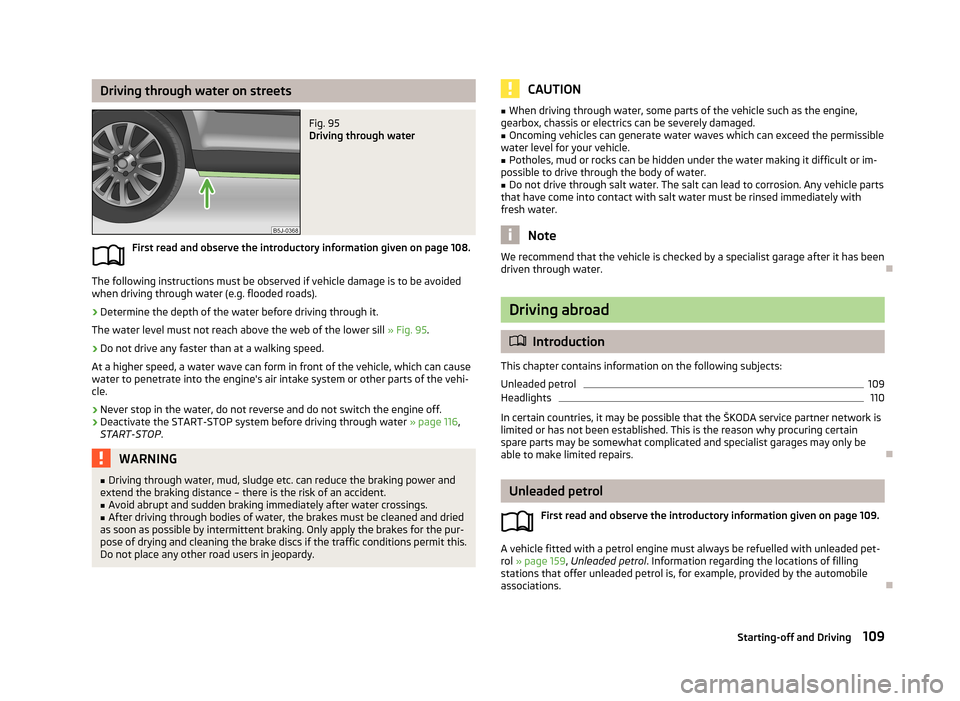
Driving through water on streetsFig. 95
Driving through water
First read and observe the introductory information given on page 108.
The following instructions must be observed if vehicle damage is to be avoided
when driving through water (e.g. flooded roads).
›
Determine the depth of the water before driving through it.
The water level must not reach above the web of the lower sill » Fig. 95.
›
Do not drive any faster than at a walking speed.
At a higher speed, a water wave can form in front of the vehicle, which can cause
water to penetrate into the engine's air intake system or other parts of the vehi- cle.
›
Never stop in the water, do not reverse and do not switch the engine off.
›
Deactivate the START-STOP system before driving through water » page 116,
START-STOP .
WARNING■
Driving through water, mud, sludge etc. can reduce the braking power and
extend the braking distance – there is the risk of an accident.■
Avoid abrupt and sudden braking immediately after water crossings.
■
After driving through bodies of water, the brakes must be cleaned and dried
as soon as possible by intermittent braking. Only apply the brakes for the pur-
pose of drying and cleaning the brake discs if the traffic conditions permit this.
Do not place any other road users in jeopardy.
CAUTION■ When driving through water, some parts of the vehicle such as the engine,
gearbox, chassis or electrics can be severely damaged.■
Oncoming vehicles can generate water waves which can exceed the permissible
water level for your vehicle.
■
Potholes, mud or rocks can be hidden under the water making it difficult or im-
possible to drive through the body of water.
■
Do not drive through salt water. The salt can lead to corrosion. Any vehicle parts
that have come into contact with salt water must be rinsed immediately with
fresh water.
Note
We recommend that the vehicle is checked by a specialist garage after it has been
driven through water.
Driving abroad
Introduction
This chapter contains information on the following subjects:
Unleaded petrol
109
Headlights
110
In certain countries, it may be possible that the ŠKODA service partner network is
limited or has not been established. This is the reason why procuring certain
spare parts may be somewhat complicated and specialist garages may only be
able to make limited repairs.
Unleaded petrol
First read and observe the introductory information given on page 109.
A vehicle fitted with a petrol engine must always be refuelled with unleaded pet-
rol » page 159 , Unleaded petrol . Information regarding the locations of filling
stations that offer unleaded petrol is, for example, provided by the automobile
associations.
109Starting-off and Driving
Page 127 of 223
Safety
Passive Safety
General information
Introduction
This chapter contains information on the following subjects:
Safety equipment
124
Before every journey
124
What influences driving safety?
125
In this section you will find important information, tips and notes on the subject
of passive safety in your vehicle.
We have combined everything here which you should be familiar with, for exam- ple, regarding seat belts, airbags, child seats and safety of children.
WARNING■ This chapter contains important information on how to use the vehicle for
the driver and his occupants.■
You will find further information on safety, which concerns you and those
travelling with you, in the following chapters of this Owner's Manual.
■
The complete on-board literature should always be in the vehicle. This ap-
plies in particular, if you rent out or sell the vehicle.
Safety equipment
First read and observe the introductory information and safety warn-ings
on page 124.
The following list contains only part of the safety equipment in your vehicle.
› Three-point seat belts for all the seats.
› Belt force limiters for the front seats.
› Belt tensioners for the front seats.
› Seat belt height adjusters for the front seats.
›
Front airbag for the driver and the front passenger.
› Side airbags.
› Head airbags.
› Anchoring points for child seats using the ISOFIX system.
› Anchoring points for child seats using the TOP TETHER system.
› Head restraints adjustable for height.
› Adjustable steering column.
The specified safety equipment works together, in order to optimally protect you
and those travelling with you in accident situations.
The safety equipment does not protect you or the people travelling with you, if
you or your occupants adopt an incorrect seated position or the equipment is not
correctly adjusted or used.
If the seat belt is not fastened properly, this may result in injuries during an acci-
dent caused by the deployed airbag.
Before every journey
First read and observe the introductory information and safety warn-ings
on page 124.
For your own safety and the safety of the people travelling with you, please pay
attention to the following points before setting off.
› Ensure that the lighting and the turn signal system are functioning properly.
› Check the tyre inflation pressure.
› Ensure that all of the windows offer good visibility to the outside.
› Secure all items of luggage
» page 58.
› Ensure that no objects can obstruct the pedals.
› Adjust the mirrors, the front seat and head restraint to your body size.
› Advise your passengers to adjust the head restraints to their body size.
› Protect children in suitable child seats with correctly fastened seat
belts » page 140 , Transporting children safely .
› Adopt the correct seated position
» page 125. Tell your passengers to assume
the correct seated position.
› Correctly fasten the seat belt. Also instruct your passengers to fasten their seat
belt correctly » page 128, Wearing seat belts .
124Safety
Page 128 of 223
What influences driving safety?First read and observe the introductory information and safety warn-
ings
on page 124.
The driver is fully responsible for himself and his occupants. If your driving safety is effected, you place yourself and the oncoming traffic at risk.
The following guidelines must therefore be observed. › Do not get distracted from concentrating on the traffic situation, e.g. by your
passengers or mobile phone calls.
› Never drive when your driving ability is impaired, e.g. through medication, alco-
hol or drugs.
› Keep to the traffic regulations and the permissible speed limit.
› Always adjust the driving speed to the road, traffic and weather conditions.
› Take regular breaks on long journeys – at least every two hours.
Correct seated position
Introduction
This chapter contains information on the following subjects:
Correct seated position of the driver
126
Correct seated position of the front passenger
126
Correct seated position of the rear seat passengers
126
Examples of incorrect seated positions
126WARNINGGeneral information■The front seats and head restraints must be adjusted to match the body
size at all times and the seat belt must always be fastened properly to provide the most effective levels of protection to the passengers.■
If the occupant adopts an incorrect seated position, he is exposed to life-
threatening injuries, in case he is hit by a deployed airbag.
■
If the occupants on the rear seats are not sitting upright, the risk of injury is
increased due to incorrect routing of the seat belt.
■
The seat backrests must not be reclined too far when driving otherwise this
will affect proper operation of the seat belts and of the airbag system – risk of
injury.
WARNINGInformation for the driver■Always assume the correct seated position before setting off and do not
change this position while driving. Also advise your passengers to adopt the
correct seated position and not to change this position while the car is mov-
ing.■
Keep a distance of at least 25 cm from the steering wheel. Not keeping to
this minimum distance will mean that the airbag system will not be able to
properly protect you – risk of death.
■
When driving, hold the steering wheel with both hands firmly on the outer
edge in the 9 o'clock and 3 o'clock position. Never hold the steering wheel in
the 12 o'clock position or in any other way (e.g. in the middle or inner edge of
the steering wheel). In such cases, you could severely injure your arms, hands
and head when the driver airbag is deployed.
■
Ensure that there are no objects in the driver's footwell as they may get
caught behind the pedals while you are driving or under braking. You would
then no longer be able to operate the clutch, brake or accelerate.
WARNINGInformation for the front seat passenger■Maintain a distance of at least 25 cm from the dash panel. Not maintaining
this minimum distance will mean that the airbag system will not be able to
properly protect you - there is a risk that you could be killed.■
Always keep your feet in the footwell when the car is being driven - never
place your feet on the instrument panel, out of the window or on the seats.
You will be exposed to increased risk of injury if it becomes necessary to apply
the brakes or in the event of an accident. You may suffer fatal injuries when
an airbag is deployed if you have adopted an incorrect seating position.
125Passive Safety
Page 130 of 223
Incorrect seated positions considerably reduce the protective functions of the
seat belts and therefore increase the risk of injury due to an incorrect routing of
the seat belt.
The driver is fully responsible for himself and passengers, especially children.
Never allow a passenger to adopt an incorrect seated position when the car is
moving.
The following list contains instructions which, if not observed, may lead to serious
injuries or death. This list is not complete, however we would like you to familiar-
ise yourself with this subject.
Observe the following instructions while driving. › Do not stand up.
› Do not stand on the seats.
› Do not kneel on the seats.
› Do not recline the seat backrest too far.
› Do not lean against the dash panel.
› Do not lie on the rear bench seat.
› Do not sit only on the front edge of the seat.
› Do not sit facing to the side.
› Do not lean out of the window.
› Do not put your feet out of the window.
› Do not put your feet on the dash panel.
› Do not put your feet on the seat upholstery.
› Do not transport somebody in the footwell.
› Do not drive without wearing a seat belt.
› Do not sit in the luggage compartment.
127Passive Safety