handbrake SKODA FABIA 2016 3.G / NJ Owner's Manual
[x] Cancel search | Manufacturer: SKODA, Model Year: 2016, Model line: FABIA, Model: SKODA FABIA 2016 3.G / NJPages: 196, PDF Size: 31.86 MB
Page 28 of 196
Operation
cockpit
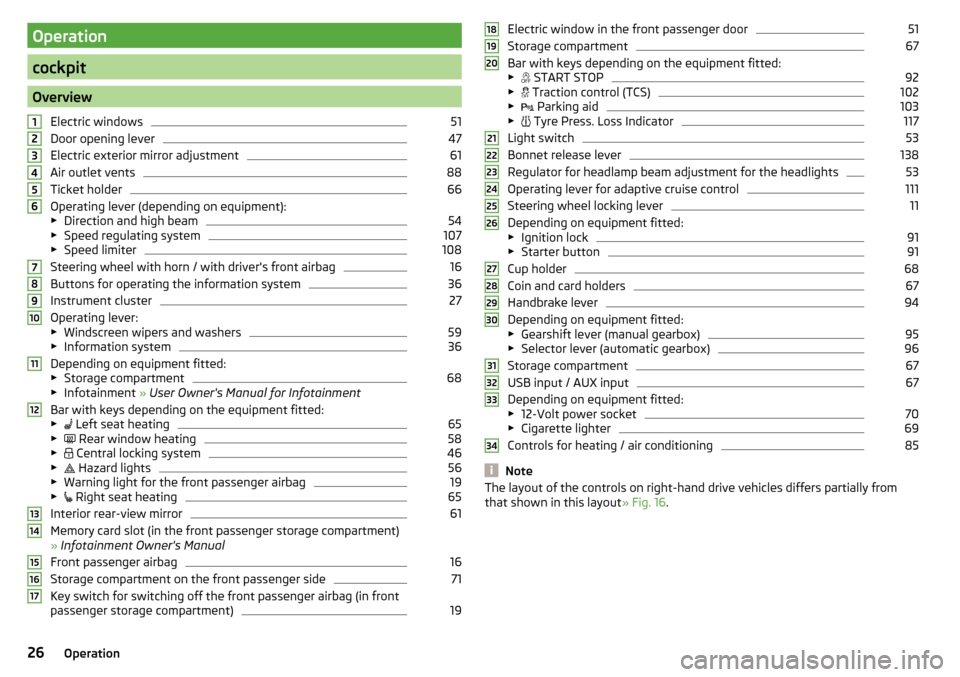
OverviewElectric windows
51
Door opening lever
47
Electric exterior mirror adjustment
61
Air outlet vents
88
Ticket holder
66
Operating lever (depending on equipment):
▶ Direction and high beam
54
▶Speed regulating system
107
▶Speed limiter
108
Steering wheel with horn / with driver's front airbag
16
Buttons for operating the information system
36
Instrument cluster
27
Operating lever:
▶ Windscreen wipers and washers
59
▶Information system
36
Depending on equipment fitted:
▶ Storage compartment
68
▶Infotainment » User Owner's Manual for Infotainment
Bar with keys depending on the equipment fitted:
▶ Left seat heating
65
▶
Rear window heating
58
▶
Central locking system
46
▶
Hazard lights
56
▶
Warning light for the front passenger airbag
19
▶
Right seat heating
65
Interior rear-view mirror
61
Memory card slot (in the front passenger storage compartment)
» Infotainment Owner's Manual
Front passenger airbag
16
Storage compartment on the front passenger side
71
Key switch for switching off the front passenger airbag (in front
passenger storage compartment)
191234567891011121314151617Electric window in the front passenger door51
Storage compartment
67
Bar with keys depending on the equipment fitted:
▶ START STOP
92
▶
Traction control (TCS)
102
▶
Parking aid
103
▶
Tyre Press. Loss Indicator
117
Light switch
53
Bonnet release lever
138
Regulator for headlamp beam adjustment for the headlights
53
Operating lever for adaptive cruise control
111
Steering wheel locking lever
11
Depending on equipment fitted:
▶ Ignition lock
91
▶Starter button
91
Cup holder
68
Coin and card holders
67
Handbrake lever
94
Depending on equipment fitted:
▶ Gearshift lever (manual gearbox)
95
▶Selector lever (automatic gearbox)
96
Storage compartment
67
USB input / AUX input
67
Depending on equipment fitted:
▶ 12-Volt power socket
70
▶Cigarette lighter
69
Controls for heating / air conditioning
85
Note
The layout of the controls on right-hand drive vehicles differs partially from
that shown in this layout » Fig. 16.181920212223242526272829303132333426Operation
Page 30 of 196
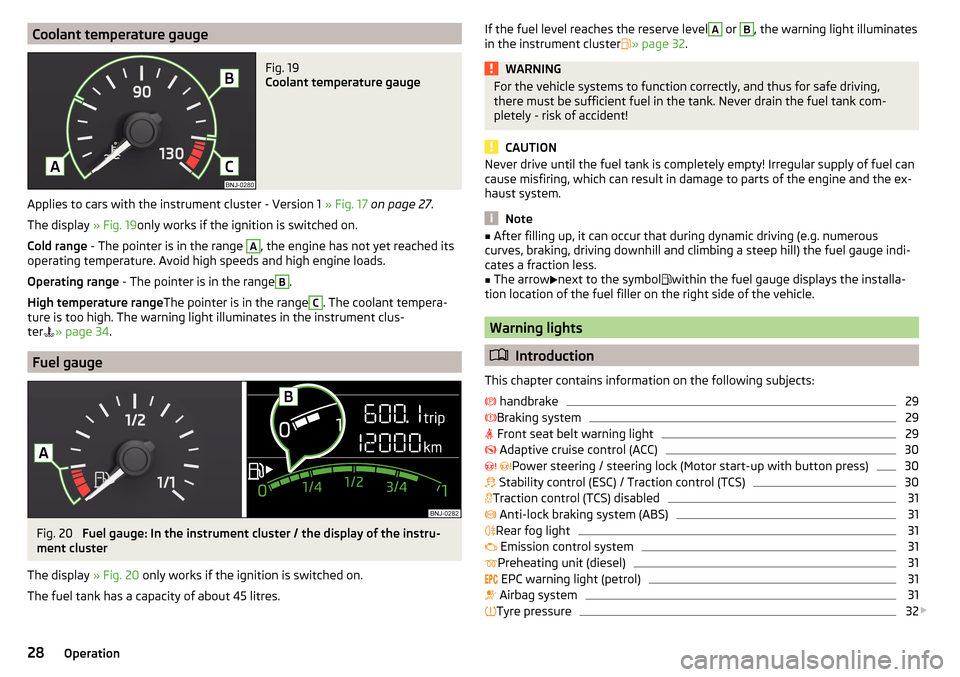
Coolant temperature gaugeFig. 19
Coolant temperature gauge
Applies to cars with the instrument cluster - Version 1 » Fig. 17 on page 27 .
The display » Fig. 19only works if the ignition is switched on.
Cold range - The pointer is in the range
A
, the engine has not yet reached its
operating temperature. Avoid high speeds and high engine loads.
Operating range - The pointer is in the range
B
.
High temperature range The pointer is in the range
C
. The coolant tempera-
ture is too high. The warning light illuminates in the instrument clus-
ter » page 34
.
Fuel gauge
Fig. 20
Fuel gauge: In the instrument cluster / the display of the instru-
ment cluster
The display » Fig. 20 only works if the ignition is switched on.
The fuel tank has a capacity of about 45 litres.
If the fuel level reaches the reserve levelA or B, the warning light illuminates
in the instrument cluster » page 32 .WARNINGFor the vehicle systems to function correctly, and thus for safe driving,
there must be sufficient fuel in the tank. Never drain the fuel tank com-
pletely - risk of accident!
CAUTION
Never drive until the fuel tank is completely empty! Irregular supply of fuel can
cause misfiring, which can result in damage to parts of the engine and the ex-
haust system.
Note
■ After filling up, it can occur that during dynamic driving (e.g. numerous
curves, braking, driving downhill and climbing a steep hill) the fuel gauge indi-
cates a fraction less.■
The arrow
next to the symbol
within the fuel gauge displays the installa-
tion location of the fuel filler on the right side of the vehicle.
Warning lights
Introduction
This chapter contains information on the following subjects:
handbrake
29
Braking system
29
Front seat belt warning light
29
Adaptive cruise control (ACC)
30
Power steering / steering lock (Motor start-up with button press)
30
Stability control (ESC) / Traction control (TCS)
30
Traction control (TCS) disabled
31
Anti-lock braking system (ABS)
31
Rear fog light
31
Emission control system
31
Preheating unit (diesel)
31
EPC warning light (petrol)
31
Airbag system
31
Tyre pressure
32
28Operation
Page 31 of 196
Fuel reserve32 Turn signal system32
Trailer turn signal lights
33
Fog lights
33
Speed regulating system / speed limiter
33
Brake pedal (automatic gearbox)
33
Main beam
33
Automatic gearbox
33
Rear seat belt warning light
33
Generator
34
Coolant
34
Engine oil pressure
34
Engine oil level
34
Lamp failure
35
Diesel particle filter (diesel)
35
Windscreen washer fluid level
35
START-STOPsystem
35
Display a low temperature
35
Adaptive cruise control (ACC)
36
Distance warning (Front Assist)
36
Advance warning / Emergency braking (Front Assist)
36
Service
36
The warning lights in the instrument cluster indicate certain functions or
faults.
Some warning lights can be accompanied by acoustic signals and messages in
the display of the instrument cluster.
After switching on the ignition, some warning lights light up briefly as a func-
tion test. If the tested systems are OK, the corresponding warning lights go
out a few seconds after switching on the ignition or after starting the engine.
The warning lights are at the following locations in the instrument clus-
ter » Fig. 17 on page 27 or» Fig. 18 on page 27 .
▶ Engine revolutions counter
1
▶Display
2
▶Speedometer
3
▶Bar with warning lights
4Warning lights in the display
Depending on the importance the warning light (danger) or (warning) illumi-
nates along with some of the warning lights in the bar with the warning lights.WARNING■ Ignoring illuminated indicator lights and related messages or instructions
in the instrument cluster display may lead to serious personal injury or
damage to the vehicle.■
If you have to stop for technical reasons, then park the vehicle at a safe
distance from the traffic, switch off the engine and activate the hazard
warning lights system » page 56. Place the warning triangle at the pre-
scribed distance.
■
The engine compartment of your car is a hazardous area. While working in
the engine compartment, be sure to observe the following warnings
» page 137 , Engine compartment .
handbrake
Read and observe
on page 29 first.
lights up – the hand brake has been applied.
An acoustic signal will sound if you drive the vehicle above 5 km/h while the
handbrake is still on.
▶ Release the handbrake.
Braking system
Read and observe
on page 29 first.
illuminates – the brake fluid level in the brake system is too low.
▶ Park the vehicle, stop driving!
Seek help from a specialist garage.
WARNINGA fault to the braking system can increase the vehicle’s braking distance -
There is a risk of an accident!
Front seat belt warning light
Read and observe
on page 29 first.
lights up - the driver or front passenger has not fastened their seat belt.
29Instruments and warning lights
Page 93 of 196

Switch on/off ignitionFig. 114
Positions of the vehicle key in the ignition lock / starter button
Read and observe
and on page 90 first.
Positions of the vehicle key in the ignition lock » Fig. 114 -
Ignition switched off, engine switched off
Ignition switched on
Starting engine
Switching on /off ignition in vehicles with starter button
›
Press the » Fig. 114 -
button, the ignition is turned on / off.
On vehicles with manual transmission the pedal must not be depressed to
switch on / off the ignition, otherwise the engine will start.
On vehicles with automatic transmission , the brake pedal must not be de-
pressed to switch on / off the ignition, otherwise the engine will start.
Starting / stopping the engine
Read and observe
and on page 90 first.
Before starting the engine
›
Firmly apply the handbrake.
›
For vehicles with manual transmission , shift gear stick to neutral, depress
the clutch pedal and hold it there until the engine starts.
›
For vehicles with automatic transmission , place the selector lever in position
P or N and » depress the brake pedal until the engine starts.
123Starting engine›On vehicles with Ignition lock, turn the key to position 3 and the engine
starts » Fig. 114 on page 91
. Then release the key, the engine will start au-
tomatically.
If the engine does not start within 10 seconds, turn the key to position 1
. Re-
peat the start-up process after 30 s.
›
On vehicles with starter button, press the button briefly » Fig. 114 on page 91 -
, the motor will start automatically.
For vehicles with diesel engines the glow plug warning light
goes on during
starting. The engine can be started after the indicator light goes out.
Switching the engine off
›
Stop the vehicle.
›
On vehicles with ignition lock, turn the key to position
1
» Fig. 114 on
page 91 .
›
On vehicles with
starter button, press the button » Fig. 114 on page 91 -
,
The engine and the ignition will be switched off simultaneously.
For vehicles with automatic transmission, the ignition key can only be removed if the selector lever is in position P .
Do not switch the engine off immediately at the end of your journey if the en-
gine has been working at high revs over a prolonged period, but leave it to run
at an idling speed for about 1 minute. This prevents any possible accumulation
of heat when the engine is switched off.
Emergency shutdown of the engine in vehicles with starter button
The system is equipped with a protective device against accidental switching
off, the engine can only be shut off while driving in the event of an emergency.
›
Keep the knob pressed » Fig. 114 on page 91 -
or press it twice within 1 sec-
ond.
After the emergency stop of the engine, the steering lock will remain un-
locked.
CAUTION
When the outdoor temperature is below -10 ° C, the selector lever when start-
ing must always be in P mode. 91Starting-off and driving
Page 95 of 196
Conditions for the system function
The following conditions are required for the correct system function.
The driver's door is closed.
The driver has fastened the seat belt.
The driving speed exceeded 4 km/h after the last stop. No trailer or other accessory is connected to the trailer socket.
System status
The system status is shown on the display » Fig. 116 when stopped.
The engine is automatically switched off; when driving off again, the en-
gine is started automatically.
The motor is not automatically switched off.
The engine does not shut down when the vehicle stops, if e.g. the following
applies.
▶ The engine temperature for the proper function of the system has not yet
been reached.
▶ The charge state of the vehicle battery is too low.
▶ The current consumption is too high.
▶ High air conditioning or heating output (high fan speed, big difference be-
tween the desired and actual interior temperature).
If the engine has shut down automatically but the system detects that the en- gine is required to run (e.g. if the brake pedal is pressed repeatedly) then the
system automatically starts up the engine.
More information about the current system status can be displayed on the In-
fotainment screen » Owner's Manual Infotainment .
If there is a system fault , the following message will appear in the display of
the instrument cluster. Seek help from a specialist garage.
Note
■ If the driver's seat belt is removed for more than 30 seconds or the driver's
door is opened after the engine has switched off automatically, the engine will
have to be restarted manually.■
No automatic engine shut-down takes place when a vehicle with automatic
transmission is moving at low speed (e.g. during a traffic jam) and remains sta-
tionary after pressing the brake pedal lightly. Automatic engine shutdown
takes place if you press the brake pedal down with more force.
■
For vehicles with automatic transmission there is no automatic engine shut-
down when the system detects a manoeuvring action due to a large steering
angle.
Manually deactivating/activatingFig. 117
Button for the START-STOP sys-
tem
›
To deactivate/activate the system, press the
button
» Fig. 117 .
When the system is deactivated, the symbol in the button lights up .
If the system is deactivated, then it is automatically activated again after
switching the ignition off and on.
Note
If the system is automatically deactivated when the engine is turned off, then
the automatic start process takes place.
Brakes and Parking
Introduction
This chapter contains information on the following subjects:
Handbrake
94
Parking
94
The wear and tear on the brake pads is dependent on the operating condi-
tions and driving style. In difficult conditions (e.g. urban, sporty driving), the
condition of the brakes should be checked between service intervals by a spe-
cialist garage.
Brake response can be slower if the brakes are covered in moisture or, in win-
ter, have a layer of ice or salt on them . The brakes should be cleaned and
dried by applying the brakes many times over »
.
Corrosion on the brake discs and dirt on the brake pads can occur if the vehicle
has been parked for a long period and if you do not make much use of the
braking system. The brakes are cleaned by applying the brakes several times
over »
.
93Starting-off and driving
Page 96 of 196
Before negotiating a long or steep gradient , reduce speed and shift down a
gear. As a result, the braking effect of the engine will be used, reducing the
load on the brakes. If, nevertheless, there is a need for additional braking, it
should be carried out at intervals.
Emergency braking warning - If it is necessary to brake hard, the system may
cause the brake lights to automatically flash, to alert the traffic behind.
New brake pads must first be““run in”” because these do not initially have the
best possible braking effect. Drive especially carefully for the first 200 km or
so.
If the brake fluid level is too low, it can cause faults in the braking system ;
the warning light will light up in the instrument cluster » page 29
,
Braking
system . If the warning light does not light up, yet the stopping distance is per-
ceived to be longer than before, the driving style should be adapted in view of
the unknown cause of the problem, and braking kept to a minimum - seek the
help of a specialist garage without delay.
The brake booster increases the pressure generated with the brake pedal. The
brake booster only operates when the engine is running.WARNING■ Greater physical effort is required for braking when the engine is switch-
ed off – risk of accident.■
The clutch pedal must be depressed when braking on a vehicle with man-
ual transmission, when the vehicle is in gear and at low revs. Otherwise,
the functionality of the brake system may be impaired – risk of accident!
■
Do not depress the brake pedal, if there is no requirement to slow down.
This causes the brakes to overheat and can also result in a longer braking
distance and excessive wear - The is a risk of an accident!
■
Only brake for the purpose of drying and cleaning the brake discs if the
traffic conditions permit this. Do not place any other road users in jeopardy.
■
Recommendations for new brake pads should be followed.
■
When stopping and parking, the parking brake should always be applied
firmly, otherwise the vehicle could move off - The is a risk of an accident!
■
If a front spoiler, full wheel trim, etc. is mounted retrospectively, it must
be ensured that the air supply to the front wheel brakes is not reduced.
Otherwise, the front brakes could be in danger of overheating – The is a
risk of an accident!
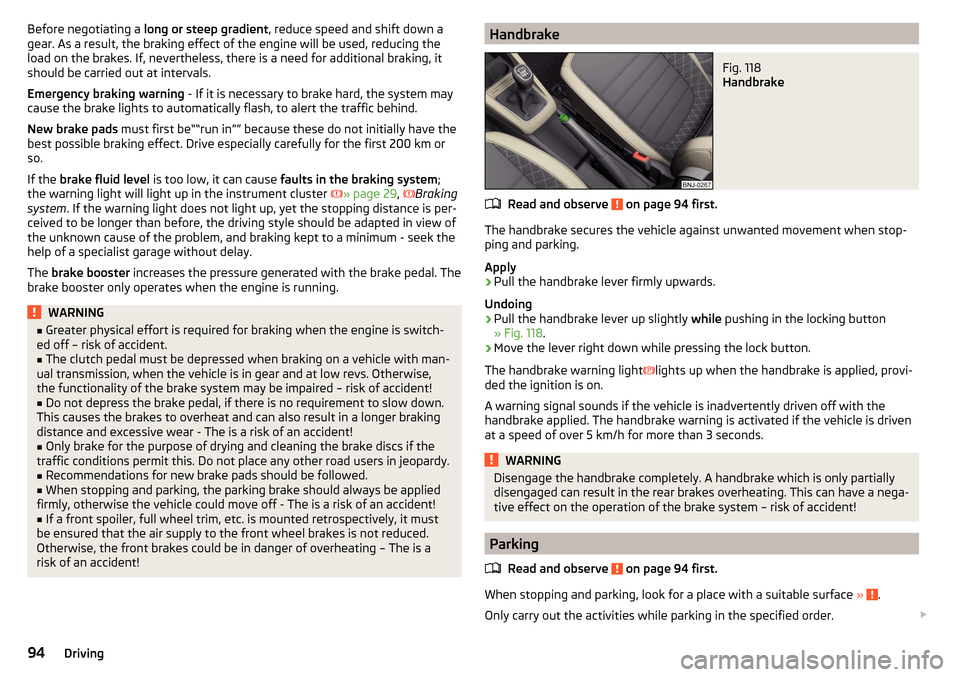
HandbrakeFig. 118
Handbrake
Read and observe on page 94 first.
The handbrake secures the vehicle against unwanted movement when stop-
ping and parking.
Apply
›
Pull the handbrake lever firmly upwards.
Undoing
›
Pull the handbrake lever up slightly while pushing in the locking button
» Fig. 118 .
›
Move the lever right down while pressing the lock button.
The handbrake warning light lights up when the handbrake is applied, provi-
ded the ignition is on.
A warning signal sounds if the vehicle is inadvertently driven off with the
handbrake applied. The handbrake warning is activated if the vehicle is driven
at a speed of over 5 km/h for more than 3 seconds.
WARNINGDisengage the handbrake completely. A handbrake which is only partially
disengaged can result in the rear brakes overheating. This can have a nega-
tive effect on the operation of the brake system – risk of accident!
Parking
Read and observe
on page 94 first.
When stopping and parking, look for a place with a suitable surface » .
Only carry out the activities while parking in the specified order.
94Driving
Page 97 of 196
›Bring the vehicle to a stop and depress the brake pedal.›Firmly apply the handbrake.›
For vehicles with
Automatic transmission , place the selector lever in the P
position.
›
Switch off the engine.
›
For vehicles with Manual transmission , select first gear or Reverse gear R .
›
Release the brake pedal.
WARNING■
The parts of the exhaust system can become very hot. Therefore, never
stop the vehicle in places where the underside of your vehicle could come
into contact with flammable materials (e.g. dry grass, leaves, spilled fuel
etc.) There is a risk of a fire and could result in severe injuries!■
When leaving the vehicle never leave people unattended in the car who
could, for example, lock the vehicle or release the brake - The is a risk of
accidents and injury!
Manual gear shifting and pedals
Introduction
This chapter contains information on the following subjects:
Manual gear changing
95
Pedals
95
Manual gear changing
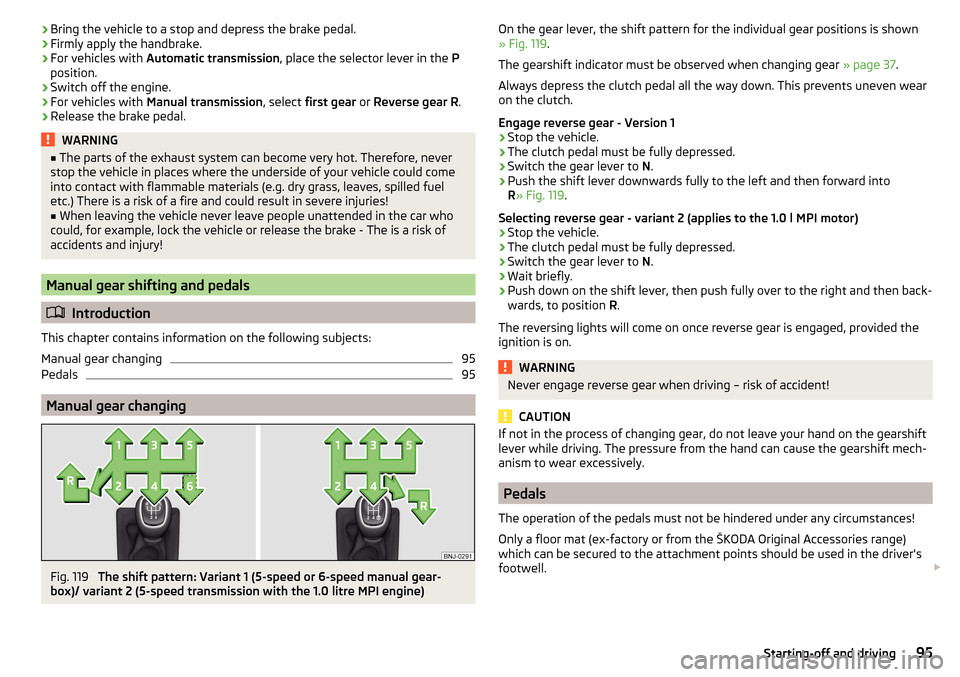
Fig. 119
The shift pattern: Variant 1 (5-speed or 6-speed manual gear-
box)/ variant 2 (5-speed transmission with the 1.0 litre MPI engine)
On the gear lever, the shift pattern for the individual gear positions is shown » Fig. 119 .
The gearshift indicator must be observed when changing gear » page 37.
Always depress the clutch pedal all the way down. This prevents uneven wear
on the clutch.
Engage reverse gear - Version 1›
Stop the vehicle.
›
The clutch pedal must be fully depressed.
›
Switch the gear lever to N.
›
Push the shift lever downwards fully to the left and then forward into
R » Fig. 119 .
Selecting reverse gear - variant 2 (applies to the 1.0 l MPI motor)
›
Stop the vehicle.
›
The clutch pedal must be fully depressed.
›
Switch the gear lever to N.
›
Wait briefly.
›
Push down on the shift lever, then push fully over to the right and then back-
wards, to position R.
The reversing lights will come on once reverse gear is engaged, provided the
ignition is on.
WARNINGNever engage reverse gear when driving – risk of accident!
CAUTION
If not in the process of changing gear, do not leave your hand on the gearshift
lever while driving. The pressure from the hand can cause the gearshift mech-
anism to wear excessively.
Pedals
The operation of the pedals must not be hindered under any circumstances!
Only a floor mat (ex-factory or from the ŠKODA Original Accessories range)
which can be secured to the attachment points should be used in the driver's
footwell.
95Starting-off and driving
Page 139 of 196
CAUTIONDiesel fuel additives■The diesel fuel in accordance with the prescribed standards meets all the
conditions for a smooth running engine. Therefore, we recommend that you do
not add any fuel additives to the diesel - - there is a risk of engine damage or
damage to the exhaust system.
Engine compartment
Introduction
This chapter contains information on the following subjects:
Opening and closing the bonnet
138
Engine compartment overview
138
Windscreen washer fluid
139WARNINGNever cover the engine with additional insulation material (e.g. with a blan-
ket) – risk of fire.WARNINGWhen working in the engine compartment, the following instructions must
be observed - otherwise risk of injury or fire. The engine compartment of
your car is a hazardous area.WARNINGInstructions before beginning work in the engine compartment■Stop the engine and remove the ignition key, on vehicles with the KESSY
system, open the driver's door.■
Firmly apply the handbrake.
■
On vehicles with manual transmission , move the lever to the neutral po-
sition. For vehicles with automatic transmission, place the selector lever in
the P position.
■
Allow the engine to cool.
■
Never open the bonnet if you can see steam or coolant flowing out of the
engine compartment – risk of scalding! Wait until the steam or coolant has
stopped escaping.
WARNINGInformation for working in the engine room■Keep everyone away from the engine compartment.■
Do not touch any hot engine parts – there is a risk of burns.
■
Never touch the radiator fan. The radiator fan may still turn suddenly
about 10 minutes after switching off the ignition!
■
Do not smoke in the vicinity of the engine and avoid the use of open
flames or sparks.
■
Do not leave any items (e.g. cleaning cloths or tools) in the engine com-
partment. There is a fire hazard and the risk of engine damage.
■
Read the information and warning instructions on the fluid containers.
WARNINGInformation for working in the engine compartment with the engine run-
ning■
If it is necessary to work on the engine with the engine running, beware
of rotating engine parts and electrical plants - they can be fatal!
■
Never touch the electric wiring on the ignition system.
■
Avoid short circuits in the electrical system, particularly on the vehicle's
battery.
CAUTION
Only refill using fluids with the proper specification - risk of damage to the ve-
hicle!
Note
■ Fluids with the proper specifications can be purchased from the ŠKODA Origi-
nal Accessories or from the ŠKODA Genuine Parts ranges.■
We recommend you have the operating fluids replaced by a specialist garage.
137Inspecting and replenishing
Page 153 of 196
CAUTIONScrew the jack back to its starting position prior to putting it back in its box -
risk of damage to the box.
Note
The declaration of conformity is included with the jack or the log folder.
Changing a wheel
Preliminary work
For safety's sake, the following instructions must be observed before
changing a wheel on the road.
›
Park the vehicle as far as possible away from the traffic flow - choose a place
with a flat and firm surface.
›
Switch off the engine.
›
For vehicles with manual transmission select1, gear .
›
For vehicles with automatic transmission , place the selector lever in the P
position.
›
Firmly apply the handbrake.
›
Switch on the hazard warning lights and set up the warning triangle at the
prescribed distance.
›
Have all the occupants get out . The passengers should not stand on the
road while the wheel is being changed (they should remain behind a crash
barrier, for instance).
›
Uncouple any trailers.
Changing a wheel
›
Take out the emergency or spare wheel » page 152.
›
Remove the full wheel trim » page 152or caps» page 152 .
›
Loosen the wheel bolts » page 153 » .
›
Jack up the vehicle » page 153 until the wheel that needs changing is clear of
the ground.
›
Unscrew the wheel bolts and place them on a clean surface (cloth, paper,
etc.).
›
Remove the wheel carefully.
›
Attach the spare wheel and slightly screw on the wheel bolts.
›
Lower the vehicle.
›
Tighten the wheel bolts opposite each other using the wheel wrench (“pull- ing crossways”) » page 153.
›Replace the wheel trim
» page 152and caps» page 152 .
When fitting unidirectional tyres, ensure that the direction of rotation is cor-
rect » page 145 .
All bolts must be clean and must turn easily. If screws are corroded and diffi-
cult to move, these must be replaced.WARNING■ Undo the wheel bolts just a little (about one turn), provided the vehicle
has not yet been jacked up. Otherwise the wheel could come loose and fall
off – risk of injury.■
Under no circumstances must the bolts be greased or oiled - cause an ac-
cident.
Subsequent steps
After changing the wheel, the following work should be carried out.
›
Stow the replaced wheel in the well under the floor covering of the luggage
compartment and secure it with a nut.
›
Stow the tool kit in the space provided and secure using the strap.
›
Check tyre pressure on the mounted wheel and adjust if necessary and, with
vehicles with tyre pressure monitoring, save the tyre pressure values in the
system » page 117 .
›
Have the tightening torque of the wheel bolts checked as soon as possible.
The prescribed tightening torque is 120 Nm.
Change the damaged wheel or consult a specialist garage about repair possi-
bilities.
WARNINGTightening torque which is too high can damage the threads and this can
result in permanent deformation of the contact surfaces on the rim. Where
tightening torque is too low, the wheels may become loose while driving -
risk of accident. Therefore drive cautiously and only at a moderate speed
until the tightening torque has been checked.151Emergency equipment, and self-help
Page 157 of 196
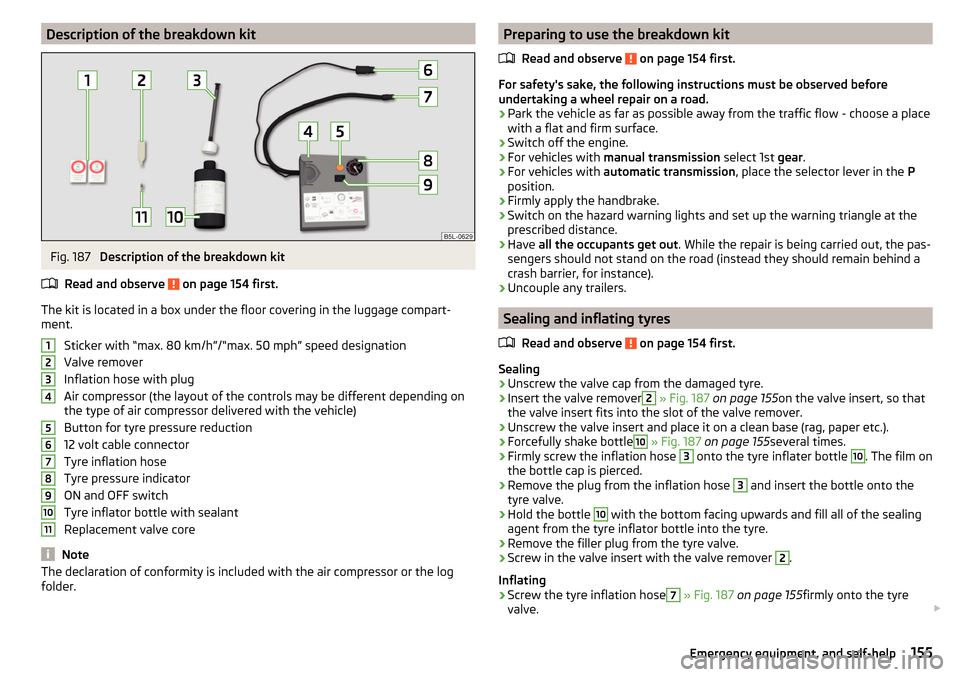
Description of the breakdown kitFig. 187
Description of the breakdown kit
Read and observe
on page 154 first.
The kit is located in a box under the floor covering in the luggage compart-
ment.
Sticker with “max. 80 km/h”/“max. 50 mph” speed designation
Valve remover
Inflation hose with plug
Air compressor (the layout of the controls may be different depending on
the type of air compressor delivered with the vehicle)
Button for tyre pressure reduction
12 volt cable connector
Tyre inflation hose
Tyre pressure indicator
ON and OFF switch
Tyre inflator bottle with sealant
Replacement valve core
Note
The declaration of conformity is included with the air compressor or the log
folder.1234567891011Preparing to use the breakdown kit
Read and observe
on page 154 first.
For safety's sake, the following instructions must be observed before
undertaking a wheel repair on a road.
›
Park the vehicle as far as possible away from the traffic flow - choose a place
with a flat and firm surface.
›
Switch off the engine.
›
For vehicles with manual transmission select 1st gear.
›
For vehicles with automatic transmission , place the selector lever in the P
position.
›
Firmly apply the handbrake.
›
Switch on the hazard warning lights and set up the warning triangle at the
prescribed distance.
›
Have all the occupants get out . While the repair is being carried out, the pas-
sengers should not stand on the road (instead they should remain behind a
crash barrier, for instance).
›
Uncouple any trailers.
Sealing and inflating tyres
Read and observe
on page 154 first.
Sealing
›
Unscrew the valve cap from the damaged tyre.
›
Insert the valve remover
2
» Fig. 187 on page 155 on the valve insert, so that
the valve insert fits into the slot of the valve remover.
›
Unscrew the valve insert and place it on a clean base (rag, paper etc.).
›
Forcefully shake bottle
10
» Fig. 187 on page 155 several times.
›
Firmly screw the inflation hose
3
onto the tyre inflater bottle
10
. The film on
the bottle cap is pierced.
›
Remove the plug from the inflation hose
3
and insert the bottle onto the
tyre valve.
›
Hold the bottle
10
with the bottom facing upwards and fill all of the sealing
agent from the tyre inflator bottle into the tyre.
›
Remove the filler plug from the tyre valve.
›
Screw in the valve insert with the valve remover
2
.
Inflating
›
Screw the tyre inflation hose
7
» Fig. 187 on page 155 firmly onto the tyre
valve.
155Emergency equipment, and self-help