ABS SKODA OCTAVIA 2005 1.G / (1U) User Guide
[x] Cancel search | Manufacturer: SKODA, Model Year: 2005, Model line: OCTAVIA, Model: SKODA OCTAVIA 2005 1.G / (1U)Pages: 315, PDF Size: 11.8 MB
Page 185 of 315
Seat belts
184
The physical principle of a frontal
collision
The physical principle of a frontal accident can be explained quite simply: Motion energy, so-called kinetic energy, is produced as soon as the
vehicle is moving, both for the vehicle and its occupants. The magnitude
of this kinetic energy depends essentially on the speed at which the
vehicle is travelling and on the weight of the vehicle and the occupants.
The greater the speed and weight increase, the greater the amount of
energy which has to be absorbed in the event of an accident.
The speed of the vehicle is, nevertheless, the most important factor.
Doubling the speed of the vehicle from 25 km/h up to 50 km/hour
increases the kinetic energy four times.
The common opinion that it is possible to support your body in a minor
accident with your hands, is incorrect. Even in a collision at only a low
speed, the forces acting on the body are such that it is no longer possible
to support your body.
Even if you only drive at a speed within the range from 30 km/hour to 50
km/hour, the forces which are produced on your body in the event of an
accident can easily exceed 10,000 N (Newton). This equals a weight of
one tonne (1 000 kg).
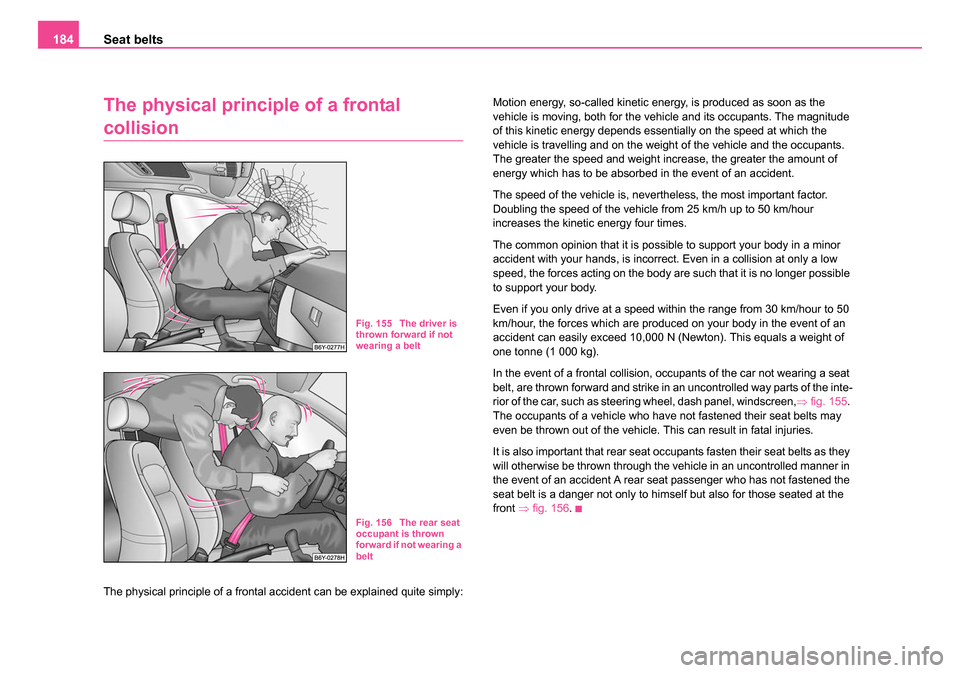
In the event of a frontal collision, occupants of the car not wearing a seat
belt, are thrown forward and strike in an uncontrolled way parts of the inte-
rior of the car, such as steering wheel, dash panel, windscreen,
⇒fig. 155 .
The occupants of a vehicle who have not fastened their seat belts may
even be thrown out of the vehicle. This can result in fatal injuries.
It is also important that rear seat occupants fasten their seat belts as they
will otherwise be thrown through the vehicle in an uncontrolled manner in
the event of an accident A rear seat passenger who has not fastened the
seat belt is a danger not only to himself but also for those seated at the
front ⇒fig. 156 .
Fig. 155 The driver is
thrown forward if not
wearing a belt
Fig. 156 The rear seat
occupant is thrown
forward if not wearing a
belt
s24s.book Page 184 Thursday, November 24, 2005 12:27 PM
Page 214 of 315
Intelligent Technology213
Using the systemSafetyDriving TipsGeneral MaintenanceBreakdown assistanceTechnical Data
Driving Tips
Intelligent Technology
Electronic stability programme (ESP)*
General
General
The ESP aids you maintain control of your vehicle in situations in border-
line driving situations such as when negotiating a curve too fast. The risk
of skidding is reduced and your car thus offers greater driving stability
depending on the conditions of the road surface. This occurs at all speeds.
The following systems are integrated into the electronic stability
programme:
•Electronic Differential Lock (EDL),
•Traction control system (TCS),
•Driver-steering recommendation,
•Antilock brake system (ABS),
•Brake Assist,
•Uphill-Start off-Assist.
Operating principle
The ESP switches on automatically when the engine is started and then
conducts a self-test. The ESP control unit processes data from the indi-
vidual systems. It also processes additional measurement data which are
supplied by highly sensitive sensors: the rotational velocity of the vehicle
about its vertical axis, the lateral acceleration of the vehicle, the braking
pressure and the steering angle.
The direction which the driver wishes to take is determined based on the
steering angle and the speed of the vehicle and is constantly compared
with the actual behaviour of the vehicle. If differences exist, such as the
car beginning to skid, the ESP will automatically brake the appropriate
wheel.
The car is stabilised again by the forces which take effect when the wheel
is braked. Intervention into the brake system takes place primarily on the
outer front wheel of a vehicle which tends to oversteer (tendency for the
rear of the vehicle to break away) while occurs this is on the inner rear
wheel of a vehicle which tends to understeer (tendency to shift out of the
curve). This braking control cycle is accompanied by noises.
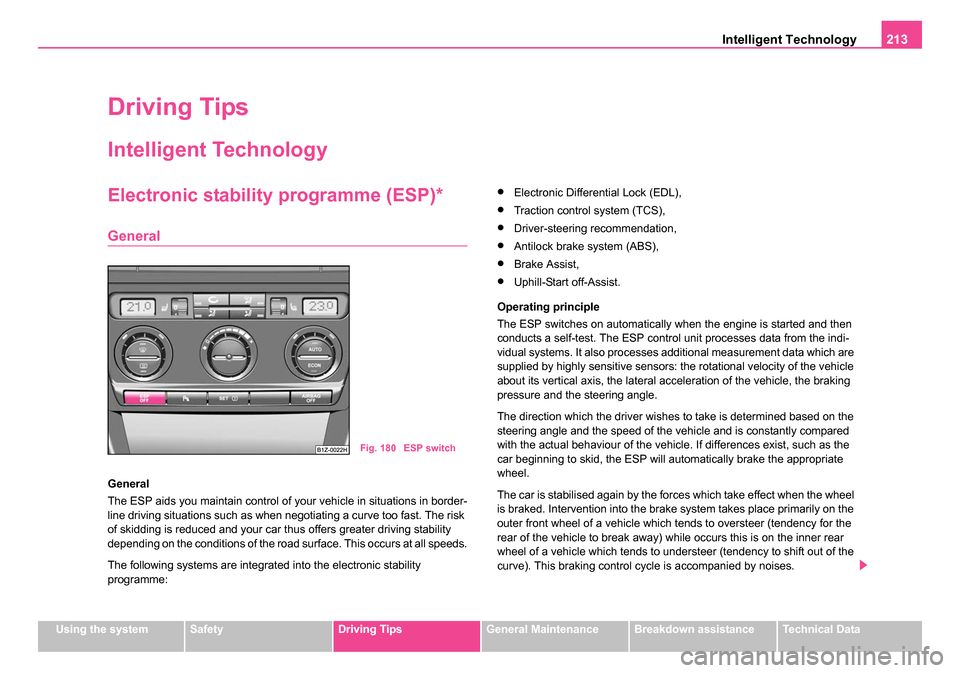
Fig. 180 ESP switch
s24s.book Page 213 Thursday, November 24, 2005 12:27 PM
Page 215 of 315
Intelligent Technology
214
The ESP operates in combination with the ABS ⇒page 218, “Antilock
brake system (ABS)”. If there is a fault in the ABS system, the ESP also
does not operate.
The ESP warning light ⇒page 40 lights up in the instrument cluster when
there is a fault on the ESP.
Switching off
You can switch the ESP off and on again as you wish, by pressing the
button ⇒page 213, fig. 180 . The ESP warning light ⇒page 40 lights up in
the instrument cluster when the ESP is switched off.
The ESP should normally always be switched on. It may be good practice
in certain exceptional cases, such as when you wish to have wheel slip,
to switch off the system.
Examples:
•when driving with snow chains
•when driving in deep snow or on a loose surface
•when it is necessary to rock a car free when it has become stuck
then you should switch on the ESP again.
WARNING
It is also not possible for the E SP to overcome the physical limits
of the vehicle. Even if a vehicle fitted with ESP you should still
always adapt your style of driving to the condition of the road
surface and the traffic situation. This particularly applies when
driving on slippery and wet roads. The increased safety offered
must not tempt you to take greater risks than otherwise - risk of an
accident!
Note
•All four wheels must be fitted with the same tyres in order to achieve
problem-free operation of the ESP. Differing rolling circumferences of the
tyres can lead to an undesirable reduction in the engine output.
•Changes to vehicle (e.g. on engine, on the brakes, on chassis or other
assignment of tyres and wheels) can influence the function of the ESP
⇒ page 270, “Accessories, changes and replacement of parts”.
Electronic Differential Lock (EDL)*
The electronic differential lock prevents an individual
wheel from slipping.
Models fitted with ESP are equipped with electronic differential lock (EDL).
General
The EDL makes it much easier, and sometimes at all possible, to start off,
accelerate and climb a steep hill when the conditions of the road surface
are unfavourable.
Operating principle
The EDL is activated automatically, that is without any action on the part
of the driver. It monitors the speeds of the driven wheels with the aid of the
ABS sensors. Should only one drive wheel begin spinning on a slippery
surface there will be an appreciable difference in the speed of the driven
wheels. The EDL function brakes the slipping wheel and the differential
transmits a greater driving force to the other driven wheel. This control
process is also accompanied by noises.
Overheating of the brakes
The EDL switches off automatically if unusually severe stresses exist in
order to avoid excessive heat generation in the disc brake on the wheel
s24s.book Page 214 Thursday, November 24, 2005 12:27 PM
Page 216 of 315
Intelligent Technology215
Using the systemSafetyDriving TipsGeneral MaintenanceBreakdown assistanceTechnical Data
which is being braked. The vehicle can continue to be driven and has the
same characteristics as a vehicle not fitted with EDL.
The EDL switches on again automatically as soon as the brake has cooled
down.
WARNING
•Depress the accelerator carefully when accelerating on
uniformly slippery road surfaces, such as ice and snow. The driven
wheels might still spin despite the EDL and affect the stability of
the vehicle - risk of an accident!
•You should always adapt your style of driving to the condition
of road surface and to the traffic situation even when your vehicle
is fitted with EDL. The increased safety offered must not tempt you
to take greater risks than otherwise - risk of an accident!
Note
•If the ABS or ESP warning light comes on, this may also indicate a fault
in the EDL. Please have the car inspected as soon as possible by a
specialist garage.
•Changes to vehicle (e.g. on engine, on the brakes, on chassis or other
assignment of tyres and wheels) can influence the function of the EDL
⇒ page 270, “Accessories, changes and replacement of parts”.
Traction control system (TCS)
The traction control system prevents the driven wheels
from spinning when accelerating.
General
The TCS makes it much easier, and sometimes at all possible, to start off,
accelerate and climb a steep hill when the conditions of the road surface
are unfavourable.
Operating principle
The TCS switches on automatically when the engine is started and then
conducts a self-test. The system monitors the speeds of the driven wheels
with the aid of the ABS sensors. If the wheels are spinning, the force trans-
mitted to the road surface is automatically adapted by reducing the engine
speed. This occurs at all speeds.
The TCS operates in combination with the ABS ⇒page 218, “Antilock
brake system (ABS)”. The TCS will not function if a fault exists in the ABS
system.
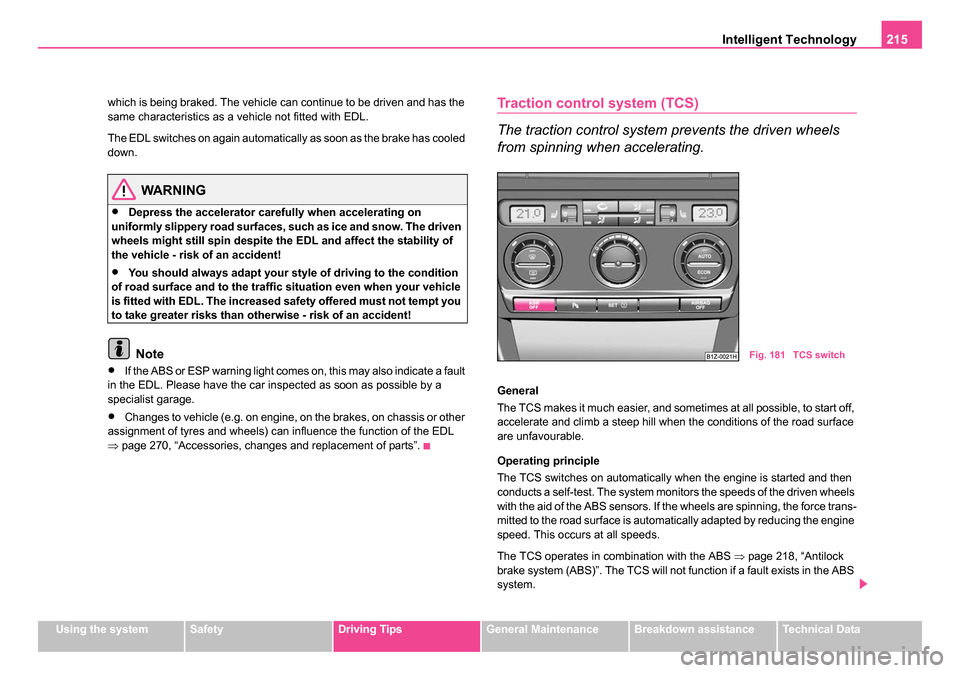
Fig. 181 TCS switch
s24s.book Page 215 Thursday, November 24, 2005 12:27 PM
Page 219 of 315
Intelligent Technology
218
WARNING
•Never switch off the engine before the vehicle is stationary.
•The brake booster only operates when the engine is running.
Greater physical effort for braking is required when engine is
switched off. Because if you do not stop as normal, this can cause
an accident and severe injuries.
Antilock brake system (ABS)
ABS prevents the wheels locking when braking.
General
The ABS contributes significantly to enhancing the active safety of your
vehicle. Compared to a car not fitted with the ABS brake system, you are
able to retain optimal steering ability even during a full brake application
on a slippery road surface because the wheels do not lock up.
You must not expect, however, that the braking distance will be shorter
under all circumstances as a result of the ABS. The braking distance for
example on gravel and fresh snow, when you should anyway be driving
slowly and cautiously, will be longer.
Operating principle
The brake pressure will be reduced on a wheel which is rotating at a speed
which is too low for the speed of the vehicle and tending to lock. This
control cycle is noticeable from a pulsating movement of the brake
pedal which is accompanied by noises. This is consciously intended to
provide the driver with the information that the wheels are tending to lock
(ABS control range). You must always keep the brake pedal depressed to
enable the ABS to optimally control the brake application in this braking
range. Never interrupt the application of the brakes!
WARNING
•The ABS can also not overcome the physical limits of your
vehicle. Please do not forget this, particularly when driving on icy
or wet road surfaces. If the ABS is operating within the control
range, adapt your speed immediatel y to the conditions of the road
surface and the traffic situation. The increased safety offered by
the ABS must not tempt you to take greater risks than otherwise -
risk of an accident!
•The normal braking system is still fully functional if there is an
ABS fault. Visit a specialist garage as quickly as possible and
adjust your style of driving to take account of the ABS fault in the
meantime since you will not know how great the damage is.
Note
•A warning light comes on if a fault occurs in the ABS system
⇒ page 38.
•Changes to vehicle (e.g. on engine, on the brakes, on chassis or other
assignment of tyres and wheels) can influence the function of the ABS
⇒ page 270, “Accessories, changes and replacement of parts”.
Brake Assist*
During a severe brake application (e.g. if a hazard exists), the Brake
Assist increases the braking force and thus makes it possible to rapidly
produce the pressure required in the brake system.
The majority of drivers do apply the brakes in good time in dangerous situ-
ations, but do not depress the brake pedal with sufficient pressure. Conse-
quently, it is not possible for the car to achieve its maximum deceleration
and the car covers a greater distance than necessary.
s24s.book Page 218 Thursday, November 24, 2005 12:27 PM
Page 220 of 315
Intelligent Technology219
Using the systemSafetyDriving TipsGeneral MaintenanceBreakdown assistanceTechnical Data
The Brake Assist is activated by the very quick operation of the brake
pedal. In such cases, a much greater braking pressure exists than during
a normal brake application. This makes it possible, even with a relatively
low resistance of the brake pedal, to produce an adequate pressure in the
brake system in the shortest possible time, which is required for maximum
deceleration of the car. You must apply the brake pedal firmly and hold it
in this position in order to achieve the shortest possible braking distance.
The Brake Assist is able to help you achieve a shorter braking distance in
emergency situations by rapidly producing the pressure required in the
brake system. It fully exploits the attributes of the ABS. After you release
the brake pedal, the function of the Brake Assist is automatically switched
off and the brakes operate in the normal way.
The Brake Assist is part of the ESP system. If a fault occurs in the ESP,
the Brake Assist function is also not available. Further information on the
ESP
⇒page 213.
WARNING
•The Brake Assist is also not able to overcome the physical
limits of your car in terms of the braking distance required.
•Adapt your speed to the conditions of the road surface and to
the traffic situation.
•The increased safety offered by the Brake Assist must not tempt
you to take a greater safety risk than otherwise.
Uphill-Start off-Assist*
The uphill-start off-assist makes it much easier to start off on steep hills.
The system assists a start off by holding the brake pressure produced by
the brake pedal actuation for approx. 2 seconds after releasing the brake
pedal. The driver can therefore move his foot from the brake pedal to the accelerator pedal and start off on the slope, without having to actuate the
handbrake. The brake pressure drops gradually the more you operate the
accelerator pedal. If the vehicle does not start off within 2 seconds, it starts
to roll back.
The uphill-start off-assist is active in the event of a 5% slope, if the vehicle
door is closed. It is always active on slopes when in forward or reverse
start off. When driving downhill, it is inactive.
Electromechanical
power steering
The power steering enables you to steer the vehicle with less physical
force.
With the electromechanical power steering, the steering assist is automat-
ically adapted to the speed and to the steering angle.
It is still possible to fully steer the vehicle if the power steering fails or if the
engine is not running (vehicle being towed in). The only difference is that
greater physical effort is required.
If there is a fault in the power steering, a red or yellow warning light
lights up in the instrument cluster ⇒page 33.
WARNING
Contact your specialist garage if the power steering is defective.
s24s.book Page 219 Thursday, November 24, 2005 12:27 PM
Page 221 of 315
Intelligent Technology
220
Tyre inflation pressure-control system*
The tyre inflation pressure-control system compares with the aid of the
ABS sensors the speed and also the rolling circumference of the individual
wheels. If the rolling circumference of a wheel is changed, the warning
light
lights up in the dash panel insert ⇒page 38. The rolling circumfer-
ence of the tyre can change if:
•the tyre inflation pressure is too low,
•the structure of the tyre is damaged,
•the vehicle is loaded on one side,
•the wheels of an axle are loaded heavily (e.g. when towing a trailer or
when driving uphill or downhill),
•snow chains are mounted,
•the temporary spare wheel is mounted,
•one wheel per axle was changed. Basic setting of tyre inflation pressure-control system
After changing the tyre inflation pressures or after changing one or several
wheels, the button for the tyre inflation pressure-control system must be
pressed long enough until an acknowledegment tone sounds when the
ignition is switched on.
•Inflate all tyres to the specified inflation pressure
⇒page 264.
•Switch on the ignition.
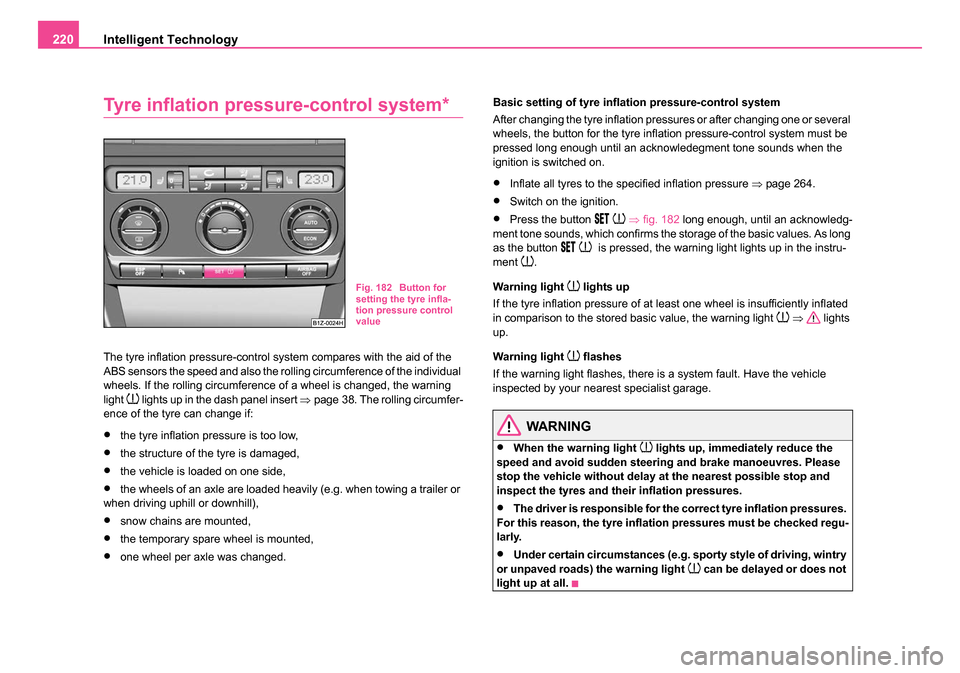
•Press the button ⇒ fig. 182 long enough, until an acknowledg-
ment tone sounds, which confirms the storage of the basic values. As long
as the button
is pressed, the warning light lights up in the instru-
ment .
Warning light
lights up
If the tyre inflation pressure of at least one wheel is insufficiently inflated
in comparison to the stored basic value, the warning light
⇒ lights
up.
Warning light
flashes
If the warning light flashes, there is a system fault. Have the vehicle
inspected by your nearest specialist garage.
WARNING
•When the warning light lights up, immediately reduce the
speed and avoid sudden steering and brake manoeuvres. Please
stop the vehicle without delay at the nearest possible stop and
inspect the tyres and their inflation pressures.
•The driver is responsible for the correct tyre inflation pressures.
For this reason, the tyre inflation pressures must be checked regu-
larly.
•Under certain circumstances (e.g. sporty style of driving, wintry
or unpaved roads) the warning light can be delayed or does not
light up at all.
Fig. 182 Button for
setting the tyre infla-
tion pressure control
value
s24s.book Page 220 Thursday, November 24, 2005 12:27 PM
Page 241 of 315
Taking care of your vehicle and cleaning the vehicle
240
Removing stains
– Remove fresh stains which are water-based (e.g. coffee, tea, juices, blood etc.) with an absorbent cloth or household paper
or use the cleaner from the care set for a stain which has
already dried in.
– Remove fresh stains on a fat base (e.g. butter, mayonnaise,
chocolate etc.) with an absorbent cloth or household cleaning
paper or with the cleaner from the care set if the stain has not
yet penetrated into the surface.
– Use a grease dissolver for grease stains which have dried
in .
–Eliminate special stains (e.g. ball-point pens, felt pen, nail
varnish, dispersion paint, shoe cream etc.) with a special stain
remover suitable for leather.
Leather care
– Treat the leather every six months with the leather care product available from Škoda dealers.
– Apply only a small amount of the care product.
– Dry the leather off with a soft cloth
It is best to consult your Škoda dealer if you have any questions regarding
cleaning and care of the leather interior.
Caution
•You must on no account treat the leather with solvents (e.g. gasoline,
turpentine), floor wax, shoe cream or such like.
•Avoid leaving your vehicle for lengthy periods in bright sunlight in order
to avoid bleaching the leather. If you leave your vehicle parked in the open
for lengthy periods, protect the leather from the direct rays of the sun by
covering it over.
•Sharp-edged objects on items of clothing such as zip fasteners, rivets,
sharp-edged belts may leave permanent scratches or signs of rubbing on
the surface.
Note
•Use a care cream with light blocker and impregnation effect regularly
and each time after cleaning the leather. The cream nourishes the leather,
allows it to breathe and keeps it supple and also provides moisture. It also
creates surface protection.
•Clean the leather every 2 to 3 months, remove fresh soiling each time
this occurs.
•Remove fresh stains such as those from ball-point pens, ink, lipstick,
shoe cream etc., as quickly as possible.
•Care also for the leather dye. Refreshen areas which have lost their
colour with a special coloured leather cream as required.
Seat belts
– Keep the seat belts clean!
– Wash seat belts which have become soiled using a mild soapy solution.
– Inspect the seat belts regularly to ensure they are in good condition.
s24s.book Page 240 Thursday, November 24, 2005 12:27 PM
Page 250 of 315
Inspecting and Replenishing249
Using the systemSafetyDriving TipsGeneral MaintenanceBreakdown assistanceTechnical Data
•Allow the engine to cool down.
•Keep children clear of the engine compartment.
•Never spill oil and other fluids over the hot engine. Such fluids
(e.g. the antifreeze contained in the coolant) may ignite!
•Avoid short circuits in the electrical system - particularly on the
battery.
•Never place your hand into the radiator fan as long as the
engine is still warm. The fan might suddenly start running!
•Never open the cap of the coolant expansion bottle as long as
the engine is still warm. The cooling system is pressurized!
•Cover over the cap of the coolant expansion reservoir with a
large cloth when opening it as protection for your face, hands and
arms from hot steam or hot coolant.
•Do not let objects, such as e.g cleaning cloth or tools lie in the
engine compartment.
•If you wish to work under the vehicle, you must secure the
vehicle from rolling away and support it with suitable supporting
blocks: the car jack is not sufficient for this - risk of injury!
•In cases where it be necessary to carry out inspection work
when the engine is running there is an additional risk from rotating
parts (e.g. the V-ribbed belt, alternator, radiator fan) and from the
high-voltage ignition system. Please observe in addition the
following:
−Never touch the electrical cables of the ignition system.
− Absolutely avoid any jewellery, loose items of clothing or
long hair from getting into the rotating parts of the engine -
Hazard! Therefore remove any jewellery beforehand, tie up your
hair and wear tight fitting clothing.
•Please also comply with the warning instructions stated below
when carrying out any essential work on the fuel system or on the
electrical system:
−Always separate the car battery from the electrical system.
− Do not smoke.
− Never carry out any work close to naked flames.
− Always keep a working fi re extinguisher at hand.
Caution
When replenishing fluids in the engine, always ensure that the fluids are
on no account mixed up. This may result in major operating problems and
also vehicle damage!
WARNING (continued)WARNING (continued)
s24s.book Page 249 Thursday, November 24, 2005 12:27 PM
Page 258 of 315
Inspecting and Replenishing257
Using the systemSafetyDriving TipsGeneral MaintenanceBreakdown assistanceTechnical Data
A slight drop in the fluid level results when driving due to normal wear-and-
tear and automatic adjustment of the brake pads, and is perfectly normal.
There may be an indication of a leak in the brake system, however, if the
fluid level drops significantly within a short time or if it drops below the
“MIN” marking. A situation where the brake fluid level is too low is indi-
cated by the warning light
lighting up in the instrument cluster
⇒ page 40. In this case stop the car immediately and do not drive any
further! Contact a Škoda Dealer to obtain professional assistance.
WARNING
•Read and observe the warning notes ⇒page 248, “Working in
the engine compartment” before working in the engine compart-
ment.
•If the fluid level has dropped below the “MIN” marking, do not
drive any further - risk of accident! Contact a Škoda dealer to obtain
professional assistance.
Replacing brake fluid
Brake fluid absorbs moisture. This causes the fluid to absorb moisture
from the surrounding air over a period of time. Excessive water in the
brake fluid may be the cause of corrosion in the brake system. The water
content also lowers the boiling point of the brake fluid. This is why brake
fluid must be replaced every two years.
One may only use new genuine brake fluid from Škoda Auto. The specifi-
cation for the brake fluid is “FMVSS 116 DOT 4”.
We recommend that you have the brake fluid replaced by a Škoda dealer
as part of an Inspection Service.
WARNING
•Using old brake fluid can result in severe stress on the brakes
because of the formation of vapour bubbles in the brake system.
This greatly impairs the braking efficiency and thus also the safety
of your vehicle.
•Brake fluid is toxic! It must therefore be kept safely in closed
original containers and well away from children and unauthorized
persons.
Caution
Brake fluid damages the paintwork of the vehicle.
For the sake of the environment
In view of the problems involved with proper disposal of brake fluid, the
special tools and the professional knowledge required, you should have
the brake fluid replaced by a Škoda dealer.
s24s.book Page 257 Thursday, November 24, 2005 12:27 PM