cooling SKODA OCTAVIA 2005 1.G / (1U) Owner's Manual
[x] Cancel search | Manufacturer: SKODA, Model Year: 2005, Model line: OCTAVIA, Model: SKODA OCTAVIA 2005 1.G / (1U)Pages: 315, PDF Size: 11.8 MB
Page 7 of 315
Contents
6
Important safety information regarding the use
of seat belts . . . . . . . . . . . . . . . . . . . . . . . . . .
How are seat belts correctly fastened? . . . . .
Belt tensioners . . . . . . . . . . . . . . . . . . . . . . . .
Airbag system. . . . . . . . . . . . . . . . . . . . . . . . .
Description of the airbag system . . . . . . . . . .
Front airbags . . . . . . . . . . . . . . . . . . . . . . . . .
Side airbags* . . . . . . . . . . . . . . . . . . . . . . . . .
Head airbags* . . . . . . . . . . . . . . . . . . . . . . . .
Deactivating an airbag . . . . . . . . . . . . . . . . . .
Transporting children safely. . . . . . . . . . . . .
What you should know about transporting
children! . . . . . . . . . . . . . . . . . . . . . . . . . . . . .
Child seat . . . . . . . . . . . . . . . . . . . . . . . . . . . .
Attaching child seat using the “ISOFIX” system
Driving Tips . . . . . . . . . . . . . . . . . . . . . .
Intelligent Technology . . . . . . . . . . . . . . . . . .
Electronic stability programme (ESP)* . . . . . .
Brakes . . . . . . . . . . . . . . . . . . . . . . . . . . . . . .
Brake booster . . . . . . . . . . . . . . . . . . . . . . . .
Antilock brake system (ABS) . . . . . . . . . . . . .
Brake Assist* . . . . . . . . . . . . . . . . . . . . . . . . .
Uphill-Start off-Assist* . . . . . . . . . . . . . . . . . .
Electromechanical power steering . . . . . . . . .
Tyre inflation pressure-control system* . . . . .
Driving and the Environment. . . . . . . . . . . .
The first 1 500 kilometres and then afterwards
Catalytic converter . . . . . . . . . . . . . . . . . . . . .
Driving in an economical and environmentally
conscious manner . . . . . . . . . . . . . . . . . . . . .
Environmental compatibility . . . . . . . . . . . . . .
Motoring abroad . . . . . . . . . . . . . . . . . . . . . . .
Avoiding damage to your vehicle . . . . . . . . . .
Towing a trailer. . . . . . . . . . . . . . . . . . . . . . . .
Towing a trailer . . . . . . . . . . . . . . . . . . . . . . .
Detachable ball head* . . . . . . . . . . . . . . . . . .
General Maintenance. . . . . . . . . .
Taking care of your vehicle and cleaning the
vehicle . . . . . . . . . . . . . . . . . . . . . . . . . . . . . . .
General . . . . . . . . . . . . . . . . . . . . . . . . . . . . .
Care of the exterior of vehicle . . . . . . . . . . . .
Care of the interior of vehicle . . . . . . . . . . . . .
Fuel. . . . . . . . . . . . . . . . . . . . . . . . . . . . . . . . . .
Petrol . . . . . . . . . . . . . . . . . . . . . . . . . . . . . . .
Diesel . . . . . . . . . . . . . . . . . . . . . . . . . . . . . .
Refuelling . . . . . . . . . . . . . . . . . . . . . . . . . . .
Inspecting and Replenishing. . . . . . . . . . . .
Engine compartment . . . . . . . . . . . . . . . . . . .
Engine oil . . . . . . . . . . . . . . . . . . . . . . . . . . . .
Cooling system . . . . . . . . . . . . . . . . . . . . . . .
Brake fluid . . . . . . . . . . . . . . . . . . . . . . . . . . .
The battery . . . . . . . . . . . . . . . . . . . . . . . . . .
Windscreen Wiper and Washer System . . . .
Wheels and Tyres . . . . . . . . . . . . . . . . . . . . .
Wheels . . . . . . . . . . . . . . . . . . . . . . . . . . . . .
Accessories, changes and replacement of
parts . . . . . . . . . . . . . . . . . . . . . . . . . . . . . . . . .
Accessories and replacement parts . . . . . . .
Technical changes . . . . . . . . . . . . . . . . . . . . .
Breakdown assistance . . . . . . . .
Breakdown assistance . . . . . . . . . . . . . . . . .
First-aid box* and warning triangle* (Octavia)
First-aid box* and warning triangle* (Estate
car) . . . . . . . . . . . . . . . . . . . . . . . . . . . . . . . . Fire extinguisher* . . . . . . . . . . . . . . . . . . . . .
Vehicle tool kit . . . . . . . . . . . . . . . . . . . . . . . .
Tyre repair kit* . . . . . . . . . . . . . . . . . . . . . . . .
Spare wheel . . . . . . . . . . . . . . . . . . . . . . . . .
Changing a wheel . . . . . . . . . . . . . . . . . . . . .
Jump-starting . . . . . . . . . . . . . . . . . . . . . . . .
Tow-starting and towing vehicle . . . . . . . . . .
Fuses and light bulbs . . . . . . . . . . . . . . . . . .
Electric fuses . . . . . . . . . . . . . . . . . . . . . . . . .
Bulbs . . . . . . . . . . . . . . . . . . . . . . . . . . . . . . .
Te c h n i c a l D a ta . . . . . . . . . . . . . . . . . .
General . . . . . . . . . . . . . . . . . . . . . . . . . . . . . .
Identification data . . . . . . . . . . . . . . . . . . . . .
Index . . . . . . . . . . . . . . . . . . . . . . . . . . . . . .
185
186
188
190
190
192
195
197
199
202
202
206
210
213
213
213
216
217
218
218
219
219
220
221
221
222
223
227
228
228 229
229
231
233
233
233
233
239
242
242
242
245
247
247
250
253
256
258
262
263
263
270
270
270
273
273
273
273274
274
275
275
276
281
283
288
288
294
303
303
303
305
s24s.book Page 6 Thursday, November 24, 2005 12:27 PM
Page 15 of 315
Instruments and Indicator/Warning Lights
14
Engine revolutions counter
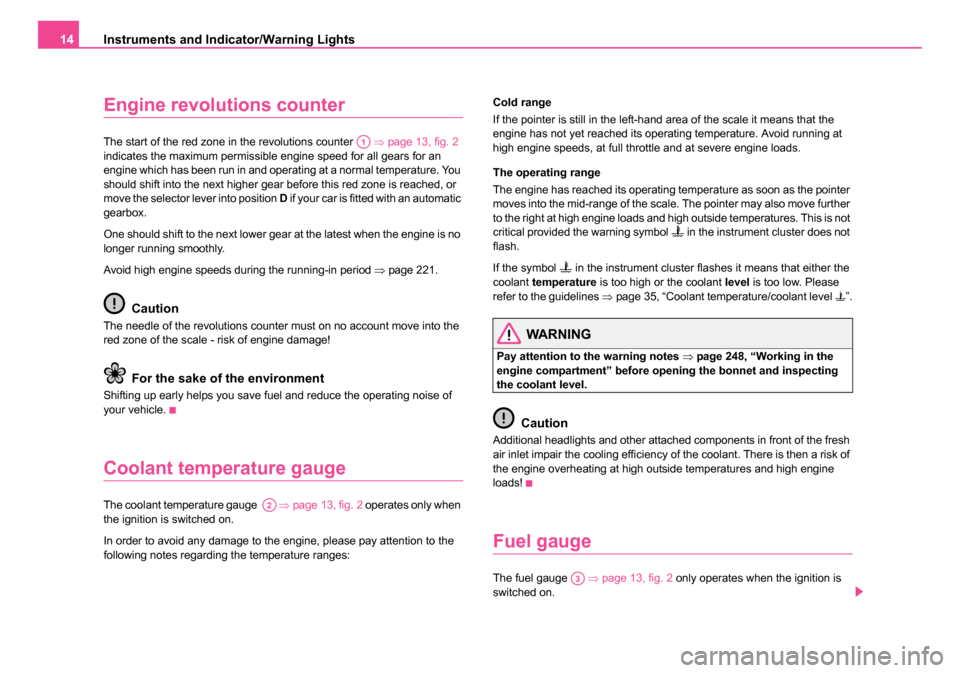
The start of the red zone in the revolutions counter ⇒page 13, fig. 2
indicates the maximum permissible engine speed for all gears for an
engine which has been run in and operating at a normal temperature. You
should shift into the next higher gear before this red zone is reached, or
move the selector lever into position D if your car is fitted with an automatic
gearbox.
One should shift to the next lower gear at the latest when the engine is no
longer running smoothly.
Avoid high engine speeds during the running-in period ⇒page 221.
Caution
The needle of the revolutions counter must on no account move into the
red zone of the scale - risk of engine damage!
For the sake of the environment
Shifting up early helps you save fuel and reduce the operating noise of
your vehicle.
Coolant temperature gauge
The coolant temperature gauge ⇒ page 13, fig. 2 operates only when
the ignition is switched on.
In order to avoid any damage to the engine, please pay attention to the
following notes regarding the temperature ranges: Cold range
If the pointer is still in the left-hand area of the scale it means that the
engine has not yet reached its operating temperature. Avoid running at
high engine speeds, at full throttle and at severe engine loads.
The operating range
The engine has reached its operating temperature as soon as the pointer
moves into the mid-range of the scale. The pointer may also move further
to the right at high engine loads and high outside temperatures. This is not
critical provided the warning symbol
in the instrument cluster does not
flash.
If the symbol
in the instrument cluster flashes it means that either the
coolant temperature is too high or the coolant level is too low. Please
refer to the guidelines ⇒page 35, “Coolant temperature/coolant level ”.
WARNING
Pay attention to the warning notes ⇒page 248, “Working in the
engine compartment” before opening the bonnet and inspecting
the coolant level.
Caution
Additional headlights and other attached components in front of the fresh
air inlet impair the cooling efficiency of the coolant. There is then a risk of
the engine overheating at high outside temperatures and high engine
loads!
Fuel gauge
The fuel gauge ⇒page 13, fig. 2 only operates when the ignition is
switched on.
A1
A2
A3
s24s.book Page 14 Thursday, November 24, 2005 12:27 PM
Page 37 of 315
Instruments and Indicator/Warning Lights
36
In this case stop and switch the engine off and check the coolant level;
top up the coolant as necessary.
Do not continue your journey if for some reason it is not possible under
the conditions prevailing to top up with coolant. Keep the engine
switched off and obtain professional assistance from a specialist garage,
otherwise it could lead to severe engine damages.
If the coolant is within the specified range, the increased temperature may
be caused by an operating problem at the coolant fan. Check the fuse for
the coolant fan, replace it if necessary ⇒page 290, “Fuse assignment in
engine compartment - version 1” or ⇒page 291, “Fuse assignment in
engine compartment - version 2”.
Do not continue driving if the warning light does not go off although the
fluid is at the correct level and also the fuse of the fan is in proper order.
Contact a specialist garage to obtain assistance.
Please also refer to the additional instructions ⇒page 253, “Cooling
system”.
The following text will be displayed in the information display*:
STOP Check coolant! Owner's manual (STOP! Check coolant!
Owner's manual)
WARNING
•If you must stop for technical reasons, then park the vehicle at
a safe distance from the traffic and switch off the engine and switch
on the hazard warning light system ⇒page 68.
•Take care when opening the coolant expansion bottle. If the
engine is hot, the cooling system is pressurized - risk of scalding!
It is best to allow the engine to cool down before removing the cap.
•Do not touch the coolant fan The coolant fan may switch on
automatically even if the ignition is off.
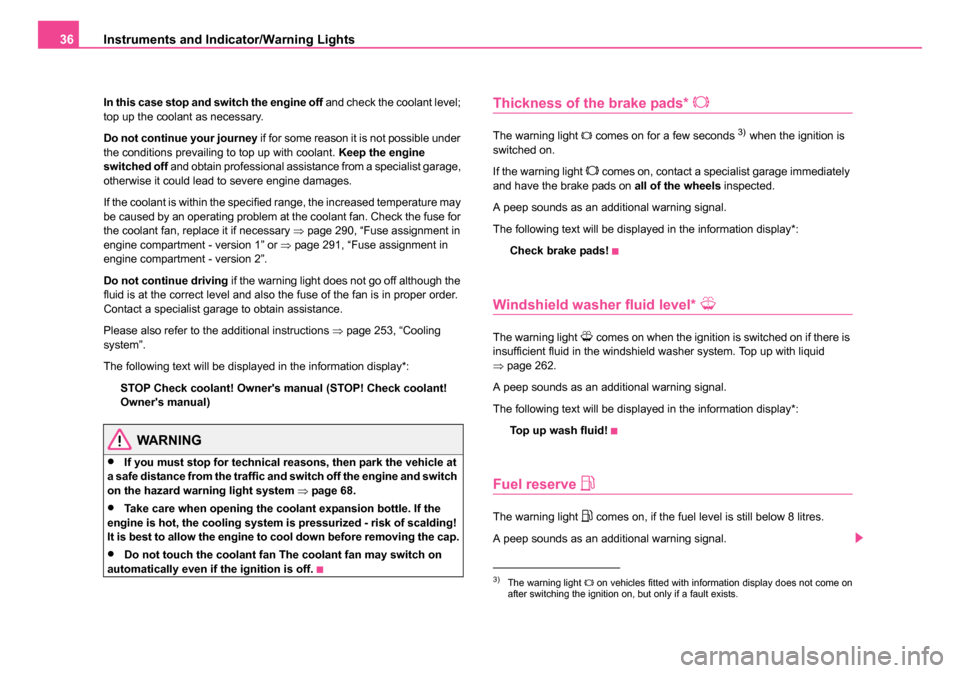
Thickness of the brake pads*
The warning light comes on for a few seconds 3) when the ignition is
switched on.
If the warning light
comes on, contact a specialist garage immediately
and have the brake pads on all of the wheels inspected.
A peep sounds as an additional warning signal.
The following text will be displayed in the information display*: Check brake pads!
Windshield washer fluid level*
The warning light comes on when the ignition is switched on if there is
insufficient fluid in the windshield washer system. Top up with liquid
⇒ page 262.
A peep sounds as an additional warning signal.
The following text will be displayed in the information display*: Top up wash fluid!
Fuel reserve
The warning light comes on, if the fuel level is still below 8 litres.
A peep sounds as an additional warning signal.
3)The warning light on vehicles fitted with information display does not come on
after switching the ignition on, but only if a fault exists.
s24s.book Page 36 Thursday, November 24, 2005 12:27 PM
Page 41 of 315
Instruments and Indicator/Warning Lights
40
Note
If the battery has been disconnected and reconnected, the warning light comes on after switching on the ignition. The warning light must go out
after driving a short distance.
Electronic Stability Programme (ESP)*
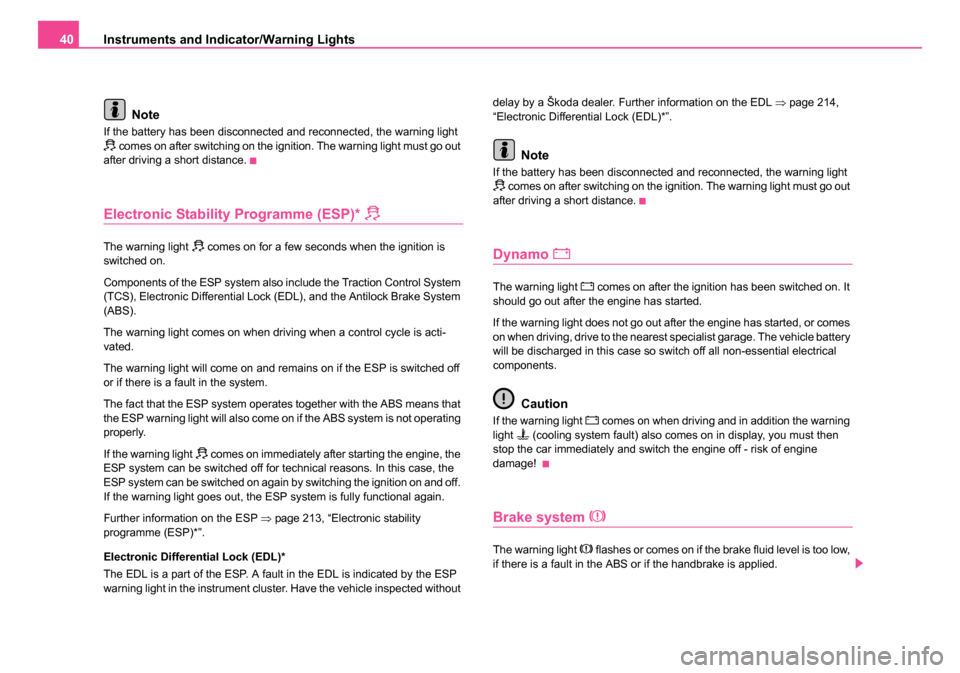
The warning light comes on for a few seconds when the ignition is
switched on.
Components of the ESP system also include the Traction Control System
(TCS), Electronic Differential Lock (EDL), and the Antilock Brake System
(ABS).
The warning light comes on when driving when a control cycle is acti-
vated.
The warning lig ht will come on an d remains on if the ESP is switched off
or if there is a fault in the system.
The fact that the ESP system operates together with the ABS means that
the ESP warning light will also come on if the ABS system is not operating
properly.
If the warning light
comes on immediately after starting the engine, the
ESP system can be switched off for technical reasons. In this case, the
ESP system can be switched on again by switching the ignition on and off.
If the warning light goes out, the ESP system is fully functional again.
Further information on the ESP ⇒page 213, “Electronic stability
programme (ESP)*”.
Electronic Differential Lock (EDL)*
The EDL is a part of the ESP. A fault in the EDL is indicated by the ESP
warning light in the instrument cluster. Have the vehicle inspected without delay by a Škoda dealer. Further information on the EDL
⇒page 214,
“Electronic Differential Lock (EDL)*”.
Note
If the battery has been disconnected and reconnected, the warning light comes on after switching on the ignition. The warning light must go out
after driving a short distance.
Dynamo
The warning light comes on after the ignition has been switched on. It
should go out after the engine has started.
If the warning light does not go out after the engine has started, or comes
on when driving, drive to the nearest specialist garage. The vehicle battery
will be discharged in this case so switch off all non-essential electrical
components.
Caution
If the warning light comes on when driving and in addition the warning
light (cooling system fault) also comes on in display, you must then
stop the car immediately and switch the engine off - risk of engine
damage!
Brake system
The warning light flashes or comes on if the brake fluid level is too low,
if there is a fault in the ABS or if the handbrake is applied.
s24s.book Page 40 Thursday, November 24, 2005 12:27 PM
Page 110 of 315
Seats and Stowage109
Using the systemSafetyDriving TipsGeneral MaintenanceBreakdown assistanceTechnical Data
– Raise the lid and press it until the catch is heard to engage.
There is a holder for a pen and note book on the inside of the lid.
WARNING
•The storage compartment must always be closed when driving
for safety reasons.
•The beverage holder should not be used while driving.
Cooling of storage compar tment on front passenger
side*
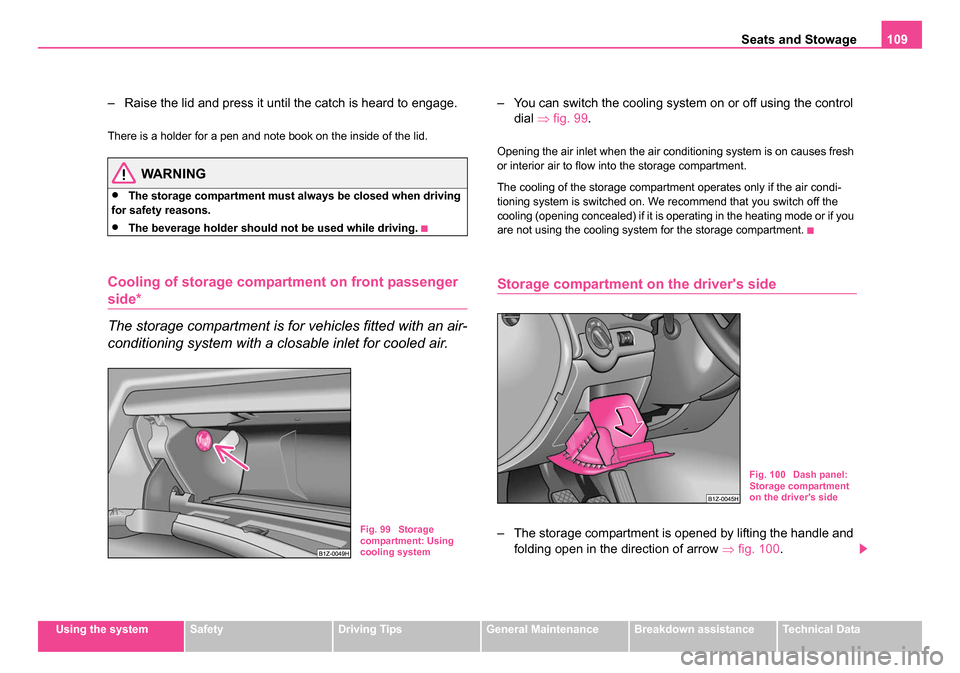
The storage compartment is for vehicles fitted with an air-
conditioning system with a closable inlet for cooled air.
– You can switch the cooling system on or off using the control
dial ⇒fig. 99.
Opening the air inlet when the air conditioning system is on causes fresh
or interior air to flow into the storage compartment.
The cooling of the storage compartment operates only if the air condi-
tioning system is switched on. We recommend that you switch off the
cooling (opening concealed) if it is operating in the heating mode or if you
are not using the cooling system for the storage compartment.
Storage compartment on the driver's side
– The storage compartment is opened by lifting the handle and
folding open in the direction of arrow ⇒fig. 100 .Fig. 99 Storage
compartment: Using
cooling system
Fig. 100 Dash panel:
Storage compartment
on the driver's side
s24s.book Page 109 Thursday, November 24, 2005 12:27 PM
Page 113 of 315
Seats and Stowage
112
Stowage compartment be low front passenger seat*
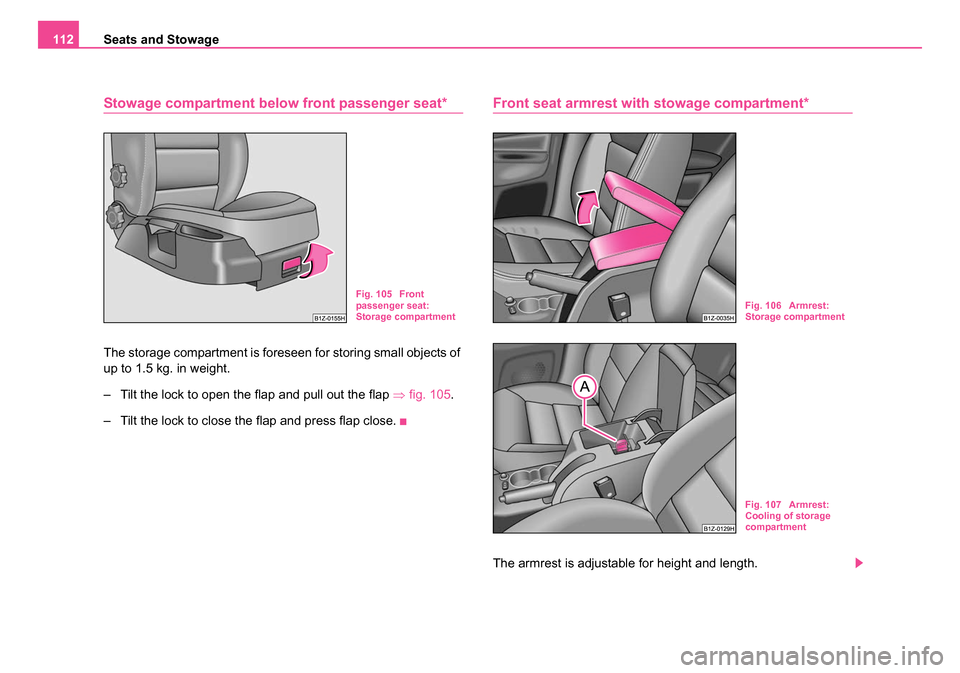
The storage compartment is foreseen for storing small objects of
up to 1.5 kg. in weight.
– Tilt the lock to open the flap and pull out the flap ⇒fig. 105 .
– Tilt the lock to close the flap and press flap close.
Front seat armrest with stowage compartment*
The armrest is adjustable for height and length.
Fig. 105 Front
passenger seat:
Storage compartmentFig. 106 Armrest:
Storage compartment
Fig. 107 Armrest:
Cooling of storage
compartment
s24s.book Page 112 Thursday, November 24, 2005 12:27 PM
Page 124 of 315
Heating and air conditioning system 123
Using the systemSafetyDriving TipsGeneral MaintenanceBreakdown assistanceTechnical Data
Climatic* (semi-automatic air
conditioning system)
Description
The Climatic is a combined cooling and heating system. It
makes it possible to optimally control the air temperature
at any season of the year.
Description of the Climatic
It is important for your safety and for your driving comfort that the Climatic
is operating properly.
The cooling only operates if button ⇒page 124, fig. 119 is
pressed, and the following conditions are met:
•engine running,
•outside temperature above +2 °C and
•blower switch switched on (positions 1 to 4).
If the cooling system is switched on, the temperature and air humidity
drops in the vehicle. The wellbeing of the occupants of the car is
enhanced as a result of this particularly at high outside temperatures and
a high air humidity. The system prevents the windows misting up during
the cold season of the year.
The heating effect is dependent upon the coolant temperature, thus full
heat output only occurs when the engine has reached its operating
temperature.
It is possible to briefly activate recirculated air mode in order to enhance
the cooling effect ⇒.
Air at a temperature of about 5°C may flow out of the vents under certain
circumstances when the cooling system is operating. Lengthy and uneven distribution of the air flow out of the vents (in particular at the leg area) and
large differences in temperature, for example when getting out of the
vehicle, can result in chills in sensitive persons.
The air inlet in front of the windscreen must be free of ice, snow or leaves
in order to ensure that the heating and cooling systems operate properly.
After switching on the cooling
Condensation from the evaporator of the
air conditioning may drip down and form a puddle below the vehicle. This
is quite normal and not an indication of a leak!
WARNING
•For your own safety and that of other road users, ensure that all
the windows are free of ice, snow and misting. Please familiarize
yourself about how to correctly operate the heating and ventilation
systems, how to demist and defrost the windows, as well as with
the cooling mode.
•You should not leave recirculated air mode on over a longer
period of time. “Stale air” may result in fatigue in the driver and
passengers, reduce attention levels and also cause the windows to
mist up. The risk of having an accident increases. Switch recircu-
lated air mode off as soon as the windows begin misting up.
Note
•We recommend that you do not smoke in the vehicle when the recir-
culating air mode is operating since the smoke which is drawn at the evap-
orator from the interior of the vehicle forms deposits in the evaporator of
the air conditioning system. This produces a permanent odour when the
air conditioning system is operating which can only be eliminated through
considerable effort and expense (replacement of compressor).
ACA1
s24s.book Page 123 Thursday, November 24, 2005 12:27 PM
Page 125 of 315
Heating and air conditioning system
124
Using the system
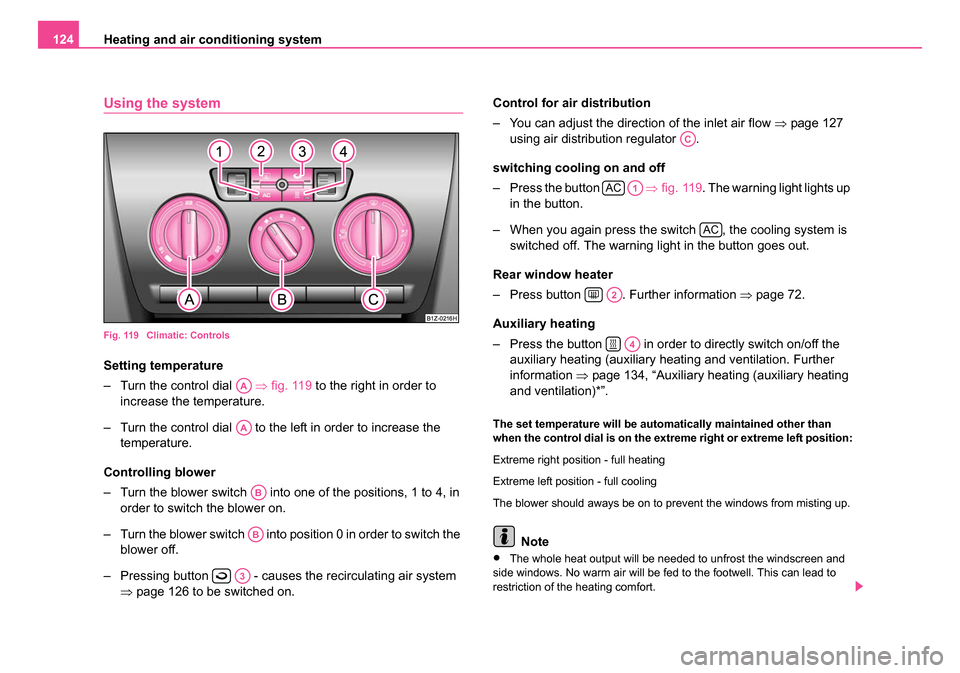
Fig. 119 Climatic: Controls
Setting temperature
– Turn the control dial ⇒fig. 119 to the right in order to
increase the temperature.
– Turn the control dial to the left in order to increase the temperature.
Controlling blower
– Turn the blower switch into one of the positions, 1 to 4, in order to switch the blower on.
– Turn the blower switch into position 0 in order to switch the blower off.
– Pressing button - causes the recirculating air system ⇒page 126 to be switched on. Control for air distribution
– You can adjust the direction of the inlet air flow
⇒page 127
using air distribution regulator .
switching cooling on and off
– Press the button ⇒fig. 119 . The warning light lights up
in the button.
– When you again press the switch , the cooling system is switched off. The warning light in the button goes out.
Rear window heater
– Press button . Further information ⇒page 72.
Auxiliary heating
– Press the button in order to directly switch on/off the auxiliary heating (auxiliary heating and ventilation. Further
information ⇒page 134, “Auxiliary heating (auxiliary heating
and ventilation)*”.
The set temperature will be automatically maintained other than
when the control dial is on the extreme right or extreme left position:
Extreme right position - full heating
Extreme left position - full cooling
The blower should aways be on to prevent the windows from misting up.
Note
•The whole heat output will be needed to unfrost the windscreen and
side windows. No warm air will be fed to the footwell. This can lead to
restriction of the heating comfort.
AA
AA
AB
AB
A3
AC
ACA1
AC
A2
A4
s24s.book Page 124 Thursday, November 24, 2005 12:27 PM
Page 126 of 315
Heating and air conditioning system 125
Using the systemSafetyDriving TipsGeneral MaintenanceBreakdown assistanceTechnical Data
•The used air streams out through the air removal openings in the
luggage compartment.
•If the cooling system has not been switched on for a lengthy period,
odours may be produced at the evaporator because of deposits. Switch
the cooling system on at least once a month for approximately 5 minutes
at the highest blower stage - also during the cold season of the year - in
order to remove such odours. Also open a window for a short time.
•Please refer to the information regarding recirculated air mode
⇒ page 126.
Set Climatic
Recommended settings of Climatic controls for the respective operating
modes:
Defrosting the windscreen and side windows
•Put the control dial ⇒page 124, fig. 119 to the temperature selected
as usual by you (we recommend 22 °C); Climatic puts automatically the
heating to maximum power, until the temperature selected by you is
achieved
•Blower switch in position 3
•Turn the air distribution control into the position
•Open air outlet vents 3 ⇒ page 127, fig. 120 and point towards the side
window
•Close the air outlet vents 4
Keeping windscreen and side windows demisted
We recommend that you use the following setting in cases where the
windows are misted up more than usual (e.g. when it is raining):
Blower switch in position 2
Turn the air distribution control into the position
Open air outlet vents 3 and point towards the side window
Close the air outlet vents 4
Switch on the cooling system by pressing button
Warming up the inside of the vehicle as rapidly as possible
•Put the control dial to the temperature selected as usual by you (we
recommend 22 °C); Climatic puts au tomatically the heating to maximum
power, until the temperature selected by you is achieved
•Blower switch in position 3
•Turn the air distribution control into the position
•Open the air outlet vents 3 and 4
•We recommend briefly pressing button air recirculation mode. The
windows can steam up in this position however.
Heating the vehicle to a comfortable temperature
We recommend the following setting once the windows are no longer
misted up and the desired teperature has been reached:
•Control dial at the desired heat temperature
•Blower switch in position 2 or 3
•Turn the air distribution control into the position
•Open the air outlet vents 3
•Close the air outlet vents 4
•Set the air distribution regulator as required between positions
and , if the windscreen gets misted up again.
Cooling down the inside of the vehicle as rapidly as possible
•Close all windows and the sliding/tilting roof
•Put the control dial to the temperature selected as usual by you (we
recommend 22 °C); Climatic puts au tomatically the heating to maximum
power, until the temperature selected by you is achieved.
AA
AB
AC
AB
AC
A1
AA
AB
AC
A3
AA
AB
AC
AC
AA
s24s.book Page 125 Thursday, November 24, 2005 12:27 PM
Page 127 of 315
Heating and air conditioning system
126
•Control dial in the position 4, supplies the interior of the car with
fresh air.
•After brief airing, turn the control dial to the position 2 or 3
•Turn the air distribution control into the position
•Open the air outlet vents 3 and 4
•Switch on the cooling system by pressing button
•We recommend briefly pressing button air recirculation mode.
Optimum cooling
•Control dial at the desired heat temperature. This temperature will
be maintained automatically.
•Blower switch in position 1, 2 , or 3
•Turn the air distribution control into the position
•Open the air outlet vents 3 and 4
•Switch on the cooling system by pressing button
•We recommend setting the air outlet vents 3 and 4 in such a way that
the air flows to the rear over the heads of the occupants. Do not switch to
recirculated air mode.
Fresh air mode - ventilation
Non pre-warmed fresh air streams through the air inlet nozzles 3 and 4 for
the following settings.
•Turn the control dial ⇒page 124, fig. 119 to the left up to the stop
•Blower switch in the desired position
•Turn the air distribution control into the position
•Open air outlet vents 3 and 4 ⇒ page 127, fig. 120
•Switch off the cooling by pressing button
•Switch off the recirculated air mode by pressing button
The control dial can be set to other positions as required.
Recirculated air mode
In recirculated air mode air is sucked out of the interior of
the vehicle and then fed back into the interior.
Recirculated air mode prevents polluted air outside the vehicle
from getting into the vehicle, for example when driving through a
tunnel or when standing in a traffic jam.
Switching recirculated air mode on
– Press the button ⇒page 124, fig. 119 - the warning light
lights up in the button.
Switching recirculated air mode off
– Press again the button - the warning light in the button goes out.
Recirculated air mode is switched off automatically if the air distribution
control is in position ⇒ page 124, fig. 119 . You can also switch recir-
culated air mode on again from this setting by repeatedly pressing button
.
WARNING
You should not leave recirculated air mode on over a longer period
of time. “Stale air” may result in fatigue in the driver and passen-
gers, reduce attention levels and also cause the windows to mist
up. The risk of having an accident increases. Switch recirculated
air mode off as soon as the windows begin misting up.
AB
AB
AC
A1
A3
AA
AB
AC
A1
AA
AB
AC
A1
A3
AC
AC
s24s.book Page 126 Thursday, November 24, 2005 12:27 PM