ECU SKODA OCTAVIA 2006 Owner´s Manual
[x] Cancel search | Manufacturer: SKODA, Model Year: 2006, Model line: OCTAVIA, Model: SKODA OCTAVIA 2006Pages: 218, PDF Size: 5.48 MB
Page 66 of 218
CAUTION
Please ensure that the heating elements for the rear window heater are not dam-
aged as a result of objects placed in this area. Note
Opening the boot lid also lifts up the boot cover. ÐFoldable boot cover (Combi)
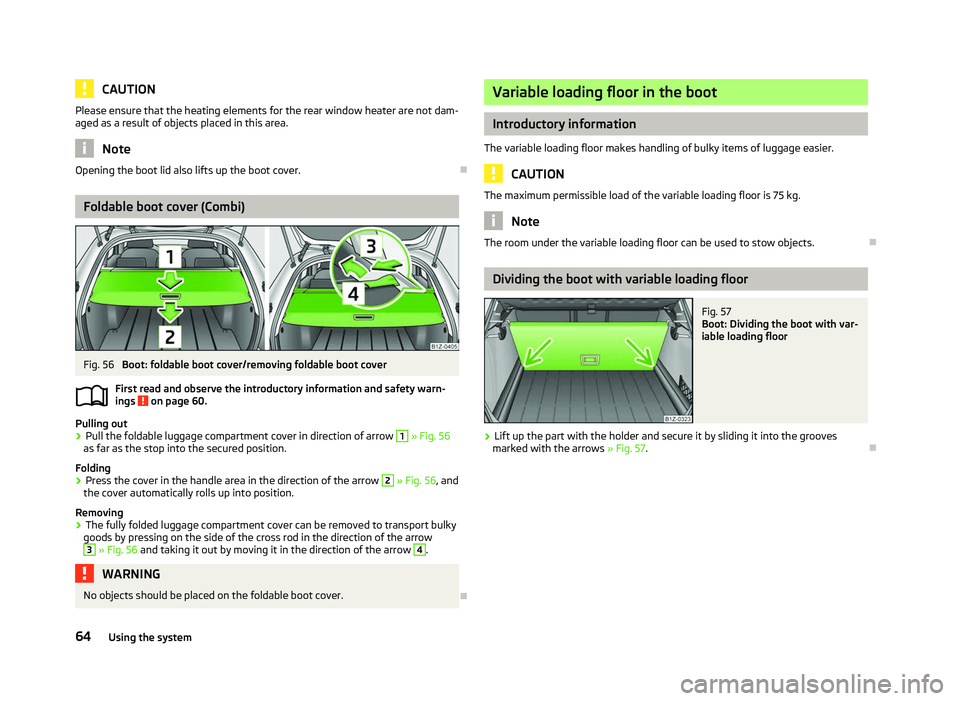
Fig. 56
Boot: foldable boot cover/removing foldable boot cover
First read and observe the introductory information and safety warn-
ings on page 60.
Pulling out
›
Pull the foldable luggage compartment cover in direction of arrow 1
» Fig. 56
as far as the stop into the secured position.
Folding
› Press the cover in the handle area in the direction of the arrow 2
» Fig. 56
, and
the cover automatically rolls up into position.
Removing
› The fully folded luggage compartment cover can be removed to transport bulky
goods by pressing on the side of the cross rod in the direction of the arrow 3
» Fig. 56
and taking it out by moving it in the direction of the arrow 4
.
WARNING
No objects should be placed on the foldable boot cover. Ð
ä Variable loading floor in the boot
Introductory information
The variable loading floor makes handling of bulky items of luggage easier. CAUTION
The maximum permissible load of the variable loading floor is 75 kg. Note
The room under the variable loading floor can be used to stow objects. Ð Dividing the boot with variable loading floor
Fig. 57
Boot: Dividing the boot with var-
iable loading floor
› Lift up the part with the holder and secure it by sliding it into the grooves
marked with the arrows »
Fig. 57. Ð
64 Using the system
Page 67 of 218
Removing the variable loading floor
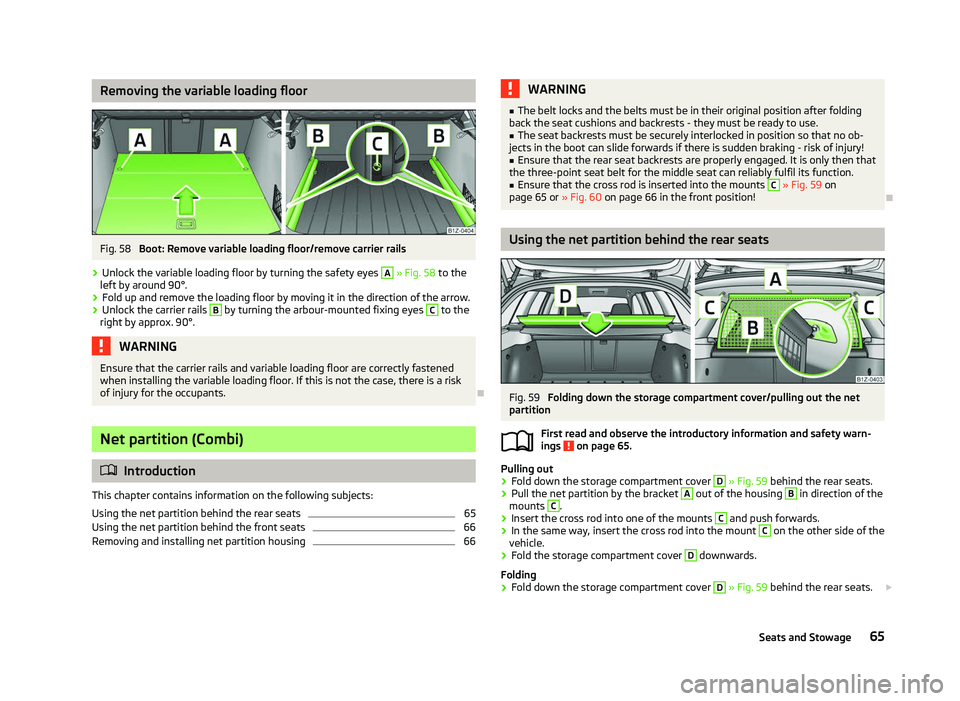
Fig. 58
Boot: Remove variable loading floor/remove carrier rails
› Unlock the variable loading floor by turning the safety eyes A
» Fig. 58
to the
left by around 90°.
› Fold up and remove the loading floor by moving it in the direction of the arrow.
› Unlock the carrier rails B
by turning the arbour-mounted fixing eyes C
to the
right by approx. 90°. WARNING
Ensure that the carrier rails and variable loading floor are correctly fastened
when installing the variable loading floor. If this is not the case, there is a risk
of injury for the occupants. ÐNet partition (Combi)
ä
Introduction
This chapter contains information on the following subjects:
Using the net partition behind the rear seats 65
Using the net partition behind the front seats 66
Removing and installing net partition housing 66 WARNING
■ The belt locks and the belts must be in their original position after folding
back the seat cushions and backrests - they must be ready to use.
■ The seat backrests must be securely interlocked in position so that no ob-
jects in the boot can slide forwards if there is sudden braking - risk of injury!
■ Ensure that the rear seat backrests are properly engaged. It is only then that
the three-point seat belt for the middle seat can reliably fulfil its function. ■ Ensure that the cross rod is inserted into the mounts C
» Fig. 59 on
page 65 or » Fig. 60 on page 66 in the front position! Ð Using the net partition behind the rear seats
Fig. 59
Folding down the storage compartment cover/pulling out the net
partition
First read and observe the introductory information and safety warn-
ings on page 65.
Pulling out
› Fold down the storage compartment cover D
» Fig. 59 behind the rear seats.
› Pull the net partition by the bracket A
out of the housing B
in direction of the
mounts C
.
› Insert the cross rod into one of the mounts C
and push forwards.
› In the same way, insert the cross rod into the mount C
on the other side of the
vehicle.
› Fold the storage compartment cover D
downwards.
Folding
› Fold down the storage compartment cover D
» Fig. 59 behind the rear seats.
£
ä
65
Seats and Stowage
Page 69 of 218
WARNING
■ The items which you transport on the roof bar system must be reliably at-
tached - risk of accident!
■ Always secure the load with appropriate and undamaged lashing straps or
tensioning straps. ■ Distribute the load evenly over the roof rack system.
■ The handling properties of your vehicle change when you transport heavy or
bulky items on the roof bar system as a result of the displacement of the cen-
tre of gravity and the increased wind attack area - risk of accident! The style
of driving and speed must therefore be adapted to the current circumstances. ■ Avoid abrupt and sudden driving/braking manoeuvres.
■ Adjust the speed and driving style to the visibility, weather, road and traffic
conditions. ■ The permissible roof load, permissible axle loads and gross permissible
weight of your vehicle must not be exceeded under any circumstances - risk
of accident! CAUTION
■ Only use roof rack systems approved by ŠKODA.
■ If other roof rack systems are used or if the roof bars are not fitted correctly,
any resulting damage to the vehicle is not covered by the warranty. It is therefore
essential that the supplied fitting instructions for the roof rack system are ob-
served.
■ On models fitted with a power sliding/tilting roof, ensure that the opened slid-
ing/tilting roof does not strike any items of luggage transported on the roof. ■ Ensure that the boot lid does not hit the roof load when opened.
■ The height of the vehicle changes after mounting a roof luggage rack system
and the load that is secured to it. Compare the vehicle height with available clear-
ances, such as underpasses and garage doors.
■ Always remove the roof luggage rack system before entering an automated car
wash. ■ Ensure the roof aerial is not impaired by the secured load. For the sake of the environment
The increased aerodynamic drag results in a higher fuel consumption. Note
If the vehicle is not factory-equipped with a roof rack, it can be purchased from
the
ŠKODA Original Accessories. Ð Attachment points
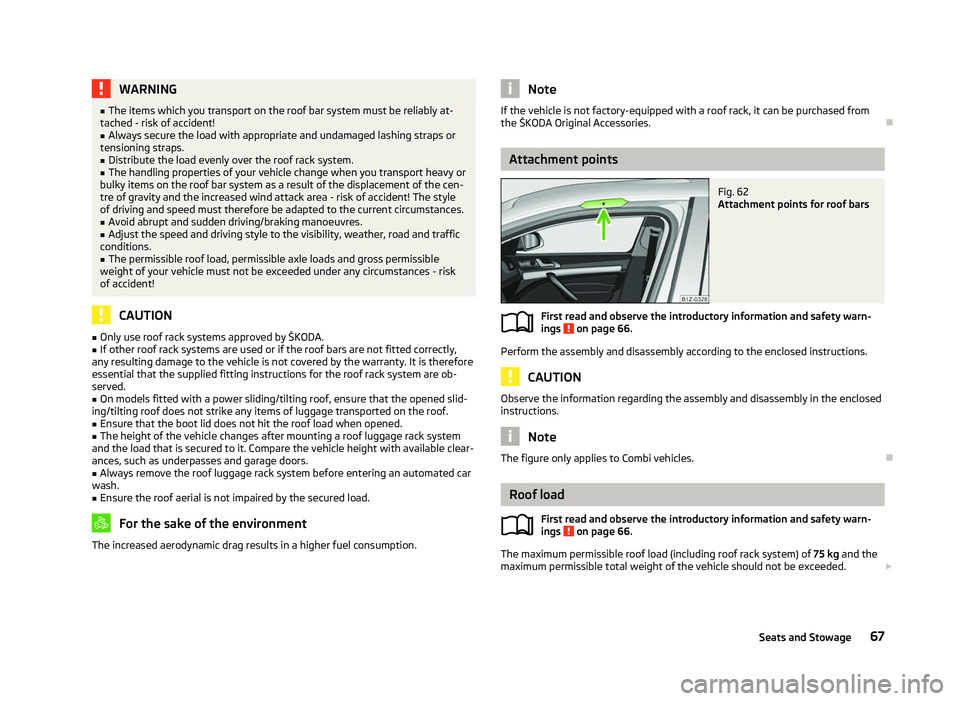
Fig. 62
Attachment points for roof bars
First read and observe the introductory information and safety warn-
ings on page 66.
Perform the assembly and disassembly according to the enclosed instructions.
CAUTION
Observe the information regarding the assembly and disassembly in the enclosed
instructions. Note
The figure only applies to Combi vehicles. Ð Roof load
First read and observe the introductory information and safety warn-
ings on page 66.
The maximum permissible roof load (including roof rack system) of
75 kg and the
maximum permissible total weight of the vehicle should not be exceeded. £
ä
ä
67
Seats and Stowage
Page 74 of 218
WARNING
The storage compartment must always be closed when driving for safety rea-
sons. ÐStorage compartment on the dash panel
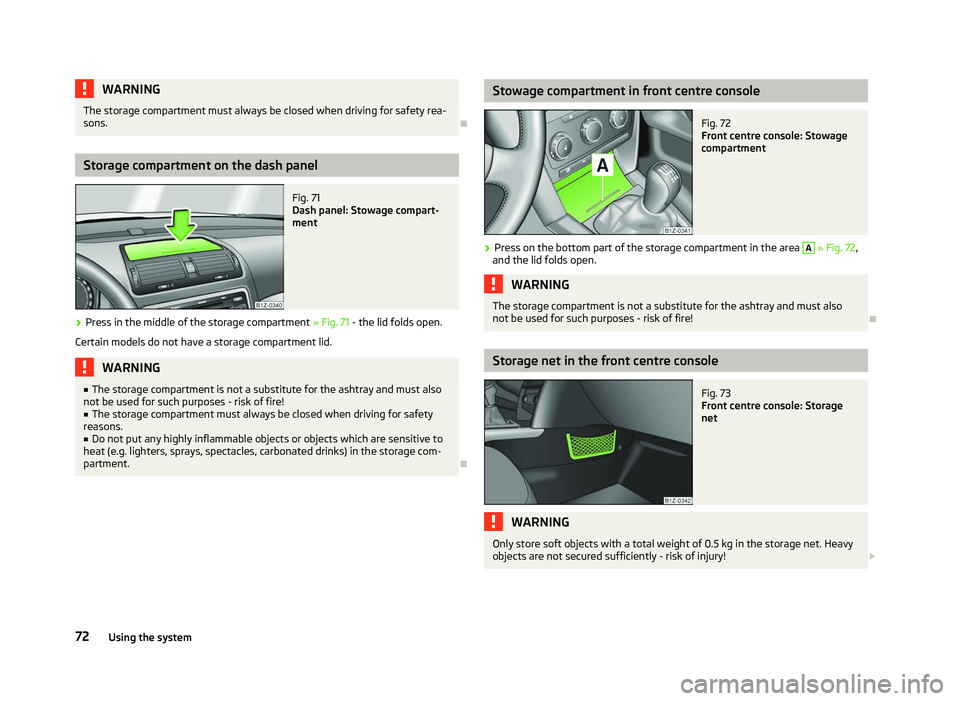
Fig. 71
Dash panel: Stowage compart-
ment
› Press in the middle of the storage compartment
» Fig. 71 - the lid folds open.
Certain models do not have a storage compartment lid. WARNING
■ The storage compartment is not a substitute for the ashtray and must also
not be used for such purposes - risk of fire!
■ The storage compartment must always be closed when driving for safety
reasons.
■ Do not put any highly inflammable objects or objects which are sensitive to
heat (e.g. lighters, sprays, spectacles, carbonated drinks) in the storage com-
partment. Ð Stowage compartment in front centre console
Fig. 72
Front centre console: Stowage
compartment
› Press on the bottom part of the storage compartment in the area A
» Fig. 72
,
and the lid folds open. WARNING
The storage compartment is not a substitute for the ashtray and must also
not be used for such purposes - risk of fire! Ð Storage net in the front centre console
Fig. 73
Front centre console: Storage
net WARNING
Only store soft objects with a total weight of 0.5 kg in the storage net. Heavy
objects are not secured sufficiently - risk of injury! £
72 Using the system
Page 78 of 218
Opening from the passenger compartment
›
You can fold down the armrest at the loop
» page 60.
› Pull the handle upwards to the stop
» Fig. 81 - and fold the cover down.
Opening from the boot
› Push the unlock button 1
» Fig. 81
- down and fold the cover (including the
armrest) forwards.
Closing
› Fold the cover and armrest upwards to the stop - the lid must click into place.
Ensure that the armrest is always locked into place after closing. This is apparent
as the red field above the unlocking button 1
» Fig. 81
- is not visible from the
luggage compartment. WARNING
The through-loading channel is only intended for transporting skis that are
placed in a properly secured, removable through-loading bag » page 76.ÐRemovable through-loading bag
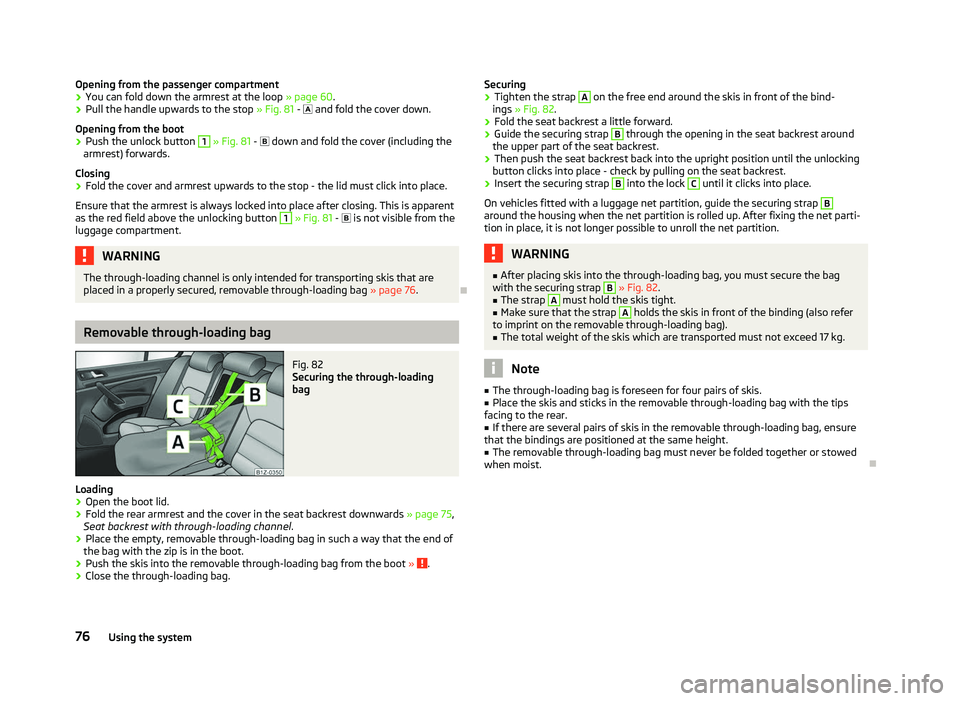
Fig. 82
Securing the through-loading
bag
Loading › Open the boot lid.
› Fold the rear armrest and the cover in the seat backrest downwards
» page 75,
Seat backrest with through-loading channel .
› Place the empty, removable through-loading bag in such a way that the end of
the bag with the zip is in the boot.
› Push the skis into the removable through-loading bag from the boot
» .
› Close the through-loading bag. Securing
›
Tighten the strap A
on the free end around the skis in front of the bind-
ings » Fig. 82 .
› Fold the seat backrest a little forward.
› Guide the securing strap B
through the opening in the seat backrest around
the upper part of the seat backrest.
› Then push the seat backrest back into the upright position until the unlocking
button clicks into place - check by pulling on the seat backrest.
› Insert the securing strap B
into the lock C
until it clicks into place.
On vehicles fitted with a luggage net partition, guide the securing strap B
around the housing when the net partition is rolled up. After fixing the net parti-
tion in place, it is not longer possible to unroll the net partition.
WARNING
■ After placing skis into the through-loading bag, you must secure the bag
with the securing strap B
» Fig. 82.
■ The strap A
must hold the skis tight.
■ Make sure that the strap A
holds the skis in front of the binding (also refer
to imprint on the removable through-loading bag).
■ The total weight of the skis which are transported must not exceed 17 kg. Note
■ The through-loading bag is foreseen for four pairs of skis.
■ Place the skis and sticks in the removable through-loading bag with the tips
facing to the rear.
■ If there are several pairs of skis in the removable through-loading bag, ensure
that the bindings are positioned at the same height.
■ The removable through-loading bag must never be folded together or stowed
when moist. Ð
76 Using the system
Page 113 of 218

Note
■ If a suitable adapter is available for your mobile phone, only use your mobile
phone in the adapter inserted in the telephone mount so that the radiation in the
vehicle drops to a minimum. ■ Placing the mobile phone in the adapter inserted in the telephone mount en-
sures optimum sending and receiving power. ÐInserting the mobile phone and adapter
Fig. 106
Universal telephone preinstalla-
tion
Only one telephone mount is factory-fitted. An adapter for the mobile phone can
be purchased from ŠKODA Original Accessories.
Inserting the adapter and mobile phone › First of all push the adapter A
in the direction of the arrow
» Fig. 106 up to the
stop into the mount. Then press the adapter slightly downwards, until it locks
securely into position.
› Insert the mobile phone into the adapter A
(as specified in the instructions
from the manufacturer of the adapter).
Removing the adapter and mobile phone
› Simultaneously press the locks on the mount
» Fig. 106 and remove the adapter
with the mobile phone. CAUTION
Taking the mobile phone out of the adapter during the call can lead to interrup-
tion of the connection. When removing the mobile phone, the connection to the
factory-fitted antenna is interrupted, which reduces the quality of the transmit-
ting and receiving signal. The charging of the mobile phone battery is also inter-
rupted. Ð Managing telephone calls with the help of the adapter
Fig. 107
Principle sketch: single-button adapter/two-button adapter
Function overview of the »
Fig. 107 (PTT - “push to talk”) button on the adapt-
er:
› Switch on/off voice control;
› Accept/end a call.
On some adapters include the button SOS » Fig. 107
A
in addition to the button
. After pressing this button for 2 seconds, the number 112 (Emergency call) is
dialled. Note
On vehicles fitted with the Columbus navigation system , the buttons and
SOS do not work.
Ð
111
Communication
Page 122 of 218
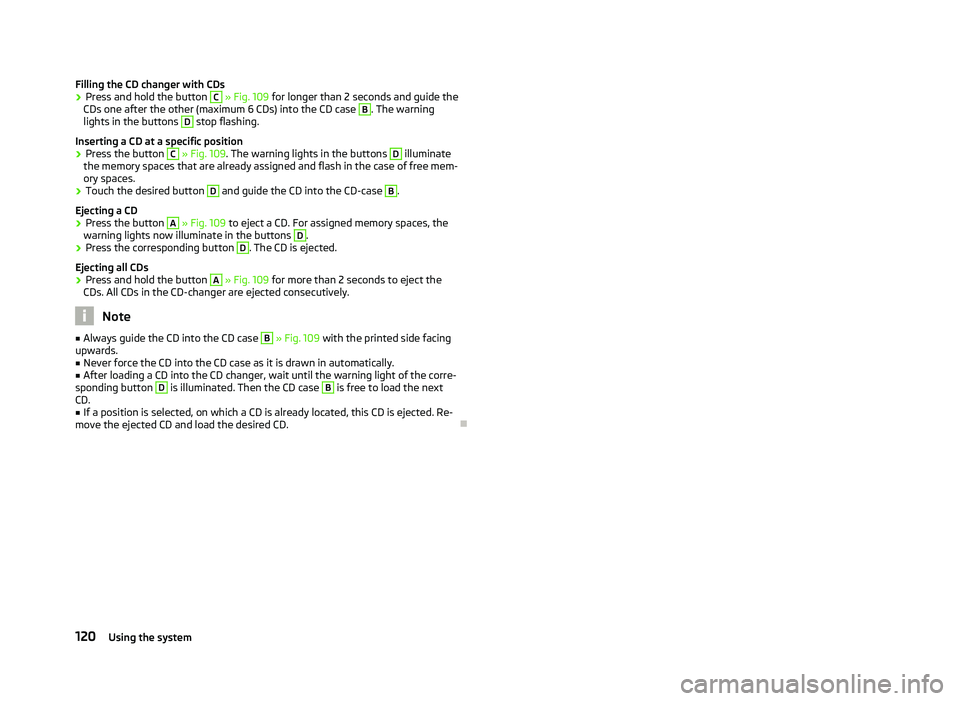
Filling the CD changer with CDs
›
Press and hold the button C
» Fig. 109 for longer than 2
seconds and guide the
CDs one after the other (maximum 6 CDs) into the CD case B
. The warning
lights in the buttons D
stop flashing.
Inserting a CD at a specific position
› Press the button C
» Fig. 109. The warning lights in the buttons D
illuminate
the memory spaces that are already assigned and flash in the case of free mem-
ory spaces.
› Touch the desired button D
and guide the CD into the CD-case B
.
Ejecting a CD
› Press the button A
» Fig. 109 to eject a CD. For assigned memory spaces, the
warning lights now illuminate in the buttons D
.
› Press the corresponding button D
. The CD is ejected.
Ejecting all CDs
› Press and hold the button A
» Fig. 109 for more than 2
seconds to eject the
CDs. All CDs in the CD-changer are ejected consecutively. Note
■ Always guide the CD into the CD case B
» Fig. 109 with the printed side facing
upwards.
■ Never force the CD into the CD case as it is drawn in automatically.
■ After loading a CD into the CD changer, wait until the warning light of the corre-
sponding button D
is illuminated. Then the CD case B
is free to load the next
CD.
■ If a position is selected, on which a CD is already located, this CD is ejected. Re-
move the ejected CD and load the desired CD. Ð
120 Using the system
Page 123 of 218
Safety
Passive Safety
General information
ä
Introduction
This chapter contains information on the following subjects:
Safety equipment 121
Before setting off 121
What influences the driving safety? 122
In this section you will find important information, tips and notes on the subject
of passive safety in your vehicle. We have combined everything here which you
should be familiar with, for example, regarding seat belts, airbags, child seats and
safety of children. It is therefore important, in particular, to comply with the notes
and warnings in this section for your own interest and in the interest of those
travelling with you. WARNING
■ This chapter contains important information on how to use the vehicle for
the driver and his occupants. You will find further information on safety, which
concerns you and those travelling with you, in the following chapters of this
Owner's Manual.
■ The complete on-board literature should always be in the vehicle. This ap-
plies in particular, if you rent out or sell the vehicle. ÐSafety equipment
First read and observe the introductory information and safety warn-
ings on page 121.
The following list contains part of the safety equipment in your vehicle:
› three-point seat belts for all the seats;
› belt force limiter for front and outer rear seats;
ä ›
belt tensioners for front seats;
› seat belt height adjusters for front seats;
› Front airbag for the driver and the front seat passenger;
› side airbags;
› head airbags;
› anchoring points for child seat using the
ISOFIX system;
› anchoring points for child seat using the TOP TETHER system;
› head restraints adjustable for height;
› adjustable steering column.
The specified safety equipment works together, in order to optimally protect you
and those travelling with you in accident situations. The safety equipment does
not protect you or the people travelling with you, if you or your occupants adopt
an incorrect seated position or the equipment is not correctly adjusted or used. Ð Before setting off
First read and observe the introductory information and safety warn-
ings on page 121.
For your own safety and the safety of the people travelling with you, please pay
attention to the following points before setting off.
›
Ensure that the lighting and the turn signal system are functioning properly.
› Check the tyre inflation pressure.
› Ensure that all of the windows offer good visibility to the outside.
› Secure all items of luggage
» page 60, Boot.
› Ensure that no objects can obstruct the pedals.
› Adjust the mirrors, the front seat and head restraint to your body size.
› Advise your passengers to adjust the head restraints to their body size.
› Protect children in suitable child seats with correctly fastened seat
belts
» page 135, Transporting children safely .
› Adopt the correct seated position
» page 122, Correct seated position . Tell your
passengers to assume the correct seated position.
› Correctly fasten the seat belt. Also inform passengers to fasten the seat belt
correctly » page 125, Seat belts . Ð
ä
121
Passive Safety
Page 138 of 218
The following guidelines must be observed when using a child safety seat in
which the child is seated with its back facing the direction of travel on the front
passenger seat.
›
Switch off the front passenger airbag
» page 133, Deactivating airbags .
› Slide the front passenger seat all the way back.
› Move the front passenger seat backrest into the vertical position.
› Set the height-adjustable front passenger seat as high up as possible.
› Adjust the seat belt for the front passenger seat so that it is as high as possible
(not suitable for a child seat fastened with the
ISOFIX system).
› Place and fasten the child seat on the seat and the child in the child seat ac-
cording to the specifications in the manufacturer's user manual of the child
seat . WARNING
■ It is essential to always switch off the front passenger airbag when attach-
ing a child safety seat to the front passenger seat where the child is seated
with its back facing in direction of travel » page 133 , Deactivating airbags.
■ Never use a child safety seat in which the child is seated with its back facing
the direction of travel on the front passenger seat if the airbag is switched on.
This child safety seat is positioned in the deployment area of the front pas-
senger airbag. The airbag may cause the child severe, or even fatal injuries, in
the event of it being deployed.
■ This is also clearly stated on the sticker which is located on the B column on
the front passenger side » Fig. 121. The sticker is visible upon opening the
front passenger door. For some countries, the sticker is also affixed to the sun
visor of the front passenger.
■ If a child safety seat in which the child faces in the direction of travel is used
on the front passenger seat, the front passenger seat must be moved back
and to the top fully. Move the backrest into the vertical position. ■ The front passenger airbag must be reactivated as soon as you no longer
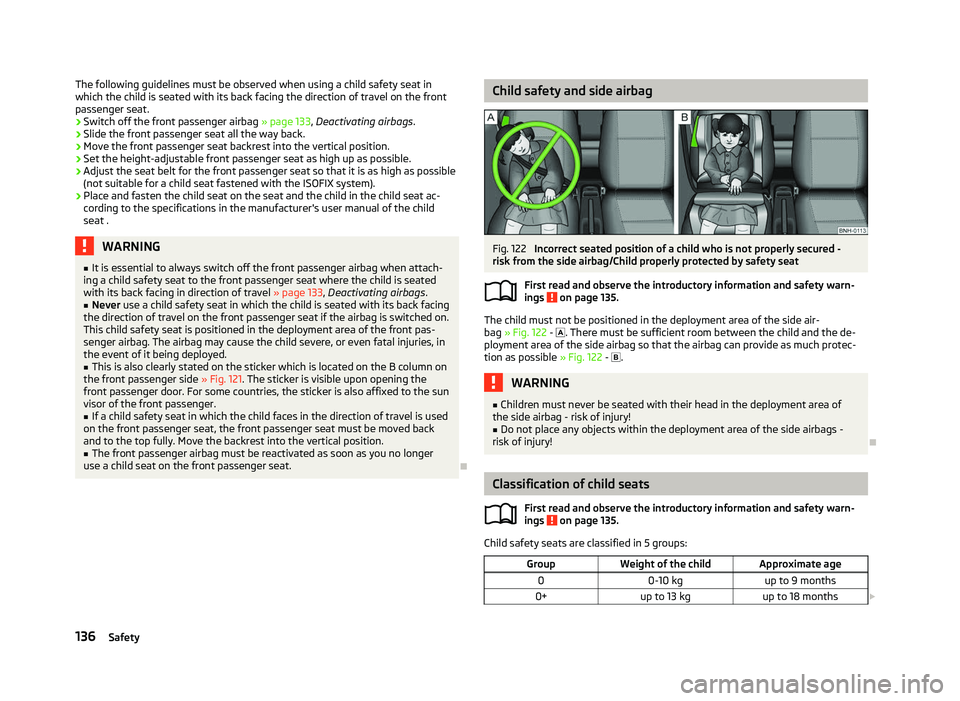
use a child seat on the front passenger seat. Ð Child safety and side airbag
Fig. 122
Incorrect seated position of a child who is not properly secured -
risk from the side airbag/Child properly protected by safety seat
First read and observe the introductory information and safety warn-
ings on page 135.
The child must not be positioned in the deployment area of the side air-
bag » Fig. 122 - . There must be sufficient room between the child and the de-
ployment area of the side airbag so that the airbag can provide as much protec-
tion as possible » Fig. 122 - . WARNING
■ Children must never be seated with their head in the deployment area of
the side airbag - risk of injury!
■ Do not place any objects within the deployment area of the side airbags -
risk of injury! Ð Classification of child seats
First read and observe the introductory information and safety warn-
ings on page 135.
Child safety seats are classified in 5 groups:
Group Weight of the child Approximate age
0 0-10 kg up to 9 months
0+ up to 13 kg up to 18 months£ ä
ä
136 Safety
Page 147 of 218
Towing a trailer
Towing a trailer
Technical requirements
If your vehicle has already been factory-fitted with a towing device or is fitted
with a towing device from ŠKODA Original Accessories, then it meets all of the
technical requirements and national legal provisions for towing a trailer.
On vehicles with a towing device, the ball rod is detachable and is stowed togeth-
er with separate operating instructions in the spare wheel well or in the compart-
ment for the spare wheel within the boot » page 179, Vehicle tool kit .
Your vehicle is fitted with a 13-pin power socket for the electrical connection be-
tween the vehicle and trailer. If the trailer that is to be towed has a 7-pin connec-
tor, you can use a suitable adapter from
ŠKODA Original Accessories.
If a towing device is retrofitted, it must be completed in accordance with the
manufacturer's specifications. Note
If you have any questions, please contact a ŠKODA Service Partner. ÐLoading a trailer
Loading a trailer
The vehicle/trailer combination must be balanced, whereby the maximum permis-
sible drawbar load must be utilised. If the drawbar load is too low, it jeopardises
the performance of the vehicle/trailer combination.
Distribution of the load
Distribute the load in the trailer in such a way that heavy items are located as
close to the axle as possible. Secure the items from slipping.
The distribution of the weight is very poor if your vehicle is unladen and the trail-
er is laden. Maintain a particularly low speed if you cannot avoid driving with this
combination. Tyre pressure
Correct the tyre inflation pressure on your vehicle for a
“full load” » page 171,
Service life of tyres.
Trailer load
The permissible trailer load must not be exceeded under any circumstan-
ces » page 197, Technical data .
The trailer loads specified apply only to altitudes up to 1 000 metres above mean
sea level. As the engine output drops at an increasing altitude due to the declin-
ing air pressure and therefore the climbing ability is also reduced, this means that
the maximum permissible towed weight must be reduced by 10 % for every fur-
ther increase of 1 000 m in height. The towed weight comprises the actual weight
of the (loaded) towing vehicle and the (loaded) trailer. Always drive particularly
carefully with the trailer.
The trailer and drawbar load information on the type plate of the towing device
are merely test data for the towing device The vehicle-specific values are detailed
in the vehicle documents. WARNING
■ If the maximum permissible axle and drawbar load and the maximum per-
missible total or towed weight of the vehicle and the trailer are exceeded this
can cause accidents and serious injuries.
■ Slipping loads can significantly affect the stability and safety of the vehicle/
trailer combination, causing accidents and serious injuries. Ð Towing a trailer
Exterior mirrors
You have to have additional exterior mirrors fitted if you are not able to see the
traffic behind the trailer with the standard rear-view mirrors. The national legal
requirements must be observed.
Headlights
The headlight settings must be checked before starting a journey with a coupled
trailer. If necessary, adjust the settings with the headlight beam adjust-
ment » page 44 , Headlight beam adjustment .
Driving speed
For safety reasons, do not drive faster than the maximum permissible speed indi-
cated on the trailer. £
145
Towing a trailer