child seat SKODA OCTAVIA 2006 Owner´s Manual
[x] Cancel search | Manufacturer: SKODA, Model Year: 2006, Model line: OCTAVIA, Model: SKODA OCTAVIA 2006Pages: 218, PDF Size: 5.48 MB
Page 129 of 218
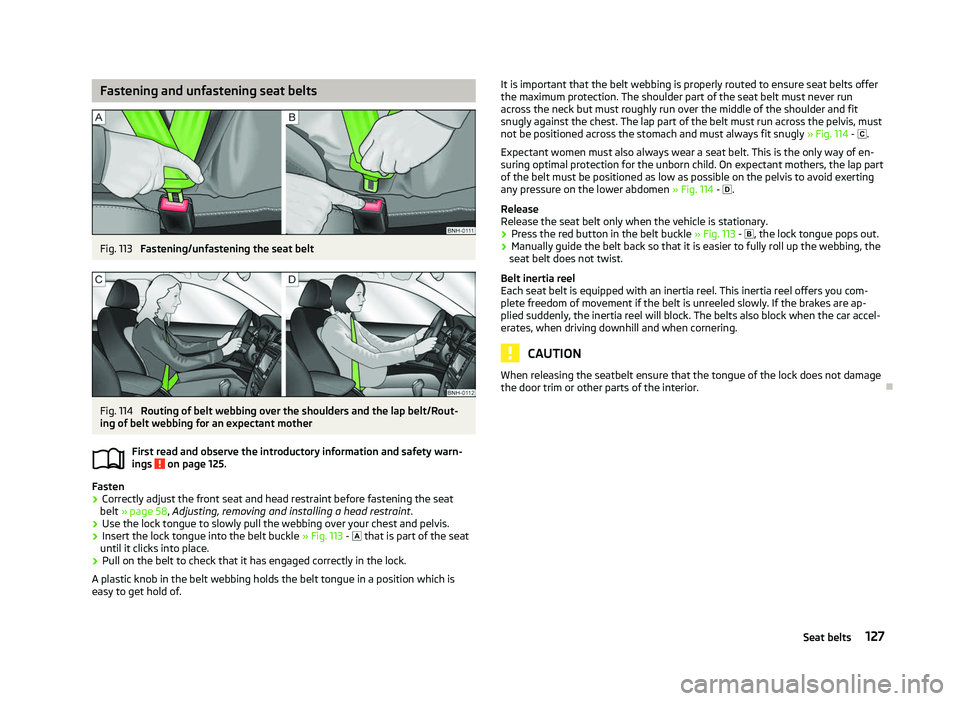
Fastening and unfastening seat belts
Fig. 113
Fastening/unfastening the seat belt Fig. 114
Routing of belt webbing over the shoulders and the lap belt/Rout-
ing of belt webbing for an expectant mother
First read and observe the introductory information and safety warn-
ings on page 125.
Fasten
›
Correctly adjust the front seat and head restraint before fastening the seat
belt » page 58, Adjusting, removing and installing a head restraint .
› Use the lock tongue to slowly pull the webbing over your chest and pelvis.
› Insert the lock tongue into the belt buckle
» Fig. 113 - that is part of the seat
until it clicks into place.
› Pull on the belt to check that it has engaged correctly in the lock.
A plastic knob in the belt webbing holds the belt tongue in a position which is
easy to get hold of.
ä It is important that the belt webbing is properly routed to ensure seat belts offer
the maximum protection. The shoulder part of the seat belt must never run
across the neck but must roughly run over the middle of the shoulder and fit
snugly against the chest. The lap part of the belt must run across the pelvis, must
not be positioned across the stomach and must always fit snugly
» Fig. 114 - .
Expectant women must also always wear a seat belt. This is the only way of en-
suring optimal protection for the unborn child. On expectant mothers, the lap part
of the belt must be positioned as low as possible on the pelvis to avoid exerting
any pressure on the lower abdomen » Fig. 114 - .
Release
Release the seat belt only when the vehicle is stationary.
› Press the red button in the belt buckle
» Fig. 113 - , the lock tongue pops out.
› Manually guide the belt back so that it is easier to fully roll up the webbing, the
seat belt does not twist.
Belt inertia reel
Each seat belt is equipped with an inertia reel. This inertia reel offers you com-
plete freedom of movement if the belt is unreeled slowly. If the brakes are ap-
plied suddenly, the inertia reel will block. The belts also block when the car accel-
erates, when driving downhill and when cornering. CAUTION
When releasing the seatbelt ensure that the tongue of the lock does not damage
the door trim or other parts of the interior. Ð
127
Seat belts
Page 133 of 218
The airbag allows the gas to flow out of the inflated airbag in a controlled manner
(depending on the load of the particular car occupant) in order to cushion head
and chest areas. The airbag then deflates subsequently to such an extent, after
an accident, to again provide a clear view forward.
WARNING
■ For the driver and front passenger, it is important to maintain a distance of
at least 25 cm to the steering wheel or dashboard A
» Fig. 117
. Not maintain-
ing this minimum distance will mean that the airbag system will not be able to
properly protect you - hazard! The front seats and the head restraints must
always also be correctly adjusted to match the body size of the occupant.
■ The airbag develops enormous forces when triggered, which can lead to in-
juries if the sitting position or seated position is not correct.
■ There must not by any further persons, animals or objects positioned be-
tween the front seated occupants and the deployment area of the airbag. ■ Never transport children on the front seat of a vehicle without using a prop-
er restraint system. If airbags are deployed in the event of an accident, the
child might suffer severe or even fatal injuries!
■ It is essential to always switch off the front passenger airbag when attach-
ing a child safety seat to the front passenger seat where the child is seated
with its back facing in direction of travel » page 133, Deactivating airbags. If
this is not done, there is a risk of the child suffering severe or even fatal inju-
ries if the front passenger airbag is deployed. When transporting a child on
the front passenger seat, pay attention to any relevant national regulations
regarding the use of child safety seats.
■ The steering wheel and the surface of the airbag module in the dash panel
on the passenger side must not have stickers attached, be covered or modi-
fied in any other way. These parts should only be cleaned with a cloth that is
dry or has been moistened with water. No objects such as cup holders, mobile
phone mounts, etc. must be attached to the covers of the airbag modules or
be located within their immediate vicinity.
■ Never place objects on the surface of the front passenger airbag module in
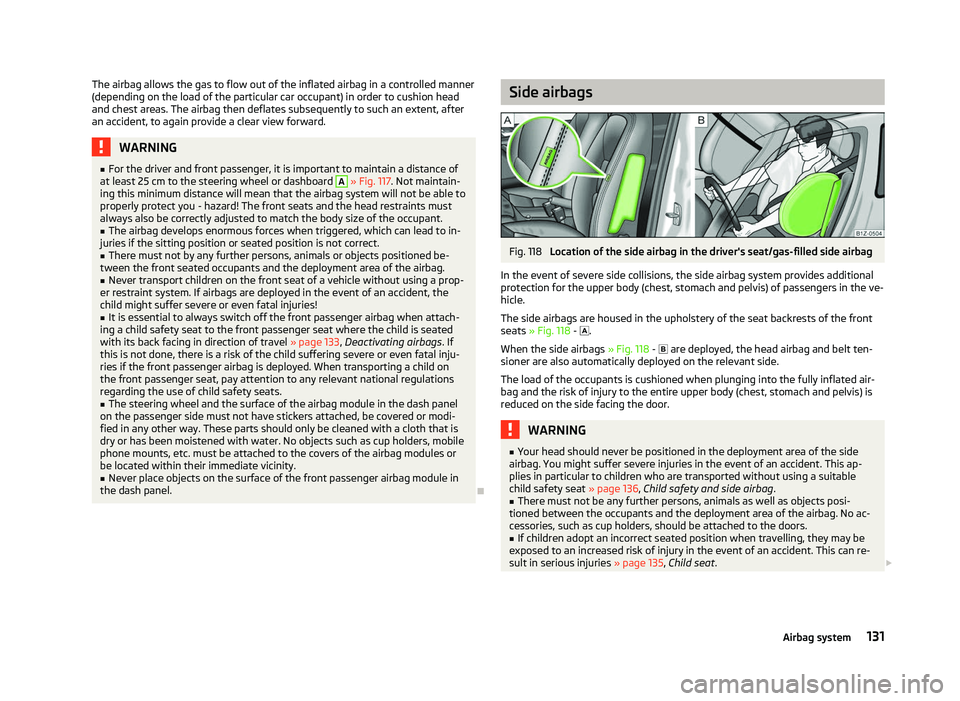
the dash panel. Ð Side airbags
Fig. 118
Location of the side airbag in the driver's seat/gas-filled side airbag
In the event of severe side collisions, the side airbag system provides additional
protection for the upper body (chest, stomach and pelvis) of passengers in the ve-
hicle.
The side airbags are housed in the upholstery of the seat backrests of the front
seats » Fig. 118 - .
When the side airbags » Fig. 118 - are deployed, the head airbag and belt ten-
sioner are also automatically deployed on the relevant side.
The load of the occupants is cushioned when plunging into the fully inflated air-
bag and the risk of injury to the entire upper body (chest, stomach and pelvis) is
reduced on the side facing the door. WARNING
■ Your head should never be positioned in the deployment area of the side
airbag. You might suffer severe injuries in the event of an accident. This ap-
plies in particular to children who are transported without using a suitable
child safety seat » page 136, Child safety and side airbag.
■ There must not be any further persons, animals as well as objects posi-
tioned between the occupants and the deployment area of the airbag. No ac-
cessories, such as cup holders, should be attached to the doors. ■ If children adopt an incorrect seated position when travelling, they may be
exposed to an increased risk of injury in the event of an accident. This can re-
sult in serious injuries » page 135, Child seat. £
131
Airbag system
Page 135 of 218
WARNING (Continued)
■ The airbag control unit operates with sensors located in the front doors. For
this reason no adjustments must be carried out to the doors and door panels
(e.g. additional installation of loudspeakers). Resulting damages can have a
negative affect on the operation of the airbag system. All work on the front
doors and their panels must only be carried out by a
ŠKODA specialist garage.
■ There must no other persons (e.g. children) or animals between the passen-
ger and the deployment area of the head airbag. In addition, none of the occu-
pants should lean their head out of the window when driving, or extend their
arms and hands out of the window.
■ The sun visors must not be swivelled towards the side windows in the de-
ployment area of the head airbags if any objects, such as ball-point pens, etc.
are attached to them. This might result in injuries to the occupants if the head
airbag is deployed.
■ The installation of impermissible accessories in the vicinity of the head air-
bags can considerably impair the protection offered by the head airbag in the
event of it being deployed. When the deployed head airbag is inflated, parts of
the fitted accessories could be thrown into the interior of the car and injure
the occupants » page 177, Accessories, changes and replacement of parts .Ð Deactivating airbags
Deactivating airbags
Deactivation of airbags is envisaged only for particular instances, such as if:
› using a child seat on the front passenger seat, in which the child has its back to
the vehicle's direction of travel (in some countries this must be in the direction
of travel due to different legal regulations applying) » page 135, Transporting
children safely ;
› not being able to maintain a distance of at least 25 cm between the middle of
the steering wheel and chest, despite the driver's seat being correctly adjusted;
› special attachments are required in the area of the steering wheel because of a
physical disability;
› other seats have been installed (e.g. orthopaedic seats without side airbags).
The front passenger airbag can be switched off with the key-operated
switch » page 133 , Key switch for the front seat passenger airbag .
We recommend that you ask a
ŠKODA Service Partner to switch off any other air-
bags. Monitoring the airbag system
The functionality of the airbag system is monitored electronically even if one of
the airbags is switched off.
If the airbag was switched off using diagnostic equipment:
› The airbag warning light
illuminates for around 4
seconds after the ignition is
switched on and then flashes approximately another 12 seconds in 2 second in-
tervals.
The following applies if the airbag has been switched off using the key switch
in the storage compartment:
› The airbag warning light
comes on for around 4 seconds after the ignition is
switched on;
› The deactivated airbag is indicated by the illumination of the warning light
in the middle of the dash panel » Fig. 120 on page 133 3
.
Note
■ The national regulations for switching off airbags must be observed.
■ A ŠKODA Service Partner will be able to inform you which airbags in your vehicle
can/must be deactivated. Ð Key switch for the front seat passenger airbag
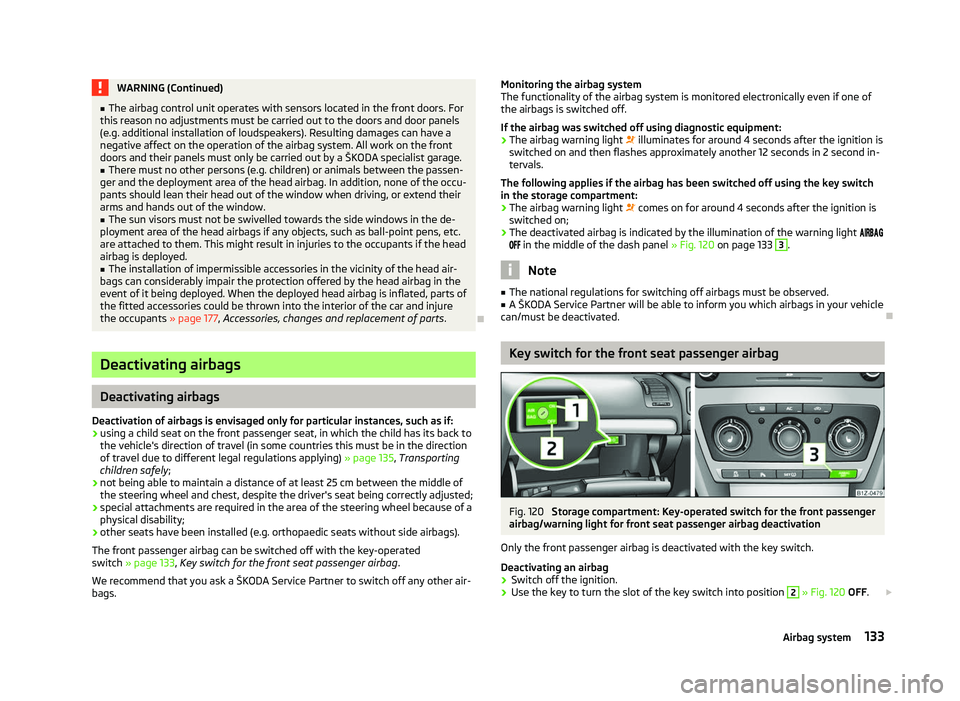
Fig. 120
Storage compartment: Key-operated switch for the front passenger
airbag/warning light for front seat passenger airbag deactivation
Only the front passenger airbag is deactivated with the key switch.
Deactivating an airbag › Switch off the ignition.
› Use the key to turn the slot of the key switch into position 2
» Fig. 120 OFF.
£
133
Airbag system
Page 137 of 218
Transporting children safely
Child seat
ä
Introduction
This chapter contains information on the following subjects:
Use of a child seat on the front passenger seat 135
Child safety and side airbag 136
Classification of child seats 136
Suitability of child seats 137
Child seats with the ISOFIX system 137
Child seat with the TOP TETHER system 137
Children are generally safer on the rear seats than on the front passenger seat.
In contrast to adults, the muscles and bone structure of children are not yet fully
developed. Thus children are exposed to increased risk of injury.
Children should be transported in accordance with the relevant statutory provi-
sions.
Child seats that comply with the ECE-R
44 standard must be used. The ECE-R
Norm stands for: Economic Commission for Europe - Regulation.
Child seats that comply with the ECE-R 44 standard have a test seal that cannot
be removed: a large E within a circle with the test number below. WARNING
■ The national legal requirements must be observed when using child seats.
■ One should never carry children, and also not babies! - on one's lap.
■ Never leave children unattended in the vehicle. Certain outside climatic con-
ditions can cause life-threatening temperatures in the vehicle.
■ Under no circumstances allow children to be transported without the use of
a suitable restraint system. In the event of an accident the child will be
thrown through the vehicle and may as a result suffer fatal injuries, and also
injure other occupants. WARNING (Continued)
■ Children are exposed to an increased risk of injury in the event of an acci-
dent if they lean forward or adopt an incorrect seated position when the vehi-
cle is moving. This particularly applies to children who are transported on the
front passenger seat as they can suffer severe, or even fatal injuries if the air-
bag system is deployed!
■ Pay particular attention to the information provided by the manufacturer of
the child safety seat regarding the correct routing of the belt. Seat belts
which are not correctly adjusted can themselves cause injuries even in minor
accidents.
■ Safety belts must be checked to ensure that they are running properly. One
should also ensure that the belt is not damaged by sharp-edged fittings.
■ It is essential to switch off the front passenger airbag if using a child seat in
which the child is seated with its back facing the direction of travel on the
front passenger seat. Further information » page 135, Use of a child seat on
the front passenger seat. Note
We recommend that you use child seats from ŠKODA Original Accessories. These
child seats were developed and also tested for use in
ŠKODA vehicles. They fulfil
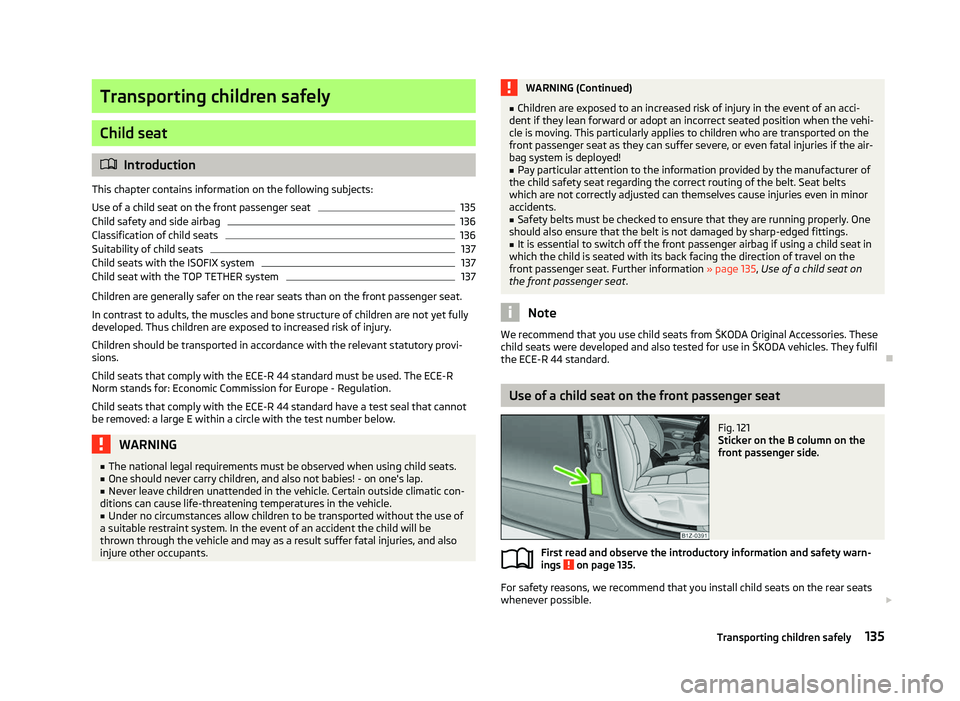
the ECE-R 44 standard. Ð Use of a child seat on the front passenger seat
Fig. 121
Sticker on the B column on the
front passenger side.
First read and observe the introductory information and safety warn-
ings on page 135.
For safety reasons, we recommend that you install child seats on the rear seats
whenever possible. £
ä
135
Transporting children safely
Page 138 of 218
The following guidelines must be observed when using a child safety seat in
which the child is seated with its back facing the direction of travel on the front
passenger seat.
›
Switch off the front passenger airbag
» page 133, Deactivating airbags .
› Slide the front passenger seat all the way back.
› Move the front passenger seat backrest into the vertical position.
› Set the height-adjustable front passenger seat as high up as possible.
› Adjust the seat belt for the front passenger seat so that it is as high as possible
(not suitable for a child seat fastened with the
ISOFIX system).
› Place and fasten the child seat on the seat and the child in the child seat ac-
cording to the specifications in the manufacturer's user manual of the child
seat . WARNING
■ It is essential to always switch off the front passenger airbag when attach-
ing a child safety seat to the front passenger seat where the child is seated
with its back facing in direction of travel » page 133 , Deactivating airbags.
■ Never use a child safety seat in which the child is seated with its back facing
the direction of travel on the front passenger seat if the airbag is switched on.
This child safety seat is positioned in the deployment area of the front pas-
senger airbag. The airbag may cause the child severe, or even fatal injuries, in
the event of it being deployed.
■ This is also clearly stated on the sticker which is located on the B column on
the front passenger side » Fig. 121. The sticker is visible upon opening the
front passenger door. For some countries, the sticker is also affixed to the sun
visor of the front passenger.
■ If a child safety seat in which the child faces in the direction of travel is used
on the front passenger seat, the front passenger seat must be moved back
and to the top fully. Move the backrest into the vertical position. ■ The front passenger airbag must be reactivated as soon as you no longer
use a child seat on the front passenger seat. Ð Child safety and side airbag
Fig. 122
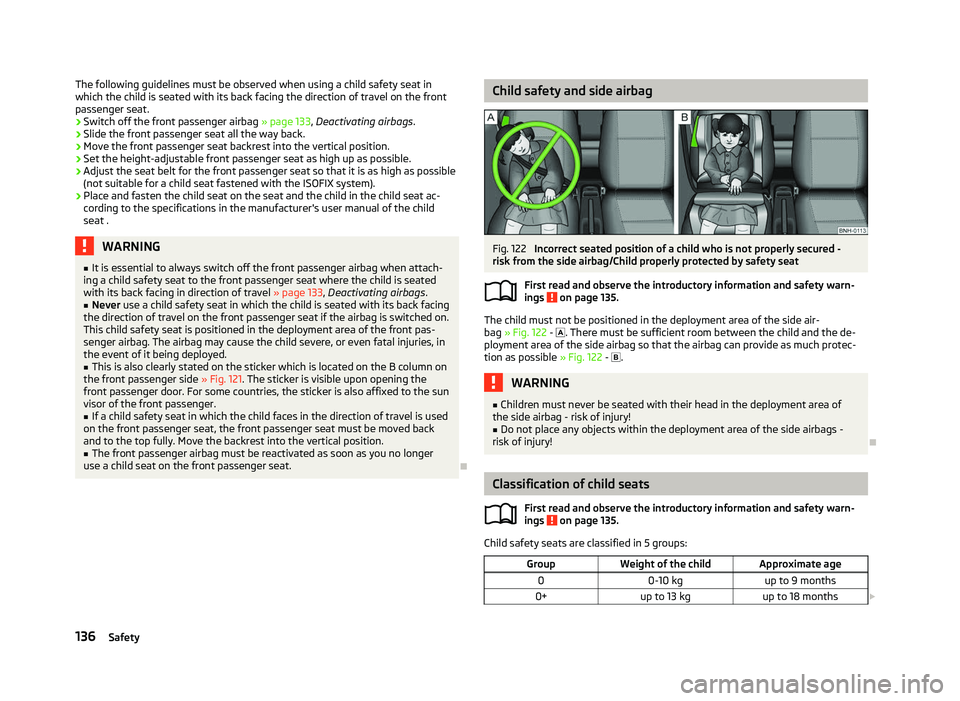
Incorrect seated position of a child who is not properly secured -
risk from the side airbag/Child properly protected by safety seat
First read and observe the introductory information and safety warn-
ings on page 135.
The child must not be positioned in the deployment area of the side air-
bag » Fig. 122 - . There must be sufficient room between the child and the de-
ployment area of the side airbag so that the airbag can provide as much protec-
tion as possible » Fig. 122 - . WARNING
■ Children must never be seated with their head in the deployment area of
the side airbag - risk of injury!
■ Do not place any objects within the deployment area of the side airbags -
risk of injury! Ð Classification of child seats
First read and observe the introductory information and safety warn-
ings on page 135.
Child safety seats are classified in 5 groups:
Group Weight of the child Approximate age
0 0-10 kg up to 9 months
0+ up to 13 kg up to 18 months£ ä
ä
136 Safety
Page 139 of 218
Group
Weight of the child Approximate age
1 9-18 kg up to 4 years
2 15-25 kg up to 7 years
3 22-36 kg over 7 years Ð
Suitability of child seats
First read and observe the introductory information and safety warn-
ings on page 135.
Overview of the suitability of child seats according to the standard ECE-R
44
Seat Child seat
type
Front passenger seat U
+
Rear seat outside U
+
T
Rear seat middle U
T
Universal category – a child seat with the word UNIVERSAL, which is de-
signed for fastening on the seat with the seat belt.
ISOFIX
– a child seat which is designed for fastening on the seat with eyelets
for the ISOFIX system is provided » page 137, Child seats with the ISOFIX
system.
ISOFIX – a child seat which is designed for fastening on the seat with an eye-
let for the TOP TETHER system is provided » page 137, Child seat with the
TOP TETHER system. ÐChild seats with the ISOFIX system
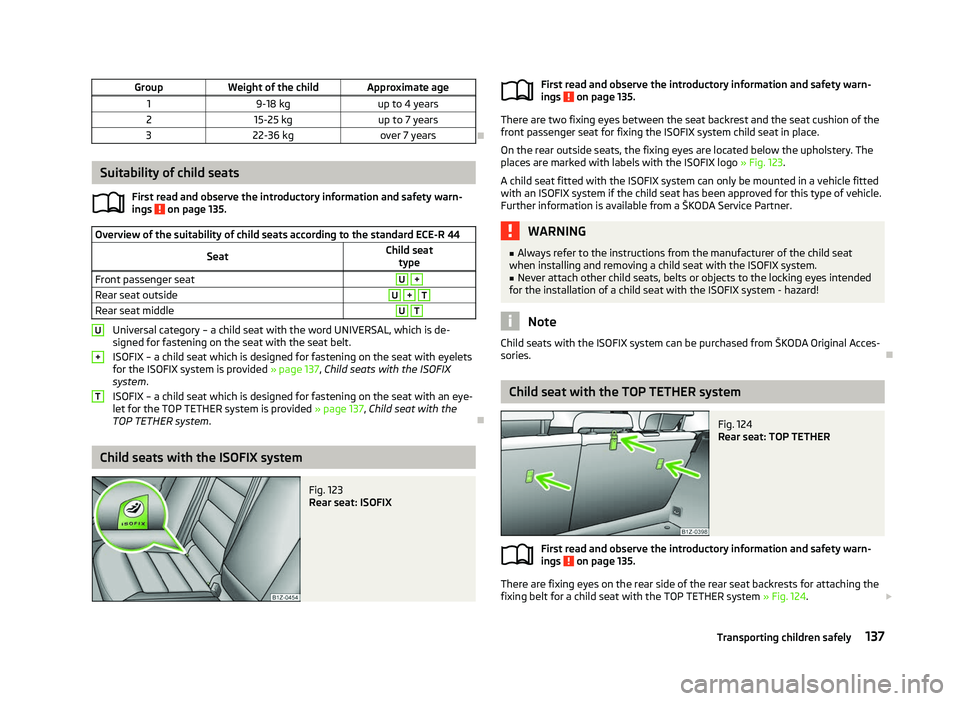
Fig. 123
Rear seat: ISOFIX
ä U
+
T First read and observe the introductory information and safety warn-
ings
on page 135.
There are two fixing eyes between the seat backrest and the seat cushion of the
front passenger seat for fixing the
ISOFIX system child seat in place.
On the rear outside seats, the fixing eyes are located below the upholstery. The
places are marked with labels with the ISOFIX logo » Fig. 123.
A child seat fitted with the ISOFIX system can only be mounted in a vehicle fitted
with an ISOFIX system if the child seat has been approved for this type of vehicle.
Further information is available from a ŠKODA Service Partner. WARNING
■ Always refer to the instructions from the manufacturer of the child seat
when installing and removing a child seat with the
ISOFIX system.
■ Never attach other child seats, belts or objects to the locking eyes intended
for the installation of a child seat with the
ISOFIX system - hazard! Note
Child seats with the ISOFIX system can be purchased from ŠKODA Original Acces-
sories. Ð Child seat with the TOP TETHER system
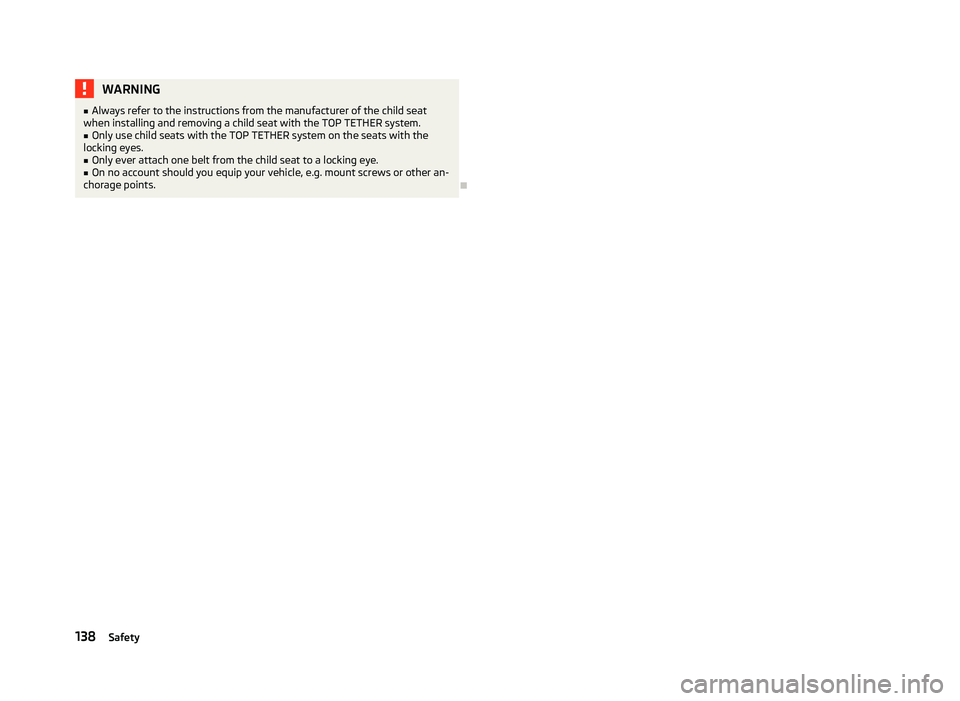
Fig. 124
Rear seat: TOP TETHER
First read and observe the introductory information and safety warn-
ings on page 135.
There are fixing eyes on the rear side of the rear seat backrests for attaching the
fixing belt for a child seat with the
TOP TETHER system » Fig. 124. £
ä
ä 137
Transporting children safely
Page 140 of 218
WARNING
■ Always refer to the instructions from the manufacturer of the child seat
when installing and removing a child seat with the
TOP TETHER system.
■ Only use child seats with the TOP TETHER system on the seats with the
locking eyes. ■ Only ever attach one belt from the child seat to a locking eye.
■ On no account should you equip your vehicle, e.g. mount screws or other an-
chorage points. Ð
138 Safety
Page 150 of 218

General Maintenance
Taking care of and cleaning the vehicle
Taking care of your vehicle
ä
Introduction
This chapter contains information on the following subjects:
Washing the vehicle 149
Automatic car wash systems 149
Washing by hand 149
Washing with a high-pressure cleaner 149
Preserving and polishing the vehicle paintwork 150
Chrome parts 150
Paint damage 150
Plastic parts 150
De-icing windows and exterior mirrors 151
Radio reception and aerial 151
Headlight lenses 151
Rubber seals 151
Door lock cylinders 151
Wheels 152
Underbody protection 152
Protection of hollow spaces 152
Artificial leather and materials 153
Fabric covers on electrically heated seats 153
Natural leather 153
Seat belts 154
Regular and proper care help to retain the efficiency and value of your vehicle. It
may also be one of the requirements for the acceptance of warranty claims relat-
ing to corrosion damage and paint defects on the bodywork.
We recommend using care products from
ŠKODA Original Accessories that are
available from ŠKODA Service Partners. The instructions for use on the package
must be observed. WARNING
■ Care products may be harmful to your health if not used according to the in-
structions.
■ Always store care products in a safe place, out of the reach of children - risk
of poisoning! ■ When washing your vehicle in the winter: Water and ice in the brake system
can affect the braking efficiency - risk of accident! ■ Only wash the vehicle when the ignition is switched off - risk of accident!
■ Protect your hands and arms from sharp-edged metal parts when cleaning
the underfloor, the inside of the wheel housings or the wheel trims - risk of
cuts!
■ Air fresheners and scents can be hazardous to heath when the temperature
inside the vehicle is high. CAUTION
■ Be sure to check clothing for colourfastness to avoid any damage or visible
stains on the material (leather), panels and textiles.
■ Cleaners containing solvents can damage the material being cleaned.
■ Do not wash your vehicle in bright sunlight - risk of paint damage.
■ If washing the vehicle in the winter using a hose or high-pressure cleaner, en-
sure that the jet of water is not aimed directly at the locking cylinders or the
door/panel joints - risk of freezing!
■ Do not use any insect sponges, rough kitchen sponges or similar cleaning prod-
ucts - risk of damaging the surface of paintwork.
■ Do not stick any stickers on the inside of the rear windows, the rear side win-
dows and in the vicinity of the heating elements on the windscreen or near the
window aerial. These may get damaged. With regard to the antenna, they may in-
terfere with the radio or navigation system.
■ Do not clean the inside of the windows with sharp-edged objects or corrosive
and acidic cleaning agents - risk of damaging the heating elements or window
aerial.
■ Do not attach scents and air fresheners to the dashboard - risk of damage to
the dashboard.
■ To avoid damaging the parking aid sensors while cleaning with high-pressure
cleaners or steam jets, the sensors must only be directly sprayed for short periods
while a minimum distance of 10
cm must be observed.
■ Do not clean the roof trim with a brush - risk of damage to the trim surface. £
148 General Maintenance
Page 211 of 218
Checking
Battery electrolyte level 167
Brake fluid 164
Coolant level 163
Engine oil 161
Oil level 161
Windscreen washer fluid 165
Children and safety 135
Child safety Side airbag 136
Child safety lock 27
Child seat Classification 136
ISOFIX 137
on the front passenger seat 135
Suitability 137
TOP TETHER 137
Chrome parts refer to Taking care of your vehicle 150
Cigarette lighter 69
Cleaning 148
Artificial leather 153
Headlight lenses 151
Material coverings 153
Materials 153
Natural leather 153
Plastic parts 150
Wheels 152
Clock 11
Clothes hooks 77
Cockpit 12-volt power socket 70
Ashtray 68
Cigarette lighter 69
General view 7
Light 45
Storage compartments 70
Compartments 70
Computer see Multifunction display 12Coolant
Checking 163
Replenishing 163
Temperature gauge 9
Correct seated position 122
Counter for distance driven 10
Cruise control system (CCS) 99
D
Dash panel insert 8
Daylight driving light 40
Deactivating an airbag 133
Deactivating an airbag 133
Defrsoting rear window 47
Delayed locking of the boot lid see Boot lid 33
Diesel refer to Fuel 158
Diesel fuel Operation in winter 158
Diesel particulate filter 23
Digital clock 11
Dipstick 161
Display Coolant temperature 9
Service interval 10
Distance driven 10
Door Child safety lock 27
Warning light for an open door 20
Doors Emergency locking 32
Driving Abroad 143
Driving through water on the street 144
Emissions 197
Fuel consumption 197 E
Economical and environmentally friendly driving 140
EDS 97
Electrical power windows Button in the driver's door 34
Electric power windows Central locking system 36
Electric sliding/tilting roof 37
Electronic Differential Lock 97
Electronic immobiliser 92
Emergency Automatic gearbox 106
Changing a wheel 179
Hazard warning light system 44
Jump-starting 185
locking of the doors 32
Selector lever-unlocking 106
Sliding roof 38
Towing the vehicle 186
Tyre repair 182
Unlocking the boot lid 34
Emissions 197
Engine Running in 139
Starting and stopping the engine 91
Engine compartment Brake fluid 164
Coolant 162
Overview 160
Vehicle battery 165
Engine oil Capacity 200
Changing 162
Checking 161
Replenishing 161
Specification 200
Engine revolutions counter 9
Environment 140
Environmental compatibility 142
209
Index
Page 213 of 218
Manual dimming interior mirror 51
Vanity 47
Mobile phone 107, 109, 112
Connecting to the hands-free system 110, 113
Multifunction display Functions 12
Memory 12
Operation 13
Multimedia 118
AUX-IN 119
MDI 119
N
Net partition 65
O
Oil refer to Engine oil 161
Onboard computer see Multifunction display 12
Operation in winter De-icing windows 151
Diesel fuel 158
Vehicle battery 167
Outside temperature 13
Overview Engine compartment 160
Warning lights 18
P
Paint see Paint damage 150
Paint damage 150
Parking Parking aid 98
Parking ticket holder 77
Passive Safety 121
Periodic wiping 49Petrol
refer to Fuel 156
Polishing the paintwork refer to Taking care of your vehicle 150
Power steering 92
Power windows Button in the driver's door 35
Button in the front passenger door 36
Button in the rear doors 36
Operational faults 37
Preservation refer to Taking care of your vehicle 150
R
Radiator fan 164
Radio reception Aerial 151
Functional fault 151
Raise vehicle 181
Rear mirror Automatic dimming interior mirror 52
Exterior mirror 52
Manual dimming interior mirror 51
Recirculated air mode Climatronic 86
Manual air conditioning system 84
Recommended gear 11
Refuelling 155
Fuel 155
Regulation Headlight beam 44
Remote control 30
Synchronisation process 31
Remote control key Replacing the battery 26
Removable through-loading bag 76
Removing the seats 59
Replacement of parts 177Replacing
Bulbs 191
Fuses 189
Vehicle battery 168
Windscreen wiper blade 51
Replenishing Coolant 163
Engine oil 161
Windscreen washer fluid 165
Roof luggage rack Attachment points 67
Roof rack system Roof load 67
Running in Brake pads 139
Engine 139
The first 1
500 km 139
Tyres 139
S
Safe securing system 28
Safety 121
Child safety 135
Child safety seats 135
Head restraints 58
ISOFIX 137
TOP TETHER 137
Save electrical energy 140
Seat Adjusting 55
Seat belt Warning light 19
Seat belt height adjuster 128
Seat belts Belt tensioners 128
Cleaning 154
fastening and unfastening 127
Height adjustment 128
211
Index