oil SKODA OCTAVIA 2006 Owner´s Manual
[x] Cancel search | Manufacturer: SKODA, Model Year: 2006, Model line: OCTAVIA, Model: SKODA OCTAVIA 2006Pages: 218, PDF Size: 5.48 MB
Page 141 of 218
Driving Tips
Driving and the Environment
The first 1 500 km
New engine
The engine has to be run in during the first 1 500 kilometres.
Up to 1 000 kilometres › Do not drive faster than 3/4 of the maximum speed of the gear in use, i.e. 3/4 of
the maximum permissible engine speed.
› No full throttle.
› Avoid high engine speeds.
› Do not tow a trailer.
From 1 000 up to 1
500 kilometres
› Gradually
increase the power output of the engine up to the full speed of the
gear engaged, i.e. up to the maximum permissible engine speed.
During the first operating hours the engine has higher internal friction than later
until all of the moving parts have harmonized. The driving style which you adopt
during the first approx.1
500 kilometres plays a decisive part in the success of
running in your car.
Never drive at unnecessarily high engine speeds even after the running-in period
is complete. The maximum permissible engine speed is marked by the start of the
red scale area of the revolutions counter. On vehicles fitted with a manual gear-
box, at the very latest shift up into the next gear when the red area is reached.
During acceleration (depressing the accelerator) exceptionally high engine
speeds are automatically reduced, yet the engine is not protected against too
high engine speeds which are caused by incorrectly shifting down the gears re-
sulting in a sudden increase of the engine speeds above the permitted maximum
revolutions which can lead to engine damage.
For a vehicle fitted with a manual gearbox the converse situation also applies: Do
not drive at an engine speed that is too low. Shift down a gear when the engine
is no longer running smoothly. Observe the recommended gear » page 11, Recom-
mended gear . CAUTION
All the speed and engine revolution figures apply only when the engine is at its
normal operating temperature. Never rev up a cold engine when the vehicle is
stationary or when driving in individual gears. For the sake of the environment
Not driving at unnecessarily high engine revolutions and shifting to a higher gear
as early as possible are ways to minimise fuel consumption and operating noise
levels and protects the environment. Ð New tyres
New tyres have to be “
run in” since they do not offer optimal grip at first. Drive
especially carefully for the first 500 km or so. Ð New brake pads
New brake pads initially do not provide full braking efficiency. The brake pads
must initially be “run in
”. Drive especially carefully for the first 200 km or so. Ð Catalytic converter
Proper operation of the emission control system (catalytic converter) is of major
significance for driving your vehicle in an environmentally conscious way.
The following guidelines must be observed: › Vehicles fitted with a petrol engine must always be refueled with unleaded pet-
rol » page 156, Unleaded petrol ;
› Do not pour too much oil into the engine
» page 161, Checking the engine oil
level;
› Do not switch off the ignition while driving.
If you drive your vehicle in a country in which unleaded petrol is not available, you
must have the catalytic converter replaced later when driving the vehicle into a
country in which use of a catalytic converter is mandatory. £
139
Driving and the Environment
Page 143 of 218
Note
Observe the recommended gear » page 11, Recommended gear .ÐAvoiding full throttle
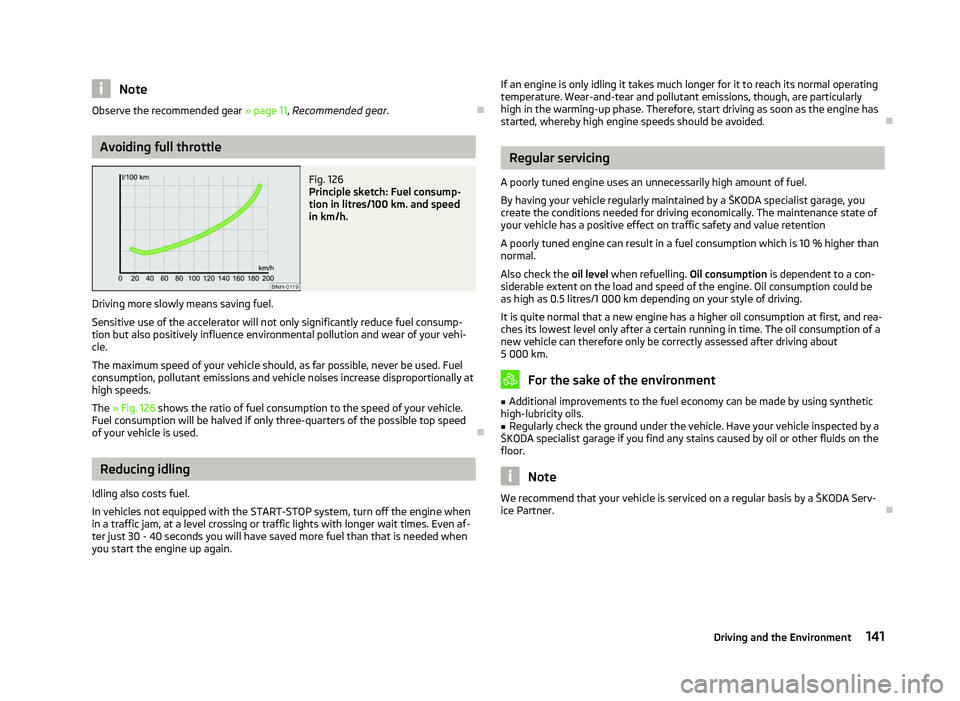
Fig. 126
Principle sketch: Fuel consump-
tion in litres/100 km. and speed
in km/h.
Driving more slowly means saving fuel.
Sensitive use of the accelerator will not only significantly reduce fuel consump-
tion but also positively influence environmental pollution and wear of your vehi-
cle.
The maximum speed of your vehicle should, as far possible, never be used. Fuel
consumption, pollutant emissions and vehicle noises increase disproportionally at
high speeds.
The » Fig. 126 shows the ratio of fuel consumption to the speed of your vehicle.
Fuel consumption will be halved if only three-quarters of the possible top speed
of your vehicle is used. ÐReducing idling
Idling also costs fuel.
In vehicles not equipped with the
START-STOP system, turn off the engine when
in a traffic jam, at a level crossing or traffic lights with longer wait times. Even af-
ter just 30 - 40 seconds you will have saved more fuel than that is needed when
you start the engine up again. If an engine is only idling it takes much longer for it to reach its normal operating
temperature. Wear-and-tear and pollutant emissions, though, are particularly
high in the warming-up phase. Therefore, start driving as soon as the engine has
started, whereby high engine speeds should be avoided. Ð Regular servicing
A poorly tuned engine uses an unnecessarily high amount of fuel.
By having your vehicle regularly maintained by a ŠKODA
specialist garage, you
create the conditions needed for driving economically. The maintenance state of
your vehicle has a positive effect on traffic safety and value retention
A poorly tuned engine can result in a fuel consumption which is 10 % higher than
normal.
Also check the oil level when refuelling. Oil consumption is dependent to a con-
siderable extent on the load and speed of the engine. Oil consumption could be
as high as 0.5 litres/1 000 km depending on your style of driving.
It is quite normal that a new engine has a higher oil consumption at first, and rea-
ches its lowest level only after a certain running in time. The oil consumption of a
new vehicle can therefore only be correctly assessed after driving about
5 000 km. For the sake of the environment
■ Additional improvements to the fuel economy can be made by using synthetic
high-lubricity oils.
■ Regularly check the ground under the vehicle. Have your vehicle inspected by a
ŠKODA specialist garage if you find any stains caused by oil or other fluids on the
floor. Note
We recommend that your vehicle is serviced on a regular basis by a ŠKODA Serv-
ice Partner. Ð
141
Driving and the Environment
Page 145 of 218
›
The use of solvent-free adhesives.
› No CFCs used in the production process.
› Without use of mercury.
› Use of water-soluble paints.
Trade-in and recycling of old cars
ŠKODA
meets the requirements of the brand and its products with regard to pro-
tecting the environment and the preserving resources. All new ŠKODA vehicles
can be utilized up to 95 % and always 1)
be returned. In a lot of countries sufficient
trade-in networks have been created, where you can trade-in your vehicle. After
you trade-in your vehicle, you will receive a confirmation stating the recycling in
accordance with environmental regulations. Note
Detailed information about the trade-in and recycling of old cars is available from
a ŠKODA Service Partner. ÐDriving abroad
Introductory information
In certain countries it is also possible that the
ŠKODA Service Partner network is
limited or has not been established yet. This is the reason why procuring certain
spare parts may be somewhat complicated and specialist garages may only be
able to make limited repairs. ŠKODA in the Czech Republic and its importers are
happy to provide information about technical aspects of the vehicle, required
maintenance work and possibilities for getting repairs done. ÐUnleaded petrol
A vehicle fitted with a petrol engine must always be refuelled with unleaded pet-
rol » page 156, Unleaded petrol . Information regarding the locations of filling sta-
tions that offer unleaded petrol is, for example, provided by the automobile asso-
ciations. Ð Headlights
The low beam of your headlights is set asymmetrically. It illuminates the side of
the road on which the vehicle is being driven to a greater extent.
When driving in countries in which the traffic drives on the other side of the road
than in your home country, the asymmetrical low beam may dazzle oncoming
drivers. To prevent oncoming traffic from being dazzled, the headlights must be
adjusted by a
ŠKODA Service Partner.
Headlights with Xenon lights are adjusted in the menu of the information dis-
play » page 15, MAXI DOT (information display) . Note
Further information on adjusting the headlights is available from a ŠKODA Service
Partner. Ð Avoiding damage to your vehicle
To prevent damage to your vehicle, pay special attention: › When driving on poorly maintained roads and lanes
› When driving over kerb stones
› When driving up steep ramps
› So that any low-slung parts, such as the spoiler and exhaust, do not touch the
ground and get damaged
This particularly applies to models with a sport suspension and also when your
vehicle is fully laden. Ð1)
Subject to fulfilment of the national legal requirements.
143
Driving and the Environment
Page 151 of 218
For the sake of the environment
■ Used cans of vehicle care products represent a special type of hazardous waste.
These must be disposed of in accordance with national legal regulations. ■ Only wash the vehicle at washing bays intended for this purpose. Note
■ Remove fresh stains such as those from ball-point pens, ink, lipstick, shoe pol-
ish, etc., from the material (leather), panels and textiles as quickly as possible. ■ Due to possible issues with the cleaning and care of the interior of your vehicle,
the special tools and knowledge required, we recommend that this is completed
by a
ŠKODA Service Partner. ÐWashing the vehicle
First read and observe the introductory information and safety warn-
ings on page 148.
The best protection for your vehicle against harmful environmental influences is
frequent washing and wax treatment. How often the vehicle should be washed
depends on a wide range of factors, such as:
›
Frequency of use;
› The parking situation (garage, below trees etc.);
› Season of the year;
› Weather conditions;
› Environmental influences.
The longer insect residues, bird droppings, tree sap, road and industrial dust, tar,
soot particles, road salt and other aggressive deposits remain adhering to the
paintwork of your vehicle, the more detrimental their destructive effect can be.
High temperatures, such as those caused by intensive sun's rays, accentuate this
caustic effect.
It is essential to also thoroughly clean the underside of the vehicle at the end of
the winter. ÐAutomatic car wash systems
First read and observe the introductory information and safety warn-
ings on page 148.ä
ä Your vehicle can be washed in automatic car wash systems.
The usual precautionary measures must be taken before washing the vehicle in
an automatic car wash system (closing the windows including the sliding/tilting
roof, etc.).
If your vehicle is fitted with any particular attached parts, such as a spoiler, roof
luggage rack, two-way radio aerial - it is best to consult the operator of the car
wash system beforehand.
It is important to degrease the lips of the windscreen wiper rubbers after passing
through the automatic vehicle wash system. Ð Washing by hand
First read and observe the introductory information and safety warn-
ings on page 148.
When washing by hand, first soften the dirt with plenty of water and rinse off as
much as possible.
Clean the vehicle with a soft
sponge, a washing glove or a washing brush. Work
from the top to the bottom - starting with the roof. Only apply slight pressure
when cleaning the vehicle's paintwork. Only use a car shampoo for stubborn dirt.
Wash out the sponge or washing glove thoroughly at short intervals.
Clean wheels, door sills and similar parts last. Use a second sponge for such
areas.
Give the vehicle a good rinse after washing it and dry it off using a chamois leath-
er. Ð Washing with a high-pressure cleaner
First read and observe the introductory information and safety warn-
ings on page 148.
When washing the vehicle with a high-pressure cleaner, the instructions for use
of the equipment must be observed. This applies in particular to the
pressure
used and to the spraying distance. Maintain a sufficiently large distance to the
parking aid sensors and soft materials such as rubber hoses or insulation materi-
al. £
ä
ä
149
Taking care of and cleaning the vehicle
Page 155 of 218

Artificial leather and materials
First read and observe the introductory information and safety warn-
ings on page 148.
The artificial leather can be cleaned using a damp cloth. If this does not prove to
be adequate, these parts can only be treated with special
solvent-free plastic
cleaning and care products .
Clean upholstery cover materials and cloth trims on doors, boot cover, etc. using
specific cleaning agents, e.g., dry foam. Use a soft sponge, brush, or commercially
available microfibre cloth. Use a cloth and a specific cleaning agent to clean the
roof trim.
Some clothing materials, such as dark denim, do, in part, not have sufficient col-
our fastness. This can cause damage or clearly visible discolouration to seat cov-
ers (fabric or leather) even when used correctly. This particularly applies to light
seat covers (fabric or leather). This is not a defect in the seat cover, but poor col-
our fastness of the clothing textiles. ÐFabric covers on electrically heated seats
First read and observe the introductory information and safety warn-
ings on page 148.
Do not clean the seat covers
using moisture as this can damage the seat heating
system.
Use a specific cleaning agent such as dry foam or similar to clean the covers. ÐNatural leather
First read and observe the introductory information and safety warn-
ings on page 148.
Depending on the amount of wear-and-tear, the leather should be cleaned on a
regular basis.
Normal cleaning
Clean soiled areas of the leather with slightly moistened cotton or woollen cloth.
ä
ä
ä
Severe soiling
Ensure that the leather is not soaked through at any point and that no water gets
into the stitching of the seams.
Dry off the leather with a soft, dry cloth.
Removing stains
Remove fresh water-based stains (e.g., coffee, tea, juices, blood) with an absorb-
ent cloth or household cleaning paper. A specific cleaning agent is required for
dried-on stains.
Remove fresh grease-based stains (e.g. butter, mayonnaise, chocolate, etc.) with
an absorbent cloth, household cleaning paper, or use a suitable cleaner if the
stain has not yet penetrated into the surface.
Use a grease solvent for grease stains which have dried in .
Remove specific stains (e.g. ball-point pens, marker pen, nail varnish, dispersion
paint, shoe polish, etc.) with a special stain remover suitable for leather.
Leather care
Treat the leather roughly every six months with a suitable leather care product.
Apply only a small amount of the cleaning and care product.
Dry off the leather with a soft, dry cloth. CAUTION
■ Avoid leaving the vehicle for lengthy periods in bright sunlight to avoid the
leather from bleaching. If the vehicle is parked in the open for lengthy periods,
protect the leather from direct sunlight by covering it.
■ Sharp-edged objects on items of clothing such as zip fasteners, rivets, sharp-
edged belts, jewellery and pendants may leave permanent scratches or signs of
rubbing on the surface.
■ The use of a mechanical steering wheel lock may damage the leather surface of
the steering wheel. Note
■ Use a care cream with light blocker and impregnation effect on a regular basis
and each time after cleaning. The cream nourishes the leather, allows it to
breathe and keeps it supple and also provides moisture. It also creates surface
protection. ■ Clean the leather every 2 to 3 months, remove any fresh stains as they occur. £
153
Taking care of and cleaning the vehicle
Page 156 of 218
■
Also look after the leather dye. Refresh any areas with a special coloured leath-
er cream as required.
■ The leather is a natural material with specific properties. During the use of the
vehicle, minor optical changes can occur on the leather parts of the covers (e. g
wrinkles or creases as a result of the stress of the covers). ÐSeat belts
First read and observe the introductory information and safety warn-
ings on page 148.
Keep the seat belts clean!
Clean dirty seat belts using a mild soapy solution and remove coarse dirt with a
soft brush!
Check the condition of all the seat belts on a regular basis.
Belt webbing which has become severely soiled may prevent the inertia reel from
reeling up the belt properly. WARNING
■ The seat belts must not be removed for cleaning.
■ Never clean the seat belts chemically as chemical cleaning products could
destroy the fabric. The seat belts must also not be allowed to come into con-
tact with corrosive liquids (such as acids etc.).
■ Seat belts which have damage to the webbing, connections, inertia reel or
lock should be replaced by a ŠKODA specialist garage.
■ Inertia reel belts must be completely dried before being reeled up. Ðä
154 General Maintenance
Page 159 of 218

■
Fuels with metallic content may not be used. There is a risk of causing consider-
able damage to parts of the engine or exhaust system!
■ The use of unsuitable fuel additives can cause considerable damage to parts of
the engine or the exhaust system. ÐEthanol E85
Fig. 130
MultiFuel - power socket
First read and observe the introductory information and safety warn-
ings on page 155.
Only valid for vehicles with the 1.6/75°kW MultiFuel engine.
Biofuel Ethanol E85 consists of 85 % bioethanol and 15 % unleaded petrol com-
plying with the standard (DIN) EN°228.
Biofuel Ethanol E85 in accordance with the standard (DIN) EN
228 can be mixed in
any desired ratio with unleaded petrol.
Drive the vehicle for at least 5 minutes without interruption, if biofuel Ethanol
E85 has been refuelled, so that the engine control unit can determine the share
of the biofuel in the fuel. During this period do not drive at top speed of your ve-
hicle or high engine speeds and not at full throttle. During this process decrease
the idling speed.
Operation in winter
If you use biofuel Ethanol E85 at very low temperatures, it is necessary to preheat
the engine before an engine start.
The power socket for the engine preheating is located in the front bumper next
to the fog light » Fig. 130.
ä The outside temperature
Duration of engine preheating
Below -10 °C We recommend up to 1 hour
Below -15 ℃ at least 1 hours.
Below -25 °C at least 2 hours. If an engine preheating is not possible at outside temperatures below -10 °C, the
share of unleaded petrol complying with EN 228 must be as high as possible.
Thus the cold start property of the engine is clearly improved.
If there is biofuel Ethanol E85 in the tank and the engine is not preheated, it can
lead at temperatures below -15 °C to very poor or no starting of the engine. CAUTION
■ Just filling the tank once with diesel fuel that does not comply with the stand-
ard, can cause severe damage to parts of the engine, the fuel and exhaust sys-
tem!
■ If you park the car for a lengthy period, fill with petrol complying with (DIN) EN
°228, because Ethanol E85 can contain low quantities of impurities, which can
lead to corrosion. For the sake of the environment
■ If you use Ethanol E85, the CO
2 emission of your vehicle is lowered up to 5 %.
■ The use of engine preheating at temperatures below -10 °C has a positive effect
on the fuel consumption and thus on the environment. Note
■ When operating with Ethanol E85, the fuel consumption increases by approx 33
%, as a lower quantity of energy is contained in the bioethanol than in unleaded
petrol. ■ Biofuel Ethanol E85 contains only a low quantity of additives in contrast to un-
leaded petrol. Therefore we recommend to fill up the tank with unleaded petrol
complying with EN 228 every 15 000 km (e.g. before the oil change) and run it
empty, so that the engine remains clean.
■ The interval of 15 000 km applies for the oil change.
■ An extension cable used for connecting to the electrical network is located in
the luggage compartment. Ð
157
Inspecting and replenishing
Page 160 of 218
Diesel fuel
First read and observe the introductory information and safety warn-
ings on page 155.
Your vehicle can only be operated with
diesel fuel, which complies with the
standard EN
590 (standard DIN 51628 in Germany, standard ÖNORM C 1590 in
Austria, GOST R 52368-2005/EN 590:2004 in Russia).
Operation in winter - Winter-grade diesel fuel
In the winter, only use diesel fuel, which complies with the standard EN 590
(standard DIN 51628 in Germany, standard ÖNORM C 1590 in Austria,
GOST R 52368-2005/EN 590:2004 in Russia). “Winter-grade diesel fuel” will still
operate properly even at a temperature of -20 °C.
It is often the case in countries with different climatic conditions that diesel fuels
available have a different temperature characteristic. The ŠKODA Service Partners
and filling stations in the relevant country will be able to provide you with infor-
mation regarding the diesel fuels available.
Preheating fuel
The vehicle is fitted with a fuel filter preheating system. This secures operation of
a vehicle using diesel fuel down to an environmental temperature of -25 °C.
Fuel additives
Fuel additives, so-called “flow improvers” (petrol and similar products) must not
be added to the diesel fuel. CAUTION
■ Just filling the tank once with diesel fuel that does not comply with the stand-
ard, can cause severe damage to parts of the engine, the fuel and exhaust sys-
tem!
■ If a different fuel other than diesel fuel, which complies to the above mentioned
standards (e.g. petrol) is used by mistake do not start the engine or switch on the
ignition! Extensive damage to engine parts can occur! We recommend that the
fuel system is cleaned by a
ŠKODA Service Partner.
■ Water which has collected in the fuel filter can cause engine faults.
■ Your vehicle is not adapted for use of biofuel (RME), therefore this fuel must not
be refuelled and driven. The use of biofuel (RME) can cause considerable damage
to parts of the engine or fuel system. Ð
ä Engine compartment
ä
Introduction
This chapter contains information on the following subjects:
Opening and closing the bonnet 160
Engine compartment overview 160
Checking the engine oil level 161
Replenishing the engine oil 161
Changing engine oil 162
Coolant 162
Checking the coolant level 163
Replenishing the coolant 163
Radiator fan 164
Checking the brake fluid 164
Changing the brake fluid 164
Windscreen washer system 165
There is a risk of injuries, scalding, accidents and fire when working in the en-
gine compartment, e.g. inspecting and replenishing oil and other fluids. For this
reason, it is essential to comply with the warning instructions stated below and
with the general applicable rules of safety. The vehicle's engine compartment is
a hazardous area . WARNING
■ Never open the bonnet if you can see steam or coolant flowing out of the
engine compartment - risk of scalding! Wait until the steam or coolant has
stopped escaping.
■ Turn off the engine and withdraw the ignition key.
■ If the vehicle is fitted with a manual gearbox, move the gearshift lever into
Neutral, or if the vehicle is fitted with an automatic gearbox, move the selec-
tor lever into position P .
■ Firmly apply the handbrake.
■ Allow the engine to cool.
■ For safety reasons, the bonnet must always be properly closed when driving.
This is why after closing the bonnet, the lock must always be checked to en-
sure it has engaged properly. £
158 General Maintenance
Page 162 of 218
Opening and closing the bonnet
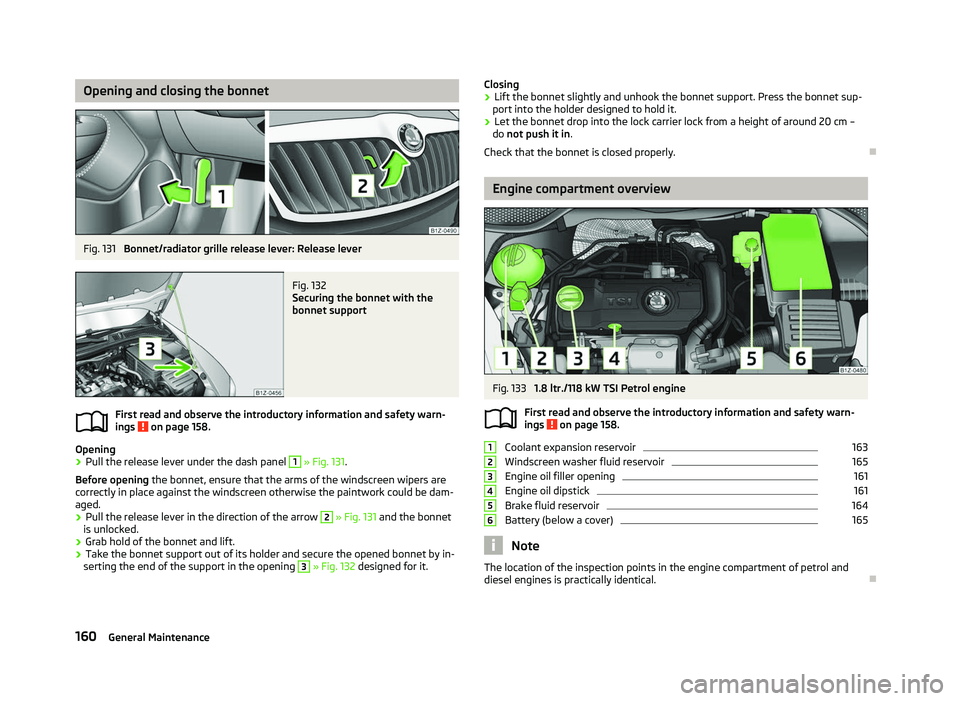
Fig. 131
Bonnet/radiator grille release lever: Release lever Fig. 132
Securing the bonnet with the
bonnet support
First read and observe the introductory information and safety warn-
ings on page 158.
Opening
›
Pull the release lever under the dash panel 1
» Fig. 131.
Before opening the bonnet, ensure that the arms of the windscreen wipers are
correctly in place against the windscreen otherwise the paintwork could be dam-
aged.
› Pull the release lever in the direction of the arrow 2
» Fig. 131 and the bonnet
is unlocked.
› Grab hold of the bonnet and lift.
› Take the bonnet support out of its holder and secure the opened bonnet by in-
serting the end of the support in the opening 3
» Fig. 132
designed for it.
ä Closing
› Lift the bonnet slightly and unhook the bonnet support. Press the bonnet sup-
port into the holder designed to hold it.
› Let the bonnet drop into the lock carrier lock from a height of around 20 cm –
do not push it in .
Check that the bonnet is closed properly. Ð Engine compartment overview
Fig. 133
1.8 ltr./118 kW TSI Petrol engine
First read and observe the introductory information and safety warn-
ings on page 158.
Coolant expansion reservoir 163
Windscreen washer fluid reservoir 165
Engine oil filler opening 161
Engine oil dipstick 161
Brake fluid reservoir 164
Battery (below a cover) 165
Note
The location of the inspection points in the engine compartment of petrol and
diesel engines is practically identical. Ð
ä 1
2
3
4
5
6
160
General Maintenance
Page 163 of 218

Checking the engine oil level
Fig. 134
Dipstick
First read and observe the introductory information and safety warn-
ings on page 158.
The dipstick indicates the level of oil in the engine
» Fig. 134.
Checking the oil level
› Ensure that the vehicle is positioned on a level surface and the engine has
reached its operating temperature.
› Switch off the engine.
› Open the bonnet.
› Wait a few minutes until the engine oil flows back into the oil sump and remove
the dipstick.
› Wipe the dipstick with a clean cloth and insert it again to the stop.
› Then pull the dipstick out again and check the oil level.
Oil level within range A
›
No oil must be refilled.
Oil level within range B
›
Oil can
be refilled. It is possible that the oil level may then be within range A
after doing this.
Oil level within range C
›
Oil must be refilled. It is sufficient, once this is done, to keep the oil level within
range B
.
It is normal for the engine to consume oil. The oil consumption may be as much as
0.5 l/1 000 km depending on your style of driving and the conditions under which
you operate your vehicle. Consumption may be slightly higher than this during the
first 5 000 kilometres. ä
One should therefore check the oil level at regular intervals, preferably every time
after the fuel tank is filled or after driving for long stretches.
We recommend maintaining the oil level within the range A
, but not above
, if
the engine has been operating at high loads, for example, during a lengthy motor-
way trip during the summer months, towing a trailer or negotiating a high moun-
tain pass.
The warning light in the instrument cluster will indicate whether the oil level is
too low » page 21, Engine oil . In this case, check the oil level with the dip-
stick, as soon as possible. Add oil accordingly. CAUTION
■ The oil level must on no account extend beyond the range A
» Fig. 134. Risk of
damaging the exhaust system!
■ Do not continue your journey if for some reason it is not possible to top up
the engine oil under the prevailing conditions! Switch off the engine and obtain
professional assistance from a
ŠKODA specialist garage, otherwise it could cause
severe engine damage. Note
Engine oil specifications » page 200, Specifications and engine oil capacity .Ð Replenishing the engine oil
First read and observe the introductory information and safety warn-
ings on page 158.
›
Check the engine oil level
» page 161.
› Unscrew the cap of the engine oil filler opening.
› Replenish the oil in portions of 0.5 litres in accordance with the correct specifi-
cations » page 200, Specifications and engine oil capacity .
› Check the oil level
» page 161.
› Carefully screw on the oil filler opening cap and push the dipstick in fully. Ð
ä
161
Inspecting and replenishing