tow SKODA OCTAVIA 2006 Owner´s Manual
[x] Cancel search | Manufacturer: SKODA, Model Year: 2006, Model line: OCTAVIA, Model: SKODA OCTAVIA 2006Pages: 218, PDF Size: 5.48 MB
Page 49 of 218
WARNING
If the entry light is on, do not touch its cover - risk of burns! ÐBoot light
The light comes on automatically when the boot lid is opened. If the lid remains
open for more than about 10
minutes, the boot light switches off automatically. ÐVisibility
Rear window heater
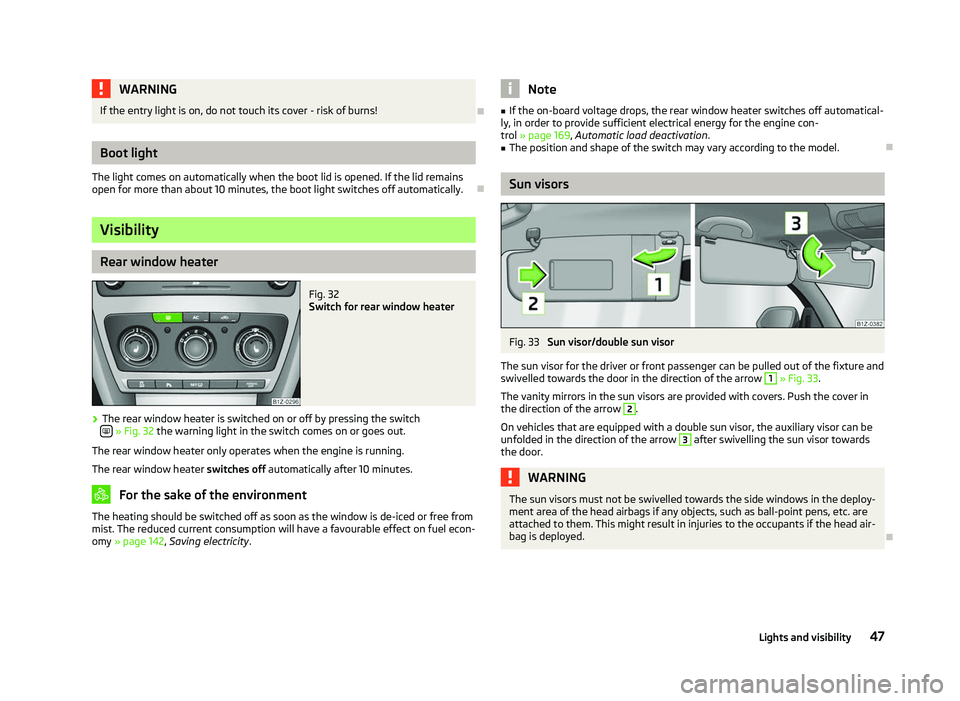
Fig. 32
Switch for rear window heater
› The rear window heater is switched on or off by pressing the switch
»
Fig. 32 the warning light in the switch comes on or goes out.
The rear window heater only operates when the engine is running.
The rear window heater switches off automatically after 10 minutes. For the sake of the environment
The heating should be switched off as soon as the window is de-iced or free from
mist. The reduced current consumption will have a favourable effect on fuel econ-
omy »
page 142 , Saving electricity . Note
■ If the on-board voltage drops, the rear window heater switches off automatical-
ly, in order to provide sufficient electrical energy for the engine con-
trol » page 169, Automatic load deactivation .
■ The position and shape of the switch may vary according to the model. Ð Sun visors
Fig. 33
Sun visor/double sun visor
The sun visor for the driver or front passenger can be pulled out of the fixture and
swivelled towards the door in the direction of the arrow 1
» Fig. 33
.
The vanity mirrors in the sun visors are provided with covers. Push the cover in
the direction of the arrow 2
.
On vehicles that are equipped with a double sun visor, the auxiliary visor can be
unfolded in the direction of the arrow 3
after swivelling the sun visor towards
the door. WARNING
The sun visors must not be swivelled towards the side windows in the deploy-
ment area of the head airbags if any objects, such as ball-point pens, etc. are
attached to them. This might result in injuries to the occupants if the head air-
bag is deployed. Ð
47
Lights and visibility
Page 51 of 218
CAUTION
■ In cold temperatures and during the winter, check before the journey or before
switching on the ignition that the wiper blades are not frozen to the windscreen.
If the windscreen wipers are switched on when the blades are frozen to the
windscreen, this may damage both the blades and windscreen wiper motor!
■ If the ignition is switched off while the windscreen wipers are switched on, the
windscreen wipers will continue wiping in the same mode after the ignition is
turned back on. The windscreen wipers could freeze up in cold temperatures be-
tween the time the ignition was turned off and when it was turned back on again.
■ Carefully detach frozen wiper blades from the front or rear window.
■ Remove snow and ice from the windscreen wipers before driving.
■ If the windscreen wipers are handled carelessly, there is a risk of damage to the
windscreen.
■ Replace the windscreen wiper blades once or twice a year for safety reasons.
These can be purchased from a ŠKODA Service Partner.
■ The ignition must not be switched on if the front windscreen wiper arms are fol-
ded out. The wiper blades would move back into their rest position and while do-
ing so damage the paintwork of the bonnet. Note
■ If the slower 2
» Fig. 35 on page 49 or the faster 3
wiper setting is switched
on and the vehicle speed decreases to below 4 km/h, the lower wiper step is
switched on automatically. At a speed increase of more than 8 km/h the previous
wiper setting is established again.
■ If there is an obstacle on the windscreen, the wiper will try to push away the
obstacle. If the obstacle continues to block the wiper, the wiper stops automati-
cally after 5 attempts to eliminate the obstacle, in order to avoid a damage to the
wiper. Remove the the obstacle and switch the wiper on again. ■ The windscreen washer nozzles for the windscreen are heated when the en-
gine is running and the outside temperature is less than approx. +10
°C.
■ The content of the windscreen washer fluid reservoir is 3 litres. On vehicles fit-
ted with the headlight cleaning system, the volume is 5.5
litres. On vehicles fitted
with auxiliary heating, the content of the windscreen wiper reservoir is 4.5 litres.
■ The wiper blades should be cleaned on a regular basis with a windscreen clean-
er to avoid any smears. The wiper blades should be cleaned with a sponge or
cloth if they are heavily soiled by insect residues, for example. Ð Activating the windscreen wipers and washers
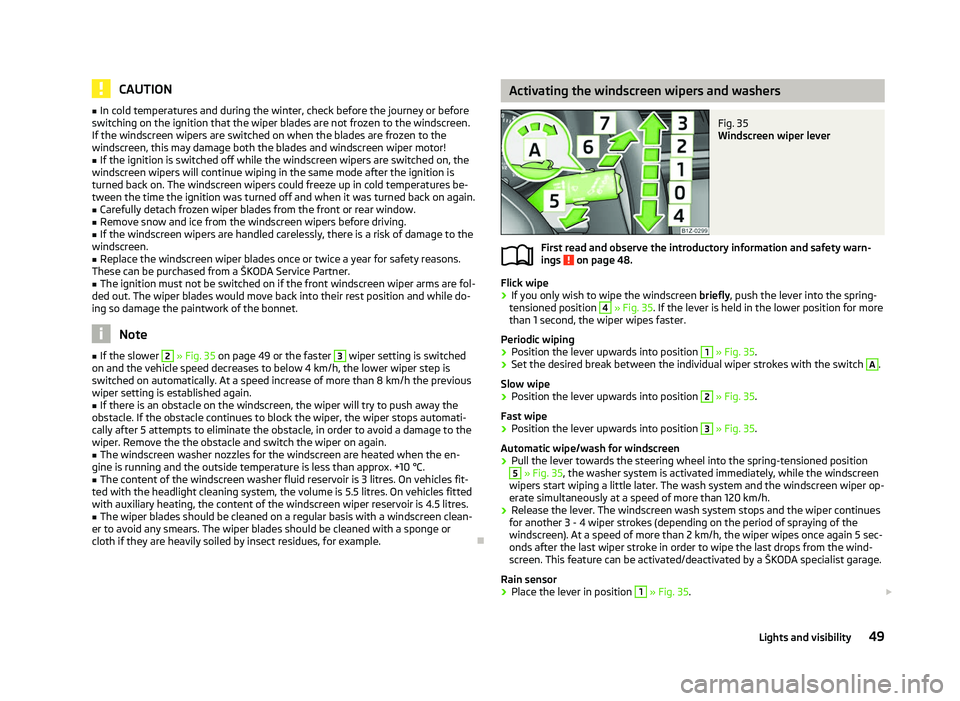
Fig. 35
Windscreen wiper lever
First read and observe the introductory information and safety warn-
ings on page 48.
Flick wipe
›
If you only wish to wipe the windscreen
briefly, push the lever into the spring-
tensioned position 4
» Fig. 35. If the lever is held in the lower position for more
than 1 second, the wiper wipes faster.
Periodic wiping
› Position the lever upwards into position 1
» Fig. 35.
› Set the desired break between the individual wiper strokes with the switch A
.
Slow wipe
› Position the lever upwards into position 2
» Fig. 35.
Fast wipe
› Position the lever upwards into position 3
» Fig. 35.
Automatic wipe/wash for windscreen
› Pull the lever towards the steering wheel into the spring-tensioned position 5
» Fig. 35, the washer system is activated immediately, while the windscreen
wipers start wiping a little later. The wash system and the windscreen wiper op-
erate simultaneously at a speed of more than 120
km/h.
› Release the lever. The windscreen wash system stops and the wiper continues
for another 3 - 4 wiper strokes (depending on the period of spraying of the
windscreen). At a speed of more than 2 km/h, the wiper wipes once again 5 sec-
onds after the last wiper stroke in order to wipe the last drops from the wind-
screen. This feature can be activated/deactivated by a
ŠKODA specialist garage.
Rain sensor
› Place the lever in position 1
» Fig. 35.
£
ä
49
Lights and visibility
Page 56 of 218
Seats and Stowage
Front seats
ä
Introduction
This chapter contains information on the following subjects:
Manually adjusting the front seats 55
Adjusting front seats electrically 55
Storing setting 56
Assigning the remote control key to the memory button 56
Retrieving the seat and exterior mirror settings 56
The driver's seat should be adjusted in such a way that the pedals can be fully
pressed to the floor with slightly bent legs.
The seat backrest on the driver's seat should be adjusted in such a way that the
upper point of the steering wheel can be easily reached with slightly bent arms.
Correct adjustment of the seats is particularly important for:
› safely and quickly reaching the controls;
› a relaxed, fatigue-free body position;
› achieving the maximum protection offered by the seat belts and the airbag
system. WARNING
■ Only adjust the driver's seat when the vehicle is stationary - risk of accident!
■ Caution when adjusting the seat! You may suffer injuries or bruises as a re-
sult of adjusting the seat without paying proper attention. ■ As the electric front seats can also be adjusted when the ignition is switch-
ed off (even when the ignition key is withdrawn), never leave children unat-
tended in the car. ■ The seat backrests must not be angled too far back when driving otherwise
this will affect proper operation of the seat belts and of the airbag system -
risk of injury! ■ Never carry more people than the number of seats in the vehicle. WARNING (Continued)
■ Each occupant must correctly fasten the seat belt belonging to the seat.
Children must be fastened » page 135, Transporting children safely with a
suitable restraint system.
■ The front seats and the head restraints must always be adjusted to match
the body size of the seat occupant as well as the seat belts must always be
correctly fastened in order to provide an optimal protection for you and your
occupants.
■ Always keep your feet in the footwell when the car is being driven - never
place your feet on the instrument panel, out of the window or on the surfaces
of the seats. This is particularly important for the front seat passenger. You
will be exposed to increased risk of injury if it becomes necessary to apply the
brake or in the event of an accident. If an airbag is deployed, you may suffer
fatal injuries when adopting an incorrect seated position!
■ It is important for the driver and front passenger to maintain a distance of at
least 25 cm from the steering wheel or dash panel. Not maintaining this mini-
mum distance will mean that the airbag system will not be able to properly
protect you - hazard!
■ Ensure that there are no objects in the footwell as they may get caught be-
hind the pedals when driving or applying the braking. You would then no lon-
ger be able to operate the clutch, brake or accelerate.
■ Do not transport any objects on the front passenger seat except objects
(e.g. child safety seat) provided for this purpose - risk of accident! Note
After a certain time, play can develop within the adjustment mechanism of the
backrest angle. Ð
54 Using the system
Page 57 of 218
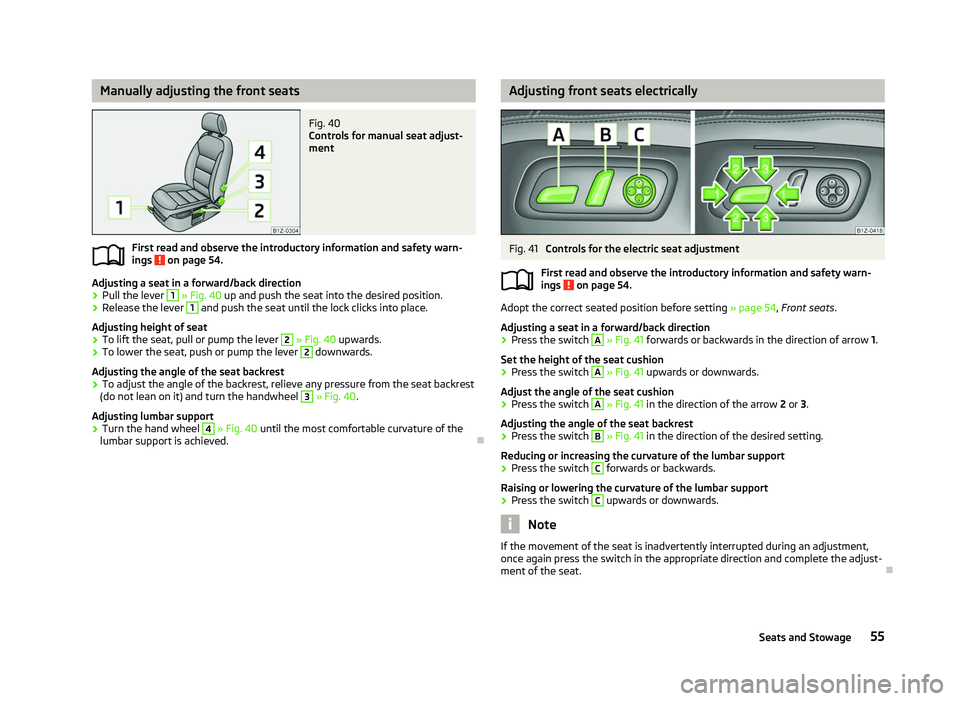
Manually adjusting the front seats
Fig. 40
Controls for manual seat adjust-
ment
First read and observe the introductory information and safety warn-
ings on page 54.
Adjusting a seat in a forward/back direction
›
Pull the lever 1
» Fig. 40 up and push the seat into the desired position.
› Release the lever 1
and push the seat until the lock clicks into place.
Adjusting height of seat
› To lift the seat, pull or pump the lever 2
» Fig. 40 upwards.
› To lower the seat, push or pump the lever 2
downwards.
Adjusting the angle of the seat backrest
› To adjust the angle of the backrest, relieve any pressure from the seat backrest
(do not lean on it) and turn the handwheel 3
» Fig. 40.
Adjusting lumbar support
› Turn the hand wheel 4
» Fig. 40
until the most comfortable curvature of the
lumbar support is achieved. Ð
ä Adjusting front seats electrically
Fig. 41
Controls for the electric seat adjustment
First read and observe the introductory information and safety warn-
ings on page 54.
Adopt the correct seated position before setting
» page 54, Front seats.
Adjusting a seat in a forward/back direction
› Press the switch A
» Fig. 41
forwards or backwards in the direction of arrow 1.
Set the height of the seat cushion
› Press the switch A
»
Fig. 41
upwards or downwards.
Adjust the angle of the seat cushion
› Press the switch A
»
Fig. 41
in the direction of the arrow 2 or 3.
Adjusting the angle of the seat backrest
› Press the switch B
»
Fig. 41
in the direction of the desired setting.
Reducing or increasing the curvature of the lumbar support
› Press the switch C
forwards or backwards.
Raising or lowering the curvature of the lumbar support
› Press the switch C
upwards or downwards.
Note
If the movement of the seat is inadvertently interrupted during an adjustment,
once again press the switch in the appropriate direction and complete the adjust-
ment of the seat. Ð
ä
55
Seats and Stowage
Page 59 of 218
Retrieving settings via the remote control key
›
If the driver's door is closed and the ignition is switched off, briefly press the
button on the remote control key and open the driver's door.
The seat and exterior mirrors now move automatically into the stored positions.
Retrieving setting of exterior mirror for reversing
› Turn the rotary knob for the exterior mirror setting into the position
» page 52
before engaging the reverse gear.
› Engage reverse gear.
The mirror returns into its initial position, after the rotary knob is moved out of
the position and put into another position or if the speed is more than 15 km/h.
Emergency Off
The setting process for the seats and exterior mirrors can be interrupted if neces-
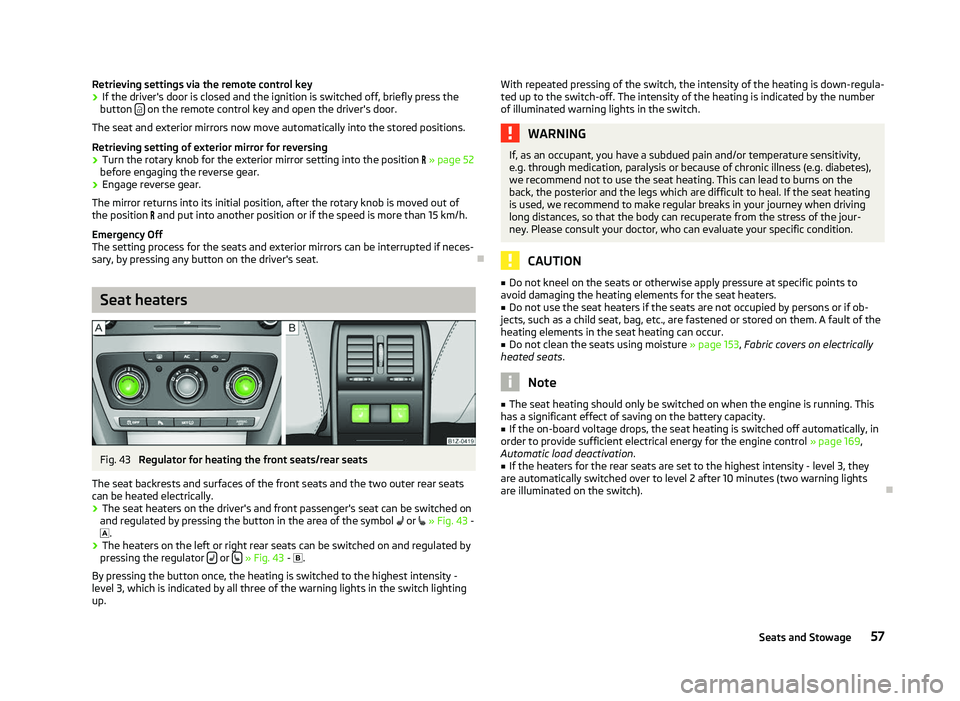
sary, by pressing any button on the driver's seat. ÐSeat heaters
Fig. 43
Regulator for heating the front seats/rear seats
The seat backrests and surfaces of the front seats and the two outer rear seats
can be heated electrically. › The seat heaters on the driver's and front passenger's seat can be switched on
and regulated by pressing the button in the area of the symbol or
»
Fig. 43 -
.
› The heaters on the left or right rear seats can be switched on and regulated by
pressing the regulator or
» Fig. 43 -
.
By pressing the button once, the heating is switched to the highest intensity -
level 3, which is indicated by all three of the warning lights in the switch lighting
up. With repeated pressing of the switch, the intensity of the heating is down-regula-
ted up to the switch-off. The intensity of the heating is indicated by the number
of illuminated warning lights in the switch. WARNING
If, as an occupant, you have a subdued pain and/or temperature sensitivity,
e.g. through medication, paralysis or because of chronic illness (e.g. diabetes),
we recommend not to use the seat heating. This can lead to burns on the
back, the posterior and the legs which are difficult to heal. If the seat heating
is used, we recommend to make regular breaks in your journey when driving
long distances, so that the body can recuperate from the stress of the jour-
ney. Please consult your doctor, who can evaluate your specific condition. CAUTION
■ Do not kneel on the seats or otherwise apply pressure at specific points to
avoid damaging the heating elements for the seat heaters.
■ Do not use the seat heaters if the seats are not occupied by persons or if ob-
jects, such as a child seat, bag, etc., are fastened or stored on them. A fault of the
heating elements in the seat heating can occur.
■ Do not clean the seats using moisture » page 153, Fabric covers on electrically
heated seats. Note
■ The seat heating should only be switched on when the engine is running. This
has a significant effect of saving on the battery capacity. ■ If the on-board voltage drops, the seat heating is switched off automatically, in
order to provide sufficient electrical energy for the engine control » page 169,
Automatic load deactivation .
■ If the heaters for the rear seats are set to the highest intensity - level 3, they
are automatically switched over to level
2 after 10 minutes (two warning lights
are illuminated on the switch). Ð
57
Seats and Stowage
Page 61 of 218
Rear seats
Folding the seat backrest forwards
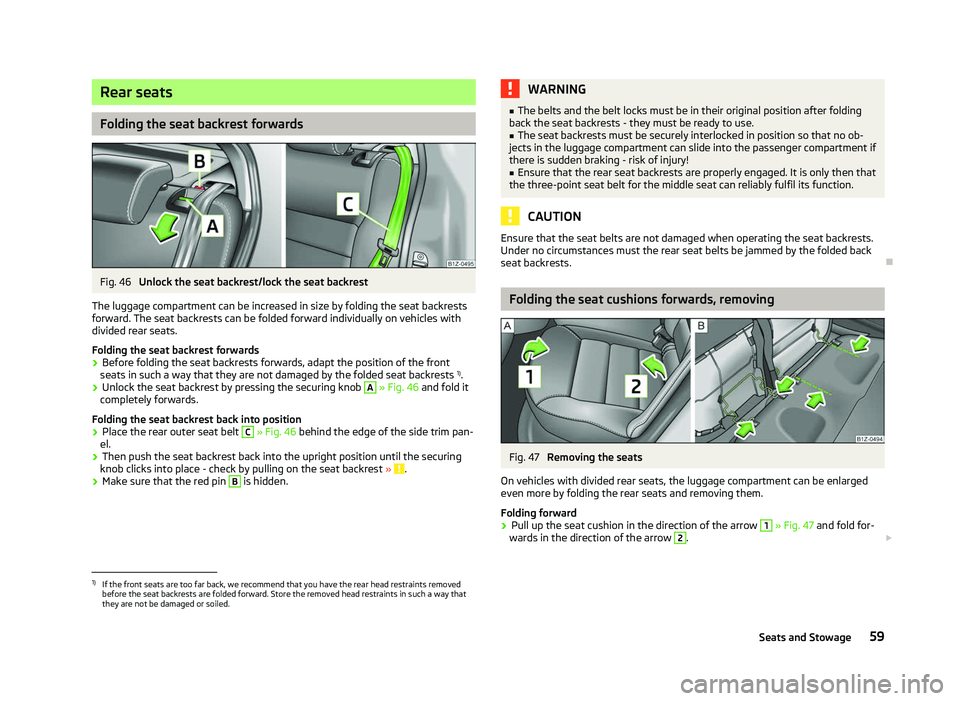
Fig. 46
Unlock the seat backrest/lock the seat backrest
The luggage compartment can be increased in size by folding the seat backrests
forward. The seat backrests can be folded forward individually on vehicles with
divided rear seats.
Folding the seat backrest forwards
› Before folding the seat backrests forwards, adapt the position of the front
seats in such a way that they are not damaged by the folded seat backrests 1)
.
› Unlock the seat backrest by pressing the securing knob A
» Fig. 46
and fold it
completely forwards.
Folding the seat backrest back into position
› Place the rear outer seat belt C
» Fig. 46 behind the edge of the side trim pan-
el.
› Then push the seat backrest back into the upright position until the securing
knob clicks into place - check by pulling on the seat backrest » .
› Make sure that the red pin B
is hidden. WARNING
■ The belts and the belt locks must be in their original position after folding
back the seat backrests - they must be ready to use.
■ The seat backrests must be securely interlocked in position so that no ob-
jects in the luggage compartment can slide into the passenger compartment if
there is sudden braking - risk of injury! ■ Ensure that the rear seat backrests are properly engaged. It is only then that
the three-point seat belt for the middle seat can reliably fulfil its function. CAUTION
Ensure that the seat belts are not damaged when operating the seat backrests.
Under no circumstances must the rear seat belts be jammed by the folded back
seat backrests. Ð Folding the seat cushions forwards, removing
Fig. 47
Removing the seats
On vehicles with divided rear seats, the luggage compartment can be enlarged
even more by folding the rear seats and removing them.
Folding forward
› Pull up the seat cushion in the direction of the arrow 1
» Fig. 47 and fold for-
wards in the direction of the arrow 2
.
£1)
If the front seats are too far back, we recommend that you have the rear head restraints removed
before the seat backrests are folded forward. Store the removed head restraints in such a way that
they are not be damaged or soiled.
59
Seats and Stowage
Page 63 of 218
WARNING (Continued)
■ The items carried in the boot must be stored in such a way that no objects
are able to slip forward if any sudden driving or braking manoeuvres are un-
dertaken - risk of injury! ■ When transporting fastened objects which are sharp and dangerous in the
boot that has been enlarged by folding the rear seats forward, ensure the
safety of the passengers transported on the other rear seats » page 123, Cor-
rect seated position for the occupants on the rear seats .
■ If the rear seat next to the folded forward seat is occupied, ensure maxi-
mum safety, e.g. by placing the goods to be transported in such a way that the
seat is prevented from folding back in case of a rear collision.
■ Never drive with the boot lid fully opened or slightly ajar otherwise exhaust
gases may get into the interior of the vehicle - risk of poisoning!
■ Under no circumstances, should the permissible axle loads and permissible
gross weight of the vehicle be exceeded - risk of accident!
■ Never transport people in the boot! CAUTION
Make sure that transported objects with sharp edges do not damage the follow-
ing:
■ heating elements in the rear window;
■ elements of the aerial integrated in the rear window;
■ elements of the aerial integrated in the rear side windows (Estate car). Note
Tyre pressure must be adjusted to the load » page 171, Service life of tyres.ÐClass N1 vehicles
First read and observe the introductory information and safety warn-
ings on page 60.
On class N1 vehicles, which are not fitted with a protective grille, a lashing set
which complies with the standard EN
12195 (1 - 4) must be used for fastening the
load. Ð
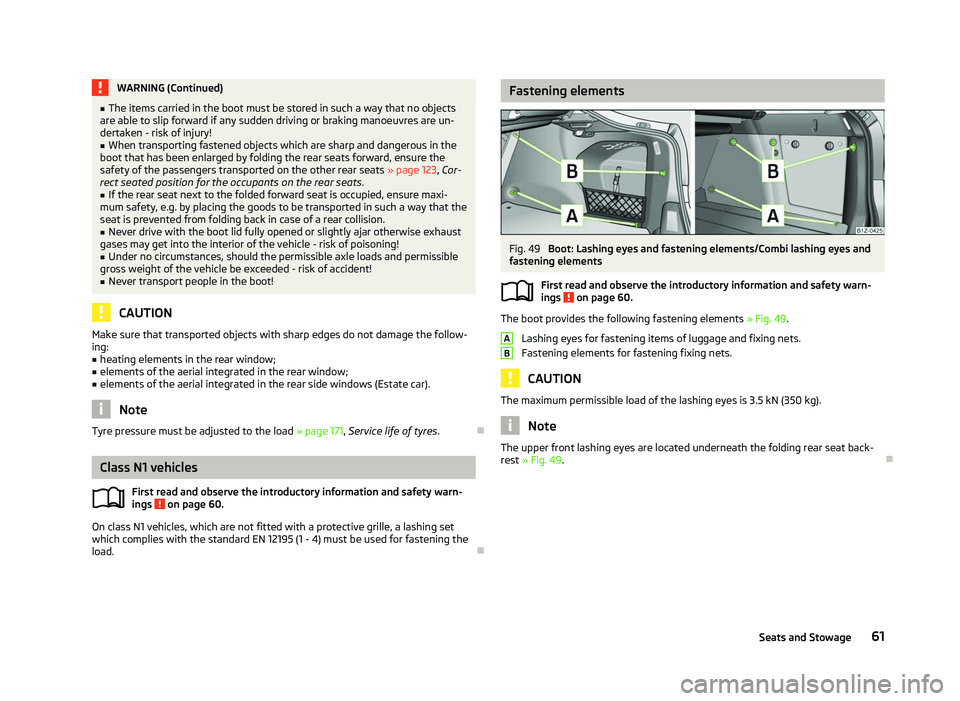
ä Fastening elements
Fig. 49
Boot: Lashing eyes and fastening elements/Combi lashing eyes and
fastening elements
First read and observe the introductory information and safety warn-
ings on page 60.
The boot provides the following fastening elements
»
Fig. 49.
Lashing eyes for fastening items of luggage and fixing nets.
Fastening elements for fastening fixing nets. CAUTION
The maximum permissible load of the lashing eyes is 3.5 kN (350 kg). Note
The upper front lashing eyes are located underneath the folding rear seat back-
rest » Fig. 49. Ð
ä A
B
61
Seats and Stowage
Page 65 of 218
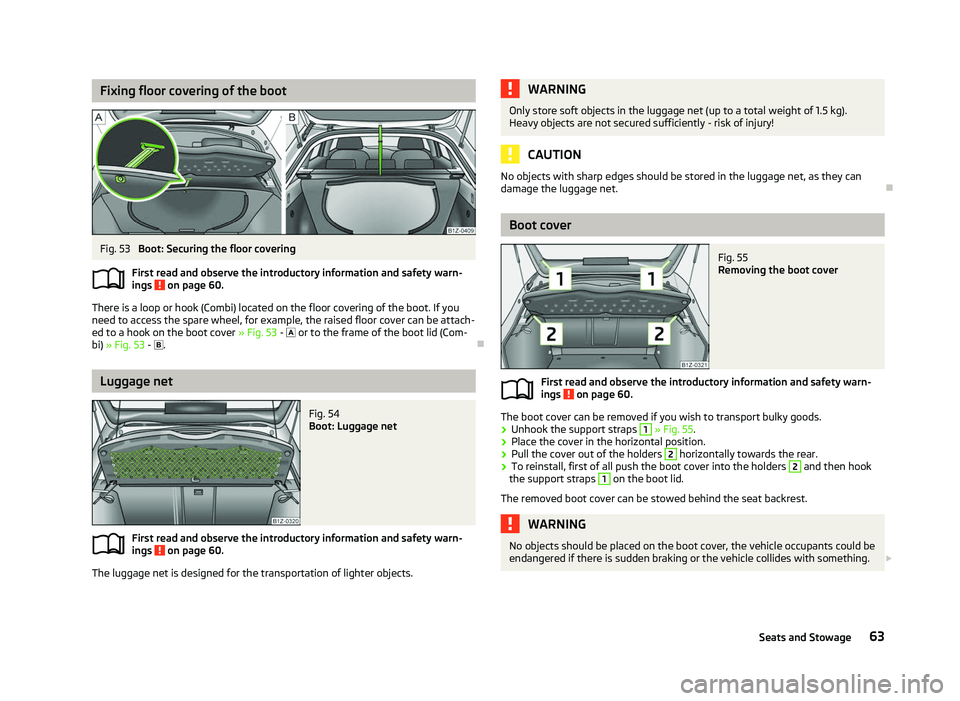
Fixing floor covering of the boot
Fig. 53
Boot: Securing the floor covering
First read and observe the introductory information and safety warn-
ings on page 60.
There is a loop or hook (Combi) located on the floor covering of the boot. If you
need to access the spare wheel, for example, the raised floor cover can be attach-
ed to a hook on the boot cover » Fig. 53 -
or to the frame of the boot lid (Com-
bi) » Fig. 53 - . ÐLuggage net
Fig. 54
Boot: Luggage net
First read and observe the introductory information and safety warn-
ings on page 60.
The luggage net is designed for the transportation of lighter objects.ä
ä WARNING
Only store soft objects in the luggage net (up to a total weight of 1.5 kg).
Heavy objects are not secured sufficiently - risk of injury! CAUTION
No objects with sharp edges should be stored in the luggage net, as they can
damage the luggage net. Ð Boot cover
Fig. 55
Removing the boot cover
First read and observe the introductory information and safety warn-
ings on page 60.
The boot cover can be removed if you wish to transport bulky goods.
›
Unhook the support straps 1
» Fig. 55.
› Place the cover in the horizontal position.
› Pull the cover out of the holders 2
horizontally towards the rear.
› To reinstall, first of all push the boot cover into the holders 2
and then hook
the support straps 1
on the boot lid.
The removed boot cover can be stowed behind the seat backrest. WARNING
No objects should be placed on the boot cover, the vehicle occupants could be
endangered if there is sudden braking or the vehicle collides with something. £
ä
63
Seats and Stowage
Page 66 of 218
CAUTION
Please ensure that the heating elements for the rear window heater are not dam-
aged as a result of objects placed in this area. Note
Opening the boot lid also lifts up the boot cover. ÐFoldable boot cover (Combi)
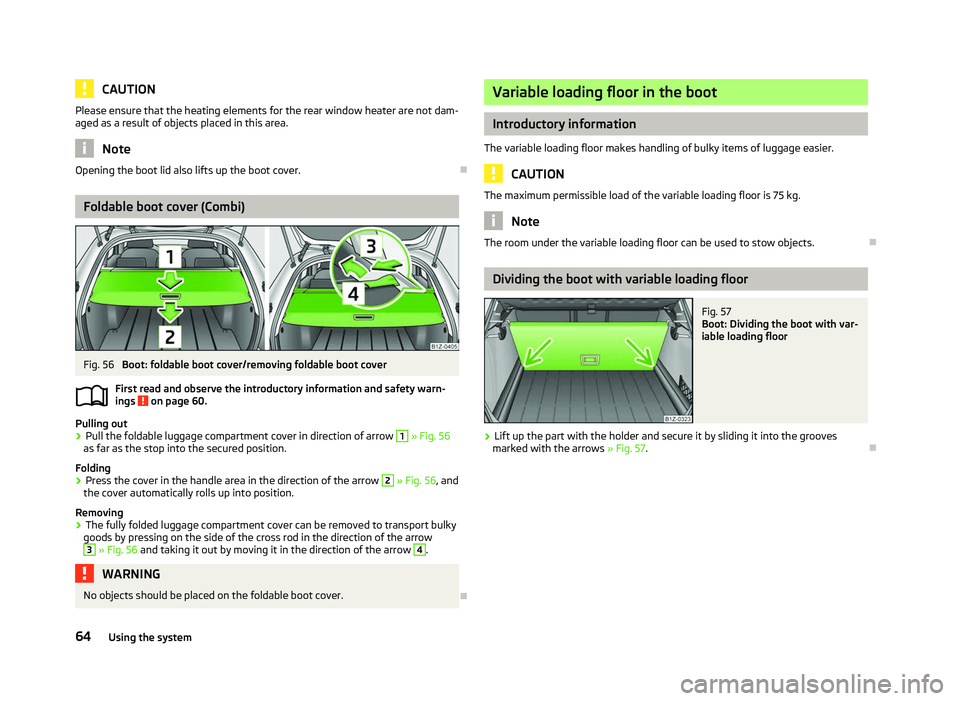
Fig. 56
Boot: foldable boot cover/removing foldable boot cover
First read and observe the introductory information and safety warn-
ings on page 60.
Pulling out
›
Pull the foldable luggage compartment cover in direction of arrow 1
» Fig. 56
as far as the stop into the secured position.
Folding
› Press the cover in the handle area in the direction of the arrow 2
» Fig. 56
, and
the cover automatically rolls up into position.
Removing
› The fully folded luggage compartment cover can be removed to transport bulky
goods by pressing on the side of the cross rod in the direction of the arrow 3
» Fig. 56
and taking it out by moving it in the direction of the arrow 4
.
WARNING
No objects should be placed on the foldable boot cover. Ð
ä Variable loading floor in the boot
Introductory information
The variable loading floor makes handling of bulky items of luggage easier. CAUTION
The maximum permissible load of the variable loading floor is 75 kg. Note
The room under the variable loading floor can be used to stow objects. Ð Dividing the boot with variable loading floor
Fig. 57
Boot: Dividing the boot with var-
iable loading floor
› Lift up the part with the holder and secure it by sliding it into the grooves
marked with the arrows »
Fig. 57. Ð
64 Using the system
Page 67 of 218
Removing the variable loading floor
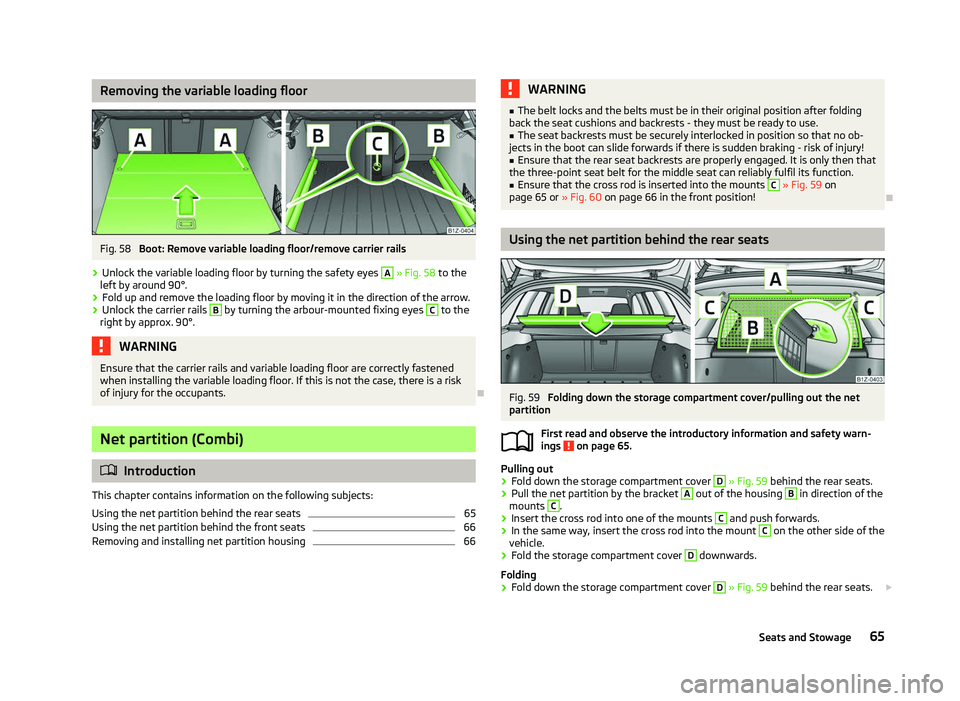
Fig. 58
Boot: Remove variable loading floor/remove carrier rails
› Unlock the variable loading floor by turning the safety eyes A
» Fig. 58
to the
left by around 90°.
› Fold up and remove the loading floor by moving it in the direction of the arrow.
› Unlock the carrier rails B
by turning the arbour-mounted fixing eyes C
to the
right by approx. 90°. WARNING
Ensure that the carrier rails and variable loading floor are correctly fastened
when installing the variable loading floor. If this is not the case, there is a risk
of injury for the occupants. ÐNet partition (Combi)
ä
Introduction
This chapter contains information on the following subjects:
Using the net partition behind the rear seats 65
Using the net partition behind the front seats 66
Removing and installing net partition housing 66 WARNING
■ The belt locks and the belts must be in their original position after folding
back the seat cushions and backrests - they must be ready to use.
■ The seat backrests must be securely interlocked in position so that no ob-
jects in the boot can slide forwards if there is sudden braking - risk of injury!
■ Ensure that the rear seat backrests are properly engaged. It is only then that
the three-point seat belt for the middle seat can reliably fulfil its function. ■ Ensure that the cross rod is inserted into the mounts C
» Fig. 59 on
page 65 or » Fig. 60 on page 66 in the front position! Ð Using the net partition behind the rear seats
Fig. 59
Folding down the storage compartment cover/pulling out the net
partition
First read and observe the introductory information and safety warn-
ings on page 65.
Pulling out
› Fold down the storage compartment cover D
» Fig. 59 behind the rear seats.
› Pull the net partition by the bracket A
out of the housing B
in direction of the
mounts C
.
› Insert the cross rod into one of the mounts C
and push forwards.
› In the same way, insert the cross rod into the mount C
on the other side of the
vehicle.
› Fold the storage compartment cover D
downwards.
Folding
› Fold down the storage compartment cover D
» Fig. 59 behind the rear seats.
£
ä
65
Seats and Stowage