seats SKODA OCTAVIA 2006 Owner´s Manual
[x] Cancel search | Manufacturer: SKODA, Model Year: 2006, Model line: OCTAVIA, Model: SKODA OCTAVIA 2006Pages: 218, PDF Size: 5.48 MB
Page 77 of 218
The air inlet in the storage compartment is connected to position
through ad-
justment of the control dial for air distribution. This setting causes the maximum
amount of air to flow into the storage compartment (depending on the rotary reg-
ulator position for the fan).
The storage compartment can, for example, be used to temper drinks cans, etc.
If you do not use the air inlet in the storage compartment, the inlet should al-
ways be kept closed. Note
Push the armrest cover all the way back to the stop before applying the hand-
brake. ÐRear armrest with storage compartment
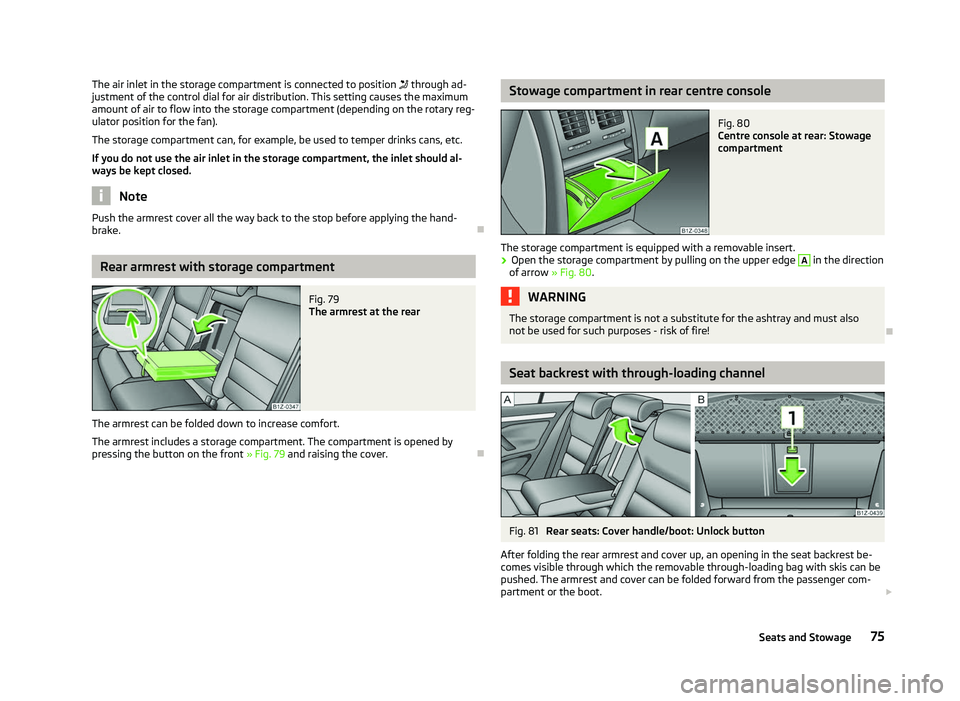
Fig. 79
The armrest at the rear
The armrest can be folded down to increase comfort.
The armrest includes a storage compartment. The compartment is opened by
pressing the button on the front » Fig. 79 and raising the cover. Ð Stowage compartment in rear centre console
Fig. 80
Centre console at rear: Stowage
compartment
The storage compartment is equipped with a removable insert. › Open the storage compartment by pulling on the upper edge A
in the direction
of arrow » Fig. 80 . WARNING
The storage compartment is not a substitute for the ashtray and must also
not be used for such purposes - risk of fire! Ð Seat backrest with through-loading channel
Fig. 81
Rear seats: Cover handle/boot: Unlock button
After folding the rear armrest and cover up, an opening in the seat backrest be-
comes visible through which the removable through-loading bag with skis can be
pushed. The armrest and cover can be folded forward from the passenger com-
partment or the boot. £
75
Seats and Stowage
Page 79 of 218
Side compartment in the luggage compartment
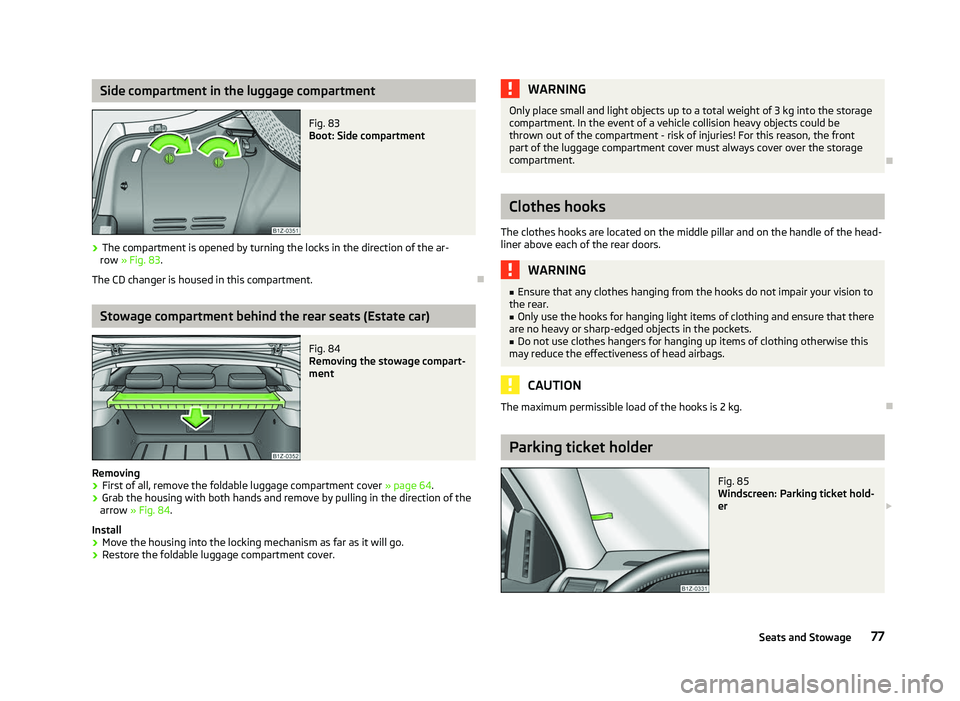
Fig. 83
Boot: Side compartment
› The compartment is opened by turning the locks in the direction of the ar-
row » Fig. 83.
The CD changer is housed in this compartment. ÐStowage compartment behind the rear seats (Estate car)
Fig. 84
Removing the stowage compart-
ment
Removing
› First of all, remove the foldable luggage compartment cover
» page 64.
› Grab the housing with both hands and remove by pulling in the direction of the
arrow » Fig. 84 .
Install
› Move the housing into the locking mechanism as far as it will go.
› Restore the foldable luggage compartment cover. WARNING
Only place small and light objects up to a total weight of 3 kg into the storage
compartment. In the event of a vehicle collision heavy objects could be
thrown out of the compartment - risk of injuries! For this reason, the front
part of the luggage compartment cover must always cover over the storage
compartment. Ð Clothes hooks
The clothes hooks are located on the middle pillar and on the handle of the head-
liner above each of the rear doors. WARNING
■ Ensure that any clothes hanging from the hooks do not impair your vision to
the rear.
■ Only use the hooks for hanging light items of clothing and ensure that there
are no heavy or sharp-edged objects in the pockets.
■ Do not use clothes hangers for hanging up items of clothing otherwise this
may reduce the effectiveness of head airbags. CAUTION
The maximum permissible load of the hooks is 2 kg. Ð Parking ticket holder
Fig. 85
Windscreen: Parking ticket hold-
er £
77
Seats and Stowage
Page 94 of 218
Note
■ The engine can only be started with a genuine ŠKODA key with the matching
code. ■ The engine running noises may louder at first be louder for a short time after
starting the cold engine. This is quite normal and is not an operating problem. ■ After switching off the ignition, the radiator fan can intermittently continue to
operate for approx. 10
minutes.
■ If the engine does not start up after a second attempt, the fuse for the fuel
pump/glow plug system (Diesel engines) may have a fault. Check the fuse and re-
place, if necessary » page 190, Fuses in the dash panel
or seek assistance from a
ŠKODA specialist garage.
■ We recommend locking the steering wheel whenever leaving the vehicle. This
acts as a deterrent against the attempted theft of your car. ÐAdjusting the steering wheel position
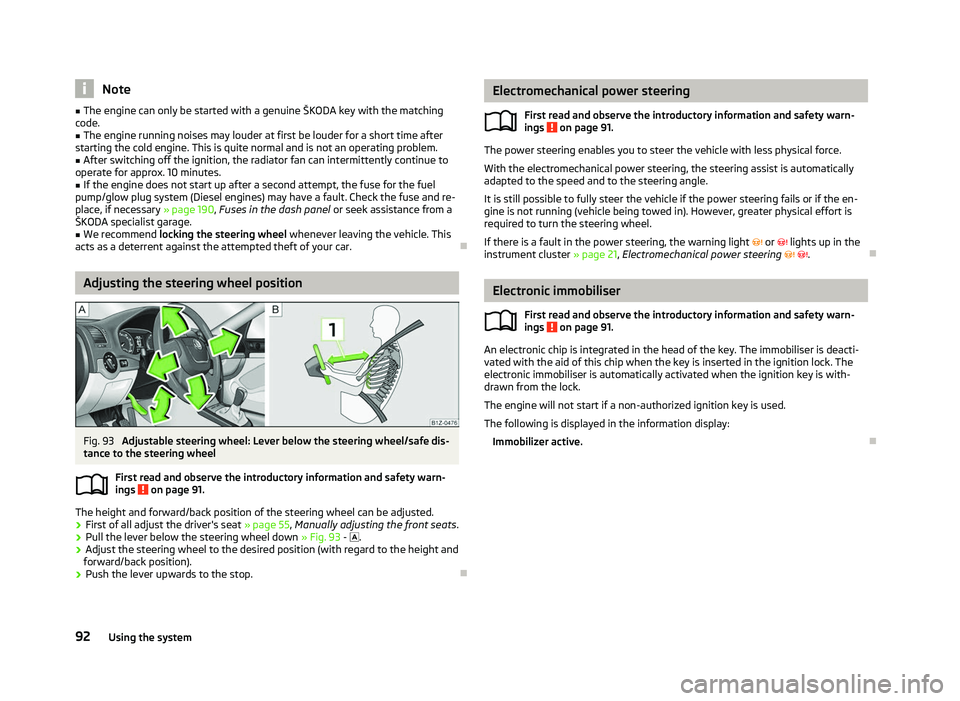
Fig. 93
Adjustable steering wheel: Lever below the steering wheel/safe dis-
tance to the steering wheel
First read and observe the introductory information and safety warn-
ings on page 91.
The height and forward/back position of the steering wheel can be adjusted.
›
First of all adjust the driver's seat
» page 55, Manually adjusting the front seats .
› Pull the lever below the steering wheel down
» Fig. 93 - .
› Adjust the steering wheel to the desired position (with regard to the height and
forward/back position).
› Push the lever upwards to the stop. Ð
ä Electromechanical power steering
First read and observe the introductory information and safety warn-
ings on page 91.
The power steering enables you to steer the vehicle with less physical force.
With the electromechanical power steering, the steering assist is automatically
adapted to the speed and to the steering angle.
It is still possible to fully steer the vehicle if the power steering fails or if the en-
gine is not running (vehicle being towed in). However, greater physical effort is
required to turn the steering wheel.
If there is a fault in the power steering, the warning light or lights up in the
instrument cluster » page 21, Electromechanical power steering . Ð Electronic immobiliser
First read and observe the introductory information and safety warn-
ings on page 91.
An electronic chip is integrated in the head of the key. The immobiliser is deacti-
vated with the aid of this chip when the key is inserted in the ignition lock. The
electronic immobiliser is automatically activated when the ignition key is with-
drawn from the lock.
The engine will not start if a non-authorized ignition key is used.
The following is displayed in the information display: Immobilizer active. Ð
ä
ä
92 Using the system
Page 123 of 218
Safety
Passive Safety
General information
ä
Introduction
This chapter contains information on the following subjects:
Safety equipment 121
Before setting off 121
What influences the driving safety? 122
In this section you will find important information, tips and notes on the subject
of passive safety in your vehicle. We have combined everything here which you
should be familiar with, for example, regarding seat belts, airbags, child seats and
safety of children. It is therefore important, in particular, to comply with the notes
and warnings in this section for your own interest and in the interest of those
travelling with you. WARNING
■ This chapter contains important information on how to use the vehicle for
the driver and his occupants. You will find further information on safety, which
concerns you and those travelling with you, in the following chapters of this
Owner's Manual.
■ The complete on-board literature should always be in the vehicle. This ap-
plies in particular, if you rent out or sell the vehicle. ÐSafety equipment
First read and observe the introductory information and safety warn-
ings on page 121.
The following list contains part of the safety equipment in your vehicle:
› three-point seat belts for all the seats;
› belt force limiter for front and outer rear seats;
ä ›
belt tensioners for front seats;
› seat belt height adjusters for front seats;
› Front airbag for the driver and the front seat passenger;
› side airbags;
› head airbags;
› anchoring points for child seat using the
ISOFIX system;
› anchoring points for child seat using the TOP TETHER system;
› head restraints adjustable for height;
› adjustable steering column.
The specified safety equipment works together, in order to optimally protect you
and those travelling with you in accident situations. The safety equipment does
not protect you or the people travelling with you, if you or your occupants adopt
an incorrect seated position or the equipment is not correctly adjusted or used. Ð Before setting off
First read and observe the introductory information and safety warn-
ings on page 121.
For your own safety and the safety of the people travelling with you, please pay
attention to the following points before setting off.
›
Ensure that the lighting and the turn signal system are functioning properly.
› Check the tyre inflation pressure.
› Ensure that all of the windows offer good visibility to the outside.
› Secure all items of luggage
» page 60, Boot.
› Ensure that no objects can obstruct the pedals.
› Adjust the mirrors, the front seat and head restraint to your body size.
› Advise your passengers to adjust the head restraints to their body size.
› Protect children in suitable child seats with correctly fastened seat
belts
» page 135, Transporting children safely .
› Adopt the correct seated position
» page 122, Correct seated position . Tell your
passengers to assume the correct seated position.
› Correctly fasten the seat belt. Also inform passengers to fasten the seat belt
correctly » page 125, Seat belts . Ð
ä
121
Passive Safety
Page 124 of 218
What influences the driving safety?
First read and observe the introductory information and safety warn-
ings on page 121.
The driver is fully responsible for himself and his occupants. If your driving safety
is effected, you place yourself and the oncoming traffic at risk.
The following guidelines must therefore be observed. › Do not get distracted from concentrating on the traffic situation, e.g. by your
passengers or mobile phone calls.
› Never drive when your driving ability is impaired, e.g. through medication, alco-
hol, drugs.
› Keep to the traffic regulations and the permissible speed limit.
› Always adjust the driving speed to the road, traffic and weather conditions.
› Take regular breaks on long journeys – at least every two hours. ÐCorrect seated position
ä
Introduction
This chapter contains information on the following subjects:
Correct seated position for the driver 123
Correct seated position for the front passenger 123
Correct seated position for the occupants on the rear seats 123
Examples of an incorrect seated position 124
WARNING
■ The front seats and the head restraints must always be adjusted to match
the body size of the seat occupant as well as the seat belts must always be
correctly fastened in order to provide an optimal protection for you and your
occupants.
■ Always assume the correct seated position before setting off and do not
change this position while driving. Also advise your passengers to adopt the
correct seated position and not to change this position while the car is mov-
ing.
ä WARNING (Continued)
■ If the occupant adopts an incorrect seated position, he is exposed to life-
threatening injuries, in case he is hit by a deployed airbag.
■ If the occupants on the rear seats are not sitting upright, the risk of injury is
increased due to incorrect routing of the seat belt.
■ The driver must maintain a distance of at least 25 cm to the steering wheel.
The front passenger must maintain a distance of at least 25 cm to the dash
panel. Not maintaining this minimum distance will mean that the airbag sys-
tem will not be able to properly protect you - hazard!
■ When driving, hold the steering wheel with both hands firmly on the outer
edge in the 9
o'clock and 3 o'clock position. Never hold the steering wheel in
the 12 o'clock position or in any other way (e.g. in the middle or inner edge of
the steering wheel). In such cases, you could severely injure the arms, hands
and head when the driver airbag is deployed.
■ The seat backrests must not be angled too far back when driving otherwise
this will affect proper operation of the seat belts and of the airbag system -
risk of injury!
■ Ensure that there are no objects in the driver's footwell as they may get
caught behind the pedals when driving or applying the braking. You would
then no longer be able to operate the clutch, brake or accelerate.
■ Always keep your feet in the footwell when the car is being driven - never
place your feet on the instrument panel, out of the window or on the surfaces
of the seats. You will be exposed to increased risk of injury if it becomes nec-
essary to apply the brake or in the event of an accident. If an airbag is de-
ployed, you may suffer fatal injuries when adopting an incorrect seated posi-
tion! Ð
122 Safety
Page 125 of 218
Correct seated position for the driver
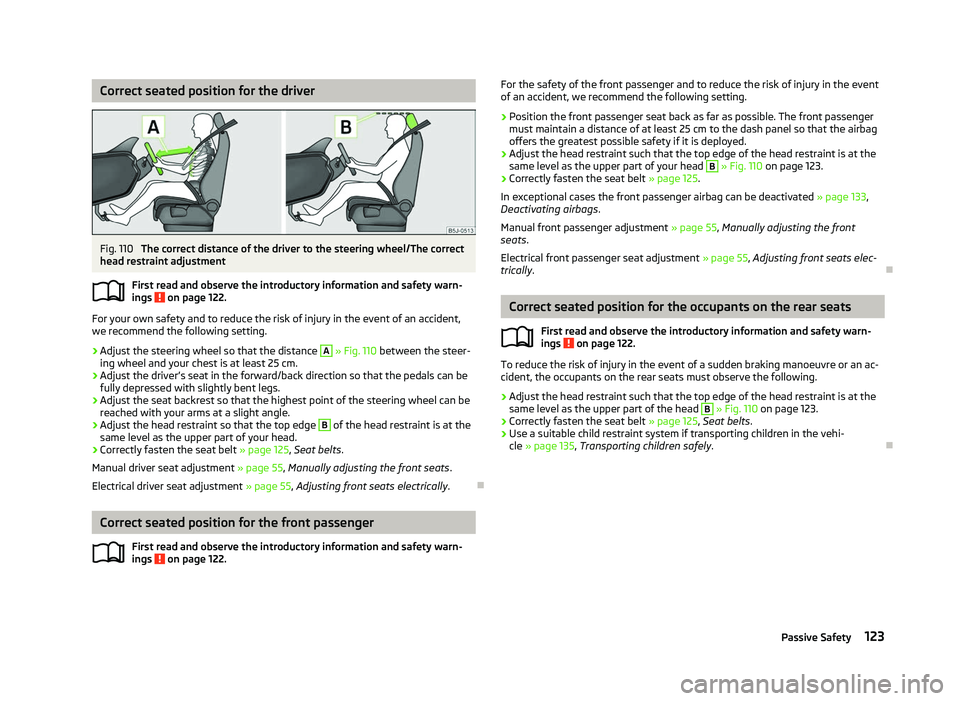
Fig. 110
The correct distance of the driver to the steering wheel/The correct
head restraint adjustment
First read and observe the introductory information and safety warn-
ings on page 122.
For your own safety and to reduce the risk of injury in the event of an accident,
we recommend the following setting.
› Adjust the steering wheel so that the distance A
» Fig. 110 between the steer-
ing wheel and your chest is at least 25 cm.
› Adjust the driver’s seat in the forward/back direction so that the pedals can be
fully depressed with slightly bent legs.
› Adjust the seat backrest so that the highest point of the steering wheel can be
reached with your arms at a slight angle.
› Adjust the head restraint so that the top edge B
of the head restraint is at the
same level as the upper part of your head.
› Correctly fasten the seat belt
» page 125, Seat belts.
Manual driver seat adjustment » page 55, Manually adjusting the front seats .
Electrical driver seat adjustment » page 55, Adjusting front seats electrically .Ð Correct seated position for the front passenger
First read and observe the introductory information and safety warn-
ings on page 122.ä
ä For the safety of the front passenger and to reduce the risk of injury in the event
of an accident, we recommend the following setting.
› Position the front passenger seat back as far as possible. The front passenger
must maintain a distance of at least 25
cm to the dash panel so that the airbag
offers the greatest possible safety if it is deployed.
› Adjust the head restraint such that the top edge of the head restraint is at the
same level as the upper part of your head B
» Fig. 110
on page
123.
› Correctly fasten the seat belt
» page 125.
In exceptional cases the front passenger airbag can be deactivated » page 133,
Deactivating airbags .
Manual front passenger adjustment » page 55, Manually adjusting the front
seats .
Electrical front passenger seat adjustment » page 55, Adjusting front seats elec-
trically. Ð Correct seated position for the occupants on the rear seats
First read and observe the introductory information and safety warn-
ings on page 122.
To reduce the risk of injury in the event of a sudden braking manoeuvre or an ac-
cident, the occupants on the rear seats must observe the following.
› Adjust the head restraint such that the top edge of the head restraint is at the
same level as the upper part of the head B
» Fig. 110 on page 123.
› Correctly fasten the seat belt
» page 125, Seat belts.
› Use a suitable child restraint system if transporting children in the vehi-
cle » page 135, Transporting children safely . Ð
ä
123
Passive Safety
Page 126 of 218
Examples of an incorrect seated position
First read and observe the introductory information and safety warn-
ings on page 122.
Seat belts offer their optimum protection only if the webbing of the seat belts is
properly routed. Incorrect seated positions considerably reduce the protective
functions of the seat belts and therefore increase the risk of injury due to an in-
correct routing of the seat belt. The driver is fully responsible for himself and pas-
sengers, especially children. Never allow a passenger to adopt an incorrect seated
position when the car is moving.
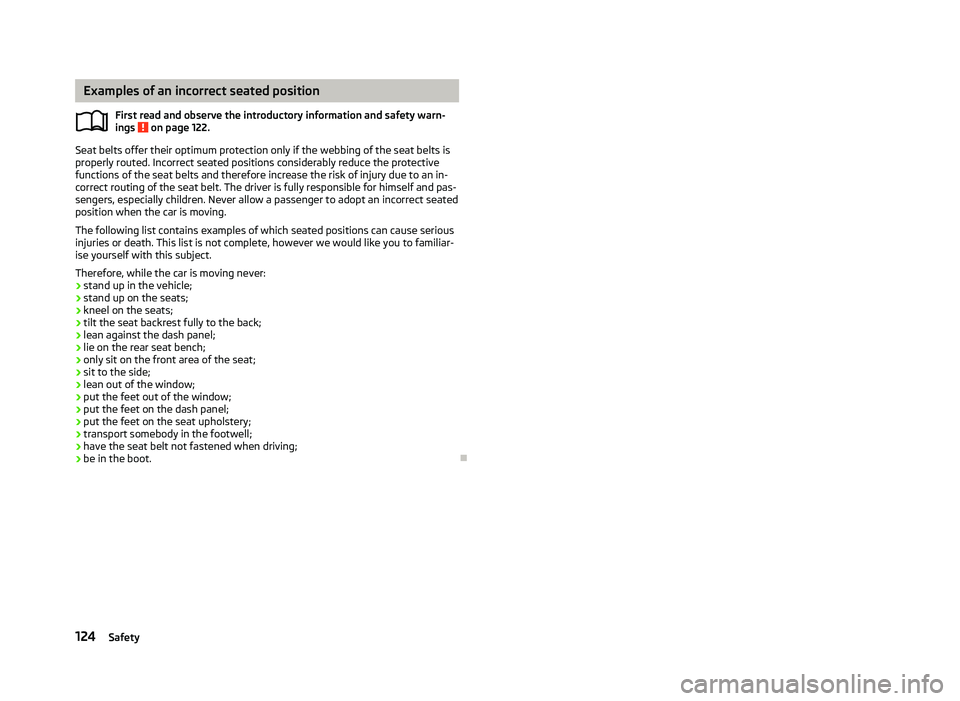
The following list contains examples of which seated positions can cause serious
injuries or death. This list is not complete, however we would like you to familiar-
ise yourself with this subject.
Therefore, while the car is moving never:
› stand up in the vehicle;
› stand up on the seats;
› kneel on the seats;
› tilt the seat backrest fully to the back;
› lean against the dash panel;
› lie on the rear seat bench;
› only sit on the front area of the seat;
› sit to the side;
› lean out of the window;
› put the feet out of the window;
› put the feet on the dash panel;
› put the feet on the seat upholstery;
› transport somebody in the footwell;
› have the seat belt not fastened when driving;
› be in the boot. Ðä
124 Safety
Page 127 of 218
Seat belts
Seat belts
ä
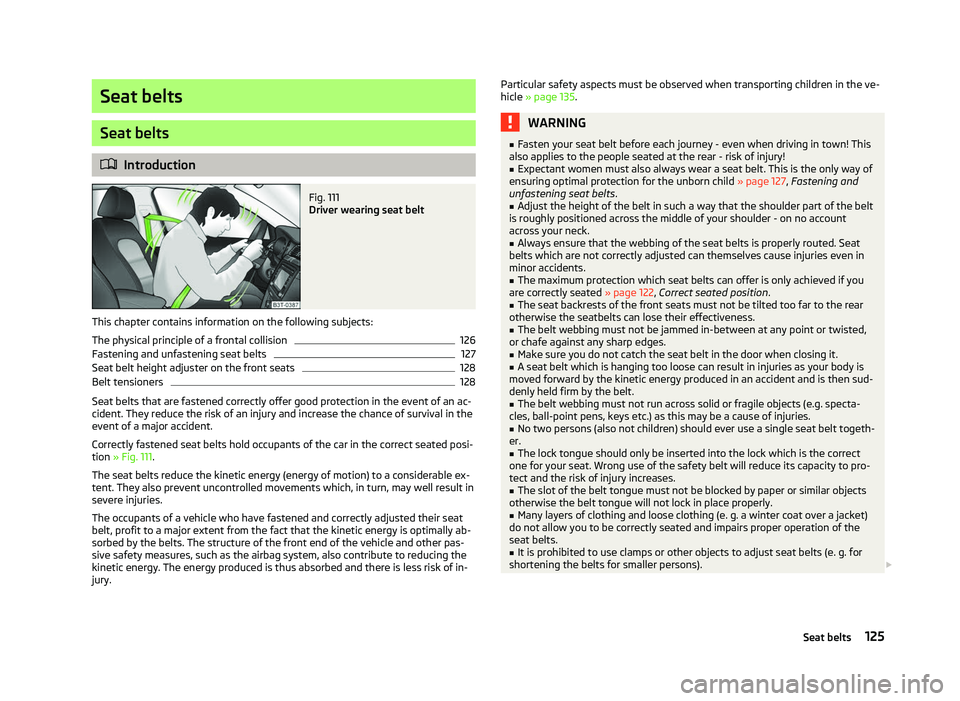
Introduction Fig. 111
Driver wearing seat belt
This chapter contains information on the following subjects:
The physical principle of a frontal collision 126
Fastening and unfastening seat belts 127
Seat belt height adjuster on the front seats 128
Belt tensioners 128
Seat belts that are fastened correctly offer good protection in the event of an ac-
cident. They reduce the risk of an injury and increase the chance of survival in the
event of a major accident.
Correctly fastened seat belts hold occupants of the car in the correct seated posi-
tion » Fig. 111.
The seat belts reduce the kinetic energy (energy of motion) to a considerable ex-
tent. They also prevent uncontrolled movements which, in turn, may well result in
severe injuries.
The occupants of a vehicle who have fastened and correctly adjusted their seat
belt, profit to a major extent from the fact that the kinetic energy is optimally ab-
sorbed by the belts. The structure of the front end of the vehicle and other pas-
sive safety measures, such as the airbag system, also contribute to reducing the
kinetic energy. The energy produced is thus absorbed and there is less risk of in-
jury. Particular safety aspects must be observed when transporting children in the ve-
hicle
» page 135. WARNING
■ Fasten your seat belt before each journey - even when driving in town! This
also applies to the people seated at the rear - risk of injury!
■ Expectant women must also always wear a seat belt. This is the only way of
ensuring optimal protection for the unborn child » page 127, Fastening and
unfastening seat belts .
■ Adjust the height of the belt in such a way that the shoulder part of the belt
is roughly positioned across the middle of your shoulder - on no account
across your neck.
■ Always ensure that the webbing of the seat belts is properly routed. Seat
belts which are not correctly adjusted can themselves cause injuries even in
minor accidents.
■ The maximum protection which seat belts can offer is only achieved if you
are correctly seated » page 122, Correct seated position .
■ The seat backrests of the front seats must not be tilted too far to the rear
otherwise the seatbelts can lose their effectiveness.
■ The belt webbing must not be jammed in-between at any point or twisted,
or chafe against any sharp edges.
■ Make sure you do not catch the seat belt in the door when closing it.
■ A seat belt which is hanging too loose can result in injuries as your body is
moved forward by the kinetic energy produced in an accident and is then sud-
denly held firm by the belt.
■ The belt webbing must not run across solid or fragile objects (e.g. specta-
cles, ball-point pens, keys etc.) as this may be a cause of injuries.
■ No two persons (also not children) should ever use a single seat belt togeth-
er.
■ The lock tongue should only be inserted into the lock which is the correct
one for your seat. Wrong use of the safety belt will reduce its capacity to pro-
tect and the risk of injury increases.
■ The slot of the belt tongue must not be blocked by paper or similar objects
otherwise the belt tongue will not lock in place properly.
■ Many layers of clothing and loose clothing (e. g. a winter coat over a jacket)
do not allow you to be correctly seated and impairs proper operation of the
seat belts.
■ It is prohibited to use clamps or other objects to adjust seat belts (e. g. for
shortening the belts for smaller persons). £
125
Seat belts
Page 128 of 218
WARNING (Continued)
■ The seat belts for the rear seats can only fulfil their function reliably when
the seat backrests are correctly locked into position » page 59, Rear seats.
■ The belt webbing must always be kept clean. Soiled belt webbing may im-
pair proper operation of the inertia reel » page 154, Seat belts.
■ The seat belts must not be removed or changed in any way. Do not attempt
to repair the seat belts yourself.
■ Check the condition of all the seat belts on a regular basis. If any damage to
the seat belts, seat belt connections, inertia reel or the lock is detected, the
relevant seat belt must be replaced by a
ŠKODA specialist garage.
■ Damaged seat belts which have been subjected to stress in an accident and
were therefore stretched, must be replaced - this is best done by a
ŠKODA
specialist garage. The anchorage points for the belts should also be checked. Note
The national legal requirements must be observed when using seat belts. ÐThe physical principle of a frontal collision
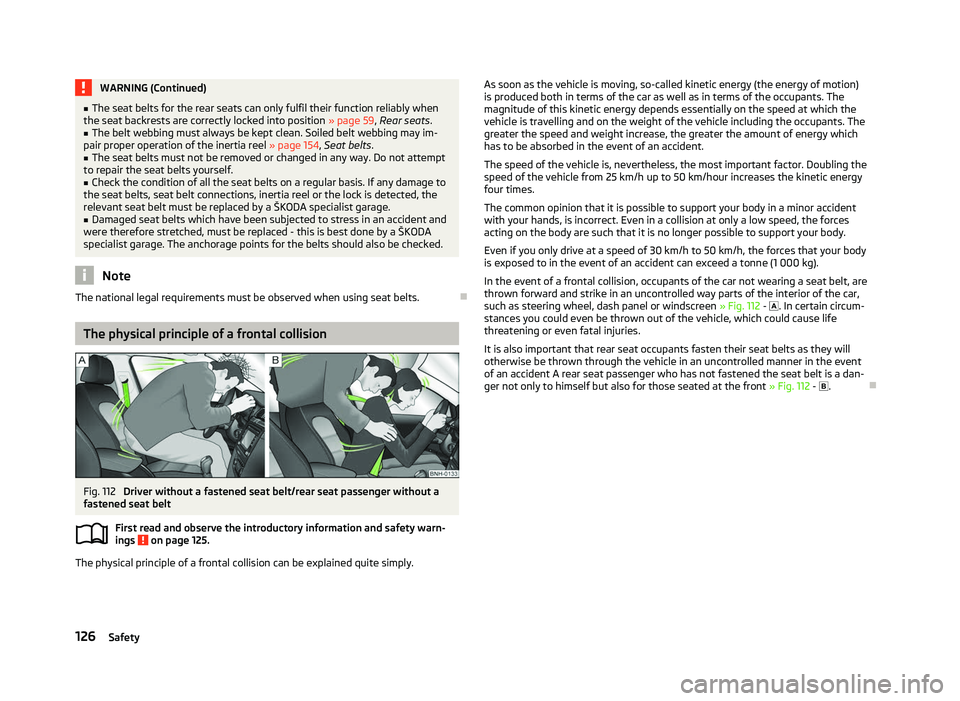
Fig. 112
Driver without a fastened seat belt/rear seat passenger without a
fastened seat belt
First read and observe the introductory information and safety warn-
ings on page 125.
The physical principle of a frontal collision can be explained quite simply.
ä As soon as the vehicle is moving, so-called kinetic energy (the energy of motion)
is produced both in terms of the car as well as in terms of the occupants. The
magnitude of this kinetic energy depends essentially on the speed at which the
vehicle is travelling and on the weight of the vehicle including the occupants. The
greater the speed and weight increase, the greater the amount of energy which
has to be absorbed in the event of an accident.
The speed of the vehicle is, nevertheless, the most important factor. Doubling the
speed of the vehicle from 25 km/h up to 50 km/hour increases the kinetic energy
four times.
The common opinion that it is possible to support your body in a minor accident
with your hands, is incorrect. Even in a collision at only a low speed, the forces
acting on the body are such that it is no longer possible to support your body.
Even if you only drive at a speed of 30
km/h to 50 km/h, the forces that your body
is exposed to in the event of an accident can exceed a tonne (1 000 kg).
In the event of a frontal collision, occupants of the car not wearing a seat belt, are
thrown forward and strike in an uncontrolled way parts of the interior of the car,
such as steering wheel, dash panel or windscreen » Fig. 112 - . In certain circum-
stances you could even be thrown out of the vehicle, which could cause life
threatening or even fatal injuries.
It is also important that rear seat occupants fasten their seat belts as they will
otherwise be thrown through the vehicle in an uncontrolled manner in the event
of an accident A rear seat passenger who has not fastened the seat belt is a dan-
ger not only to himself but also for those seated at the front » Fig. 112 - . Ð
126 Safety
Page 130 of 218
Seat belt height adjuster on the front seats
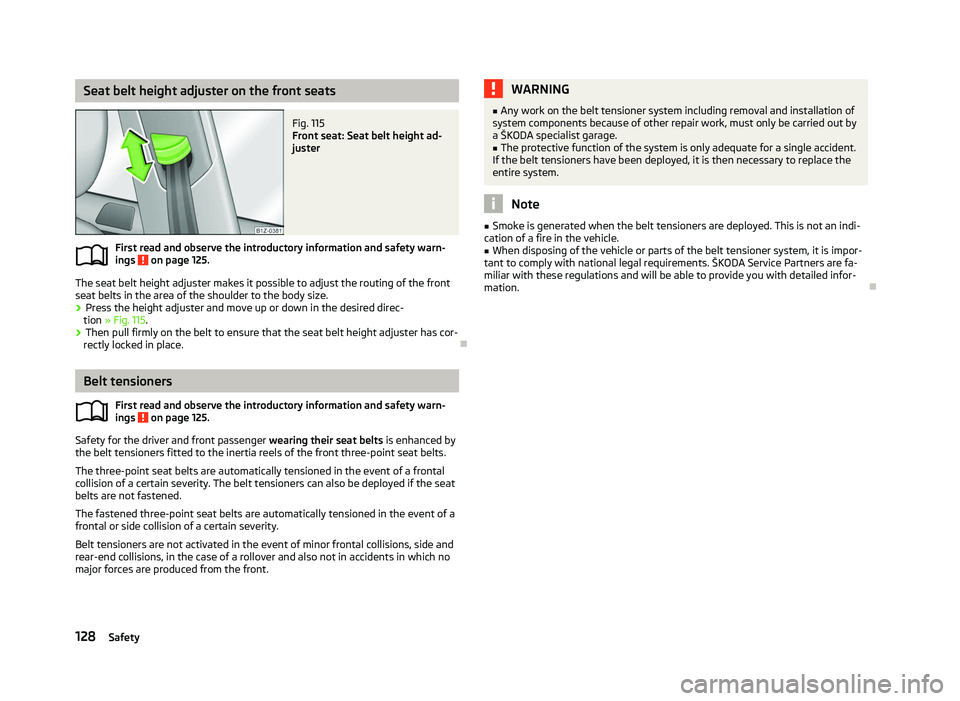
Fig. 115
Front seat: Seat belt height ad-
juster
First read and observe the introductory information and safety warn-
ings on page 125.
The seat belt height adjuster makes it possible to adjust the routing of the front
seat belts in the area of the shoulder to the body size.
›
Press the height adjuster and move up or down in the desired direc-
tion » Fig. 115.
› Then pull firmly on the belt to ensure that the seat belt height adjuster has cor-
rectly locked in place. ÐBelt tensioners
First read and observe the introductory information and safety warn-
ings on page 125.
Safety for the driver and front passenger
wearing their seat belts is enhanced by
the belt tensioners fitted to the inertia reels of the front three-point seat belts.
The three-point seat belts are automatically tensioned in the event of a frontal
collision of a certain severity. The belt tensioners can also be deployed if the seat
belts are not fastened.
The fastened three-point seat belts are automatically tensioned in the event of a
frontal or side collision of a certain severity.
Belt tensioners are not activated in the event of minor frontal collisions, side and
rear-end collisions, in the case of a rollover and also not in accidents in which no
major forces are produced from the front.
ä
ä WARNING
■ Any work on the belt tensioner system including removal and installation of
system components because of other repair work, must only be carried out by
a
ŠKODA specialist garage.
■ The protective function of the system is only adequate for a single accident.
If the belt tensioners have been deployed, it is then necessary to replace the
entire system. Note
■ Smoke is generated when the belt tensioners are deployed. This is not an indi-
cation of a fire in the vehicle. ■ When disposing of the vehicle or parts of the belt tensioner system, it is impor-
tant to comply with national legal requirements.
ŠKODA Service Partners are fa-
miliar with these regulations and will be able to provide you with detailed infor-
mation. Ð128
Safety