airbag off SKODA OCTAVIA 2007 1.G / (1U) User Guide
[x] Cancel search | Manufacturer: SKODA, Model Year: 2007, Model line: OCTAVIA, Model: SKODA OCTAVIA 2007 1.G / (1U)Pages: 288, PDF Size: 15.19 MB
Page 150 of 288
Communication149
Using the systemSafetyDriving TipsGeneral MaintenanceBreakdown assistanceTechnical Data
Note
•Not valid for all mobile phones which enable a communication via Bluetooth.
•Please operate your mobile phone exclusively with a suitable adapter, in order
to keep a low radiation in the vehicle.
•Inserting the mobile phone into the adapter ensures an optimal sending and
receiving power and offers at the same ti me the advantage of the battery charging.
•If you insert the mobile telephone into the adapter, the connection is estab-
lished via the interface in the adapter set and the Bluetooth connection is discon-
nected. You can hear an increasing tone sequence from the loudspeakers of the
vehicle.
•Note that the range of the Bluetooth connection to the handsfree-system is
limited to the vehicle interior. The range is dependent on local factors, e.g. obstacles
between the devices and interferences with other devices. If your mobile phone is
e.g. in a jacket pocket, this can lead to difficulties wh en establishing the Bluetooth
connection with the handsfree-system or the data transfer.
•If you have set the Portugue se language in the information display, it is used
automatically for the mobile phone operatio n, as this is the language, which was
entered during coding of the handsfree-system.
•On certain mobile phones with operating system, it is necessary to install on the
mobile phone an application of the mobile phone manufacturer, which enables the
take-over of the phone phonebook via Bluetooth.
Mobile phones and two-way radio systems
The installation of a mobile phone and tw o-way radio system in a vehicle should
only be carried out by a Škoda Dealer.
Škoda Auto a.s. permits the operation of mobile phones and two-way radio
systems with a professionally installed external aerial and a maximum transmission
power of up to 10 watts.
Our specialist garage is also happy to inform you about the possibilities available
for installing and operating mobile teleph ones and radio transmitters which have
an output greater than 10 watts. The Šk oda Service Partners can provide you with details about the technical possibilities for retrofitting of mobile telephones and
radio transmitters.
Operation of mobile phones or two-way
radio systems may interfere with func-
tioning of the electronic systems of your vehicle. The reasons for this may be:
•no external aerial
•external aerial incorrectly installed
•transmission power gr eater than 10 watts.
You should therefore not operate a mobile phone or two-way radio system
inside the vehicle without the use of an external aerial, or with an external aerial
which has been incorrectly installed.
You should also be aware of the fact that only an external aerial makes it possible
to achieve the optimal range of such equipment.
WARNING
•If a mobile phone or two-way radio sy stem is operated inside the vehicle
without using an external aerial, or wi th an external aerial which has been
incorrectly installed, the result can be excessive electromagnetic fields
which may cause harm to your health.
•Please always pay full attention to the traffic situation around you!
•You must not install two-way radio systems, mobile phones or mounts
on the covers of the airbags or within the immediate deployment range of
airbags. This might result in injuries to the occupants in the event of an acci-
dent.
Note
Please also refer to the operating instructions of the mobile phones and two-way
radio systems.
NKO A5 20 MR08.book Page 149 Wednesday, April 11, 2007 2:54 PM
Page 157 of 288
Passive Safety
156
Correct seated position for the front passenger
The front passenger must maintain a distance of at least 25 cm from
the dash panel so that the airbag offers the greatest possible safety
when an airbag is deployed.
For the safety of the front passenger and to reduce the risk of injury in the event of
an accident, we recommend the following setting:
•Adjust the front passenger seat as far as possible to the rear.
•Adjust the head restraint so that the top edge of the head restraint is at the same
level as the upper part of your head ⇒page 155, fig. 156 .
•Fasten the seat belt correctly ⇒ page 160, “How are seat belts correctly
fastened?”.
In exceptional cases the front pass enger airbag can be deactivated ⇒page 171,
“Deactivating an airbag”.
Manual front passenger adjustment ⇒page 67, “Adjusting the front seats”.
Electrical front passenger seat adjustment ⇒page 68, “Adjusting front seats electri-
cally*”.
WARNING
•The front seats and the head restraints must always be adjusted to match
the body size of the seat occupant as well as the seat belts must always be
correctly fastened in order to provide an optimal protection for you and your
occupants.
•The front passenger must maintain a distance of at least 25 cm to the
dash panel. Not maintaining this minimum distance will mean that the
airbag system will not be able to properly protect you - hazard!
•Always keep your feet in the footwell when the car is being driven - never
place your feet on the instrument panel, out of the window or on the
surfaces of the seats. You will be exposed to increased risk of injury if it
becomes necessary to apply the brake or in the event of an accident. If an
airbag is deployed, you may suffer fata l injuries when adopting an incorrect
seated position!
•The backrests must not be angled too far back when driving otherwise
this will affect proper operation of the seat belts and of the airbag system -
risk of injury!
Correct seated position for the occupants on the rear seats
Occupants on the rear seats must si t upright, keep the feet in the
footwell and must have their seat belts correctly fastened.
To reduce the risk of injury in the event of a sudden braking manoeuvre or an acci-
dent, the occupants on the rear seats must observe the following:
•Adjust the head restraints so that the to p edge of the head restraints are at the
same level as the upper part of your head ⇒ page 155, fig. 156.
•Fasten the seat belt correctly ⇒page 160, “How are seat belts correctly
fastened?”.
•If you are transporting ⇒page 173, “Transporting children safely” children in
the vehicle, please use a suitable child restraint system.
WARNING
•The head restraints must always be adjusted to match the body size, in
order to offer an optimal protection for you and your occupants.
•Always keep your feet in the footwell when the car is being driven - never
put your feet out of the window or on the surfaces of the seats. You will be
exposed to increased risk of injury if it becomes necessary to apply the brake
or in the event of an accident. If an airbag is deployed, you may suffer fatal
injuries when adopting an incorrect seated position!
•If the occupants on the rear seats are not sitting upright, the risk of injury
is increased due to incorrec t routing of the seat belt.
WARNING (continued)
NKO A5 20 MR08.book Page 156 Wednesday, April 11, 2007 2:54 PM
Page 158 of 288

Passive Safety157
Using the systemSafetyDriving TipsGeneral MaintenanceBreakdown assistanceTechnical Data
Examples of an incorrect seated position
An incorrect seated position can lead to severe injuries or death for
the occupants.
Seat belts offer their optimum protection only if the webbing of the seat belts is
properly routed. Incorrect seated positi ons considerably reduce the protective
functions of the seat belts and therefore increase the risk of injury due to an incor-
rect routing of the seat belt. The driver is fully responsible for himself and the occu-
pants, in particular for the children. Do not permit an occupant to adopt an incor-
rect seated position when the car is moving.
The following list contains the examples of seated positions which are dangerous
for the occupants. This list is not comple te, however we would like you to get inter-
ested in this subject.
Therefore, while the car is moving never:
•stand up in the vehicle,
•stand up on the seats,
•kneel onto the seats,
•tilt the backrest fully to the back,
•lean against the dash panel,
•lie on the rear seats,
•only sit on the front area of the seat,
•sit to the side,
•lean out of the window,
•put the feet out of the window,
•put the feet on the dash panel,
•put the feet on the seat upholstery,
•occupy the footwell,
•have the seat belt not fastened,
•occupy the luggage compartment.
WARNING
•If the occupant adopts an incorrect seated position, he is exposed to life-
threatening injuries, in case he is hit by a deployed airbag.
•Before setting off, please adopt the correct seated position and do not
change this seated position while the car is moving. Also advise your occu-
pants to adopt the correct seated position and not to change this seated
position while the car is moving.
NKO A5 20 MR08.book Page 157 Wednesday, April 11, 2007 2:54 PM
Page 159 of 288
Seat belts
158
Seat belts
Why seat belts?
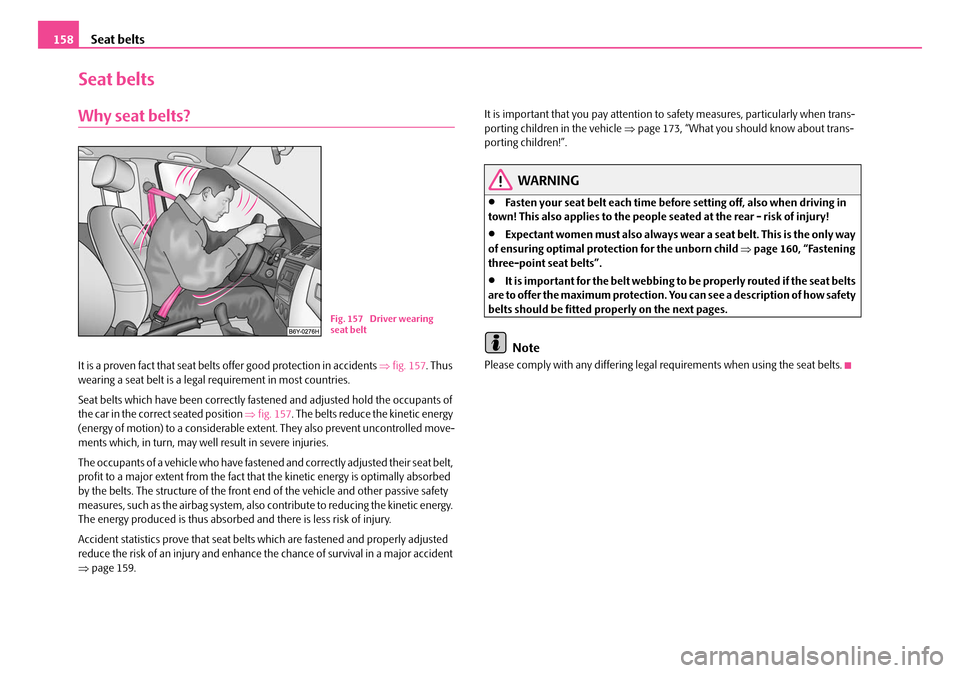
It is a proven fact that seat belt s offer good protection in accidents ⇒fig. 157 . Thus
wearing a seat belt is a legal requirement in most countries.
Seat belts which have been correctly fastened and adjusted hold the occupants of
the car in the correc t seated position ⇒fig. 157 . The belts reduce the kinetic energy
(energy of motion) to a considerable extent. They also prevent uncontrolled move-
ments which, in turn, may well result in severe injuries.
The occupants of a vehicle who have fastened and correctly adjusted their seat belt,
profit to a major extent from the fact that the kinetic energy is optimally absorbed
by the belts. The structure of the front end of the vehicle and other passive safety
measures, such as the airbag system, also contribute to reducing the kinetic energy.
The energy produced is thus absorbed and there is less risk of injury.
Accident statistics prove that seat belts which are fastened and properly adjusted
reduce the risk of an injury and enhance the chance of survival in a major accident
⇒ page 159. It is important that you pay attention to
safety measures, particularly when trans-
porting children in the vehicle ⇒ page 173, “What you should know about trans-
porting children!”.
WARNING
•Fasten your seat belt each time before setting off, also when driving in
town! This also applies to the people seated at the rear - risk of injury!
•Expectant women must also always wear a seat belt. This is the only way
of ensuring optimal protection for the unborn child ⇒page 160, “Fastening
three-point seat belts”.
•It is important for the belt webbing to be properly routed if the seat belts
are to offer the maximum protection. You can see a description of how safety
belts should be fitted pr operly on the next pages.
Note
Please comply with any differing legal requirements when using the seat belts.
Fig. 157 Driver wearing
seat belt
NKO A5 20 MR08.book Page 158 Wednesday, April 11, 2007 2:54 PM
Page 163 of 288
Seat belts
162
Taking seat belts off
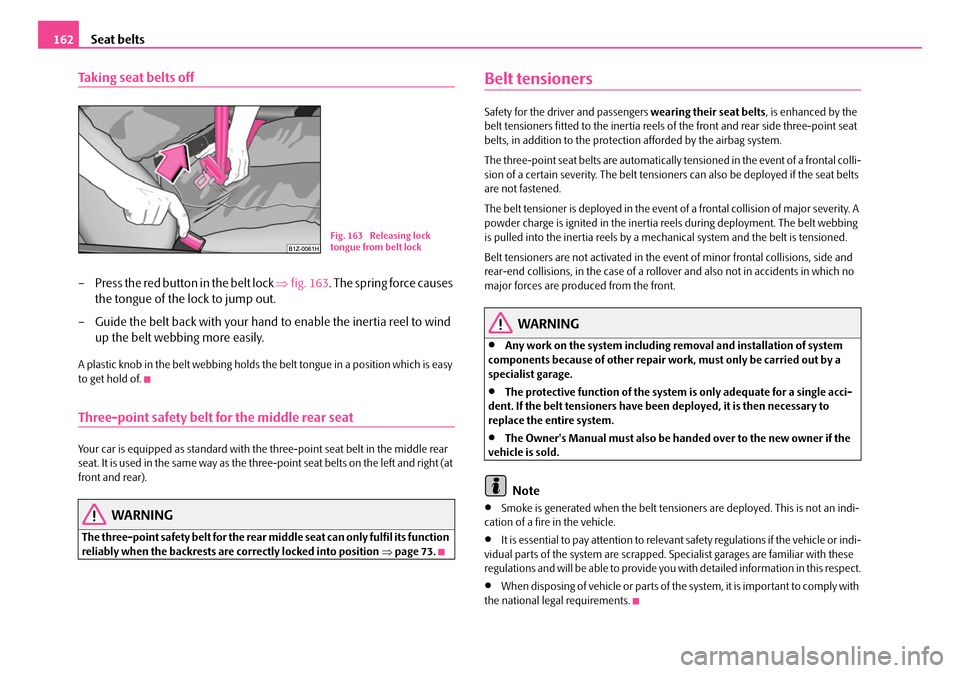
– Press the red button in the belt lock ⇒fig. 163 . The spring force causes
the tongue of the lock to jump out.
– Guide the belt back with your hand to enable the inertia reel to wind
up the belt webbing more easily.
A plastic knob in the belt webbing holds the belt tongue in a position which is easy
to get hold of.
Three-point safety belt for the middle rear seat
Your car is equipped as standa rd with the three-point seat belt in the middle rear
seat. It is used in the same way as the three-point seat belts on the left and right (at
front and rear).
WARNING
The three-point safety belt for the rear middle seat can only fulfil its function
reliably when the backrests are correctly locked into position ⇒page 73.
Belt tensioners
Safety for the driver and passengers wearing their seat belts, is enhanced by the
belt tensioners fitted to the inertia reels of the front and rear side three-point seat
belts, in addition to the protecti on afforded by the airbag system.
The three-point seat belts are automatically tensioned in the event of a frontal colli-
sion of a certain severity. Th e belt tensioners can also be deployed if the seat belts
are not fastened.
The belt tensioner is deployed in the event of a frontal collision of major severity. A
powder charge is ignited in the inertia reels during deployment. The belt webbing
is pulled into the inertia reels by a mech anical system and the belt is tensioned.
Belt tensioners are not activated in the ev ent of minor frontal collisions, side and
rear-end collisions, in the ca se of a rollover and also not in accidents in which no
major forces are produced from the front.
WARNING
•Any work on the system including removal and installation of system
components because of other repair work, must only be carried out by a
specialist garage.
•The protective function of the system is only adequate for a single acci-
dent. If the belt tensioners have been deployed, it is then necessary to
replace the entire system.
•The Owner's Manual must also be ha nded over to the new owner if the
vehicle is sold.
Note
•Smoke is generated when the belt tensione rs are deployed. This is not an indi-
cation of a fire in the vehicle.
•It is essential to pay attention to relevant safety regulations if the vehicle or indi-
vidual parts of the system are scrapped. Specialist garages are familiar with these
regulations and will be able to provide you with detailed information in this respect.
•When disposing of vehicle or parts of the system, it is important to comply with
the national legal requirements.
Fig. 163 Releasing lock
tongue from belt lock
NKO A5 20 MR08.book Page 162 Wednesday, April 11, 2007 2:54 PM
Page 164 of 288
Airbag system163
Using the systemSafetyDriving TipsGeneral MaintenanceBreakdown assistanceTechnical Data
Airbag system
Description of the airbag system
General information on the airbag system
The front airbag system is complementary to the three-point seat belts and offers
additional protection for the head and chest area of the driver and passenger in the
event of a frontal collision.
In the case of a violent side crash, the si de* and head* airbags reduce the risk of
injuries to the occupants on the part of the body facing the side of the accident
⇒ .
The airbag system is only functional af ter the ignition has been switched on.
The operational readiness of the airbag system is monitored electronically. The
airbag warning light comes on for a few seconds each time the ignition is switched
on.
The airbag system (according to vehicl e equipment) essentially consists of:
•an electronic control unit,
•front airbag for the driver and the front seat passenger*,
•Side airbags*,
•head airbags*,
•an airbag warning light in the instrument cluster,
•a front passenger airbag switch* ⇒page 172,
•an indicator light for a switched off front seat passenger airbag* in the middle
of the dash panel ⇒page 172.
A fault in the airbag system exists if:
•the airbag indicator light do es not light up when the ignition is switched on,
•the warning light does not go out after about 4 seconds after the ignition is
switched on,
•the airbag indicator light goes out and comes on again after the ignition is
switched on,
•the airbag indicator light comes on or flickers when driving,
•an airbag indicator light showing a swit ched-off front passenger airbag* in the
middle of the dash panel flashes.
WARNING
•To enable the occupants of a car to be protected with the greatest
possible effect when the airbag is deployed, the front seats must be
⇒ page 155, “Correct seated position” co rrectly adjusted to match the body
size of the occupant.
•If you do not fasten the seat belts when driving, lean too far forward or
adopt an incorrect seated position, you are exposing yourself to increased
risk of injury in the event of an accident.
•Have the airbag system checked immedi ately by a specialist garage if a
fault exists. Otherwise, there is a risk of the airbag not being activated in the
event of an accident.
•No modifications of any kind may be made to parts of the airbag system.
•It is prohibited to manipulate individual parts of the airbag system as this
might result in the airbag being deployed.
•The protective function of the airbag system is sufficient for only one
accident. The airbag system must then be replaced if the airbag has been
deployed.
•The airbag system needs no main tenance during its working life.
•If you sell your car, please hand over the complete vehicle documenta-
tion to the new owener. Please note that the documents relating to the
possibility of deactivating the front passenger airbag are also part of the
vehicle documents!
•If the vehicle or individual parts of the airbag system are scrapped, it is
essential to observe the relevant safety precautions. Škoda Service Partners
are familiar with these regulations.
•When disposing of vehicle or parts of the airbag system, it is important
to comply with the national legal requirements.
NKO A5 20 MR08.book Page 163 Wednesday, April 11, 2007 2:54 PM
Page 165 of 288
Airbag system
164
When are the airbags deployed?
The airbag system is designed in such a way that the driver airbag and the front
passenger airbag* are deployed in the event of a frontal collision of major severity.
In the case of a violent side crash , the side airbag* on the side of the car at which
the collision occurs, is deployed together with the head airbag*.
In certain accident situations it is possible that both the front as well as the side
airbags and the relevant head airbag are deployed at the same time.
The airbags are not deployed in the case of minor frontal and side collisions, in the
case of rear-end collisi ons and vehicle rollover.
Deployment factors
It is not possible to state globally which deployment conditions apply to the airbag
system in every situation as the circumstances which exist in the case of accidents
vary greatly. An important role in this case , for example, is played by factors such as
the type of object against which the vehicle impacts (hard, soft), the angle of impact,
the vehicle speed etc.
A decisive factor for the deployment of the airbags is the deceleration which occurs
during a collision. The control unit analyses the nature of the collision and activates
the relevant restraint system. If the vehicle deceleration which occurs and is meas-
ured during the collision remains below the prescribed reference values specified
in the control unit, the airbags are not deployed although the vehicle may well
suffer severe damage to the bodywork as a consequence of the accident.
The airbags are not deployed if:
•ignition off,
•a minor frontal collision,
•a minor side collision,
•a rear-end collision,
•rollover.
Note
•A grey white, non harmful gas is released when airbag is inflated. This is
perfectly normal and is not an indi cation of a fire in the vehicle.
•The dash panel must be replaced afte r the front passenger airbag has been
deployed.
•In the event of an accident in which the airbags are deployed:
− The interior lighting comes on (if the swit ch for the interior light is in the door
contact position),
− The hazard warning light is switched on,
− All the doors are unlocked,
− the fuel supply to the engine is interrupted.
NKO A5 20 MR08.book Page 164 Wednesday, April 11, 2007 2:54 PM
Page 166 of 288
Airbag system165
Using the systemSafetyDriving TipsGeneral MaintenanceBreakdown assistanceTechnical Data
Front airbag
Description of the front airbags
The airbag system is not a substitute for the seat belt!
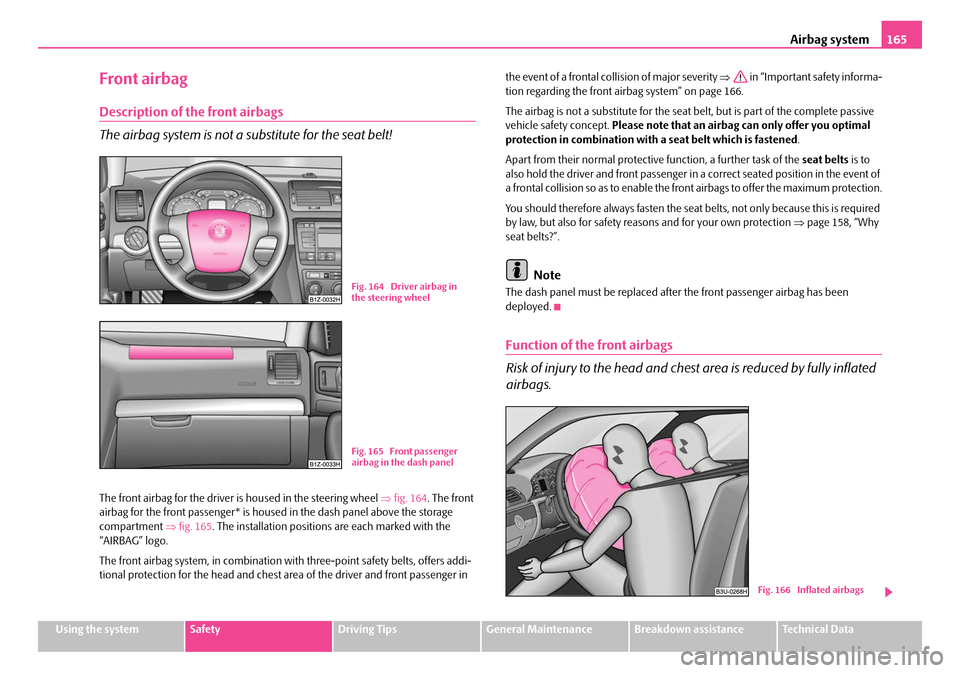
The front airbag for the driver is housed in the steering wheel ⇒fig. 164 . The front
airbag for the front passenger* is housed in the dash panel above the storage
compartment ⇒fig. 165 . The installation positions are each marked with the
“AIRBAG” logo.
The front airbag system, in combination with three-point safety belts, offers addi-
tional protection for the head and chest ar ea of the driver and front passenger in the event of a frontal collision of major severity
⇒ in “Important safety informa-
tion regarding the front airbag system” on page 166.
The airbag is not a substitute for the seat belt, but is part of the complete passive
vehicle safety concept. Please note that an airbag can only offer you optimal
protection in combination with a seat belt which is fastened .
Apart from their normal protective function, a further task of the seat belts is to
also hold the driver and front passenger in a correct seated position in the event of
a frontal collision so as to enable the front airbags to offer the maximum protection.
You should therefore always fasten the seat belts, not only because this is required
by law, but also for safety reas ons and for your own protection ⇒ page 158, “Why
seat belts?”.
Note
The dash panel must be replaced afte r the front passenger airbag has been
deployed.
Function of the front airbags
Risk of injury to the head and chest area is reduced by fully inflated
airbags.
Fig. 164 Driver airbag in
the steering wheel
Fig. 165 Front passenger
airbag in the dash panel
Fig. 166 Inflated airbags
NKO A5 20 MR08.book Page 165 Wednesday, April 11, 2007 2:54 PM
Page 167 of 288
Airbag system
166
The airbag system is designed in such a way that the driver and the front passenger
airbag* are deployed in the event of a frontal collision of major severity.
In certain accident situations both the fr ont airbags as well as the head and side
airbags may be deployed together.
If the airbags are deployed, the airbags are filled with a propellant gas and inflated
in front of the driver and front passenger ⇒page 165, fig. 166 . The airbags inflate
in fractions of a second and at a high spee d in order to be able to offer that addi-
tional protection in the event of an acci dent. The forward movement of the driver
and of the front passenger is cushioned when they make contact with the fully
inflated airbag and the risk of injury to head and chest is thus reduced.
The specially developed airbag allows the gas to flow out of the inflated airbag in a
controlled manner (depending on the load of the particular car occupant) in order
to cushion head and chest areas. The airbag then deflates subsequently to such an
extent, after an accident, to again provide a clear view forward.
A grey white, non harmful gas is released when airbag is inflated. This is perfectly
normal and is not an indication of a fire in the vehicle.
The airbag develops enormous forces when triggered, which can lead to injuries if
the sitting position or seated position is not correct ⇒ in “Important safety
information regarding the front airbag system” on page 166.Important safety information regarding the front airbag system
Correct use of the airbag system considerably reduces the risk of
injury!
WARNING
•Never transport children on the front seat of a vehicle without using a
proper restraint system. If airbags are deployed in the event of an accident,
the child might suffer severe or even fatal injuries!
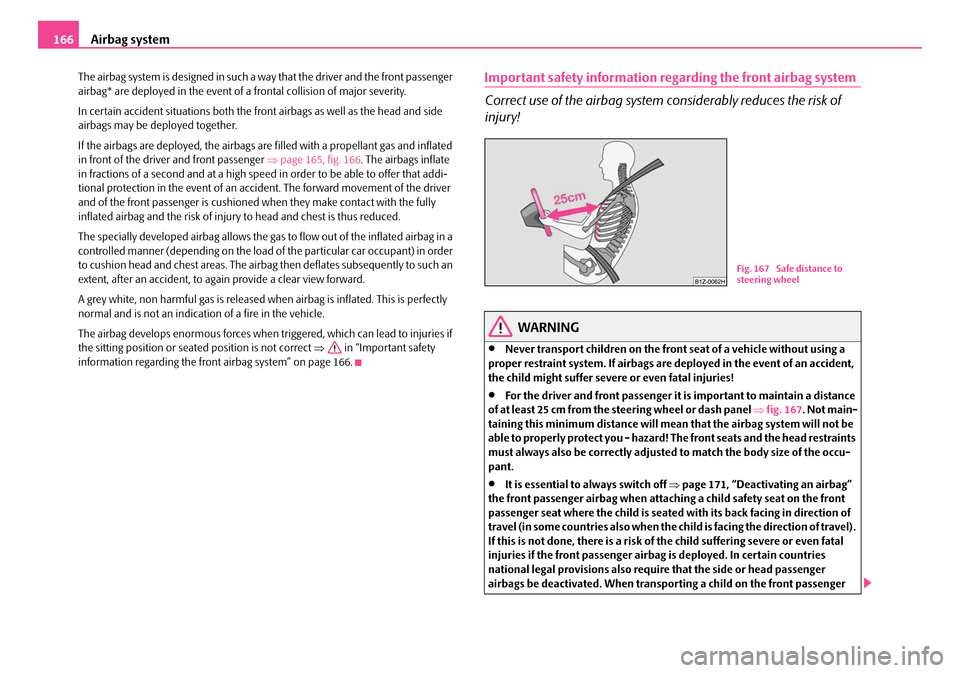
•For the driver and front passenger it is important to maintain a distance
of at least 25 cm from the steering wheel or dash panel ⇒fig. 167 . Not main-
taining this minimum distance will mean that the airbag system will not be
able to properly protect you - hazard! The front seats and the head restraints
must always also be correctly adjusted to match the body size of the occu-
pant.
•It is essential to always switch off ⇒page 171, “Deactivating an airbag”
the front passenger airbag when attach ing a child safety seat on the front
passenger seat where the child is seated with its back facing in direction of
travel (in some countries al so when the child is facing the direction of travel).
If this is not done, there is a risk of the child suffering severe or even fatal
injuries if the front passenger airbag is deployed. In certain countries
national legal provisions also requir e that the side or head passenger
airbags be deactivated. When transporting a child on the front passenger
Fig. 167 Safe distance to
steering wheel
NKO A5 20 MR08.book Page 166 Wednesday, April 11, 2007 2:54 PM
Page 168 of 288
Airbag system167
Using the systemSafetyDriving TipsGeneral MaintenanceBreakdown assistanceTechnical Data
seat, please comply with the appropri
ate national regulations regarding the
use of child safety seats.
•There must not by any further persons, animals or objects positioned
between the front seated occupants and the deployment area of the airbag.
•The steering wheel and the surface of the airbag module in the dash
panel on the passenger side must not be stuck onto, covered or modified in
any other way. These parts should only be cleaned with a dry cloth or a cloth
moistened with water. No objects such as cup holders, mobile phone
mounts, etc. may be attached to the covers of the airbag modules or be
located within the immediate area.
•No modifications of any kind may be made to parts of the airbag system.
Any work on the airbag system includ ing installing and removing system
components because of other repair work (e.g. removing the steering
wheel) must only be carried out by a specialist garage.
•Never carry out changes on the front bumper or on the body.
•Never place any objects on the surfac e of the front passenger airbag in
the dash panel.
Side airbags*
Description of side airbags
The side airbag together with the head airbag offers enhanced occu-
pant protection in the ev ent of a side collision.
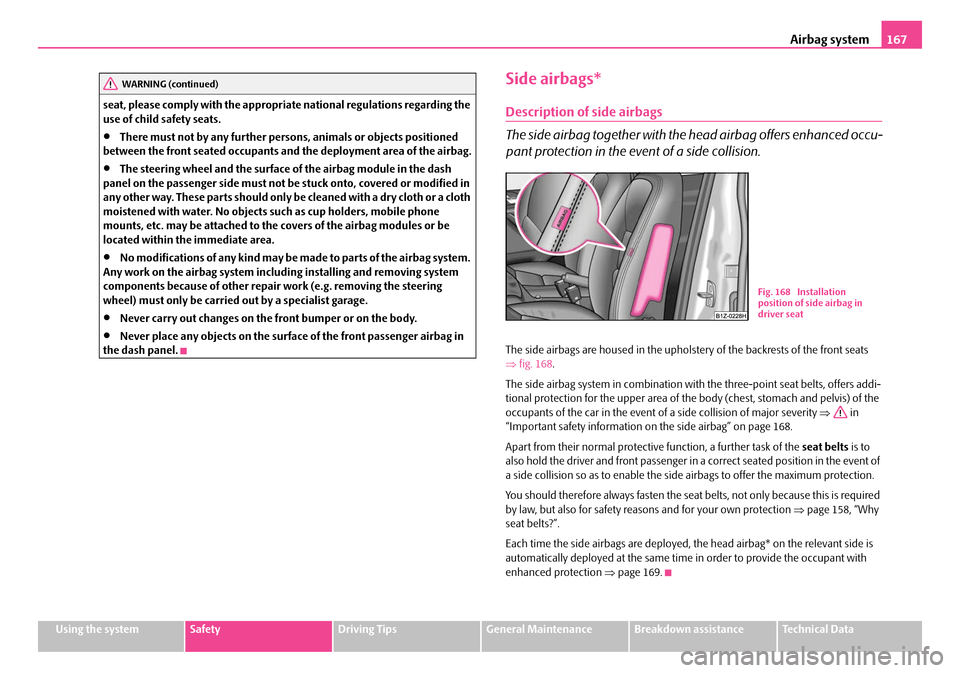
The side airbags are housed in the upholstery of the backrests of the front seats
⇒fig. 168 .
The side airbag system in combination with the three-point seat belts, offers addi-
tional protection for the upper area of th e body (chest, stomach and pelvis) of the
occupants of the car in the event of a side collision of major severity ⇒ in
“Important safety information on the side airbag” on page 168.
Apart from their normal protective function, a further task of the seat belts is to
also hold the driver and front passenger in a correct seated position in the event of
a side collision so as to enable the side airbags to offer the maximum protection.
You should therefore always fasten the seat belts, not only because this is required
by law, but also for safety reas ons and for your own protection ⇒ page 158, “Why
seat belts?”.
Each time the side airbags are deployed, th e head airbag* on the relevant side is
automatically deployed at th e same time in order to provide the occupant with
enhanced protection ⇒page 169.
WARNING (continued)
Fig. 168 Installation
position of side airbag in
driver seat
NKO A5 20 MR08.book Page 167 Wednesday, April 11, 2007 2:54 PM