Child SKODA OCTAVIA 2007 1.G / (1U) Owner's Guide
[x] Cancel search | Manufacturer: SKODA, Model Year: 2007, Model line: OCTAVIA, Model: SKODA OCTAVIA 2007 1.G / (1U)Pages: 288, PDF Size: 15.19 MB
Page 159 of 288

Seat belts
158
Seat belts
Why seat belts?
It is a proven fact that seat belt s offer good protection in accidents ⇒fig. 157 . Thus
wearing a seat belt is a legal requirement in most countries.
Seat belts which have been correctly fastened and adjusted hold the occupants of
the car in the correc t seated position ⇒fig. 157 . The belts reduce the kinetic energy
(energy of motion) to a considerable extent. They also prevent uncontrolled move-
ments which, in turn, may well result in severe injuries.
The occupants of a vehicle who have fastened and correctly adjusted their seat belt,
profit to a major extent from the fact that the kinetic energy is optimally absorbed
by the belts. The structure of the front end of the vehicle and other passive safety
measures, such as the airbag system, also contribute to reducing the kinetic energy.
The energy produced is thus absorbed and there is less risk of injury.
Accident statistics prove that seat belts which are fastened and properly adjusted
reduce the risk of an injury and enhance the chance of survival in a major accident
⇒ page 159. It is important that you pay attention to
safety measures, particularly when trans-
porting children in the vehicle ⇒ page 173, “What you should know about trans-
porting children!”.
WARNING
•Fasten your seat belt each time before setting off, also when driving in
town! This also applies to the people seated at the rear - risk of injury!
•Expectant women must also always wear a seat belt. This is the only way
of ensuring optimal protection for the unborn child ⇒page 160, “Fastening
three-point seat belts”.
•It is important for the belt webbing to be properly routed if the seat belts
are to offer the maximum protection. You can see a description of how safety
belts should be fitted pr operly on the next pages.
Note
Please comply with any differing legal requirements when using the seat belts.
Fig. 157 Driver wearing
seat belt
NKO A5 20 MR08.book Page 158 Wednesday, April 11, 2007 2:54 PM
Page 161 of 288

Seat belts
160
•No two persons (also not children) should ever use a single seat belt
together.
•The maximum protection which seat belts can offer is only achieved if
you are correctly seated ⇒page 155, “Correct seated position”.
•The belt webbing must no t run across solid or fragile objects (e.g. spec-
tacles, ball-point pens, keys etc.) as this may be a cause of injuries.
•Bulky, loose clothing (e.g. a winter coat over a jacket) does not allow you
to be correctly seated and impairs proper operation of the seat belts.
•It is prohibited to use clamps or other objects to adjust seat belts (e.g. for
shortening the belts for smaller persons).
•The lock tongue should only be insert ed into the lock which is the correct
one for your seat. Wrong use of the safety belt will reduce its capacity to
protect and the risk of injury increases.
•The backrests of the front seats must not be tilted too far to the rear
otherwise the seatbelts can lose their effectiveness.
•The belt webbing must always be ke pt clean. Soiled belt webbing may
impair proper operation of the inertia reel ⇒page 205, “Seat belts”.
•The slot of the belt tongue must not be blocked by paper or similar
objects otherwise the belt tongue will not lock in place properly.
•Inspect the seat belts regularly to ensure they are in good condition. If
you find seat belts which have damage to the seat belt webbing, seat belt
connections, to the inertia reels or to the lock, the relevant safety belt must
be replaced by a specialist garage.
•The seat belts must not be removed or changed in any way. Do not make
an attempt to repair the seat belts yourself.
•Damaged seat belts which have been subjected to stress in an accident
and were therefore stretched, must be replaced - this is best done by a
specialist garage. The anchorage points of the belts must also be inspected.
The anchorage points for the be lts should also be checked.
•In certain countries it is possible to use seat belts which differ in terms of
their operation from the seat belts which are described on the pages which
follow.
How are seat belts correctly fastened?
Fastening three-point seat belts
Fasten your seat belt before starting!
– Correctly adjust the front seat and the head restraint before fastening
your seat belt ⇒page 67.
WARNING (continued)
Fig. 160 Routing of
webbing over the shoul-
ders and the lap belt
Fig. 161 Routing of belt
webbing for an expectant
mother
NKO A5 20 MR08.book Page 160 Wednesday, April 11, 2007 2:54 PM
Page 167 of 288

Airbag system
166
The airbag system is designed in such a way that the driver and the front passenger
airbag* are deployed in the event of a frontal collision of major severity.
In certain accident situations both the fr ont airbags as well as the head and side
airbags may be deployed together.
If the airbags are deployed, the airbags are filled with a propellant gas and inflated
in front of the driver and front passenger ⇒page 165, fig. 166 . The airbags inflate
in fractions of a second and at a high spee d in order to be able to offer that addi-
tional protection in the event of an acci dent. The forward movement of the driver
and of the front passenger is cushioned when they make contact with the fully
inflated airbag and the risk of injury to head and chest is thus reduced.
The specially developed airbag allows the gas to flow out of the inflated airbag in a
controlled manner (depending on the load of the particular car occupant) in order
to cushion head and chest areas. The airbag then deflates subsequently to such an
extent, after an accident, to again provide a clear view forward.
A grey white, non harmful gas is released when airbag is inflated. This is perfectly
normal and is not an indication of a fire in the vehicle.
The airbag develops enormous forces when triggered, which can lead to injuries if
the sitting position or seated position is not correct ⇒ in “Important safety
information regarding the front airbag system” on page 166.Important safety information regarding the front airbag system
Correct use of the airbag system considerably reduces the risk of
injury!
WARNING
•Never transport children on the front seat of a vehicle without using a
proper restraint system. If airbags are deployed in the event of an accident,
the child might suffer severe or even fatal injuries!
•For the driver and front passenger it is important to maintain a distance
of at least 25 cm from the steering wheel or dash panel ⇒fig. 167 . Not main-
taining this minimum distance will mean that the airbag system will not be
able to properly protect you - hazard! The front seats and the head restraints
must always also be correctly adjusted to match the body size of the occu-
pant.
•It is essential to always switch off ⇒page 171, “Deactivating an airbag”
the front passenger airbag when attach ing a child safety seat on the front
passenger seat where the child is seated with its back facing in direction of
travel (in some countries al so when the child is facing the direction of travel).
If this is not done, there is a risk of the child suffering severe or even fatal
injuries if the front passenger airbag is deployed. In certain countries
national legal provisions also requir e that the side or head passenger
airbags be deactivated. When transporting a child on the front passenger
Fig. 167 Safe distance to
steering wheel
NKO A5 20 MR08.book Page 166 Wednesday, April 11, 2007 2:54 PM
Page 168 of 288

Airbag system167
Using the systemSafetyDriving TipsGeneral MaintenanceBreakdown assistanceTechnical Data
seat, please comply with the appropri
ate national regulations regarding the
use of child safety seats.
•There must not by any further persons, animals or objects positioned
between the front seated occupants and the deployment area of the airbag.
•The steering wheel and the surface of the airbag module in the dash
panel on the passenger side must not be stuck onto, covered or modified in
any other way. These parts should only be cleaned with a dry cloth or a cloth
moistened with water. No objects such as cup holders, mobile phone
mounts, etc. may be attached to the covers of the airbag modules or be
located within the immediate area.
•No modifications of any kind may be made to parts of the airbag system.
Any work on the airbag system includ ing installing and removing system
components because of other repair work (e.g. removing the steering
wheel) must only be carried out by a specialist garage.
•Never carry out changes on the front bumper or on the body.
•Never place any objects on the surfac e of the front passenger airbag in
the dash panel.
Side airbags*
Description of side airbags
The side airbag together with the head airbag offers enhanced occu-
pant protection in the ev ent of a side collision.
The side airbags are housed in the upholstery of the backrests of the front seats
⇒fig. 168 .
The side airbag system in combination with the three-point seat belts, offers addi-
tional protection for the upper area of th e body (chest, stomach and pelvis) of the
occupants of the car in the event of a side collision of major severity ⇒ in
“Important safety information on the side airbag” on page 168.
Apart from their normal protective function, a further task of the seat belts is to
also hold the driver and front passenger in a correct seated position in the event of
a side collision so as to enable the side airbags to offer the maximum protection.
You should therefore always fasten the seat belts, not only because this is required
by law, but also for safety reas ons and for your own protection ⇒ page 158, “Why
seat belts?”.
Each time the side airbags are deployed, th e head airbag* on the relevant side is
automatically deployed at th e same time in order to provide the occupant with
enhanced protection ⇒page 169.
WARNING (continued)
Fig. 168 Installation
position of side airbag in
driver seat
NKO A5 20 MR08.book Page 167 Wednesday, April 11, 2007 2:54 PM
Page 169 of 288

Airbag system
168
Function of the side airbags
Risk of injury to the upper part of the body is reduced by fully inflated
side airbags.
In the case of a violent side crash the side airbag on the front seat on the side on
which the collision occurs is deployed ⇒fig. 169 .
In certain accident situations both the fr ont airbags as well as the head and side
airbags may be deployed together.
If an airbag is deployed, the airbag is fill ed with propellant gas. The airbags inflate
in fractions of a second and at a high spee d in order to be able to offer that addi-
tional protection in the event of an accident.
A grey white, non harmful gas is released when airbag is inflated. This is perfectly
normal and is not an indication of a fire in the vehicle.
The load of the occupants is cushioned when plunging into the fully inflated airbag
and the risk of injury to the entire u pper body (chest, stomach and pelvis) is
reduced on the side facing the door.
Important safety information on the side airbag
Correct use of the airbag system considerably reduces the risk of
injury!
WARNING
•It is essential to always switch off ⇒page 171, “Deactivating an airbag”
the front passenger airbag when attach ing a child safety seat on the front
passenger seat where the child is seated with its back facing in direction of
travel (in some countries al so when the child is facing the direction of travel).
If this is not done, there is a risk of the child suffering severe or even fatal
injuries if the front passenger airbag is deployed. In certain countries
national legal provisions also requir e that the side or head passenger
airbags be deactivated. When transporting a child on the front passenger
seat, please comply with the appropri ate national regulations regarding the
use of child safety seats.
•Your head should never be positioned in the deployment area of the side
airbag. You might suffer severe injuries in the event of an accident. This
applies in particular to children who are transported without using a suit-
able child safety seat ⇒page 175, “Child safety and side airbag*”.
•If children adopt an incorrect seated position when travelling, they may
be exposed to an increased risk of injury in the event of an accident. This can
result in serious injuries ⇒page 173, “What you should know about trans-
porting children!”.
•There must not be any further persons, animals as well as objects posi-
tioned between the occupants and the deployment area of the airbag. There
must also be no accessories such as cup holders, attached to the doors to
enable the side airbags to activate properly.
•The airbag control unit operates together with the pressure sensors,
which are attached in the front doors. For this reason no adjustments must
be carried out at the doors as well as at the door panels (for example addi-
tional installation of loudspeakers). Resulting damages can have a negative
affect on the operation of the airbag system. All work on the front doors and
their panels must only be carried out by a specialist garage.
Fig. 169 Inflated side
airbag
NKO A5 20 MR08.book Page 168 Wednesday, April 11, 2007 2:54 PM
Page 171 of 288
Airbag system
170
You should therefore always fasten the seat belts, not only because this is required
by law, but also for safety reasons and for your own protection ⇒page 158, “Why
seat belts?”.
Together with other elements (such as cros s bars in the seats, stable vehicle struc-
ture) the head airbags are the conseque nt further development of occupant
protection in the case of side collisions.
Function of the head airbags
The risk of injury to the head and neck area is reduced in the event of
a side collision by fully inflated head airbags.
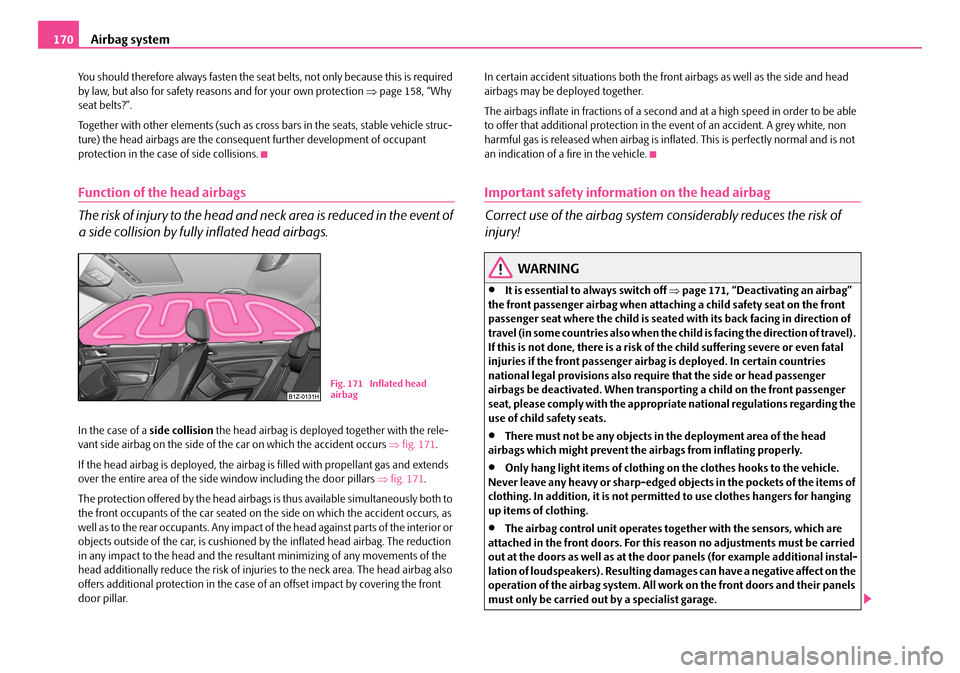
In the case of a side collision the head airbag is deployed together with the rele-
vant side airbag on the side of th e car on which the accident occurs ⇒fig. 171 .
If the head airbag is deployed, the airbag is filled with propellant gas and extends
over the entire area of the side window including the door pillars ⇒fig. 171 .
The protection offered by the head airbags is thus available simultaneously both to
the front occupants of the car seated on th e side on which the accident occurs, as
well as to the rear occupants. Any impact of the head against parts of the interior or
objects outside of the car, is cushioned by the inflated head airbag. The reduction
in any impact to the head and the result ant minimizing of any movements of the
head additionally reduce the risk of injuries to the neck area. The head airbag also
offers additional protection in the case of an offset impact by covering the front
door pillar. In certain accident situations
both the front airbags as well as the side and head
airbags may be deployed together.
The airbags inflate in fractions of a second and at a high speed in order to be able
to offer that additional protection in the event of an accident. A grey white, non
harmful gas is released when airbag is infl ated. This is perfectly normal and is not
an indication of a fire in the vehicle.
Important safety information on the head airbag
Correct use of the airbag system considerably reduces the risk of
injury!
WARNING
•It is essential to always switch off ⇒page 171, “Deactivating an airbag”
the front passenger airbag when attach ing a child safety seat on the front
passenger seat where the child is seated with its back facing in direction of
travel (in some countries al so when the child is facing the direction of travel).
If this is not done, there is a risk of the child suffering severe or even fatal
injuries if the front passenger airbag is deployed. In certain countries
national legal provisions also requir e that the side or head passenger
airbags be deactivated. When transporting a child on the front passenger
seat, please comply with the appropri ate national regulations regarding the
use of child safety seats.
•There must not be any objects in the deployment area of the head
airbags which might prevent the airbags from inflating properly.
•Only hang light items of clothing on the clothes hooks to the vehicle.
Never leave any heavy or sh arp-edged objects in the pockets of the items of
clothing. In addition, it is not permit ted to use clothes hangers for hanging
up items of clothing.
•The airbag control unit operates together with the sensors, which are
attached in the front doors. For this reason no adjustments must be carried
out at the doors as well as at the door panels (for example additional instal-
lation of loudspeakers). Resulting dama ges can have a negative affect on the
operation of the airbag system. All work on the front doors and their panels
must only be carried out by a specialist garage.
Fig. 171 Inflated head
airbag
NKO A5 20 MR08.book Page 170 Wednesday, April 11, 2007 2:54 PM
Page 172 of 288

Airbag system171
Using the systemSafetyDriving TipsGeneral MaintenanceBreakdown assistanceTechnical Data
•There must not be any other persons (e.g. children) or animals between
the car occupant and the deployment ar ea of the head airbag. In addition,
none of the occupants should lean their head out of the window when
driving, or extend their arms and hands out of the window.
•The sun visors must not be swivelled to the side windows into the
deployment area of the head airbags if any objects, such as ball-point pens
etc. are attached to them. This might result in injuries to the occupants if the
head airbag is deployed.
•Installing impermissible accessories in the area of the head airbags may
considerably impair the protection offered by the head airbag in the event of
it being deployed. When the deployed head airbag is inflated, parts of the
accessories fitted may in certain circumstances be thrown into the interior
of the car and cause injuries to the occupants ⇒page 229, “Accessories,
changes and replacement of parts”.
•Any work on the head airbag system including installing and removing
system components because of other re pair work (e.g. removing headliner)
must only be carried ou t by a specialist garage.
Deactivating an airbag
Deactivating airbags
If any airbags have been deactivated, switch them on again as soon
as possible so that they are able to again provide their proper protec-
tion.
There is the technical means installed within your vehicle to switch off the front,
side* or head airbag* (take out of commission).
This is why you should have the deactiva tion of the airbags carried out by a
specialist garage.
On vehicles equipped with the switch for deactivation of the airbags, you can deac-
tivate the front and side passenger airbag by means of this switch ⇒page 172. Deactivation of airbags is envisaged only for particular instances, such as if:
•you must
in exceptional cases use a child seat on the front passenger seat
where the child has its back to the directio n of travel of the vehicle (in some coun-
tries this must be in the direction of travel due to other legal regulations applying)
⇒ page 173, “Important safety information regarding the use of child safety seats”
•you are not able to maintain the distance of at least 25 cm between middle of
steering wheel and chest, despite the driver seat being correctly adjusted,
•special attachments are required in the area of the steering wheel because of a
physical disability,
•you have installed other seats (e.g. orthopaedic seats without side airbags).
Monitoring the airbag system
The functionality of the airbag system is also monitored electronically, when one
airbag has been switched off
If the airbag was switched of f using diagnostic equipment:
•The warning light for the airbag system lights up for 4 seconds after switching
on the ignition and then flashes for 12 seconds afterwards in 2 second intervals.
Front passenger airbags switched off using the switch for front passenger
airbags* in stowage compartmen t on the front passenger side:
•The airbag warning light comes on in the instrument cluster for about 4 seconds
each time the ignition is switched on.
•Switching off airbags is indicated in the middle of the dash panel by the lighting
up of the indicator light ⇒ page 172, fig. 173 .
Note
Your Škoda Service Partner will be able to advise you whether national legislation in
your country allows airbags in your vehi cle to be deactivated, and which ones.
WARNING (continued)
NKO A5 20 MR08.book Page 171 Wednesday, April 11, 2007 2:54 PM
Page 174 of 288

Transporting children safely173
Using the systemSafetyDriving TipsGeneral MaintenanceBreakdown assistanceTechnical Data
Transporting children safely
What you should know about transporting children!
An introduction to the subject
Accident statistics have revealed that children are generally more
safely transported on the rear seat s than on the front passenger seat.
Children younger than 12 years of age should normally travel on the rear seat of the
vehicle (take note of any na tional legal provisions which differ from this). They
should be secured there by means of a child restraint system or by using the existing
seat belts depending on their age, body si ze and weight. The child seat should be
mounted behind the front passen ger seat for safety reasons.
The physical principle of an accident do es, of course, also apply to children
⇒ page 159, “The physical principle of a fronta l collision”. They differ from adults in
that their muscles and bone structure of ch ildren are not yet fully developed. Thus
children are exposed to increased risk of injury.
Children should be transported by using special child safety seats in order to
reduce this risk of injury.
Use only child safety seats which are offici ally approved and are suitable for chil-
dren and which comply with the ECE-R 44 Standard, which classifies child safety
seats into 5 groups ⇒page 176, “Classification of child seats into groups”. Child
restraint systems which have been tested for conformity with ECE-R 44 have a non-
detachable test seal (a large E within a circle and below this the test number)
attached to the seat.
We recommend that you use ch ild safety seats from the Škoda genuine accessories.
These child seats were developed and also tested for use in Škoda vehicles. They
fulfil the standard ECE-R 44.
WARNING
Always comply with legal provisions and instructions from the relevant child
safety seat manufacturer when in stalling and using the child seat ⇒ in
“Important safety information regarding the use of child safety seats”.
Note
Any varying national legal regulations take priority over the information provided in
these instructions for use, or stated in this chapter.
Important safety information regarding the use of child safety
seats
Correct use of child safety seats considerably reduces the risk of
injury!
WARNING
•All the occupants of the car - in particular children - must wear a seat belt
when the car is moving.
•Chi ld re n le s s tha n 1. 5 0 m i n h e ig ht or younger than 12 years must not use
a normal seat belt withou t a child restraint system otherwise this may result
in injuries to the stomach and neck areas. Comply with the national legal
requirements.
•One should never carry children, and also not babies! - on one's lap.
•You can transport a child safely in a suitable child safety seat ⇒page 176,
“Child seat”!
•Only one child may be fastened with a seat belt into a child safety seat.
•Never leave the child sitting unattended in the seat.
•Certain outside climatic conditions can cause life-threatening tempera-
tures in the vehicle.
•Never allow your child to be transported in a vehicle without the use of a
suitable restraint system.
•Children should also never stand up in a vehicle or kneel on the seats
when the vehicle is moving. In the event of an accident the child will be
thrown through the vehicle and may as a result suffer fatal injuries, and also
injure other occupants.
NKO A5 20 MR08.book Page 173 Wednesday, April 11, 2007 2:54 PM
Page 175 of 288

Transporting children safely
174
•Children are exposed to an increased risk of injury in the event of an acci-
dent if they lean forward or adopt an incorrect seated position when the
vehicle is moving. This particularly applies to children who are transported
on the front passenger seat if the airb ag system deploys in the event of an
accident. This can result in severe or even fatal injuries.
•It is important that the belt webbing is properly routed if the seat belts
are to offer their maximum protection ⇒page 160, “How are seat belts
correctly fastened?”. Pay particular atte ntion to the information provided by
the manufacturer of the child safety se at regarding correct routing of the
belt. Seat belts which are not correctly adjusted can themselves cause inju-
ries even in minor accidents.
•Safety belts must be checked to ensure that they are running properly.
One should also ensure that the belt is not damaged by sharp-edged fittings.
•It is essential to always switch off ⇒page 171 the front passenger airbag
when attaching a child safety seat on the front passenger seat where the
child is seated with its back facing in direction of travel (in some countries
also when the child is facing the direction of travel). If this is not done, there
is a risk of the child suffering severe or even fatal injuries if the front
passenger airbag is deploy ed. In certain countries national legal provisions
also require that the si de and head airbags be deactivated. When trans-
porting a child on the front passenger seat, please comply with the appro-
priate national regulations regarding the use of child safety seats.
Use of child safety seats on the front passenger seat
Child safety seats should always be attached to the rear seats.
We recommend, for safety reasons, that you always mount a child restraint systems
on the rear seats whenever possible. If you still decide, however, to use a child
safety seat on the front passenger seat th en you must pay attention to the following
warnings in connection with the use of th e airbag system on the front passenger
seat.
WARNING
•Warning - particular hazard! Never use a child safety seat on the front
passenger seat in which the child is seat ed with its back facing the direction
of travel. This child safety seat is positioned in the deployment area of the
front passenger airbag. The airbag may cause the child severe, or even fatal
injuries, in the event of it being deployed.
•This is also clearly stated on the st icker which is located on the centre
column of the body on the front passenger side ⇒fig. 174 . The sticker is
visible upon opening the front passen ger door. For some countries, the
sticker is also affixed to the sun visor of the front passenger.
WARNING (continued)
Fig. 174 Sticker on the
centre column of the
body on the front
passenger side.
NKO A5 20 MR08.book Page 174 Wednesday, April 11, 2007 2:54 PM
Page 176 of 288

Transporting children safely175
Using the systemSafetyDriving TipsGeneral MaintenanceBreakdown assistanceTechnical Data
•It is essential to always switch off ⇒page 171, “Deactivating an airbag”
the front passenger airbag when attach ing a child safety seat on the front
passenger seat where the child is seated with its back facing in direction of
travel (in some countries also when the ch ild is facing the direction of travel).
If this is not done, there is a risk of the child suffering severe or even fatal
injuries if the front passenger airbag is deployed. In certain countries
national legal provisions also requir e that the side or head passenger
airbags be deactivated. When transporting a child on the front passenger
seat, please comply with the appropri ate national regulations regarding the
use of child safety seats.
•If the front passenger airbag has been switched off by a specialist garage
using the vehicle system tester, the side and head passenger airbag*
remains switched on. In certain countries national legal provisions require
that besides the front pa ssenger airbag also the side or head passenger
airbags are deactivated. Please comply with any differing national legal
regulations regarding the use of child safety seats.
•If a child safety seat in which the child faces in the direction of travel is
used on the front passenger seat, the front passenger seat must be moved
back fully. For vehicles with height ad justable front passenger seat, the seat
must be put in the highest position.
•If this is not done, a child seated on the front passenger seat may suffer
severe or even fatal injuries if the front passenger airbag or airbags are
deployed. Have the airbag (or ai rbags) deactivated if necessary ⇒page 171.
•You should have the front passenger airbag (or airbags) reactivated just
as soon as you no longer use a child sa fety seat on the front passenger seat.
Child safety and side airbag*
Children must never be seated in the deployment area of the side
airbags and head airbags.
In the event of a side collision, the side airbags offer the vehicle occupants
enhanced protection.
The side airbags are inflated in fractions of a second in order to be able to provide
this protection ⇒page 168, “Function of the side airbags”.
An airbag inflating develops such a strong force that an occupant who has not
adopted an upright seated position may suffer injuries from the airbag or as a result
of objects which are located within th e deployment area of the side airbag.
WARNING (continued)
Fig. 175 Seated position
of an unprotected child at
risk from side airbag
Fig. 176 Child properly
protected by safety seat
NKO A5 20 MR08.book Page 175 Wednesday, April 11, 2007 2:54 PM