Service SKODA OCTAVIA 2007 1.G / (1U) Owner's Guide
[x] Cancel search | Manufacturer: SKODA, Model Year: 2007, Model line: OCTAVIA, Model: SKODA OCTAVIA 2007 1.G / (1U)Pages: 288, PDF Size: 15.19 MB
Page 172 of 288

Airbag system171
Using the systemSafetyDriving TipsGeneral MaintenanceBreakdown assistanceTechnical Data
•There must not be any other persons (e.g. children) or animals between
the car occupant and the deployment ar ea of the head airbag. In addition,
none of the occupants should lean their head out of the window when
driving, or extend their arms and hands out of the window.
•The sun visors must not be swivelled to the side windows into the
deployment area of the head airbags if any objects, such as ball-point pens
etc. are attached to them. This might result in injuries to the occupants if the
head airbag is deployed.
•Installing impermissible accessories in the area of the head airbags may
considerably impair the protection offered by the head airbag in the event of
it being deployed. When the deployed head airbag is inflated, parts of the
accessories fitted may in certain circumstances be thrown into the interior
of the car and cause injuries to the occupants ⇒page 229, “Accessories,
changes and replacement of parts”.
•Any work on the head airbag system including installing and removing
system components because of other re pair work (e.g. removing headliner)
must only be carried ou t by a specialist garage.
Deactivating an airbag
Deactivating airbags
If any airbags have been deactivated, switch them on again as soon
as possible so that they are able to again provide their proper protec-
tion.
There is the technical means installed within your vehicle to switch off the front,
side* or head airbag* (take out of commission).
This is why you should have the deactiva tion of the airbags carried out by a
specialist garage.
On vehicles equipped with the switch for deactivation of the airbags, you can deac-
tivate the front and side passenger airbag by means of this switch ⇒page 172. Deactivation of airbags is envisaged only for particular instances, such as if:
•you must
in exceptional cases use a child seat on the front passenger seat
where the child has its back to the directio n of travel of the vehicle (in some coun-
tries this must be in the direction of travel due to other legal regulations applying)
⇒ page 173, “Important safety information regarding the use of child safety seats”
•you are not able to maintain the distance of at least 25 cm between middle of
steering wheel and chest, despite the driver seat being correctly adjusted,
•special attachments are required in the area of the steering wheel because of a
physical disability,
•you have installed other seats (e.g. orthopaedic seats without side airbags).
Monitoring the airbag system
The functionality of the airbag system is also monitored electronically, when one
airbag has been switched off
If the airbag was switched of f using diagnostic equipment:
•The warning light for the airbag system lights up for 4 seconds after switching
on the ignition and then flashes for 12 seconds afterwards in 2 second intervals.
Front passenger airbags switched off using the switch for front passenger
airbags* in stowage compartmen t on the front passenger side:
•The airbag warning light comes on in the instrument cluster for about 4 seconds
each time the ignition is switched on.
•Switching off airbags is indicated in the middle of the dash panel by the lighting
up of the indicator light ⇒ page 172, fig. 173 .
Note
Your Škoda Service Partner will be able to advise you whether national legislation in
your country allows airbags in your vehi cle to be deactivated, and which ones.
WARNING (continued)
NKO A5 20 MR08.book Page 171 Wednesday, April 11, 2007 2:54 PM
Page 181 of 288
Transporting children safely
180
You can obtain child seats with the “ISOFIX” attachment system from specialist
garages who will also installed it as well.
Complete installation instructions are enclosed with the child safety seat.
WARNING
•The locking eyes have just been developed for child safety seats which
use the “ISOFIX” system. You should therefore never attach other child
safety seats, seat belts or obje cts to the locking eyes - hazard!
•Ask a Škoda Service Partner whether a child seat which you bought for
another vehicle is recommended for use in a Škoda before using an “ISOFIX”
system.
•Certain child seats which use the “ISOFIX” system can be attached with
standard three-point seat belts. Please pay close attention to instructions
from the manufacturer of the child safety seat when installing and removing
the seat.
Note
•Child seats which use the “ISOFIX” system are currently available for children
weighing from 9 up to 18 kg. This correspo nds to an age range of from 9 months to
4 years.
•The child seats can also be fitted with the “Top Tether” system ⇒page 180.
Attaching child seat using the “Top Tether” system
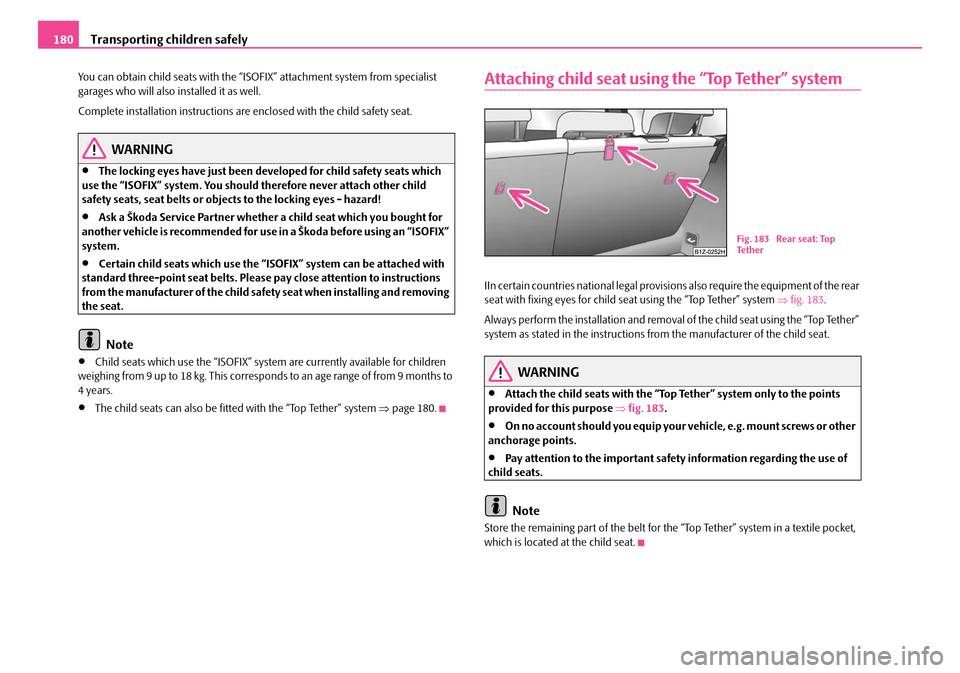
IIn certain countries national legal provisions also require the equipment of the rear
seat with fixing eyes for child seat using the “Top Tether” system ⇒fig. 183 .
Always perform the installation and removal of the child seat using the “Top Tether”
system as stated in the instructions from the manufacturer of the child seat.
WARNING
•Attach the child seats with the “Top Tether” system only to the points
provided for this purpose ⇒fig. 183 .
•On no account should you equip your vehicle, e.g. mount screws or other
anchorage points.
•Pay attention to the important safety information regarding the use of
child seats.
Note
Store the remaining part of the belt for the “Top Tether” system in a textile pocket,
which is located at the child seat.
Fig. 183 Rear seat: Top
Te t h e r
NKO A5 20 MR08.book Page 180 Wednesday, April 11, 2007 2:54 PM
Page 185 of 288
Intelligent Technology
184
WARNING
Even with this additional function the vehicle cannot be steered automati-
cally! The driver is furthermore fully reponsible for the steering of the
vehicle!
Brakes
What has a negative effect on braking efficiency?
Wear-and-tear
Wear-and-tear to the brake pads is greatly dependent on the operating conditions
of the vehicle and your style of driving. Particularly if you drive a great deal in towns
and over short distances or if you adopt a sporty style of driving, it may be neces-
sary to have the thickness of the brake pads inspected at a specialist garage
between the service inspections.
Wet roads or road salt
There may be a certain delay before the brakes take full effect under certain condi-
tions such as when driving through water, during heavy rain showers or after the
vehicle has been washed in an automatic vehicle wash, since the brake discs and
brake pads may be moist or even have a coating of ice on them in winter. You
should dry the brakes as soon as possib le (by applying and releasing the brakes
several times, if the road conditions and the traffic situation allows it).
There also may be a certain delay before the full braking efficiency is available when
driving on roads which have been treated wi th road salt if you have not used the
brakes for some considerable time beforeha nd. The layer of salt on the brake discs
and brake pads must first be rubb ed off when you apply the brakes.
Corrosion
Corrosion on the brake discs and dirt on th e bake pads occur if the vehicle has been
parked for a long period and if you do not make much use of the braking system.
We recommend cleaning the brake discs by firmly applying the brakes at a fairly
high speed if you do not make much use of the braking system or if surface corro-
sion is present ⇒. Faults in the brake surface
If you notice that the braking distance
has suddenly become longer and that the
brake pedal can be depressed further, it is possible that a brake circuit of the dual-
circuit brake system has failed. Drive, in such cases, to the nearest specialist garage
without delay in order to have the problem rectified. Drive at a reduced speed while
on your way to the dealer and adapt your style of driving to the higher brake pedal
pressure required.
Low brake fluid level
An insufficient level of brake fluid may result in problems in the brake system. The
level of the brake fluid is monitored electronically ⇒page 32, “Brake system ”.
WARNING
•Only apply the brakes for the purpos e of drying and cleaning the brake
discs if the traffic conditions permit this. Do not place any other road users
in jeopardy.
•When retrospectively mounting a front spoiler, solid wheel hubs etc. one
must ensure that the air supply to the front wheel brakes is not reduced
otherwise the braking sy stem could run too hot.
•Allow for the fact that new brake pads do not achieve their full braking
efficiency until approximately 200 kilo metres. New brake pads must be first
“run in” before they develop their optimal friction force. You can, however,
compensate for this slightly reduced braking force by increasing the pres-
sure on the brake pedal. This guidelin e also applies to any new brake pads
installed at a future date.
Caution
•Never allow the brakes to ru b by applying slight pressure if you do not wish to
brake the vehicle. This causes the brakes to overheat and can also result in a longer
braking distance and excessive wear.
•Before negotiating a steep downhill sect ion, please reduce your speed, shift
down into the next lower gear (manual ge arbox) or select a lower driving stage
(automatic gearbox). This enables you to make full use of the braking power of the
NKO A5 20 MR08.book Page 184 Wednesday, April 11, 2007 2:54 PM
Page 189 of 288

Intelligent Technology
188
Diesel particle filter* (diesel engine)
In the diesel particle filter the resulting soot particles are collected
and burnt during the combustion of diesel fuel.
Code 7GG on the vehicle data sticker ⇒fig. 187 indicates that your
vehicle is equipped with a diesel particle filter. The vehicle data sticker is
located on the floor of the luggage compartment and is also stated in the
Service schedule.
The diesel particle filter filters the soot particles completely from the exhaust. The
soot is collected in the diesel particle filter and burnt regularly. To assist this proce-
dure, we recommend not to drive regularly over short distances.
If the diesel particle filter is clogged or there is a fault, it is indicated by the warning
light
⇒ page 26, “Diesel particle filter* (diesel engine)”.
WARNING
•The diesel particle filter achieves very high temperatures. Therefore do
not park at points where the hot filter comes into direct contact with dry
grass or other combustible materials - risk of fire!
•Never use additional underbody protection or corrosion-protection
agents for the exhaust pipes, catalytic converters, diesel particle filter or
heat shields. When the engine reaches its operating temperature, these
substances might ignite - risk of fire.
Note
•When using diesel fuel with high sulphur content the life of the diesel particle
filter is clearly reduced. A specialist garage will be able to tell you which countries
use only diesel fuel wi th high sulphur content.
Fig. 187 Vehicle data
sticker
WARNING (continued)
NKO A5 20 MR08.book Page 188 Wednesday, April 11, 2007 2:54 PM
Page 193 of 288
Driving and the Environment
192
Avoiding full throttle
Driving more slowly means saving fuel.
Sensitive use of the accelera tor will not only significantly reduce fuel consumption
but also positively influence environmen tal pollution and wear of your vehicle.
You should avoid fully exploi ting the top speed of your vehicle wherever possible.
Fuel consumption, pollutant emissions and vehicle noises increase disproportion-
ally at high speeds.
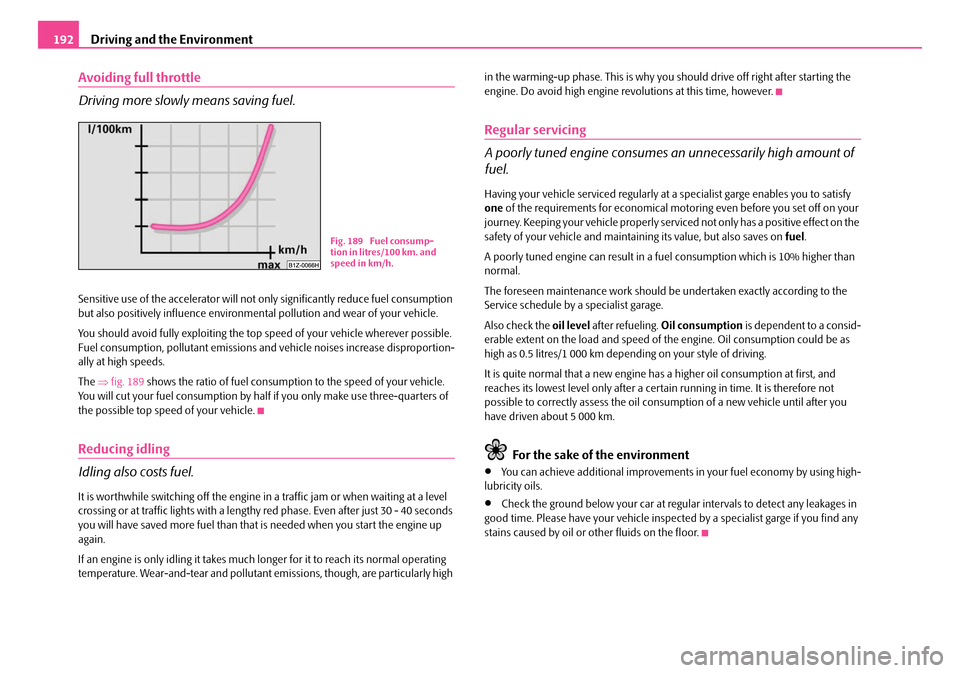
The ⇒fig. 189 shows the ratio of fuel consumption to the speed of your vehicle.
You will cut your fuel consumption by half if you only make use three-quarters of
the possible top speed of your vehicle.
Reducing idling
Idling also costs fuel.
It is worthwhile switching off the engine in a traffic jam or when waiting at a level
crossing or at traffic lights with a length y red phase. Even after just 30 - 40 seconds
you will have saved more fuel than that is needed when you start the engine up
again.
If an engine is only idling it takes much longer for it to reach its normal operating
temperature. Wear-and-tear and pollutant em issions, though, are particularly high in the warming-up phase. This is why you
should drive off right after starting the
engine. Do avoid high engine revolutions at this time, however.
Regular servicing
A poorly tuned engine consumes an unnecessarily high amount of
fuel.
Having your vehicle serviced regularly at a specialist garge enables you to satisfy
one of the requirements for economical moto ring even before you set off on your
journey. Keeping your vehicle properly servic ed not only has a positive effect on the
safety of your vehicle and maintaining its value, but also saves on fuel.
A poorly tuned engine can result in a fu el consumption which is 10% higher than
normal.
The foreseen maintenance work should be undertaken exactly according to the
Service schedule by a specialist garage.
Also check the oil level after refueling. Oil consumption is dependent to a consid-
erable extent on the load and speed of the engine. Oil consumption could be as
high as 0.5 litres/1 000 km depending on your style of driving.
It is quite normal that a new engine ha s a higher oil consumption at first, and
reaches its lowest level only after a certain running in time. It is therefore not
possible to correctly assess the oil cons umption of a new vehicle until after you
have driven about 5 000 km.
For the sake of the environment
•You can achieve additional improvements in your fuel economy by using high-
lubricity oils.
•Check the ground below your car at regula r intervals to detect any leakages in
good time. Please have your vehicle inspected by a specialist garge if you find any
stains caused by oil or other fluids on the floor.
Fig. 189 Fuel consump-
tion in litres/100 km. and
speed in km/h.
NKO A5 20 MR08.book Page 192 Wednesday, April 11, 2007 2:54 PM
Page 195 of 288
Driving and the Environment
194
Keeping a log of your fuel consumption
If you really wish to ke ep a close check on your fuel consumption, it is best to enter
the figures in a logbook. This does not take much time but is a very worthwhile exer-
cise. It enables you to detect any change (positive and negative) at an early stage
and to take any appropriate action.
If you find that your fuel consumption is too high, you sh ould reflect on how, where
and in what conditions you have driven the vehicle since you last refuelled.
Environmental compatibility
Environmental protection has played a majo r role in the design, selection of mate-
rials and manufacture of your new Škoda. Particular emphasis has been paid to a
number of aspects, including:
Design measures
•joints designed to be easily detached,
•simplified disassembly due to the modular structure system,
•improved purity of different classes of materials,
•identification of all plastic parts in accordance with VDA Recommendation 260,
•reduced fuel consumption and exhaust emission CO2,
•minimum fuel leakage during accidents,
•reduced noise,
Choice of materials
•extensive use of recyclable material,
•air conditioning filled wi th CFC-free refrigerant,
•no cadmium,
•no asbestos
•reduction in the “vaporisation” of plastics,
Manufacture
•solvent-free cavity protection,
•solvent-free protection of the vehicle for transportation from the production
plant to the customer,
•The use of solvent-free adhesives,
•No CFCs used in the production process,
•without use of mercury,
•Use of water-soluble paints.
Motoring abroad
General
Other circumstances may exist abroad.
It is also possible, in ce rtain countries, that the Škod a Service Partner network is
limited or has not been established yet. This is the reason why obtaining certain
spare parts may be somewhat complicate d and specialist garage personnel may
only be able to ma ke li mite d re pa irs. Škoda Auto a.s. i n the Czech Republic and rele -
vant importers are happy to provide info rmation about technical aspects of the
vehicle, required maintenance work and possibilities for getting repairs done.
Unleaded petrol
A vehicle fitted with a petrol engine must always be refuelled with unleaded petrol
⇒ page 190. The automobile associations can provide you with information
regarding the locations of filling stations which offer unleaded petrol.
Headlight
The low beam of your headlights is set asym metrically. It illuminates the side of the
road on which you are driving to a greater extent. If you drive abroad on the other
side of the road, you wi ll dazzle oncoming traffic.
It is necessary in order to avoid dazzling oncoming traffic to stick a sticker over a
certain part of the headlights.
NKO A5 20 MR08.book Page 194 Wednesday, April 11, 2007 2:54 PM
Page 196 of 288
Driving and the Environment195
Using the systemSafetyDriving TipsGeneral MaintenanceBreakdown assistanceTechnical Data
Headlight stickers can be obtained as a spare part from the Skoda Service Partners.
Headlights with Xenon lamps are designed for driving in countries with traffic on
the right or on the left. Have this done always at a Škoda Service Partner.
Note
You can obtain further information regarding masking over or converting the head-
lights from your Škoda Service Partner.
Avoiding damage to your vehicle
When driving on poor roads and lanes or when driving over kerbstones, steep
ramps etc., you must pay particular attention to ensuring that any low-slung parts
of the vehicle, such as spoiler and ex
haust, do not touch the ground and get
damaged.
This particularly applies to models with a lowered suspension (sport suspension)
and also when your vehicle is fully laden.
NKO A5 20 MR08.book Page 195 Wednesday, April 11, 2007 2:54 PM
Page 197 of 288
Towing a trailer
196
Towing a trailer
To w i n g a t r a i l e r
Technical requirements
The towing device must satisfy certain technical requirements.
Your vehicle is designed primarily for tr ansporting persons and luggage. It can,
however, also be used for towing a traile r - provided certain technical equipment is
fitted.
If your vehicle has already been supplied with a factory-fitted towing device then
everything that is necessary for towing a trailer in technical terms, and in terms of
the law, has already been taken into account.
Your vehicle is fitted with a 13-pin power socket for the electrical connection
between the vehicle and trailer. If th e trailer which you wish to tow has a 7-pin
connector, you can use a suitable adapter
10) from Škoda original accessories.
This work must be carried out in accordan ce with the manufacturer's specifications
if a towing device is retrofitted.
Škoda Service Partners are familiar with de tails relating to retrofitting a towing
device and for any necessary modi fications to the cooling system.
WARNING
We recommend that you have the towing device from Škoda original acces-
sories installed by a Škoda Service Partner. He is familiar with all the relevant
details relating to retrofitting such equi pment. There is a risk of an accident
if the towing device is not properly fitted!
General Maintenance
There are a number of points to pay attention to when towing a
trailer.
Trailer load
The permissible trailer load must on no account be exceeded.
You can negotiate appropriately steeper inclines and descents if you do not make
full use of the perm issible trailer load.
The trailer loads specified only apply for altitudes up to 1 000 metres above mean
sea level. The fact that the engine power ou tput drops with increasing height due to
a lowering of air pressure and thus the abil ity to climb, means that the towed weight
must be reduced by 10% for every further increase of 1 000 metres in height above
sea level. The towed weight is the weight of the (laden) vehicle and the (laden)
trailer together. One should take this into account before driving up to higher alti-
tudes.
The trailer and drawbar load information on the type plate of the towing
device are merely test data for the tow ing device The data relating to your
vehicle, which is often less than this test data, can be found in your vehicle
registration documents.
Distribution of the load
Distribute the load in the trailer in such a way that any heavy items are located as
close as possible to the axle. Secure the items to prevent them slipping.
Tyre inflation pressure
Select the tyre inflation pressure on your vehicle for that of “fully laden”,
⇒ page 223. The inflation pressure of the tyres fitted to the trailer adjust in accord-
ance with the manufacturer's recommendation.
Exterior mirrors
You have to have additional exterior mirrors fitted if you are not able to see the
traffic behind the trailer with the standard rear-view mirrors. Both exterior mirrors
10)In some countries the adapter is supplied with the towing device.
NKO A5 20 MR08.book Page 196 Wednesday, April 11, 2007 2:54 PM
Page 198 of 288
Towing a trailer197
Using the systemSafetyDriving TipsGeneral MaintenanceBreakdown assistanceTechnical Data
should be attached to folding arms. Adjust
the mirrors so that they provide you with
an adequate field of view to the rear.
Headlights
Before starting off with a hitched trailer, also check the setting of the headlights.
Alter the setting as necessary with th e aid of the headlight beam adjuster
⇒ page 55.
Detachable ball head
The ball rod is detachable on vehicles which feature a factory-fitted towing device.
It is stowed together with separate fitting instructions in the spare wheel well in the
luggage compartment of the vehicle.
Further information on the towing device ⇒page 198.
Note
•We recommend that you also have yo ur vehicle inspected between service
intervals if you tow a trailer frequently.
•The handbrake on the towing vehicle must be put on when coupling and
decoupling the trailer.
Driving Tips
Particular caution is required when towing a trailer.
– Do not, as far as possible, drive with your vehicle unladen and the
trailer laden.
– Do not make full use of the legal maximum speeds. This applies in particular to downhill sections.
– Apply the brakes in good time.
– Keep a check on the coolant temperature gauge if the outside temper- ature is high.
Distribution of weight
The distribution of the weight is very poor if your vehicle is unladen and the trailer
is laden. Maintain a particularly low speed if you cannot avoid driving with this
combination.
Driving speed
Do not drive faster than 80 km/hour for safety reasons. This also applies for coun-
tries in which higher speeds are allowed.
The fact that the driving stability of the vehicle + trailer combination reduces with
increasing speed means that the legally allowed speed should not be used when
there are unfavourable road, weather or wind conditions, particularly near accident
black spots.
You must always reduce your speed immedi ately as soon as you detect even just
the slightest swaying of the trailer. On no account attempt to stop the trailer from
“swaying” by accelerating.
Apply the brakes in good time! If the trailer is fitted with a trailer brake, apply the
brakes gently at first and then brake firmly . This will avoid brake jolts resulting from
the trailer wheels locking. Shift down gears in good time before negotiating a down-
hill section to allow the engine to also act as a brake.
Engine overheating
Please keep a check on the coolant temperature gauge if you have to negotiate a
lengthy slope in a low gear at a high engine speed when the outside temperature is
very high ⇒page 11.
If the needle of the coolant temperature gauge moves into the right-hand area or
even the red area of the scale, reduce yo ur speed immediately. Stop and switch off
the engine if the warning light
in the instrument cluste r begins flashing. Wait a
few minutes and check the level of coolant in the coolant expansion bottle
⇒ page 215, “Inspecting the coolant level”.
Please refer to the following guidelines ⇒page 28, “Coolant temperature/ Coolant
quantity ”.
The coolant temperature can be reduced by switching on the heating.
Any increase in the cooling effect of the coolant fan through shifting down a gear
and increasing the engine speed is not possible since the fan speed is independent
NKO A5 20 MR08.book Page 197 Wednesday, April 11, 2007 2:54 PM
Page 202 of 288
Taking care of your vehicle and cleaning the vehicle201
Using the systemSafetyDriving TipsGeneral MaintenanceBreakdown assistanceTechnical Data
WARNING
It is particularly important that you do not clean tyres with circular spray
jets. Visible but also invisible damage to tyres may occur even at a relatively
large spraying distance and if sprayed only for a short time - risk of accident!
Caution
The water containing wax must be no hott er than 60°C, otherwise the vehicle can
be damaged.
Wax treatment
Good wax treatment is an effective way of protecting the paintwork from harmful
environmental influences an d minor mechanical damage.
The vehicle must be treated with a high-qua lity hard wax polish at the latest, when
no more drops form on the clean paintwork.
A new layer of a high-quality hard wax polish can be applied to the clean bodywork
after it has dried thoroughly. Even if you use a wax preserver regularly we still
recommend that you treat the paintwork of the vehicle at least twice a year with
hard wax.
Caution
Never apply wax to the windows.
Polishing
Polishing is only necessary if the paintwor k of your vehicle has become unattractive
and if it is no longer possible to achieve a gloss with wax preservers.
You must treat the paintwork with a wax preserver if the polish you use does not
contain any preserving elements ⇒page 201, “Wax treatment”.
We recommend using a preservative from Škoda genuine accessories offered by
your Škoda dealer.
Caution
•You must not treat mat painted parts or plastic with polishing products or hard
wax.
•Do not polish the paintwork of the vehicle in a dusty environment, otherwise
the paintwork can be scratched.
Chrome parts
First clean the chrome parts with a damp clotch and then polish them with a soft,
dry cloth. If it does not prove to be adequate, use a chrome care product from
Škoda original accessories.
Caution
Do not polish the chrome parts in a du sty environment, otherwise they can be
scratched.
Paint damage
Slight damage to paintwork such as scratche s, scuffs or traces of chip damage must
be touched up immediately with paint (Škoda painting pen) before any corrosion
can result. You can of course have this wo rk carried out by a Škoda Service Partner.
Škoda Service Partners have a range of matching touch-up pens or spray cans
available in the colo ur of your vehicle.
The paint number of the original paintwor k of your vehicle is indicated on the
vehicle data sticker ⇒page 255.
Any corrosion which has already have formed must be removed thoroughly. Apply
a corrosion protection primer and then the paint to the affected point. You can of
course have this work carried out by a Škoda Service Partner.
NKO A5 20 MR08.book Page 201 Wednesday, April 11, 2007 2:54 PM