engine SKODA OCTAVIA 2009 2.G / (1Z) Owner's Guide
[x] Cancel search | Manufacturer: SKODA, Model Year: 2009, Model line: OCTAVIA, Model: SKODA OCTAVIA 2009 2.G / (1Z)Pages: 304, PDF Size: 19.56 MB
Page 63 of 304
Lights and Visibility
62
Fog lights*
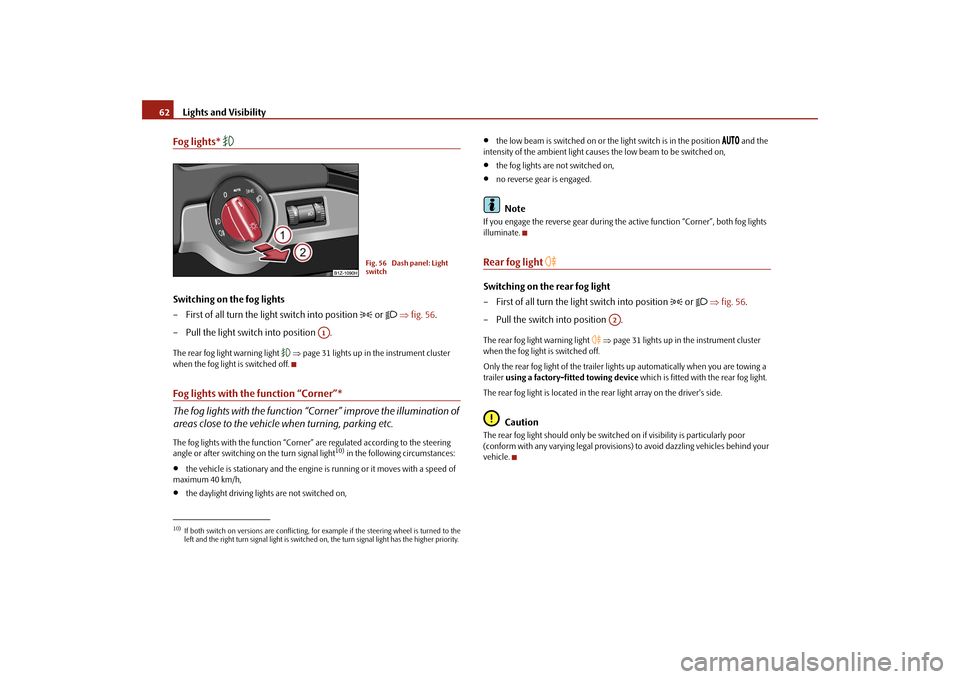
Switching on the fog lights – First of all turn the light switch into position
or
⇒
fig. 56
.
– Pull the light switch into position .The rear fog light warning light
⇒page 31 lights up in the instrument cluster
when the fog light is switched off.Fog lights with the function “Corner”* The fog lights with the function “Corner” improve the illumination of areas close to the vehicle
when turning, parking etc.
The fog lights with the function “Corner”
are regulated according to the steering
angle or after switching on the turn signal light
10) in the following circumstances:
•
the vehicle is stationary and the engine
is running or it moves with a speed of
maximum 40 km/h,•
the daylight driving lights are not switched on,
•
the low beam is switched on or the
light switch is in the position
and the
intensity of the ambient light causes
the low beam to be switched on,
•
the fog lights are not switched on,
•
no reverse gear is engaged.Note
If you engage the reverse gear during the
active function “Corner”, both fog lights
illuminate.Rear fog light
Switching on the rear fog light – First of all turn the light switch into position
or
⇒
fig. 56
.
– Pull the switch into position .The rear fog light warning light
⇒page 31 lights up in the instrument cluster
when the fog light is switched off. Only the rear fog light of the trailer ligh
ts up automatically when you are towing a
trailer
using a factory-fitted towing device
which is fitted with the rear fog light.
The rear fog light is located in the rear light array on the driver's side.
Caution
The rear fog light should only be switched
on if visibility is particularly poor
(conform with any varying legal provisions) to avoid dazzling vehicles behind your vehicle.
10)If both switch on versions are conflicting, fo
r example if the steering wheel is turned to the
left and the right turn signal light is switched on, the turn signal light has the higher priority.
Fig. 56 Dash panel: Light switch
A1
A2
se0.1.book Page 62 Friday, April 10, 2009 3:19 PM
Page 68 of 304

Lights and Visibility
67
Using the system
Safety
Driving Tips
General Maintenance
Breakdown assistance
Technical Data
If a door, the bonnet or the boot lid re
mains open, the light goes out within 2
minutes if the ignition is switched off.
WARNING
If the entry light comes on, do not touch its cover - risk of burns!VisibilityRear window heater– You can switch the rear window heater on or off by pressing the switch
⇒
fig. 63
- the indicator light in the
switch comes on or goes out.
The rear window heater only oper
ates when the engine is running.
The rear window heater
switches
off automatically after 10 minutes.
For the sake of the environment
As soon as the window is de-iced or free from mist, the heating should be switched off. The reduced current consumption will have a favourable effect on fuel economy
⇒page 205, “Saving electricity”.
Note
•
The position and the shape of the switch can differ depending on equipment
installed in the vehicle.•
If the on-board voltage drops, the rear
window heater
is switched off automat-
ically, in order to provide sufficient electrical energy for the engine control.Sun visorsYou can pull the sun visor for the driver or
front passenger out of the fixture and
swivel it toward the door in the direction of the arrow
⇒fig. 64
.
Fig. 63 Switch for rear window heater
Fig. 64 Sun visor: swivelling outFig. 65 Double sun visorA1
se0.1.book Page 67 Friday, April 10, 2009 3:19 PM
Page 74 of 304

Lights and Visibility
73
Using the system
Safety
Driving Tips
General Maintenance
Breakdown assistance
Technical Data
Note
•
Automatic mirror dimming operates only pr
operly if the sun screen* for the rear
window in the housing on the luggage comp
artment cover is not in use or the light
striking the interior rear-view mirror is not affected by other objects.•
Do not affix any stickers in front of the light sensor, so that you do not impair the
automatic dimming function or put it out of operation.•
If you switch off the automatic dimming interior rear-view mirror, also the exte-
rior mirror dimming is switched off.Exterior mirror You can adjust the exterior mirrors electrically*.The exterior mirror heater only oper
ates when the engine is running and
up to an outside temperature of +20 °C. Heating of the external mirror – Turn the rotary knob to position
⇒
fig. 72
.
Adjusting left and right exterior mirrors simultaneously – Turn the rotary knob to position
. The movement of the mirror surface
is identical to the movement of the rotary knob.
Adjusting the right-hand exterior mirror – Turn the rotary knob to position
. The movement of the mirror
surface is identical to the movement of the rotary knob.
Switching off operating control – Turn the rotary knob to position
.
Folding in both exterior mirrors* – Turn the rotary knob to position
.
Lowerable exterior mirror* with the aid of the key for remote control – If all the windows are closed, press the unlock button on the radio
remote control
⇒
page 50, fig. 47
for approx. 2 seconds.
Tilting surface of front pa
ssenger exterior mirror*
When the rotary knob is in position
⇒fig. 72
and the reverse gear is engaged, the
s ur fa ce o f t h e m i rro r t i l ts d o w n s l i g h t l y. T h i s p ro v i d e s a n a i d i n s e e i n g th e ke r b o f t h e pavement when parking the car. The mirror returns into its initial position, after the rotary knob is moved out of the position
and put into another position or if
the speed is more than 15 km/h.
Memory for exterior mirrors* On vehicles fitted with a memory for the driver seat, the relevant setting of the exte- rior mirror is also stored automatica
lly when the seat position is stored
⇒page 76.
WARNING
•
Convex (curved outward) or spherical (differently curved) exterior
mirrors increase the vision field. Th
ey do, however, make objects appear
smaller in the mirror. These mirrors are
only of limited use, therefore, for
estimating distances to the following vehicles.•
Use whenever possible the interior rear mirror, for estimating the
distances to the following vehicles.
Fig. 72 Inner part of door: Rotary knob
A3
se0.1.book Page 73 Friday, April 10, 2009 3:19 PM
Page 85 of 304
Seats and Stowage
84
recuperate from the stress of the journey. Please consult your doctor, who can evaluate your specific condition.
Caution
•
You should not kneel on the seats or otherwise apply pressure at specific points
in order to avoid damaging the heating elements of the seat heaters.•
Do not use the seat heating if the seats are not occupied by persons or if objects
are fastened or stored on them, for exampl
e a child seat, a bag etc. A fault of the
heating elements in the seat heating can occur.•
Do not clean the seats moist
⇒page 216.
Note
•
The seat heating should only be switched
on when the engine is running. This
has a significant effect of sa
ving on the battery capacity.
•
If the on-board voltage drops, the seat
heating is switched off automatically, in
order to provide sufficient electrical energy for the engine control.PedalsConcerning a secure depressi
ng of the pedal, you should use only footmats from
the Škoda genuine
accessories.
Operation of the pedals must not be hindered!
WARNING
•
Greater pedal distances may be needed when there is a fault in the brake
system.•
Do not place any footmats or other additional floor coverings in the area
of the pedals in order to ensure that
all the pedals can be fully depressed and
are able to return unobstructed to their initial position - risk of accident!
•
There must be no objects on the floor which could roll under the pedals.
You would then no longer be able to
apply the brakes, operate the clutch or
accelerator - risk of accident!luggage compartmentLoading the luggage compartmentPlease observe the following in the inte
rest of having good handling char-
acteristics of
your vehicle:
– Distribute the items of luggage as evenly as possible. – Place heavy objects as far forward as possible. – Attach the items of luggage to the lashing eyes or the safety net*
⇒
page 85.
In the event of an accident, there is such a
high kinetic energy which is produced by
small and light objects that they can caus
e severe injuries. The magnitude of the
kinetic energy depends on the speed at wh
ich the vehicle is travelling and on the
weight of the object. The speed at which the
vehicle is travelling
is in this case the
more significant factor. Example: In the event of a frontal collision at a speed of 50 km/h, an unsecured object with a weight of 4.5 kg produces
an energy, which corresponds to 20 times
its own weight. This means that it results in a weight of approx. 90 kg. You can imagine the injuries that can occur, if this
“bullet” is flying through the interior
compartment and hits an occupant.
WARNING
•
Stow the objects in the luggage compartment and attach them to the
lashing eyes.
WARNING (continued)
WARNING (continued)
se0.1.book Page 84 Friday, April 10, 2009 3:19 PM
Page 99 of 304

Seats and Stowage
98
Cigarette lighter*, power socketsCigarette lighter You can also use the socket on the cigarette lighter for other elec- trical appliances.Using the cigarette lighter – Press in the button of the cigarette lighter
⇒
fig. 116
.
– Wait until the button jumps forward. – Remove the cigarette lighter immediately and use it.– Insert the cigarette lighter again into the socket. Using the socket – Remove the cigarette lighter or the cover of the power socket. – Connect the plug of the electr
ical appliance to the socket.
The 12 volt power socket can also be used
to supply power to electrical accessories
with a power uptake up to 180 watts.
WARNING
•
Take care when using the cigarette li
ghter! Not paying proper attention
or incorrect use the cigarette lighter in
an uncontrolled manner may result in
burns.•
The cigarette lighter and the power so
cket also operates when the igni-
tion is switched off or the ignition key withdrawn. You should therefore never leave children unattended in the vehicle.
Caution
Always use matching
plugs to avoid damagi
ng the power socket.
Note
•
Connecting electrical components when the engine is not running will
drain the battery of the vehicl
e - risk of battery draining!
•
Further information
⇒page 244, “Accessories, changes and replacement of
parts”.Power socket in the luggage compartment (Combi)– Open the cover of the power socket
⇒
fig. 117
.
Fig. 116 Centre console: Cigarette lighter
Fig. 117 Luggage compart-ment: Power socket
se0.1.book Page 98 Friday, April 10, 2009 3:19 PM
Page 100 of 304

Seats and Stowage
99
Using the system
Safety
Driving Tips
General Maintenance
Breakdown assistance
Technical Data
– Connect the plug of the electr
ical appliance to the socket.
You can only use the power socket for the
connection of approved electrical acces-
sories with a power uptake up to 180 watts
. The vehicle battery will be discharged
in the process if the engine is stationary. The same remarks apply here as for
⇒page 98.
Further information
⇒page 244, “Accessorie
s, changes and replacement of
parts”.Storage compartmentsOverviewYou will find the following storage facilities in your vehicle:
WARNING
•
Please do not place anything on top of the dash panel. Such objects
might slide or fall down when driving
(when accelerating or cornering) and
may distract you from concentrating on the traffic situation - risk of acci- dent!•
Ensure that when driving no objects from the centre console of from
other storage possibilities may get into the footwell of the driver. You would then no longer be able to apply the br
akes, operate the clutch or accelerator
- risk of accident!Storage compartment on the front passenger sideOpening and closing the storage compartment on the front passenger side – Press the handle of the lid
⇒
fig. 118
- the lid folds down.
– Raise the lid and press it until the catch is heard to engage.
Storage compartment on the front passenger side
⇒ page 99
Storage compartment on the driver's side
⇒page 100
Storage compartment on the dash panel*
⇒page 101
Storage compartment in front centre console*
⇒page 101
Storage compartment for spectacles*
⇒page 102
Storage compartment in the front doors
⇒page 102
Storage compartment below front passenger seat*
⇒page 103
Front seat armrest with storage compartment*
⇒page 103
Rear armrest with storage compartment*
⇒page 104
Storage compartment in rear centre console*
⇒page 104
Seat backrest with opening for skis*
⇒page 105
Through-loading bag*
⇒page 105
Side compartment*
⇒page 106
Storage compartment behind the rear seats* (Combi)
⇒page 107
Clothes hooks*
⇒page 107
Fig. 118 Dash panel: Storage compartment on the front passenger side
se0.1.book Page 99 Friday, April 10, 2009 3:19 PM
Page 110 of 304
Heating and air conditioning system
109
Using the system
Safety
Driving Tips
General Maintenance
Breakdown assistance
Technical Data
HeatingUsing the system The heating system delivers air into
the interior of the vehicle and
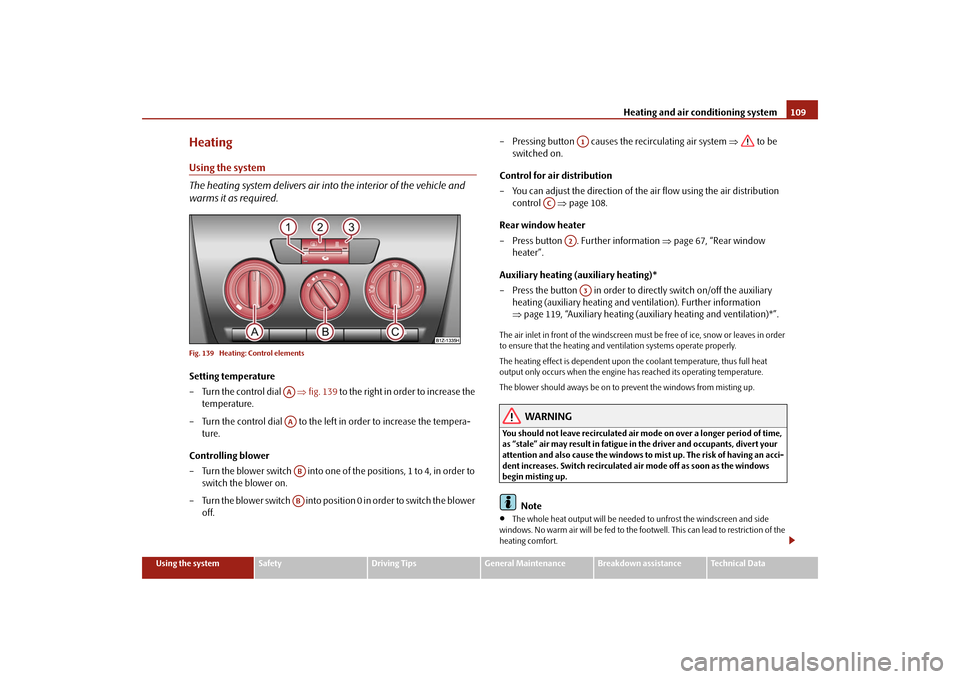
warms it as required.Fig. 139 Heating: Control elementsSetting temperature – Turn the control dial
⇒
fig. 139
to the right in order to increase the
temperature.
– Turn the control dial to the left in order to increase the tempera-
ture.
Controlling blower – Turn the blower switch into one of the positions, 1 to 4, in order to
switch the blower on.
– Turn the blower switch into position 0 in order to switch the blower
off.
– Pressing button causes the recirculating air system
⇒
to be
switched on.
Control for air distribution – You can adjust the direction of the air flow using the air distribution
control
⇒
page 108.
Rear window heater – Press button . Further information
⇒
page 67, “Rear window
heater”.
Auxiliary heating (auxiliary heating)* – Press the button in order to directly switch on/off the auxiliary
heating (auxiliary heating and ve
ntilation). Further information
⇒
page 119, “Auxiliary heating (auxiliary heating and ventilation)*”.
The air inlet in front of the windscreen must
be free of ice, snow or leaves in order
to ensure that the heating and ventilation systems operate properly. The heating effect is dependent upon th
e coolant temperature, thus full heat
output only occurs when the engine has reached its operating temperature. The blower should aways be on to
prevent the windows from misting up.
WARNING
You should not leave recirculated air mode on over a longer period of time, as “stale” air may result in fatigue in the driver and occupants, divert your attention and also cause the windows to mist up. The risk of having an acci- dent increases. Switch recirculated air mode off as soon as the windows begin misting up.
Note
•
The whole heat output will be needed
to unfrost the windscreen and side
windows. No warm air will be fed to the footwell. This can lead to restriction of the heating comfort.
AAAAABAB
A1
AC
A2A3
se0.1.book Page 109 Frida
y, April 10, 2009 3:19 PM
Page 112 of 304
Heating and air conditioning system
111
Using the system
Safety
Driving Tips
General Maintenance
Breakdown assistance
Technical Data
Recirculated air mode In recirculated air mode air is sucked
out of the interior of the vehicle
and then fed back into the interior.Recirculated air mode prevents polluted air outside the vehicle from getting into the vehicle, for example when driving through a tunnel or when standing in a traffic jam. Switching recirculated air mode on – Press the button - the warning light lights up in the button
⇒
page 109, fig. 139
.
Switching recirculated air mode off – Press again the button - the warning light in the button goes out.The recirculated air mode is switched off au
tomatically if the air distribution control
is in position
⇒page 109, fig. 139
. You can also switch recirculated air mode
on again from this setting by repeatedly pressing button .
WARNING
You should not leave recirculated air mode on over a longer period of time, as “stale” air may result in fatigue in
the driver and occupants, divert your
attention and also cause the windows to mist up. The risk of having an acci- dent increases. Switch recirculated
air mode off as so
on as the windows
begin misting up.
Climatic* (semi-automatic air conditioning system)Description The Climatic is a combined cooling and heating system. It makes it possible to optimally control the air temperature at any season of the year.Description of the Climatic It is important for your safety and for your driving comfort that the Climatic is oper- ating properly. The cooling only operates if button
⇒page 112, fig. 140
is pressed, and the
following conditions are met:•
engine running,
•
outside temperature above approx. +2°C and
•
blower switch switched
on (positions 1 to 4).
If the cooling system is switched on, th
e temperature and air humidity drops in the
vehicle. The wellbeing of the occupants of
the car is enhanced as a result of this
particularly at high outside temperatur
es and a high air humidity. The system
prevents the windows misting up during the cold season of the year. The heating effect is dependent upon th
e coolant temperature, thus full heat
output only occurs when the engine has reached its operating temperature. It is possible to briefly activate recirc
ulated air mode in order to enhance the
cooling effect
⇒
.
Air at a temperature of about 5°C may flow
out of the vents under certain circum-
stances when the cooling system is operating. Lengthy and uneven distribution of the air flow out of the vents and large differences in temperature, for example when getting out of the vehicle, can resu
lt in chills in sensitive persons.
The air inlet in front of the windscreen must
be free of ice, snow or leaves in order
to ensure that the heating and cooling systems operate properly. After switching on the cooling
Condensation
from the evaporator of the air condi-
tioning may drip down and form a puddle be
low the vehicle. This is quite normal
and not an indication of a leak!
AC
AC
A1
se0.1.book Page 111 Frida
y, April 10, 2009 3:19 PM
Page 115 of 304

Heating and air conditioning system
114
Recirculated air mode In recirculated air mode air is sucked
out of the interior of the vehicle
and then fed back into the interior.Recirculated air mode prevents polluted air outside the vehicle from getting into the vehicle, for example when driving through a tunnel or when standing in a traffic jam. Switching recirculated air mode on – Press the button
⇒
page 112, fig. 140
the warning light lights
up in the button.
Switching recirculated air mode off – Press again the button - the warning light in the button goes out.The recirculated air mode is switched off au
tomatically if the air distribution control
is in position
⇒page 112, fig. 140
. You can also switch recirculated air mode
on again from this setting by
repeatedly pressing button .
WARNING
You should not leave recirculated air mode on over a longer period of time, as “stale” air may result in fatigue in the driver and occupants, divert your attention and also cause the windows to mist up. The risk of having an acci-dent increases. Switch recirculated air mode off as soon as the windows begin misting up.Using the air conditioning system economicallyThe compressor on the air co
nditioning system uses po
wer from the engine when
in cooling mode which will effect the fuel consumption. It recommended to open the windows or the doors of a vehicle for which the inte- rior has been strongly heated through the ef
fect of direct sunlight in order to allow
the heated air to escape. The cooling system should not be switched on while travelling when the window is open. The desired interior temperature can also be achieved without switching in the cooling system just by switching to fresh air mode.
comfortable heating
desired tempera-
ture
2 or 3
switched off
do not switch on
open
the fastest cooling
recommended
22°C
briefly 4, then
2or 3
switched on
briefly switched on
open
optimal cooling
desired tempera-
ture
1, 2 or 3
switched on
do not switch on
open and align to the roof
Fresh air mode - ventilation
up to the stop towards the left
desired position
switched off
do not switch on
open
Set-up
Setting of the control dial
Button
Air outlet vents 3
AA
AB
AC
A1
A4
A4
AC
se0.1.book Page 114 Frida
y, April 10, 2009 3:19 PM
Page 116 of 304
Heating and air conditioning system
115
Using the system
Safety
Driving Tips
General Maintenance
Breakdown assistance
Technical Data
For the sake of the environment
When you economize on fuel, you
also reduce pollutant emissions.
Operational problemsIf the cooling system does not operate at outside temperatures higher than +5 °C, there is a problem in the system. The reasons for this may be:•
The fuse on the air conditioning system
has blown. Check the fuse, replace it if
necessary
⇒page 258.
•
The cooling system has switched off automatically for a short time because the
coolant temperature of the engine is too hot
⇒page 18.
If you are not able to rectify the operat
ional problem yourself, or if the cooling
capacity decreases, switch the cooling sy
stem off. Contact a specialist garage.
Climatronic* (automatic air conditioning)Description The Climatronic system is a combin
ation of an automatic heating,
fresh air and cooling system which provides optimal comfort for the occupants of the car.The Climatronic maintains fully automatically a convenience temperature. This is achieved by automatically varying the temperature of the outflowing air, the blower stages and the air distribution. The system also takes into account sunlight which eliminates the need to alte
r the settings manually. The
automatic mode
⇒ page 117 ensures maximum wellbeing of th
e occupants at all times of the year.
Description of Climatronic system The cooling operates only if the following conditions are met:•
engine running,
•
outside temperature above approx. +2°C,
•
switched on.
If the cooling system is switched on, th
e temperature and air humidity drops in the
vehicle. The wellbeing of the occupants of
the car is enhanced as a result of this
particularly at high outside temperatur
es and a high air humidity. The system
prevents the windows misting up during the cold season of the year. The heating effect is dependent upon th
e coolant temperature, thus full heat
output only occurs when the engine has reached its operating temperature. It is possible to briefly activate recirc
ulated air mode in order to enhance the
cooling effect
⇒page 118.
The air inlet in front of the windscreen must
be free of ice, snow or leaves in order
to ensure that the heating and cooling systems operate properly. The AC compressor is switched off at a hi
gh coolant temperature in order to provide
cooling at a high load of the engine. After switching on the cooling
Condensation
from the evaporator of the air condi-
tioning may drip down and form a puddle be
low the vehicle. This is quite normal
and not an indication of a leak! Recommended setting for all periods of the year:•
Set the desired temperature, we recommend 22 °C.
•
Press the button
⇒page 116, fig. 141
.
•
Move the air outlet vents
3 and
4, so that the air flow
is directed slightly
upwards. Aeration of the vehicle when ignition is switched off* On models fitted with power sliding/tilting roof with solar cells, the fresh air blower is automatically switched over
to “solar mode” if the sun ray's are sufficient after
switching off the ignition. The solar cells on
the sliding/tilting roof deliver power for
the fresh air blower. This supplies the interior of the car with fresh air. For an optimum ventilation, the air outlet vents
3 and
4 must be opened
⇒ page 108, fig. 137
.
The ventilation functions only when
the sliding/tilting roof is closed.
AC
AUTO
se0.1.book Page 115 Frida
y, April 10, 2009 3:19 PM