belt SKODA OCTAVIA 2012 3.G / (5E) Owner's Guide
[x] Cancel search | Manufacturer: SKODA, Model Year: 2012, Model line: OCTAVIA, Model: SKODA OCTAVIA 2012 3.G / (5E)Pages: 222, PDF Size: 13.52 MB
Page 148 of 222

Airbag system
Description of the airbag system
Introductory information
The airbags inflate in fractions of a second and at a high speed to offer additional protection in the event of an accident.
The functional status of the airbag system is indicated by the indicator light in
the instrument cluster » page 19.
The airbag system (according to vehicle equipment) consists of: › an electronic control unit;
› Front airbags for the driver and front seat passenger
» page 147;
› a driver’s knee airbag
» page 148;
› side airbags
» page 149;
› head airbags
» page 150;
› an airbag warning light in the instrument cluster
» page 19;
› a key switch for the front seat passenger airbag
» page 151;
› a warning light in the middle of the dash panel to indicate the front seat pas-
senger airbag is switched off » page 151.
WARNING■
The airbag is not a substitute for the seat belt, but instead forms part of the
complete passive vehicle safety concept. Please note that an airbag can only
offer you optimal protection in combination with a seat belt which is fas- tened .■
To ensure passengers are protected with the greatest possible effect when
the airbag is deployed, the front seats must be correctly adjusted to match
the body size » page 139, Correct seated position .
■
If you do not fasten the seat belts when driving, lean too far forward or
adopt an incorrect seated position, you are exposing yourself to increased risk of injury in the event of an accident.
■
If there is a fault, have the airbag system checked immediately by a ŠKODA
specialist garage. Otherwise, there is a risk of the airbag not being activated in
the event of an accident.
WARNING (Continued)■ No modifications of any kind must be made to parts of the airbag system.
Any work on the airbag system including the installation and removal of sys-
tem components due to other repair work (e.g. removal of the steering wheel)
must only be carried out by a ŠKODA specialist garage.■
Never make any changes to the front bumper or bodywork.
■
It is prohibited to manipulate individual parts of the airbag system as this
might result in the airbag being deployed.
■
The protective function of the airbag system is sufficient for only one acci-
dent. The airbag system must then be replaced if the airbag has been de-
ployed.
■
The airbag system needs no maintenance during its working life.
■
If you sell your vehicle, provide the complete vehicle documentation to the
new owner. Please note that the information relating to the possibility of de-
activating the front passenger airbag must be included!
■
When disposing of vehicle or parts of the airbag system, it is important to
comply with the national legal requirements.
Airbag deployment
The airbag system is only functional when the ignition is switched on.
When the airbags are deployed they fill with gas and inflate.
A grey white or red, non-harmful gas is released when the airbag is inflated. This
is perfectly normal and is not an indication of a fire in the vehicle.
In certain accident situations, the several airbags may be deployed simultaneous- ly.
The airbags are not deployed in the case of minor frontal and side collisions, rear-
end collisions, tilting of the vehicle and vehicle rollover.
Deployment factors
It is not possible to generally determine which deployment conditions apply to the airbag system in every situation. An important role is played by factors such as the type of object that the vehicle hits (hard, soft), the impact angle, vehicle
speed, etc.
A decisive factor for the deployment of the airbags is the deceleration which oc- curs. The control unit analyses the nature of the collision and activates the rele-
vant restraint system. If the vehicle deceleration which occurs and is measured
146Safety
Page 151 of 222
Side airbagsFig. 134
Installation location of the side airbags front/rear
Fig. 135
Inflated side airbags
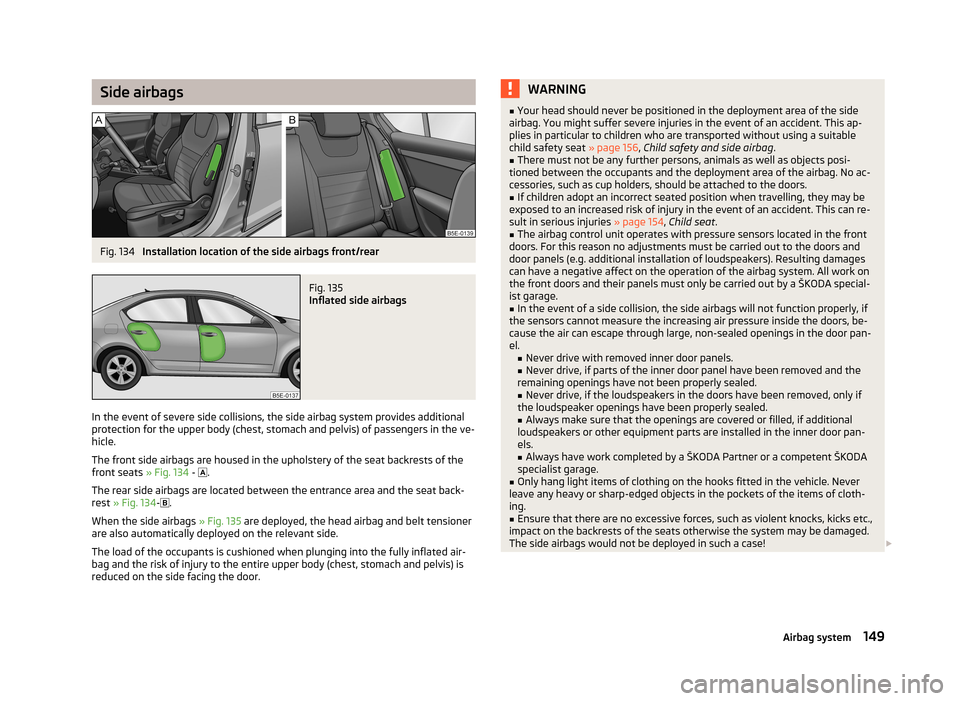
In the event of severe side collisions, the side airbag system provides additional
protection for the upper body (chest, stomach and pelvis) of passengers in the ve-
hicle.
The front side airbags are housed in the upholstery of the seat backrests of the front seats » Fig. 134 -
.
The rear side airbags are located between the entrance area and the seat back-
rest » Fig. 134 -
.
When the side airbags » Fig. 135 are deployed, the head airbag and belt tensioner
are also automatically deployed on the relevant side.
The load of the occupants is cushioned when plunging into the fully inflated air-
bag and the risk of injury to the entire upper body (chest, stomach and pelvis) is
reduced on the side facing the door.
WARNING■ Your head should never be positioned in the deployment area of the side
airbag. You might suffer severe injuries in the event of an accident. This ap- plies in particular to children who are transported without using a suitable
child safety seat » page 156, Child safety and side airbag .■
There must not be any further persons, animals as well as objects posi-
tioned between the occupants and the deployment area of the airbag. No ac-
cessories, such as cup holders, should be attached to the doors.
■
If children adopt an incorrect seated position when travelling, they may be
exposed to an increased risk of injury in the event of an accident. This can re-
sult in serious injuries » page 154, Child seat .
■
The airbag control unit operates with pressure sensors located in the front
doors. For this reason no adjustments must be carried out to the doors and
door panels (e.g. additional installation of loudspeakers). Resulting damages
can have a negative affect on the operation of the airbag system. All work on
the front doors and their panels must only be carried out by a ŠKODA special-
ist garage.
■
In the event of a side collision, the side airbags will not function properly, if
the sensors cannot measure the increasing air pressure inside the doors, be-
cause the air can escape through large, non-sealed openings in the door pan-
el. ■ Never drive with removed inner door panels.
■ Never drive, if parts of the inner door panel have been removed and the
remaining openings have not been properly sealed.
■ Never drive, if the loudspeakers in the doors have been removed, only if
the loudspeaker openings have been properly sealed. ■ Always make sure that the openings are covered or filled, if additional
loudspeakers or other equipment parts are installed in the inner door pan- els.
■ Always have work completed by a ŠKODA Partner or a competent ŠKODA
specialist garage.
■
Only hang light items of clothing on the hooks fitted in the vehicle. Never
leave any heavy or sharp-edged objects in the pockets of the items of cloth-
ing.
■
Ensure that there are no excessive forces, such as violent knocks, kicks etc.,
impact on the backrests of the seats otherwise the system may be damaged.
The side airbags would not be deployed in such a case!
149Airbag system
Page 152 of 222
WARNING (Continued)■Any seat or protective covers which you fit to the driver or front passenger
seats must only be of the type expressly authorized by ŠKODA. In view of the
fact that the airbag inflates out of the backrest of the seat, use of non-ap-
proved seat or protective covers would considerably impair the protective
function of the side airbag.■
Any damage to the original seat covers in the area of the side airbag module
must be repaired without delay by your ŠKODA specialist garage.
■
The airbag modules in the front seats must not display any damage, cracks
or deep scratches. It is not permissible to use force in order to open the mod-
ules.
Head airbags
Fig. 136
Location of the head airbag/gas-filled head airbag
In the event of a severe side collision, the head airbag system offers additional
protection for the head and neck area of passengers.
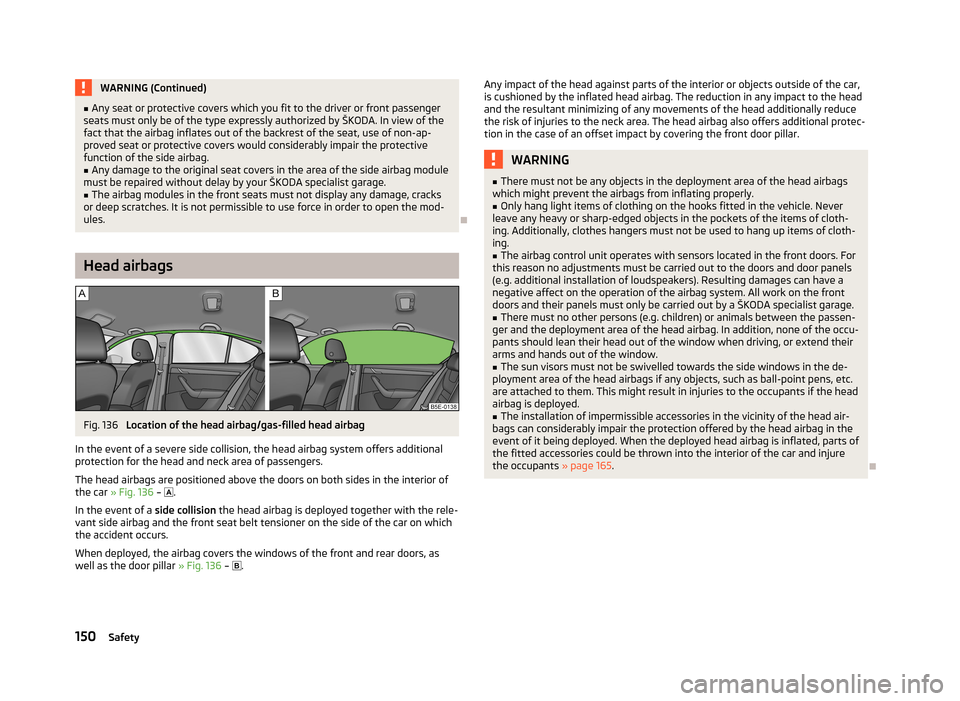
The head airbags are positioned above the doors on both sides in the interior ofthe car » Fig. 136 –
.
In the event of a side collision the head airbag is deployed together with the rele-
vant side airbag and the front seat belt tensioner on the side of the car on which
the accident occurs.
When deployed, the airbag covers the windows of the front and rear doors, as well as the door pillar » Fig. 136 –
.
Any impact of the head against parts of the interior or objects outside of the car,
is cushioned by the inflated head airbag. The reduction in any impact to the head
and the resultant minimizing of any movements of the head additionally reduce
the risk of injuries to the neck area. The head airbag also offers additional protec-
tion in the case of an offset impact by covering the front door pillar.WARNING■ There must not be any objects in the deployment area of the head airbags
which might prevent the airbags from inflating properly.■
Only hang light items of clothing on the hooks fitted in the vehicle. Never
leave any heavy or sharp-edged objects in the pockets of the items of cloth-
ing. Additionally, clothes hangers must not be used to hang up items of cloth-
ing.
■
The airbag control unit operates with sensors located in the front doors. For
this reason no adjustments must be carried out to the doors and door panels (e.g. additional installation of loudspeakers). Resulting damages can have anegative affect on the operation of the airbag system. All work on the front
doors and their panels must only be carried out by a ŠKODA specialist garage.
■
There must no other persons (e.g. children) or animals between the passen-
ger and the deployment area of the head airbag. In addition, none of the occu-
pants should lean their head out of the window when driving, or extend their
arms and hands out of the window.
■
The sun visors must not be swivelled towards the side windows in the de-
ployment area of the head airbags if any objects, such as ball-point pens, etc.
are attached to them. This might result in injuries to the occupants if the head
airbag is deployed.
■
The installation of impermissible accessories in the vicinity of the head air-
bags can considerably impair the protection offered by the head airbag in the
event of it being deployed. When the deployed head airbag is inflated, parts of
the fitted accessories could be thrown into the interior of the car and injure
the occupants » page 165.
150Safety
Page 156 of 222
Transporting children safely
Child seat
Introduction
This chapter contains information on the following subjects:
Use of a child seat on the front passenger seat
155
Child safety and side airbag
156
Classification of child seats
156
Use of child seats fastened with a seat belt
156
Locking eyes of the ISOFIX system
157
Using child seats with the ISOFIX system
157
Locking eyes of the TOP TETHER system
158
Children are generally safer on the rear seats than on the front passenger seat.
In contrast to adults, the muscles and bone structure of children are not yet fully developed. Thus children are exposed to increased risk of injury.
Children should be transported in accordance with the relevant statutory provi-sions.
Child seats that comply with the ECE-R 44 standard must be used. The ECE-R Norm stands for: Economic Commission for Europe – Regulation.
Child seats that comply with the ECE-R 44 standard have a test seal that cannotbe removed: a large E within a circle with the test number below.
WARNING■ The national legal requirements must be observed when using child seats.■One should never carry children, and also not babies! - on one's lap.■
Never leave children unattended in the vehicle. Certain outside climatic con-
ditions can cause life-threatening temperatures in the vehicle.
■
Under no circumstances allow children to be transported without the use of
a suitable restraint system. In the event of an accident the child will be thrown through the vehicle and may as a result suffer fatal injuries, and also
injure other occupants.
WARNING (Continued)■ Children are exposed to an increased risk of injury in the event of an acci-
dent if they lean forward or adopt an incorrect seated position when the vehi-
cle is moving. This particularly applies to children who are transported on the
front passenger seat as they can suffer severe, or even fatal injuries if the air-
bag system is deployed!■
Pay particular attention to the information provided by the manufacturer of
the child safety seat regarding the correct routing of the belt. Seat belts which are not correctly adjusted can themselves cause injuries even in minor
accidents.
■
Safety belts must be checked to ensure that they are running properly. One
should also ensure that the belt is not damaged by sharp-edged fittings.
■
It is essential to switch off the front passenger airbag if using a child seat in
which the child is carried with its back facing the direction of travel on the front passenger seat. Further information » page 155, Use of a child seat on
the front passenger seat .
CAUTION
When installing a child seat in which the child faces forward, adjust the head re-
straints so that they are as high as possible. If the head restraints still prevent the
child seat from being installed, even in the highest position, you will need to re-
move them » page 63. After removing the child seat, re-install the head re-
straints.
Note
We recommend that you use child seats from ŠKODA Original Accessories. These child seats were developed and also tested for use in ŠKODA vehicles. They fulfil
the ECE-R 44 standard.
154Safety
Page 157 of 222
Use of a child seat on the front passenger seat
Never use a rearward-facing child restraint system on a seat which is protected by an active airbag installed in front of it. This could cause serious injury to the child, even death.Fig. 139
Sticker on the B column on the front passenger side/warning label
First read and observe the introductory information and safety warn- ings
on page 154.
For safety reasons, we recommend that you install child seats on the rear seats whenever possible.
The following advice must be heeded when using a child seat in which the child is
carried on the front passenger seat.
› It is essential to switch off the front passenger airbag if using a child seat in
which the child is carried with its back facing the direction of travel »
.
› Slide the front passenger seat all the way back.
› If the model of child seat allows it, bring the front passenger seat rest into the
vertical position.
› Set the height-adjustable front passenger seat as high up as possible.
› Set the front passenger seat belt as high up as possible.
› Place and fasten the child seat on the seat and the child in the child seat ac-
cording to the specifications in the manufacturer's user manual of the childseat .
WARNING■ It is essential to switch off the front passenger airbag if using a child seat in
which the child is carried with its back facing the direction of travel on the
front passenger seat » page 151, Deactivating airbags .■
Never use a child safety seat in which the child is seated with its back facing
the direction of travel on the front passenger seat if the airbag is switched on.
This child safety seat is positioned in the deployment area of the front pas-
senger airbag. The airbag may cause the child severe, or even fatal injuries, in
the event of it being deployed.
■
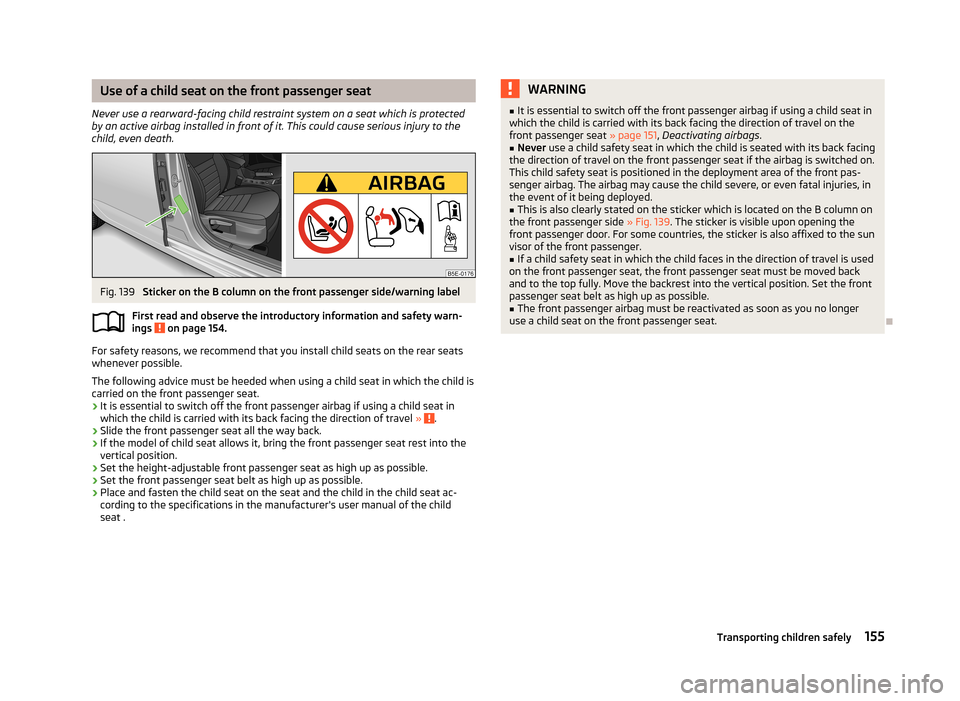
This is also clearly stated on the sticker which is located on the B column on
the front passenger side » Fig. 139. The sticker is visible upon opening the
front passenger door. For some countries, the sticker is also affixed to the sun
visor of the front passenger.
■
If a child safety seat in which the child faces in the direction of travel is used
on the front passenger seat, the front passenger seat must be moved back
and to the top fully. Move the backrest into the vertical position. Set the front
passenger seat belt as high up as possible.
■
The front passenger airbag must be reactivated as soon as you no longer
use a child seat on the front passenger seat.
155Transporting children safely
Page 158 of 222
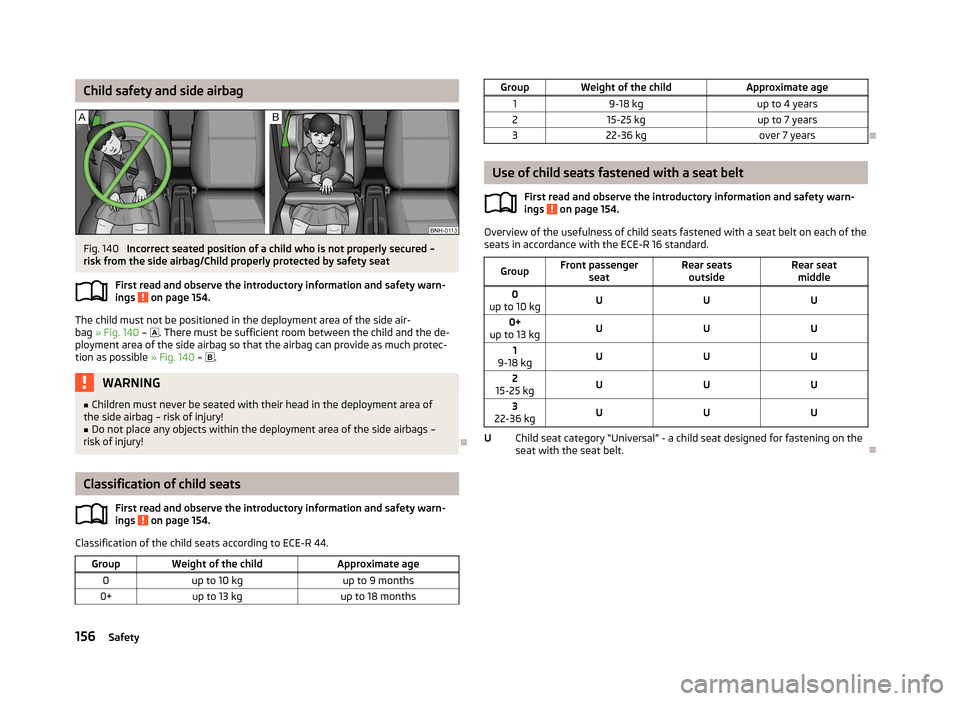
Child safety and side airbagFig. 140
Incorrect seated position of a child who is not properly secured –
risk from the side airbag/Child properly protected by safety seat
First read and observe the introductory information and safety warn-
ings
on page 154.
The child must not be positioned in the deployment area of the side air- bag » Fig. 140 –
. There must be sufficient room between the child and the de-
ployment area of the side airbag so that the airbag can provide as much protec-
tion as possible » Fig. 140 –
.
WARNING■
Children must never be seated with their head in the deployment area of
the side airbag – risk of injury!■
Do not place any objects within the deployment area of the side airbags –
risk of injury!
Classification of child seats
First read and observe the introductory information and safety warn-
ings
on page 154.
Classification of the child seats according to ECE-R 44.
GroupWeight of the childApproximate age0up to 10 kgup to 9 months0+up to 13 kgup to 18 monthsGroupWeight of the childApproximate age19-18 kgup to 4 years215-25 kgup to 7 years322-36 kgover 7 years
Use of child seats fastened with a seat belt
First read and observe the introductory information and safety warn-ings
on page 154.
Overview of the usefulness of child seats fastened with a seat belt on each of the seats in accordance with the ECE-R 16 standard.
GroupFront passenger
seatRear seatsoutsideRear seatmiddle0
up to 10 kgUUU0+
up to 13 kgUUU1
9-18 kgUUU2
15-25 kgUUU3
22-36 kgUUU
Child seat category “Universal” - a child seat designed for fastening on the
seat with the seat belt.
U156Safety
Page 159 of 222
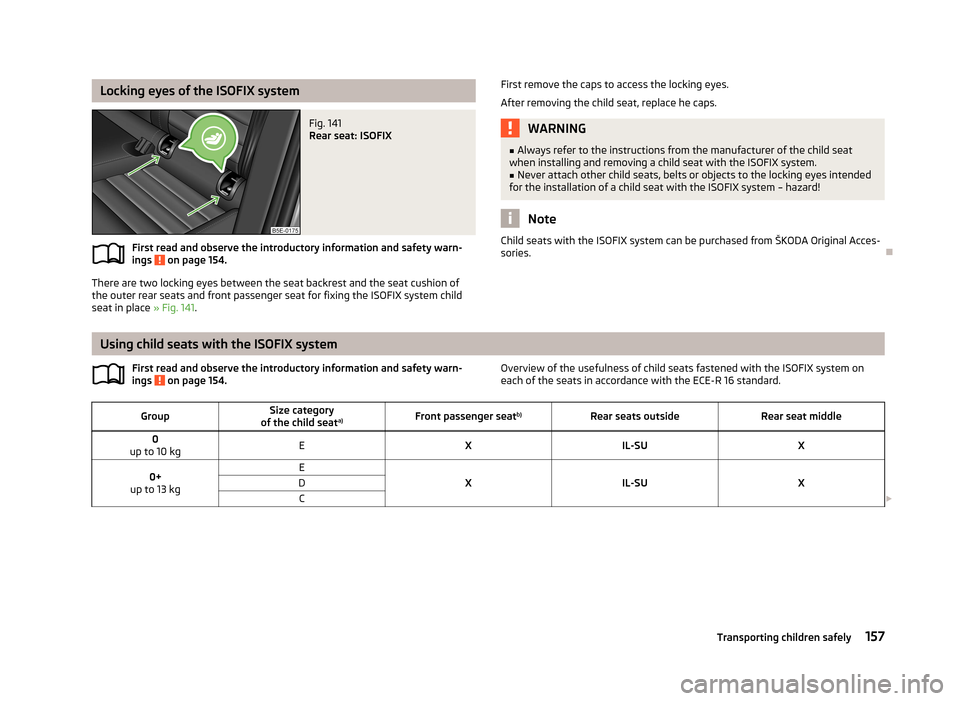
Locking eyes of the ISOFIX systemFig. 141
Rear seat: ISOFIX
First read and observe the introductory information and safety warn-ings on page 154.
There are two locking eyes between the seat backrest and the seat cushion of
the outer rear seats and front passenger seat for fixing the ISOFIX system child seat in place » Fig. 141.
First remove the caps to access the locking eyes.
After removing the child seat, replace he caps.WARNING■ Always refer to the instructions from the manufacturer of the child seat
when installing and removing a child seat with the ISOFIX system.■
Never attach other child seats, belts or objects to the locking eyes intended
for the installation of a child seat with the ISOFIX system – hazard!
Note
Child seats with the ISOFIX system can be purchased from ŠKODA Original Acces-
sories.
Using child seats with the ISOFIX system
First read and observe the introductory information and safety warn- ings on page 154.Overview of the usefulness of child seats fastened with the ISOFIX system on each of the seats in accordance with the ECE-R 16 standard.GroupSize category
of the child seat a)Front passenger seat b)Rear seats outsideRear seat middle0
up to 10 kgEXIL-SUX0+
up to 13 kgE
XIL-SUX
DC 157Transporting children safely
Page 160 of 222
GroupSize category
of the child seat a)Front passenger seat b)Rear seats outsideRear seat middle
1
9-18 kg
D
XIL-SU IUFX
CBB1Aa)
The size category is shown on the label attached to the child seat.
b)
If the front passenger seat is fitted with fixing eyes for the ISOFIX system, this suits installation of an ISOFIX child seat with the “Semi-Universal” approval.
The seat is suited for installation of an ISOFIX child seat with the “Semi-
Universal” approval. The category “Semi-Universal” means that the child
seat with the ISOFIX system is approved for your vehicle. Observe the in-
formation in the list of vehicles which comes with the child seat.
The seat is suitable for the installation of an ISOFIX child seat with the ap- proval “Universal” and attachment with the TOP TETHER belt.
The seat is not fitted with fixing eyes for the ISOFIX system.
Locking eyes of the TOP TETHER system
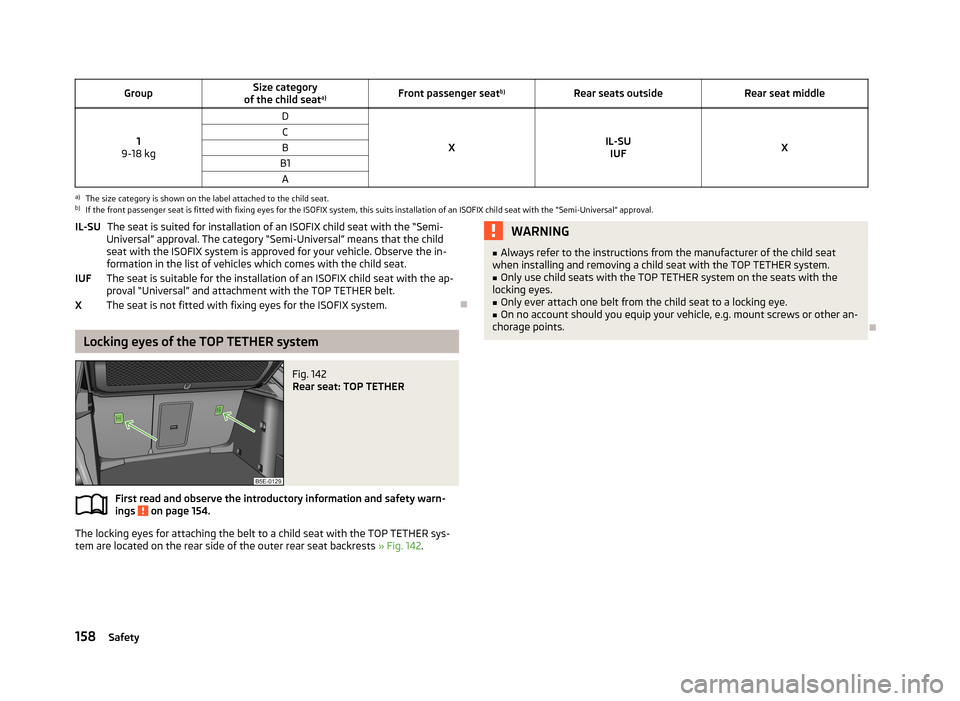
Fig. 142
Rear seat: TOP TETHER
First read and observe the introductory information and safety warn-ings on page 154.
The locking eyes for attaching the belt to a child seat with the TOP TETHER sys-
tem are located on the rear side of the outer rear seat backrests » Fig. 142.
IL-SU
IUFXWARNING■
Always refer to the instructions from the manufacturer of the child seat
when installing and removing a child seat with the TOP TETHER system.■
Only use child seats with the TOP TETHER system on the seats with the
locking eyes.
■
Only ever attach one belt from the child seat to a locking eye.
■
On no account should you equip your vehicle, e.g. mount screws or other an-
chorage points.
158Safety
Page 161 of 222
General Maintenance
Taking care of and cleaning the vehicle
Taking care of your vehicle
Introduction
This chapter contains information on the following subjects:
Washing the vehicle
160
Automatic car wash systems
160
Washing by hand
160
Washing with a high-pressure cleaner
161
Preserving and polishing the vehicle paintwork
161
Chrome parts
161
Paint damage
161
Plastic parts
162
De-icing windows and exterior mirrors
162
Radio reception and aerial
162
Headlight lenses
162
Rubber seals
163
Door lock cylinders
163
Wheels
163
Underbody protection
163
Protection of hollow spaces
164
Artificial leather, cloths and Alcantara ®
164
Fabric covers on electrically heated seats
164
Natural leather
164
Seat belts
165
Regular and proper care help to retain the efficiency and
value of your vehicle. It
may also be one of the requirements for the acceptance of warranty claims relat- ing to corrosion damage and paint defects on the bodywork.
We recommend using care products from ŠKODA Original Accessories that areavailable from ŠKODA Partners. The instructions for use on the package must be
observed.
WARNING■ Care products may be harmful to your health if not used according to the in-
structions.■
Always store care products in a safe place, out of the reach of children – risk
of poisoning!
■
Water and ice in the brake system when washing the vehicle in winter can
affect the braking efficiency – risk of accident!
■
Only wash the vehicle when the ignition is switched off – risk of accident!
■
When washing the car by hand, protect your hands and arms from sharp-
edged metal parts (e.g. when cleaning the underfloor, the inside of the wheel
housings or the wheel trims, etc) - risk of cuts!
■
Air fresheners and scents can be hazardous to heath when the temperature
inside the vehicle is high.
CAUTION
■ Be sure to check clothing for colourfastness to avoid any damage or visible
stains on the material (leather), panels and textiles.■
Cleaners containing solvents can damage the material being cleaned.
■
Do not wash your vehicle in bright sunlight – risk of paint damage.
■
If washing the vehicle in the winter using a hose or high-pressure cleaner, en-
sure that the jet of water is not aimed directly at the locking cylinders or the
door/panel joints – risk of freezing!
■
Do not use any insect sponges, rough kitchen sponges or similar cleaning prod-
ucts – risk of damaging the surface of paintwork.
■
Do not stick any stickers on the inside of the rear windows, the rear side win-
dows and in the vicinity of the heating elements on the windscreen or near the
window aerial. These may get damaged. With regard to the antenna, they may in-terfere with the radio or navigation.
■
Do not clean the inside of the windows with sharp-edged objects or corrosive
and acidic cleaning agents – risk of damaging the heating elements or window
aerial.
■
Do not attach scents and air fresheners to the dashboard – risk of damage to
the dashboard.
■
To avoid damaging the parking aid sensors while cleaning with high-pressure
cleaners or steam jets, the sensors must only be directly sprayed for short periods while a minimum distance of 10 cm must be observed.
■
Do not clean the roof trim with a brush – risk of damage to the trim surface.
■
Fold in the exterior mirrors to prevent damage before washing the vehicle in an
automatic car wash system. Never manually fold in electric exterior mirrors - al-
ways use the electric controls.
159Taking care of and cleaning the vehicle
Page 167 of 222
Leather care
Treat the leather roughly every six months with a suitable leather care product.
Apply only a small amount of the cleaning and care product.
Dry off the leather with a soft, dry cloth.
Use a care cream with light blocker and impregnation effect on a regular basis and each time after cleaning. The cream nourishes the leather, allows it to
breathe and keeps it supple and also provides moisture. It also creates surface
protection.
Clean the leather every 2 to 3 months, remove any fresh stains as they occur. Also look after the leather dye. Refresh any areas with a special coloured leather cream as required.
The leather is a natural material with specific properties. During the use of the ve- hicle, minor visible changes can occur on the leather parts of the covers (e. g wrin- kles or creases as a result of the stress of the covers).
CAUTION
■ Avoid leaving the vehicle for lengthy periods in bright sunlight to avoid the
leather from bleaching. If the vehicle is parked in the open for lengthy periods,
protect the leather from direct sunlight by covering it.■
Sharp-edged objects on items of clothing such as zip fasteners, rivets, sharp-
edged belts, jewellery and pendants may leave permanent scratches or signs of
rubbing on the surface.
■
The use of a mechanical steering wheel lock may damage the leather surface of
the steering wheel.
Seat belts
First read and observe the introductory information and safety warn-
ings
on page 159.
Keep the seat belts clean!
Clean dirty seat belts using a mild soapy solution and remove coarse dirt with a soft brush!
Check the condition of all the seat belts on a regular basis. Belt webbing which has become severely soiled may prevent the inertia reel from
reeling up the belt properly.
WARNING■ The seat belts must not be removed for cleaning.■Never clean the seat belts chemically as chemical cleaning products could
destroy the fabric. The seat belts must also not be allowed to come into con-
tact with corrosive liquids (such as acids etc.).■
Seat belts which have damage to the webbing, connections, inertia reel or
lock should be replaced by a ŠKODA specialist garage.
■
Inertia reel belts must be completely dried before being reeled up.
Accessories, changes and replacement of parts
Introduction
This chapter contains information on the following subjects:
Repairs and technical modifications
166
Changes and impairments of the airbag system
166
If you want to retrofit your vehicle with accessories, if a vehicle part is to be re-
placed with a new one, or when needing to make technical changes, the follow-
ing instructions must be observed.
› Always seek advice from a ŠKODA Partner
before purchasing any accessories or
parts and before making any technical changes »
.
› Technical modifications must satisfy the latest guidelines and advice issued by
ŠKODA.
› We recommend you have any modifications and adjustments on the vehicle car-
ried out by a ŠKODA Partner. Partners can provide more detailed information
and also carry out all the necessary work professionally and correctly.
› Only install such parts whose version and properties meet factory-installed
parts on the vehicle.
Adhering to the advice given will prevent any kind of damage to the vehicle, and
its travelling and operating safety will be maintained. The vehicle also complies
with German road transport regulations (StVZO).
165Taking care of and cleaning the vehicle