heating SKODA OCTAVIA 2012 3.G / (5E) Owner's Guide
[x] Cancel search | Manufacturer: SKODA, Model Year: 2012, Model line: OCTAVIA, Model: SKODA OCTAVIA 2012 3.G / (5E)Pages: 222, PDF Size: 13.52 MB
Page 166 of 222
Protection of hollow spacesFirst read and observe the introductory information and safety warn-
ings
on page 159.
All the cavities of your vehicle which are at risk from corrosion are protected for life by a layer of protective wax applied in the factory.
Wax protection does not require to be inspected or re-treated. If any small amount of wax flow out of the cavities at high temperatures, these must be re-
moved with a plastic scraper and the stains cleaned using a petroleum cleaner.
WARNINGSafety regulations should be observed when using petroleum cleaner to re-
move wax – risk of fire!
Artificial leather, cloths and Alcantara ®
First read and observe the introductory information and safety warn- ings
on page 159.
The artificial leather can be cleaned using a damp cloth. If this does not prove suf-
ficient, only use cleaning agents designed specifically for this purpose.
Dust and fine dirt particles in pores, creases and seams may chafe and damagethe surface. If you leave your vehicle parked in the open for lengthy periods, pro-
tect the Alcantara ®
seat covers from the direct rays of the sun to prevent fading.
Minor changes in colour caused by use are normal.
Clean upholstery cover materials and cloth trims on doors, luggage compartment
cover, etc. using specific cleaning agents, e.g., dry foam. Use a soft sponge, brush,
or commercially available microfibre cloth. Use a cloth and a specific cleaning
agent to clean the roof trim.
Some clothing materials, such as dark denim, do, in part, not have sufficient col-
our fastness. This can cause damage or clearly visible discolouration to seat cov-
ers (fabric or leather) even when used correctly. This particularly applies to light
seat covers (fabric or leather). This is not a defect in the seat cover, but poor col-
our fastness of the clothing textiles.
CAUTIONDo not use any leather cleaners on Alcantara ®
seat covers.
Fabric covers on electrically heated seats
First read and observe the introductory information and safety warn-
ings
on page 159.
Do not clean the seat covers using moisture as this can damage the seat heating
system.
Use a specific cleaning agent such as dry foam or similar to clean the covers.
Natural leather
First read and observe the introductory information and safety warn-
ings
on page 159.
Depending on the amount of wear-and-tear, the leather should be cleaned on a
regular basis.
Normal cleaning
Clean soiled areas of the leather with slightly moistened cotton or woollen cloth.
Severe soiling
Ensure that the leather is not soaked through at any point and that no water gets
into the stitching of the seams.
Dry off the leather with a soft, dry cloth.
Removing stains
Remove fresh water-based stains (e.g., coffee, tea, juices, blood) with an absorb-
ent cloth or household cleaning paper. A specific cleaning agent is required for
dried-on stains.
Remove fresh grease-based stains (e.g. butter, mayonnaise, chocolate, etc.) with
an absorbent cloth, household cleaning paper, or use a suitable cleaner if the
stain has not yet penetrated into the surface.
Use a grease solvent to remove grease stains which have dried in .
Remove specific stains (e.g. ball-point pens, marker pen, nail varnish, dispersion
paint, shoe polish, etc.) with a special stain remover suitable for leather.
164General Maintenance
Page 170 of 222
›Hold the fuel filler cap on the fuel filler tube with one hand and lock it by turn-
ing the vehicle key to the right and remove the key.›
Close the fuel filler flap until it clicks into place.
›
Check that the fuel filler flap is closed properly.
Incorrect refuelling guard on vehicles with diesel engines The fuel filler tube on vehicles with diesel engines has been fitted with a incor-
rect refuelling guard » Fig. 145. This guard means it is only possible to refuel with
the diesel pump nozzle.
If the diesel pump nozzle does not sit directly in the fuel filler tube, move it to and fro with slight pressure to insert it correctly.
CAUTION
■ The fuel tank is full just as soon as the pump nozzle switches off for the first
time, provided the nozzle has been operated properly. Do not continue filling the fuel tank otherwise the expansion volume is filled up.■
Before refuelling, switch off the auxiliary heating system (auxiliary heating and
ventilation).
■
Be careful when filling diesel fuel from the spare canister - danger of contami-
nating the body.
Note
The fuel tank has a capacity of about 50 litres, containing a reserve of approx.
7 litres .
Unleaded petrol
First read and observe the introductory information and safety warn-
ings
on page 167.
Your vehicle can only be operated with unleaded fuel that complies with the
standard EN 228 (in Germany: standard DIN 51626-1 or E10 for unleaded fuel with
an octane rating of 95 RON and 91 RON or DIN 51626-2 or E5 for unleaded fuel
with the octane rating 95 RON and 98 RON).
Prescribed fuel – unleaded fuel 95/91 RON Use unleaded fuel with the octane rating 95 RON. Unleaded petrol 91 RON can al-
so be used but results in a slight loss in performance.
Prescribed fuel – unleaded petrol min. 95 RONUse unleaded fuel with the octane rating 95 RON.
In case of necessity, you can refuel with petrol with the octane rating 91 RON if
petrol with the octane rating 95 RON is not available.
Even in the event of an emergency, petrol of a lower octane number than 91 RON
must not be used, otherwise the engine can be severely damaged!
Unleaded petrol with higher octane number
Unleaded petrol that has a higher octane number than that required by the en-
gine can be used without limitations.
On vehicles with prescribed unleaded petrol 95/91 RON, the use of petrol with a
higher octane number than 95 RON does not result in a noticeable power in-
crease or a lower fuel consumption.
On vehicles using prescribed unleaded petrol of min. 95 RON, the use of petrol
with a higher octane number than 95 RON can increase the power and reduce
fuel consumption.
Prescribed fuel – unleaded petrol 98/(95) RON
Use unleaded fuel with the octane rating 98 RON. Unleaded petrol 95 RON can
also be used but results in a slight loss in performance.
In case of necessity, you can refuel with petrol with the octane rating 91 RON of
unleaded fuel with octane rating 98 RON or 95 RON is not available.
Even in the event of an emergency, petrol of a lower octane number than 91 RON
must not be used, otherwise the engine can be severely damaged!
Fuel additives
Only use unleaded petrol, which complies with the standard EN 228 (in Germany:
standard DIN 51626-1 or E10 for unleaded fuel with an octane rating of 95 RON and 91 RON or DIN 51626-2 or E5 for unleaded fuel with an octane rating of
95 RON and 98 RON), as these meet all of the requirements for fault-free engine operation. We therefore recommend that no fuel additives are used.
CAUTION
■ All ŠKODA vehicles with petrol engines must only be operated with unleaded
petrol. Just filling the tank with leaded petrol once will damage the exhaust sys-
tem!■
If, in an emergency, the vehicle has to be refuelled with petrol of a lower octane
number than the one prescribed, the journey must only be continued at medium
engine speeds and a low engine load. Driving at high engine revs or a high engine
load can severely damage the engine! Refuel using petrol of the prescribed oc-
tane number as soon as possible.
168General Maintenance
Page 171 of 222
■Engine parts can be damaged if petrol with a lower octane number than the one
prescribed is used.■
In no case may fuel additives with metal components be used, especially not
with manganese and iron content. Do not use any LRP fuels (lead replacement petrol) with metal parts - risk of serious damage to parts of the engine or exhaust
system!
■
Do not use any fuels with metal parts - risk of serious damage to parts of the
engine or exhaust system!
■
The use of unsuitable fuel additives can cause considerable damage to parts of
the engine or the exhaust system.
Diesel fuel
First read and observe the introductory information and safety warn-ings
on page 167.
Your vehicle can only be operated with diesel fuel, which complies with the
standard EN 590 (standard DIN 51628 in Germany, standard ÖNORM C 1590 in
Austria, GOST R 52368-2005/EN 590:2004 in Russia).
All diesel engines can be operated with diesel fuel with a maximum content of
7 % bio-fuel (B7), which complies with the standard DIN 52638 in Germany (in
Austria C 1590, in France EN 590).
Operation in winter – Winter-grade diesel fuel In the cold season, only use “winter-grade diesel fuel” which will still operateproperly even at a temperature of -20 °C.
It is often the case in countries with different climatic conditions that diesel fuels available have a different temperature characteristic. The ŠKODA Partners and
filling stations in the relevant country will be able to provide you with information
regarding the diesel fuels available.
Preheating fuel
The vehicle is fitted with a fuel filter preheating system. This secures operation of
a vehicle using diesel fuel down to an environmental temperature of -25 °C.
Fuel additives
Fuel additives, so-called “flow improvers” (petrol and similar products) must not
be added to the diesel fuel.
CAUTION■ Just filling the tank once with diesel fuel that does not comply with the stand-
ard, can cause severe damage to parts of the engine, the fuel and exhaust sys-
tem!■
Damage caused by using diesel fuel which does not comply with the standards
are excluded from the warranty.
■
If a different fuel other than diesel fuel, which complies to the above mentioned
standards (e.g. petrol) is used by mistake do not start the engine or switch on the
ignition! Extensive damage to engine parts can occur! We recommend that the
fuel system is cleaned by a ŠKODA Partner.
■
Water which has collected in the fuel filter can cause engine faults.
■
Your vehicle is not adapted for use of biofuel (RME), therefore this fuel must not
be refuelled and driven. The use of biofuel (RME) can cause considerable damage
to parts of the engine or fuel system.
■
Comply with the proscribed oil change intervals.
Engine compartment
Introduction
This chapter contains information on the following subjects:
Opening and closing the bonnet
171
Engine compartment overview
172
Checking the engine oil level
172
Replenishing the engine oil
173
Changing engine oil
173
Coolant
173
Checking the coolant level
174
Replenishing the coolant
175
Radiator fan
175
Checking the brake fluid
175
Brake fluid change
176
Windscreen washer system
176
169Inspecting and replenishing
Page 176 of 222
Coolant capacity1)Petrol enginesCapacities (in litres)1.2 ltr./63 kW TSI8.91.4 ltr./103 kW TSI10.21.8 ltr./132 kW TSI7.8Diesel enginesCapacities (in litres)1.6 ltr./77 kW TDI CR8.42.0 l/110 kW TDI CR - MG/DSG11,6 / 11,9
CAUTION
■
The amount of coolant additive in the coolant must never be allowed to be less
than 40 %.■
Over 60 % of coolant additive in the coolant reduces the antifreeze protection
and coolant effectiveness.
■
Other coolant additives that do not comply with the correct specifications can
above all significantly reduce the anticorrosion effect.
■
Any faults resulting from corrosion may cause a loss of coolant and can conse-
quently result in major engine damage!
Checking the coolant level
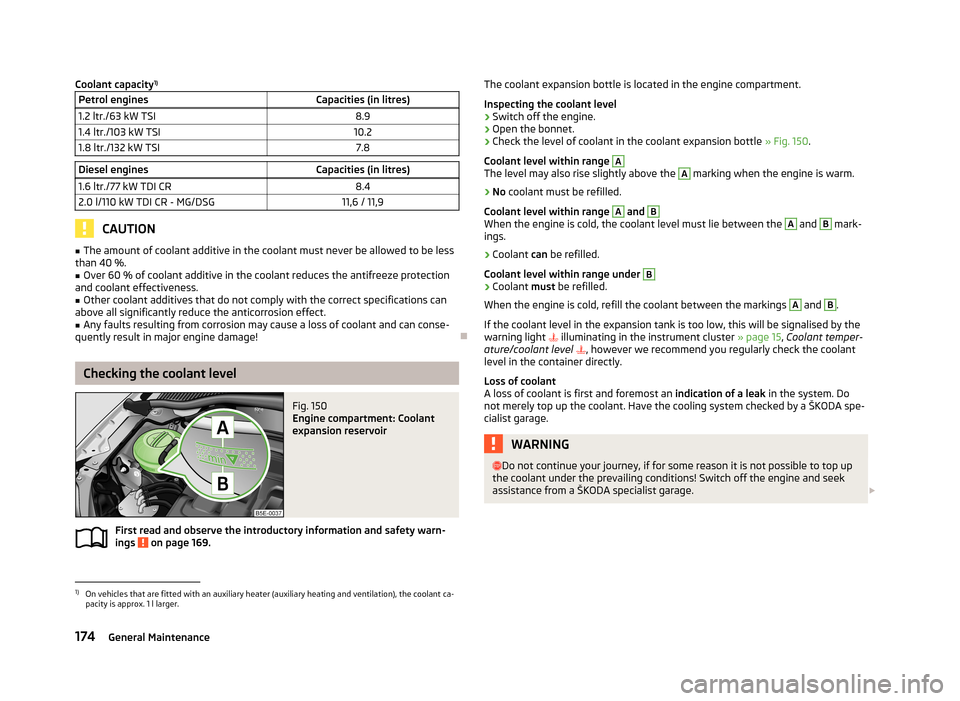
Fig. 150
Engine compartment: Coolant
expansion reservoir
First read and observe the introductory information and safety warn-
ings on page 169.
The coolant expansion bottle is located in the engine compartment.
Inspecting the coolant level›
Switch off the engine.
›
Open the bonnet.
›
Check the level of coolant in the coolant expansion bottle » Fig. 150.
Coolant level within range
A
The level may also rise slightly above the
A
marking when the engine is warm.
›
No coolant must be refilled.
Coolant level within range
A
and
B
When the engine is cold, the coolant level must lie between the
A
and
B
mark-
ings.
›
Coolant can be refilled.
Coolant level within range under
B›
Coolant must be refilled.
When the engine is cold, refill the coolant between the markings
A
and
B
.
If the coolant level in the expansion tank is too low, this will be signalised by the warning light
illuminating in the instrument cluster » page 15, Coolant temper-
ature/coolant level
, however we recommend you regularly check the coolant
level in the container directly.
Loss of coolant
A loss of coolant is first and foremost an indication of a leak in the system. Do
not merely top up the coolant. Have the cooling system checked by a ŠKODA spe- cialist garage.
WARNING Do not continue your journey, if for some reason it is not possible to top up
the coolant under the prevailing conditions! Switch off the engine and seek
assistance from a ŠKODA specialist garage. 1)
On vehicles that are fitted with an auxiliary heater (auxiliary heating and ventilation), the coolant ca-
pacity is approx. 1 l larger.
174General Maintenance
Page 196 of 222
Sealing and inflating tyresFirst read and observe the introductory information and safety warn-ings
on page 192.
Sealing
›
Forcefully shake the tyre inflator bottle
10
» Fig. 166 on page 193 several times.
›
Firmly screw the inflation hose
3
onto the tyre inflator bottle
10
clockwise.
The film on the cap is pierced automatically.
›
Remove the plug from the inflation hose
3
and plug the open end fully onto
the tyre valve.
›
Hold the bottle
10
with the bottom facing upwards and fill all of the sealing
agent from the tyre inflator bottle into the tyre.
›
Remove the empty tyre inflator bottle from the valve.
›
Screw the valve core back into the tyre valve using the valve remover
1
.
Inflating
›
Screw the tyre inflation hose
5
» Fig. 166 on page 193 of the air compressor
firmly onto the tyre valve.
›
Check that the air release valve
7
is closed.
›
Start the engine and run it in idle.
›
Plug the connector
9
into 12 Volt socket » page 71.
›
Switch on the air compressor with the ON and OFF switch
8
.
›
Allow the air compressor to run until a pressure of 2.0 - 2.5 bar is achieved. Max-
imum run time of 8 minutes » !
›
Switch off the air compressor.
›
If you cannot reach an air pressure of 2.0 – 2.5 bar, unscrew the tyre inflation
hose
5
from the tyre valve.
›
Drive the vehicle 10 metres forwards or backwards to allow the sealing agent to
“distribute” in the tyre.
›
Firmly screw the tyre inflation hose
5
back onto the tyre valve and repeat the
inflation process.
›
If you cannot reach the required tyre inflation pressure here either, this means
the tyre has sustained too much damage. You cannot seal with tyre with the breakdown kit »
.
›
Switch off the air compressor.
›
Remove the tyre inflation hose
5
from the tyre valve.
Once a tyre inflation pressure of 2.0 – 2.5 bar is achieved, continue the journey at
a maximum speed of 80 km/h.
Check the tyre inflation pressure after driving for 10 minutes » page 194.
WARNING■
During inflation, the tyre inflation hose and air compressor may get hot- risk
of injury!■
Do not place the hot tyre inflation hose or hot air compressor on flammable
materials – risk of fire!
■
If you cannot inflate the tyre to at least 2.0 bar, this means the damage sus-
tained was too serious. The sealing agent cannot be used to seal the tyre.
Do not drive the vehicle. Seek help from a ŠKODA specialist garage!
CAUTION
Switch off the air compressor after running 8 minutes at the latest – danger of
overheating! Allow the air compressor to cool a few minutes before switching it
on again.
Check after driving for 10 minutes
First read and observe the introductory information and safety warn-
ings
on page 192.
Check the tyre inflation pressure after driving for 10 minutes!
If the tyre inflation pressure is 1.3 bar or less:
›
Do not drive the vehicle! You cannot properly seal with tyre with the break-
down kit.
›
Seek help from a ŠKODA specialist garage.
If the tyre inflation pressure is 1.3 bar or more:
›
Adjust the tyre inflation pressure to the correct value (see inside of fuel filler cap).
›
Continue driving carefully to the nearest ŠKODA specialist garage at a maximum
speed of 80 km/h.
194Do-it-yourself
Page 202 of 222
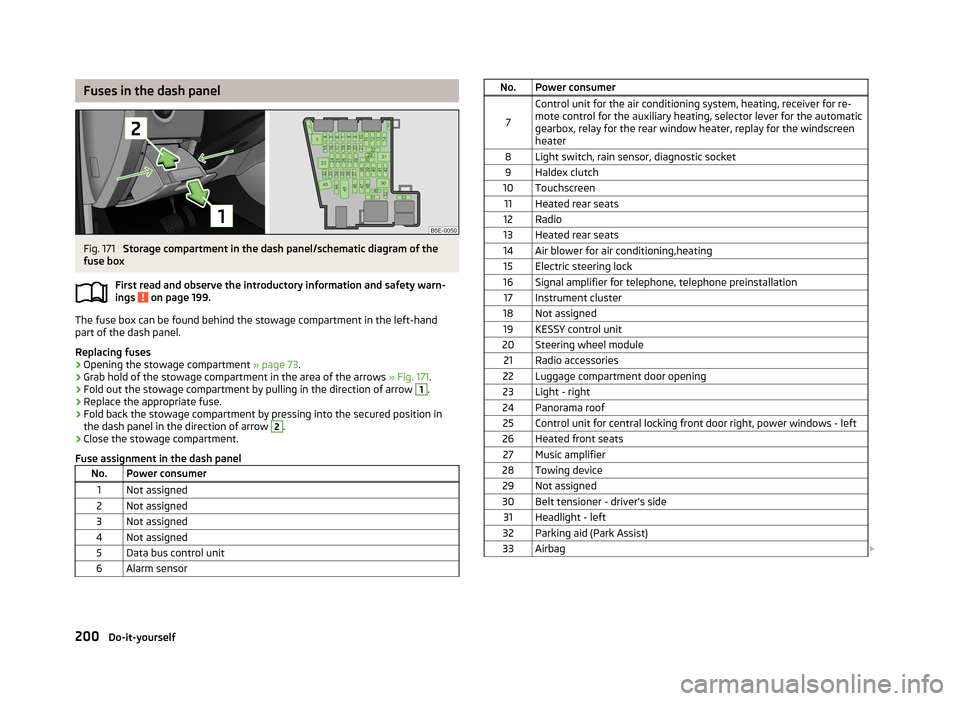
Fuses in the dash panelFig. 171
Storage compartment in the dash panel/schematic diagram of the
fuse box
First read and observe the introductory information and safety warn-
ings
on page 199.
The fuse box can be found behind the stowage compartment in the left-hand
part of the dash panel.
Replacing fuses
›
Opening the stowage compartment » page 73.
›
Grab hold of the stowage compartment in the area of the arrows » Fig. 171.
›
Fold out the stowage compartment by pulling in the direction of arrow
1
.
›
Replace the appropriate fuse.
›
Fold back the stowage compartment by pressing into the secured position in
the dash panel in the direction of arrow
2
.
›
Close the stowage compartment.
Fuse assignment in the dash panel
No.Power consumer1Not assigned2Not assigned3Not assigned4Not assigned5Data bus control unit6Alarm sensorNo.Power consumer
7
Control unit for the air conditioning system, heating, receiver for re-
mote control for the auxiliary heating, selector lever for the automatic gearbox, relay for the rear window heater, replay for the windscreen
heater8Light switch, rain sensor, diagnostic socket9Haldex clutch10Touchscreen11Heated rear seats12Radio13Heated rear seats14Air blower for air conditioning,heating15Electric steering lock16Signal amplifier for telephone, telephone preinstallation17Instrument cluster18Not assigned19KESSY control unit20Steering wheel module21Radio accessories22Luggage compartment door opening23Light - right24Panorama roof25Control unit for central locking front door right, power windows - left26Heated front seats27Music amplifier28Towing device29Not assigned30Belt tensioner - driver's side31Headlight - left32Parking aid (Park Assist)33Airbag 200Do-it-yourself
Page 203 of 222
No.Power consumer
34
TCS button, ESC, tyre control display, pressure sensor for air-condi-tioning, reverse light switch, dimming rear view mirror, START-STOPbutton, telephone preinstallation, control for heating of rear seats,sensor for air-conditioning, 230 V power socket, sound actuator35Headlight, headlamp beam adjustment, diagnostic connector, camera,
radar36Headlight right37Headlight left38Towing device39Control unit for central locking front door - right, power windows -
front and rear right4012-Volt power socket41CNG relay42Control unit for central locking rear door - left, right, headlight clean-
ing system, windscreen wipers43Visor for gas discharge bulbs, interior lighting44Towing device45Control unit for control of seat adjustment46230-Volt power socket47Rear window wiper48Not assigned49Coil on starter relay, clutch pedal switch50Not assigned51Belt tensioner - front passenger side52Not assigned53Relay for rear window heater
Note
On right-hand drive vehicles, the fuse box is located on the front passenger's side
behind the stowage compartment in the left-hand section of the dash panel.
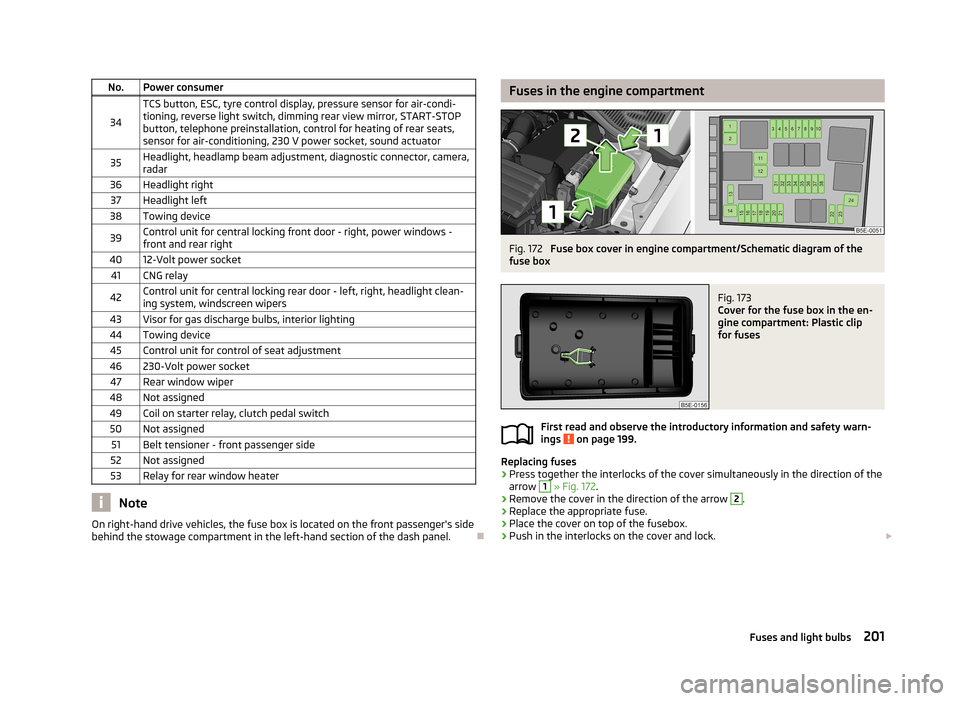
Fuses in the engine compartmentFig. 172
Fuse box cover in engine compartment/Schematic diagram of the
fuse box
Fig. 173
Cover for the fuse box in the en-
gine compartment: Plastic clip
for fuses
First read and observe the introductory information and safety warn-
ings on page 199.
Replacing fuses
›
Press together the interlocks of the cover simultaneously in the direction of the
arrow
1
» Fig. 172 .
›
Remove the cover in the direction of the arrow
2
.
›
Replace the appropriate fuse.
›
Place the cover on top of the fusebox.
›
Push in the interlocks on the cover and lock.
201Fuses and light bulbs
Page 204 of 222
Fuse assignment in engine compartmentNo.Power consumerF1Control unit for ESCF2Control unit for ESC, ABSF3Engine control unitF4Engine control unit, relay for electric auxiliary heatingF5Engine componentsF6Brake sensor, engine componentsF7Coolant pump, engine componentsF8Lambda probeF9Ignition, control unit for glow plug system, engine componentsF10Control unit for fuel pump, ignitionF11Electrical auxiliary heating systemF12Electrical auxiliary heating systemF13Control unit for automatic gearboxF14Windscreen heater - leftF15HornF16IgnitionF17Control unit for ABS, ESC, engine control unitF18Data bus control unitF19Windscreen wipersF20AlarmF21ABSF22Engine control unitF23StarterF24Electrical auxiliary heating systemF31Not assignedF32Not assignedF33Not assignedF34Windscreen heater - rightF35Not assignedF36Not assignedNo.Power consumerF37Control unit for auxiliary heatingF38Not assigned
Bulbs
Introduction
This chapter contains information on the following subjects:
Headlights
203
Changing the bulb for the low beam
203
Replacing the bulb for main beam and separate daytime running lights
204
Changing the bulb for daytime running lights and parking light
204
Changing light bulbs for fog lights
204
Changing the bulb for the licence plate light
205
Tail lamp assembly
205
Replacing the bulbs in the tail lamp assembly
206
Some manual skills are required to change a bulb. For this reason, if uncertain, we recommend that bulbs are replaced by a ŠKODA specialist garage or other experthelp is sought.
› Switch off the ignition and all of the lights before replacing a bulb.
› Faulty bulbs must only be replaced with the same type of bulbs. The designa-
tion is located on the light socket or the glass bulb.
› A stowage compartment for replacement bulbs is located in a plastic box in the
spare wheel or underneath the floor covering in the luggage compartment.
WARNING■ Accidents can be caused if the road in front of the vehicle is not sufficiently
illuminated and the vehicle cannot or can only be seen with difficulty by other
road users.■
Always read and observe the warnings before completing any work in the
engine compartment » page 169.
202Do-it-yourself
Page 214 of 222
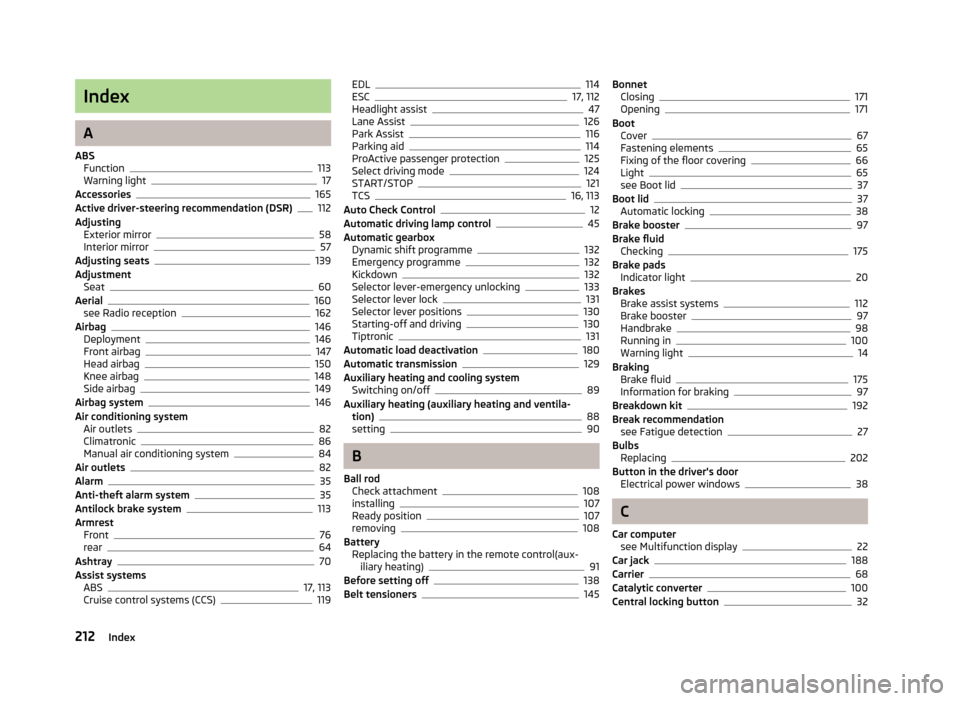
Index
A
ABS Function
113
Warning light17
Accessories165
Active driver-steering recommendation (DSR)112
Adjusting Exterior mirror
58
Interior mirror57
Adjusting seats139
Adjustment Seat
60
Aerial160
see Radio reception162
Airbag146
Deployment146
Front airbag147
Head airbag150
Knee airbag148
Side airbag149
Airbag system146
Air conditioning system Air outlets
82
Climatronic86
Manual air conditioning system84
Air outlets82
Alarm35
Anti-theft alarm system35
Antilock brake system113
Armrest Front
76
rear64
Ashtray70
Assist systems ABS
17, 113
Cruise control systems (CCS)119
EDL114
ESC17, 112
Headlight assist47
Lane Assist126
Park Assist116
Parking aid114
ProActive passenger protection125
Select driving mode124
START/STOP121
TCS16, 113
Auto Check Control12
Automatic driving lamp control45
Automatic gearbox Dynamic shift programme
132
Emergency programme132
Kickdown132
Selector lever-emergency unlocking133
Selector lever lock131
Selector lever positions130
Starting-off and driving130
Tiptronic131
Automatic load deactivation180
Automatic transmission129
Auxiliary heating and cooling system Switching on/off
89
Auxiliary heating (auxiliary heating and ventila- tion)
88
setting90
B
Ball rod Check attachment
108
installing107
Ready position107
removing108
Battery Replacing the battery in the remote control(aux-
iliary heating)
91
Before setting off138
Belt tensioners145
Bonnet Closing171
Opening171
Boot Cover
67
Fastening elements65
Fixing of the floor covering66
Light65
see Boot lid37
Boot lid37
Automatic locking38
Brake booster97
Brake fluid Checking
175
Brake pads Indicator light
20
Brakes Brake assist systems
112
Brake booster97
Handbrake98
Running in100
Warning light14
Braking Brake fluid
175
Information for braking97
Breakdown kit192
Break recommendation see Fatigue detection
27
Bulbs Replacing
202
Button in the driver's door Electrical power windows
38
C
Car computer see Multifunction display
22
Car jack188
Carrier68
Catalytic converter100
Central locking button32
212Index
Page 216 of 222
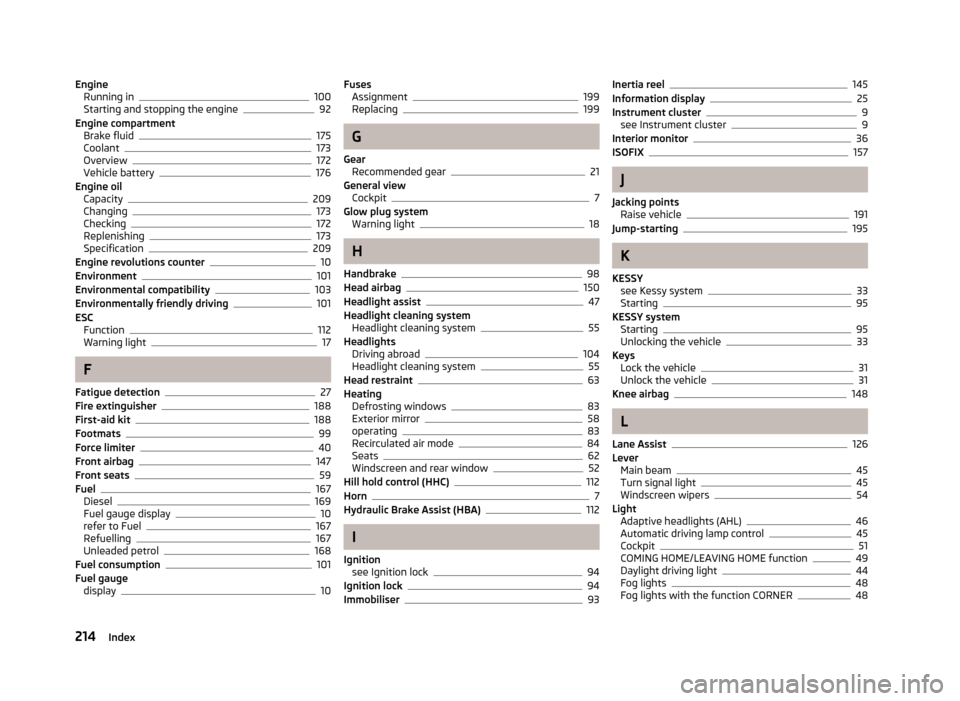
EngineRunning in100
Starting and stopping the engine92
Engine compartment Brake fluid
175
Coolant173
Overview172
Vehicle battery176
Engine oil Capacity
209
Changing173
Checking172
Replenishing173
Specification209
Engine revolutions counter10
Environment101
Environmental compatibility103
Environmentally friendly driving101
ESC Function
112
Warning light17
F
Fatigue detection
27
Fire extinguisher188
First-aid kit188
Footmats99
Force limiter40
Front airbag147
Front seats59
Fuel167
Diesel169
Fuel gauge display10
refer to Fuel167
Refuelling167
Unleaded petrol168
Fuel consumption101
Fuel gauge display
10
FusesAssignment199
Replacing199
G
Gear Recommended gear
21
General view Cockpit
7
Glow plug system Warning light
18
H
Handbrake
98
Head airbag150
Headlight assist47
Headlight cleaning system Headlight cleaning system
55
Headlights Driving abroad
104
Headlight cleaning system55
Head restraint63
Heating Defrosting windows
83
Exterior mirror58
operating83
Recirculated air mode84
Seats62
Windscreen and rear window52
Hill hold control (HHC)112
Horn7
Hydraulic Brake Assist (HBA)112
I
Ignition see Ignition lock
94
Ignition lock94
Immobiliser93
Inertia reel145
Information display25
Instrument cluster9
see Instrument cluster9
Interior monitor36
ISOFIX157
J
Jacking points Raise vehicle
191
Jump-starting195
K
KESSY see Kessy system
33
Starting95
KESSY system Starting
95
Unlocking the vehicle33
Keys Lock the vehicle
31
Unlock the vehicle31
Knee airbag148
L
Lane Assist
126
Lever Main beam
45
Turn signal light45
Windscreen wipers54
Light Adaptive headlights (AHL)
46
Automatic driving lamp control45
Cockpit51
COMING HOME/LEAVING HOME function49
Daylight driving light44
Fog lights48
Fog lights with the function CORNER48
214Index