ECU SKODA OCTAVIA 2015 3.G / (5E) User Guide
[x] Cancel search | Manufacturer: SKODA, Model Year: 2015, Model line: OCTAVIA, Model: SKODA OCTAVIA 2015 3.G / (5E)Pages: 268, PDF Size: 37.54 MB
Page 89 of 268
Folding forward›Place the lever in position 1 » Fig. 80 .›
Fold the backrest in the direction of the arrow
2
.
The locking mechanism must audibly snap into place.
Folding backwards
›
Place the lever in position
1
» Fig. 80 .
›
Fold the seat backrest in the opposite direction of the arrow
2
.
The locking mechanism must audibly snap into place.
WARNING■ The front passenger airbag should be switched off when transporting ob-
jects on the seat which was folded forwards » page 19.■
Adjust the seat backrest only when the vehicle is stationary.
■
When moving the seat backrest, make sure the seat backrest has been
properly secured – check by pulling on the seat backrest.
■
If the seat backrest is folded, passengers may only be transported on the
outer seat behind the driver.
■
When moving the seat backrest, keep limbs away from between the seat
cushion and seat backrest – risk of injury!
■
Never transport the following items on the seat backrest when folded
forwards. ■ Objects that could restrict the driver's view.
■ Objects which make it impossible for the driver to control the vehicle,
e.g. if they roll under the pedals, or could protrude into the driver's zone. ■ Objects which could lead to injury to passengers due to a change of di-
rection or braking manoeuvre when accelerating sharply.
Seat backrestsFig. 81
Fold the seat backrest forwards from the interior/pull the belt for
the side trim
Fig. 82
Fold the backrest forward from the luggage compartment: Var-
iant 1/variant 2
The luggage compartment can be increased by folding back the seat. This can
be done either from the interior or of from the luggage compartment.
The seat backrests can also be folded forward individually on vehicles with
divided rear seats.
Before folding the seat backrests forwards, adapt the position of the front
seats in such a way that they are not damaged by the folded seat backrests.
If the front seats are too far back, we recommend that you have the rear head
restraints removed before the seat backrests are folded forward » page 83.
Folding forward from the interior
›
Press the release lever
A
in the direction of arrow
1
» Fig. 81 .
87Seats and head restraints
Page 90 of 268
›Fold the backrest in the direction of the arrow 2.
In the undivided seat back, press the release handles A
on both sides of the
seat back at the same time.
Folding forward from the luggage compartment
There is a lever on the left side of the luggage compartment for unlocking the
left rear seat backrest.
There is a lever on the right side of the luggage compartment for unlocking
the right and the middle rear seat backrests.
Before folding the seat backrest forward, check that there are no objects on
the rear seat.
On vehicles with a net partition, the left and then the right and middle rear
seat backrest must first be unlocked. The net partition must be rolled up in the
housing.
›
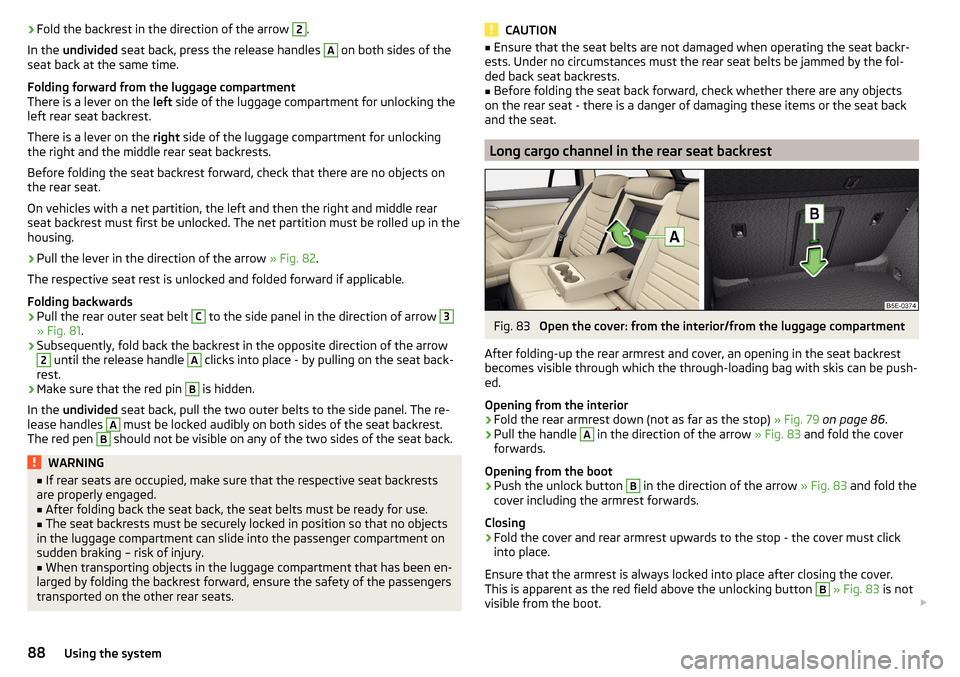
Pull the lever in the direction of the arrow » Fig. 82.
The respective seat rest is unlocked and folded forward if applicable.
Folding backwards
›
Pull the rear outer seat belt
C
to the side panel in the direction of arrow
3
» Fig. 81 .
›
Subsequently, fold back the backrest in the opposite direction of the arrow
2
until the release handle
A
clicks into place - by pulling on the seat back-
rest.
›
Make sure that the red pin
B
is hidden.
In the undivided seat back, pull the two outer belts to the side panel. The re-
lease handles
A
must be locked audibly on both sides of the seat backrest.
The red pen
B
should not be visible on any of the two sides of the seat back.
WARNING■ If rear seats are occupied, make sure that the respective seat backrests
are properly engaged.■
After folding back the seat back, the seat belts must be ready for use.
■
The seat backrests must be securely locked in position so that no objects
in the luggage compartment can slide into the passenger compartment on
sudden braking – risk of injury.
■
When transporting objects in the luggage compartment that has been en-
larged by folding the backrest forward, ensure the safety of the passengers
transported on the other rear seats.
CAUTION■ Ensure that the seat belts are not damaged when operating the seat backr-
ests. Under no circumstances must the rear seat belts be jammed by the fol-
ded back seat backrests.■
Before folding the seat back forward, check whether there are any objects
on the rear seat - there is a danger of damaging these items or the seat back
and the seat.
Long cargo channel in the rear seat backrest
Fig. 83
Open the cover: from the interior/from the luggage compartment
After folding-up the rear armrest and cover, an opening in the seat backrest
becomes visible through which the through-loading bag with skis can be push-
ed.
Opening from the interior
›
Fold the rear armrest down (not as far as the stop) » Fig. 79 on page 86 .
›
Pull the handle
A
in the direction of the arrow » Fig. 83 and fold the cover
forwards.
Opening from the boot
›
Push the unlock button
B
in the direction of the arrow » Fig. 83 and fold the
cover including the armrest forwards.
Closing
›
Fold the cover and rear armrest upwards to the stop - the cover must click
into place.
Ensure that the armrest is always locked into place after closing the cover.
This is apparent as the red field above the unlocking button
B
» Fig. 83 is not
visible from the boot.
88Using the system
Page 91 of 268
WARNINGThe through-loading channel is only intended for transporting skis that are
placed in a properly secured, through-loading bag.Transporting and practical equipment
Useful equipment
Introduction
This chapter contains information on the following subjects:
Car park ticket holder
90
Storage compartment on the driver's side
90
stowage compartments in the doors
90
Storage compartment in the front centre console
91
Cup holders
91
Cigarette lighter
92
Ashtray
92
12-Volt power outlet
93
Waste container
93
Multimedia holder
94
Storage compartment under the front arm rest
95
Glasses compartment
95
Storage compartment on the front passenger side
95
Clothes hook
96
Storage pockets on the backs of the front seats
96
Storage compartment in the rear centre console
97
230-volt socket
97
Removable through-loading bag
98
AUX and USB inputs
99WARNING■ Do not place anything on the dash panel. These objects might slide or fall
down when driving (when accelerating, cornering or with an incorrect driv-
ing action) and may distract you from concentrating on the traffic – there is
the risk of an accident.■
When driving, ensure that no objects from the centre console or from oth-
er storage compartments can get into the driver's footwell. You would not
be able to brake, operate the clutch pedal or accelerate - danger of causing
an accident!
89Transporting and practical equipment
Page 92 of 268
WARNING (Continued)■No objects should be placed in the storage compartments nor in the
drinks holders; the vehicle occupants could be endangered if there is sud-
den braking or the vehicle collides with something.■
Ash, cigarettes, cigars and the like. may only be placed in the ashtray!
Car park ticket holder
Fig. 84
Parking ticket holder
Read and observe on page 89 first.
The parking ticket holder » Fig. 84 is designed e.g. for securing car park tickets.
WARNINGThe attached note has to always be removed before starting off in order
not to restrict the driver's vision.
Storage compartment on the driver's side
Fig. 85
Opening the storage compart-
ment
Read and observe on page 89 first.
Opening
›
Raise the handle and open out the compartment in the direction of the arrow
» Fig. 85 .
Closing
›
Swivel the lid against the direction of the arrow until it clicks into place.
WARNINGThe storage compartment must always be closed when driving for safety
reasons.
stowage compartments in the doors
Fig. 86
Storage compartments: in the front door/in the rear door
Read and observe
on page 89 first.
Storage compartments » Fig. 86
Storage compartment in the front door
Bottle storage compartment with a capacity of max. 1.5 l in the front door
Storage compartment in the rear door
Bottle storage compartment with a capacity of max. 0.5 l in the rear door
WARNINGThe storage compartment A» Fig. 86 is to be used exclusively for storing
objects which do not project out because there is the danger of limiting the
operating range of the side airbags.ABCD90Using the system
Page 100 of 268
CAUTION■The power socket can only be used for connecting approved electrical acces-
sories with a two-pin 230V plug, with a total power uptake of up to 150 watt.■
Place the connector on the electrical device into the power socket as far as it
can go to create a connection between the contacts.
■
If the connector of the electrical device is not inserted fully into the power
socket, the child safety lock might release, and the power socket be activated.
The electrical device is still not supplied with power.
■
The socket is temporarily disabled at engine start-up and the indicator light
flashes red. After starting the engine, the power socket is re-activated auto-
matically.
■
Do not connect any lamps with neon filaments to the power socket - risk of
damaging the lamp.
■
A larger current surge may arise in some power supplies (e.g. for notebooks)
when connecting them to the power socket- this will automatically deactivate
the power socket. In this case, disconnect the power supply from the consum-
er and connect the power supply to the power socket first, followed by the
consumer.
■
The connected appliances may behave differently to when connected to the
mains.
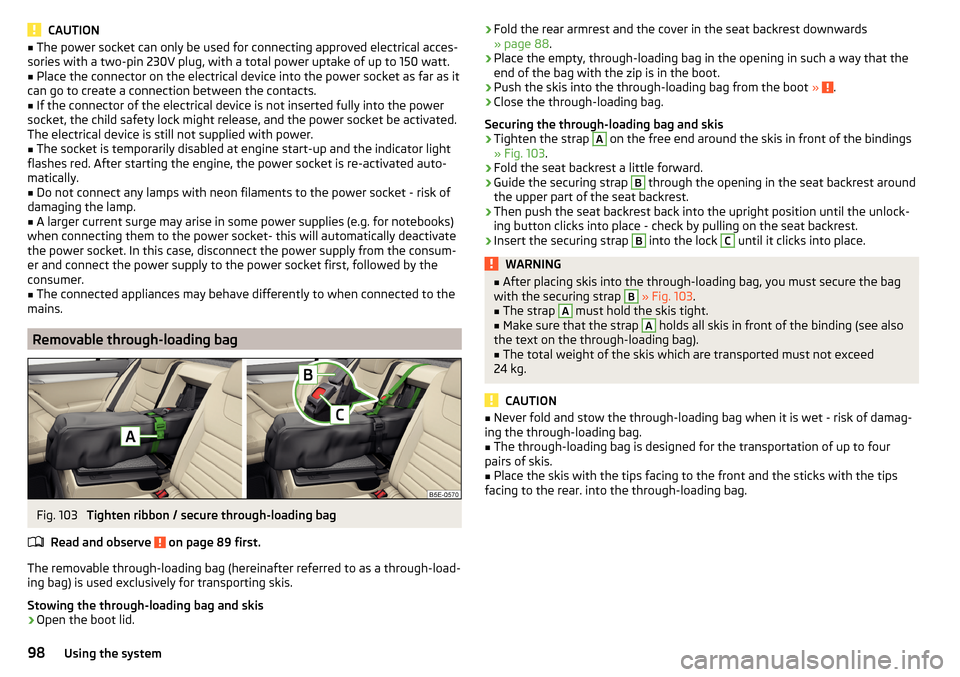
Removable through-loading bag
Fig. 103
Tighten ribbon / secure through-loading bag
Read and observe
on page 89 first.
The removable through-loading bag (hereinafter referred to as a through-load-
ing bag) is used exclusively for transporting skis.
Stowing the through-loading bag and skis
›
Open the boot lid.
› Fold the rear armrest and the cover in the seat backrest downwards
» page 88 .›
Place the empty, through-loading bag in the opening in such a way that the
end of the bag with the zip is in the boot.
›
Push the skis into the through-loading bag from the boot » .
›
Close the through-loading bag.
Securing the through-loading bag and skis
›
Tighten the strap
A
on the free end around the skis in front of the bindings
» Fig. 103 .
›
Fold the seat backrest a little forward.
›
Guide the securing strap
B
through the opening in the seat backrest around
the upper part of the seat backrest.
›
Then push the seat backrest back into the upright position until the unlock-
ing button clicks into place - check by pulling on the seat backrest.
›
Insert the securing strap
B
into the lock
C
until it clicks into place.
WARNING■ After placing skis into the through-loading bag, you must secure the bag
with the securing strap B » Fig. 103 .■
The strap
A
must hold the skis tight.
■
Make sure that the strap
A
holds all skis in front of the binding (see also
the text on the through-loading bag).
■
The total weight of the skis which are transported must not exceed
24 kg.
CAUTION
■ Never fold and stow the through-loading bag when it is wet - risk of damag-
ing the through-loading bag.■
The through-loading bag is designed for the transportation of up to four
pairs of skis.
■
Place the skis with the tips facing to the front and the sticks with the tips
facing to the rear. into the through-loading bag.
98Using the system
Page 101 of 268
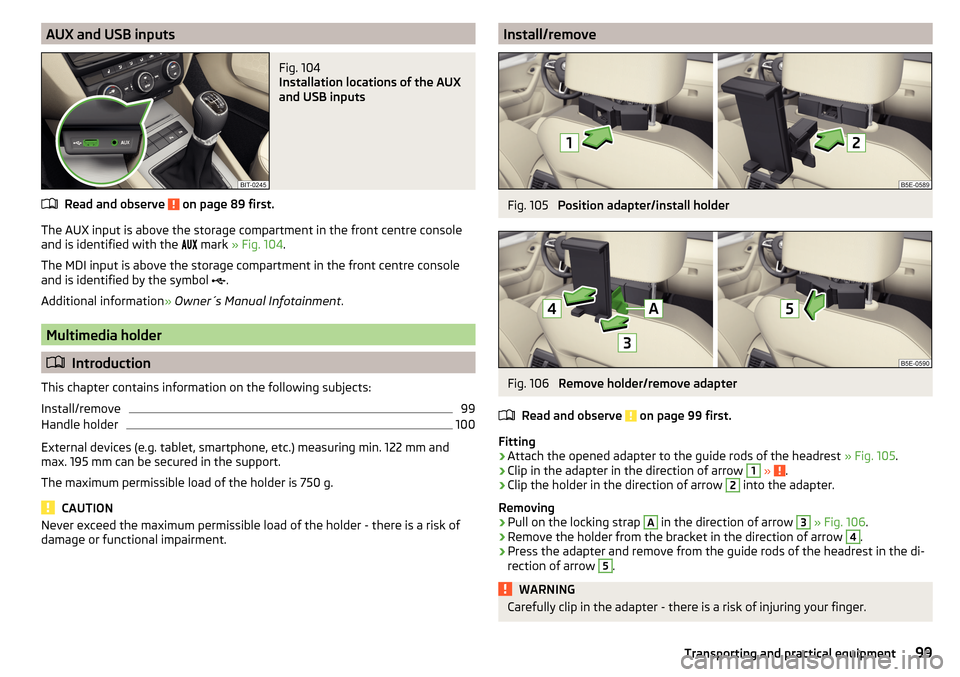
AUX and USB inputsFig. 104
Installation locations of the AUX
and USB inputs
Read and observe on page 89 first.
The AUX input is above the storage compartment in the front centre console and is identified with the mark
» Fig. 104 .
The MDI input is above the storage compartment in the front centre console
and is identified by the symbol .
Additional information » Owner´s Manual Infotainment .
Multimedia holder
Introduction
This chapter contains information on the following subjects:
Install/remove
99
Handle holder
100
External devices (e.g. tablet, smartphone, etc.) measuring min. 122 mm and
max. 195 mm can be secured in the support.
The maximum permissible load of the holder is 750 g.
CAUTION
Never exceed the maximum permissible load of the holder - there is a risk of
damage or functional impairment.Install/removeFig. 105
Position adapter/install holder
Fig. 106
Remove holder/remove adapter
Read and observe
on page 99 first.
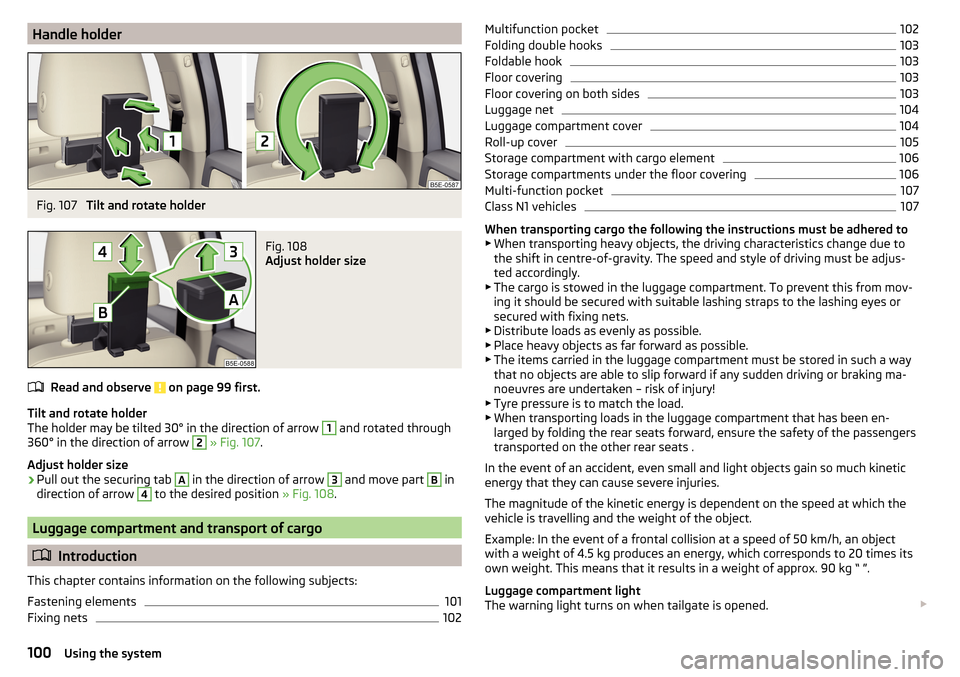
Fitting
›
Attach the opened adapter to the guide rods of the headrest » Fig. 105.
›
Clip in the adapter in the direction of arrow
1
» .
›
Clip the holder in the direction of arrow
2
into the adapter.
Removing
›
Pull on the locking strap
A
in the direction of arrow
3
» Fig. 106 .
›
Remove the holder from the bracket in the direction of arrow
4
.
›
Press the adapter and remove from the guide rods of the headrest in the di-
rection of arrow
5
.
WARNINGCarefully clip in the adapter - there is a risk of injuring your finger.99Transporting and practical equipment
Page 102 of 268
Handle holderFig. 107
Tilt and rotate holder
Fig. 108
Adjust holder size
Read and observe on page 99 first.
Tilt and rotate holder
The holder may be tilted 30° in the direction of arrow
1
and rotated through
360° in the direction of arrow
2
» Fig. 107 .
Adjust holder size
›
Pull out the securing tab
A
in the direction of arrow
3
and move part
B
in
direction of arrow
4
to the desired position » Fig. 108.
Luggage compartment and transport of cargo
Introduction
This chapter contains information on the following subjects:
Fastening elements
101
Fixing nets
102Multifunction pocket102Folding double hooks103
Foldable hook
103
Floor covering
103
Floor covering on both sides
103
Luggage net
104
Luggage compartment cover
104
Roll-up cover
105
Storage compartment with cargo element
106
Storage compartments under the floor covering
106
Multi-function pocket
107
Class N1 vehicles
107
When transporting cargo the following the instructions must be adhered to
▶ When transporting heavy objects, the driving characteristics change due to
the shift in centre-of-gravity. The speed and style of driving must be adjus-
ted accordingly.
▶ The cargo is stowed in the luggage compartment. To prevent this from mov-
ing it should be secured with suitable lashing straps to the lashing eyes or
secured with fixing nets.
▶ Distribute loads as evenly as possible.
▶ Place heavy objects as far forward as possible.
▶ The items carried in the luggage compartment must be stored in such a way
that no objects are able to slip forward if any sudden driving or braking ma-
noeuvres are undertaken – risk of injury!
▶ Tyre pressure is to match the load.
▶ When transporting loads in the luggage compartment that has been en-
larged by folding the rear seats forward, ensure the safety of the passengers
transported on the other rear seats .
In the event of an accident, even small and light objects gain so much kinetic
energy that they can cause severe injuries.
The magnitude of the kinetic energy is dependent on the speed at which the
vehicle is travelling and the weight of the object.
Example: In the event of a frontal collision at a speed of 50 km/h, an object
with a weight of 4.5 kg produces an energy, which corresponds to 20 times its
own weight. This means that it results in a weight of approx. 90 kg “ ”.
Luggage compartment light
The warning light turns on when tailgate is opened.
100Using the system
Page 103 of 268
The warning light turns off when the tailgate is closed.
If the boot lid is open and the ignition switched off, the light will extinguish
automatically after around 10 minutes.WARNING■ Never exceed the maximum permissible load of the respective fasteners,
nets, hooks etc. as heavy objects are not e sufficiently secured - there is a
risk of injury!■
If the cargo is tied down with unsuitable or damaged lashing straps, inju-
ries can occur in the event of braking manoeuvres or accidents.
■
Loose cargo can be thrown forward during a sudden manoeuvre or in case
of an accident and can injure the occupants or other road users.
■
Loose cargo could hit a deployed airbag and injure occupants – danger of
death!
CAUTION
■ Never exceed the maximum permissible load of the respective fasteners,
nets, hooks etc. - these could be damaged.■
Make sure that transported objects with sharp edges do not damage the
threads of the following devices. ■Rear window heater.
■ Rear window with an integrated antenna.
■ Integrated antenna in the rear side windows.
Fastening elements
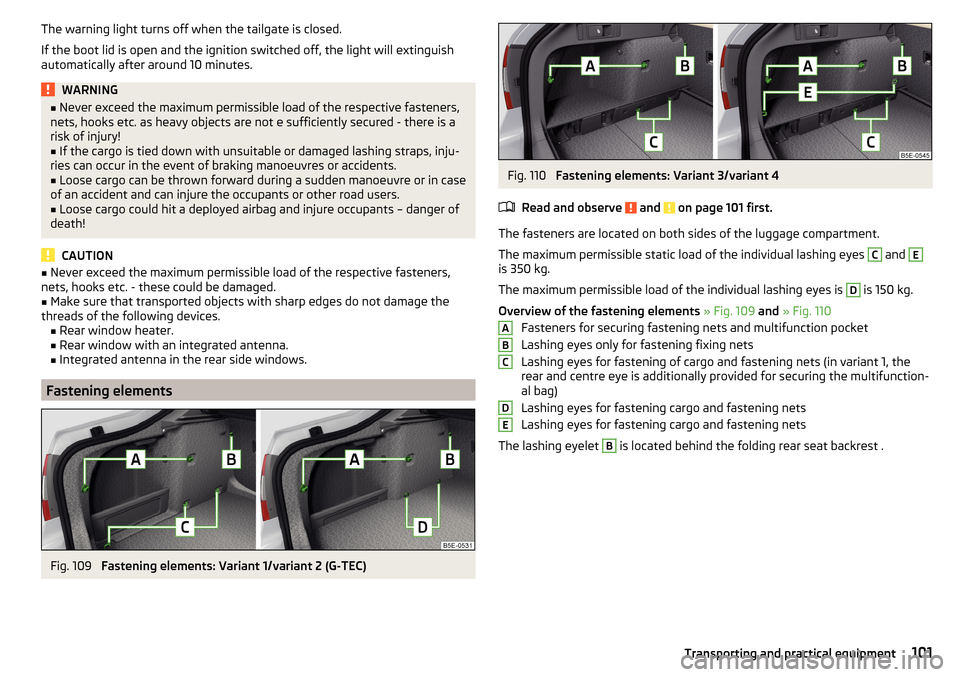
Fig. 109
Fastening elements: Variant 1/variant 2 (G-TEC)
Fig. 110
Fastening elements: Variant 3/variant 4
Read and observe
and on page 101 first.
The fasteners are located on both sides of the luggage compartment.
The maximum permissible static load of the individual lashing eyes
C
and
E
is 350 kg.
The maximum permissible load of the individual lashing eyes is
D
is 150 kg.
Overview of the fastening elements » Fig. 109 and » Fig. 110
Fasteners for securing fastening nets and multifunction pocket
Lashing eyes only for fastening fixing nets
Lashing eyes for fastening of cargo and fastening nets (in variant 1, the
rear and centre eye is additionally provided for securing the multifunction-
al bag)
Lashing eyes for fastening cargo and fastening nets
Lashing eyes for fastening cargo and fastening nets
The lashing eyelet
B
is located behind the folding rear seat backrest .
ABCDE101Transporting and practical equipment
Page 104 of 268
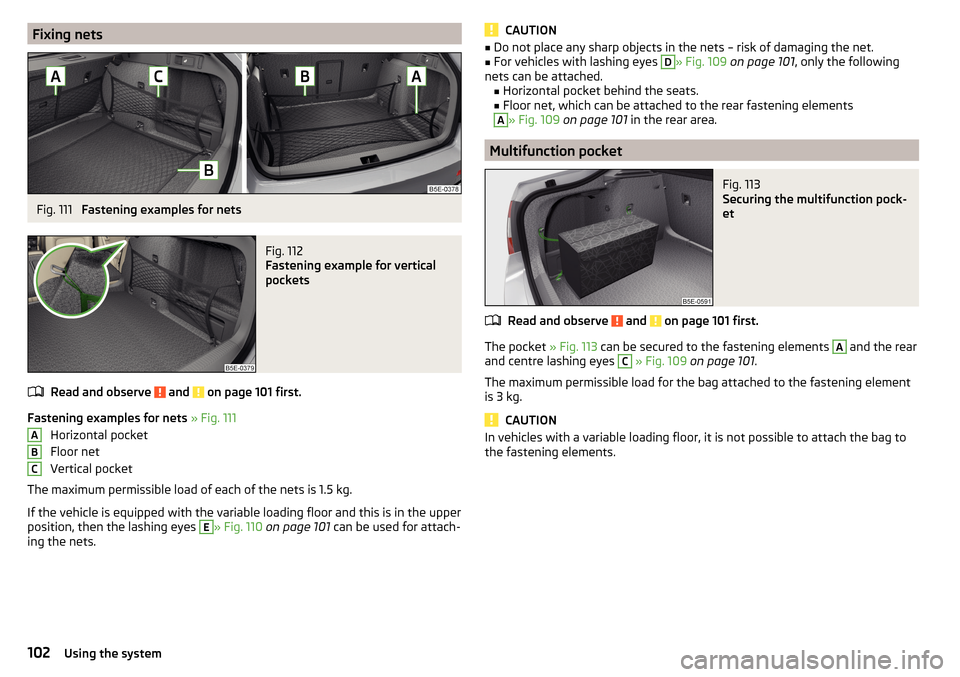
Fixing netsFig. 111
Fastening examples for nets
Fig. 112
Fastening example for vertical
pockets
Read and observe and on page 101 first.
Fastening examples for nets » Fig. 111
Horizontal pocket
Floor net
Vertical pocket
The maximum permissible load of each of the nets is 1.5 kg.
If the vehicle is equipped with the variable loading floor and this is in the upper
position, then the lashing eyes
E
» Fig. 110 on page 101 can be used for attach-
ing the nets.
ABCCAUTION■ Do not place any sharp objects in the nets – risk of damaging the net.■For vehicles with lashing eyes D» Fig. 109 on page 101 , only the following
nets can be attached. ■ Horizontal pocket behind the seats.
■ Floor net, which can be attached to the rear fastening elementsA
» Fig. 109 on page 101 in the rear area.
Multifunction pocket
Fig. 113
Securing the multifunction pock-
et
Read and observe and on page 101 first.
The pocket » Fig. 113 can be secured to the fastening elements
A
and the rear
and centre lashing eyes
C
» Fig. 109 on page 101 .
The maximum permissible load for the bag attached to the fastening element
is 3 kg.
CAUTION
In vehicles with a variable loading floor, it is not possible to attach the bag to
the fastening elements.102Using the system
Page 108 of 268
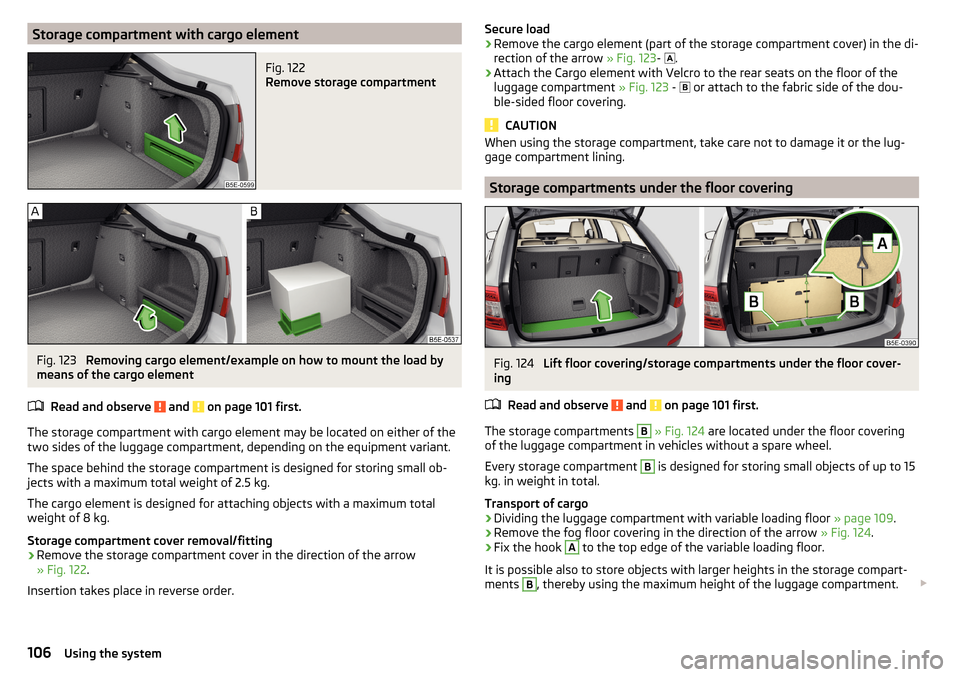
Storage compartment with cargo elementFig. 122
Remove storage compartment
Fig. 123
Removing cargo element/example on how to mount the load by
means of the cargo element
Read and observe
and on page 101 first.
The storage compartment with cargo element may be located on either of the
two sides of the luggage compartment, depending on the equipment variant.
The space behind the storage compartment is designed for storing small ob-
jects with a maximum total weight of 2.5 kg.
The cargo element is designed for attaching objects with a maximum total
weight of 8 kg.
Storage compartment cover removal/fitting
›
Remove the storage compartment cover in the direction of the arrow
» Fig. 122 .
Insertion takes place in reverse order.
Secure load›Remove the cargo element (part of the storage compartment cover) in the di-
rection of the arrow » Fig. 123-
.›
Attach the Cargo element with Velcro to the rear seats on the floor of the
luggage compartment » Fig. 123 -
or attach to the fabric side of the dou-
ble-sided floor covering.
CAUTION
When using the storage compartment, take care not to damage it or the lug-
gage compartment lining.
Storage compartments under the floor covering
Fig. 124
Lift floor covering/storage compartments under the floor cover-
ing
Read and observe
and on page 101 first.
The storage compartments
B
» Fig. 124 are located under the floor covering
of the luggage compartment in vehicles without a spare wheel.
Every storage compartment
B
is designed for storing small objects of up to 15
kg. in weight in total.
Transport of cargo
›
Dividing the luggage compartment with variable loading floor » page 109.
›
Remove the fog floor covering in the direction of the arrow » Fig. 124.
›
Fix the hook
A
to the top edge of the variable loading floor.
It is possible also to store objects with larger heights in the storage compart-
ments
B
, thereby using the maximum height of the luggage compartment.
106Using the system