gearbox SKODA OCTAVIA 2016 3.G / (5E) User Guide
[x] Cancel search | Manufacturer: SKODA, Model Year: 2016, Model line: OCTAVIA, Model: SKODA OCTAVIA 2016 3.G / (5E)Pages: 324, PDF Size: 48.85 MB
Page 223 of 324
MalfunctionsRead and observe
and on page 219 first.
If, for some unknown reason, the system is not available, an appropriate mes-
sage appears in the display of the instrument cluster.
Sensor covered / dirty
If the sensor is dirty or covered, a message indicating that there is no sensor
view appears. Clean the sensor cover or remove the obstacles » Fig. 240 on
page 199 .
System unavailable
If the system is currently unavailable, a message concerning the unavailability
appears. Stop the vehicle, switch off the engine and then start it again. If the
system still is not available, seek the assistance of a specialist garage.
Select the driving mode (Driving Mode Selection)
Introduction
This chapter contains information on the following subjects:
Adaptive Chassis Control (DCC)
221
Mode
Eco221
Mode
Comfort222
Mode
normal222
Mode
Sports222
mode
individual222
Mode
Offroad222
Mode selection and infotainment display
223
Individual mode
settings223
By selecting the driving mode, the driving behaviour can be adapted to the de-
sired mode of operation.
The following modes
Eco
.
Comfort
.
Normal
.
Sports
.
Individual
and
Offroad
are availa-
ble.
The
Comfort
is only on vehicles with adaptive chassis control (DCC) and the
mode
Offroad
available only on vehicles Octavia Scout.
WARNINGThe general information relating to the use of assistance systems must be
observed » page 199, in section Introduction .
Adaptive Chassis Control (DCC)
Read and observe
on page 221 first.
The adaptive chassis control (following known as DCC) provides the ability to
adjust the shock characteristics for the sporty, normal or comfortable driving
when the corresponding control mode is selected.
The DCC evaluates steering response and road conditions while driving contin-
uously and adjusts the suspension behaviour within the selected driving mode
accordingly.
Mode
Eco
Read and observe on page 221 first.
This mode is suitable for a relaxed style of driving and helps to save fuel.
Selecting this mode primarily affects the function of the following systems.
Drive
Vehicle acceleration is more relaxed than in
Normal
mode.
The recommended gear is controlled such to achieve the lowest possible fuel
consumption » page 42.
If the START-STOP system is deactivated manually » page 191, this will be auto-
matically activated.
The automatic gearbox is set automatically to mode E » page 195 .
Adaptive Cruise Control (ACC)
Acceleration occurs more relaxed than in
Normal
» page 214 mode with distance
control.
Xenon headlight
The system is in economic mode » page 66. The headlamps are in basic setting
and do not adapt to the direction of travel.
221Assist systems
Page 238 of 324
With the engine switched off, the vehicle battery is discharged by the connec-
ted consumers.
At low charge state of the vehicle battery, the power supply to the trailer (ac-
cessories) is interrupted.WARNING■ An improperly connected electrical installation of the trailer (accessories)
may result in an accident or serious injury from electrical shock.■
Do not make any adjustments to the electrical installation of the vehicle
and the trailer (accessories) - risk of an accident or serious injury from elec-
trical shock.
■
After the electrical connection between the vehicle and trailer (accessory)
the trailer / accessory lights should be checked for function.
■
Never use the securing eye to tow - The is a risk of an accident!
CAUTION
■ An improperly connected electrical installation of the trailer (accessories) can
lead to the inoperability of the vehicle electronics.■
The total power consumption of all the connected loads to the trailer power
supply must not exceed 350 watts, otherwise there is a risk of damage to the
electrical system of the vehicle.
Loading a trailer
Correct the tyre inflation pressure on the vehicle for “full load” » page 261.
Distribution of the cargo
Distribute the cargo in the trailer in such a way that heavy items are located as
close to the trailer axle as possible. Secure the load from slipping.
The distribution of the weight is very poor if your vehicle is unladen and the
trailer is laden. Nevertheless, maintain a particularly low speed if you cannot
avoid driving with this combination.WARNINGSliding cargo can significantly adversely affect stability and driving safety -
risk of accident!
Trailer
The permissible trailer load must not be exceeded under any circumstances.Permissible trailer load - OctaviaEngineGearboxPermissible trailer weight, braked (kg) with gradients up to 12%.Permissible trailer weight, unbraked (kg)1.0 l/85 kW TSIMG1300610DSG13006201.2 l/63 kW TSIMG11006101.4 l/81 kW TSI G-TECMG1400690DSG14007001.4 l/110 kW TSIMG1500620DSG15006301.6 l./81 kW MPIMG1100600AG1100620 236Driving
Page 239 of 324

EngineGearboxPermissible trailer weight, braked (kg)with gradients up to 12%.Permissible trailer weight, unbraked (kg)1.8 l/132 kW TSI
MG1600650DSG1600660DSG 4x416007101.6 l/66 kW TDI CRMG1400640
1.6 l/81 kW TDI CR
MG51500650MG61000640MG 4x41700700DSG15006502.0 l/105 kW TDI CRMG1600660DSG1600670
2.0 l/110 kW TDI CR
MG1600660MG 4x42000710DSG16006702.0 l/135 kW TDI CRDSG 4x41800730
Permissible trailer load - Octavia RS
EngineGearboxPermissible trailer weight, braked (kg) with gradients up to 12%.Permissible trailer weight, unbraked (kg)2.0 l./162 kW TSIMG1600710DSG16007202.0 l./169 kW TSIMG1600720DSG1600730
2.0 l/135 kW TDI CR
MG1600720DSG1600730DSG 4x41800750
Permissible trailer load - Octavia Combi
EngineGearboxPermissible trailer weight, braked (kg)with gradients up to 12%.Permissible trailer weight, unbraked (kg)1.0 l/85 kW TSIMG1300620DSG13006301.2 l/63 kW TSIMG1100620 237Towing device and trailer
Page 240 of 324

EngineGearboxPermissible trailer weight, braked (kg)with gradients up to 12%.Permissible trailer weight, unbraked (kg)1.4 l/81 kW TSI G-TECMG1400700DSG14007101.4 l/110 kW TSIMG1500630DSG15006401.6 l./81 kW MPIMG1100610AG1100620
1.8 l/132 kW TSI
MG1600660DSG1600670DSG 4x416007201.6 l/66 kW TDI CRMG1400650
1.6 l/81 kW TDI CR
MG51500660MG61000640MG 4x41700710DSG15006602.0 l/105 kW TDI CRMG1600670DSG1600680
2.0 l/110 kW TDI CR
MG1600670MG 4x42000720DSG16006802.0 l/135 kW TDI CRDSG 4x41800730
Permissible trailer load - Octavia Combi RS
EngineGearboxPermissible trailer weight, braked (kg) with gradients up to 12%.Permissible trailer weight, unbraked (kg)2.0 l/162 kW TSIMG1600720DSG16007302.0 l/169 kW TSIMG1600730DSG1600740
2.0 l/135 kW TDI CR
MG1600730DSG1600740DSG 4x41800750 238Driving
Page 241 of 324
Permissible trailer load - Octavia Combi ScoutEngineGearboxPermissible trailer weight, braked (kg)with gradients up to 12%.Permissible trailer weight, unbraked (kg)1.8 l/132 kW TSIDSG 4x416007501.6 l/81 kW TDI CRMG 4x417007502.0 l/110 kW TDI CRMG 4x420007502.0 l/135 kW TDI CRDSG 4x41800750WARNINGThe maximum vertical load and the maximum trailer load must not be ex-
ceeded - there is risk of an accident!
Trailer operation
Driving speed
For safety reasons, do not drive with the trailer any faster than 100 km/h
(when the towing vehicle is a passenger car of category M1) or 80 km/h (when
the towing vehicle is a truck of category N1).
Immediately reduce your speed as soon as even the slightest swaying of the
trailer is detected. Never attempt to stop the trailer from “swaying” by acceler-
ating.
Brakes
Apply the brakes in good time! If the trailer is fitted with a trailer brake, apply
the brakes gently at first, then brake firmly. This will avoid brake jolts resulting
from the trailer wheels locking.
On downhill sections shift down a gear in good time to also use the engine as
a brake.
WARNINGAlways drive particularly carefully with the trailer.
CAUTION
With frequent towing, the vehicle is excessively loaded so this must also be
checked between service intervals.Anti-theft alarm system
The alarm is triggered if, with a vehicle with activated anti-theft alarm (herein-
after only warning system), the electrical connection to the trailer (accessory)
is interrupted.
Always switch off the anti-theft alarm system before a trailer (accessory) is
coupled or uncoupled » page 55.
Conditions for including a trailer (accessory) in the anti-theft alarm system. The vehicle is factory-fitted with an anti-theft alarm system and a towing
device.
The trailer (accessory) is electrically connected to the towing vehicle by
means of the trailer socket.
The electrical system of the vehicle and trailer (accessory) is functional.
The vehicle is locked and the anti-theft alarm system is activated.
The trailer (accessory) is not equipped with LED taillights.239Towing device and trailer
Page 275 of 324
WARNING■Never clamp the jump cable to the negative terminal of the discharged
battery - There is a risk of explosion.■
The non-insulated parts of the terminal clamps must never touch each
other – risk of short circuit!
■
The jump-start cable connected to the positive terminal of the battery
must not come into contact with electrically conducting parts of the vehicle
– risk of short circuit!
■
Position the jump cables so that they cannot be caught in rotating parts
in the engine compartment - danger of injuries and the risk of vehicle dam-
age.
Towing the vehicle
Information about the towing process
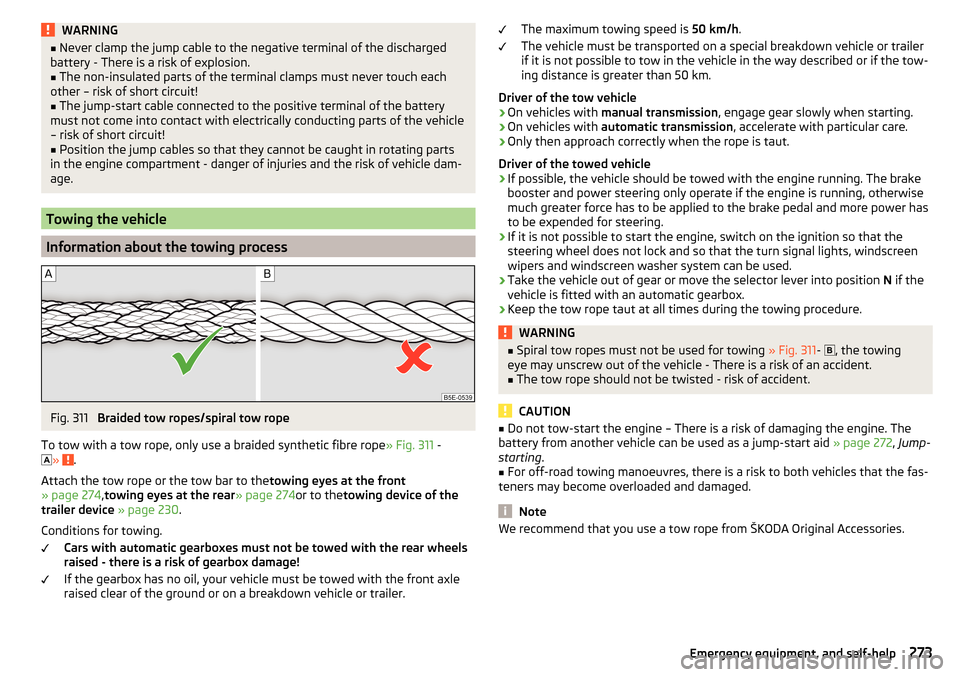
Fig. 311
Braided tow ropes/spiral tow rope
To tow with a tow rope, only use a braided synthetic fibre rope » Fig. 311 -
»
.
Attach the tow rope or the tow bar to the towing eyes at the front
» page 274 ,towing eyes at the rear » page 274or to thetowing device of the
trailer device » page 230 .
Conditions for towing. Cars with automatic gearboxes must not be towed with the rear wheels
raised - there is a risk of gearbox damage!
If the gearbox has no oil, your vehicle must be towed with the front axle
raised clear of the ground or on a breakdown vehicle or trailer.
The maximum towing speed is 50 km/h.
The vehicle must be transported on a special breakdown vehicle or trailer
if it is not possible to tow in the vehicle in the way described or if the tow-
ing distance is greater than 50 km.
Driver of the tow vehicle›
On vehicles with manual transmission , engage gear slowly when starting.
›
On vehicles with automatic transmission , accelerate with particular care.
›
Only then approach correctly when the rope is taut.
Driver of the towed vehicle
›
If possible, the vehicle should be towed with the engine running. The brake
booster and power steering only operate if the engine is running, otherwise
much greater force has to be applied to the brake pedal and more power has
to be expended for steering.
›
If it is not possible to start the engine, switch on the ignition so that the
steering wheel does not lock and so that the turn signal lights, windscreen
wipers and windscreen washer system can be used.
›
Take the vehicle out of gear or move the selector lever into position N if the
vehicle is fitted with an automatic gearbox.
›
Keep the tow rope taut at all times during the towing procedure.
WARNING■ Spiral tow ropes must not be used for towing » Fig. 311- , the towing
eye may unscrew out of the vehicle - There is a risk of an accident.■
The tow rope should not be twisted - risk of accident.
CAUTION
■ Do not tow-start the engine – There is a risk of damaging the engine. The
battery from another vehicle can be used as a jump-start aid » page 272, Jump-
starting .■
For off-road towing manoeuvres, there is a risk to both vehicles that the fas-
teners may become overloaded and damaged.
Note
We recommend that you use a tow rope from ŠKODA Original Accessories.273Emergency equipment, and self-help
Page 283 of 324
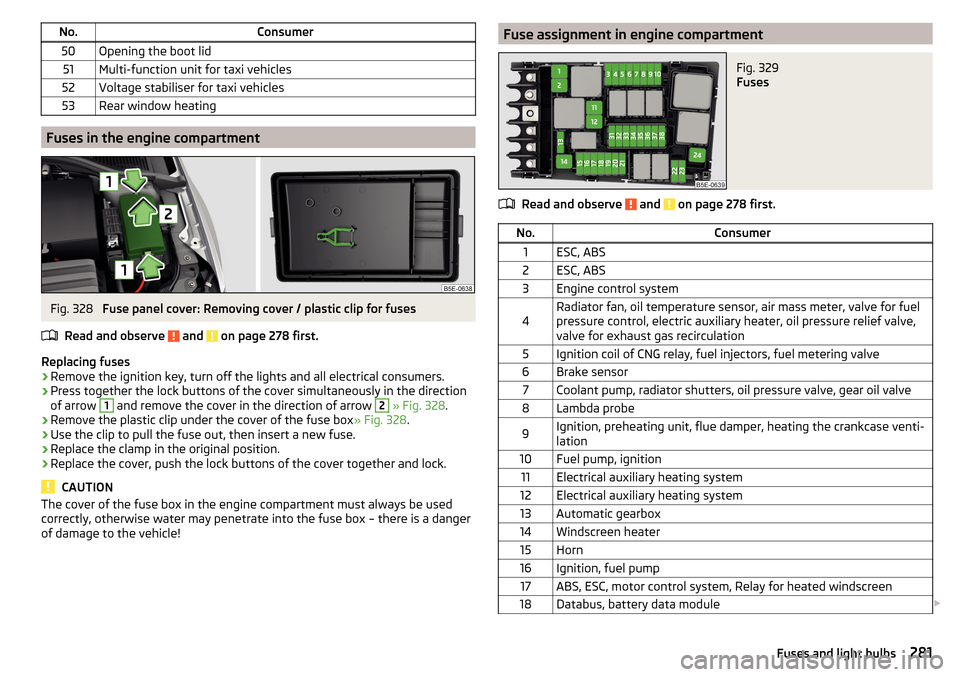
No.Consumer50Opening the boot lid51Multi-function unit for taxi vehicles52Voltage stabiliser for taxi vehicles53Rear window heating
Fuses in the engine compartment
Fig. 328
Fuse panel cover: Removing cover / plastic clip for fuses
Read and observe
and on page 278 first.
Replacing fuses
›
Remove the ignition key, turn off the lights and all electrical consumers.
›
Press together the lock buttons of the cover simultaneously in the direction
of arrow
1
and remove the cover in the direction of arrow
2
» Fig. 328 .
›
Remove the plastic clip under the cover of the fuse box » Fig. 328.
›
Use the clip to pull the fuse out, then insert a new fuse.
›
Replace the clamp in the original position.
›
Replace the cover, push the lock buttons of the cover together and lock.
CAUTION
The cover of the fuse box in the engine compartment must always be used
correctly, otherwise water may penetrate into the fuse box – there is a danger
of damage to the vehicle!Fuse assignment in engine compartmentFig. 329
Fuses
Read and observe and on page 278 first.
No.Consumer1ESC, ABS2ESC, ABS3Engine control system4Radiator fan, oil temperature sensor, air mass meter, valve for fuel
pressure control, electric auxiliary heater, oil pressure relief valve,
valve for exhaust gas recirculation5Ignition coil of CNG relay, fuel injectors, fuel metering valve6Brake sensor7Coolant pump, radiator shutters, oil pressure valve, gear oil valve8Lambda probe9Ignition, preheating unit, flue damper, heating the crankcase venti-
lation10Fuel pump, ignition11Electrical auxiliary heating system12Electrical auxiliary heating system13Automatic gearbox14Windscreen heater15Horn16Ignition, fuel pump17ABS, ESC, motor control system, Relay for heated windscreen18Databus, battery data module 281Fuses and light bulbs
Page 290 of 324
Technical data
Technical data
Basic vehicle data
Introduction
This chapter contains information on the following subjects:
Vehicle data
288
Operating weight
289
Payload
291
Measurement of fuel consumption and CO 2 emissions according to ECE
Regulations and EU Directives
291
Dimensions - Octavia
292
Dimensions - Octavia estate
293
Track gauge front/rear
294
Departure angle
295
The details given in the vehicle's technical documentation always take prece-
dence over the details in the Owner's Manual.
The performance values listed were determined without performance-reduc- ing equipment, e.g. air conditioning system.
The values given have been determined in accordance with regulations and in
conditions prescribed by legal or technical provisions for determining the oper-
ating and technical data of vehicles.
The values listed are for the basic model without optional equipment.
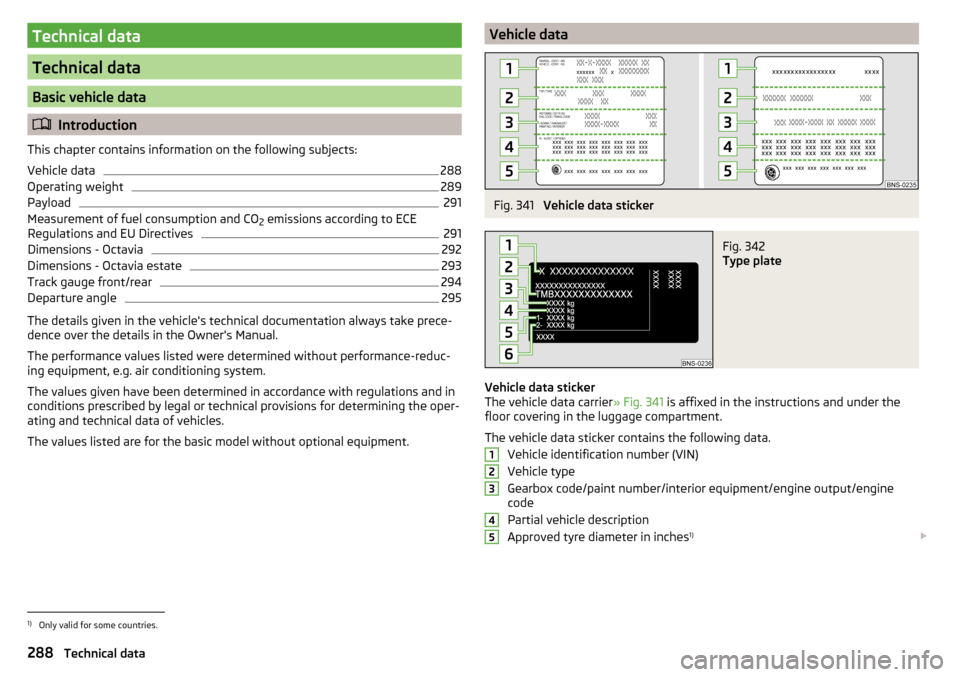
Vehicle dataFig. 341
Vehicle data sticker
Fig. 342
Type plate
Vehicle data sticker
The vehicle data carrier » Fig. 341 is affixed in the instructions and under the
floor covering in the luggage compartment.
The vehicle data sticker contains the following data. Vehicle identification number (VIN)
Vehicle type
Gearbox code/paint number/interior equipment/engine output/engine
code
Partial vehicle description
Approved tyre diameter in inches 1)
123451)
Only valid for some countries.
288Technical data
Page 298 of 324

Vehicle-specific details per engine type
Introduction
This chapter contains information on the following subjects:
1.0 l/85 kW TSI engine296
1.2 ltr. / 63 kW TSI engine
296
1.4 l/81 kW TSI G-TEC engine
297
1.4 ltr./110 kW TSI engine
297
1.6 l/81 kW MPI engine
297
1.8 l/132 kW TSI engine
2982.0 l/162 kW TSI engine2982.0 ltr./169 kW TSI engine298
1.6 ltr./66 kW TDI CR engine
299
1.6 ltr./81 kW TDI CR engine
299
2.0 l/105 kW TDI CR engine
299
2.0 ltr./110 kW TDI CR engine
300
2.0 ltr./135 kW TDI CR engine
300The specified values have been determined in accordance with rules and under conditions set out by legal or technical requirements for determining operational
and technical data for motor vehicles.The emissions standard is detailed in the technical vehicle documentation as well as in the certificate of conformity (COC document), which can be obtained from a ŠKODA partner a)
.a)
Only valid for some countries and some models.
1.0 l/85 kW TSI engine
Output (kW at 1/min)85/5000-5500Maximum torque (Nm at 1/min)200/2000-3500Number of cylinders/displacement (cm 3
)3/999BodyOctaviaOctavia EstateGearboxMGDSGMGDSGTop speeds (km/h)202202200200Acceleration 0-100 km/h (s)9.91010.110.2
1.2 ltr. / 63 kW TSI engine
Output (kW at 1/min)63/4300-5300Maximum torque (Nm at 1/min)160/1400-3500Number of cylinders/displacement (cm 3
)4/1197BodyOctaviaOctavia EstateGearboxMGMGTop speeds (km/h)181178Acceleration 0-100 km/h (s)1212.2296Technical data
Page 299 of 324

1.4 l/81 kW TSI G-TEC engineOutput (kW at 1/min)81/4800-6000Maximum torque (Nm at 1/min)200/1500-3500Number of cylinders/displacement (cm3
)4/1395BodyOctaviaOctavia EstateGearboxMGDSGMGDSGTop speeds (km/h)195195193193Acceleration 0-100 km/h (s)10.9111111.1
1.4 ltr./110 kW TSI engine
Output (kW at 1/min)110/5000-6000Maximum torque (Nm at 1/min)250/1500-3500Number of cylinders/displacement (cm 3
)4/1395BodyOctaviaOctavia EstateGearboxMGDSGMGDSGTop speeds (km/h)219219216216Acceleration 0-100 km/h (s)8.18.28.28.3
1.6 l/81 kW MPI engine
Output (kW at 1/min)81/5800Maximum torque (Nm at 1/min)155/3800-4000Number of cylinders/displacement (cm 3
)4/1598BodyOctaviaOctavia EstateGearboxMGAGMGAGTop speeds (km/h)192190191188Acceleration 0-100 km/h (s)10.61210.812.2297Technical data