coolant level SKODA OCTAVIA TOUR 2009 1.G / (1U) Owner's Manual
[x] Cancel search | Manufacturer: SKODA, Model Year: 2009, Model line: OCTAVIA TOUR, Model: SKODA OCTAVIA TOUR 2009 1.G / (1U)Pages: 224, PDF Size: 13.53 MB
Page 18 of 224
Instruments and Indicator/Warning Lights
17
Using the system
Safety
Driving Tips
General Maintenance
Breakdown assistance
Technical Data
In order to avoid any damage to the engine
, please pay attention to the following
notes regarding the temperature ranges: Cold range If the pointer is in the left-hand area of the scale it means that the engine has not yet reached its operating temperature. Avoid
running at high engine speeds, at full
throttle and at severe engine loads. The operating range The engine has reached its operating temp
erature as soon as the pointer moves
into the mid-range of the scale. The pointe
r may also move further to the right at
high engine loads and high outside temperat
ures. This is not critical provided the
warning symbol
in the instrument cluster does not flash.
If the symbol
in the instrument cluster flashes it means that either the coolant
temperature
is too high or the coolant
level
is too low. Observe the guidelines
⇒ page 30, “Coolant temperature/ Coolant quantity
”.
WARNING
Pay attention to the warning notes
⇒page 160, “Working in the engine
compartment” before opening the bonnet and inspecting the coolant level.
Caution
Additional headlights and other attached co
mponents in front of the fresh air inlet
impair the cooling efficiency of the coolant. There is then a risk of the engine over- heating at high outside temperatures and high engine loads!Fuel gaugeThe fuel gauge
⇒page 16, fig. 18
only operates when the ignition is switched
on. The fuel tank has a capacity of about 55 litres. The warning symbol
in the instru-
ment cluster lights up when the pointer reaches the reserve marking. There are now
about 7 litres of fuel remaining in the tank. This symbol is a reminder for you,
that
you must refuel
.
The following will be displayed in the information display*:
PLEASE REFUEL
A peep sounds as an additional warning signal.
Caution
Never run the fuel tank completely empty! An irregular fuel supply can result in poor ignition or misfiring. Unburnt fuel may get into the exhaust system and damage the catalytic converter.SpeedometerWarning against excessive speeds* An acoustic warning signal will sound when the vehicle speed exceeds 120 kilome- tres per hour. The acoustic warning signal
will switch off again when the vehicle
speed goes below this speed limit.
Note
This function is only
valid for some countries.
A3
s2g8.b.book Page 17 Tuesday, April 7, 2009 8:53 AM
Page 26 of 224
Instruments and Indicator/Warning Lights
25
Using the system
Safety
Driving Tips
General Maintenance
Breakdown assistance
Technical Data
Auto Check ControlCar stateThe Auto Check Control carries out a check of certain functions and vehicle compo- nents. The check is performed constantly
when the ignition is switched on, both
when the vehicle is stationary, as well as when driving. Operational faults, urgent repairs, service
work or other information appear in the
display of the instrument cluster. The disp
lays are shown with a red or yellow light
symbol depending on the priority of the message. The red symbols indicate
danger
(priority 1) while the yellow symbols indicate a
warning
(priortity 2). Information for the driver
may also appear in addition to the
symbols
⇒page 27.
Investigate the displayed faults as soon as
possible. If several operational faults exist
at the same time, the symbols will appear
one after the other and are each visible
for about 2 seconds. The error messages are faded out after 10 seconds or by actuating the rocker switch ⇒page 24, fig. 26
and are stored under the information
CAR STATUS
.
There is at least one error message to be read when the term
CAR STATUS
is
flashing in the menu. The display will show
STATUS 1/2
(for example) if a number
of error messages are present. This display
indicates that the first of a total of two
error messages should be displayed. Actuate the rocker switch , to call up the individual error messages.If a fault occurs, a warning signal will also sound in addition to the symbol and text in the display:•
Priority 1 - three warning signals
•
Priority 2 - one warning signal
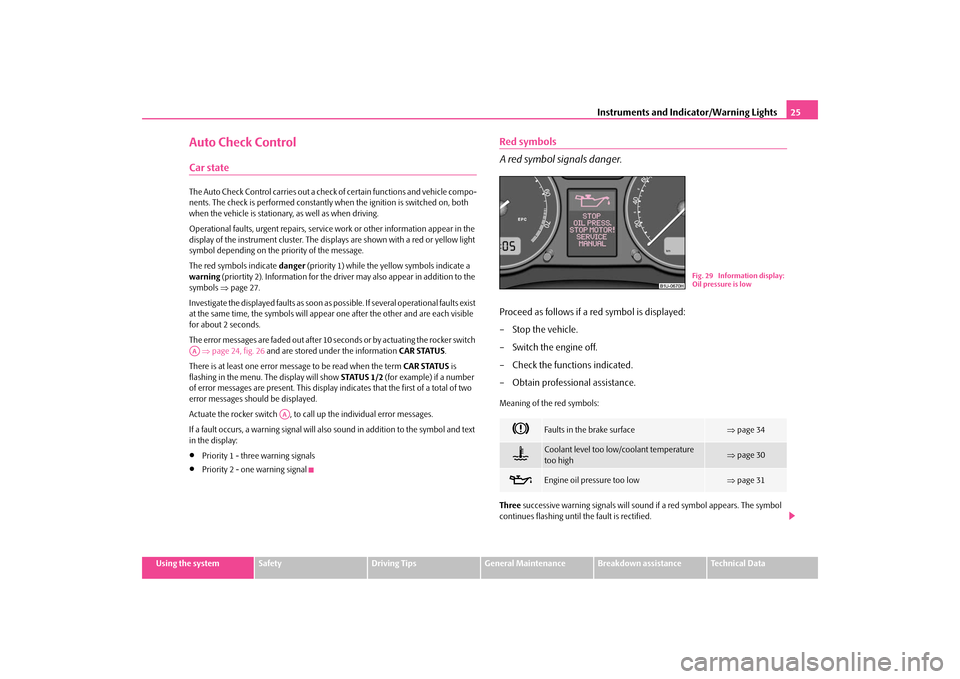
Red symbols A red symbol signals danger.Proceed as follows if a red symbol is displayed: – Stop the vehicle.– Switch the engine off. – Check the functions indicated. – Obtain professional assistance.Meaning of the red symbols: Three
successive warning signals will sound if a red symbol appears. The symbol
continues flashing until
the fault is rectified.
AA
AA
Faults in the brake surface
⇒page 34
Coolant level too low/coolant temperature too high
⇒ page 30
Engine oil pressure too low
⇒page 31
Fig. 29 Information display: Oil pressure is low
s2g8.b.book Page 25 Tuesday, April 7, 2009 8:53 AM
Page 29 of 224
Instruments and Indicator/Warning Lights
28
WARNING
•
If you do not pay attention to the wa
rning lights coming on and the corre-
sponding descriptions and warning notes, this may result in severe body injuries or major vehicle damage.•
The engine compartment of your car is
a hazardous area. There is a risk
of injuries, scalding, accidents and
fire when working in the engine
compartment, e.g. inspecting and replenis
hing oil and other fluids. It is also
essential to obse
rve all warnings
⇒page 160.
Note
•
Arrangement of the indicator lights depends on the model and model version.
The symbols shown in the following function
al description are to be found as indi-
cator lights in the instrument cluster.•
Operational faults are shown in the inst
rument cluster as red symbols (priority
1 - danger) or yellow symbols (priority 2 - warning).Turn signal system
Either the left
or right
indicator light flashes depending on the position of the
turn signal lever. The indicator light flashes at twice its normal rate if a turn signal light fails. This does not apply when towing a trailer. Switching off the hazard warning light system is switched on will cause all of the turn signal lights as well as both indicator lights to flash. Further information about the turn signal system
⇒page 52.
Turn signal system for vehicles towing a trailer
*
The warning light
flashes together with the other turn signal lights only if the
vehicle is towing a trailer. The indicator light does not flash if a turn si
gnal light on the trailer or on the vehicle
is not operating.
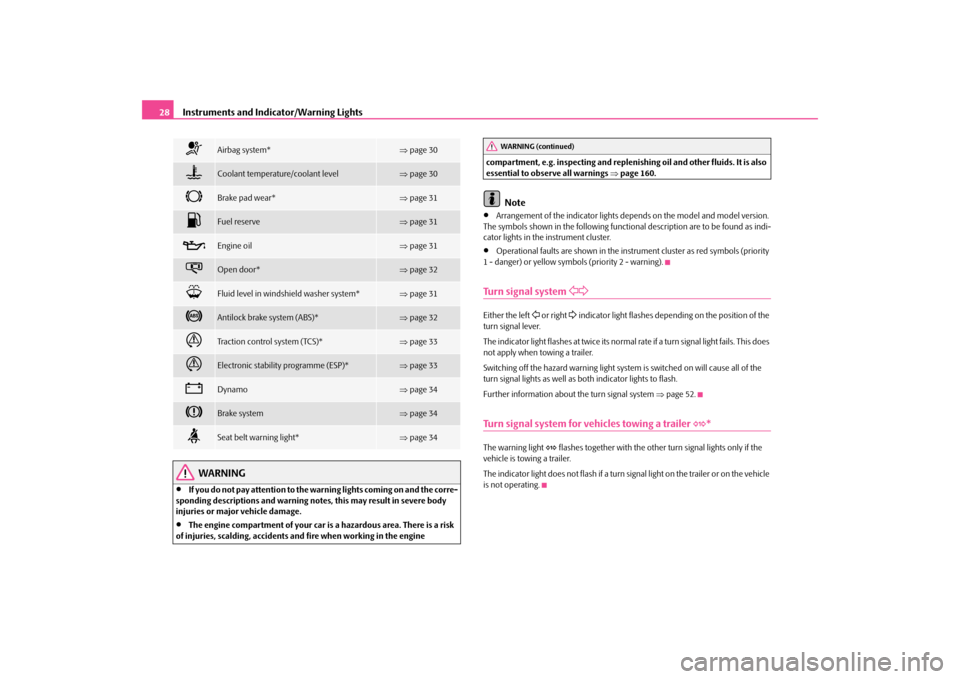
Airbag system*
⇒ page 30
Coolant temperature/coolant level
⇒page 30
Brake pad wear*
⇒page 31
Fuel reserve
⇒page 31
Engine oil
⇒page 31
Open door*
⇒page 32
Fluid level in windshield washer system*
⇒page 31
Antilock brake system (ABS)*
⇒page 32
Traction control system (TCS)*
⇒page 33
Electronic stability programme (ESP)*
⇒page 33
Dynamo
⇒page 34
Brake system
⇒page 34
Seat belt warning light*
⇒page 34
WARNING (continued)
s2g8.b.book Page 28 Tuesday, April 7, 2009 8:53 AM
Page 31 of 224
Instruments and Indicator/Warning Lights
30
Glow plug system
(diesel engine)
The warning light lights up for a
cold
engine when switching on the ignition (pre-
heat position)
2 ⇒page 94. Start the engine just as soon as the indicator light goes
out. The glow plug indicator light will come on for about 1 second if the engine is at a normal operating temperature
or if the outside temperature is above +5°C. This
means that you can start the engine
right away
.
There is a fault in the glow plug system if the
warning light
does not come on
at all
or lights up continuously
. Contact a specialist garage
as soon as possible to
obtain assistance. If the
warning light
begins
to flash
while driving, a fault exists in the engine
control. The engine management system
selects an emergency programme which
enables you to drive to the nearest specialist garage by adopting a gentle style of driving. The following text will be displayed in the information display*:
ENGINE WORKSHOP!
Airbag system
Monitoring the airbag system The warning light
comes on for a few seconds when the ignition is switched on.
There is a fault in the system if the warn
ing light does not go out or comes on or
flashes while driving
⇒
. This also applies if the warning light does not come on
when the ignition is switched on. The following text will be displayed in the information display*:
AIRBAG FAULT
The functionality of the airbag system is also monitored electronically when one airbag has been switched off. Front airbag or side pass
enger airbag deactivated us
ing the diagnostic equip-
ment:
•
The warning light
lights up for 3 seconds after switching on the ignition and
then flashes again for 12 seconds. Front passenger airbags switched off
using the switch for front passenger
airbags* in storage compartment on the front passenger side:•
The warning light
comes on for 3 seconds after the ignition has been
switched on.•
The deactivation of the airb
ag is indicated by the ligh
ting up of the indicator
light
in the interior lighting
⇒page 121.
WARNING
Have the airbag system ch
ecked immediately by a specialist garage if a fault
exists. Otherwise, there is a risk of th
e airbag not being activated in the event
of an accident.
Note
Further information about switching off airbags
⇒page 120.
Coolant temperature/ Coolant quantity
The warning light
comes on for a few seconds
2) w h e n t h e i g n i t i o n i s s w i tc h e d o n .
The coolant temperature is too high or the coolant level too low if the warning light does not go out or flashes while driving.3 peeps sound as an additional warning signal.In this case stop and switch the engine off
and check the coolant level; top up the
coolant as necessary. Do not continue your journey
if for some reason it
is not possible under the
conditions prevailing to
top up with coolant.
Keep the engine switched off
and
2)The warning light
on vehicles fitted with information display does not come on after
switching the ignition on, but only if the coola
nt temperature is too high or the coolant level
is too low.
s2g8.b.book Page 30 Tuesday, April 7, 2009 8:53 AM
Page 32 of 224
Instruments and Indicator/Warning Lights
31
Using the system
Safety
Driving Tips
General Maintenance
Breakdown assistance
Technical Data
obtain professional assistance from a specialist garage, otherwise it could lead to severe engine damage. If the coolant is within the specified
range, the increased temperature may be
caused by an operating problem at the coolant fan. Check the fuse for the coolant fan, replace it if necessary
⇒page 193, “Fuse assignment in engine compartment -
version 1” or
⇒page 194, “Fuse assignment in en
gine compartment - version 2”.
Do not continue driving
if the warning light does not go
off although the fluid is at
the correct level and also the fuse of the fa
n is in proper order. Contact a specialist
garage to obtain assistance. Please also refer to the additional instructions
⇒page 165, “Cooling system”.
The following text will be displayed in the information display*:
STOP CHECK COOLANT SERVICE MANUAL
WARNING
•
If you must stop for technical reasons, then park the vehicle at a safe
distance from the traffic
and switch off the engine and switch on the hazard
warning light system
⇒page 52.
•
Take care when opening the coolant expa
nsion bottle. If the engine is hot,
the cooling system is pressurized - risk of scalding! It is best to allow the engine to cool down before removing the cap.•
Do not touch the coolant fan The coolant fan may switch on automati-
cally even if the ignition is off.Thickness of the brake pads*
The warning light
comes on for a few seconds when the ignition is switched on.
If the warning light
comes on, contact a specialist garage immediately and have
the brake pads on
all of the wheels
inspected.
A peep sounds as an addi
tional warning signal.
The following text will be displayed in the information display*:
CHECK BRAKE PADS
Windshield washer fluid level*
The warning light
comes on when the ignition is
switched on if there is insuffi-
cient fluid in the windshield washer system. Top up with liquid
⇒page 172.
A peep sounds as an additional warning signal.The following text will be displayed in the information display*:
TOP UP WASH FLUID
Fuel reserve
The warning light
comes on, if the fuel level is still below 7 litres.
A peep sounds as an additional warning signal.The following text will be displayed in the information display*:
PLEASE REFUELNote
The Text in the information display* goes out only after refuelling and driving a short distance.Engine oil
The warning light
lights up red (low oil pressure)
The warning light comes on for a few seconds when the ignition is switched on
3).
Stop the vehicle and sw
itch the engine off
if the warning light does not go off
within a few seconds after switching on the ignition or flashes while driving. Check the oil level and top up with oil as necessary
⇒page 163.
3 peeps sound as an additional warning signal.3)The warning light
on vehicles fitted with information display does not come on after
switching the ignition on, but only if a fault exists or the engine oil level is too low.
s2g8.b.book Page 31 Tuesday, April 7, 2009 8:53 AM
Page 93 of 224
Heating and air conditioning system
92
Note
If the windscreen mists up, press the button
⇒page 90, fig. 102
. After the
windscreen has been demisted, press the button .Setting temperatureYou can set the interior temperature randomly with the buttons and
.
You can set the interior temperature between +18°C (64°F) and +29°C (84 °F). The interior temperature is regulated automatica
lly within this range. If you select the
temperature below +18°C (64 °F), “LO” appe
ars in the display. If you select the
temperature higher than +29°C (84 °F), “H
I” appears in the display. In both limit
positions the Climatronic operates at
maximum cooling or heating capacity,
respectively. The temperature is not controlled in this case. Lengthy and uneven distribution of the air flow out of the vents (in particular at the leg area) and large differences in temperature, for example when getting out of the vehicle, can result in chills in sensitive persons.Controlling blower There are a total of six blower stages available.The Climatronic system controls the bl
ower stages automatically in line
with the interior temperature. You
can also, however, adapt the blower
stages manually to suit
your particular needs.
– Press the button or
⇒
page 90, fig. 102
in order to decrease or
increase the speed.
If you switch off the blowers, th
e Climatronic is switched off and
OFF
is shown in
the display. The set blower speed is indicated by the lighting up of the respective number of bars at the point .
WARNING
•
“Stale air” may result in fatigue in
the driver and occupants, reduce
attention levels and also cause the windows to mist up. The risk of having an accident increases.•
Do not switch the Climatronic syst
em off for longer than necessary.
•
Switch the Climatronic system on as soon as the windows mist up.
Operational problemsIf all the symbols on the display of the au
tomatic air conditioning system flash for
approx. 15 seconds after switching on the ignition, then there is a fault in the system - visit a specialist garage. If the cooling system does not oper
ate, the following faults may exist:
•
the outside temperature is lower than +5°C,
•
The compressor of the automatic air
conditioning system was temporarily
switched off due to a too high temperature of the coolant,•
a blown fuse.
Check the fuse, replace it if necessary
⇒page 192. If a blown fuse is not the source
of the fault, switch the Climatronic off and have it checked. If the cooling capacity decreases, switch
the Climatronic off and have it checked.
A1AUTO
A15
A16
A11
A12
A2
s2g8.b.book Page 92 Tuesday, April 7, 2009 8:53 AM
Page 146 of 224
Towing a trailer
145
Using the system
Safety
Driving Tips
General Maintenance
Breakdown assistance
Technical Data
should be attached to folding arms. Adjust
the mirrors so that they provide you with
an adequate field of view to the rear. Headlights Before starting off with a hitched trailer, also check the setting of the headlights. Alter the setting as necessary with th
e aid of the headlight beam adjuster
⇒ page 51. Detachable ball head The ball rod is detachable on vehicles which feature a factory-fitted towing device. It is stowed together with separate fitting instructions in the spare wheel well in the luggage compartment of the vehicle. Further information on the towing device
⇒page 146.
Note
•
We recommend that you also have yo
ur vehicle inspected between service
intervals if you tow a trailer frequently.•
The handbrake on the towing vehicle
must be put on when coupling and
decoupling the trailer.Driving Tips Particular caution is required when towing a trailer.– Do not, as far as possible, drive
with your vehicle unladen and the
trailer laden.
– Do not make full use of the legal maximum speeds. This applies in
particular to downhill sections.
– Apply the brakes in good time.– Keep a check on the coolant temper
ature gauge if the outside temper-
ature is high.
Distribution of weight The distribution of the weight is very poor
if your vehicle is
unladen and the trailer
is laden. Maintain a particularly low speed if you cannot avoid driving with this combination. Driving speed Do not drive faster than 80 km/hour for safety reasons. This also applies for coun- tries in which higher speeds are allowed. The fact that the driving stability of the vehicle + trailer combination reduces with increasing speed means that the legally allowed speed should not be used when there are unfavourable road, weather or wind
conditions, particul
arly near accident
black spots. You must always reduce your speed immedi
ately as soon as you detect even just
the
slightest swaying
of the trailer. On no account attempt to stop the trailer from
“swaying” by
accelerating.
Apply the brakes in good time! If the trailer is fitted with a
trailer brake
, apply the
brakes gently at first and then brake firmly
. This will avoid brake jolts resulting from
the trailer wheels locking. Shift down gears
in good time before negotiating a down-
hill section to allow the engine to also act as a brake. Engine overheating Please keep a check on the coolant temperature gauge if you have to negotiate a lengthy slope in a low gear at a high engine speed when the outside temperature is very high
⇒page 16.
If the needle of the coolant temperature gauge moves into the right-hand area or even the red area of the scale, reduce yo
ur speed immediately. Stop and switch off
the engine if the warning light
in the instrument cluste
r begins flashing. Wait a
few minutes and check the level of coolant in the coolant expansion bottle ⇒ page 165, “Inspecting the coolant level”. Please refer to the following guidelines
⇒page 30, “Coolant temperature/ Coolant
quantity
”.
The coolant temperature can be reduced by switching on the heating.Any increase in the cooling effect of the coolant fan through shifting down a gear and increasing the engine speed is not possible since the fan speed is independent
s2g8.b.book Page 145 Tuesday, April 7, 2009 8:53 AM
Page 166 of 224
Inspecting and replenishing
165
Using the system
Safety
Driving Tips
General Maintenance
Breakdown assistance
Technical Data
Check hydraulic oil The hydraulic system of the power steering is filled with the hydraulic oil designated in the catalogue as G 002 000. Perform the inspection of the hydraulic oil level when the engine is cold and not running. The hydraulic oil level must be between the “MIN” and “MAX” markings ⇒ page 164, fig. 153
. If the level drops below the mark
ing “MIN”, it is necessary that
the power steering is checked by a specialist
garage. It is not sufficient to solely refill
with hydraulic oil.
Note
If the engine is not running (when towing) or
if the V-ribbed belt is torn, the power
steering does not operate. The vehicle is fully steerable however. There is however increased force required to turn the steering wheel.Cooling systemCoolant The job of the coolant is to cool the engine.The cooling system does not require an
y maintenance under normal operating
conditions. The coolant consists of water
with a concentration of coolant additive
of 40 %. This mixture not only provides
antifreeze protection down to -25°C but
also protects the cooling and heating system from corrosion. It also prevents the formation of scale and significantly increases the boiling point of the coolant. You must therefore not reduce the concentr
ation of antifreeze agent in the coolant
by adding water, also not during the summ
er months or in countries with a warm
climate.
The concentration of coolant additive in the coolant must be at least
40%. You can increase the amount of antifreeze
in the coolant if a higher concentration
of antifreeze is necessary for climatic
reasons but only up to 60% (antifreeze
protection down to approx. -40°C). The an
tifreeze protection tails off above that
concentration.
Vehicles exported to countries with a co
ld climate (e.g. Sweden, Norway, Finland)
are already factory-filled with a coolant which offers antifreeze protection down to about -35°C. In these countries the concentr
ation of coolant additive should be at
least 50 %. Coolant The cooling system is factory-filled with
coolant (purple in colour), which complies
with the specification TL-VW 774 G. We recommend that you use the same c
oolant additive - G12 PLUS-PLUS (purple
in colour) for topping up the system. Please contact a specialist garage if you have any questions regarding the coolant or if you wish to fill up with a different coolant. A specialist garage can also supply
you with the correct coolant additives.
Caution
•
Other coolant additives may cause operational problems which, in partic-
ular, involves significantly reducing the anticorrosion effect.•
Any faults or problems resulting from corrosion may cause a loss of
coolant and, as a consequence of th
is, result in major engine damage.
Inspecting the coolant level
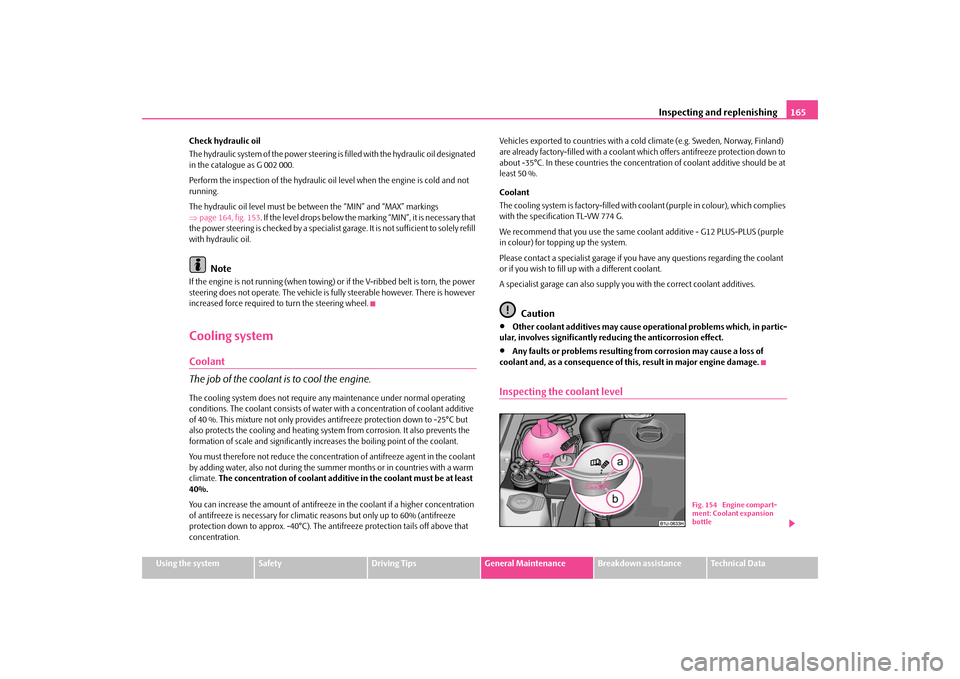
Fig. 154 Engine compart- ment: Coolant expansion bottle
s2g8.b.book Page 165 Tuesday, April 7, 2009 8:53 AM
Page 167 of 224
Inspecting and replenishing
166
The coolant expansion bottle is loca
ted in the engine compartment on
the right. – Switch the engine off. – Open the bonnet
⇒
in “Working in the engine compartment” on
page 160.
– Check the level of coolant in the coolant expansion bottle
⇒
page 165, fig. 154
. When the engine is cold, the coolant level must
lie between the and markings. When the engine is warm, the level may also lie slightly above the hatched part.
If the coolant level in the reservoir is too low, this is indicated by the warning light in the instrument cluster
⇒page 30. We nevertheless recommend inspecting
the coolant level directly at th
e reservoir from time to time.
Loss of coolant A loss of coolant is first and foremost an
indication of a leak
in the system. You
should not merely top up the coolant in the reservoir. It is also important to have the cooling system inspected without delay by a specialist garage. Losses can only occur through the pressure
relief in the cap of the coolant expan-
sion bottle which is completely free of leak
s if the coolant boils as a result of over-
heating and is forced out of the cooling system.
WARNING
Read and observe the warning notes
⇒page 160, “Working in the engine
compartment” before working in the engine compartment.
Caution
One should contact a specialist garage as soon as possible if the source of over-heating itself cannot be
determined and removed, since there may be grave
damage to the engine.
Replenishing the coolant– Switch the engine off. – Allow the engine to cool down. – Place a cloth over the cap of the coolant expansion reservoir
⇒
page 165, fig. 154
and unscrew the cap
carefully
by turning it to the
left
⇒
.
– Top up the coolant. – Screw the cap tight until it is heard to lock.The coolant which you use for replenishing the system, must comply with one specific specification
⇒page 165, “Coolant”. Do not use an alternative additive if
the coolant additive G12 PLUS - PLUS is not av
ailable in exceptional cases. Just top
up the system with water and as soon as possible arrange adjustment to correct the mixing ratio of water and coolant additive again by a specialist garage. Only use fresh coolant for topping up the system.Do not top up the fluid above the hatched
part! Excess coolant which is heated up
is forced out of the cooling system through the pressure relief valve in the cap of the coolant compensation bottle. Wait until the engine has cooled down for a system which has suffered a major loss of coolant before pouring in coolant. This is necessary to avoid engine damage.
WARNING
•
The cooling system is pressurized! Do not open the cap of the coolant
expansion bottle if the engine is
still hot - risk of scalding!
•
The coolant additive and thus all of the coolant is harmful to your health.
Avoid contact with the coolant. Coolant vapours are also harmful to the health. It is important, therefore, to always safely store any coolant additive in its original container out of the reach of children - risk of poisoning!•
If any splashes of coolant get into yo
ur eyes, rinse out
your eyes immedi-
ately with clear water and contact a doctor as soon as possible.
Aa
Ab
s2g8.b.book Page 166 Tuesday, April 7, 2009 8:53 AM
Page 168 of 224
Inspecting and replenishing
167
Using the system
Safety
Driving Tips
General Maintenance
Breakdown assistance
Technical Data
•
You should also consult a doctor without delay if you have inadvertently
swallowed coolant.
Caution
Do not continue your journey if for some reason it is not possible under the conditions prevailing to top up with coolant. Switch the engine off
and obtain
professional assistance from a specialist garage, otherwise it could lead to severe engine damage.
For the sake of the environment
Do not re-use coolant if it is necessary to
drain the coolant in the system. It should
be collected and disposed of in comp
liance with environmental protection
regulations.Radiator fan The radiator fan may switch on suddenly.The radiator fan is driven by an electr
ic motor and controlled according to the
coolant temperature. The radiator fan may continue running fo
r up to 10 minutes after the engine has
been switched off - even if
the ignition is also off. It
may also switch on suddenly
after a certain time, if•
the coolant temperature has risen beca
use of an accumulation of heat or
•
the warm engine compartment is heated
up additionally by
strong sunlight.
WARNING
You must therefore be aware when work
ing in the engine compartment that
the fan may switch on suddenly - risk of injury!
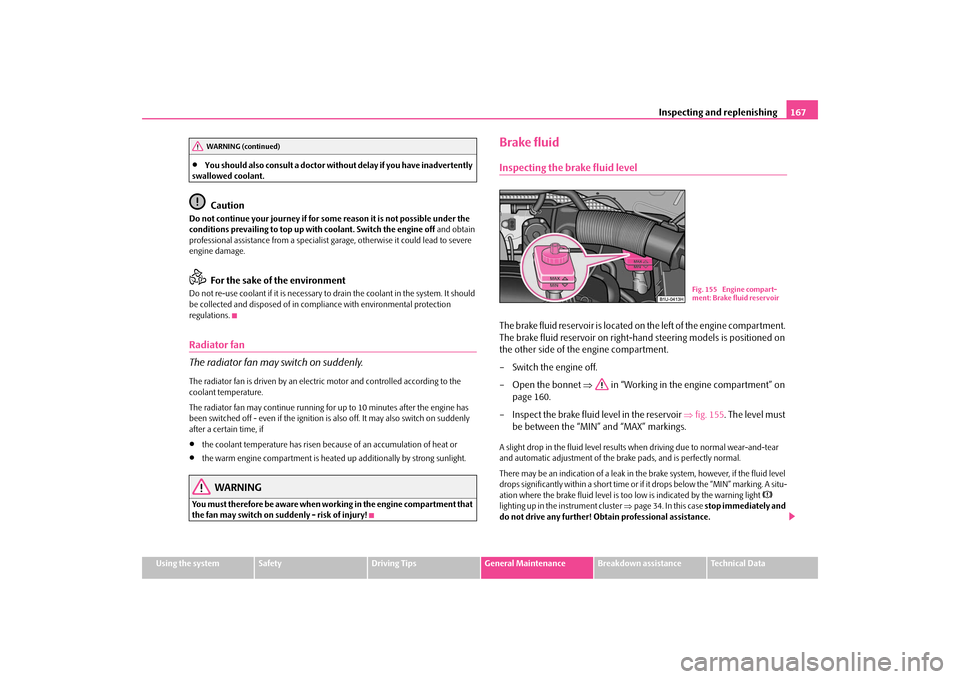
Brake fluidInspecting the brake fluid levelThe brake fluid reservoir is located on the left of the engine compartment. The brake fluid reservoir on right-hand steering models is positioned on the other side of the engine compartment. – Switch the engine off.– Open the bonnet
⇒
in “Working in the engine compartment” on
page 160.
– Inspect the brake fluid level in the reservoir
⇒
fig. 155
. The level must
be between the “MIN” and “MAX” markings.
A slight drop in the fluid level results when driving due to normal wear-and-tear and automatic adjustment of the br
ake pads, and is perfectly normal.
There may be an indication of a leak in the brake system, however, if the fluid level drops significantly within a short time or if it drops below the “MIN” marking. A situ- ation where the brake fluid level is too low is indicated by the warning light
lighting up in the instrument cluster
⇒page 34. In this case
stop immediately and
do not drive any further! Obtain professional assistance.
WARNING (continued)
Fig. 155 Engine compart- ment: Brake fluid reservoir
s2g8.b.book Page 167 Tuesday, April 7, 2009 8:53 AM