bonnet SKODA RAPID 2012 1.G User Guide
[x] Cancel search | Manufacturer: SKODA, Model Year: 2012, Model line: RAPID, Model: SKODA RAPID 2012 1.GPages: 180, PDF Size: 4.36 MB
Page 129 of 180
WARNING (Continued)
■ If you notice that the lock is not properly engaged while driving, stop the ve-
hicle immediately and close the bonnet – risk of an accident!
■ Keep children clear of the engine compartment.
■ Do not touch any hot engine parts – risk of burns!
■ Never spill fluids on the hot engine. Such fluids (e.g. the antifreeze con-
tained in the coolant) may ignite!
■ Avoid short circuits in the electrical system – particularly on the vehicle's
battery.
■ Never touch the radiator fan while the engine is still warm. The fan might
suddenly start running! ■ Never open the end cover of the coolant expansion reservoir while the en-
gine is still warm. The cooling system is pressurized!
■ When opening the end cover of the coolant expansion reservoir, cover it
with a cloth to protect your face, hands and arms from hot steam or hot cool-
ant.
■ Do not leave any items such as cloths or tools in the engine compartment.
■ If you wish to work under the vehicle, you must secure the vehicle from roll-
ing away and support it with suitable supporting blocks: the car jack is not
sufficient for this – risk of injury!
■ If any inspection work has to be carried out when the engine is running,
there is an additional risk from rotating parts (e.g. V-belt, alternator, radiator
fan) and the high-voltage ignition system. The following must also be ob-
served. ■ Never touch the electric wiring on the ignition system.
■ Always make sure that no jewellery, loose clothing or long hair can get
caught in rotating engine parts – hazard! Always remove any jewellery, tie
back long hair and wear tight fitting clothing before completing any work.
■ Additionally, the following warning instructions must be observed if work
has to be carried out on the fuel or electrical system. ■Always disconnect the vehicle battery from the electrical system.
■ Do not smoke.
■ Never work near open flames.
■ Always have a functioning fire extinguisher nearby. CAUTION
■ Always top up using the correct specification of fluids. This may result in major
operating problems and also vehicle damage!
■ Never open the bonnet using the locking lever – danger of causing damage. For the sake of the environment
In view of the environmentally friendly disposal of fluids, the specials tools and
knowledge required for such work, we recommend that fluids are changed by a
Škoda
Service Partner as part of the inspection service. Note
■ If you have any questions regarding the fluids, visit a
ŠKODA Service Partner.
■ Fluids with the correct specifications can be purchased from ŠKODA Original Ac-
cessories. Ð
127
Inspecting and replenishing
Page 130 of 180

Opening and closing the bonnet
Fig. 96
Bonnet/radiator grille release lever: Release lever Fig. 97
Securing the bonnet
First read and observe the introductory information and safety warn-
ings on page 126.
Opening
›
Open the front left door.
› Pull the release lever under the dash panel 1
» Fig. 96
in the direction of the
arrow.
Before opening the bonnet, ensure that the arms of the windscreen wipers are
correctly in place against the windscreen otherwise the paintwork could be dam-
aged.
› Press the release lever in the direction of the arrow 2
» Fig. 96
and the bonnet
is unlocked.
› Grab hold of the bonnet and lift.
ä ›
Take the bonnet support out of its holder 3
in the direction of the ar-
row » Fig. 97 and secure the opened bonnet by inserting the end of the support
in the opening 4
in the bonnet.
Closing
› Lift the bonnet slightly and unhook the bonnet support. Press the bonnet sup-
port into the holder 3
designed to hold it.
› Let the bonnet drop into the lock carrier lock from a height of around 20 cm –
do not push it in .
› Check that the bonnet is closed properly. Ð Engine compartment overview
Fig. 98
1.2 ltr./63 kW TSI petrol engine
First read and observe the introductory information and safety warn-
ings on page 126.
Coolant expansion reservoir 130
Windscreen washer fluid reservoir 132
Engine oil filler opening 129
Engine oil dipstick 129
Brake fluid reservoir 132
Vehicle battery 133
£
ä 1
2
3
4
5
6
128
General Maintenance
Page 131 of 180

Note
The location of the inspection points in the engine compartment of petrol and
diesel engines is practically identical. ÐChecking the engine oil level
Fig. 99
Dipstick
First read and observe the introductory information and safety warn-
ings on page 126.
The dipstick indicates the level of oil in the engine
» Fig. 99.
Checking the oil level
› Ensure that the vehicle is positioned on a level surface and the engine has
reached its operating temperature.
› Switch off the engine.
› Open the bonnet.
› Wait a few minutes until the engine oil flows back into the oil sump and remove
the dipstick.
› Wipe the dipstick with a clean cloth and insert it again to the stop.
› Then pull the dipstick out again and check the oil level.
Oil level within range A
›
No oil must be refilled.
Oil level within range B
›
Oil can
be refilled. It is possible that the oil level may then be within range A
after doing this.
Oil level within range C
›
Oil must be refilled. It is sufficient, once this is done, to keep the oil level within
range B
.
ä
It is normal for the engine to consume oil. The oil consumption may be as much as
0.5 l/1 000
km depending on your style of driving and the conditions under which
you operate your vehicle. Consumption may be slightly higher than this during the
first 5 000 kilometres.
One should therefore check the oil level at regular intervals, preferably every time
after the fuel tank is filled or after driving for long stretches.
We recommend maintaining the oil level within the range A
, but not above
, if
the engine has been operating at high loads, for example, during a lengthy motor-
way trip during the summer months, towing a trailer or negotiating a high moun-
tain pass.
The warning light in the instrument cluster will indicate whether the oil level is
too low » page 18 , Engine oil . In this case, check the oil level with the dip-
stick, as soon as possible. Add oil accordingly. CAUTION
■ The oil level must on no account extend beyond the range A
» Fig. 99
. Risk of
damaging the exhaust system!
■ If it is not possible to top up the engine oil under the prevailing conditions, do
not continue your journey! Switch off the engine and obtain professional assis-
tance from a ŠKODA specialist garage, otherwise it could cause severe engine
damage. Note
Engine oil specifications » page 166 , Specifications and engine oil capacity .Ð Replenishing the engine oil
First read and observe the introductory information and safety warn-
ings on page 126.
›
Check the engine oil level
» page 129.
› Unscrew the cap of the engine oil filler opening.
› Replenish the oil in portions of 0.5 litres in accordance with the correct specifi-
cations » page 166 , Specifications and engine oil capacity .
› Check the oil level
» page 129.
› Carefully screw on the oil filler opening cap and push the dipstick in fully. Ð
ä
129
Inspecting and replenishing
Page 132 of 180
Changing engine oil
First read and observe the introductory information and safety warn-
ings on page 126.
The engine oil must be changed at the intervals stated in the Service schedule or
according to the service interval indicator
» page 10, Service Interval Display.CAUTION
Additives must not be added to the engine oil – risk of causing considerable dam-
age to parts of the engine! Damage, which results from such product, are exclu-
ded from the warranty. Note
If your skin has come into contact with oil, it must be washed thoroughly. ÐCoolant
First read and observe the introductory information and safety warn-
ings on page 126.
The cooling system is filled with a coolant in the factory.
The coolant consists of water with a concentration of coolant additive of 40 %.
This mixture provides antifreeze protection down to -25
°C and also protects the
cooling and heating system from corrosion. It also prevents the formation of scale
and significantly increases the boiling point of the coolant.
The concentration of coolant must therefore not be reduced by adding water dur-
ing the summer months or in countries with a warm climate. The concentration of
coolant additive in the coolant must be at least 40 %.
If a higher concentration of antifreeze is required for climatic reasons, the amount
of coolant additive can only be increased up to 60 % (antifreeze protection down
to approx. -40 °C). The antifreeze protection tails off above that concentration.
Vehicles exported to countries with a cold climate are already factory-filled with a
coolant which offers antifreeze protection down to about -35 °C. In these coun-
tries the concentration of coolant additive should be at least 50 %.
When refilling, we only recommend you use the same antifreeze written on the
antifreeze expansion tank » Fig. 100 on page 130.
ä
ä Coolant capacity
Petrol engines Capacities (in litres)
1.2 ltr./55 kW MPI 4.2
1.2 ltr./63 kW TSI 7.0
1.2 ltr./77 kW TSI 7.0
1.4 ltr./90 kW TSI 7.0 Diesel engine
Capacities (in litres)
1.6 ltr./77 kW TDI CR 6.5 CAUTION
■ Other coolant additives that do not comply with the correct specifications can
above all significantly reduce the anticorrosion effect.
■ Any faults resulting from corrosion may cause a loss of coolant and can conse-
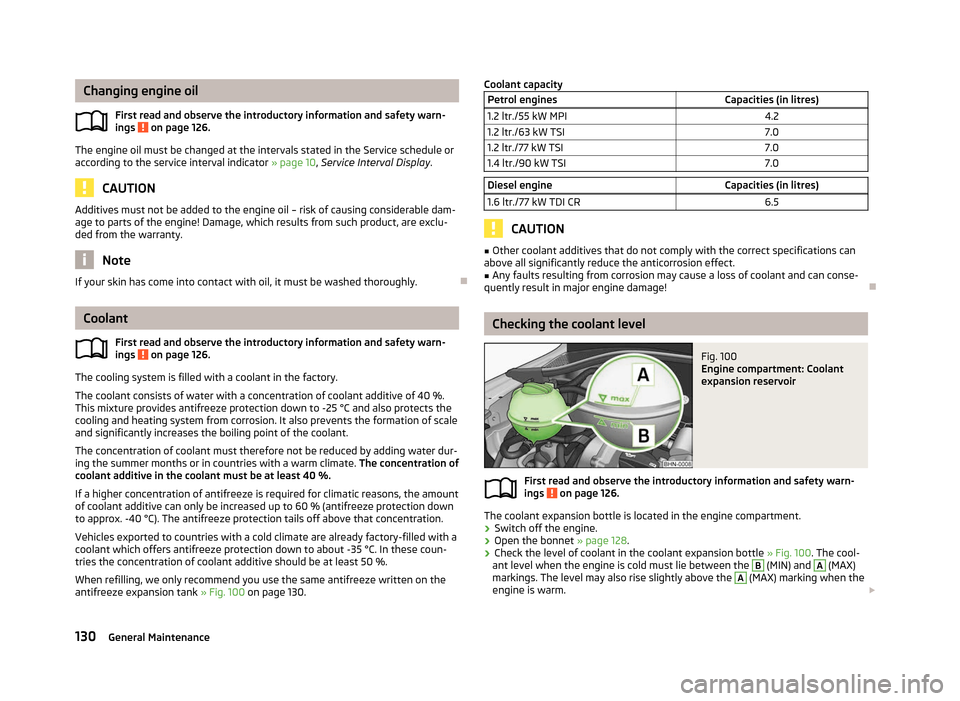
quently result in major engine damage! Ð Checking the coolant level
Fig. 100
Engine compartment: Coolant
expansion reservoir
First read and observe the introductory information and safety warn-
ings on page 126.
The coolant expansion bottle is located in the engine compartment.
›
Switch off the engine.
› Open the bonnet
» page 128.
› Check the level of coolant in the coolant expansion bottle
» Fig. 100. The cool-
ant level when the engine is cold must lie between the B
(MIN) and A
(MAX)
markings. The level may also rise slightly above the A
(MAX) marking when the
engine is warm. £
ä
130 General Maintenance
Page 134 of 180

Checking the brake fluid
Fig. 101
Engine compartment: Brake fluid
reservoir
First read and observe the introductory information and safety warn-
ings on page 126.
The brake fluid reservoir is located in the engine compartment.
›
Switch off the engine.
› Open the bonnet
» page 128.
› Check the level of brake fluid in the reservoir
» Fig. 101. The level must be be-
tween the “MIN” and “MAX” markings.
When driving, a slight drop in the fluid level is caused by the wear-and-tear and
automatic adjustment of the brake pads, and is therefore perfectly normal.
There may be an indication of a leak in the brake system, however, if the fluid lev-
el drops significantly within a short time or if it drops below the “MIN” marking. If
the brake fluid level is too low, this is indicated by the warning light lighting up
in the instrument cluster » page 17, Brake system . WARNING
If the fluid level has dropped below the MIN marking, do not continue your
journey – risk of accident! Seek help from a
ŠKODA specialist garage.ÐBrake fluid change
First read and observe the introductory information and safety warn-
ings on page 126.ä
ä Brake fluid absorbs moisture. Over time it therefore absorbs moisture from the
environment. Excessive water in the brake fluid may be the cause of corrosion in
the brake system. The water content also lowers the boiling point of the brake
fluid.
The brake fluid must comply with the following standards or specifications:
› VW 50114;
› FMVSS 116 DOT4. WARNING
Using old brake fluid can result in severe stress on the brakes because of the
formation of vapour bubbles in the brake system. This greatly impairs the
braking efficiency and thus also the safety of your vehicle. CAUTION
Brake fluid damages the paintwork of the vehicle. Ð Windscreen washer system
Fig. 102
Engine compartment: Wind-
screen washer fluid reservoir
First read and observe the introductory information and safety warn-
ings on page 126.
The windscreen washer fluid reservoir contains the cleaning fluid for the wind-
screen or rear window and for the headlight cleaning system. The windscreen
washer fluid reservoir is located in the engine compartment.
The capacity of the reservoir is about 3.5 litres or about 5.4
litres on vehicles that
have a headlight cleaning system. £
ä
132 General Maintenance
Page 172 of 180
Index
A
ABS 73
Warning light 20
Accessories 144
Adjusting Exterior mirror 42
Adjusting seats 92
Adjustment Seat 45
Aerial 118
see Radio reception 120
Airbag 99
Deployment 99
Front airbag 100
Head airbag 102
Side airbag 101
Airbag system 99
Air conditioning system Air outlet vents 60
Climatronic 65
Manual air conditioning system 62
Alarm 29
Anti-theft alarm system 29
Antilock brake system 73
Armrest 45
rear 48
Ashtray 53
ASR 73
Assist systems ABS 20, 73
ASR 73
Cruise control systems (CCS) 75
EDL 73
ESC 19, 72
Parking aid 74START/STOP 77
TCS 20
Auto Check Control 16
Automatic gearbox 79
Dynamic shift programme 82
Emergency programme 82
Information for driving 79
Kickdown 82
Manual shifting of gears 81
Parking 80
Selector lever-emergency unlocking 83
Selector lever lock 81
Selector lever positions 80
Starting off 80
Stopping 80
Tiptronic 81
Automatic load deactivation 136
AUX-IN 90
Avoiding damage to your vehicle 113
B
Before setting off 91
Belts 95
Belt tensioners 98
Bonnet Closing 128
Opening 128
Boot Class
N1 vehicles 49
Cover 50
Emergency unlocking 31
Fastening elements 49
Fixing nets 50
Hooks 50
Light 49
see Boot lid 31
Unlocking the boot lid 31
Boot lid 31
Automatic locking 31
Brake assist 72Brake booster 72
Brake fluid Checking 132
Brakes Brake booster 72
Handbrake 72
Running in 109
Warning light 17
Braking Brake fluid 132
Breakdown kit 149
Bulbs Replacing 159
Button in the driver's door Electrical power windows 31
C
Car computer see Multifunction display 11
Car jack 145
Carrier 51
Catalytic converter 109
Central locking button 27
Central locking system 25
lock 27
unlock 26
Changes 144
Changing Engine oil 130
Wheel 146
Charging a vehicle battery 135
Checking Battery electrolyte level 135
Brake fluid 132
Coolant level 130
Engine oil 129
Oil level 129
Windscreen washer fluid 132
Children and safety 105
170 Index