service SKODA RAPID 2012 1.G User Guide
[x] Cancel search | Manufacturer: SKODA, Model Year: 2012, Model line: RAPID, Model: SKODA RAPID 2012 1.GPages: 180, PDF Size: 4.36 MB
Page 33 of 180

Opening/closing
Fig. 15
Opening the boot lid
First read and observe the introductory information and safety warn-
ings on page 30.
After unlocking the vehicle, you can open the lid by pushing the handle located
above the licence plate.
Opening
›
Push the handle and lift the boot lid in the direction of the arrow
» Fig. 15.
Closing
› Pull down the boot lid and close it with a slight swing.
A handle which makes the closing easier is located on the inner panelling of the
boot lid. ÐAutomatic locking
First read and observe the introductory information and safety warn-
ings on page 30.
If the vehicle was locked with the button
on the remote control key before the
boot lid was closed, the lid is automatically locked as soon as it is closed.
The delayed automatic locking function of the boot lid can be activated on your
vehicle. The following applies following activation of this function: If the boot lid
was locked with the button on the remote control key 2
» page 28, then it is
possible to open the lid within a limited period of it being closed.
If you wish, a
ŠKODA Service Partner can activate or deactivate the delayed auto-
matic locking of the boot lid. The Service Partner will also provide any further in-
formation that is required.
ä
ä There is a risk of unwanted entry into the vehicle before the boot lid is locked au-
tomatically. Always lock the vehicle using the button on the remote control or
with the key if no remote control is available » page 27 .Ð Emergency unlocking
Fig. 16
Emergency unlocking of the boot
lid
First read and observe the introductory information and safety warn-
ings on page 30.
The boot lid can be unlocked manually if there is a fault in the central locking sys-
tem.
Unlocking
›
Fold the rear seat backrest forward
» page 47, Rear seats.
› Insert the vehicle key into the slot in the trim panel as far as the stop.
› Unlock the lid by moving it in the direction of the arrow.
› Open the boot lid. Ð Electrical power windows
ä
Introduction
This chapter contains information on the following subjects:
Opening/closing the windows 32
£
ä
31
Unlocking and locking
Page 42 of 180
The windshield wipers and the windshield washer system only operate if the igni-
tion is switched on.
The rear window is wiped once if the windscreen wipers are on when reverse
gear is selected.
Top up with windscreen wiper fluid
» page 132.WARNING
■ Properly maintained windscreen wiper blades are essential for clear visibility
and safe driving » page 41. ■ Do not use the windscreen washer system at low temperatures, without
heating the windscreen beforehand. Otherwise the window cleaner could
freeze on the windscreen and restrict the view to the front. CAUTION
■ In cold temperatures and during the winter, check before the journey or before
switching on the ignition that the wiper blades are not frozen to the windscreen.
If the windscreen wipers are switched on when the blades are frozen to the
windscreen, this may damage both the blades and windscreen wiper motor!
■ If the ignition is switched off while the windscreen wipers are switched on, the
windscreen wipers will continue wiping in the same mode after the ignition is
turned back on. The windscreen wipers could freeze up in cold temperatures be-
tween the time the ignition was turned off and when it was turned back on again.
■ Carefully detach frozen wiper blades from the front or rear window.
■ Remove snow and ice from the windscreen wipers before driving.
■ If the windscreen wipers are handled carelessly, there is a risk of damage to the
windscreen.
■ Replace the windscreen wiper blades once or twice a year for safety reasons.
These can be purchased from a ŠKODA Service Partner.
■ The ignition must not be switched on if the front windscreen wiper arms are fol-
ded out. The wiper blades would move back into their rest position and while do-
ing so damage the paintwork of the bonnet. Note
■ Keep the wiper blades clean. The wiper blades can become soiled with wax resi-
dues after washing in automatic vehicle wash systems » page 118.
■ On vehicles equipped with washer nozzles for the windscreen, these are heated
when the engine is running. Ð Activating the windscreen wipers and washers
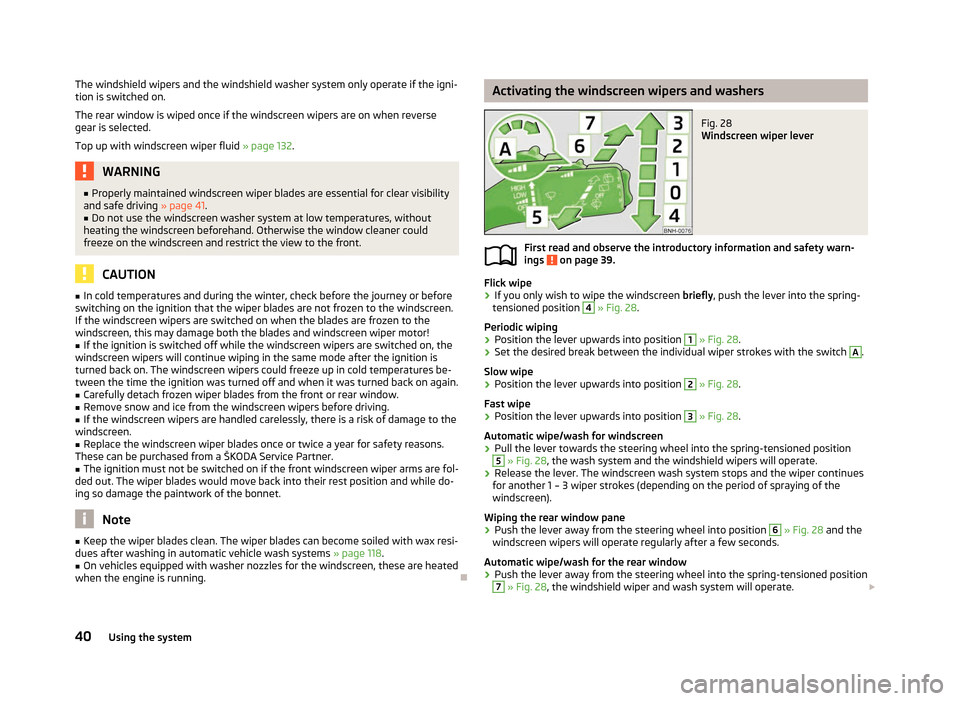
Fig. 28
Windscreen wiper lever
First read and observe the introductory information and safety warn-
ings on page 39.
Flick wipe
› If you only wish to wipe the windscreen
briefly, push the lever into the spring-
tensioned position 4
» Fig. 28
.
Periodic wiping
› Position the lever upwards into position 1
» Fig. 28
.
› Set the desired break between the individual wiper strokes with the switch A
.
Slow wipe
› Position the lever upwards into position 2
» Fig. 28
.
Fast wipe
› Position the lever upwards into position 3
» Fig. 28
.
Automatic wipe/wash for windscreen
› Pull the lever towards the steering wheel into the spring-tensioned position 5
» Fig. 28, the wash system and the windshield wipers will operate.
› Release the lever. The windscreen wash system stops and the wiper continues
for another 1 – 3 wiper strokes (depending on the period of spraying of the
windscreen).
Wiping the rear window pane
› Push the lever away from the steering wheel into position 6
» Fig. 28 and the
windscreen wipers will operate regularly after a few seconds.
Automatic wipe/wash for the rear window
› Push the lever away from the steering wheel into the spring-tensioned position 7
» Fig. 28, the windshield wiper and wash system will operate.
£
ä
40 Using the system
Page 43 of 180
›
Release the lever. The washer system stops and the wiper continues for anoth-
er 1 to 3 wiper strokes (depending on the duration of the spraying process). The
lever will stay in position after releasing it 6
.
Switching windscreen wipers off
› Move the lever back into the home position 0
» Fig. 28
. ÐHeadlight cleaning system
First read and observe the introductory information and safety warn-
ings on page 39.
When the low beam or main beam are switched on, and the windscreen wiper
lever is pulled into the position 5
» Fig. 28
on page
40, the headlights are
sprayed briefly. To clean the headlights, the windshield is also sprayed after every
ten squirts.
You should remove stubborn dirt (such as insect residues) from the headlight len-
ses at regular intervals, for example when refuelling. The following guidelines
must be observed » page 120, Headlight lenses.
To ensure the proper operation of the cleaning system during the winter, any
snow should be removed from the washer nozzle fixtures and ice should be
cleared with a de-icing spray. CAUTION
Never remove the nozzles from the headlight cleaning system by hand – risk of
damage! ÐReplacing the front windscreen wiper blades
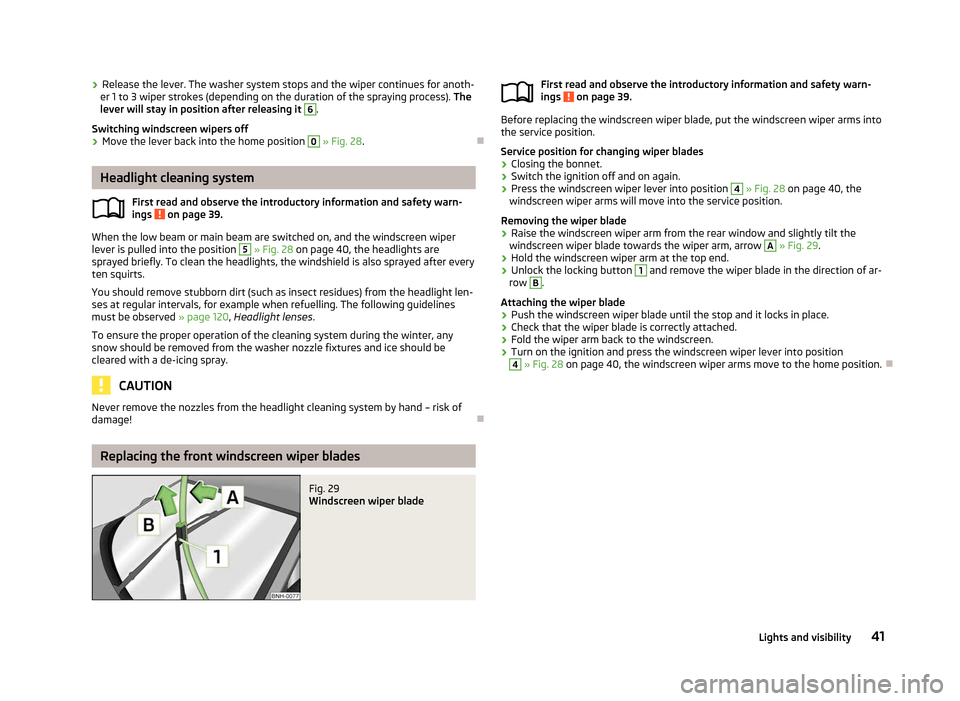
Fig. 29
Windscreen wiper blade
ä
First read and observe the introductory information and safety warn-
ings on page 39.
Before replacing the windscreen wiper blade, put the windscreen wiper arms into
the service position.
Service position for changing wiper blades
› Closing the bonnet.
› Switch the ignition off and on again.
› Press the windscreen wiper lever into position 4
» Fig. 28
on page
40, the
windscreen wiper arms will move into the service position.
Removing the wiper blade
› Raise the windscreen wiper arm from the rear window and slightly tilt the
windscreen wiper blade towards the wiper arm, arrow A
»
Fig. 29
.
› Hold the windscreen wiper arm at the top end.
› Unlock the locking button 1
and remove the wiper blade in the direction of ar-
row B
.
Attaching the wiper blade
› Push the windscreen wiper blade until the stop and it locks in place.
› Check that the wiper blade is correctly attached.
› Fold the wiper arm back to the windscreen.
› Turn on the ignition and press the windscreen wiper lever into position 4
» Fig. 28 on page 40
, the windscreen wiper arms move to the home position. Ð
ä
41
Lights and visibility
Page 51 of 180
WARNING (Continued)
■ The items carried in the boot must be stored in such a way that no objects
are able to slip forward if any sudden driving or braking manoeuvres are un-
dertaken – risk of injury!
■ When transporting fastened objects which are sharp and dangerous in the
boot that has been enlarged by folding the rear seats forward, ensure the
safety of the passengers transported on the other rear seats » page 93, Cor-
rect seated position for the occupants on the rear seats .
■ If the rear seat next to the folded forward seat is occupied, ensure maxi-
mum safety, e.g. by placing the goods to be transported in such a way that the
seat is prevented from folding back in case of a rear collision.
■ Never drive with the boot lid fully opened or slightly ajar otherwise exhaust
gases may get into the interior of the vehicle – risk of poisoning!
■ Under no circumstances, should the permissible axle loads and permissible
gross weight of the vehicle be exceeded – risk of accident! ■ Never transport people in the boot! CAUTION
Please ensure that the heating elements for the rear window heater are not dam-
aged as a result of abrasive objects. Note
Tyre pressure must be adjusted to the load » page 138, Service life of tyres .Ð Boot light
First read and observe the introductory information and safety warn-
ings on page 48.
The light comes on automatically when the boot lid is opened. If the lid remains
open for more than about 10
minutes, the boot light switches off automatically. ÐClass N1 vehicles
First read and observe the introductory information and safety warn-
ings on page 48.ä
ä On class N1 vehicles, which are not fitted with a protective grille, a lashing set
which complies with the standard EN
12195 (1 - 4) must be used for fastening the
load. Ð Fastening elements
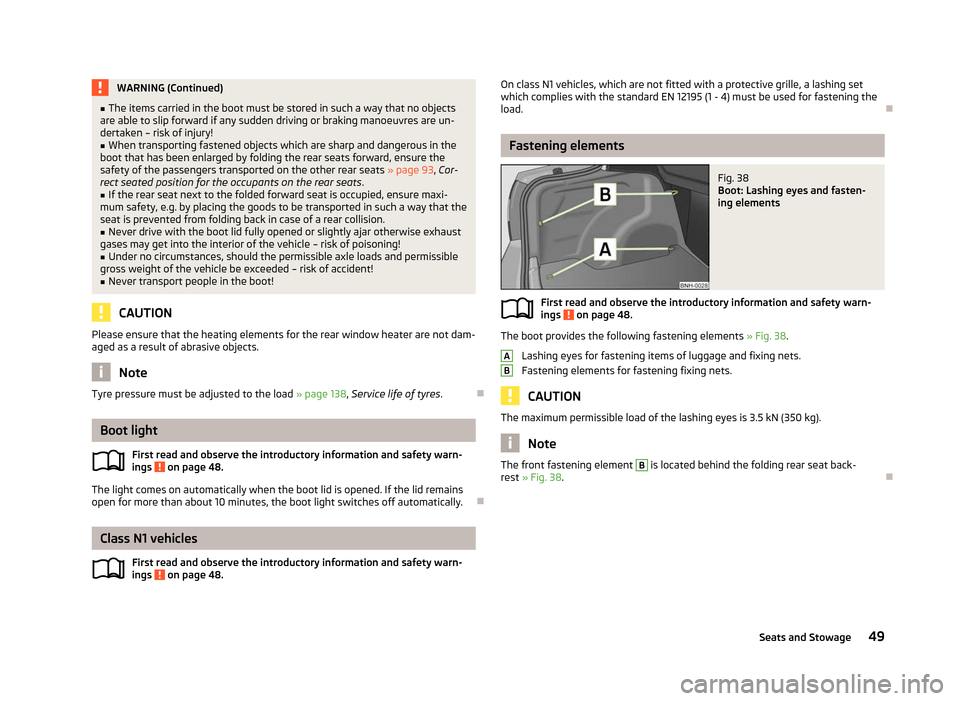
Fig. 38
Boot: Lashing eyes and fasten-
ing elements
First read and observe the introductory information and safety warn-
ings on page 48.
The boot provides the following fastening elements
»
Fig. 38.
Lashing eyes for fastening items of luggage and fixing nets.
Fastening elements for fastening fixing nets. CAUTION
The maximum permissible load of the lashing eyes is 3.5 kN (350 kg). Note
The front fastening element B
is located behind the folding rear seat back-
rest » Fig. 38. Ð
ä A
B
49
Seats and Stowage
Page 73 of 180
WARNING
■ The brake booster only operates when the engine is running. Greater physi-
cal effort for braking is required when the engine is switched off – risk of acci-
dent!
■ Depress the clutch pedal when stopping or braking a vehicle with a petrol
engine and manual transmission in the low rev range. If you fail to do so, the
functionality of the brake booster can be impaired – risk of accident! ■ If a front spoiler, full wheel trim, etc. is mounted retrospectively, it must be
ensured that the air supply to the front wheel brakes is not reduced. Other-
wise, the functionality of the brake system could be impaired – risk of acci-
dent!
■ Please note that the handbrake must be fully released. A handbrake which
is only partially released can result in the rear brakes overheating, which can
have a negative effect on the operation of the brake system – risk of accident!
■ Never leave children unattended in the vehicle. The children might, for ex-
ample, release the handbrake or take the vehicle out of gear. The vehicle
might then move off – risk of accident!
■ A lack of fuel can cause irregular engine running or cause the engine to shut
down. The brake assist systems would then be without function – risk of acci-
dent!
■ Adjust the speed and driving style to the current visibility, weather, road and
traffic conditions. The increased safety offered by the brake assist systems
must not tempt you to take greater risks than otherwise – risk of an accident! CAUTION
■ Observe the recommendations on the new brake pads » page 109.
■ Never let the brakes slip with light pressure on the pedal if braking is not neces-
sary. This causes the brakes to overheat and can also result in a longer braking
distance and excessive wear. ■ All four wheels must be fitted with the same tyres approved by the manufactur-
er to ensure the brake assist systems operate correctly. Note
■ If the brakes are applied in full and the control unit for the braking system con-
siders the situation to be dangerous for the following traffic, the brake light
flashes automatically. After the speed was reduced below around 10
km/h or the
vehicle was stopped, the brake light stops flashing and the hazard warning light
system switches on. The hazard warning light system is switched off automatical-
ly after accelerating or driving off again. ■ Before negotiating a steep downhill section, reduce the speed, shift down into
the next lower gear (manual gearbox) or select a lower drive position (automatic
gearbox). As a result, the braking effect of the engine will be used, reducing the
load on the brakes. Any additional braking should be completed intermittently,
not continuously. ■ Changes to the vehicle (e.g. to the engine, brakes, chassis or another combina-
tion of tyres and wheels) can influence the functionality of the brake assist sys-
tems »
page 144 , Accessories, changes and replacement of parts .
■ If a fault occurs in the ABS system, the ESC, ASR and EDL also do not work. A
warning light » page 20 comes on if a fault occurs in the ABS system. Ð Information for braking
First read and observe the introductory information and safety warn-
ings on page 70.
Wear-and-tear
The wear of the brake pads is dependent on the operating conditions and driving
style. The brake pads wear more quickly if a lot of journeys are completed in
towns and over short distances or if a very sporty style of driving is adopted. If
operated under severe conditions, the thickness of the brake pads must be
checked by a ŠKODA specialist garage before the next service appointment.
Wet roads or road salt
The performance of the brakes can be delayed as the brake discs and brake pads
may be moist or have a coating of ice or layer of salt on them in winter. The
brakes are cleaned and dried by applying the brakes several times.
Corrosion
Corrosion on the brake discs and dirt on the bake pads occur if the vehicle has
been parked for a long period and if you do not make much use of the braking
system. If the brake system is not used much or if there is corrosion on the sur-
face, we recommend cleaning the brake discs by firmly applying the brakes from a
fairly high speed. £
ä
71
Starting-off and Driving
Page 86 of 180

Communication
Mobile phones and two-way radio systems
ŠKODA permits the operation of mobile phones and two-way radio systems with
a professionally installed external aerial and a maximum transmission power of
up to 10 watts.
Please refer to a ŠKODA Service Partner for information about the possibilities of
installing and operating mobile phones and two-way radio systems that have a
transmission power of more than 10
W.
Operating mobile phones or two-way radio systems may interfere with the func-
tionality of the electronic systems in your vehicle.
The reasons for this are as follows:
› no external aerial;
› external aerial incorrectly installed;
› transmission power greater than 10 watts. WARNING
■ Concentrate fully at all times on your driving! As the driver you are fully re-
sponsible for road safety. Use the telephone system only to such an extent
that you are in full control of your vehicle at any time.
■ The national regulations for using a mobile phone in a vehicle must be ob-
served.
■ If a mobile phone or a two-way radio system is operated in a vehicle without
an external aerial or an external aerial which has been installed incorrectly,
this can increase the strength of the electromagnetic field inside the vehicle. ■ Two-way radio systems, mobile phones or mounts must not be installed on
airbag covers or within the immediate deployment range of the airbags.
■ Never leave a mobile phone on a seat, on the dash panel or in another area,
from which it can be thrown during a sudden braking manoeuvre, an accident
or a collision – risk of injury.
■ In the event of air transport, the Bluetooth ®
function for the hands-free sys-
tem must be switched off by a specialist garage. Note
■ We recommend that the installation of mobile phones and two-way radio sys-
tems in a vehicle be carried out by a ŠKODA
Service Partner.
■ Not all mobile phones that enable Bluetooth ®
communication are compatible
with the universal telephone preinstallation GSM
II. You can ask an authorised
ŠKODA Service Partner whether your telephone is compatible with the universal
telephone preinstallation GSM II. ■ The range of the Bluetooth ®
connection to the hands-free system is restricted
to the vehicle interior. The range is dependent on local factors, e.g. obstacles be-
tween the devices and mutual interferences with other devices. If your mobile
phone is in a jacket pocket, for example, this can lead to difficulties when estab-
lishing a connection with the hands-free-system or transferring data. Ð Universal telephone preinstallation GSM II
Introductory information
The universal telephone preinstallation GSM
II (hands-free system) includes a
convenience mode for the mobile phone via voice control, the multifunction
steering wheel, the radio or navigation system.
The universal telephone preinstallation GSM II comprises the following functions. › Phone Phonebook » page 85.
› Convenience operation of the telephone via the multifunction steering
wheel » page 85 .
› Operation of the telephone via the information display
» page 87.
› Voice control of the telephone
» page 87.
› Music playback from the telephone or other multimedia units
» page 89.
All communication between a mobile phone and your vehicle's hands-free system
is established with the help of Bluetooth ®
technology. Note
The following guidelines must be observed » page 84, Mobile phones and two-
way radio systems. Ð
84 Using the system
Page 100 of 180

Seat belt height adjuster on the front seats
Fig. 81
Front seat: Seat belt height ad-
juster
First read and observe the introductory information and safety warn-
ings on page 95.
The seat belt height adjuster makes it possible to adjust the routing of the front
seat belts in the area of the shoulder to the body size.
› Press the height adjuster and move up or down in the desired direc-
tion » Fig. 81 .
› Then pull firmly on the belt to ensure that the seat belt height adjuster has cor-
rectly locked in place. ÐBelt tensioners
First read and observe the introductory information and safety warn-
ings on page 95.
Safety for the driver and front passenger
wearing their seat belts is enhanced by
the belt tensioners fitted to the inertia reels of the front three-point seat belts.
The three-point seat belts are automatically tensioned in the event of a frontal
collision of a certain severity. The belt tensioners can also be deployed if the seat
belts are not fastened.
The fastened three-point seat belts are automatically tensioned in the event of a
frontal or side collision of a certain severity.
Belt tensioners are not activated in the event of minor frontal collisions, side and
rear-end collisions, in the case of a rollover and also not in accidents in which no
major forces are produced from the front.
ä
ä WARNING
■ Any work on the belt tensioner system including removal and installation of
system components because of other repair work, must only be carried out by
a specialist garage.
■ The protective function of the system is only adequate for a single accident.
If the belt tensioners have been deployed, it is then necessary to replace the
entire system. Note
■ Smoke is generated when the belt tensioners are deployed. This is not an indi-
cation of a fire in the vehicle. ■ When disposing of the vehicle or parts of the belt tensioner system, it is impor-
tant to comply with national legal requirements. ŠKODA Service Partners are fa-
miliar with these regulations and will be able to provide you with detailed infor-
mation. Ð98
Safety
Page 105 of 180

Deactivating airbags
Deactivating airbags
Deactivation of airbags is envisaged only for particular instances, such as if:
› using a child seat on the front passenger seat, in which the child has its back to
the vehicle's direction of travel (in some countries this must be in the direction
of travel due to different legal regulations applying) » page 105, Child seat ;
› not being able to maintain a distance of at least 25
cm between the middle of
the steering wheel and chest, despite the driver's seat being correctly adjusted;
› special attachments are required in the area of the steering wheel because of a
physical disability;
› other seats have been installed (e.g. orthopaedic seats without side airbags).
The front passenger airbag can be switched off with the key-operated
switch » page 103.
We recommend that you ask a ŠKODA Service Partner to switch off any other air-
bags.
Monitoring the airbag system
The functionality of the airbag system is also monitored electronically when one
airbag has been switched off.
If the airbag was switched off using diagnostic equipment:
› The airbag indicator light
lights up for around 4 seconds after the ignition is
switched on and then flashes for around 12 seconds.
If the airbag was switched off using the key switch on the side of the dash pan-
el:
› The airbag warning light
comes on for around 4 seconds after the ignition is
switched on;
› Airbags that are switched off are indicated in the middle of the dashboard by
the indicator light
in the display » Fig. 86 on page 103 3
.
Note
■ The national regulations for switching off airbags must be observed.
■ A ŠKODA Service Partner will be able to inform you which airbags in your vehicle
can/must be deactivated. Ð Key switch for the front seat passenger airbag
Fig. 86
Key-operated switch for the front passenger airbag/warning light
for front seat passenger airbag deactivation
Only the front passenger airbag is deactivated with the key switch.
Deactivating an airbag › Switch off the ignition.
› Open the storage box on the front passenger's side.
› Use the key to turn the slot of the key switch into position 2
» Fig. 86 OFF.
› Check whether the airbag indicator light 3
in the display
in the middle of the dash panel lights up when the ignition is turned on.
Activating an airbag
› Switch off the ignition.
› Use the key to turn the slot of the key switch into position 1
» Fig. 86 ON
.
› Close the storage box on the front passenger's side.
› Check whether the airbag indicator light 3
in the display
in the middle of the dash panel does not light up when the ignition is turned
on.
Indicator light in the display (front passenger airbag
switched off)
In cases where the front passenger airbag is switched off the airbag indicator
light comes on for a few seconds after switching on the ignition, goes out for
about a second and then comes on again.
There is a system fault in the deactivated airbag » if the airbag warning light
flashes. Immediately visit a ŠKODA specialist garage. £
103
Airbag system
Page 109 of 180

Group
Weight of the child Approximate age
1 9-18 kg up to 4 years
2 15-25 kg up to 7 years
3 22-36 kg over 7 years Ð
Suitability of child seats
First read and observe the introductory information and safety warn-
ings on page 105.
Overview of the suitability of child seats according to the standard ECE-R
44
Seat Child seat
type
Front passenger seat U
Rear seat outside U
+
T
Rear seat middle U
Universal category – a child seat with the word UNIVERSAL, which is de-
signed for fastening on the seat with the seat belt.
ISOFIX
– a child seat which is designed for fastening on the seat with eyelets
for the ISOFIX system is provided » page 107.
TOP TETHER – a child seat which is designed for fastening on the seat with
an eyelet for the TOP TETHER system is provided » page 108. ÐChild seats with the ISOFIX system
Fig. 89
Rear seat: ISOFIX
ä U
+
T First read and observe the introductory information and safety warn-
ings
on page 105.
There are two locking eyes between the rear exterior seats for fixing the
ISOFIX
system child seat in place. The places are marked with labels with the
ISOFIX
logo » Fig. 89 .
A child seat fitted with the ISOFIX system can only be mounted in a vehicle fitted
with an ISOFIX system if the child seat has been approved for this type of vehicle.
Further information is available from a ŠKODA Service Partner. WARNING
■ Always refer to the instructions from the manufacturer of the child seat
when installing and removing a child seat with the
ISOFIX system.
■ Never attach other child seats, belts or objects to the locking eyes intended
for the installation of a child seat with the
ISOFIX system – hazard! CAUTION
When using child seats with the ISOFIX system, ensure that the seats or other
parts of the vehicle interior are not damaged. Note
Child seats with the ISOFIX system can be purchased from ŠKODA Original Acces-
sories. Ð
ä
107
Transporting children safely
Page 113 of 180

Note
Observe the recommended gear » page 11, Recommended gear .ÐAvoiding full throttle
Fig. 92
Principle sketch: Fuel consump-
tion in litres/100 km. and speed
in km/h.
Driving more slowly means saving fuel.
Sensitive use of the accelerator will not only significantly reduce fuel consump-
tion but also positively influence environmental pollution and wear of your vehi-
cle.
The maximum speed of your vehicle should, as far possible, never be used. Fuel
consumption, pollutant emissions and vehicle noises increase disproportionally at
high speeds.
The » Fig. 92 shows the ratio of fuel consumption to the speed of your vehicle.
Fuel consumption will be halved if only three-quarters of the possible top speed
of your vehicle is used. ÐReducing idling
Idling also costs fuel.
In vehicles not equipped with the
START-STOP system, turn off the engine when
in a traffic jam, at a level crossing or traffic lights with longer wait times. Even af-
ter just 30 – 40 seconds you will have saved more fuel than that is needed when
you start the engine up again. If an engine is only idling it takes much longer for it to reach its normal operating
temperature. Wear-and-tear and pollutant emissions, though, are particularly
high in the warming-up phase. Therefore, start driving as soon as the engine has
started, whereby high engine speeds should be avoided.
Ð Regular servicing
A poorly tuned engine uses an unnecessarily high amount of fuel.
By having your vehicle regularly maintained by a ŠKODA
specialist garage, you
create the conditions needed for driving economically. The maintenance state of
your vehicle has a positive effect on traffic safety and value retention
A poorly tuned engine can result in a fuel consumption which is 10 % higher than
normal.
Also check the oil level when refuelling. Oil consumption is dependent to a con-
siderable extent on the load and speed of the engine. Oil consumption could be
as high as 0.5 litres/1 000 km depending on your style of driving.
It is quite normal that a new engine has a higher oil consumption at first, and rea-
ches its lowest level only after a certain running in time. The oil consumption of a
new vehicle can therefore only be correctly assessed after driving about
5 000 km. For the sake of the environment
■ Additional improvements to the fuel economy can be made by using synthetic
high-lubricity oils.
■ Regularly check the ground under the vehicle. Have your vehicle inspected by a
ŠKODA specialist garage if you find any stains caused by oil or other fluids on the
floor. Note
We recommend that your vehicle is serviced on a regular basis by a ŠKODA Serv-
ice Partner. Ð
111
Driving and the Environment