towing SKODA RAPID 2012 1.G User Guide
[x] Cancel search | Manufacturer: SKODA, Model Year: 2012, Model line: RAPID, Model: SKODA RAPID 2012 1.GPages: 180, PDF Size: 4.36 MB
Page 118 of 180

Immediately reduce your speed as soon as even the slightest swaying of the trail-
er is detected. Never attempt to stop the trailer from “swaying” by accelerating.
Brakes
Apply the brakes in good time! If the trailer is fitted with a trailer brake, apply the
brakes gently at first, then brake firmly. This will avoid brake jolts resulting from
the trailer wheels locking. On downhill sections shift down a gear in good time to
also use the engine as a brake.
Trailer is connected to the anti-theft alarm system.
› If the vehicle is factory-fitted with an anti-theft alarm system and a towing de-
vice.
› If the trailer is electrically connected to the towing vehicle by means of the trail-
er socket.
› If the electrical system of the vehicle and trailer is fully functional.
› If the vehicle is locked with the car key and the anti-theft alarm system is acti-
vated.
When the vehicle is locked, the alarm is activated as soon as the electrical con-
nection to the trailer is interrupted.
Always deactivate the anti-theft alarm system before a trailer is connected/dis-
connected. Otherwise, the anti-theft alarm system could accidentally be trig-
gered » page 29, Anti-theft alarm system .
Engine overheating
If the needle for the coolant temperature gauge moves into the right-hand area
or the red area of the scale, the speed must be reduced immediately. Stop and
switch off the engine if the warning light in the instrument cluster starts to
flash. Wait a few minutes and check the level of coolant in the coolant expansion
bottle » page 130, Checking the coolant level .
The following guidelines must be observed » page 19, Coolant temperature/cool-
ant level .
The coolant temperature can be reduced by switching on the heating. WARNING
■ Adapt your speed to the conditions of the road surface and to the traffic sit-
uation.
■ Improper or incorrectly connected electric cables can energise the trailer and
cause functional faults to the vehicle's entire electrical system as well as acci-
dents and severe injuries.
■ Any work on the electrical system must be carried out only by ŠKODA spe-
cialist garages.
■ Never directly connect the trailer's electrical system with the electrical con-
nections for the tail lights or other current sources. CAUTION
■ Avoid abrupt and sudden driving/braking manoeuvres.
■ When the ball rod is removed, the mounting shaft must be sealed with an ap-
propriate cover. This prevents foreign matter from penetrating into the mounting
shaft. See the fitting instructions for the towing device. Note
■ We recommend that you also have your vehicle inspected between service in-
tervals if you tow a trailer frequently. ■ The handbrake on the towing vehicle must be put on when coupling and decou-
pling the trailer.
■ For technical reasons, trailers with rear LED lights cannot be connected to the
anti-theft alarm system. Ð
116 Driving Tips
Page 131 of 180

Note
The location of the inspection points in the engine compartment of petrol and
diesel engines is practically identical. ÐChecking the engine oil level
Fig. 99
Dipstick
First read and observe the introductory information and safety warn-
ings on page 126.
The dipstick indicates the level of oil in the engine
» Fig. 99.
Checking the oil level
› Ensure that the vehicle is positioned on a level surface and the engine has
reached its operating temperature.
› Switch off the engine.
› Open the bonnet.
› Wait a few minutes until the engine oil flows back into the oil sump and remove
the dipstick.
› Wipe the dipstick with a clean cloth and insert it again to the stop.
› Then pull the dipstick out again and check the oil level.
Oil level within range A
›
No oil must be refilled.
Oil level within range B
›
Oil can
be refilled. It is possible that the oil level may then be within range A
after doing this.
Oil level within range C
›
Oil must be refilled. It is sufficient, once this is done, to keep the oil level within
range B
.
ä
It is normal for the engine to consume oil. The oil consumption may be as much as
0.5 l/1 000
km depending on your style of driving and the conditions under which
you operate your vehicle. Consumption may be slightly higher than this during the
first 5 000 kilometres.
One should therefore check the oil level at regular intervals, preferably every time
after the fuel tank is filled or after driving for long stretches.
We recommend maintaining the oil level within the range A
, but not above
, if
the engine has been operating at high loads, for example, during a lengthy motor-
way trip during the summer months, towing a trailer or negotiating a high moun-
tain pass.
The warning light in the instrument cluster will indicate whether the oil level is
too low » page 18 , Engine oil . In this case, check the oil level with the dip-
stick, as soon as possible. Add oil accordingly. CAUTION
■ The oil level must on no account extend beyond the range A
» Fig. 99
. Risk of
damaging the exhaust system!
■ If it is not possible to top up the engine oil under the prevailing conditions, do
not continue your journey! Switch off the engine and obtain professional assis-
tance from a ŠKODA specialist garage, otherwise it could cause severe engine
damage. Note
Engine oil specifications » page 166 , Specifications and engine oil capacity .Ð Replenishing the engine oil
First read and observe the introductory information and safety warn-
ings on page 126.
›
Check the engine oil level
» page 129.
› Unscrew the cap of the engine oil filler opening.
› Replenish the oil in portions of 0.5 litres in accordance with the correct specifi-
cations » page 166 , Specifications and engine oil capacity .
› Check the oil level
» page 129.
› Carefully screw on the oil filler opening cap and push the dipstick in fully. Ð
ä
129
Inspecting and replenishing
Page 143 of 180
Full wheel trim
First read and observe the introductory information and safety warn-
ings on page 137.
Pulling off
›
Hook the clamp found in the vehicle tool kit into the reinforced edge of the
wheel trim.
› Push the wheel wrench through the clamp, support on the tyre and pull off the
wheel trim.
Install
› First press the full wheel trim onto the wheel rim at the valve opening provided.
Then press the full wheel trim into the wheel rim until its entire circumference
locks correctly in place. CAUTION
■ Use the pressure of your hand, do not knock the full wheel trim! Heavy knocks
mainly on the points where the full wheel trim has not been inserted into the
wheel, can result in damage to the guide and centring elements of the full wheel
trim.
■ First of all check that the theft-deterrent wheel bolt is located in the hole near
the valve before fitting the full wheel trim onto a steel wheel which is attached
with a theft-deterrent wheel bolt » page 149, Securing wheels against theft .
■ If wheel trims are retrofitted it must be ensured that an adequate flow of air is
assured to cool the brake system. ÐWheel bolts
Fig. 108
Remove the cap
ä
First read and observe the introductory information and safety warn-
ings on page 137.
Pulling off
›
Push the plastic clip sufficiently far onto the cap until the inner catches of the
clip are positioned at the collar of the cap and detach the cap » Fig. 108.
Install
› Push the caps onto the wheel bolts up to the stop.
The wheel bolt caps are housed in a plastic box in the spare wheel or in the stor-
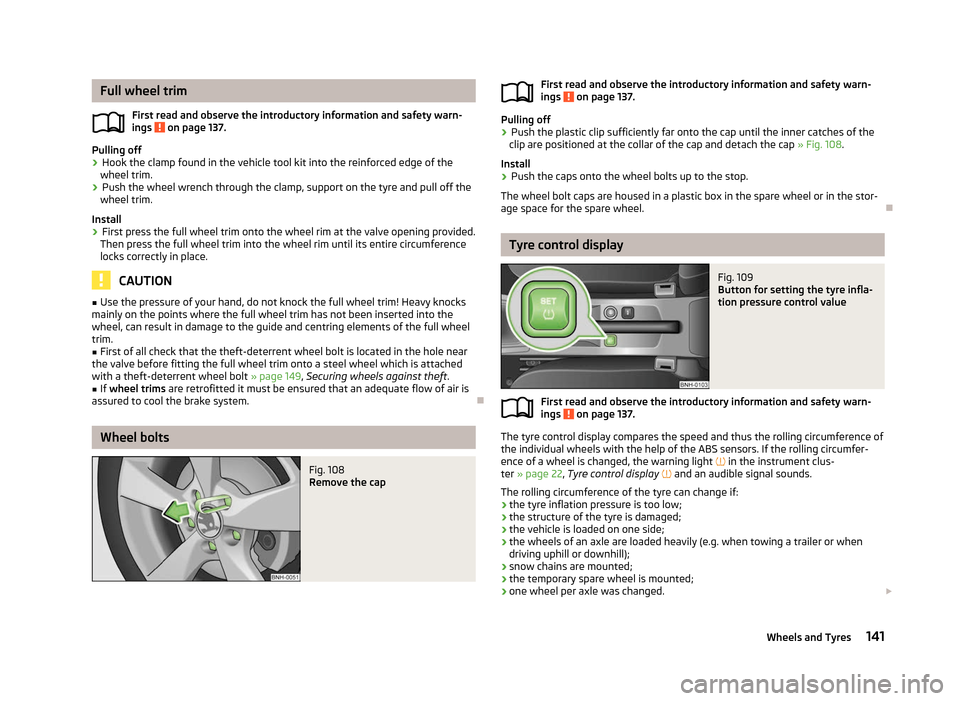
age space for the spare wheel. Ð Tyre control display
Fig. 109
Button for setting the tyre infla-
tion pressure control value
First read and observe the introductory information and safety warn-
ings on page 137.
The tyre control display compares the speed and thus the rolling circumference of
the individual wheels with the help of the ABS sensors. If the rolling circumfer-
ence of a wheel is changed, the warning light
in the instrument clus-
ter » page 22, Tyre control display and an audible signal sounds.
The rolling circumference of the tyre can change if: › the tyre inflation pressure is too low;
› the structure of the tyre is damaged;
› the vehicle is loaded on one side;
› the wheels of an axle are loaded heavily (e.g. when towing a trailer or when
driving uphill or downhill);
› snow chains are mounted;
› the temporary spare wheel is mounted;
› one wheel per axle was changed.
£
ä
ä 141
Wheels and Tyres
Page 148 of 180

The vehicle tool kit and the lifting jack with sticker are housed in a plastic box in
the spare wheel or in the storage space for the spare wheel. There is also space
here for the removable ball rod for the trailer towing device. The box is attached
with a strap on the spare wheel.
The vehicle tool kit contains the following parts (depending on equipment fitted):
Screwdriver
Adapter for anti-theft wheel bolts
Towing eye
Clamps for removing the wheel trims
Car jack
Wheel wrench
Extraction pliers for wheel bolt caps
Replacement bulb set
Before placing the lifting jack back into its storage area, screw in the arm of the
lifting jack fully. WARNING
■ The factory-supplied lifting jack is only intended for your model of vehicle.
Under no circumstances attempt to lift heavier vehicles or other loads – risk of
injury!
■ Ensure that the vehicle tool kit is safely secured in the boot. Note
Ensure that the box is always secured with the strap. ÐChanging a wheel
ä
Introduction
This chapter contains information on the following subjects:
Preliminary work 147
Changing a wheel 147
Subsequent steps 147
Loosening and tightening wheel bolts 1481
2
3
4
5
6
7
8 Raising the vehicle 148
Securing wheels against theft 149
WARNING
■ If you are in flowing traffic, switch on the hazard warning light system and
set up the warning triangle at the prescribed distance! The national legal re-
quirements must be observed. In this way you are not only protecting yourself
but other road users as well.
■ If the wheel is damaged or in the event of a puncture, park the vehicle as far
away as possible from the flow of traffic. Park on as flat and firm a surface as
possible. ■ If the wheel has to be changed on a slope, first of all block the opposite
wheel with a stone or similar object to prevent the vehicle from unexpectedly
rolling away.
■ If the vehicle is subsequently fitted with tyres which are different to those it
was fitted with at the works, follow these guidelines » page 139, New wheels
and tyres .
■ Always raise the vehicle with the doors closed.
■ Never position any body parts, such as arms or legs under the vehicle, while
the vehicle is raised with a lifting jack. ■ Secure the base plate of the lifting jack with suitable means to prevent pos-
sible moving. A soft and slippery ground under the base plate may move the
lifting jack, causing the vehicle to fall down. It is therefore always necessary to
place the lifting jack on a solid surface or use a wide and stable base. Use a
non-slip base (e.g. a rubber foot mat) if the surface is smooth, such as cobbled
stones, tiled floor, etc. ■ Never start the engine with the vehicle sitting on the raised jack – danger of
suffering injury.
■ Only attach the lifting jack to the attachment points provided for this pur-
pose. CAUTION
■ The prescribed tightening torque of the wheel bolts for steel and light alloy
wheels is 120
Nm.
■ If the anti-theft wheel bolt is fastened too tightly, it can cause damage to the
anti-theft wheel bolt and adapter. £
146 Do-it-yourself
Page 155 of 180

›
Attach the other end 4
to a solid metal part which is connected firmly to the
engine block, or to the engine block itself.
Starting engine
› Start the engine on the vehicle providing the power and allow it to idle.
› Now start the engine of the vehicle with the discharged battery.
› If the engine does not start, terminate the attempt to start the engine after
10 seconds and wait for about 30 seconds before repeating the process.
› Disconnect the cables in exactly the
reverse order to the one described above. ÐJump-starting in vehicles with the START-STOP system
Fig. 118
Jump-starting – START-STOP system
First read and observe the introductory information and safety warn-
ings on page 152.
On vehicles with the START-STOP system, the jump-start cable of the charger
must never be connected directly to the negative pole of the vehicle battery, but
only to the engine earth.
› 1.2 ltr./63
kW TSI and 1.2 ltr./77 kW TSI engines » Fig. 118 -
› 1.4 ltr./90 kW engine
» Fig. 118 -
› 1.6 ltr./77 kW TDI CR engine
» Fig. 118 - Ð
ä Towing the vehicle
ä
Introduction
This chapter contains information on the following subjects:
Front towing eye 154
Rear towing eye 155
Vehicles with manual transmission can be towed in with a tow bar or a tow rope
or with the front or rear wheels raised.
Vehicles with automatic transmission can be towed in with a tow bar or a tow
rope or with the front wheels raised. If the vehicle is raised at rear, the automatic
gearbox is damaged!
A tow bar is the safest way of towing a vehicle and also minimises any shocks.
Only use a tow rope if a suitable tow bar is not available.
When towing, the following guidelines must be observed.
Driver of the tow vehicle
› Release the clutch particularly gently when starting off or depress the accelera-
tor particularly gently if the vehicle is fitted with an automatic gearbox.
› On vehicles with a manual transmission, only push down on the accelerator
pedal once the rope is taught.
The maximum towing speed is 50 km/h.
Driver of the towed vehicle
› Switch on the ignition so that the steering wheel is not blocked and so that the
turn signal lights, horn, windscreen wipers and windscreen washer system can
be switched on.
› Take the vehicle out of gear or move the selector lever into position
N if the
vehicle is fitted with an automatic gearbox.
Please note that the brake servo unit and power steering only operate if the en-
gine is running. If the engine is not running, significantly more physical force is re-
quired to depress the brake pedal and steer the vehicle.
If using a tow rope, ensure that it is always kept taught. £
153
Do-it-yourself
Page 156 of 180

CAUTION
■ Do not tow start the engine - danger of damaging the engine! On vehicles with
a catalytic converter, unburnt fuel may get into the catalytic converter where it
may ignite. This in turn may damage or destroy the catalytic converter. The bat-
tery from another vehicle can be used as a jump-start aid » page 152, Jump-start-
ing .
■ If the gearbox of your vehicle no longer contains any oil because of a defect,
your vehicle must only be towed in with the driven wheels raised clear of the
ground, or on a special vehicle transporter or trailer.
■ The vehicle must be transported on a special vehicle or trailer if it is not possible
to tow in the vehicle in the way described or if the towing distance is greater than
50 km. ■ To protect both vehicles when tow-starting or towing, the tow rope should be
elastic. Thus one should only use plastic fibre rope or a rope made out of a simi-
larly elastic material.
■ One should be constantly vigilant not to allow impermissibly high towing forces
or jerky loadings. There is always a risk of excessive stresses and damage result-
ing at the points to which you attach the tow rope or tow bar when you attempt
to tow a vehicle which is not standing on a paved road.
■ Attach the tow rope or the tow bar to the towing eyes or to the detachable ball
head of the towing device » page 154 or »
page 155. Note
■ We recommend using a tow rope from
ŠKODA Original Accessories available
from a ŠKODA Service Partner. ■ Towing another vehicle requires a certain amount of practice. Both drivers
should be familiar with the particular points about towing a vehicle. Unskilled
drivers should not attempt to tow in another vehicle or to be towed in. ■ When towing, respect the national legal provisions, especially those which re-
late to the identification of the towing vehicle and the vehicle being towed. ■ The tow rope must not be twisted as it may in certain circumstances result in
the front towing eye being unscrewed out of your vehicle. Ð Front towing eye
Fig. 119
Front bumper: Cap/installing the towing eye
First read and observe the introductory information and safety warn-
ings on page 153.
Removing and installing the cap
› Press on the left half of the cap in the area of the arrow
» Fig. 119 - .
› Remove the cap from the front bumper.
› After screwing out the towing eye, reinstall the cap by inserting it in the
mounts and pressing on the right side of the cap. The cap must engage firmly.
Removing and installing the towing eye
› Screw in the towing eye by hand to the left up to the stop
» Fig. 119 - .
For tightening purposes, we recommend, for example, using the wheel wrench,
towing eye from another vehicle or a similar object that can be pushed through
the eye.
› Screw out the towing eye by turning it to the right. CAUTION
The towing eye must always be screwed in fully and firmly tightened, otherwise
the towing eye can tear when towing in or tow-starting. Ð
ä
154 Do-it-yourself
Page 157 of 180

Rear towing eye
Fig. 120
Rear towing eye
First read and observe the introductory information and safety warn-
ings on page 153.
The rear towing eye is located below the bumper on the right.
Remove the protective cap before using the towing eye. » Fig. 120. Replace the
protective cap after using the towing eye. Ðä
155
Do-it-yourself
Page 166 of 180

Technical data
Technical data
Introductory information
The details given in the vehicle's technical documentation always take prece-
dence over the details in the Owner's Manual. Please refer to the official vehicle
registration documents or consult a
ŠKODA Service Partner to determine which
engine your vehicle is equipped with.
The listed performance values were determined without performance-reducing
equipment, e.g. air conditioning system.
Vehicle identification number (VIN)
The vehicle identification number - VIN (vehicle body number) is stamped into the
engine compartment on the right hand suspension strut dome. This number is al-
so located on a sign on the lower left hand edge below the windscreen (together
with a VIN bar code).
Engine number
The engine number is stamped into the engine block. ÐData on the vehicle sticker and the type plate
Fig. 136
Vehicle data sticker/type plate Vehicle data sticker
The vehicle data sticker » Fig. 136 is located on the floor of the boot and is also
stated in the service schedule.
The vehicle data sticker contains the following data:
Vehicle identification number (VIN)
Vehicle type
Gearbox code/paint number/interior equipment/engine output/engine code
Partial vehicle description
Operating weight (in
kg)
Fuel consumption (in ltr./100 km) - intra-urban/extra-urban/combined
CO 2 emission levels - combined (in g/km)
Type plate
The type plate » Fig. 136 is located on the lower part of the column between the
front and rear doors on the driver's side.
The type plate lists the following weights:
Maximum permissible gross weight
Maximum permissible towed weight (towing vehicle and trailer)
Maximum permissible front axle load
Maximum permissible rear axle load
Operating weight
The specified operating weight is for orientation purposes only. This value repre-
sents the minimum operating weight without additional weight-increasing equip-
ment such as air conditioning system, spare wheel, or trailer hitch.
The operating weight also contains the weight of the driver (75 kg), the weight of
the operating fluids, the tool kit, and a fuel tank filled to 90 % capacity.
It is possible to calculate the approximate loading capacity from the difference
between the permissible total weight and the operating weight » .
The payload consists of the following components:
› Passengers
› All items of luggage and other loads
› Roof load including roof rack system
› Equipment not included in the operating weight
› Trailer drawbar load when towing a trailer (max. 50 kg).
£ 1
2
3
4
5
6
7
8
9
10
11
164
Technical data
Page 173 of 180
Child safety
Side airbag 106
Child safety lock 25
Child seat Classification 106
ISOFIX 107
on the front passenger seat 105
Suitability 107
TOP TETHER 108
Chrome parts refer to Taking care of your vehicle 119
Cigarette lighter 53
Cleaning 117
Artificial leather 122
Headlight lenses 120
Material coverings 122
Materials 122
Natural leather 122
Plastic parts 119
Wheels 121
Climatronic Recirculated air mode 66
Clock 11
Clothes hooks 58
Cockpit 12-volt power socket 54
Ashtray 53
Cigarette lighter 53
General view 7
Light 38
Storage compartments 54
Compartments 54
Computer see Multifunction display 11
Coolant Checking 130
Replenishing 131
Temperature gauge 9
Warning light 19
Correct seated position 92
Counter for distance driven 10Cruise control system (CCS) 75
Cup holder front 52
rear 53
D
DAY LIGHT see Daytime running lights 35
Daytime running lights 35
Deactivating an airbag 103
Defrsoting rear window 39
Delayed locking of the boot lid see Boot lid 31
Diesel refer to Fuel 126
Diesel fuel Operation in winter 126
Diesel particulate filter 21
Digital clock 11
Dipstick 129
Display Coolant temperature 9
Fuel gauge 9
Service interval 10
Distance driven 10
Door Child safety lock 25
Doors Emergency locking 30
Driving Abroad 113
Driving through water on the street 114
Emissions 164
Fuel consumption 164
Maximum speed 167
E
Economical and environmentally friendly driving 110EDL 73
Electrical power windows Button in the driver's door 31, 32
Button in the rear door 32
Electronic differential lock 73
Electronic immobiliser 69
Emergency Automatic gearbox 82
Changing a wheel 146
Hazard warning light system 37
Jump-starting 152
locking of the doors 30
Selector lever-unlocking 83
Towing the vehicle 153
Tyre repair 149
Unlocking the boot lid 31
Emissions 164
Engine Running in 109
Starting engine 70
Switching off the engine 70
Engine compartment Brake fluid 132
Coolant 130
Overview 128
Vehicle battery 133
Engine oil Capacity 166
Changing 130
Checking 129
Replenishing 129
Specification 166
Warning light 18
Engine revolutions counter 9
Environment 110
Environmental compatibility 112
Environmentally friendly driving 110
ESC 72
Warning light 19
171
Index
Page 176 of 180

START STOP
Jump-starting 153
Steering force assistance 69
Steering wheel 69
Storage 54
Storage compartments 54
Sun visors 39
Switching off the engine 70
T
Taking care of the vehicle Artificial leather 122
Material coverings 122
Materials 122
Natural leather 122
Seat belts 123
Taking care of your vehicle 117
Automatic car wash system 118
Chrome parts 119
Cleaning the wheels 121
Door lock cylinders 120
Headlight lenses 120
High-pressure cleaner 118
Plastic parts 119
Polishing the paintwork 119
Preservation 119
Rubber seals 120
Washing 118
Washing by hand 118
Wash system 118
TCS Warning light 20
Technical data 164
Telephone 84
Tiptronic 79
see automatic gearbox 81
Tool 145
TOP TETHER 108
Towing 153
Towing a trailer 115Towing eye 154
Towing protection 29
Traction control 73
Trailer 115
Towing a trailer 115
Transport Boot 48
Roof rack system 51
Transporting children safely 105
Two-way radio systems 84
Type plate 164
Tyre repair 149
Tyres see Wheels and tyres 139
U
Underbody protection 121
unlock Central locking system 26
Unlocking Remote control 28
Uphill start assist 72
USB 90
V
Vehicle battery Automatic load deactivation 136
Charging 135
Checking the electrolyte level 135
Operation in winter 135
Replacing 136
Safety instructions 133
Vehicle Condition see Auto Check Control 16
Vehicle data sticker 164
Vehicle dimensions 165
Vehicle key 24
Vehicle tool kit 145Visors
see Sun visors 39
W
Warning lights 16
Warning symbols see Warning lights 16
Warning triangle 145
Washing 117
Automatic car wash system 118
by hand 118
Chrome parts 119
High-pressure cleaner 118
Weights 164
Wheel bolts Anti-theft wheel bolt 149
Caps 141
Loosening and tightening 148
Wheels 137
Wheels and tyres Changing a wheel 146
Full wheel trim 141
General information 137
Handling wheels and tyres 139
new tyres 139
Service life of tyres 138
Snow chains 143
Spare wheel 140
Wheel bolts 142
Winter tyres 142
Windows De-icing 120
See Electrical power windows 31
Windscreen washer fluid Checking 132
Replenishing 132
Warning light 22
Winter 132
Windscreen washer system 132
Windscreen wipers 40
174 Index