bonnet SKODA RAPID 2013 1.G User Guide
[x] Cancel search | Manufacturer: SKODA, Model Year: 2013, Model line: RAPID, Model: SKODA RAPID 2013 1.GPages: 226, PDF Size: 15.16 MB
Page 167 of 226
WARNING (Continued)■If you intend to work underneath the vehicle, you must secure the vehicle
from rolling away and support it with suitable supporting blocks; the car jack
is not sufficient – risk of injury!■
Never cover the engine with additional insulation material (e.g. with a cover)
– risk of fire!
■
The bonnet must always be properly closed when driving. Therefore, the
lock must always be checked after closing the bonnet in order to ensure that
it has engaged properly.
■
If you notice that the lock is not properly engaged while driving, stop the ve-
hicle immediately and close the bonnet – risk of accident!
CAUTION
Always top up using the correct specification of fluids. This may result in major
operating problems and also vehicle damage!
For the sake of the environment
In view of the requirements for the environmentally friendly disposal of fluids and the special tools and knowledge required for such work, we recommend that flu-
ids be changed by a specialist garage.
Note
■ Please consult a specialist garage for any questions relating to fluids.■Fluids with the correct specifications can be purchased from ŠKODA Original Ac-
cessories.
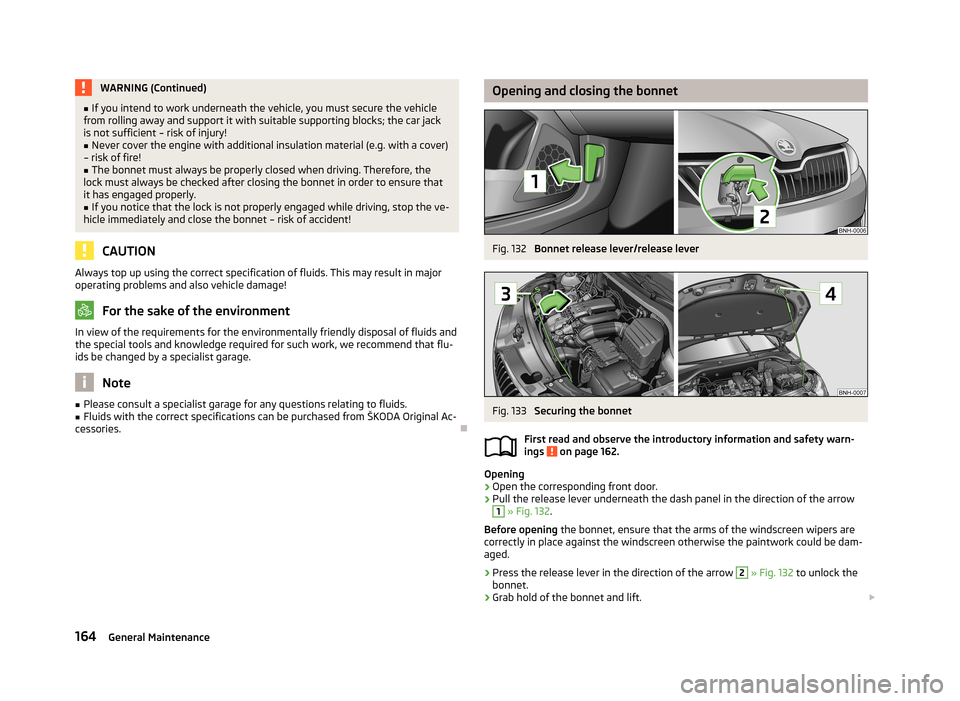
Opening and closing the bonnetFig. 132
Bonnet release lever/release lever
Fig. 133
Securing the bonnet
First read and observe the introductory information and safety warn-
ings
on page 162.
Opening
›
Open the corresponding front door.
›
Pull the release lever underneath the dash panel in the direction of the arrow
1
» Fig. 132 .
Before opening the bonnet, ensure that the arms of the windscreen wipers are
correctly in place against the windscreen otherwise the paintwork could be dam- aged.
›
Press the release lever in the direction of the arrow
2
» Fig. 132 to unlock the
bonnet.
›
Grab hold of the bonnet and lift.
164General Maintenance
Page 168 of 226
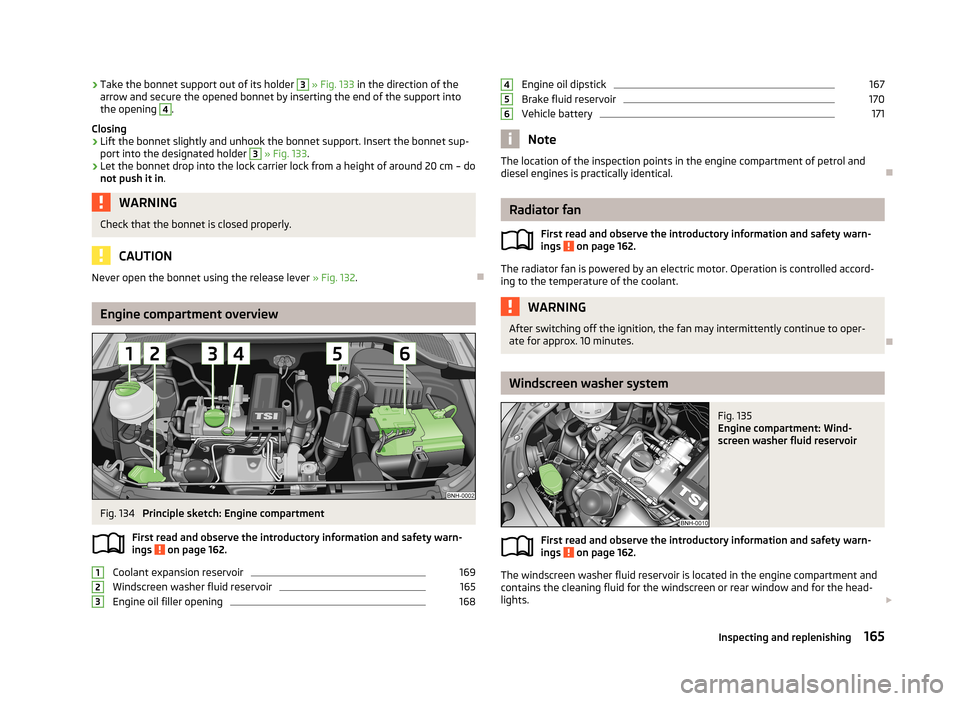
›Take the bonnet support out of its holder 3
» Fig. 133 in the direction of the
arrow and secure the opened bonnet by inserting the end of the support into the opening 4
.
Closing
›
Lift the bonnet slightly and unhook the bonnet support. Insert the bonnet sup-
port into the designated holder
3
» Fig. 133 .
›
Let the bonnet drop into the lock carrier lock from a height of around 20 cm – do
not push it in .
WARNINGCheck that the bonnet is closed properly.
CAUTION
Never open the bonnet using the release lever » Fig. 132.
Engine compartment overview
Fig. 134
Principle sketch: Engine compartment
First read and observe the introductory information and safety warn- ings
on page 162.
Coolant expansion reservoir
169
Windscreen washer fluid reservoir
165
Engine oil filler opening
168123Engine oil dipstick167Brake fluid reservoir170
Vehicle battery
171
Note
The location of the inspection points in the engine compartment of petrol and
diesel engines is practically identical.
Radiator fan
First read and observe the introductory information and safety warn-
ings
on page 162.
The radiator fan is powered by an electric motor. Operation is controlled accord-
ing to the temperature of the coolant.
WARNINGAfter switching off the ignition, the fan may intermittently continue to oper-
ate for approx. 10 minutes.
Windscreen washer system
Fig. 135
Engine compartment: Wind-
screen washer fluid reservoir
First read and observe the introductory information and safety warn- ings on page 162.
The windscreen washer fluid reservoir is located in the engine compartment and
contains the cleaning fluid for the windscreen or rear window and for the head-
lights.
456165Inspecting and replenishing
Page 170 of 226
Specifications and capacityFirst read and observe the introductory information and safety warn-
ings
on page 166.
Specifications and capacity (in l) for vehicles with flexible service intervals
Petrol enginesSpecificationFilling level1.2 l/55 kWVW 503 00, VW 504 002.81.2 l/63 kW TSIVW 504 003.91.2 l/77 kW TSIVW 504 003.91.4 l/90 kW TSIVW 503 00, VW 504 003.6Diesel engine a)SpecificationFilling level1.6 l/66, 77 kW TDI CRVW 507 004.3a)
Engine oil VW 505 01 can optionally be used in diesel engines
without a DPF.
Specifications and capacity (in l) for vehicles with fixed service intervals
Petrol enginesSpecificationFilling level1.2 l/55 kWVW 501 01, VW 502 002.81.2 l/63 kW TSIVW 502 003.91.2 l/77 kW TSIVW 502 003.91.4 l/90 kW TSIVW 501 01, VW 502 003.61.6 l/77 kWVW 501 01, VW 502 003.6
If the oils specified above are not available, oils according to ACEA A2 or ACEA A3
can be used once for refilling.
Diesel engine a)SpecificationFilling level1.6 l/66, 77 kW TDI CRVW 507 004.3a)
Engine oil VW 505 01 can optionally be used in diesel engines
without a DPF.
If the oils specified above are not available, oils according to ACEA B3 or ACEA B4
can be used once for refilling.
CAUTIONOnly the above-mentioned oils can be used on vehicles with flexible service inter-
vals. We recommend always refilling with oil of the same specification since thiswill maintain the properties of the oil. In exceptional cases, a maximum of 0.5 l ofspecification VW 502 00 (only for petrol engines) or specification VW 505 01 (only
for diesel engines) engine oil can be used to refill once. Other engine oils must not be used - risk of engine damage!
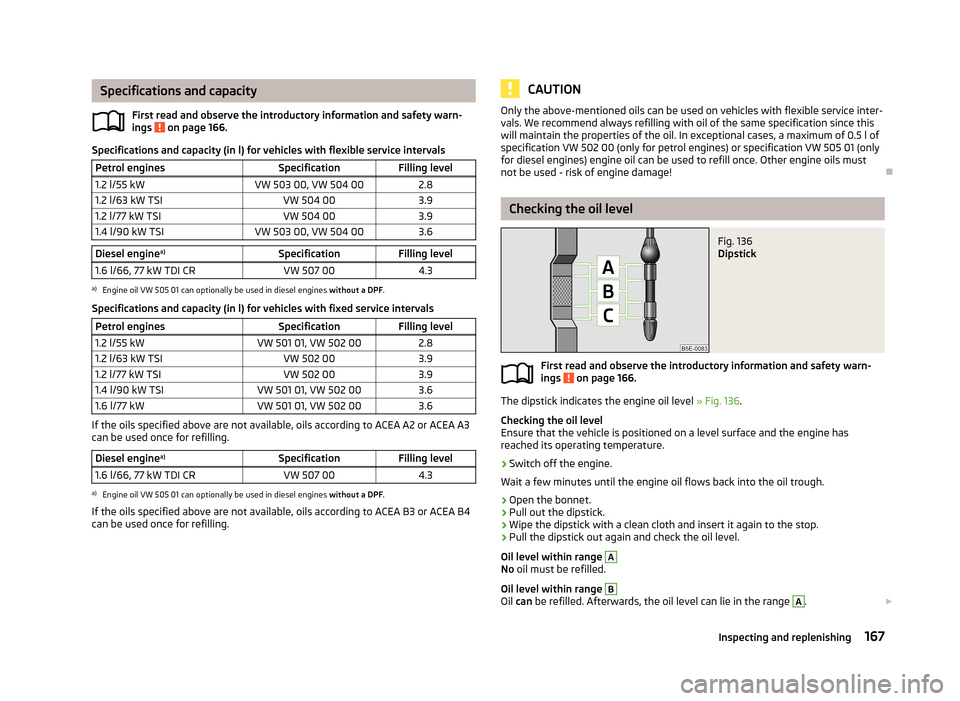
Checking the oil level
Fig. 136
Dipstick
First read and observe the introductory information and safety warn-
ings on page 166.
The dipstick indicates the engine oil level » Fig. 136.
Checking the oil level
Ensure that the vehicle is positioned on a level surface and the engine has reached its operating temperature.
›
Switch off the engine.
Wait a few minutes until the engine oil flows back into the oil trough.
›
Open the bonnet.
›
Pull out the dipstick.
›
Wipe the dipstick with a clean cloth and insert it again to the stop.
›
Pull the dipstick out again and check the oil level.
Oil level within range
A
No oil must be refilled.
Oil level within range
B
Oil can be refilled. Afterwards, the oil level can lie in the range
A
.
167Inspecting and replenishing
Page 172 of 226
WARNING■The engine compartment of your car is a hazardous area. The following
warning instructions must be followed at all times when working in the en-
gine compartment » page 162.■
Do not continue your journey if for some reason it is not possible to fill with
coolant under the current circumstances . Switch off the engine and seek
assistance from a specialist garage.
CAUTION
■ The concentration of coolant additive in the coolant must never be under 40%.■Over 60% of coolant additive in the coolant reduces the antifreeze protection
and cooling effect.■
A coolant additive that does not comply with the correct specifications can sig-
nificantly reduce the corrosion protection.
■
Any faults resulting from corrosion may cause a loss of coolant and can conse-
quently result in major engine damage!
■
Do not fill the coolant above the mark
A
» Fig. 137 on page 169.
■
If a fault causes the engine to overheat, we recommend visiting a specialist ga-
rage, as otherwise serious engine damage may occur.
Capacity
First read and observe the introductory information and safety warn-
ings
on page 168.
Coolant capacity (in litres)
Petrol enginesFilling level1.2 l/55 kW4.21.2 l/63, 77 kW TSI7.01.4 l/90 kW TSI7.01.6 l/77 kW4.5Diesel engineFilling level1.6 l/66, 77 kW TDI CR6.5
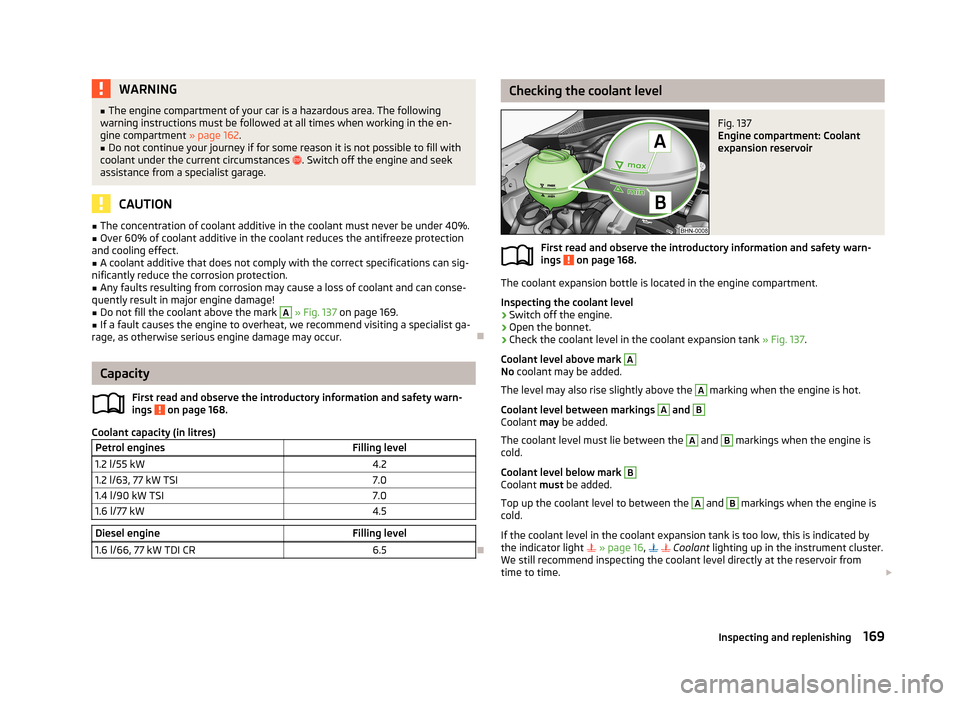
Checking the coolant levelFig. 137
Engine compartment: Coolant
expansion reservoir
First read and observe the introductory information and safety warn-
ings on page 168.
The coolant expansion bottle is located in the engine compartment.
Inspecting the coolant level
›
Switch off the engine.
›
Open the bonnet.
›
Check the coolant level in the coolant expansion tank » Fig. 137.
Coolant level above mark
A
No coolant may be added.
The level may also rise slightly above the
A
marking when the engine is hot.
Coolant level between markings
A
and
B
Coolant may be added.
The coolant level must lie between the
A
and
B
markings when the engine is
cold.
Coolant level below mark
B
Coolant must be added.
Top up the coolant level to between the
A
and
B
markings when the engine is
cold.
If the coolant level in the coolant expansion tank is too low, this is indicated by
the indicator light
» page 16 ,
Coolant lighting up in the instrument cluster.
We still recommend inspecting the coolant level directly at the reservoir from
time to time.
169Inspecting and replenishing
Page 173 of 226
Loss of coolant
A loss of coolant is first and foremost an indication of a leak in the system. Do
not merely top up the coolant. Have the cooling system checked by a specialist
garage.
Replenishing
First read and observe the introductory information and safety warn-
ings
on page 168.
Only top up with new coolant.
›
Switch off the engine.
›
Allow the engine to cool.
›
Place a cloth over the cap of the coolant expansion tank and unscrew the cap carefully .
›
Replenish the coolant.
›
Turn the cap until it clicks into place.
Do not use an alternative additive if the specified coolant is not available in an emergency. In this case, use just water and have the correct mixing ratio of waterand coolant additive restored by a specialist garage as soon as possible.
Brake fluid
Introduction
This chapter contains information on the following subjects:
Checking the brake fluid level
170
Changing
171WARNING■ The engine compartment of your car is a hazardous area. The following
warning instructions must be followed at all times when working in the en-
gine compartment » page 162.■
If the fluid level has dropped below the MIN marking » Fig. 138 on page 170,
do not continue your journey - risk of accident! Seek help from a specialist
garage.
■
Do not use used brake fluid - the function of the brake system may be im-
paired – risk of accident!
CAUTION
Brake fluid damages the paintwork of the vehicle.
Note
The brake fluid is changed as part of a compulsory inspection service.
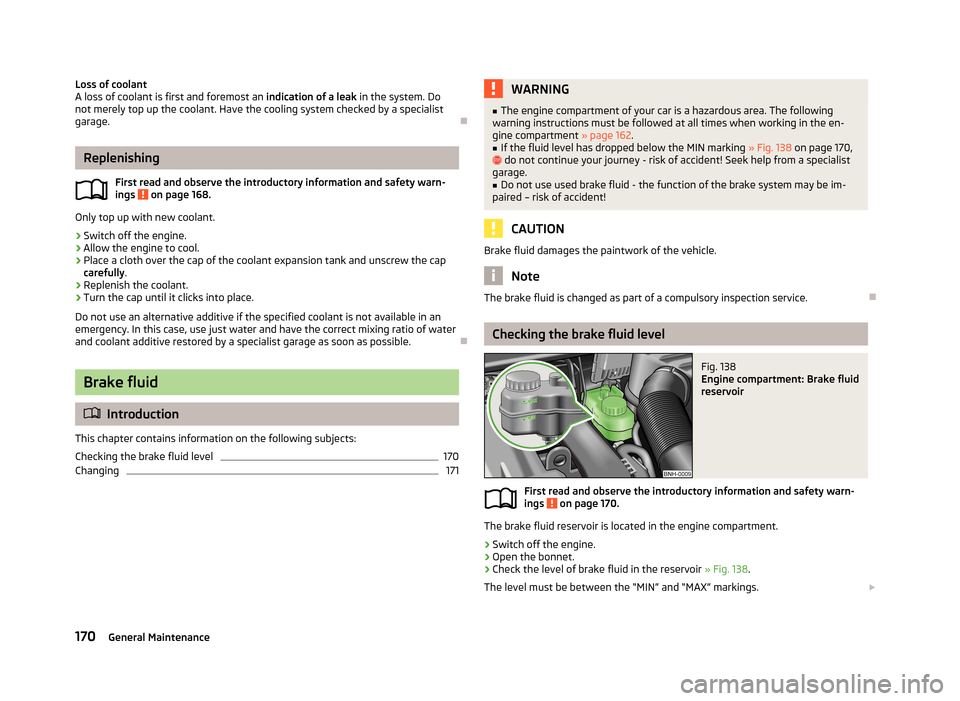
Checking the brake fluid level
Fig. 138
Engine compartment: Brake fluid
reservoir
First read and observe the introductory information and safety warn-
ings on page 170.
The brake fluid reservoir is located in the engine compartment.
›
Switch off the engine.
›
Open the bonnet.
›
Check the level of brake fluid in the reservoir » Fig. 138.
The level must be between the “MIN” and “MAX” markings.
170General Maintenance
Page 198 of 226
Selector lever-emergency unlockingFig. 162
Selector lever-emergency un-
locking
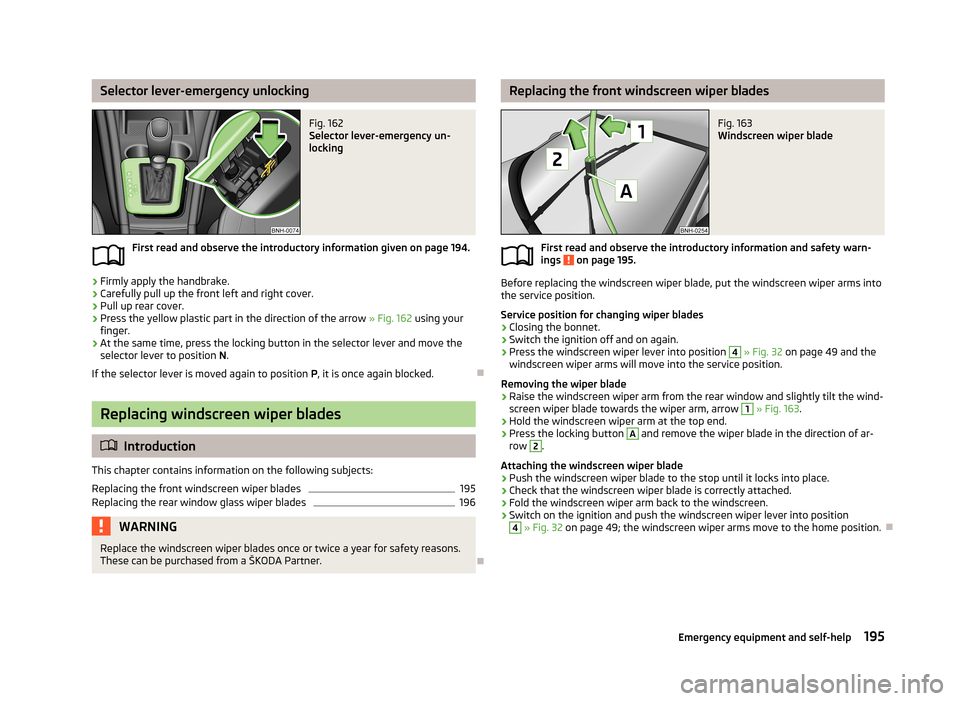
First read and observe the introductory information given on page 194.
›
Firmly apply the handbrake.
›
Carefully pull up the front left and right cover.
›
Pull up rear cover.
›
Press the yellow plastic part in the direction of the arrow » Fig. 162 using your
finger.
›
At the same time, press the locking button in the selector lever and move the selector lever to position N.
If the selector lever is moved again to position P, it is once again blocked.
Replacing windscreen wiper blades
Introduction
This chapter contains information on the following subjects:
Replacing the front windscreen wiper blades
195
Replacing the rear window glass wiper blades
196WARNINGReplace the windscreen wiper blades once or twice a year for safety reasons.
These can be purchased from a ŠKODA Partner.
Replacing the front windscreen wiper bladesFig. 163
Windscreen wiper blade
First read and observe the introductory information and safety warn- ings on page 195.
Before replacing the windscreen wiper blade, put the windscreen wiper arms into
the service position.
Service position for changing wiper blades
›
Closing the bonnet.
›
Switch the ignition off and on again.
›
Press the windscreen wiper lever into position
4
» Fig. 32 on page 49 and the
windscreen wiper arms will move into the service position.
Removing the wiper blade
›
Raise the windscreen wiper arm from the rear window and slightly tilt the wind-
screen wiper blade towards the wiper arm, arrow
1
» Fig. 163 .
›
Hold the windscreen wiper arm at the top end.
›
Press the locking button
A
and remove the wiper blade in the direction of ar-
row
2
.
Attaching the windscreen wiper blade
›
Push the windscreen wiper blade to the stop until it locks into place.
›
Check that the windscreen wiper blade is correctly attached.
›
Fold the windscreen wiper arm back to the windscreen.
›
Switch on the ignition and push the windscreen wiper lever into position
4
» Fig. 32 on page 49; the windscreen wiper arms move to the home position.
195Emergency equipment and self-help
Page 215 of 226
Index
A
Abroad Driving abroad
110
Unleaded petrol110
ABS Function
112
Warning light18
Accessories149
Adjusting Belt height
133
Exterior mirror50
Head restraints53
Interior mirror50
Manual air conditioning81
Seat53
Seats52
Steering wheel96
Adjusting the seats52, 127
Adjustment Beam range
41
Aerial153
Airbag135
Deactivating140
Deactivating the front passenger airbag140
Deployment135
Front airbag137
Head airbag139
Indicator light20
Modifications and damage to the airbag system151
Side airbag138
Airbag system135
Air conditioning system Air outlets
76
Climatronic82
Manual air conditioning system79
Air outlets76
Alarm Switching off36
Triggering36
Anti-theft alarm system Activating/deactivating
36
Trailer125
Antilock Braking System112
Armrest Front
55
Rear55
Artificial leather158
Ashtray59
ASR warning light
17
Assist system ABS
112
Assist systems111
ABS18
ASR17
Cruise Control System114
EDL112
ESC17, 111
HBA112
HHC112
Parking aid113
START-STOP116
TCS112
Auto Check Control13
Automatic gearbox Selector lever-emergency unlocking
195
Starting-off and driving103
Tiptronic103
Automatic load deactivation174
Automatic transmission101
Kickdown104
Malfunction104
Selector lever lock103
Using the selector lever102
AUX95
Avoiding damage to the vehicle Driving through water
109
Avoiding damage to your vehicle109
B
Ball head Check fitting
121
Fitting121
Ready position120
Removing122
Battery In the remote control key
193
Belts130
Belt tensioners133
Bonnet Closing
164
Opening164
Boot Class N1 vehicles
65
Double-sided floor covering70
Flexible storage compartment69
Hooks66
Meshed pocket for storage70
See Boot lid38
Storage compartments in the boot69
Boot cover Parking position
68
Boot lid Automatic locking
38
Closing38
Opening38
Brake booster100
Brake fluid170
Changing171
Checking170
Information messages15
Brakes Brake assist systems
111
Brake booster100
Brake fluid170
Handbrake100
212Index