brakes SKODA RAPID 2013 1.G User Guide
[x] Cancel search | Manufacturer: SKODA, Model Year: 2013, Model line: RAPID, Model: SKODA RAPID 2013 1.GPages: 226, PDF Size: 15.16 MB
Page 127 of 226
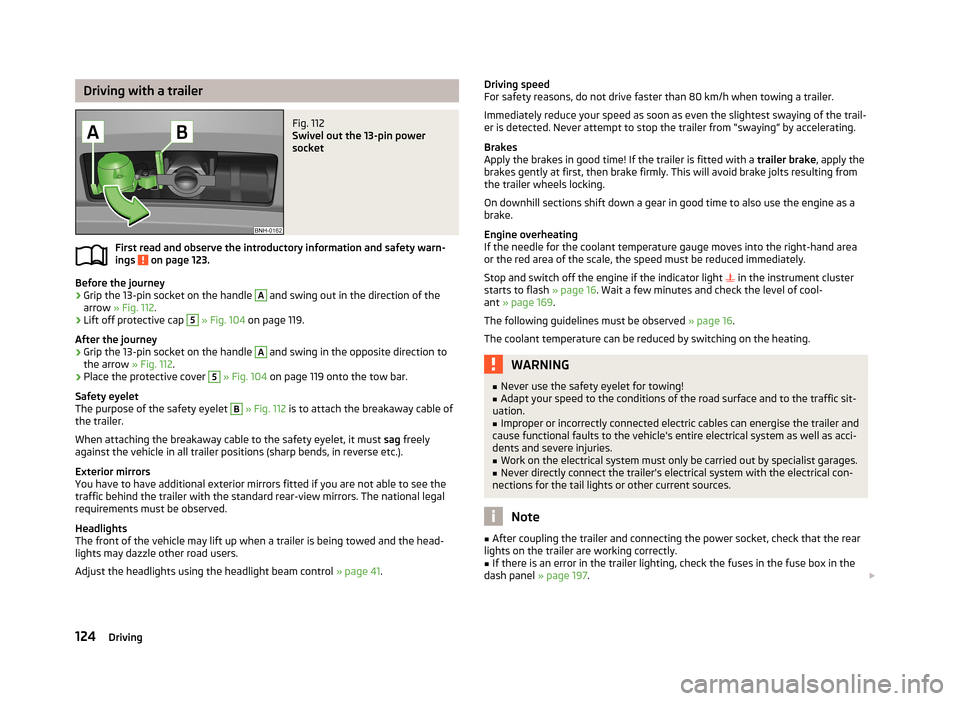
Driving with a trailerFig. 112
Swivel out the 13-pin power
socket
First read and observe the introductory information and safety warn-
ings on page 123.
Before the journey
›
Grip the 13-pin socket on the handle
A
and swing out in the direction of the
arrow » Fig. 112 .
›
Lift off protective cap
5
» Fig. 104 on page 119.
After the journey
›
Grip the 13-pin socket on the handle
A
and swing in the opposite direction to
the arrow » Fig. 112.
›
Place the protective cover
5
» Fig. 104 on page 119 onto the tow bar.
Safety eyelet
The purpose of the safety eyelet
B
» Fig. 112 is to attach the breakaway cable of
the trailer.
When attaching the breakaway cable to the safety eyelet, it must sag freely
against the vehicle in all trailer positions (sharp bends, in reverse etc.).
Exterior mirrors
You have to have additional exterior mirrors fitted if you are not able to see the
traffic behind the trailer with the standard rear-view mirrors. The national legal requirements must be observed.
Headlights
The front of the vehicle may lift up when a trailer is being towed and the head-
lights may dazzle other road users.
Adjust the headlights using the headlight beam control » page 41.
Driving speed
For safety reasons, do not drive faster than 80 km/h when towing a trailer.
Immediately reduce your speed as soon as even the slightest swaying of the trail-
er is detected. Never attempt to stop the trailer from “swaying” by accelerating.
Brakes
Apply the brakes in good time! If the trailer is fitted with a trailer brake, apply the
brakes gently at first, then brake firmly. This will avoid brake jolts resulting from
the trailer wheels locking.
On downhill sections shift down a gear in good time to also use the engine as a brake.
Engine overheating
If the needle for the coolant temperature gauge moves into the right-hand area
or the red area of the scale, the speed must be reduced immediately.
Stop and switch off the engine if the indicator light
in the instrument cluster
starts to flash » page 16. Wait a few minutes and check the level of cool-
ant » page 169 .
The following guidelines must be observed » page 16.
The coolant temperature can be reduced by switching on the heating.WARNING■ Never use the safety eyelet for towing!■Adapt your speed to the conditions of the road surface and to the traffic sit-
uation.■
Improper or incorrectly connected electric cables can energise the trailer and
cause functional faults to the vehicle's entire electrical system as well as acci-
dents and severe injuries.
■
Work on the electrical system must only be carried out by specialist garages.
■
Never directly connect the trailer's electrical system with the electrical con-
nections for the tail lights or other current sources.
Note
■ After coupling the trailer and connecting the power socket, check that the rear
lights on the trailer are working correctly.■
If there is an error in the trailer lighting, check the fuses in the fuse box in the
dash panel » page 197.
124Driving
Page 151 of 226
In order to operate a vehicle with a variable service interval, it must only be fil-
led and topped up with the prescribed engine oil.
If this engine oil is not available, the oil change is subject to a fixed service inter-
val. In this case, the vehicle must be changed to the fixed service interval.
Note
■
The corresponding motor oil specifications » page 167.■A specialist garage can perform the changeover from the variable service inter-
val to the fixed service interval, or from the fixed service interval to the variable
service interval.
Fixed service intervals QI1 - QI4
First read and observe the introductory information given on page 147.
InspectionQI1 - QI4
After the first 30,000 km or 2 years a)
, then every
30,000 km or every 1 year a)
.Every 15,000 km or every 1 year a)
(applies to Rus-
sia).
Oil change service
QI1Every 5000 km or every 1 year a)
.QI2Every 7500 km or every 1 year a)
.QI3Every 10,000 km or every 1 year a)
.QI4Every 15,000 km or every 1 year a)
.Brake fluid
change First change after 3 years, then every 2 yearsa)
(whichever comes first).
WARNINGThe brake fluid must always be changed after the first 3 years and then every
2 years. Longer intervals between changing the brake fluid can cause vapour
bubbles to form in the brake system on sharp braking. This can impair the effi- ciency of the brakes – risk of accident!NoteFor diesel operation with a high sulphur content, the oil must be changed every
7500 km. Ask your specialist garage for information on the countries where diesel fuel has a high sulphur content.
Variable service interval QI6
First read and observe the introductory information given on page 147.
The service intervals depend on the intensity at which the vehicle is driven and
the local conditions in which the vehicle is used. For example, your vehicle is sub-
jected to different loads when driven over short distances than when driven over
long distances. The service intervals are therefore variable.
InspectionAfter the first 30,000 km or 2 years a)
, then every 30,000 km
or every 1 year a)
.Oil change serviceAccording to the service interval display (at the latest after
30,000 km or 2 years a)
).Brake fluid
changeFirst change after 3 years, then every 2 yearsa)
(whichever comes first).
WARNINGThe brake fluid must always be changed after the first 3 years and then every
2 years. Longer intervals between changing the brake fluid can cause vapour
bubbles to form in the brake system on sharp braking. This can impair the effi- ciency of the brakes – risk of accident!
Information about the ŠKODA service
First read and observe the introductory information given on page 147.
You have access to an extensive servicing network of ŠKODA Service Partners for
the maintenance of your vehicle.
148General Maintenance
Page 215 of 226
Index
A
Abroad Driving abroad
110
Unleaded petrol110
ABS Function
112
Warning light18
Accessories149
Adjusting Belt height
133
Exterior mirror50
Head restraints53
Interior mirror50
Manual air conditioning81
Seat53
Seats52
Steering wheel96
Adjusting the seats52, 127
Adjustment Beam range
41
Aerial153
Airbag135
Deactivating140
Deactivating the front passenger airbag140
Deployment135
Front airbag137
Head airbag139
Indicator light20
Modifications and damage to the airbag system151
Side airbag138
Airbag system135
Air conditioning system Air outlets
76
Climatronic82
Manual air conditioning system79
Air outlets76
Alarm Switching off36
Triggering36
Anti-theft alarm system Activating/deactivating
36
Trailer125
Antilock Braking System112
Armrest Front
55
Rear55
Artificial leather158
Ashtray59
ASR warning light
17
Assist system ABS
112
Assist systems111
ABS18
ASR17
Cruise Control System114
EDL112
ESC17, 111
HBA112
HHC112
Parking aid113
START-STOP116
TCS112
Auto Check Control13
Automatic gearbox Selector lever-emergency unlocking
195
Starting-off and driving103
Tiptronic103
Automatic load deactivation174
Automatic transmission101
Kickdown104
Malfunction104
Selector lever lock103
Using the selector lever102
AUX95
Avoiding damage to the vehicle Driving through water
109
Avoiding damage to your vehicle109
B
Ball head Check fitting
121
Fitting121
Ready position120
Removing122
Battery In the remote control key
193
Belts130
Belt tensioners133
Bonnet Closing
164
Opening164
Boot Class N1 vehicles
65
Double-sided floor covering70
Flexible storage compartment69
Hooks66
Meshed pocket for storage70
See Boot lid38
Storage compartments in the boot69
Boot cover Parking position
68
Boot lid Automatic locking
38
Closing38
Opening38
Brake booster100
Brake fluid170
Changing171
Checking170
Information messages15
Brakes Brake assist systems
111
Brake booster100
Brake fluid170
Handbrake100
212Index