headlight SKODA RAPID 2013 1.G User Guide
[x] Cancel search | Manufacturer: SKODA, Model Year: 2013, Model line: RAPID, Model: SKODA RAPID 2013 1.GPages: 226, PDF Size: 15.16 MB
Page 159 of 226
When drying the windows after washing the vehicle, do not use window leathers
that have been used to polish the bodywork. Residues of preservatives in the
window leather can make the window dirty and reduce visibility.
CAUTION
■ The ice scraper should not be moved forward and backward but in one direction
to avoid any damage to the surface of the glass.■
Snow or ice that is contaminated with coarse dirt such as fine gravel, sand or
salt must not be removed from the windows and mirrors – there is a risk of dam-
age to the surface of the windows and mirrors.
■
Do not remove snow or ice from glass parts using warm or hot water – risk of
cracks forming in the glass.
■
When removing snow or ice from windows and mirror lenses ensure that the
paintwork of the vehicle is not to damage.
■
Do not clean the inside of the windows with sharp-edged objects or corrosive
and acidic cleaning agents – there is a risk of damaging the heating elements or
window aerial.
Headlight lenses
First read and observe the introductory information and safety warn-ings
on page 153.
Clean plastic front headlight lenses using clean, warm water and soap.
CAUTION
■ Never wipe headlights with a dry cloth.■Do not use any sharp objects to clean the plastic lenses, as this may damage
the protective paintwork and consequently cause cracks to form on the headlight
lenses.■
Do not use any harsh cleaning products or chemical solvents to clean the head-
lights, as this could damage the headlight lenses.
Door lock cylinders
First read and observe the introductory information and safety warn-
ings
on page 153.
Specific products must be used for de-icing door lock cylinders.
CAUTIONWhen washing your vehicle, ensure as little water as possible gets into the lock-
ing cylinders.
Cavity protection
First read and observe the introductory information and safety warn-
ings
on page 153.
All the cavities of your vehicle which are at risk from corrosion are protected for
life by a layer of protective wax applied in the factory.
This wax protection does not need to be inspected or re-applied. If any small amount of wax flow out of the cavities at high temperatures, thesemust be removed with a plastic scraper and the stains cleaned using a petroleum
cleaner.
WARNINGSafety regulations should be observed when using petroleum cleaner to re-
move wax – risk of fire!
Wheels
First read and observe the introductory information and safety warn-
ings
on page 153.
Wheel rims
Also thoroughly wash the wheel rims when washing the vehicle on a regular ba-
sis.
Regularly remove salt and brake abrasion, otherwise the rim material will be cor-
roded.
Damage to the paint layer on the wheel rims must be touched up immediately.
Light alloy wheels
After washing thoroughly and treat the wheel rims with a protective product for
light alloy wheels. Products which cause abrasion must not be used to treat the
wheel rims.
156General Maintenance
Page 169 of 226
The filling level of the container is about 3.5 litres and about 5.4 litres on vehicles
that have a headlight washing system 1)
.
Clear water is not sufficient to intensively clean the windscreen and headlights. We recommend using clean water together with a screen cleaner from the range
of ŠKODA Original Accessories (with antifreeze in winter), which will remove any
stubborn dirt.
In Winter, the washing water should always be mixed with antifreeze even if the
vehicle has heated windscreen washer nozzles.
Under exceptional circumstances, methylated spirits can also be used if no screen
cleaner with antifreeze is available. The concentration of methylated spirits must
not be more than 15 %. The freeze protection at this concentration is sufficient
only to -5 °C.
CAUTION
■ Under no circumstances must radiator antifreeze or other additives be added to
the windscreen washer fluid.■
If the vehicle is fitted with a headlight cleaning system, only cleaning products
which do not attack the polycarbonate coating of the headlights must be added
to the windscreen washer fluid.
■
Do not remove the filter from the windscreen washer fluid reservoir when refill-
ing, as this may cause contamination of the liquid transportation system, leading
in turn to a windscreen washer system malfunction.
Engine oil
Introduction
This chapter contains information on the following subjects:
Specifications and capacity
167
Checking the oil level
167
Replenishing
168
Changing
168
The engine has been factory-filled with a high-grade oil that can be use through-
out the year - except in extreme climate zones.
The engine oils are undergoing continuous further development. Thus the infor-
mation stated in this Owner's Manual is only correct at the time of publication.
ŠKODA Service Partners are informed about the latest changes by the manufac-
turer. We therefore recommend that the oil change be completed by a ŠKODA
Service Partner.
The specifications (VW standards) stated in the following can be indicated sepa-
rately or together with other specifications on the bottle.
The oil capacities include oil filter change. Check the oil level when filling; do not
over fill. The oil level must be between the markings » page 167.WARNING■
The engine compartment of your car is a hazardous area. The following
warning instructions must be followed at all times when working in the en-
gine compartment » page 162.■
Do not continue your journey if for some reason it is not possible to top up
the engine oil ! Switch off the engine and seek assistance from a specialist
garage.
■
If the oil level is above level
A
» Fig. 136 on page 167, do not continue to
drive! Switch off the engine and seek assistance from a specialist garage.
CAUTION
Do not pour any additives into the engine oil – risk of serious damage to the en-
gine parts!
Note
■ Before a long drive we recommend that you purchase and carry with you engine
oil which complies with the specification for your vehicle.■
We recommend that you use oils from ŠKODA Original Accessories.
■
If your skin has come into contact with oil, it must be washed thoroughly.
1)
In some countries, 5.4 l. applies for both variants.
166General Maintenance
Page 201 of 226
›Reinsert the cover into the dash panel in the opposite direction to the arrow
such that the guide pins are guided into the dash panel openings.
Carefully push the cover in.
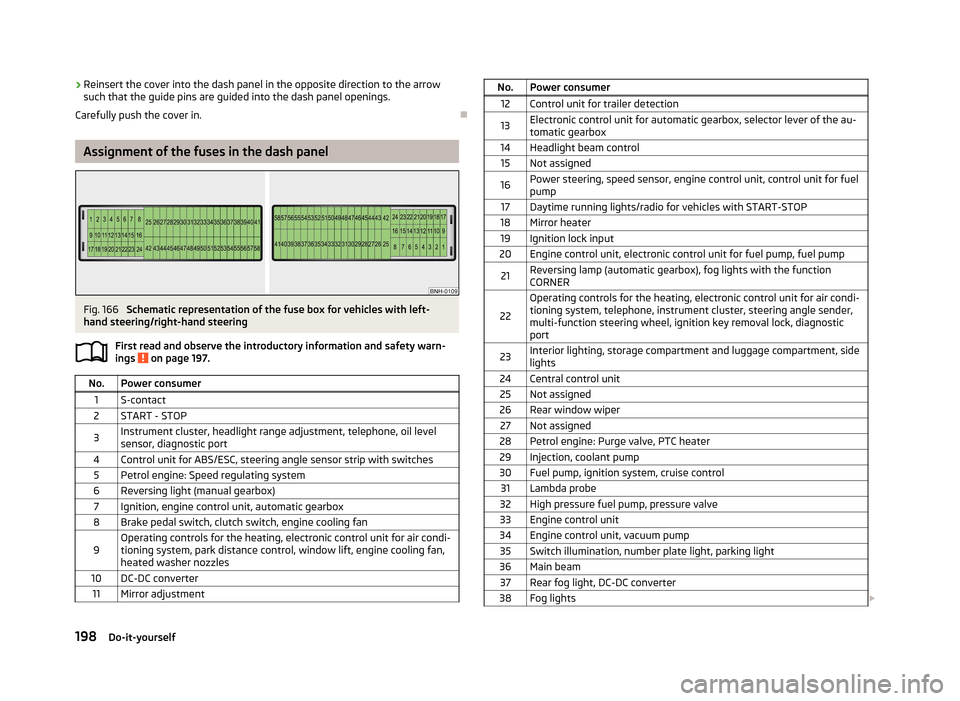
Assignment of the fuses in the dash panel
Fig. 166
Schematic representation of the fuse box for vehicles with left-
hand steering/right-hand steering
First read and observe the introductory information and safety warn-ings
on page 197.
No.Power consumer1S-contact2START - STOP3Instrument cluster, headlight range adjustment, telephone, oil level
sensor, diagnostic port4Control unit for ABS/ESC, steering angle sensor strip with switches5Petrol engine: Speed regulating system6Reversing light (manual gearbox)7Ignition, engine control unit, automatic gearbox8Brake pedal switch, clutch switch, engine cooling fan9Operating controls for the heating, electronic control unit for air condi-
tioning system, park distance control, window lift, engine cooling fan, heated washer nozzles10DC-DC converter11Mirror adjustmentNo.Power consumer12Control unit for trailer detection13Electronic control unit for automatic gearbox, selector lever of the au-tomatic gearbox14Headlight beam control15Not assigned16Power steering, speed sensor, engine control unit, control unit for fuel
pump17Daytime running lights/radio for vehicles with START-STOP18Mirror heater19Ignition lock input20Engine control unit, electronic control unit for fuel pump, fuel pump21Reversing lamp (automatic gearbox), fog lights with the function
CORNER
22
Operating controls for the heating, electronic control unit for air condi- tioning system, telephone, instrument cluster, steering angle sender,
multi-function steering wheel, ignition key removal lock, diagnostic
port23Interior lighting, storage compartment and luggage compartment, side
lights24Central control unit25Not assigned26Rear window wiper27Not assigned28Petrol engine: Purge valve, PTC heater29Injection, coolant pump30Fuel pump, ignition system, cruise control31Lambda probe32High pressure fuel pump, pressure valve33Engine control unit34Engine control unit, vacuum pump35Switch illumination, number plate light, parking light36Main beam37Rear fog light, DC-DC converter38Fog lights 198Do-it-yourself
Page 202 of 226
No.Power consumer39Air blower for heating40Not assigned41Heated front seats42Rear window heater43Horn44Windscreen wipers45Boot lid lock, central locking system46Alarm47Cigarette lighter, power socket in the luggage compartment48ABS49Turn signal lights, brake lights50DC-DC converter, radio51Electric windows (driver's window and rear left window)52Electric windows (front passenger's window and rear right)53Windscreen washer54START-STOP instrument cluster, steering wheel module, multi-function
steering wheel55Control unit for automatic gearbox56Headlight cleaning system57Low beam on the left58Low beam on the right
Fuses in the engine compartment
Fig. 167
Vehicle battery: Cover for the
fuse box (variant 1)
Fig. 168
Vehicle battery: Cover for the
fuse box (variant 2)
First read and observe the introductory information and safety warn-
ings on page 197.
Replacing fuses
›
Press the lock buttons on the cover together simultaneously in the direction of
the arrow
1
» Fig. 167 or » Fig. 168 .
›
Remove the cover in the direction of the arrow
2
.
›
Replace the appropriate fuse.
›
Place the cover on top of the fuse box.
›
Push in the interlocks on the cover and lock.
The cover must engage firmly.
199Fuses and light bulbs
Page 203 of 226
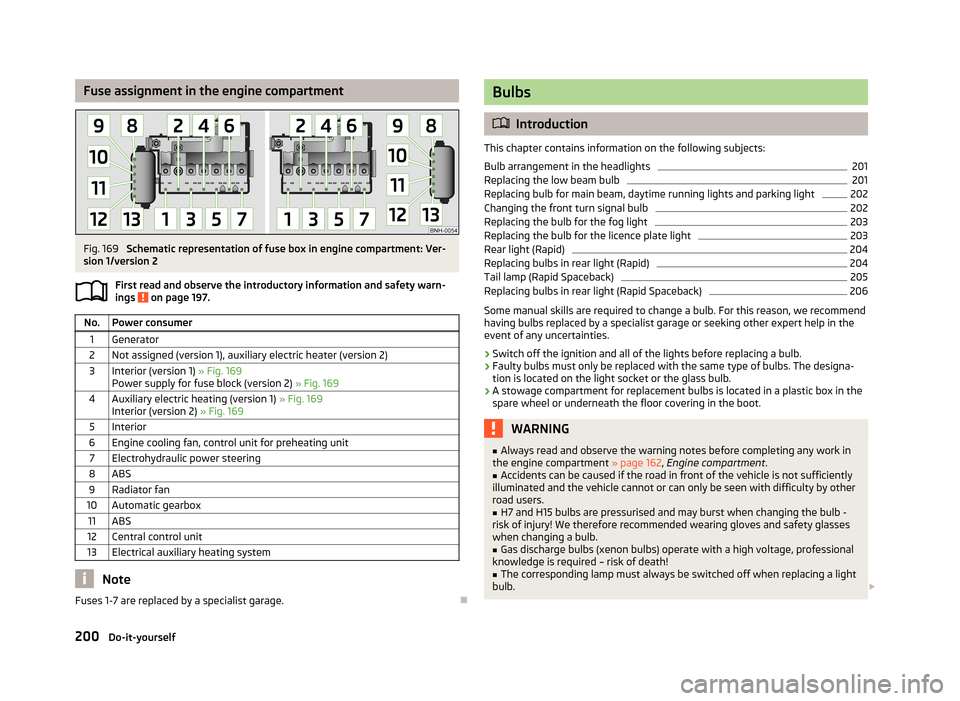
Fuse assignment in the engine compartmentFig. 169
Schematic representation of fuse box in engine compartment: Ver-
sion 1/version 2
First read and observe the introductory information and safety warn-
ings
on page 197.
No.Power consumer1Generator2Not assigned (version 1), auxiliary electric heater (version 2)3Interior (version 1) » Fig. 169
Power supply for fuse block (version 2) » Fig. 1694Auxiliary electric heating (version 1) » Fig. 169
Interior (version 2) » Fig. 1695Interior6Engine cooling fan, control unit for preheating unit7Electrohydraulic power steering8ABS9Radiator fan10Automatic gearbox11ABS12Central control unit13Electrical auxiliary heating system
Note
Fuses 1-7 are replaced by a specialist garage.
Bulbs
Introduction
This chapter contains information on the following subjects:
Bulb arrangement in the headlights
201
Replacing the low beam bulb
201
Replacing bulb for main beam, daytime running lights and parking light
202
Changing the front turn signal bulb
202
Replacing the bulb for the fog light
203
Replacing the bulb for the licence plate light
203
Rear light (Rapid)
204
Replacing bulbs in rear light (Rapid)
204
Tail lamp (Rapid Spaceback)
205
Replacing bulbs in rear light (Rapid Spaceback)
206
Some manual skills are required to change a bulb. For this reason, we recommend
having bulbs replaced by a specialist garage or seeking other expert help in the
event of any uncertainties.
› Switch off the ignition and all of the lights before replacing a bulb.
› Faulty bulbs must only be replaced with the same type of bulbs. The designa-
tion is located on the light socket or the glass bulb.
› A stowage compartment for replacement bulbs is located in a plastic box in the
spare wheel or underneath the floor covering in the boot.
WARNING■ Always read and observe the warning notes before completing any work in
the engine compartment » page 162, Engine compartment .■
Accidents can be caused if the road in front of the vehicle is not sufficiently
illuminated and the vehicle cannot or can only be seen with difficulty by other
road users.
■
H7 and H15 bulbs are pressurised and may burst when changing the bulb -
risk of injury! We therefore recommended wearing gloves and safety glasses
when changing a bulb.
■
Gas discharge bulbs (xenon bulbs) operate with a high voltage, professional
knowledge is required – risk of death!
■
The corresponding lamp must always be switched off when replacing a light
bulb.
200Do-it-yourself
Page 204 of 226
CAUTIONDo not take hold of the glass bulb with naked fingers (even the smallest amountof dirt reduces the working life of the light bulb). Use a clean cloth, napkin, or sim-
ilar.
Note
■ This Owner's Manual only describes the replacement of bulbs where it is possi-
ble to replace the bulbs on your own without any complications arising. Other bulbs must be replaced by a specialist garage.■
We recommend that a box of replacement bulbs always be carried in the vehi-
cle. Replacement bulbs can be purchased from ŠKODAOriginal Accessories.
■
We recommend having the headlight settings checked by a specialist garage af-
ter replacing a bulb in the main, low or fog beam.
■
Consult a specialist garage in the event of a failure in a xenon gas discharge
lamp.
Bulb arrangement in the headlights
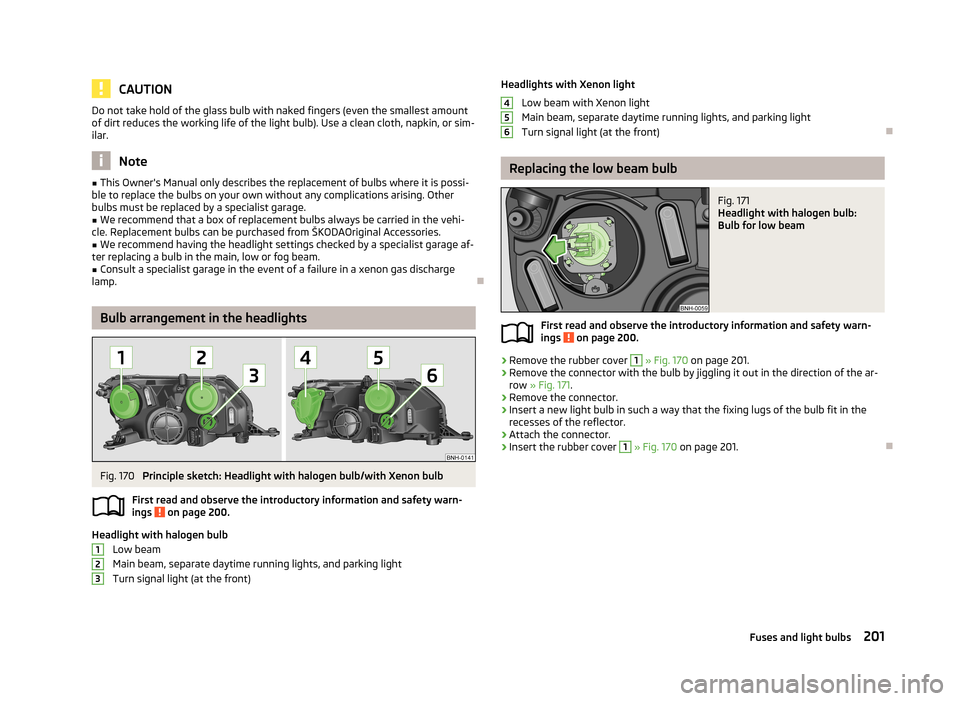
Fig. 170
Principle sketch: Headlight with halogen bulb/with Xenon bulb
First read and observe the introductory information and safety warn- ings
on page 200.
Headlight with halogen bulb
Low beam
Main beam, separate daytime running lights, and parking light
Turn signal light (at the front)
123Headlights with Xenon light
Low beam with Xenon light
Main beam, separate daytime running lights, and parking light
Turn signal light (at the front)
Replacing the low beam bulb
Fig. 171
Headlight with halogen bulb:
Bulb for low beam
First read and observe the introductory information and safety warn- ings on page 200.
›
Remove the rubber cover
1
» Fig. 170 on page 201.
›
Remove the connector with the bulb by jiggling it out in the direction of the ar-
row » Fig. 171 .
›
Remove the connector.
›
Insert a new light bulb in such a way that the fixing lugs of the bulb fit in the
recesses of the reflector.
›
Attach the connector.
›
Insert the rubber cover
1
» Fig. 170 on page 201.
456201Fuses and light bulbs
Page 205 of 226
Replacing bulb for main beam, daytime running lights and
parking lightFig. 172
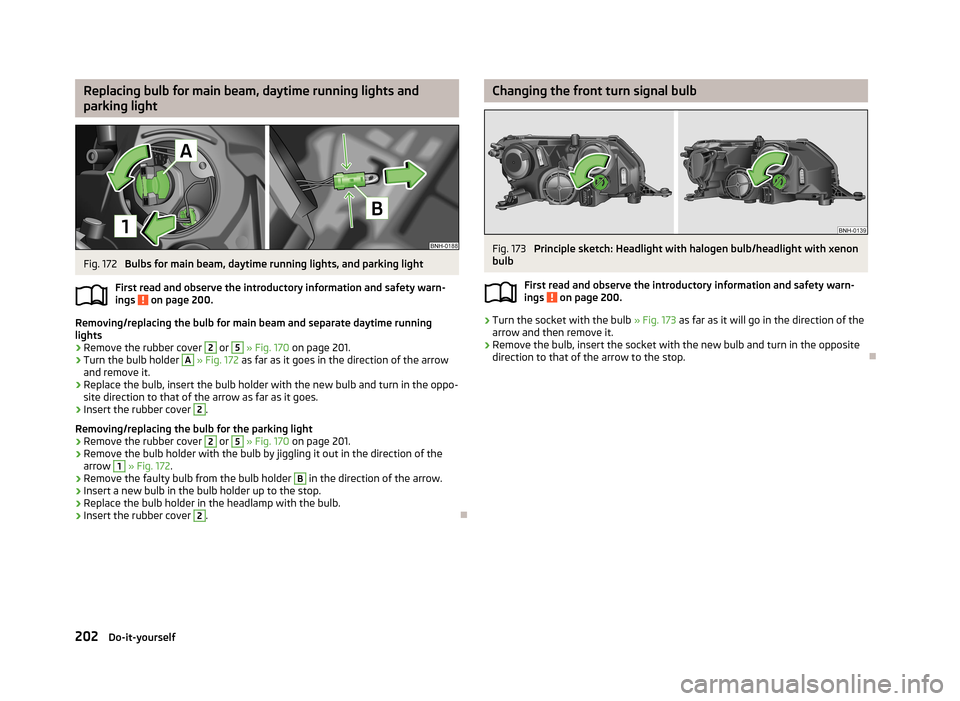
Bulbs for main beam, daytime running lights, and parking light
First read and observe the introductory information and safety warn-
ings
on page 200.
Removing/replacing the bulb for main beam and separate daytime running
lights
›
Remove the rubber cover
2
or
5
» Fig. 170 on page 201.
›
Turn the bulb holder
A
» Fig. 172 as far as it goes in the direction of the arrow
and remove it.
›
Replace the bulb, insert the bulb holder with the new bulb and turn in the oppo-
site direction to that of the arrow as far as it goes.
›
Insert the rubber cover
2
.
Removing/replacing the bulb for the parking light
›
Remove the rubber cover
2
or
5
» Fig. 170 on page 201.
›
Remove the bulb holder with the bulb by jiggling it out in the direction of the
arrow
1
» Fig. 172 .
›
Remove the faulty bulb from the bulb holder
B
in the direction of the arrow.
›
Insert a new bulb in the bulb holder up to the stop.
›
Replace the bulb holder in the headlamp with the bulb.
›
Insert the rubber cover
2
.
Changing the front turn signal bulbFig. 173
Principle sketch: Headlight with halogen bulb/headlight with xenon
bulb
First read and observe the introductory information and safety warn-ings
on page 200.
›
Turn the socket with the bulb » Fig. 173 as far as it will go in the direction of the
arrow and then remove it.
›
Remove the bulb, insert the socket with the new bulb and turn in the opposite direction to that of the arrow to the stop.
202Do-it-yourself
Page 206 of 226
Replacing the bulb for the fog lightFig. 174
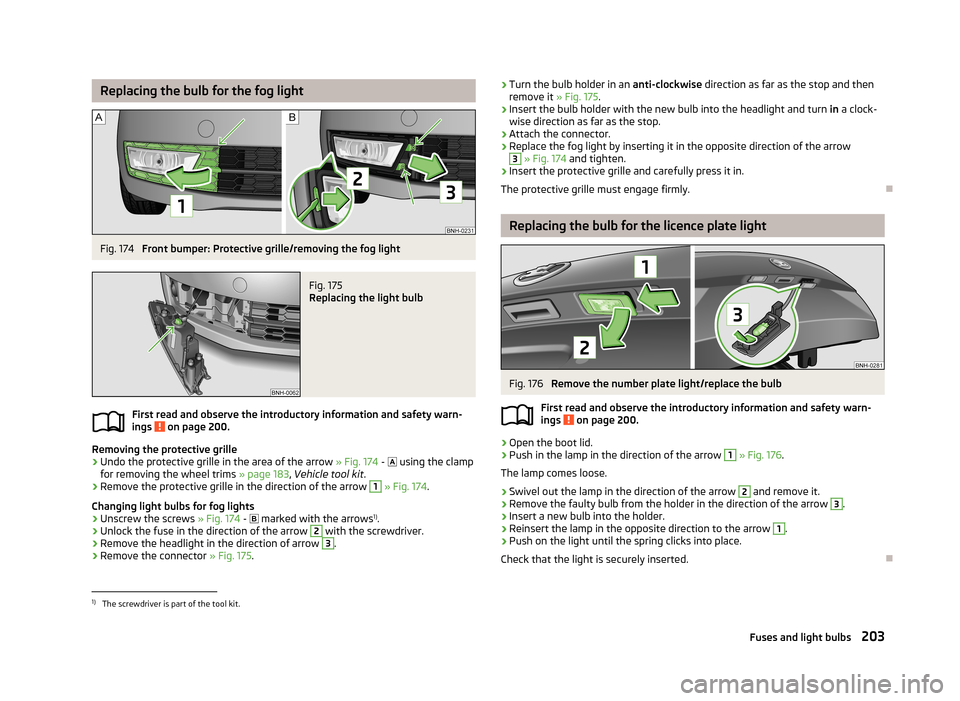
Front bumper: Protective grille/removing the fog light
Fig. 175
Replacing the light bulb
First read and observe the introductory information and safety warn-
ings on page 200.
Removing the protective grille
›
Undo the protective grille in the area of the arrow » Fig. 174 -
using the clamp
for removing the wheel trims » page 183, Vehicle tool kit .
›
Remove the protective grille in the direction of the arrow
1
» Fig. 174 .
Changing light bulbs for fog lights
›
Unscrew the screws » Fig. 174 -
marked with the arrows 1)
.
›
Unlock the fuse in the direction of the arrow
2
with the screwdriver.
›
Remove the headlight in the direction of arrow
3
.
›
Remove the connector » Fig. 175.
›Turn the bulb holder in an
anti-clockwise direction as far as the stop and then
remove it » Fig. 175.›
Insert the bulb holder with the new bulb into the headlight and turn in a clock-
wise direction as far as the stop.
›
Attach the connector.
›
Replace the fog light by inserting it in the opposite direction of the arrow
3
» Fig. 174 and tighten.
›
Insert the protective grille and carefully press it in.
The protective grille must engage firmly.
Replacing the bulb for the licence plate light
Fig. 176
Remove the number plate light/replace the bulb
First read and observe the introductory information and safety warn-
ings
on page 200.
›
Open the boot lid.
›
Push in the lamp in the direction of the arrow
1
» Fig. 176 .
The lamp comes loose.
›
Swivel out the lamp in the direction of the arrow
2
and remove it.
›
Remove the faulty bulb from the holder in the direction of the arrow
3
.
›
Insert a new bulb into the holder.
›
Reinsert the lamp in the opposite direction to the arrow
1
.
›
Push on the light until the spring clicks into place.
Check that the light is securely inserted.
1)
The screwdriver is part of the tool kit.
203Fuses and light bulbs
Page 216 of 226
Indicator light15
Running in105
Braking Information on braking
100
Breakdown kit188
Bulb failure Indicator light
18
Bulbs Indicator light
18
Replacing200
Tail lamp (Rapid Spaceback)205
Button in the driver's door Electrical power windows
38
C
Car computer See multifunction display
25
Car park ticket holder56
Carrier74
Cavity protection156
Central locking button34
Changing Brake fluid
171
Engine oil168
Front turn signal bulb202
Wheels184
Changing a wheel Follow-up work
185
Preliminary work184
Remove and attaching a wheel185
Charging a vehicle battery173
Check Fit ball head properly
121
Checking Battery electrolyte level
173
Brake fluid170
Coolant169
Engine oil167
Oil level167
Windscreen washer fluid165
Children and safety142
Child safety Side airbag
144
Child safety lock35
Child seat Classification
144
ISOFIX145
on the front passenger seat143
TOP TETHER146
Use of child seats144
Use of ISOFIX child seats145
Chrome parts refer to Taking care of your vehicle
155
Cigarette lighter59
Cleaning147
Alcantara158
Artificial leather158
cloths158
Covers of electrically heated seats159
Headlight lenses156
Natural leather158
Plastic parts154
Wheels156
Climatronic82
automatic mode83
Control elements82
Controlling blower84
Cooling system83
Defrosting windscreen84
recirculated air mode83
Setting the temperature83
Clock13
Clothes hook63
Cockpit 12-volt power outlet
60
Ashtray59
Cigarette lighter59
General view9
Lights45
Practical equipment56
Storage compartments56
Compartments56
Computer See multifunction display
25
Coolant168
Checking169
Indicator light16
Information messages16
Replenishing170
Temperature gauge11
CORNER See Fog lights with CORNER function
43
Correct seated position127
Driver128
Front passenger128
Instructions129
Rear seats128
Counter for distance driven12
Cruise control system Activating/deactivating
115
Changing the stored speed115
Indicator light21
Storing and maintaining speed115
Switching off temporarily115
Cruise Control System114
Cup holders58
D
DAY LIGHT See Daytime running lights
42
Daytime running lights42
Deactivating an airbag140
Decorative films155
Defrsoting rear window47
Delayed locking of the boot lid see Boot lid
38
Diesel refer to Fuel
162
Diesel fuel Operation in winter
162
213Index
Page 218 of 226
Fuel reserveIndicator light19
Fuses Assignment
197
Assignment of fuses in the dash panel198
Colour coding197
Fuse assignment in the engine compartment200
Replacing197
Fuses in the engine compartment Assignment
200
G
Gearbox Information messages
13
Gear change Gear recommendation
24
Information on the selected gear24
Gear changing Gear stick
101
General view Cockpit
9
Generator Indicator light
15
Glasses storage box62
Glow plug system Warning light
18
GSM85
H
Handbrake
100
Indicator light14
Hazard warning light system44
HBA112
Head airbag139
Headlight cleaning system Headlight cleaning system
49
HeadlightsBulb arrangement201
Driving abroad110
Headlight cleaning system49
Head restraint53
Heating Defrosting windows
78
Exterior mirror50
operating77
Rear window47
Recirculated air mode79
Seats54
Heating and air-conditioning76
Heating rear window47
HHC112
Hill Hold Control (HHC)112
Hooks66
Horn9
Hydraulic Brake Assist (HBA)112
I
Ice-scraper
155
Ice warning23
Ignition98
Immobiliser98
Indicator lights14
Individual settings Locking
34
Unlocking34
Inertia reels133
Information system22
Compass point display24
Door warning24
Gear recommendation24
Ice warning23
MAXI DOT display27
Multifunction display25
Operation22
Service interval display28
Instrument cluster10
Counter for distance driven12
Display11
Fuel gauge12
Indicator lights14
Overview10
Revolution counter11
Speedometer11
Temperature gauge11
Interior monitor36
ISOFIX145
J
Jack
183
Jacking points Raise vehicle
186
Jump-starting189, 190
K
Key Locking
32
Starting the engine98
Unlocking32
L
Lever Main beam
43
Turn signal43
Windscreen wipers49
Light Daytime running lights
42
Fog lights with CORNER function43
Parking light45
Replacing bulbs200
Light bulbs Rear light (Rapid)
204
Lighting Luggage compartment
64
215Index