height SKODA RAPID 2013 1.G User Guide
[x] Cancel search | Manufacturer: SKODA, Model Year: 2013, Model line: RAPID, Model: SKODA RAPID 2013 1.GPages: 226, PDF Size: 15.16 MB
Page 136 of 226
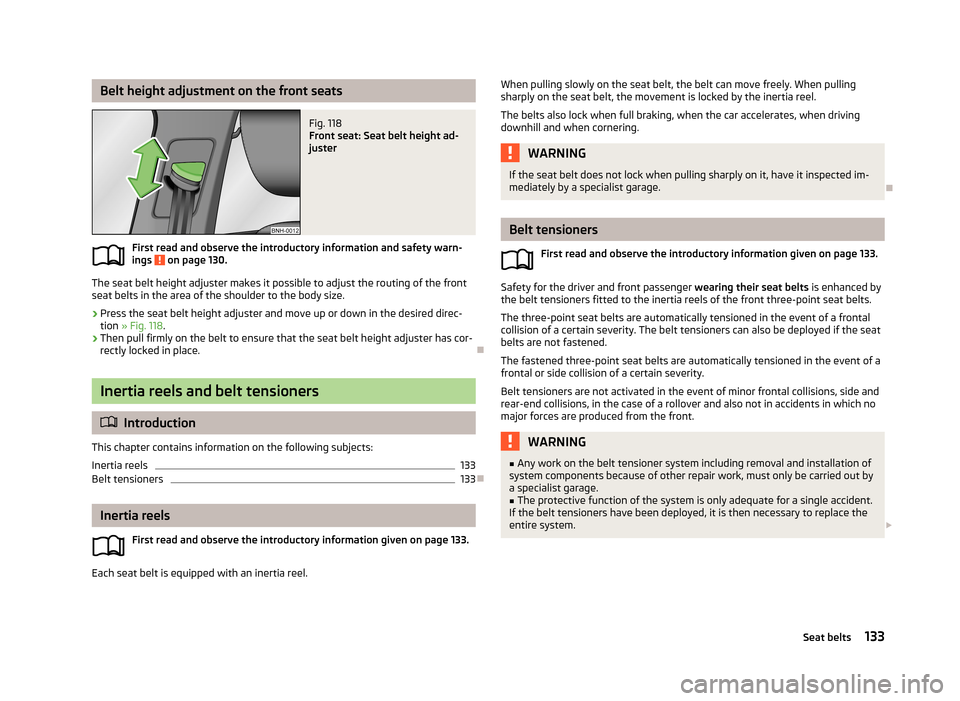
Belt height adjustment on the front seatsFig. 118
Front seat: Seat belt height ad-
juster
First read and observe the introductory information and safety warn-
ings on page 130.
The seat belt height adjuster makes it possible to adjust the routing of the front
seat belts in the area of the shoulder to the body size.
›
Press the seat belt height adjuster and move up or down in the desired direc- tion » Fig. 118 .
›
Then pull firmly on the belt to ensure that the seat belt height adjuster has cor-
rectly locked in place.
Inertia reels and belt tensioners
Introduction
This chapter contains information on the following subjects: Inertia reels
133
Belt tensioners
133
Inertia reels
First read and observe the introductory information given on page 133.
Each seat belt is equipped with an inertia reel.
When pulling slowly on the seat belt, the belt can move freely. When pulling
sharply on the seat belt, the movement is locked by the inertia reel.
The belts also lock when full braking, when the car accelerates, when driving
downhill and when cornering.WARNINGIf the seat belt does not lock when pulling sharply on it, have it inspected im- mediately by a specialist garage.
Belt tensioners
First read and observe the introductory information given on page 133.
Safety for the driver and front passenger wearing their seat belts is enhanced by
the belt tensioners fitted to the inertia reels of the front three-point seat belts.
The three-point seat belts are automatically tensioned in the event of a frontal
collision of a certain severity. The belt tensioners can also be deployed if the seat
belts are not fastened.
The fastened three-point seat belts are automatically tensioned in the event of a frontal or side collision of a certain severity.
Belt tensioners are not activated in the event of minor frontal collisions, side andrear-end collisions, in the case of a rollover and also not in accidents in which no
major forces are produced from the front.
WARNING■ Any work on the belt tensioner system including removal and installation of
system components because of other repair work, must only be carried out by
a specialist garage.■
The protective function of the system is only adequate for a single accident.
If the belt tensioners have been deployed, it is then necessary to replace the
entire system.
133Seat belts
Page 146 of 226
Use of a child seat on the front passenger seat
Never use a backwards-facing child restraint system on a seat that is protected by an active airbag installed in front of it. This could cause the child severe injury
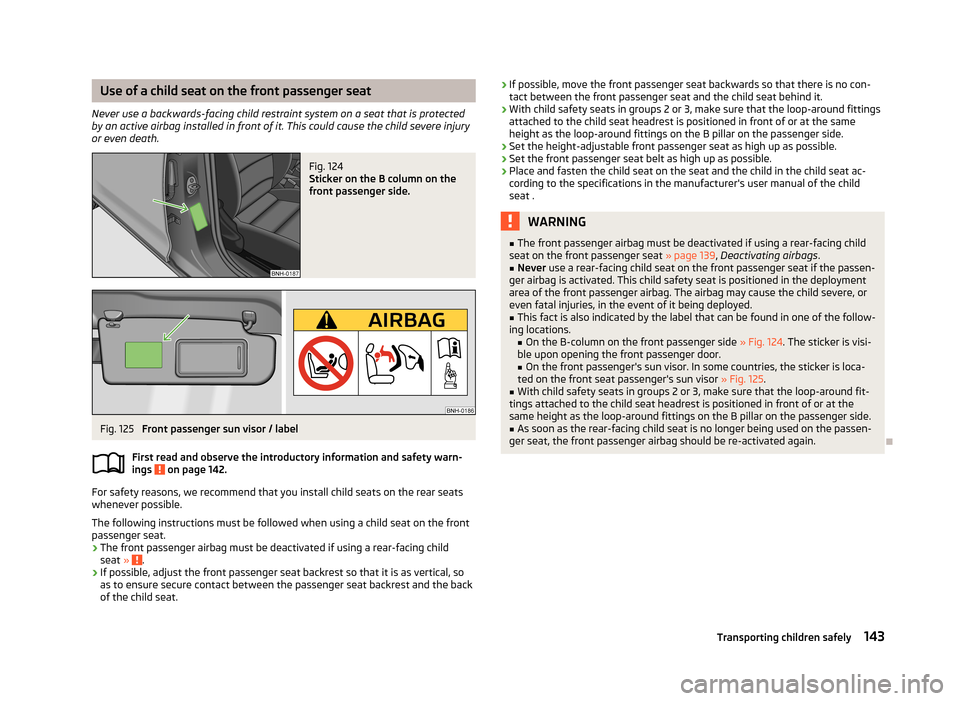
or even death.Fig. 124
Sticker on the B column on the
front passenger side.
Fig. 125
Front passenger sun visor / label
First read and observe the introductory information and safety warn-
ings
on page 142.
For safety reasons, we recommend that you install child seats on the rear seats
whenever possible.
The following instructions must be followed when using a child seat on the front passenger seat.
› The front passenger airbag must be deactivated if using a rear-facing child
seat »
.
› If possible, adjust the front passenger seat backrest so that it is as vertical, so
as to ensure secure contact between the passenger seat backrest and the back of the child seat.
› If possible, move the front passenger seat backwards so that there is no con-
tact between the front passenger seat and the child seat behind it.
› With child safety seats in groups 2 or 3, make sure that the loop-around fittings
attached to the child seat headrest is positioned in front of or at the same
height as the loop-around fittings on the B pillar on the passenger side.
› Set the height-adjustable front passenger seat as high up as possible.
› Set the front passenger seat belt as high up as possible.
› Place and fasten the child seat on the seat and the child in the child seat ac-
cording to the specifications in the manufacturer's user manual of the child seat .WARNING■ The front passenger airbag must be deactivated if using a rear-facing child
seat on the front passenger seat » page 139, Deactivating airbags .■
Never use a rear-facing child seat on the front passenger seat if the passen-
ger airbag is activated. This child safety seat is positioned in the deployment
area of the front passenger airbag. The airbag may cause the child severe, or
even fatal injuries, in the event of it being deployed.
■
This fact is also indicated by the label that can be found in one of the follow-
ing locations. ■ On the B-column on the front passenger side » Fig. 124. The sticker is visi-
ble upon opening the front passenger door. ■ On the front passenger's sun visor. In some countries, the sticker is loca-
ted on the front seat passenger's sun visor » Fig. 125.
■
With child safety seats in groups 2 or 3, make sure that the loop-around fit-
tings attached to the child seat headrest is positioned in front of or at the
same height as the loop-around fittings on the B pillar on the passenger side.
■
As soon as the rear-facing child seat is no longer being used on the passen-
ger seat, the front passenger airbag should be re-activated again.
143Transporting children safely
Page 168 of 226
›Take the bonnet support out of its holder 3
» Fig. 133 in the direction of the
arrow and secure the opened bonnet by inserting the end of the support into the opening 4
.
Closing
›
Lift the bonnet slightly and unhook the bonnet support. Insert the bonnet sup-
port into the designated holder
3
» Fig. 133 .
›
Let the bonnet drop into the lock carrier lock from a height of around 20 cm – do
not push it in .
WARNINGCheck that the bonnet is closed properly.
CAUTION
Never open the bonnet using the release lever » Fig. 132.
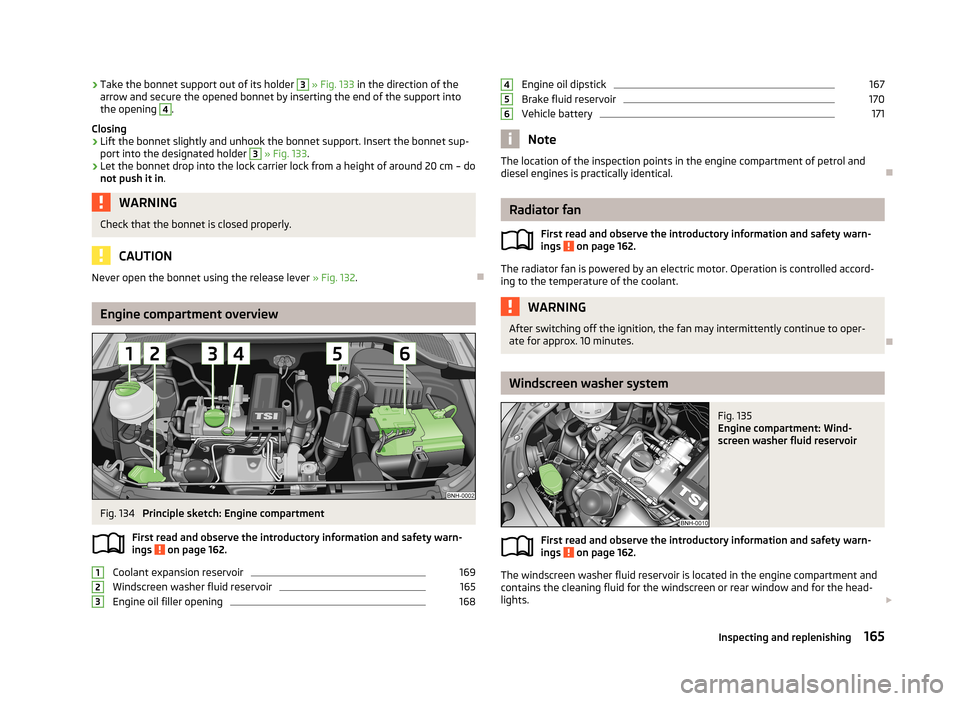
Engine compartment overview
Fig. 134
Principle sketch: Engine compartment
First read and observe the introductory information and safety warn- ings
on page 162.
Coolant expansion reservoir
169
Windscreen washer fluid reservoir
165
Engine oil filler opening
168123Engine oil dipstick167Brake fluid reservoir170
Vehicle battery
171
Note
The location of the inspection points in the engine compartment of petrol and
diesel engines is practically identical.
Radiator fan
First read and observe the introductory information and safety warn-
ings
on page 162.
The radiator fan is powered by an electric motor. Operation is controlled accord-
ing to the temperature of the coolant.
WARNINGAfter switching off the ignition, the fan may intermittently continue to oper-
ate for approx. 10 minutes.
Windscreen washer system
Fig. 135
Engine compartment: Wind-
screen washer fluid reservoir
First read and observe the introductory information and safety warn- ings on page 162.
The windscreen washer fluid reservoir is located in the engine compartment and
contains the cleaning fluid for the windscreen or rear window and for the head-
lights.
456165Inspecting and replenishing
Page 180 of 226
Always check the inflation pressure when the tyres are cold. Do not reduce the
higher pressure of warm tyres.
With greater additional load, adjust the tyre inflation pressure accordingly.
Driving style
Fast cornering, sharp acceleration and braking increase the wear of your tyres.
Balancing wheels
The wheels of a new vehicle are balanced. When driving, however, there are a
range of factors that may result in an imbalance. This may become apparent by a
“vibration” in the steering.
Have the wheels rebalanced after replacing the tyres.
Wheel alignment errors
Incorrect wheel alignment at the front or rear leads to excess wear of the tyres.
Tyre damage
Drive over kerbs and other such obstacles slowly and at right angles wherever
possible in order to avoid damage to tyres and wheel trims.
We recommend checking your tyres and wheel rims for damage (punctures, cuts,
splits and bulges, etc.) on a regular basis. Remove foreign bodies (e.g. small
stones) from the tyre tread immediately.
Replacing wheels
If significantly greater wear is present on the front tyres, we recommend replac-
ing the front wheels with the rear wheels as shown in the diagram » Fig. 142 . You
will then obtain approximately the same life for all the tyres.
We recommend that you swap the tyres every 10,000 km in order to achieve even wear on all tyres and to ensure optimal service life for the tyres.
Storing tyres
Identify disassembled tyres so that the previous direction of rotation can be maintained if the tyres are reassembled.
Always store wheels or tyres in a cool, dry place that is as dark as possible. Tyres
which are not fixed to a wheel trim should be stored upright.
Wear indicators
The base of the tread of the tyres has 1.6 mm high wear indicators installed.
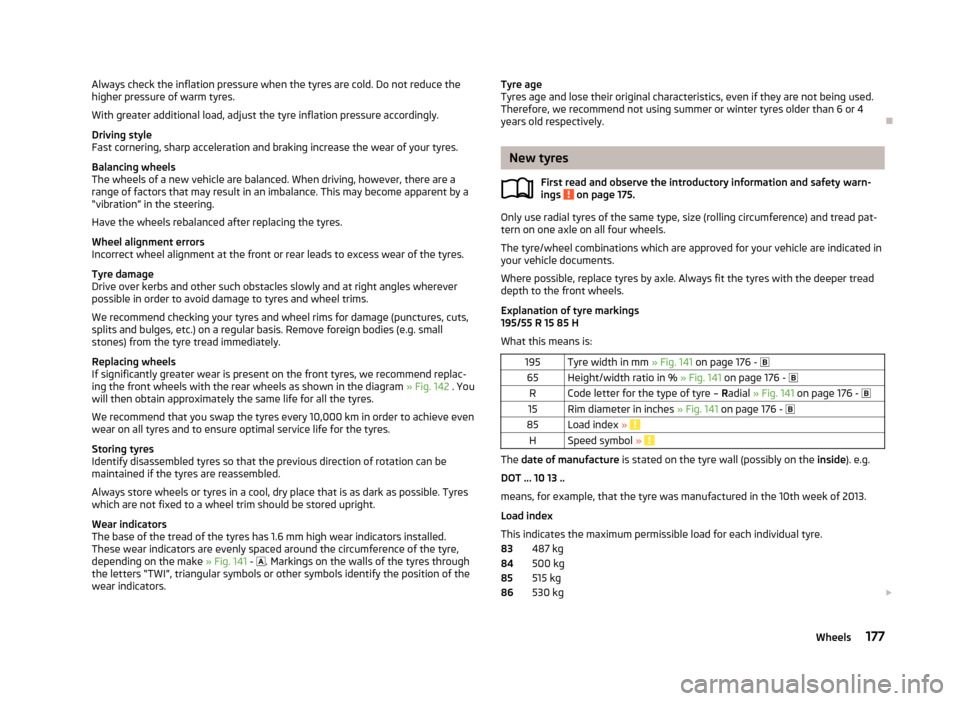
These wear indicators are evenly spaced around the circumference of the tyre, depending on the make » Fig. 141 -
. Markings on the walls of the tyres through
the letters “TWI”, triangular symbols or other symbols identify the position of the
wear indicators.Tyre age
Tyres age and lose their original characteristics, even if they are not being used.
Therefore, we recommend not using summer or winter tyres older than 6 or 4
years old respectively.
New tyres
First read and observe the introductory information and safety warn-
ings
on page 175.
Only use radial tyres of the same type, size (rolling circumference) and tread pat-
tern on one axle on all four wheels.
The tyre/wheel combinations which are approved for your vehicle are indicated in
your vehicle documents.
Where possible, replace tyres by axle. Always fit the tyres with the deeper tread
depth to the front wheels.
Explanation of tyre markings
195/55 R 15 85 H
What this means is:
195Tyre width in mm » Fig. 141 on page 176 - 65Height/width ratio in % » Fig. 141 on page 176 - RCode letter for the type of tyre – Radial » Fig. 141 on page 176 - 15Rim diameter in inches » Fig. 141 on page 176 - 85Load index » HSpeed symbol »
The date of manufacture is stated on the tyre wall (possibly on the inside). e.g.
DOT ... 10 13 ..
means, for example, that the tyre was manufactured in the 10th week of 2013.
Load index
This indicates the maximum permissible load for each individual tyre. 487 kg
500 kg
515 kg
530 kg
83848586177Wheels
Page 211 of 226
The operating weight also contains the weight of the driver (75 kg), the weight ofthe operating fluids, the tool kit, and a fuel tank filled to 90 % capacity.
It is possible to calculate the approximate loading capacity from the differencebetween the permissible total weight and the operating weight »
.
The payload consists of the following components: › Passengers
› All items of luggage and other loads
› Roof load including roof rack system
› Equipment not included in the operating weight
› Trailer drawbar load when towing a trailer (max. 50 kg).
Fuel consumption and CO 2 emissions according to ECE regulations and EU
directives
The measurement of the intra-urban cycle begins with a cold start of the engine. Afterwards standard urban driving is simulated.
In the extra-urban driving cycle, the vehicle is accelerated and decelerated in all
gears, corresponding to daily routine driving conditions. The driving speed varies
between 0 and 120 km/h.
The calculation of the combined fuel consumption considers a weighting of about 37 % for the intra-urban cycle and 63 % for the extra-urban cycle.
WARNINGDo not exceed the specified maximum permissible weights – risk of accident
and damage!
Note
■ If required, you can find out the precise weight of your vehicle at a specialist ga-
rage.■
The fuel consumption and emission values have been determined in accordance
with rules and under conditions set out by legal or technical requirements for de-
termining operational and technical data for motor vehicles.
■
Depending on the range of equipment, style of driving, traffic situation, weather
influences and vehicle condition, consumption values may deviate from the indi-
cated values.
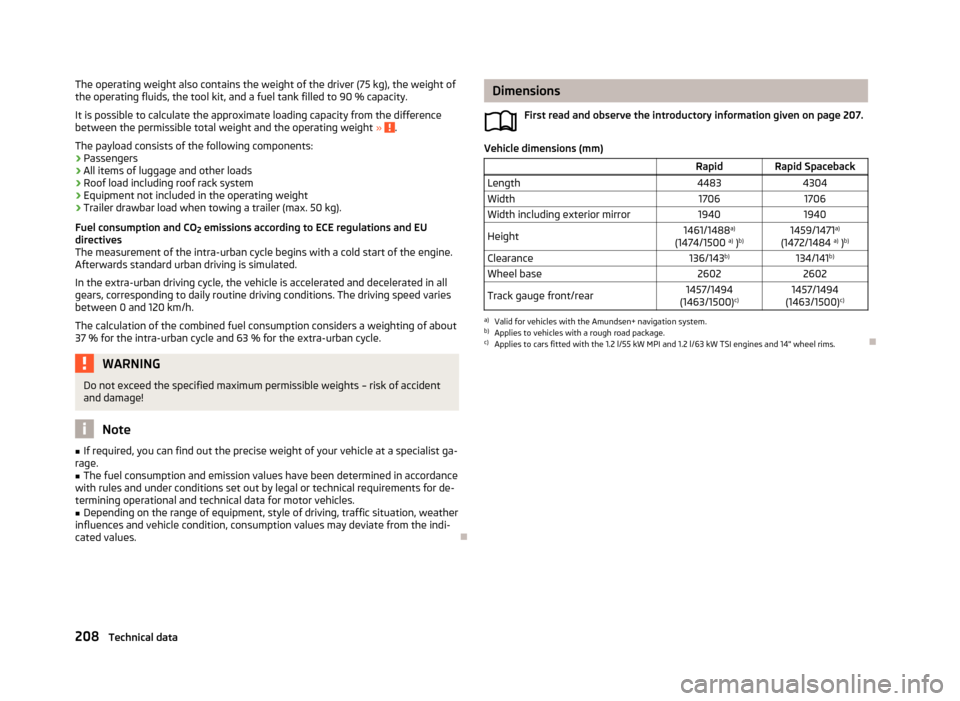
Dimensions
First read and observe the introductory information given on page 207.
Vehicle dimensions (mm)
RapidRapid SpacebackLength44834304Width17061706Width including exterior mirror19401940Height1461/1488 a)
(1474/1500 a)
) b)1459/1471 a)
(1472/1484 a)
) b)Clearance136/143 b)134/141b)Wheel base26022602Track gauge front/rear1457/1494
(1463/1500) c)1457/1494
(1463/1500) c)a)
Valid for vehicles with the Amundsen+ navigation system.
b)
Applies to vehicles with a rough road package.
c)
Applies to cars fitted with the 1.2 l/55 kW MPI and 1.2 l/63 kW TSI engines and 14" wheel rims.
208Technical data
Page 215 of 226
Index
A
Abroad Driving abroad
110
Unleaded petrol110
ABS Function
112
Warning light18
Accessories149
Adjusting Belt height
133
Exterior mirror50
Head restraints53
Interior mirror50
Manual air conditioning81
Seat53
Seats52
Steering wheel96
Adjusting the seats52, 127
Adjustment Beam range
41
Aerial153
Airbag135
Deactivating140
Deactivating the front passenger airbag140
Deployment135
Front airbag137
Head airbag139
Indicator light20
Modifications and damage to the airbag system151
Side airbag138
Airbag system135
Air conditioning system Air outlets
76
Climatronic82
Manual air conditioning system79
Air outlets76
Alarm Switching off36
Triggering36
Anti-theft alarm system Activating/deactivating
36
Trailer125
Antilock Braking System112
Armrest Front
55
Rear55
Artificial leather158
Ashtray59
ASR warning light
17
Assist system ABS
112
Assist systems111
ABS18
ASR17
Cruise Control System114
EDL112
ESC17, 111
HBA112
HHC112
Parking aid113
START-STOP116
TCS112
Auto Check Control13
Automatic gearbox Selector lever-emergency unlocking
195
Starting-off and driving103
Tiptronic103
Automatic load deactivation174
Automatic transmission101
Kickdown104
Malfunction104
Selector lever lock103
Using the selector lever102
AUX95
Avoiding damage to the vehicle Driving through water
109
Avoiding damage to your vehicle109
B
Ball head Check fitting
121
Fitting121
Ready position120
Removing122
Battery In the remote control key
193
Belts130
Belt tensioners133
Bonnet Closing
164
Opening164
Boot Class N1 vehicles
65
Double-sided floor covering70
Flexible storage compartment69
Hooks66
Meshed pocket for storage70
See Boot lid38
Storage compartments in the boot69
Boot cover Parking position
68
Boot lid Automatic locking
38
Closing38
Opening38
Brake booster100
Brake fluid170
Changing171
Checking170
Information messages15
Brakes Brake assist systems
111
Brake booster100
Brake fluid170
Handbrake100
212Index
Page 220 of 226
Power outlet12 V60
Power steering97
Indicator light17
Practical features56
Meshed pockets on the front seat backrests64
Storage compartment in centre console58
Storage compartment on the passenger side63
Storage pockets on the front seats64
Waste container60
R
Radiator fan
165
Raise vehicle186
Rear fog light44
Indicator light18
Rear interior light46
Rear mirror49
Exterior mirror50
Interior mirror50
recirculated air mode Climatronic
83
Recirculated air mode Manual air conditioning
81
Refuelling160
Fuel160
Remote control Locking
33
Replacing the battery193
Synchronisation process194
Unlocking33
Remote control key Replacing the battery
193
Repairs and technical alterations149
Replacing Bulb for main beam, daytime running lights andparking light
202
Bulb for the fog light203
Bulb for the licence plate light203
Bulb in rear light (Rapid Spaceback)206
Bulb in rear light (Rapid)204
Bulbs200
Fuses197
Fuses in the dash panel197
Fuses in the engine compartment199
Low beam bulb201
Vehicle battery174
Windscreen wiper blades195
Wiper blades196
Replenishing Coolant
170
Engine oil168
Windscreen washer fluid165
Revolution counter11
Roof luggage rack Attachment points
74
Roof rack system74
Roof load75
Running-in The first 1500 km
104
Running in Brake pads
105
Engine104
Tyres105
S
SAFE See Safe securing system
33
SAFELOCK See Safe securing system
33
Safe securing system33
Safety126
Child safety142
Child safety seats142
Correct seated position127
Head restraints53
ISOFIX145
TOP TETHER146
Saving electrical energy105
Seals Taking care of your vehicle155
Seat Adjusting
53
Seat belt warning light
15
Seat belts130
Belt tensioners133
Cleaning159
fastening and unfastening132
Height adjustment133
Inertia reels133
The physical principle of a frontal collision131
Seat features54
Seats folding forward
55
Front armrest55
Head restraints53
Heating54
Rear armrest55
Seats and useful equipment52
Adjusting the seats52
see automatic gearbox Manual shifting of gears on the multifunction
steering wheel
103
Selector lever see Using the selector lever
102
Selector lever lock Indicator light
21
Service150
Service interval display28
Service intervals147
Setting Lower position of the variable loading floor
72
Upper position of the variable loading floor71
Setting the clock Clock
13
Shelves56
Shifting gears Driving and saving energy
106
217Index
Page 222 of 226
UnlockingIndividual settings34
Key32
Remote control33
Vehicle key32
Unlocking and locking31
USB95
Useful equipment 12-volt power outlet
60
Ashtray59
Car park ticket holder56
Cigarette lighter59
Clothes hook63
Cup holders58
Glasses storage box62
Holder for reflective vest57
Multimedia holder61
Storage compartment in the front arm rest62
Storage compartments in the doors57
Using the information system22
Using the selector lever102
V
Variable loading floor
70
Folding up73
Inserting72
Lower position72
Parking position73
Removing72
Upper position71
Vehicle battery Automatic load deactivation
174
charging173
Checking the battery electrolyte level173
Cover172
Operation in winter173
Replacing174
Safety instructions171
Vehicle care147
Alcantara158
Artificial leather158
Cloths158
Vehicle Condition See Auto Check Control
13
Vehicle data sticker207
Vehicle dimensions208
Vehicle height208
vehicle identification number - VIN207
Vehicle key Locking
32
Unlocking32
Vehicle length208
Vehicle tool kit183
Vehicle width208
Vest Holder for reflective vest
57
Visibility46
Visors see Sun visors
47
W
Warning at excessive speeds
27
Warning triangle182
Warranty5
Washing147
Automatic car wash system153
by hand152
Chrome parts155
High-pressure cleaner153
Waste container60
Water Driving through
109
Wax treatment See Taking care of your vehicle
154
Weights207
Wheel bolts Anti-theft wheel bolt186
Caps180
Loosening and tightening185
Wheel rims175
Wheels Bolts
180
Changing184
Full trim180
General information175
Load index177
Replacing wheels176
Service life of tyres176
Snow chains181
Spare wheel179
Speed symbol178
Storing wheels176
Temporary spare wheel179
Tyre pressure176
Tyre sizes176
Tyre wear indicator176
Unidirectional tyres178
Winter tyres181
Window Interior mirror
50
Windows De-icing
155
See Electrical power windows38
Windscreen washer fluid Checking
165
Replenishing165
Warning light20
Winter165
Windscreen washer system165
Windscreen wipers49
Windscreen wiper Replacing the front windscreen wiper blades
195
Service position195
219Index