coolant capacity SKODA RAPID 2013 1.G Owner's Manual
[x] Cancel search | Manufacturer: SKODA, Model Year: 2013, Model line: RAPID, Model: SKODA RAPID 2013 1.GPages: 226, PDF Size: 15.16 MB
Page 15 of 226
Cold range
If the pointer is still in the left area of the scale, this indicates that the engine has not yet reached its operating temperature. Avoid high speeds, full throttle and
high engine loads. This prevents possible damage to the engine.
The operating range
The engine has reached its operating temperature as soon as the pointer moves into the mid-range of the scale. At very high ambient temperatures or heavy en- gine loads, the pointer may move even further to the right.
High temperature range
If the pointer reaches the red area of the scale, the coolant temperature is too high. Further information » page 16, Coolant .
CAUTION
Additional headlights and other attached components in front of the air inlet im-
pair the cooling efficiency of the coolant.
Fuel gauge
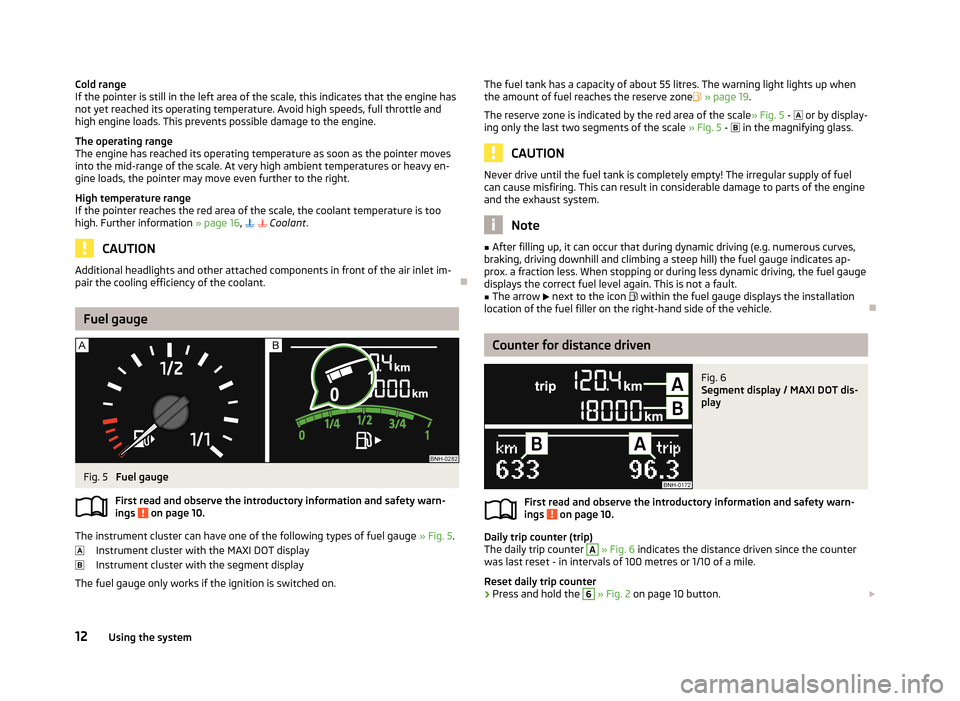
Fig. 5
Fuel gauge
First read and observe the introductory information and safety warn-
ings
on page 10.
The instrument cluster can have one of the following types of fuel gauge » Fig. 5.
Instrument cluster with the MAXI DOT display
Instrument cluster with the segment display
The fuel gauge only works if the ignition is switched on.
The fuel tank has a capacity of about 55 litres. The warning light lights up when the amount of fuel reaches the reserve zone » page 19 .
The reserve zone is indicated by the red area of the scale » Fig. 5 - or by display-
ing only the last two segments of the scale » Fig. 5 - in the magnifying glass.
CAUTION
Never drive until the fuel tank is completely empty! The irregular supply of fuel
can cause misfiring. This can result in considerable damage to parts of the engine
and the exhaust system.
Note
■ After filling up, it can occur that during dynamic driving (e.g. numerous curves,
braking, driving downhill and climbing a steep hill) the fuel gauge indicates ap-
prox. a fraction less. When stopping or during less dynamic driving, the fuel gauge displays the correct fuel level again. This is not a fault.■
The arrow next to the icon within the fuel gauge displays the installation
location of the fuel filler on the right-hand side of the vehicle.
Counter for distance driven
Fig. 6
Segment display / MAXI DOT dis-
play
First read and observe the introductory information and safety warn-
ings on page 10.
Daily trip counter (trip)
The daily trip counter
A
» Fig. 6 indicates the distance driven since the counter
was last reset - in intervals of 100 metres or 1/10 of a mile.
Reset daily trip counter
›
Press and hold the
6
» Fig. 2 on page 10 button.
12Using the system
Page 171 of 226
Oil level within range CThe engine must be topped up with oil so that the oil level at least reaches the
range B
.
The engine consumes a little oil. The oil consumption may be as much as 0.5 l/
1 000 km depending on your style of driving and the conditions under which you
operate your vehicle. Consumption may be slightly higher than this during the
first 5 000 kilometres.
The oil level must be checked at regular intervals. We recommend after each time
you refuel or prior to making a long journey.
We recommend maintaining the oil level within the range
A
, but not above , if
the engine has been operating at high loads, for example, during a lengthy motor-
way trip during the summer months, towing a trailer or negotiating a high moun- tain pass.
If the oil level is too low, this will be indicated by an indicator light in the instru- ment cluster » page 16,
Engine Oil . Check the oil level using the dipstick as
soon as possible. Add oil accordingly.
CAUTION
The oil level must not exceed level A » Fig. 136 - risk of damaging the exhaust
system!
Replenishing
First read and observe the introductory information and safety warn-
ings
on page 166.
›
Check the oil level » page 167.
›
Unscrew the cap of the engine oil filler opening » Fig. 134
on page 165.
›
Replenish the oil in portions of 0.5 litres in accordance with the correct specifi-
cations » page 167 .
›
Check the oil level » page 167.
›
Carefully screw on the oil filler opening cap and push the dipstick in fully.
Changing
First read and observe the introductory information and safety warn-ings
on page 166.
The engine oil must be changed according to prescribed service inter-
vals » page 147 or according to the service interval display » page 28, Service in-
terval display .
Coolant
Introduction
This chapter contains information on the following subjects:
Capacity
169
Checking the coolant level
169
Replenishing
170
The coolant consists of water with coolant additive. This mixture guarantees anti- freeze protection, protects the cooling/heater system against corrosion and pre-
vents lime formation.
Vehicles exported to countries with a mild climate are already factory-filled with
a coolant which offers antifreeze protection down to about -25 ℃. In these coun-
tries, the concentration of coolant additive should be at least 40%.
Vehicles exported to countries with a cold climate are already factory-filled with a
coolant which offers antifreeze protection down to about -35 °C. In these coun-
tries, the concentration of coolant additive should be at least 50%.
If a higher concentration of antifreeze is required for climatic reasons, the con-centration of coolant additive can be increased up to a maximum of 60% (anti-
freeze protection down to approx. -40 °C).
When refilling, only use antifreeze with the name specified on the coolant expan- sion tank » Fig. 137 on page 169.
168General Maintenance
Page 172 of 226
WARNING■The engine compartment of your car is a hazardous area. The following
warning instructions must be followed at all times when working in the en-
gine compartment » page 162.■
Do not continue your journey if for some reason it is not possible to fill with
coolant under the current circumstances . Switch off the engine and seek
assistance from a specialist garage.
CAUTION
■ The concentration of coolant additive in the coolant must never be under 40%.■Over 60% of coolant additive in the coolant reduces the antifreeze protection
and cooling effect.■
A coolant additive that does not comply with the correct specifications can sig-
nificantly reduce the corrosion protection.
■
Any faults resulting from corrosion may cause a loss of coolant and can conse-
quently result in major engine damage!
■
Do not fill the coolant above the mark
A
» Fig. 137 on page 169.
■
If a fault causes the engine to overheat, we recommend visiting a specialist ga-
rage, as otherwise serious engine damage may occur.
Capacity
First read and observe the introductory information and safety warn-
ings
on page 168.
Coolant capacity (in litres)
Petrol enginesFilling level1.2 l/55 kW4.21.2 l/63, 77 kW TSI7.01.4 l/90 kW TSI7.01.6 l/77 kW4.5Diesel engineFilling level1.6 l/66, 77 kW TDI CR6.5
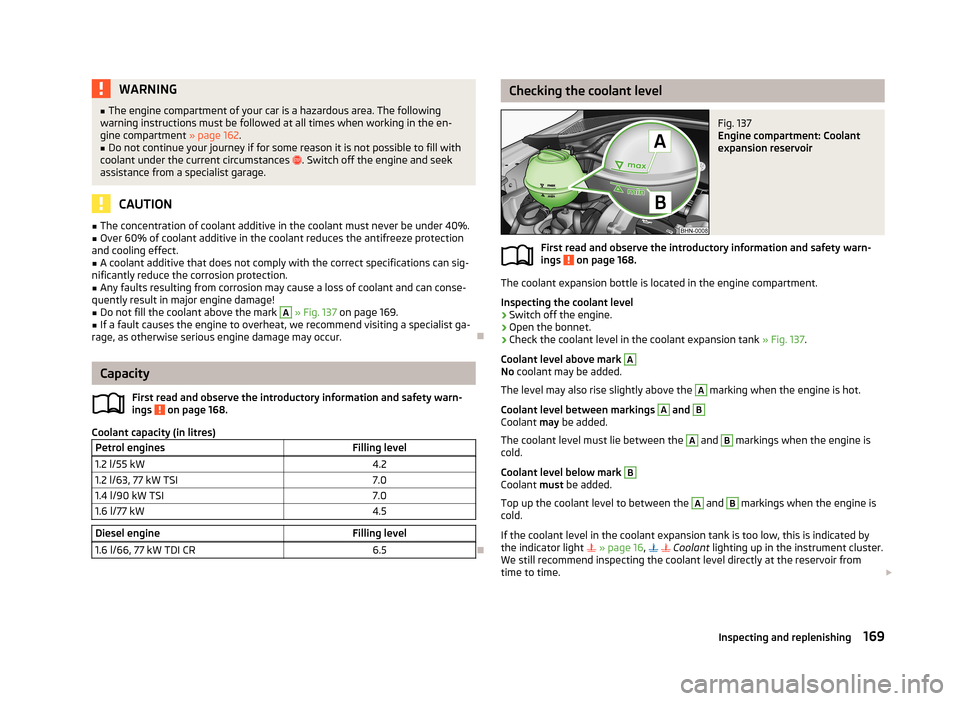
Checking the coolant levelFig. 137
Engine compartment: Coolant
expansion reservoir
First read and observe the introductory information and safety warn-
ings on page 168.
The coolant expansion bottle is located in the engine compartment.
Inspecting the coolant level
›
Switch off the engine.
›
Open the bonnet.
›
Check the coolant level in the coolant expansion tank » Fig. 137.
Coolant level above mark
A
No coolant may be added.
The level may also rise slightly above the
A
marking when the engine is hot.
Coolant level between markings
A
and
B
Coolant may be added.
The coolant level must lie between the
A
and
B
markings when the engine is
cold.
Coolant level below mark
B
Coolant must be added.
Top up the coolant level to between the
A
and
B
markings when the engine is
cold.
If the coolant level in the coolant expansion tank is too low, this is indicated by
the indicator light
» page 16 ,
Coolant lighting up in the instrument cluster.
We still recommend inspecting the coolant level directly at the reservoir from
time to time.
169Inspecting and replenishing
Page 217 of 226
Diesel particle filter19
Information messages19
Digital clock13
Dipstick167
Disconnecting and reconnecting vehicle battery
174
Display11
Compass points24
Coolant temperature11
Correct gear changes24
Fuel supply12
Service intervals28
Display of the second speed13
Distance driven12
Door Child safety lock
35
Closing35
Indicator light for an open door15
Opening35
Door locking Emergency
194
Doors Emergency locking
194
Double-sided floor covering70
Driving Abroad
110
Driving through water on streets109
Emissions207
Fuel consumption207
Maximum speed209
Driving economically Economical gear changing
106
Driving through water109
E
Economical and environmentally friendly driving 105
Economical driving Ballast
107
Driving at full throttle106
Idling106
Looking ahead106
Regular maintenance107
Saving energy108
Short distances107
Tyre inflation pressure107
EDL112
Electrical power windows Button in the driver's door
38, 39
Button in the rear door39
Electronic Differential Lock (EDL)112
Electronic immobiliser98
Electronic Stability Control (ESC)111
Emergency Changing a wheel
184
Door locking194
Hazard warning light system44
jump-starting190
Jump-starting189
Selector lever-unlocking195
Towing the using the tow hitch192
Towing the vehicle191
Tyre repair187
Unlocking the tailgate194
Emergency equipment Fire extinguisher
183
First aid kit182
Jack183
Vehicle tool kit183
Warning triangle182
Emissions207
Engine Running in
104
Switching off the engine99
Engine compartment162
Brake fluid170
Coolant169
Overview165
Vehicle battery171
Engine oil166
Capacity167
Changing168
Checking167
Indicator light16
Information messages16
Replenishing168
Specifications167
Environment105
Environmental compatibility108
Environmentally friendly driving105
EPC Indicator light
19
ESC Function
111
Warning light17
Exhaust inspection system Indicator light
18
F
Fastening elements
65
Films155
Fire extinguisher183
First aid kit182
Flashing43
Flexible storage compartment69
Fog lights43
Indicator light21
Fog lights with CORNER function43
Footmats101
see footmats101
Force limit Power windows
40
Front airbag137
Fuel160
Diesel162
Fuel gauge12
refer to Fuel160
Refuelling160
Unleaded petrol161
Fuel consumption105
214Index