heating SKODA RAPID 2015 1.G Owner's Guide
[x] Cancel search | Manufacturer: SKODA, Model Year: 2015, Model line: RAPID, Model: SKODA RAPID 2015 1.GPages: 204, PDF Size: 27.52 MB
Page 146 of 204

Coolant
Introduction
This chapter contains information on the following subjects:
Checking the coolant level
144
Replenishing
145
The coolant provides cooling for the motor.
It consists of water and coolant additive with additives that protect the cooling
system against corrosion and prevents furring.
The coolant additive share in the coolant must be at least. 40%.
The coolant additive may be increased to a maximum of 60%.
The correct mixing ratio of water and coolant additive is to be checked if nec- essary by a specialist garage or is to be restored if necessary.
The description of the coolant is shown in the coolant expansion reservoir
» Fig. 147 on page 144 .
WARNINGThe engine compartment of your car is a hazardous area. The following
warning instructions must be followed at all times when working in the en- gine compartment » page 139.■
The coolant is harmful to health.
■
Avoid contact with the coolant.
■
Coolant vapours are harmful to health.
■
Never open the end cover of the coolant expansion reservoir while the
engine is still warm. The cooling system is pressurized!
■
When opening the end cover of the coolant expansion reservoir, cover it
with a cloth to protect your face, hands and arms from hot steam or hot
coolant.
■
If any coolant splashes into your eyes, immediately rinse out your eyes
with clear water and contact a doctor as soon as possible.
■
Always keep the coolant in the original container, safe from people who
are not completely independent, especially children - there is a danger of
poisoning!
■
If coolant is swallowed, consult a doctor immediately.
■
Never spill operating fluids over the hot engine - risk of fire.
CAUTION■ Do not continue if for some reason it is not possible to fill with coolant un-
der the current circumstances! Switch off the engine and seek assistance from
a specialist garage.■
If the expansion tank is empty, do not top up with coolant. The system could
ventilate - there is a risk of engine damage,
do not continue driving! Switch
off the engine and seek assistance from a specialist garage.
■
The concentration of coolant additive in the coolant must never be under
40%.
■
Over 60% of coolant additive in the coolant reduces the antifreeze protec-
tion and cooling effect.
■
A coolant additive that does not comply with the correct specification can
significantly reduce the corrosion protection of the cooling system.
■
Any faults resulting from corrosion may cause a loss of coolant and can con-
sequently result in major engine damage.
■
Do not fill the coolant above the mark
A
» Fig. 147 on page 144 .
■
If an error occurs, leading to the engine overheating, the help of a professio-
nal garage is to be sought - there is a risk of serious engine damage occurring.
■
Additional headlights and other attached components in front of the air inlet
impair the cooling efficiency of the coolant.
■
Never cover the radiator - there is a risk of the engine overheating.
Checking the coolant level
Fig. 147
Coolant expansion reservoir
Read and observe and on page 144 first.
The coolant expansion bottle is located in the engine compartment.
Coolant expansion reservoir » Fig. 147
Mark for the maximum permissible coolant level
Mark for the lowest permissible coolant level
AB144General Maintenance
Page 165 of 204
Preparations for using the breakdown kitRead and observe
on page 162 first.
The following preparatory work must be carried out before using the puncturerepair kit.
›
Switch off the engine.
›
For vehicles with manual transmission select 1st gear.
›
On vehicles with automatic transmission , place the selector lever in the P
position.
›
Firmly apply the handbrake.
›
Check that you can carry out the repairs with the breakdown kit » page 162,
General information .
›
Uncouple trailer, if attached.
›
Remove the breakdown kit from the boot.
›
Stick the sticker
1
» Fig. 163 on page 162 on the dashboard in the driver's
field of view.
›
Unscrew the valve cap.
›
Use the valve remover
2
to unscrew the valve core and place it on a clean
surface (rag, paper, etc.).
Sealing and inflating the tyre
Read and observe
on page 162 first.
Sealing
›
Forcefully shake the tyre inflater bottle
10
» Fig. 163 on page 162 back and
forth several times.
›
Firmly screw the inflation hose
3
onto the tyre inflater bottle
10
. The film on
the cap is pierced automatically.
›
Remove the plug from the inflation hose
3
and plug the open end fully onto
the tyre valve.
›
Hold the bottle
10
with the bottom facing upwards and fill all of the sealing
agent from the tyre inflator bottle into the tyre.
›
Remove the filler plug from the tyre valve.
›
Screw the valve core back into the tyre valve using the valve remover
2
.
Inflating
›
Screw the tyre inflation hose
7
» Fig. 163 on page 162 of the air compressor
firmly onto the tyre valve.
›
For vehicles with manual transmission the lever into the neutral position.
›On vehicles with
automatic transmission , place the selector lever in the P
position.›
Start the engine and run it in idle.
›
Plug the connector
6
into the 12-volt socket » page 75.
›
Switch on the air compressor with the ON and OFF switch
9
.
›
Allow the air compressor to run until a pressure of 2.0 - 2.5 bar is achieved.
Maximum run time of 8 minutes » .
›
Switch off the air compressor.
›
If you cannot reach an air pressure of 2.0 - 2.5 bar, unscrew the tyre inflation
hose
7
from the tyre valve.
›
Drive the vehicle 10 metres forwards or backwards to allow the sealing agent
to “distribute” in the tyre.
›
Firmly screw the tyre inflation hose
7
back onto the tyre valve and repeat
the inflation process.
›
Switch off the air compressor.
›
Remove the tyre inflation hose
7
from the tyre valve.
Once a tyre inflation pressure of 2.0 - 2.5 bar is achieved, you can continue the journey.
WARNING■ If the tyre does not inflate to at least. 2.0 bar, the damage is too great.
The sealing agent cannot be used to seal the tyre. Do not drive the vehi-
cle. Seek help from a specialist garage.■
The tyre inflation hose and air compressor may get hot as the tyre is be-
ing inflated – there is a risk of burning.
CAUTION
Switch off the air compressor after running 8 minutes at the latest – there is a
risk of overheating. Allow the air compressor to cool a few minutes before
switching it on again.
Notes for driving with tyre repaired
Read and observe
on page 162 first.
The inflation pressure of the repaired tyre must be checked after driving for 10minutes.
If the tyre pressure is 1.3 bar or less
›
Do not continue to drive! You cannot properly seal with tyre with the
breakdown kit.
163Emergency equipment and self-help
Page 174 of 204
No.Power consumer15Air conditioning system, selector lever of the automatic gearbox, di-
agnosis terminal16Instrument cluster17Alarm system, horn18Not assigned19Not assigned20Not assigned21Not assigned22Front- and rear windscreen wiper system23Heated front seats24Blower fan for air conditioning system, heating, air conditioning,
heating25Not assigned26Switch for front seat heating27Rear window wiper28Not assigned29Airbag30Power windows, light switches, reverse light switches, air condition-
ing system, Park Assist, exterior mirror, power feed for centre button
strip, power feed for side button strip, interior mirror31Fuel pump, radiator fan, cruise control, coil of the relay for the front
and rear windscreen wipers32Diagnostic terminal, headlight range control, operating lever under
the steering wheel, interior lighting33Coil on starter relay, clutch pedal switch34Heated windscreen washer jets35Not assigned36Not assigned37Radar38Not assigned39Electrical auxiliary heating system40Not assigned41Rear window heaterNo.Power consumer42Power windows - front passenger43Towing hitch - contact in the socket44Cigarette lighter, 12-volt power socket45Power windows - rear right46Front and rear window washer, operating lever under the steering
wheel47Towing hitch - contact in the socket48Towing hitch - right light49Fuel pump50Radio51Heating of the external mirror52KESSY53Steering lock (KESSY)54ABS or ESC55Not assigned56Not assigned57Not assigned58Not assigned59Not assigned
Fuses in the engine compartment
Fig. 177
Cover for the fuse box - variant 1
172Do-it-yourself
Page 175 of 204
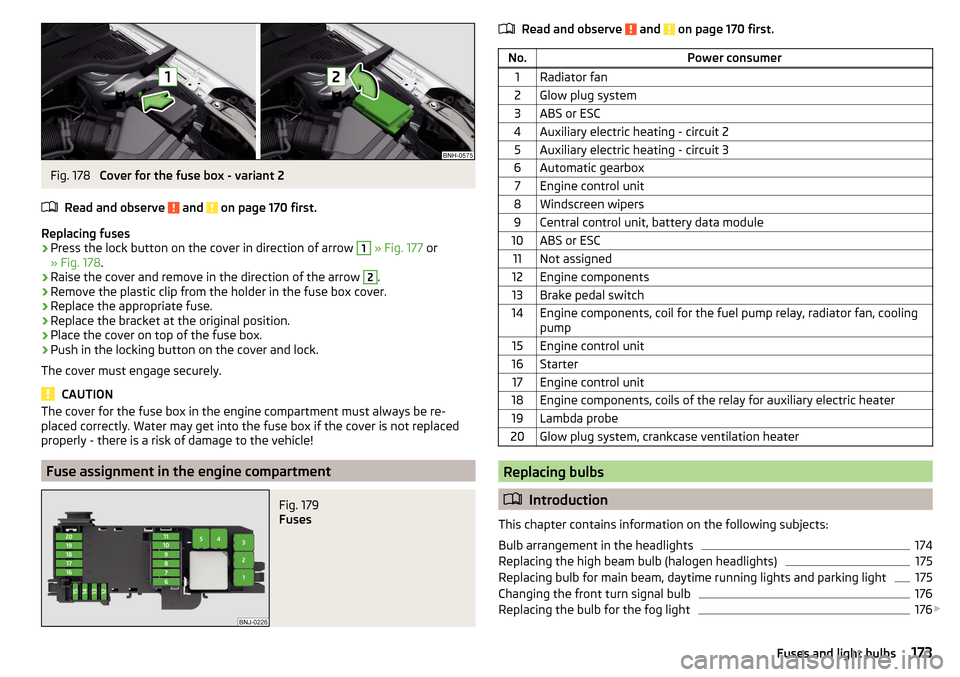
Fig. 178
Cover for the fuse box - variant 2
Read and observe
and on page 170 first.
Replacing fuses
›
Press the lock button on the cover in direction of arrow
1
» Fig. 177 or
» Fig. 178 .
›
Raise the cover and remove in the direction of the arrow
2
.
›
Remove the plastic clip from the holder in the fuse box cover.
›
Replace the appropriate fuse.
›
Replace the bracket at the original position.
›
Place the cover on top of the fuse box.
›
Push in the locking button on the cover and lock.
The cover must engage securely.
CAUTION
The cover for the fuse box in the engine compartment must always be re-
placed correctly. Water may get into the fuse box if the cover is not replaced
properly - there is a risk of damage to the vehicle!
Fuse assignment in the engine compartment
Fig. 179
Fuses
Read and observe and on page 170 first.No.Power consumer1Radiator fan2Glow plug system3ABS or ESC4Auxiliary electric heating - circuit 25Auxiliary electric heating - circuit 36Automatic gearbox7Engine control unit8Windscreen wipers9Central control unit, battery data module10ABS or ESC11Not assigned12Engine components13Brake pedal switch14Engine components, coil for the fuel pump relay, radiator fan, cooling
pump15Engine control unit16Starter17Engine control unit18Engine components, coils of the relay for auxiliary electric heater19Lambda probe20Glow plug system, crankcase ventilation heater
Replacing bulbs
Introduction
This chapter contains information on the following subjects:
Bulb arrangement in the headlights
174
Replacing the high beam bulb (halogen headlights)
175
Replacing bulb for main beam, daytime running lights and parking light
175
Changing the front turn signal bulb
176
Replacing the bulb for the fog light
176
173Fuses and light bulbs
Page 192 of 204
Vehicle tool kit157
Warning triangle156
Emissions180
Engine Messages
36
Running-in102
Starting the engine94
Engine compartment139
Brake fluid146
Overview141
Vehicle battery146
Engine number179
engine oil specification
142
Engine oil142
change142
Checking143
Replenishing143
Warning light37
EPC Warning light
34
ESC Operation
106
Warning light33
Exhaust inspection system Warning light
34
F
Fastening elements
81
Fatigue detection115
Function115
Information messages115
Films131
Fire extinguisher156
First aid kit156
Flashing60
Floor covering in the luggage compartment
84
Fog lightsWarning light35
Fog Lights61
Footmats99
see footmats99
Force limit Power windows
58
Front airbag15
Front Assist112
Disable/enable114
Distance warning113
Information messages114
Operation113
Radar sensor112
Warning and automatic braking113
Warning light38
fuel lead-free petrol
137
Fuel136
Diesel138
Fuel gauge30
refer to Fuel136
Refuelling137
Warning light35
Fuel consumption180
Fuel reserve Warning light
35
Fuses Assignment
170
Assignment of fuses in the dash panel171
Colour coding170
Fuse assignment in the engine compartment173
Replacing170
Fuses in the engine compartment Assignment
173
G
Gear change Gear recommendation
39
Information on the selected gear39
Gear changing Gear stick99
General view Cockpit
27
Genuine parts127
Glasses compartment77
Glow plug system Warning light
34
H
Handbrake
98
Warning light32
Hazard warning light system62
HBA107
Head airbag17
Headlight cleaning system Headlight cleaning system
66
Headlights Bulb arrangement
174
Driving abroad63
Headlight cleaning system66
Headlights with CORNER function62
Head restraints69
Adjust height69
Headrest, removing and installing
69
Heating86
Air distribution control89
Controls87
Exterior mirror67
Rear window64
Seats70
Heating rear window64
HHC107
Hill Start Assist (HHC)107
Hitch117
Drawback load117
Hooks82
Horn27
190Index
Page 195 of 204
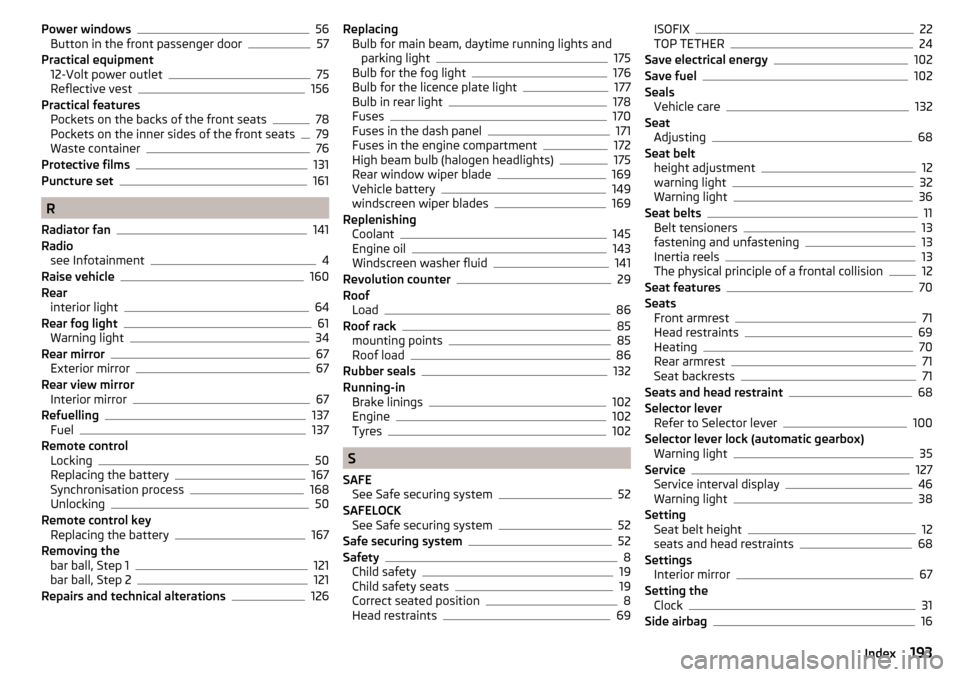
Power windows56
Button in the front passenger door57
Practical equipment 12-Volt power outlet
75
Reflective vest156
Practical features Pockets on the backs of the front seats
78
Pockets on the inner sides of the front seats79
Waste container76
Protective films131
Puncture set161
R
Radiator fan
141
Radio see Infotainment
4
Raise vehicle160
Rear interior light
64
Rear fog light61
Warning light34
Rear mirror67
Exterior mirror67
Rear view mirror Interior mirror
67
Refuelling137
Fuel137
Remote control Locking
50
Replacing the battery167
Synchronisation process168
Unlocking50
Remote control key Replacing the battery
167
Removing the bar ball, Step 1
121
bar ball, Step 2121
Repairs and technical alterations126
Replacing Bulb for main beam, daytime running lights andparking light
175
Bulb for the fog light176
Bulb for the licence plate light177
Bulb in rear light178
Fuses170
Fuses in the dash panel171
Fuses in the engine compartment172
High beam bulb (halogen headlights)175
Rear window wiper blade169
Vehicle battery149
windscreen wiper blades169
Replenishing Coolant
145
Engine oil143
Windscreen washer fluid141
Revolution counter29
Roof Load
86
Roof rack85
mounting points85
Roof load86
Rubber seals132
Running-in Brake linings
102
Engine102
Tyres102
S
SAFE See Safe securing system
52
SAFELOCK See Safe securing system
52
Safe securing system52
Safety8
Child safety19
Child safety seats19
Correct seated position8
Head restraints69
ISOFIX22
TOP TETHER24
Save electrical energy102
Save fuel102
Seals Vehicle care
132
Seat Adjusting
68
Seat belt height adjustment
12
warning light32
Warning light36
Seat belts11
Belt tensioners13
fastening and unfastening13
Inertia reels13
The physical principle of a frontal collision12
Seat features70
Seats Front armrest
71
Head restraints69
Heating70
Rear armrest71
Seat backrests71
Seats and head restraint68
Selector lever Refer to Selector lever
100
Selector lever lock (automatic gearbox) Warning light
35
Service127
Service interval display46
Warning light38
Setting Seat belt height
12
seats and head restraints68
Settings Interior mirror
67
Setting the Clock
31
Side airbag16
193Index