lock SKODA RAPID 2016 1.G Repair Manual
[x] Cancel search | Manufacturer: SKODA, Model Year: 2016, Model line: RAPID, Model: SKODA RAPID 2016 1.GPages: 184, PDF Size: 27.06 MB
Page 149 of 184
›If it is not possible to start the engine, switch on the ignition so that the
steering wheel does not lock and so that the turn signal lights, windscreen
wipers and windscreen washer system can be used.›
Take the vehicle out of gear or move the selector lever into position N if the
vehicle is fitted with an automatic gearbox.
›
Keep the tow rope taut at all times during the towing procedure.
WARNING■ Spiral tow ropes must not be used for towing » Fig. 167- , the towing
eye may unscrew out of the vehicle - risk of accident.■
The tow rope should not be twisted - there is a risk of accidents.
CAUTION
■ Do not tow-start the engine – risk of damaging the engine! The battery from
another vehicle can be used as a jump-start aid » page 145, Jump-starting .■
For off-road towing manoeuvres, there is a risk to both vehicles that the fas-
teners may become overloaded and damaged.
Note
We recommend that you use a tow rope from ŠKODA Original Accessories.
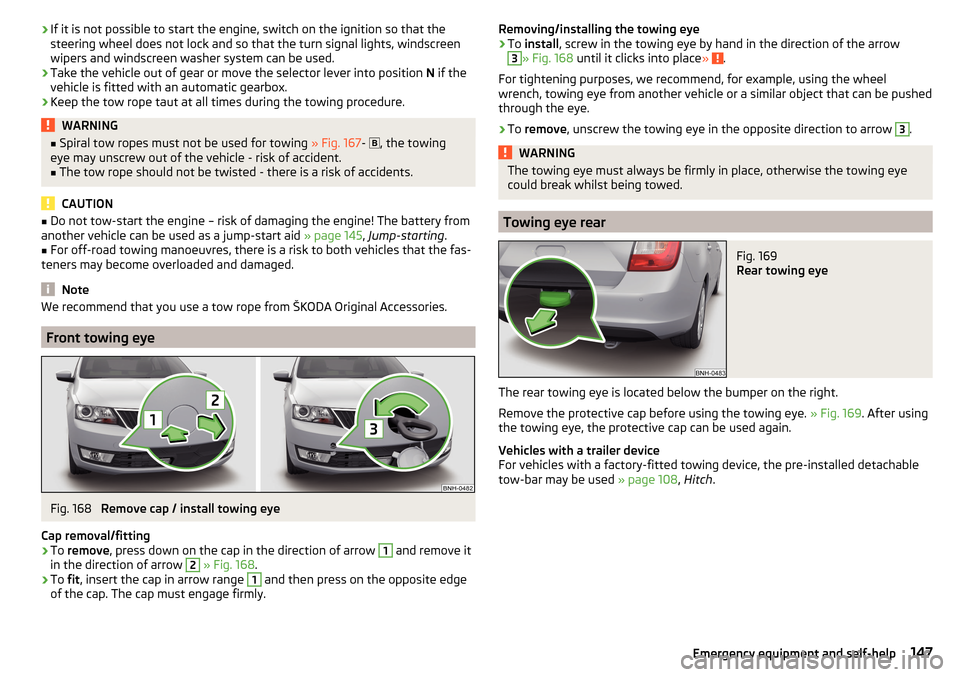
Front towing eye
Fig. 168
Remove cap / install towing eye
Cap removal/fitting
›
To remove , press down on the cap in the direction of arrow
1
and remove it
in the direction of arrow
2
» Fig. 168 .
›
To fit, insert the cap in arrow range
1
and then press on the opposite edge
of the cap. The cap must engage firmly.
Removing/installing the towing eye›To install , screw in the towing eye by hand in the direction of the arrow3
» Fig. 168 until it clicks into place » .
For tightening purposes, we recommend, for example, using the wheel
wrench, towing eye from another vehicle or a similar object that can be pushed
through the eye.
›
To remove , unscrew the towing eye in the opposite direction to arrow
3
.
WARNINGThe towing eye must always be firmly in place, otherwise the towing eye
could break whilst being towed.
Towing eye rear
Fig. 169
Rear towing eye
The rear towing eye is located below the bumper on the right.
Remove the protective cap before using the towing eye. » Fig. 169. After using
the towing eye, the protective cap can be used again.
Vehicles with a trailer device
For vehicles with a factory-fitted towing device, the pre-installed detachable tow-bar may be used » page 108, Hitch .
147Emergency equipment and self-help
Page 150 of 184
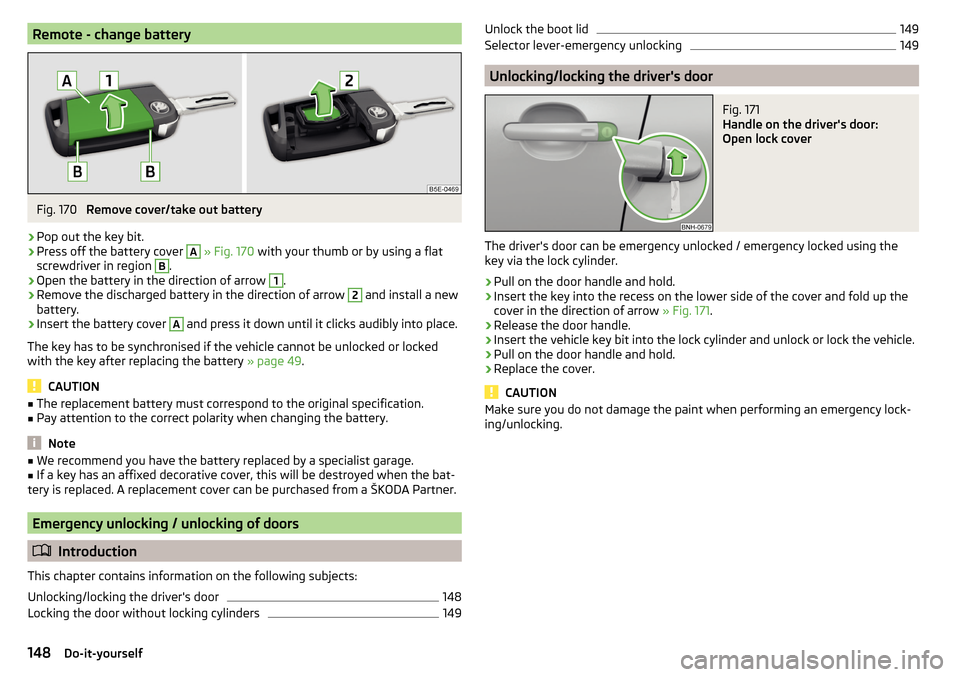
Remote - change batteryFig. 170
Remove cover/take out battery
›
Pop out the key bit.
›
Press off the battery cover
A
» Fig. 170 with your thumb or by using a flat
screwdriver in region
B
.
›
Open the battery in the direction of arrow
1
.
›
Remove the discharged battery in the direction of arrow
2
and install a new
battery.
›
Insert the battery cover
A
and press it down until it clicks audibly into place.
The key has to be synchronised if the vehicle cannot be unlocked or locked
with the key after replacing the battery » page 49.
CAUTION
■
The replacement battery must correspond to the original specification.■Pay attention to the correct polarity when changing the battery.
Note
■We recommend you have the battery replaced by a specialist garage.■If a key has an affixed decorative cover, this will be destroyed when the bat-
tery is replaced. A replacement cover can be purchased from a ŠKODA Partner.
Emergency unlocking / unlocking of doors
Introduction
This chapter contains information on the following subjects:
Unlocking/locking the driver's door
148
Locking the door without locking cylinders
149Unlock the boot lid149Selector lever-emergency unlocking149
Unlocking/locking the driver's door
Fig. 171
Handle on the driver's door:
Open lock cover
The driver's door can be emergency unlocked / emergency locked using the key via the lock cylinder.
›
Pull on the door handle and hold.
›
Insert the key into the recess on the lower side of the cover and fold up the
cover in the direction of arrow » Fig. 171.
›
Release the door handle.
›
Insert the vehicle key bit into the lock cylinder and unlock or lock the vehicle.
›
Pull on the door handle and hold.
›
Replace the cover.
CAUTION
Make sure you do not damage the paint when performing an emergency lock-
ing/unlocking.148Do-it-yourself
Page 151 of 184
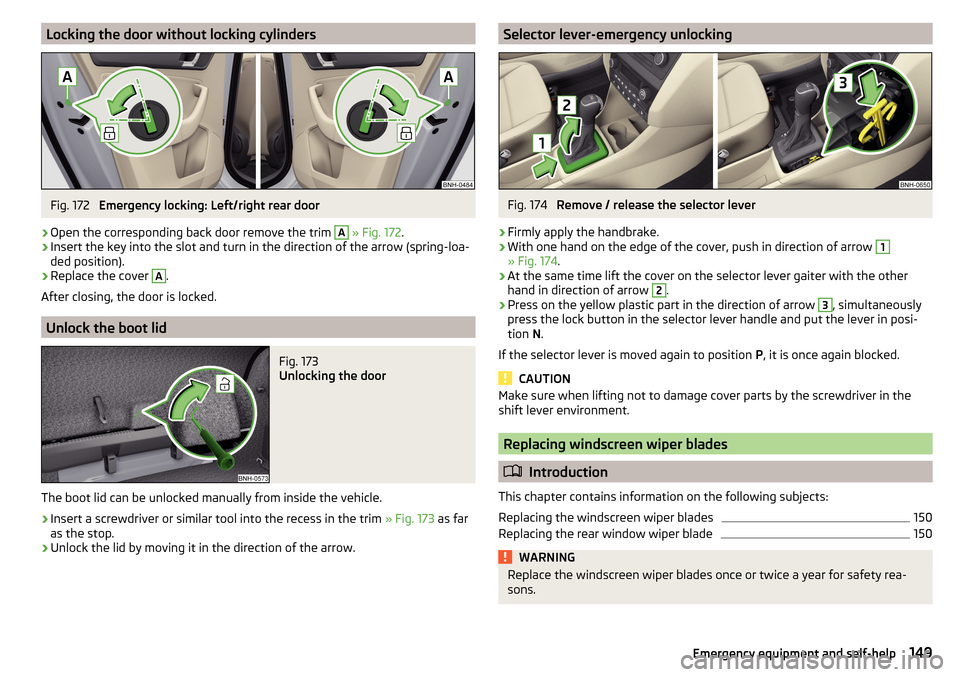
Locking the door without locking cylindersFig. 172
Emergency locking: Left/right rear door
›
Open the corresponding back door remove the trim
A
» Fig. 172 .
›
Insert the key into the slot and turn in the direction of the arrow (spring-loa-
ded position).
›
Replace the cover
A
.
After closing, the door is locked.
Unlock the boot lid
Fig. 173
Unlocking the door
The boot lid can be unlocked manually from inside the vehicle.
›
Insert a screwdriver or similar tool into the recess in the trim » Fig. 173 as far
as the stop.
›
Unlock the lid by moving it in the direction of the arrow.
Selector lever-emergency unlockingFig. 174
Remove / release the selector lever
›
Firmly apply the handbrake.
›
With one hand on the edge of the cover, push in direction of arrow
1
» Fig. 174 .
›
At the same time lift the cover on the selector lever gaiter with the other
hand in direction of arrow
2
.
›
Press on the yellow plastic part in the direction of arrow
3
, simultaneously
press the lock button in the selector lever handle and put the lever in posi-
tion N.
If the selector lever is moved again to position P, it is once again blocked.
CAUTION
Make sure when lifting not to damage cover parts by the screwdriver in the
shift lever environment.
Replacing windscreen wiper blades
Introduction
This chapter contains information on the following subjects:
Replacing the windscreen wiper blades
150
Replacing the rear window wiper blade
150WARNINGReplace the windscreen wiper blades once or twice a year for safety rea-
sons.149Emergency equipment and self-help
Page 152 of 184
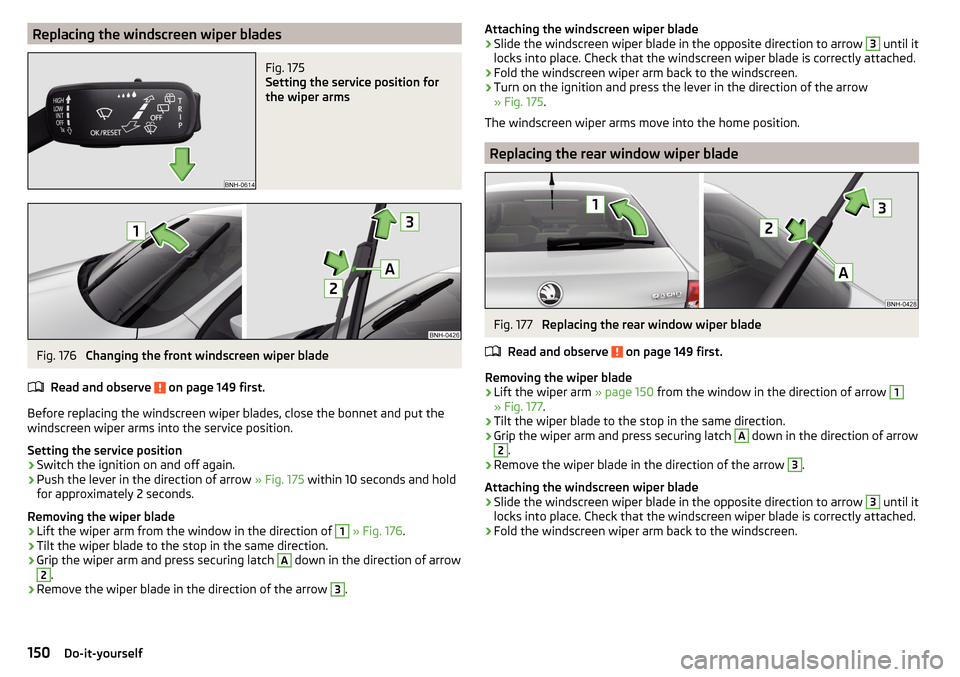
Replacing the windscreen wiper bladesFig. 175
Setting the service position for
the wiper arms
Fig. 176
Changing the front windscreen wiper blade
Read and observe
on page 149 first.
Before replacing the windscreen wiper blades, close the bonnet and put the windscreen wiper arms into the service position.
Setting the service position
›
Switch the ignition on and off again.
›
Push the lever in the direction of arrow » Fig. 175 within 10 seconds and hold
for approximately 2 seconds.
Removing the wiper blade
›
Lift the wiper arm from the window in the direction of
1
» Fig. 176 .
›
Tilt the wiper blade to the stop in the same direction.
›
Grip the wiper arm and press securing latch
A
down in the direction of arrow
2
.
›
Remove the wiper blade in the direction of the arrow
3
.
Attaching the windscreen wiper blade›Slide the windscreen wiper blade in the opposite direction to arrow 3 until it
locks into place. Check that the windscreen wiper blade is correctly attached.›
Fold the windscreen wiper arm back to the windscreen.
›
Turn on the ignition and press the lever in the direction of the arrow
» Fig. 175 .
The windscreen wiper arms move into the home position.
Replacing the rear window wiper blade
Fig. 177
Replacing the rear window wiper blade
Read and observe
on page 149 first.
Removing the wiper blade
›
Lift the wiper arm » page 150 from the window in the direction of arrow
1
» Fig. 177.
›
Tilt the wiper blade to the stop in the same direction.
›
Grip the wiper arm and press securing latch
A
down in the direction of arrow
2
.
›
Remove the wiper blade in the direction of the arrow
3
.
Attaching the windscreen wiper blade
›
Slide the windscreen wiper blade in the opposite direction to arrow
3
until it
locks into place. Check that the windscreen wiper blade is correctly attached.
›
Fold the windscreen wiper arm back to the windscreen.
150Do-it-yourself
Page 154 of 184
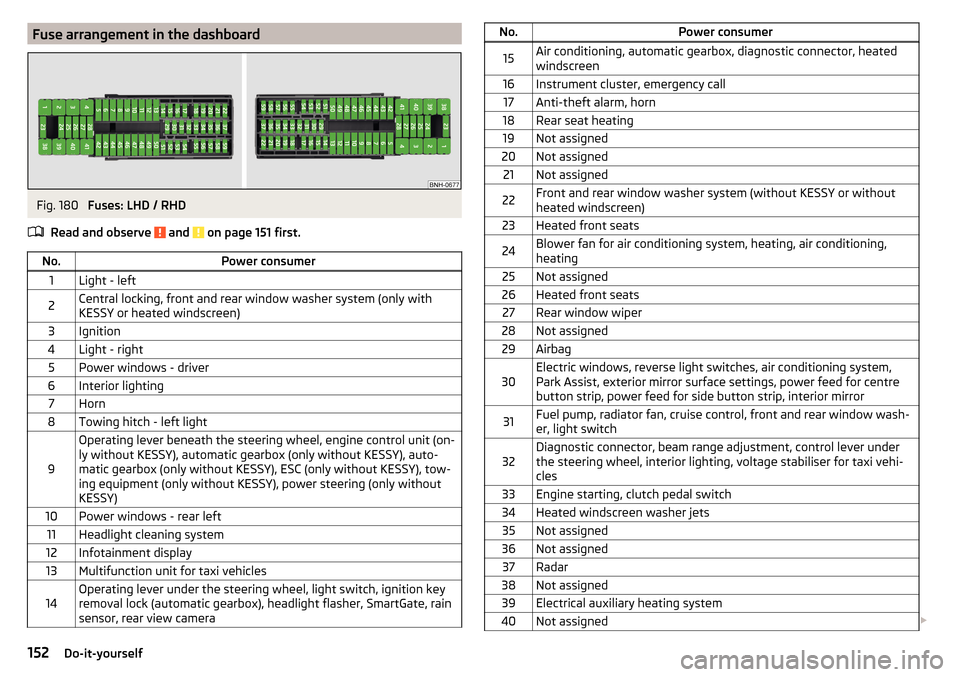
Fuse arrangement in the dashboardFig. 180
Fuses: LHD / RHD
Read and observe
and on page 151 first.
No.Power consumer1Light - left2Central locking, front and rear window washer system (only with
KESSY or heated windscreen)3Ignition4Light - right5Power windows - driver6Interior lighting7Horn8Towing hitch - left light
9
Operating lever beneath the steering wheel, engine control unit (on-
ly without KESSY), automatic gearbox (only without KESSY), auto-
matic gearbox (only without KESSY), ESC (only without KESSY), tow-
ing equipment (only without KESSY), power steering (only without
KESSY)10Power windows - rear left11Headlight cleaning system12Infotainment display13Multifunction unit for taxi vehicles14Operating lever under the steering wheel, light switch, ignition key
removal lock (automatic gearbox), headlight flasher, SmartGate, rain
sensor, rear view cameraNo.Power consumer15Air conditioning, automatic gearbox, diagnostic connector, heated windscreen16Instrument cluster, emergency call17Anti-theft alarm, horn18Rear seat heating19Not assigned20Not assigned21Not assigned22Front and rear window washer system (without KESSY or without
heated windscreen)23Heated front seats24Blower fan for air conditioning system, heating, air conditioning,
heating25Not assigned26Heated front seats27Rear window wiper28Not assigned29Airbag30Electric windows, reverse light switches, air conditioning system,
Park Assist, exterior mirror surface settings, power feed for centre
button strip, power feed for side button strip, interior mirror31Fuel pump, radiator fan, cruise control, front and rear window wash-
er, light switch32Diagnostic connector, beam range adjustment, control lever under
the steering wheel, interior lighting, voltage stabiliser for taxi vehi-
cles33Engine starting, clutch pedal switch34Heated windscreen washer jets35Not assigned36Not assigned37Radar38Not assigned39Electrical auxiliary heating system40Not assigned 152Do-it-yourself
Page 155 of 184
No.Power consumer41Rear window heater42Power windows - front passenger43Trailer device - electrical outlet44Cigarette lighter, 12-volt outlet in the interior, 12-volt power socket
in the luggage compartment45Power windows - rear right46Front and rear window washer, operating lever under the steering
wheel47Trailer device - electrical outlet48Towing hitch - right light49Fuel pump50Infotainment51Heating of the external mirror52KESSY53Steering lock (KESSY)54ABS or ESC55Not assigned56Not assigned57Not assigned58Rear seat heating59Not assigned
Fuses in the engine compartment
Fig. 181
Cover for the fuse box - variant 1
Fig. 182
Cover for the fuse box - variant 2
Read and observe
and on page 151 first.
Replacing fuses
›
Remove the ignition key, turn off the lights and all electrical consumers.
›
Press together the lock buttons of the cover simultaneously in the direction
of arrow
1
» Fig. 181 or » Fig. 182 and remove the cover in the direction of
arrow
2
.
›
Remove the plastic clip from the holder on the cover of the fuse box in the
dashboard.
›
Replace the defective fuse.
›
Replace the cover, push the lock buttons of the cover together and lock.
›
Replace the bracket at the original position.
CAUTION
The cover of the fuse box in the engine compartment must always be inserted
correctly, otherwise water may penetrate into the fuse box – there is a danger
of damage to the vehicle!153Fuses and light bulbs
Page 159 of 184
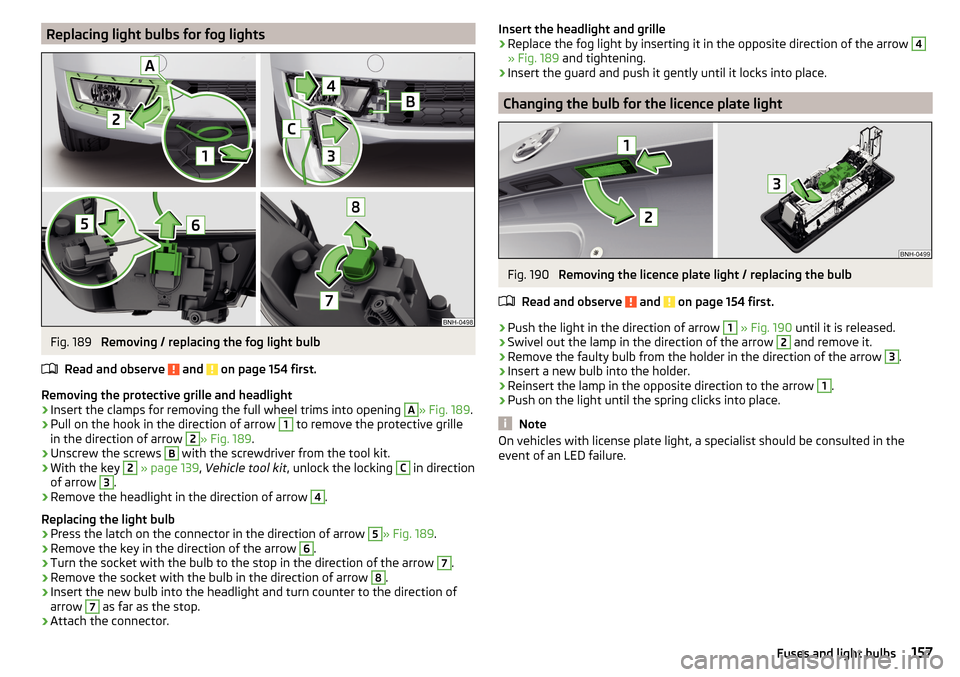
Replacing light bulbs for fog lightsFig. 189
Removing / replacing the fog light bulb
Read and observe
and on page 154 first.
Removing the protective grille and headlight
›
Insert the clamps for removing the full wheel trims into opening
A
» Fig. 189 .
›
Pull on the hook in the direction of arrow
1
to remove the protective grille
in the direction of arrow
2
» Fig. 189 .
›
Unscrew the screws
B
with the screwdriver from the tool kit.
›
With the key
2
» page 139 , Vehicle tool kit , unlock the locking
C
in direction
of arrow
3
.
›
Remove the headlight in the direction of arrow
4
.
Replacing the light bulb
›
Press the latch on the connector in the direction of arrow
5
» Fig. 189 .
›
Remove the key in the direction of the arrow
6
.
›
Turn the socket with the bulb to the stop in the direction of the arrow
7
.
›
Remove the socket with the bulb in the direction of arrow
8
.
›
Insert the new bulb into the headlight and turn counter to the direction of
arrow
7
as far as the stop.
›
Attach the connector.
Insert the headlight and grille›Replace the fog light by inserting it in the opposite direction of the arrow 4
» Fig. 189 and tightening.
›
Insert the guard and push it gently until it locks into place.
Changing the bulb for the licence plate light
Fig. 190
Removing the licence plate light / replacing the bulb
Read and observe
and on page 154 first.
›
Push the light in the direction of arrow
1
» Fig. 190 until it is released.
›
Swivel out the lamp in the direction of the arrow
2
and remove it.
›
Remove the faulty bulb from the holder in the direction of the arrow
3
.
›
Insert a new bulb into the holder.
›
Reinsert the lamp in the opposite direction to the arrow
1
.
›
Push on the light until the spring clicks into place.
Note
On vehicles with license plate light, a specialist should be consulted in the
event of an LED failure.157Fuses and light bulbs
Page 160 of 184
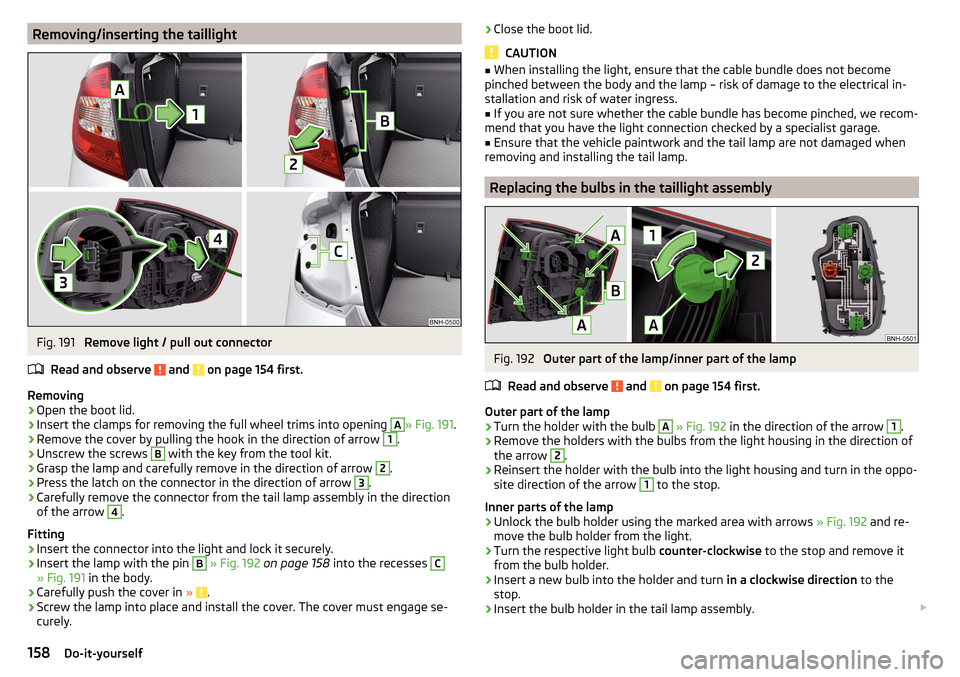
Removing/inserting the taillightFig. 191
Remove light / pull out connector
Read and observe
and on page 154 first.
Removing
›
Open the boot lid.
›
Insert the clamps for removing the full wheel trims into opening
A
» Fig. 191 .
›
Remove the cover by pulling the hook in the direction of arrow
1
.
›
Unscrew the screws
B
with the key from the tool kit.
›
Grasp the lamp and carefully remove in the direction of arrow
2
.
›
Press the latch on the connector in the direction of arrow
3
.
›
Carefully remove the connector from the tail lamp assembly in the direction
of the arrow
4
.
Fitting
›
Insert the connector into the light and lock it securely.
›
Insert the lamp with the pin
B
» Fig. 192 on page 158 into the recesses
C
» Fig. 191 in the body.
›
Carefully push the cover in » .
›
Screw the lamp into place and install the cover. The cover must engage se-
curely.
› Close the boot lid.
CAUTION
■
When installing the light, ensure that the cable bundle does not become
pinched between the body and the lamp – risk of damage to the electrical in-
stallation and risk of water ingress.■
If you are not sure whether the cable bundle has become pinched, we recom-
mend that you have the light connection checked by a specialist garage.
■
Ensure that the vehicle paintwork and the tail lamp are not damaged when
removing and installing the tail lamp.
Replacing the bulbs in the taillight assembly
Fig. 192
Outer part of the lamp/inner part of the lamp
Read and observe
and on page 154 first.
Outer part of the lamp
›
Turn the holder with the bulb
A
» Fig. 192 in the direction of the arrow
1
.
›
Remove the holders with the bulbs from the light housing in the direction of
the arrow
2
.
›
Reinsert the holder with the bulb into the light housing and turn in the oppo-
site direction of the arrow
1
to the stop.
Inner parts of the lamp
›
Unlock the bulb holder using the marked area with arrows » Fig. 192 and re-
move the bulb holder from the light.
›
Turn the respective light bulb counter-clockwise to the stop and remove it
from the bulb holder.
›
Insert a new bulb into the holder and turn in a clockwise direction to the
stop.
›
Insert the bulb holder in the tail lamp assembly.
158Do-it-yourself
Page 163 of 184
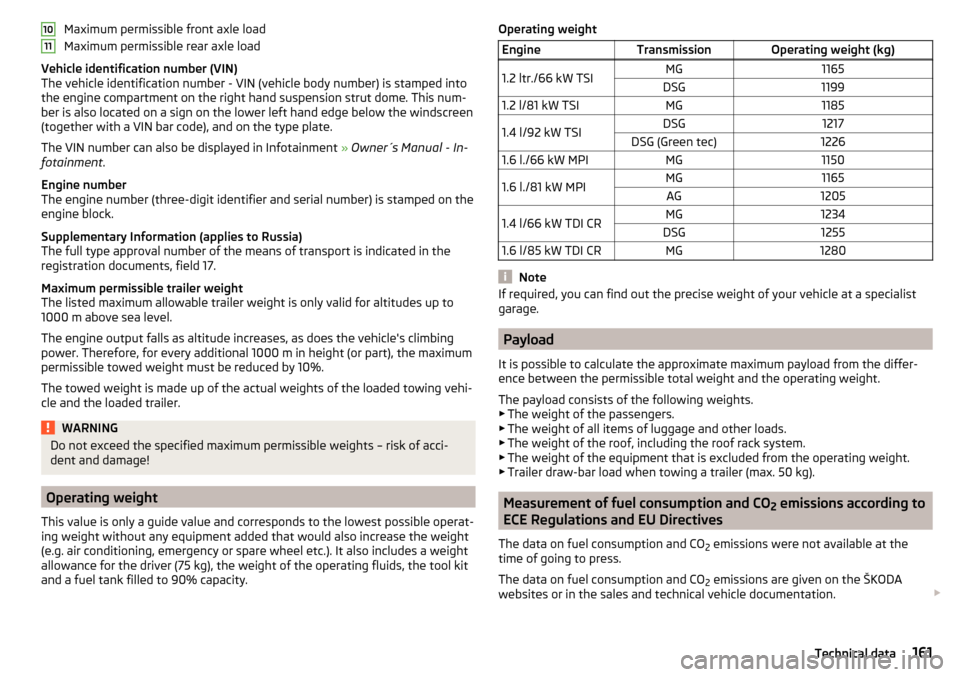
Maximum permissible front axle load
Maximum permissible rear axle load
Vehicle identification number (VIN)
The vehicle identification number - VIN (vehicle body number) is stamped into
the engine compartment on the right hand suspension strut dome. This num-
ber is also located on a sign on the lower left hand edge below the windscreen
(together with a VIN bar code), and on the type plate.
The VIN number can also be displayed in Infotainment » Owner´s Manual - In-
fotainment .
Engine number
The engine number (three-digit identifier and serial number) is stamped on the
engine block.
Supplementary Information (applies to Russia)
The full type approval number of the means of transport is indicated in the
registration documents, field 17.
Maximum permissible trailer weight
The listed maximum allowable trailer weight is only valid for altitudes up to
1000 m above sea level.
The engine output falls as altitude increases, as does the vehicle's climbing
power. Therefore, for every additional 1000 m in height (or part), the maximum
permissible towed weight must be reduced by 10%.
The towed weight is made up of the actual weights of the loaded towing vehi-
cle and the loaded trailer.WARNINGDo not exceed the specified maximum permissible weights – risk of acci-
dent and damage!
Operating weight
This value is only a guide value and corresponds to the lowest possible operat-
ing weight without any equipment added that would also increase the weight
(e.g. air conditioning, emergency or spare wheel etc.). It also includes a weight
allowance for the driver (75 kg), the weight of the operating fluids, the tool kit
and a fuel tank filled to 90% capacity.
1011Operating weightEngineTransmissionOperating weight (kg)1.2 ltr./66 kW TSIMG1165DSG11991.2 l/81 kW TSIMG11851.4 l/92 kW TSIDSG1217DSG (Green tec)12261.6 l./66 kW MPIMG11501.6 l./81 kW MPIMG1165AG12051.4 l/66 kW TDI CRMG1234DSG12551.6 l/85 kW TDI CRMG1280
Note
If required, you can find out the precise weight of your vehicle at a specialist
garage.
Payload
It is possible to calculate the approximate maximum payload from the differ-
ence between the permissible total weight and the operating weight.
The payload consists of the following weights.
▶ The weight of the passengers.
▶ The weight of all items of luggage and other loads.
▶ The weight of the roof, including the roof rack system.
▶ The weight of the equipment that is excluded from the operating weight.
▶ Trailer draw-bar load when towing a trailer (max. 50 kg).
Measurement of fuel consumption and CO
2 emissions according to
ECE Regulations and EU Directives
The data on fuel consumption and CO 2 emissions were not available at the
time of going to press.
The data on fuel consumption and CO 2 emissions are given on the ŠKODA
websites or in the sales and technical vehicle documentation.
161Technical data
Page 170 of 184
Index
A
ABS Operation
94
Warning light32
Acceptance and recycling of used vehicles
117
Accessories115
Adjusting Steering wheel
11
Adjusting the seats10
Adjustment Beam range
54
Advance warning / emergency braking37
Advice on tyre/wheel usage133
Air-conditioning system Air outlet vents
82
Airbag15
Adjustments and impairments to the airbag system
116
Deactivating18
deactivation18
Deployment16
Warning light32
Airbag system15
Air conditioning79
Air distribution control81
Climatronic80
Manual air conditioning80
Air distribution control81
Air outlet vents82
Alarm49
Trailer114
All-year tyres136
Anti-lock braking system (ABS)94
Anti-theft alarm system49
Trailer114
Anti-theft wheel bolts141
Armrest Front63
Rear64
Ashtray69
Assembling the bar ball, Step 1
110
bar ball, Step 2110
Assist systems93
Auto Check Control38
Automatic drive Selector lever
89
Automatic driving light control55
Automatic gearbox89
Kickdown91
Malfunction34
Selector lever emergency unlocking149
Selector lever lock90
Starting-off and driving91
Warning light34
Automatic shutdown of consumers131
Automatic transmission Selector lever lock
90
Tiptronic90
AUX67
Avoiding damage to your vehicle92
B
Ball bar Standy position
109
Ball head Check fitting
111
Ready position109
Battery Change in key
148
Belts12
Belt tensioners14
Bluetooth See Owner´s Manual -Infotainment
6
Bonnet Closing126
Opening126
Boot Cargo element
78
Class N1 vehicles78
Hooks76
Storage compartments77
Boot cover Parking position
77
Boot lid Automatic locking
51
Open/Close51
Brake Assist (HBA)95
Brake booster86
Brake fluid130
Check130
specification130
Brake pads new
86
Brake pedal (automatic transmission) Warning light
34
Brakes Brake booster
86
Brake fluid130
Braking and stabilisation systems93
Handbrake87
Information on braking86
Warning lights30
Brake system93
Braking Running in
91
Breakdown kit143
Breakdown service See Help in an emergency
8
Buttons in the door Electric windows
52
168Index