change time SKODA RAPID SPACEBACK 2013 1.G User Guide
[x] Cancel search | Manufacturer: SKODA, Model Year: 2013, Model line: RAPID SPACEBACK, Model: SKODA RAPID SPACEBACK 2013 1.GPages: 193, PDF Size: 14.8 MB
Page 130 of 193
Artificial leather, materials and Alcantara®
Read and observe
and on page 127 first.
Artificial leather
Clean artificial leather with a damp cloth.
If this method does not completely clean the artificial leather, use a mild soap
solution or cleaning products specially designed for this purpose.
Fabric
Clean upholstery cover materials and cloth trims on doors, boot cover, etc. us-
ing specific cleaning agents, e.g., dry foam.
Use a soft sponge, brush, or commercially available microfibre cloth.
Use a cloth and a cleaning agent specifically designed for this purpose to clean
the roof trim.
Remove any lumps on the cover fabric and any fabric residue using a brush.
Remove stubborn hair using a “cleaning glove”.
Alcantara ®
Dust and dirt in pores, creases and seams may chafe and damage the surface.
Therefore, they must be removed regularly at short intervals with a cloth or
vacuum cleaner.
Minor changes in colour caused by use are normal.
CAUTION
■ For Alcantara ®
seat covers, do not use any solvents, floor wax, shoe cream,
stain remover, leather cleaners or similar agents.■
Avoid leaving the vehicle in bright sunlight for long periods of time in order
to stop the artificial leather, materials or Alcantara ®
from bleaching. During ex-
tended periods of standing outdoors, protect artificial leather, fabrics or Alcan-
tara ®
by covering.
■
Some clothing materials, e.g. dark denim, do not have sufficient colour fast-
ness. This can cause damage or clearly visible discolouration to seat covers,
even when used correctly. This applies particularly to light-coloured seat cov-
ers. This does not relate to a fault in the seat cover, but rather to poor colour
fastness of the clothing textiles.
Seat covers
Read and observe
and on page 127 first.
Electrically heated seats
Use a specific cleaning agent for cleaning the covers e.g. dry foam among oth-
ers »
.
Seats without seat heating
Thoroughly vacuum the seat covers with a vacuum cleaner before cleaning.
Clean the seat covers with a damp cloth or cleaning products specially de-
signed for this purpose.
Indented points arising on the fabrics by everyday use, can be removed by
brushing against the direction of hair with a damp brush.
Always clean all parts of the covers, so that there are no visible edges. Then
allow the seat to dry completely.
CAUTION
■ Do not clean the covers of electrically heated seats either with water or with
other liquids - there is a risk of damaging the seat heating system.■
Regularly remove dust from the seat covers using a vacuum cleaner.
■
Electrically heated seats must not be dried after cleaning by switching on the
heater.
■
Do not sit on wet seats - risk of seat deformation.
■
Always clean the seats “from seam to seam”.
Safety belts
Read and observe
and on page 127 first.
Wash dirty seat belts with mild soapy water.
Remove coarse dirt with a soft brush.
WARNING■ The seat belts must not be removed for cleaning.■Never clean the seat belts chemically as chemical cleaning products could
destroy the fabric.■
The seat belts must not be allowed to come into contact with corrosive
liquids (e.g. acids).
■
The seat belts must be fully dried before being rolled up.
128General Maintenance
Page 136 of 193
WARNINGAfter switching off the ignition, the fan may intermittently continue to op-
erate for approx. 10 minutes.
Windscreen washer system
Fig. 124
Engine compartment: Wind-
screen washer fluid reservoir
Read and observe and on page 131 first.
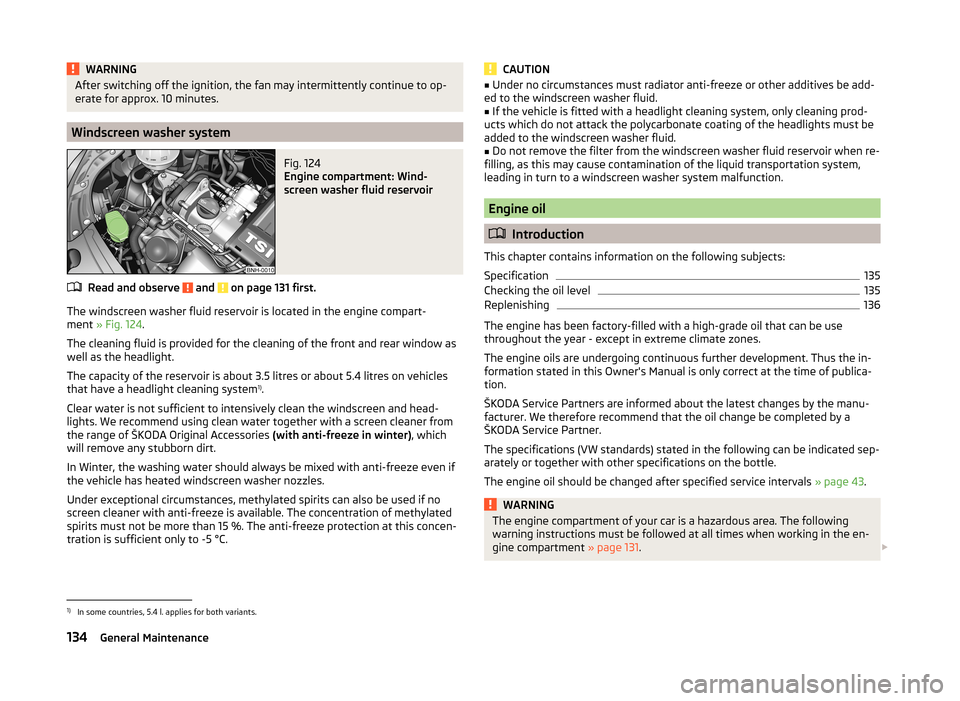
The windscreen washer fluid reservoir is located in the engine compart-
ment » Fig. 124 .
The cleaning fluid is provided for the cleaning of the front and rear window as
well as the headlight.
The capacity of the reservoir is about 3.5 litres or about 5.4 litres on vehicles
that have a headlight cleaning system 1)
.
Clear water is not sufficient to intensively clean the windscreen and head-
lights. We recommend using clean water together with a screen cleaner from
the range of ŠKODA Original Accessories (with anti-freeze in winter), which
will remove any stubborn dirt.
In Winter, the washing water should always be mixed with anti-freeze even if
the vehicle has heated windscreen washer nozzles.
Under exceptional circumstances, methylated spirits can also be used if no
screen cleaner with anti-freeze is available. The concentration of methylated
spirits must not be more than 15 %. The anti-freeze protection at this concen-
tration is sufficient only to -5 °C.
CAUTION■ Under no circumstances must radiator anti-freeze or other additives be add-
ed to the windscreen washer fluid.■
If the vehicle is fitted with a headlight cleaning system, only cleaning prod-
ucts which do not attack the polycarbonate coating of the headlights must be
added to the windscreen washer fluid.
■
Do not remove the filter from the windscreen washer fluid reservoir when re-
filling, as this may cause contamination of the liquid transportation system,
leading in turn to a windscreen washer system malfunction.
Engine oil
Introduction
This chapter contains information on the following subjects:
Specification
135
Checking the oil level
135
Replenishing
136
The engine has been factory-filled with a high-grade oil that can be use
throughout the year - except in extreme climate zones.
The engine oils are undergoing continuous further development. Thus the in- formation stated in this Owner's Manual is only correct at the time of publica-
tion.
ŠKODA Service Partners are informed about the latest changes by the manu-
facturer. We therefore recommend that the oil change be completed by a
ŠKODA Service Partner.
The specifications (VW standards) stated in the following can be indicated sep-
arately or together with other specifications on the bottle.
The engine oil should be changed after specified service intervals » page 43.
WARNINGThe engine compartment of your car is a hazardous area. The following
warning instructions must be followed at all times when working in the en-
gine compartment » page 131. 1)
In some countries, 5.4 l. applies for both variants.
134General Maintenance
Page 140 of 193

CAUTION■Do not continue your journey if the fluid level has dropped below the “MIN”
marking » Fig. 127 on page 138 , do not continue to drive - risk of accidents!
Seek help from a specialist garage.■
Brake fluid damages the paintwork of the vehicle.
Note
■ The brake fluid is changed as part of a compulsory inspection service.■We recommend using brake fluids from the ŠKODA Original Accessories
range.
Checking the brake fluid level
Fig. 127
Engine compartment: Brake fluid
reservoir
Read and observe and on page 137 first.
The fluid can be checked if the following conditions are met.
The vehicle is standing on a horizontal surface.
The engine is turned off.
The bonnet is open.
Checking the level
›
Check the level of brake fluid in the reservoir » Fig. 127.
The level must be between the “MIN” and “MAX” markings.
A slight drop in the fluid level results when driving due to normal wear-and-
tear and automatic adjustment of the brake pads.
There may be an indication of a leak in the brake system, however, if the fluid
level drops significantly within a short time or if it drops below the “MIN” mark-
ing.
Too low brake fluid level is indicated by the warning light lighting up in the
instrument cluster as well as the relevant notification being dis-
played » page 31 ,
Brake system .
Specification
Read and observe
and on page 137 first.
The brake fluid must comply with the following standards or specifications:› VW 50114;
› FMVSS 116 DOT4.
Vehicle battery
Introduction
This chapter contains information on the following subjects:
Opening the cover
139
Checking the battery electrolyte level
140
Charging
140
Replacing
141
Disconnecting and reconnecting
141
Automatic load deactivation
141
The vehicle battery represents a power source for the motor to start and for
the supply of electrical consumers in the car.
Warning symbols on the vehicle battery
SymbolMeaningAlways wear eye protection!Battery acid is severely caustic. Always wear gloves and eye pro-
tection!Keep fire, sparks, open flames and lit cigarettes well clear of the
vehicle battery!When charging the vehicle battery, a highly explosive gas mixture
is produced!Keep children away from the vehicle battery! 138General Maintenance
Page 158 of 193

Inflation hose with plug
Air compressor
Button for releasing the tyre pressure
12 volt cable connector
Tyre inflation hose
Tyre inflation pressure indicator
ON and OFF switch
Tyre inflater bottle with sealing agent
Replacement valve core
The valve remover 2
has a slot at its lower end which fits into the valve core.
Preparations for using the breakdown kit
Read and observe
on page 155 first.
Always change a wheel on a level surface as far as possible.
The following preparatory work must be carried out before using the break-
down kit.
›
Have all of the occupants get out of the vehicle. While changing a tyre, the
occupants of the vehicle should not stand on the road (they should instead
remain behind a crash barrier).
›
Switch off the engine.
›
Move the gear shift lever into Neutral or move the selector lever for the au-
tomatic gearbox into position P.
›
Firmly apply the handbrake.
›
Check that you can carry out the repairs with the breakdown kit » page 155.
›
Uncouple any trailers.
›
Remove the breakdown kit from the boot.
›
Stick the sticker
1
» Fig. 143 on page 155 on the dashboard in the driver's
field of view.
›
Do not remove the foreign body, e.g. screw or nail, from the tyre.
›
Unscrew the valve cap.
›
Use the valve remover
2
to unscrew the valve core and place it on a clean
surface (rag, paper, etc.).
34567891011Sealing and inflating the tyre
Read and observe
on page 155 first.
Sealing
›
Forcefully shake the tyre inflater bottle
10
» Fig. 143 on page 155 back and
forth several times.
›
Firmly screw the inflation hose
3
onto the tyre inflater bottle
10
in a clock-
wise direction. The film on the cap is pierced automatically.
›
Remove the plug from the inflation hose
3
and plug the open end fully onto
the tyre valve.
›
Hold the bottle
10
with the bottom facing upwards and fill all of the sealing
agent from the tyre inflater bottle into the tyre.
›
Remove the empty tyre inflater bottle from the valve.
›
Screw the valve core back into the tyre valve using the valve remover
2
.
Inflating
›
Screw the tyre inflation hose
7
» Fig. 143 on page 155 of the air compressor
firmly onto the tyre valve.
›
Start the engine and run it in idle.
›
Plug the connector
6
into 12 Volt socket » page 71, 12-Volt power outlet .
›
Switch on the air compressor with the ON and OFF switch
9
.
›
Allow the air compressor to run until a pressure of 2.0-2.5 bar is achieved.
Maximum run time of 8 minutes »
›
Switch off the air compressor.
›
If you cannot reach an air pressure of 2.0–2.5 bar, unscrew the tyre inflation
hose
7
from the tyre valve.
›
Drive the vehicle 10 metres forwards or backwards to allow the sealing agent
to “distribute” in the tyre.
›
Firmly screw the tyre inflation hose
7
back onto the tyre valve and repeat
the inflation process.
›
If you cannot reach the required tyre inflation pressure here either, this
means the tyre has sustained too much damage. You cannot seal with tyre with the breakdown kit »
.
›
Switch off the air compressor.
›
Remove the tyre inflation hose
7
from the tyre valve.
Once a tyre inflation pressure of 2.0–2.5 bar is achieved, continue the journey
at a maximum speed of 80 km/h (50 mph).
Check the tyre inflation pressure after driving for 10 minutes » page 157.
156Do-it-yourself
Page 163 of 193

Replacing the battery in the remote control keyFig. 148
Remove cover/take out battery
Read and observe
on page 160 first.
The battery change is carried out as follows.
›
Flip out the key.
›
Press off the battery cover
A
» Fig. 148 with your thumb or using a flat
screwdriver in the region of the arrows
1
.
›
Remove the discharged battery from the key by pressing the battery down in
the region of the arrow
2
.
›
Insert the new battery.
›
Place the battery cover
A
on the key and press it down until it clicks into
place.
Note
■ The key has to be synchronised if the vehicle cannot be unlocked or locked
with the remote control key after replacing the battery » page 161.■
If a key has an affixed decorative cover, this will be destroyed when the bat-
tery is replaced. A replacement cover can be purchased from a ŠKODA Partner.
Synchronising the remote control
Read and observe
on page 160 first.
If the vehicle does not unlock when pressing the remote control, the key may
not be synchronised. This can occur when the buttons on the remote control
key are actuated a number of times outside of the operative range of the
equipment or the battery in the remote control key has been replaced.
Synchronise the key as follows.
› Press any button on the remote control key.›Pressing of the button means that the door will unlock with the key within 1
minute.
Emergency unlocking/locking
Introduction
This chapter contains information on the following subjects:
Locking the door without a locking cylinder
161
Unlocking the tailgate
162
Selector lever-emergency unlocking
162
Locking the door without a locking cylinder
Fig. 149
Emergency locking: Left/right rear door
An emergency locking mechanism is located on the face side of the doors
which have no locking cylinder. It is only visible after opening the door.
Emergency locking » Fig. 149
Cover
Door locked
Door unlocked
Before using the emergency closing mechanism, remove cover
A
» Fig. 149 .
After use, reinstall the cover into the corresponding hole in the door.
After closing the locked door, it cannot be opened from the outside. The door
is unlocked by pulling on the door opening lever and is then opened from the
outside.
A161Emergency equipment and self-help
Page 168 of 193
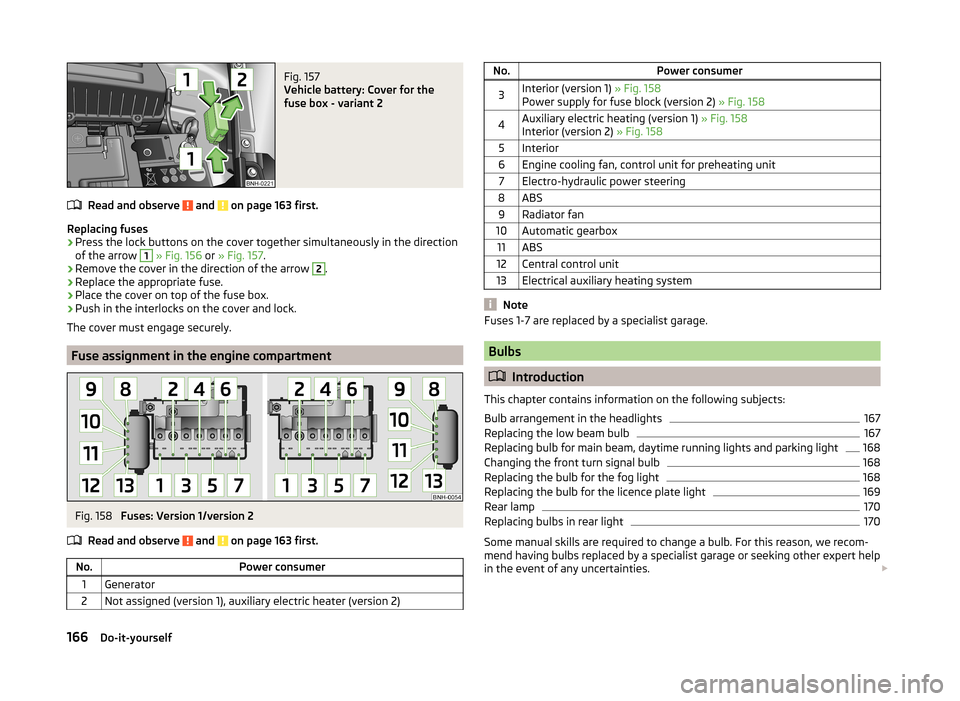
Fig. 157
Vehicle battery: Cover for the
fuse box - variant 2
Read and observe and on page 163 first.
Replacing fuses
›
Press the lock buttons on the cover together simultaneously in the direction
of the arrow
1
» Fig. 156 or » Fig. 157 .
›
Remove the cover in the direction of the arrow
2
.
›
Replace the appropriate fuse.
›
Place the cover on top of the fuse box.
›
Push in the interlocks on the cover and lock.
The cover must engage securely.
Fuse assignment in the engine compartment
Fig. 158
Fuses: Version 1/version 2
Read and observe
and on page 163 first.
No.Power consumer1Generator2Not assigned (version 1), auxiliary electric heater (version 2)No.Power consumer3Interior (version 1) » Fig. 158
Power supply for fuse block (version 2) » Fig. 1584Auxiliary electric heating (version 1) » Fig. 158
Interior (version 2) » Fig. 1585Interior6Engine cooling fan, control unit for preheating unit7Electro-hydraulic power steering8ABS9Radiator fan10Automatic gearbox11ABS12Central control unit13Electrical auxiliary heating system
Note
Fuses 1-7 are replaced by a specialist garage.
Bulbs
Introduction
This chapter contains information on the following subjects:
Bulb arrangement in the headlights
167
Replacing the low beam bulb
167
Replacing bulb for main beam, daytime running lights and parking light
168
Changing the front turn signal bulb
168
Replacing the bulb for the fog light
168
Replacing the bulb for the licence plate light
169
Rear lamp
170
Replacing bulbs in rear light
170
Some manual skills are required to change a bulb. For this reason, we recom-
mend having bulbs replaced by a specialist garage or seeking other expert help
in the event of any uncertainties.
166Do-it-yourself
Page 184 of 193

COMING HOME57
compartments68
Computer See multifunction display
39
convenience turn signal55
Coolant136
Checking137
Information messages32
Replenishing137
Temperature gauge27
Warning light32
Cooling system cost-effective use
88
malfunctions88
CORNER See Fog lights with CORNER function
56
Correct seated position7
Driver7
Front passenger8
Instructions9
Rear seats9
Counter for distance driven28
cruise control operation
108
operation description109
Cruise control system Warning light
36
Cruise Control System108
Cup holders70
D
DAY LIGHT See Daytime running lights
54
Daytime running lights54
Dazzle see sun screen of the panoramic roof
60
De-icing windows
125
Deactivating an airbag18
Decorative films124
Defrosting rear window59
Delayed locking of the boot lid see boot lid
51
Departure angle175
Diesel refer to Fuel
131
Diesel fuel Operation in winter
131
Diesel particle filter Information notices
34
Warning light34
Digital Clock Time
29
Dipstick135
Disconnecting and reconnecting vehicle battery
141
Display27
Compass points43
Coolant temperature27
Fuel supply28
Gear changes38
Service intervals43
Display a low temperature38
Display of the second speed29
Disposal Acceptance and recycling of used vehicles
121
Distance driven28
Door Child safety lock
48
Closing49
Emergency locking161
Opening49
Warning light for open door31
Door open Warning light
31
Double-sided floor covering79
Driving Driving through water105
Emissions173
Fuel consumption173
Maximum speed176
off made-up roads105
Driving economically Tips
104
Driving in Brake linings
104
the engine104
Tyres104
Driving off made-up roads105
Driving through water105
Driving with a trailer116
E
Economical driving and environmental friendli- ness
104
EDL107
Electrical power windows Button in the driver's door
51
Button in the rear door52
Buttons in the driver's door52
Electronic Differential Lock (EDL)107
Electronic immobilizer97
Electronic Stability Control (ESC)106
Emergency Changing a wheel
151
Hazard warning light system57
jump-starting158
Jump-starting157
Locking the door without a locking cylinder161
Selector lever-unlocking162
Towing the vehicle158
Towing the vehicle using the tow hitch160
Tyre repair155
Unlocking the tailgate162
emergency equipment reflective vest
149
182Index
Page 191 of 193

ŠKODA AUTO a.s. pursues a policy of constant product and model develop-
ment. We trust that you will understand that changes to models in terms of
shape, equipment and engineering, may be introduced at any time. The infor-
mation about appearance, performances, dimensions, weight, standards and
functions of the vehicle is correct at the time of publication. Some equipment
might only be introduced at a later date, or might only be offered in certain
markets; information is provided by ŠKODA Partners. It is therefore not possi-
ble for legal claims to be made based on the data, illustrations and descrip-
tions contained in this Owner's Manual.Reprinting, reproduction, translation, or any other use, either in whole or in
part, is not permitted without the written consent of ŠKODA AUTO a.s.
ŠKODA AUTO a.s. expressly reserves all rights relating to copyright laws.
Subject to change.
Issued by: ŠKODA AUTO a.s.
© ŠKODA AUTO a.s. 2014