change wheel SKODA RAPID SPACEBACK 2013 1.G User Guide
[x] Cancel search | Manufacturer: SKODA, Model Year: 2013, Model line: RAPID SPACEBACK, Model: SKODA RAPID SPACEBACK 2013 1.GPages: 193, PDF Size: 14.8 MB
Page 148 of 193

SettingFig. 132
Button for setting the tyre infla-
tion pressure control value
Read and observe and on page 145 first.
›
Inflate all of the tyres to the specified inflation pressure » page 143.
›
Switch on the ignition.
›
Press the symbol button
» Fig. 132 for longer than 2 seconds.
If the warning light in the instrument cluster lights up and does not go out
after the system configuration, this indicates a system fault.
If there is a blinking light in the instrument cluster, then there is a system
fault.
Display
Read and observe
and on page 145 first.
The control light in the instrument cluster lights up when any of the follow-
ing conditions are met.
› The tyre inflation pressure is low.
› The structure of the tyre is damaged.
› The vehicle is loaded on one side.
› The wheels of one axle are loaded more heavily (e.g. when towing a trailer or
when driving uphill or downhill).
› Snow chains are mounted.
› The spare wheel is mounted.
› One wheel per axle was changed.
WARNING■
When illuminated control lights light up in the instrument cluster lights,
immediately reduce speed and avoid violent steering and brake manoeu-
vres. Stop the vehicle as soon as possible and inspect the tyres and their
inflation pressure.■
Under certain circumstances (e.g. sporty style of driving, wintry or un-
paved roads) the warning light
in the instrument cluster may be delayed
or not light up at all.
Reserve and temporary spare wheel
Introduction
This chapter contains information on the following subjects:
Change
147
Spare wheel
147
Fit a wheel in the appropriate dimensions and design as soon as possible.
WARNING■ If, in the event of a puncture, it is necessary to fit a spare wheel with a
tyre without a dedicated running direction or with the opposite direction of
rotation, drive carefully as the optimal characteristics of the tyre are no lon-
ger applicable in this situation.■
If the dimensions or design of the spare wheel differ from the tyres fitted
to the vehicle (e.g. winter tyres or low-profile tyres), it must only be used
briefly in the event of a puncture and if an appropriately cautious style of
driving is adopted.
146General Maintenance
Page 149 of 193
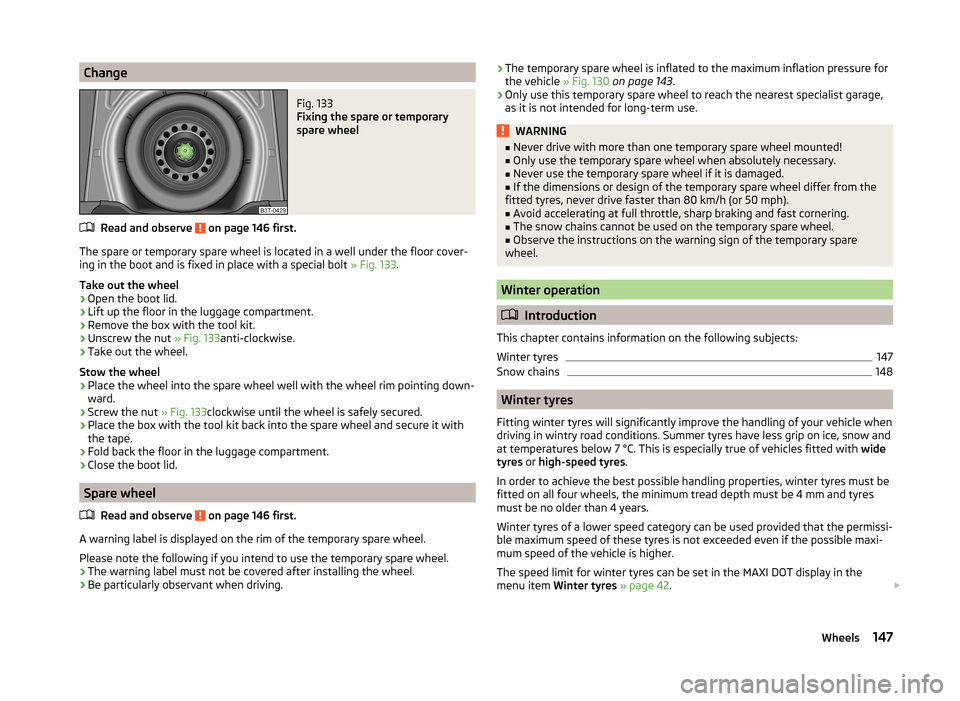
ChangeFig. 133
Fixing the spare or temporary
spare wheel
Read and observe on page 146 first.
The spare or temporary spare wheel is located in a well under the floor cover-
ing in the boot and is fixed in place with a special bolt » Fig. 133.
Take out the wheel
›
Open the boot lid.
›
Lift up the floor in the luggage compartment.
›
Remove the box with the tool kit.
›
Unscrew the nut » Fig. 133anti-clockwise.
›
Take out the wheel.
Stow the wheel
›
Place the wheel into the spare wheel well with the wheel rim pointing down-
ward.
›
Screw the nut » Fig. 133clockwise until the wheel is safely secured.
›
Place the box with the tool kit back into the spare wheel and secure it with
the tape.
›
Fold back the floor in the luggage compartment.
›
Close the boot lid.
Spare wheel
Read and observe
on page 146 first.
A warning label is displayed on the rim of the temporary spare wheel.
Please note the following if you intend to use the temporary spare wheel. › The warning label must not be covered after installing the wheel.
› Be particularly observant when driving.
› The temporary spare wheel is inflated to the maximum inflation pressure for
the vehicle » Fig. 130 on page 143 .
› Only use this temporary spare wheel to reach the nearest specialist garage,
as it is not intended for long-term use.WARNING■ Never drive with more than one temporary spare wheel mounted!■Only use the temporary spare wheel when absolutely necessary.■
Never use the temporary spare wheel if it is damaged.
■
If the dimensions or design of the temporary spare wheel differ from the
fitted tyres, never drive faster than 80 km/h (or 50 mph).
■
Avoid accelerating at full throttle, sharp braking and fast cornering.
■
The snow chains cannot be used on the temporary spare wheel.
■
Observe the instructions on the warning sign of the temporary spare
wheel.
Winter operation
Introduction
This chapter contains information on the following subjects:
Winter tyres
147
Snow chains
148
Winter tyres
Fitting winter tyres will significantly improve the handling of your vehicle when
driving in wintry road conditions. Summer tyres have less grip on ice, snow and
at temperatures below 7 °C. This is especially true of vehicles fitted with wide
tyres or high-speed tyres .
In order to achieve the best possible handling properties, winter tyres must be
fitted on all four wheels, the minimum tread depth must be 4 mm and tyres
must be no older than 4 years.
Winter tyres of a lower speed category can be used provided that the permissi-
ble maximum speed of these tyres is not exceeded even if the possible maxi-
mum speed of the vehicle is higher.
The speed limit for winter tyres can be set in the MAXI DOT display in the
menu item Winter tyres » page 42 .
147Wheels
Page 153 of 193
WARNINGThe factory-supplied lifting jack is only intended for your model of vehicle.
Under no circumstances attempt to lift heavier vehicles or other loads.
CAUTION
■ Ensure that the vehicle tool kit is safely secured in the boot.■Ensure that the box is always secured with the strap.
Changing a wheel
Introduction
This chapter contains information on the following subjects:
Preliminary work
151
Full wheel trim
152
Wheel bolts
152
Changing a wheel
152
Follow-up work
153
Loosening/tightening wheel bolts
153
Raise vehicle
153
Securing wheels against theft
154WARNING■ If you are in flowing traffic, switch on the hazard warning light system
and set up the warning triangle at the prescribed distance! The national le-
gal requirements must be observed.■
Park the vehicle as far away as possible from the flow of traffic. Park on
as flat and firm a surface as possible.
■
The following instructions must be followed if the vehicle is subsequently
fitted with tyres or rims that differ from the factory-fitted ones » page 144,
New tyres .
WARNINGNotes for vehicle lifting■If the wheel has to be changed on a slope, first of all block the opposite
wheel with a stone or similar object to prevent the vehicle from unexpect-
edly rolling away.WARNING (Continued)■ Secure the base plate of the lifting jack with suitable means to prevent
possible moving. A soft and slippery ground under the base plate may move
the lifting jack, causing the vehicle to fall down. It is therefore always nec-
essary to place the lifting jack on a solid surface or use a wide and stable
base. Use a non-slip base (e.g. a rubber foot mat) if the surface is smooth,
such as cobbled stones, tiled floor, etc.■
Only attach the lifting jack to the attachment points provided for this pur-
pose.
■
Always raise the vehicle with the doors closed.
■
Never position any body parts, such as arms or legs under the vehicle,
while the vehicle is raised with a lifting jack.
■
When the vehicle is raised, never start the engine.
WARNINGInformation on the wheel bolts■The wheel bolts must be clean and must turn easily. Never apply grease
or oil.■
The prescribed tightening torque of the wheel bolts for steel and light al-
loy wheels is 120 Nm.
■
If the wheel bolts are tightened to a too low tightening torque, the rim
can come loose when the car is moving. A tightening torque which is too
high can damage the bolts and threads and this can result in permanent
deformation of the contact surfaces on the rim.
■
In case of incorrect treatment of the wheel bolts, the wheel can loosen
when the car is moving.
Note
The national legal requirements must be observed when changing a wheel.
Preliminary work
Read and observe
on page 151 first.
Always change a wheel on a level surface as far as possible.
The following steps must be carried out before actually changing the wheel:
›
Have all of the occupants get out of the vehicle. While changing a tyre, the
occupants of the vehicle should not stand on the road (they should instead
remain behind a crash barrier).
›
Switch off the engine.
151Emergency equipment and self-help
Page 158 of 193

Inflation hose with plug
Air compressor
Button for releasing the tyre pressure
12 volt cable connector
Tyre inflation hose
Tyre inflation pressure indicator
ON and OFF switch
Tyre inflater bottle with sealing agent
Replacement valve core
The valve remover 2
has a slot at its lower end which fits into the valve core.
Preparations for using the breakdown kit
Read and observe
on page 155 first.
Always change a wheel on a level surface as far as possible.
The following preparatory work must be carried out before using the break-
down kit.
›
Have all of the occupants get out of the vehicle. While changing a tyre, the
occupants of the vehicle should not stand on the road (they should instead
remain behind a crash barrier).
›
Switch off the engine.
›
Move the gear shift lever into Neutral or move the selector lever for the au-
tomatic gearbox into position P.
›
Firmly apply the handbrake.
›
Check that you can carry out the repairs with the breakdown kit » page 155.
›
Uncouple any trailers.
›
Remove the breakdown kit from the boot.
›
Stick the sticker
1
» Fig. 143 on page 155 on the dashboard in the driver's
field of view.
›
Do not remove the foreign body, e.g. screw or nail, from the tyre.
›
Unscrew the valve cap.
›
Use the valve remover
2
to unscrew the valve core and place it on a clean
surface (rag, paper, etc.).
34567891011Sealing and inflating the tyre
Read and observe
on page 155 first.
Sealing
›
Forcefully shake the tyre inflater bottle
10
» Fig. 143 on page 155 back and
forth several times.
›
Firmly screw the inflation hose
3
onto the tyre inflater bottle
10
in a clock-
wise direction. The film on the cap is pierced automatically.
›
Remove the plug from the inflation hose
3
and plug the open end fully onto
the tyre valve.
›
Hold the bottle
10
with the bottom facing upwards and fill all of the sealing
agent from the tyre inflater bottle into the tyre.
›
Remove the empty tyre inflater bottle from the valve.
›
Screw the valve core back into the tyre valve using the valve remover
2
.
Inflating
›
Screw the tyre inflation hose
7
» Fig. 143 on page 155 of the air compressor
firmly onto the tyre valve.
›
Start the engine and run it in idle.
›
Plug the connector
6
into 12 Volt socket » page 71, 12-Volt power outlet .
›
Switch on the air compressor with the ON and OFF switch
9
.
›
Allow the air compressor to run until a pressure of 2.0-2.5 bar is achieved.
Maximum run time of 8 minutes »
›
Switch off the air compressor.
›
If you cannot reach an air pressure of 2.0–2.5 bar, unscrew the tyre inflation
hose
7
from the tyre valve.
›
Drive the vehicle 10 metres forwards or backwards to allow the sealing agent
to “distribute” in the tyre.
›
Firmly screw the tyre inflation hose
7
back onto the tyre valve and repeat
the inflation process.
›
If you cannot reach the required tyre inflation pressure here either, this
means the tyre has sustained too much damage. You cannot seal with tyre with the breakdown kit »
.
›
Switch off the air compressor.
›
Remove the tyre inflation hose
7
from the tyre valve.
Once a tyre inflation pressure of 2.0–2.5 bar is achieved, continue the journey
at a maximum speed of 80 km/h (50 mph).
Check the tyre inflation pressure after driving for 10 minutes » page 157.
156Do-it-yourself
Page 183 of 193

Brake fluid137
Checking138
Information messages31
brake pedal (automatic gearbox) indicator light
36
brakes Driving in
104
Brakes Brake booster
99
Brake fluid138
Braking and stabilisation systems106
Handbrake100
Information messages31
Brakes and parking99
Braking Information on braking
99
Breakdown kit155
bulb rear lamp
170
Bulbs Replacing
166
Buttons in the driver's door Electric power windows
51
C
Car computer See multifunction display
39
Care and maintenance119
Car park ticket holder69
Carrier83
Cavity protection125
Central locking45
Central locking button48
Change Engine oil
134
Changing Front turn signal bulb
168
Wheels151
Changing a wheel Follow-up work153
Preliminary work151
Removing and attaching a wheel152
Charging a vehicle battery140
Check Fit ball head properly
114
Checking Battery electrolyte level
140
Brake fluid138
Coolant137
Engine oil135
Oil level135
Windscreen washer fluid134
Checks Statutory checks
119
Children and safety20
Child safety Side airbag
21
Child safety lock48
Child seat Classification
22
ISOFIX22
on the front passenger seat20
TOP TETHER23
Use of child seats22
Use of ISOFIX child seats23
Chrome parts see vehicle care
124
Cigarette lighter70
cleaning chrome parts
124
Cleaning Alcantara
128
and maintaining belts128
artificial leather128
headlight glasses125
materials128
natural leather127
plastic parts124
seats covers of the electrically heated seats128
wheels126
Cleaning safety belt
128
Cleaning seat covers
128
Cleaning the interior artificial leather
128
Seat covers128
Cleaning the outside of the vehicle Decorative films
124
Cleaning the vehicle exterior Cavity protection
125
Door locking cylinder125
Headlight glasses125
Under-body protection126
wheels126
Windows and external mirrors125
Cleaning vehicle122
Cleaning vehicle exterior123
Plastic parts124
Rubber seals124
Vehicle paint work123
Wiper blades126
Clean interior Safety belt
128
clean outside of vehicle chrome parts
124
Climatronic air distribution control
85
Operating elements87
Clothes hook74
Cockpit 12-Volt power outlet
71
Ashtray71
Cigarette lighter70
General view25
Lights58
storage compartments68
useful equipment68
181Index
Page 184 of 193

COMING HOME57
compartments68
Computer See multifunction display
39
convenience turn signal55
Coolant136
Checking137
Information messages32
Replenishing137
Temperature gauge27
Warning light32
Cooling system cost-effective use
88
malfunctions88
CORNER See Fog lights with CORNER function
56
Correct seated position7
Driver7
Front passenger8
Instructions9
Rear seats9
Counter for distance driven28
cruise control operation
108
operation description109
Cruise control system Warning light
36
Cruise Control System108
Cup holders70
D
DAY LIGHT See Daytime running lights
54
Daytime running lights54
Dazzle see sun screen of the panoramic roof
60
De-icing windows
125
Deactivating an airbag18
Decorative films124
Defrosting rear window59
Delayed locking of the boot lid see boot lid
51
Departure angle175
Diesel refer to Fuel
131
Diesel fuel Operation in winter
131
Diesel particle filter Information notices
34
Warning light34
Digital Clock Time
29
Dipstick135
Disconnecting and reconnecting vehicle battery
141
Display27
Compass points43
Coolant temperature27
Fuel supply28
Gear changes38
Service intervals43
Display a low temperature38
Display of the second speed29
Disposal Acceptance and recycling of used vehicles
121
Distance driven28
Door Child safety lock
48
Closing49
Emergency locking161
Opening49
Warning light for open door31
Door open Warning light
31
Double-sided floor covering79
Driving Driving through water105
Emissions173
Fuel consumption173
Maximum speed176
off made-up roads105
Driving economically Tips
104
Driving in Brake linings
104
the engine104
Tyres104
Driving off made-up roads105
Driving through water105
Driving with a trailer116
E
Economical driving and environmental friendli- ness
104
EDL107
Electrical power windows Button in the driver's door
51
Button in the rear door52
Buttons in the driver's door52
Electronic Differential Lock (EDL)107
Electronic immobilizer97
Electronic Stability Control (ESC)106
Emergency Changing a wheel
151
Hazard warning light system57
jump-starting158
Jump-starting157
Locking the door without a locking cylinder161
Selector lever-unlocking162
Towing the vehicle158
Towing the vehicle using the tow hitch160
Tyre repair155
Unlocking the tailgate162
emergency equipment reflective vest
149
182Index
Page 185 of 193
Emergency equipmentFire extinguisher150
First aid kit149
Jack150
Vehicle tool kit150
Warning triangle149
emergency wheel146
Emissions173
Engine Switching off the engine
98
Engine compartment131
Brake fluid138
Overview133
Vehicle battery138
Engine number172
engine oil specification
135
Engine oil134
change134
Checking135
Information messages31
Replenishing136
Warning light31
Environment104
EPC Warning light
34
ESC Function
106
Warning light32
Exhaust inspection system Warning light
34
F
Fastening elements
76
Films124
Fire extinguisher150
First aid kit149
Flashing55
Flexible storage compartment79
Fog lights56
Warning light36
Fog lights with CORNER function56
Footmats101
refer to footmats101
Force limit Power windows
52
Front airbag15
Front interior light58
fuel lead-free petrol
130
Fuel129
Diesel131
Fuel gauge28
refer to Fuel129
Refuelling129
Fuel consumption104, 173
Fuel reserve Warning light
35
Fuses Assignment
163
Assignment of fuses in the dash panel164
Colour coding163
Fuse assignment in the engine compartment166
Replacing163
Fuses in the engine compartment Assignment
166
G
Gearbox Warning messages
29
Gear change Gear recommendation
38
Information on the selected gear38
Gear changing Gear stick
101
gears spare
147
General viewCockpit25
Generator Indicator light
31
Genuine parts120
Glasses compartment73
Glow plug system Warning light
34
GSM89
H
Handbrake
100
Warning light30
Hazard warning light system57
HBA107
Head airbag17
Headlight cleaning system Headlight cleaning system
62
Headlights Bulb arrangement
167
Driving abroad58
Headlight cleaning system62
Headrest removing and installing
65
Head restraints65
Adjust height65
Heating84
Air distribution control85
Control elements86
Exterior mirror63
Rear window59
Seats66
Heating rear window59
HHC107
Hill Hold Control (HHC)107
Hitch112
Drawback load112
Hooks77
Horn25
183Index
Page 188 of 193
Bulb for the licence plate light169
Bulb in rear light170
Bulbs166
Fuses163
Fuses in the dash panel164
Fuses in the engine compartment165
Low beam bulb167
Vehicle battery141
Windscreen wiper blades162
Wiper blades163
Replenishing Coolant
137
Engine oil136
Windscreen washer fluid134
Revolution counter27
Roof Load
83
Roof rack mounting points
83
Roof load83
Roof rack system83
Rubber seals124
S
SAFE See Safe securing system
47
SAFELOCK See Safe securing system
47
Safe securing system47
Safety6
Child safety20
Child safety seats20
Correct seated position7
Head restraints65
ISOFIX22
TOP TETHER23
Saving electrical energy104
Seals Vehicle care
124
SeatAdjusting64
Seat belt Warning light
31
Seat belts10
Belt tensioners13
fastening and unfastening12
Height adjustment13
Inertia reels13
The physical principle of a frontal collision11
Seat features66
Seats Front armrest
67
Head restraints65
Heating66
Rear armrest67
Seat backrests67
Seats and head restraint64
Selector lever Refer to Selector lever
102
Service120
Service interval display43
Setting29
Lower position of the variable loading floor81
seats and head restraints64
Upper position of the variable loading floor80
Setting the29
Side airbag16
Snow chains148
Spare change
147
spare wheel146
change147
instructions147
Speedometer27
See speedometer27
Speed symbol Refer to Wheels
145
Spoiler121
START-STOP109
Manually deactivating/activating the system111
Operating conditions of the system110
operation in vehicles with automatic gearbox110
operation in vehicles with manual gearbox110
system-related automatic start-up111
Starting engine Jump-starting
157
Starting the engine Jump-starting
158
START STOP Information messages
111
Jump-starting158
Start the engine98
Stating and turning off the engine97
Steering wheel8
Stopping100
Storage68
Storage compartment Glasses compartment
73
in the centre console69
in the front arm rest73
on the front passenger side73
Storage compartments68
Storage compartments in the boot78
Storage net bag79
Storage pockets on the front seats74
Stowage compartments in the doors
69
Sun visors60
Switching off the engine98
Switch light on/off53
T
Taking care of your vehicle Automatic car wash system
122
High-pressure cleaner123
Washing by hand122
Wash system122
186Index