fog light SKODA RAPID SPACEBACK 2013 1.G Owner's Manual
[x] Cancel search | Manufacturer: SKODA, Model Year: 2013, Model line: RAPID SPACEBACK, Model: SKODA RAPID SPACEBACK 2013 1.GPages: 193, PDF Size: 14.8 MB
Page 32 of 193
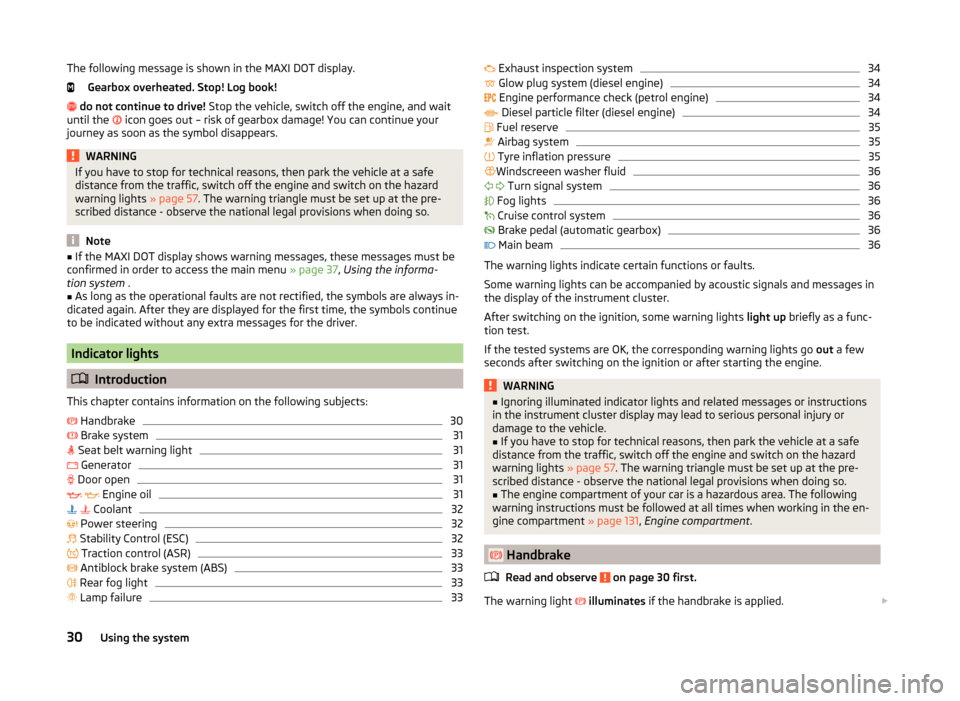
The following message is shown in the MAXI DOT display.Gearbox overheated. Stop! Log book!
do not continue to drive! Stop the vehicle, switch off the engine, and wait
until the
icon goes out – risk of gearbox damage! You can continue your
journey as soon as the symbol disappears.WARNINGIf you have to stop for technical reasons, then park the vehicle at a safe
distance from the traffic, switch off the engine and switch on the hazard
warning lights » page 57. The warning triangle must be set up at the pre-
scribed distance - observe the national legal provisions when doing so.
Note
■ If the MAXI DOT display shows warning messages, these messages must be
confirmed in order to access the main menu » page 37, Using the informa-
tion system .■
As long as the operational faults are not rectified, the symbols are always in-
dicated again. After they are displayed for the first time, the symbols continue
to be indicated without any extra messages for the driver.
Indicator lights
Introduction
This chapter contains information on the following subjects:
Handbrake
30
Brake system
31
Seat belt warning light
31
Generator
31
Door open
31
Engine oil
31
Coolant
32
Power steering
32
Stability Control (ESC)
32
Traction control (ASR)
33
Antiblock brake system (ABS)
33
Rear fog light
33
Lamp failure
33 Exhaust inspection system34 Glow plug system (diesel engine)34
Engine performance check (petrol engine)
34
Diesel particle filter (diesel engine)
34
Fuel reserve
35
Airbag system
35
Tyre inflation pressure
35
Windscreeen washer fluid
36
Turn signal system
36
Fog lights
36
Cruise control system
36
Brake pedal (automatic gearbox)
36
Main beam
36
The warning lights indicate certain functions or faults.
Some warning lights can be accompanied by acoustic signals and messages in
the display of the instrument cluster.
After switching on the ignition, some warning lights light up briefly as a func-
tion test.
If the tested systems are OK, the corresponding warning lights go out a few
seconds after switching on the ignition or after starting the engine.
WARNING■ Ignoring illuminated indicator lights and related messages or instructions
in the instrument cluster display may lead to serious personal injury or
damage to the vehicle.■
If you have to stop for technical reasons, then park the vehicle at a safe
distance from the traffic, switch off the engine and switch on the hazard
warning lights » page 57. The warning triangle must be set up at the pre-
scribed distance - observe the national legal provisions when doing so.
■
The engine compartment of your car is a hazardous area. The following
warning instructions must be followed at all times when working in the en-
gine compartment » page 131, Engine compartment .
Handbrake
Read and observe
on page 30 first.
The warning light
illuminates if the handbrake is applied.
30Using the system
Page 35 of 193
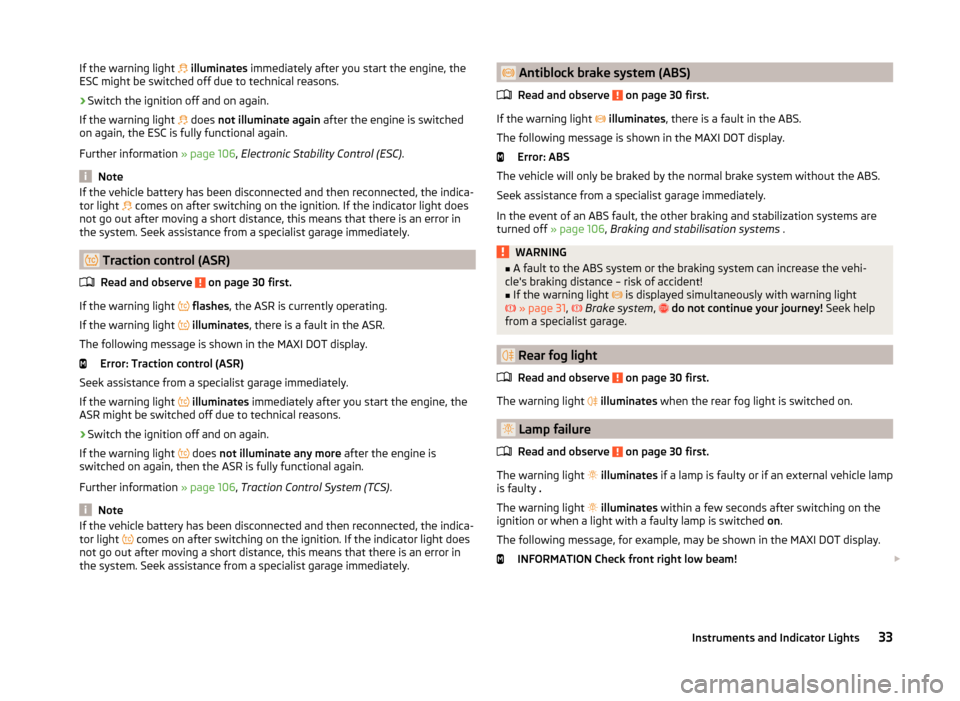
If the warning light illuminates immediately after you start the engine, the
ESC might be switched off due to technical reasons.›
Switch the ignition off and on again.
If the warning light
does not illuminate again after the engine is switched
on again, the ESC is fully functional again.
Further information » page 106, Electronic Stability Control (ESC) .
Note
If the vehicle battery has been disconnected and then reconnected, the indica-
tor light comes on after switching on the ignition. If the indicator light does
not go out after moving a short distance, this means that there is an error in
the system. Seek assistance from a specialist garage immediately.
Traction control (ASR)
Read and observe
on page 30 first.
If the warning light
flashes , the ASR is currently operating.
If the warning light
illuminates , there is a fault in the ASR.
The following message is shown in the MAXI DOT display. Error: Traction control (ASR)
Seek assistance from a specialist garage immediately.
If the warning light
illuminates immediately after you start the engine, the
ASR might be switched off due to technical reasons.
›
Switch the ignition off and on again.
If the warning light does
not illuminate any more after the engine is
switched on again, then the ASR is fully functional again.
Further information » page 106, Traction Control System (TCS) .
Note
If the vehicle battery has been disconnected and then reconnected, the indica-
tor light comes on after switching on the ignition. If the indicator light does
not go out after moving a short distance, this means that there is an error in
the system. Seek assistance from a specialist garage immediately. Antiblock brake system (ABS)
Read and observe
on page 30 first.
If the warning light
illuminates , there is a fault in the ABS.
The following message is shown in the MAXI DOT display. Error: ABS
The vehicle will only be braked by the normal brake system without the ABS.
Seek assistance from a specialist garage immediately.
In the event of an ABS fault, the other braking and stabilization systems are
turned off » page 106 , Braking and stabilisation systems .
WARNING■
A fault to the ABS system or the braking system can increase the vehi-
cle's braking distance – risk of accident!■
If the warning light
is displayed simultaneously with warning light
» page 31 ,
Brake system ,
do not continue your journey! Seek help
from a specialist garage.
Rear fog light
Read and observe
on page 30 first.
The warning light
illuminates when the rear fog light is switched on.
Lamp failure
Read and observe
on page 30 first.
The warning light
illuminates if a lamp is faulty or if an external vehicle lamp
is faulty .
The warning light
illuminates within a few seconds after switching on the
ignition or when a light with a faulty lamp is switched on.
The following message, for example, may be shown in the MAXI DOT display. INFORMATION Check front right low beam!
33Instruments and Indicator Lights
Page 38 of 193

Windscreeen washer fluidRead and observe
on page 30 first.
If the windscreen washer fluid level is too low, the warning light
illumi-
nates .
The following message is shown in the MAXI DOT display.
Top up wash fluid!
Top up with liquid » page 134, Windscreen washer system .
Turn signal system
Read and observe
on page 30 first.
Either the left or the right
warning light
flashes depending on the position
of the turn signal lever.
If there is a fault in the turn signal system, the warning light flashes at twice
its normal rate.
Switching off the hazard warning light system is switched on will cause all of
the turn signal lights as well as both warning lights to flash.
Fog lights
Read and observe
on page 30 first.
The warning light
illuminates when the fog lights are operating.
Cruise control system
Read and observe
on page 30 first.
The warning light
illuminates when the cruise control is active » page 108.
Brake pedal (automatic gearbox)
Read and observe
on page 30 first.
If the warning light
illuminates , operate the brake pedal.
Main beam
Read and observe
on page 30 first.
The warning light
illuminates when the main beam or the headlight flasher
is operated.
36Using the system
Page 55 of 193

Lights and visibility
Lights
Introduction
This chapter contains information on the following subjects:
Parking light and low beam
53
Daytime running lights(DAY LIGHT)
54
Turn signal and main beam
55
Automatic driving lamp control
55
Fog lights
56
Fog lights with CORNER function
56
Rear fog light
56
COMING HOME / LEAVING HOME
57
Hazard warning light system
57
Parking light
58
Driving abroad
58
Unless otherwise stated, the lights only work when the ignition is switched
on.
The arrangement of the controls right-hand drive models may differ from the
layout shown in » Fig. 36 on page 53 . The symbols which mark the positions
of the controls are identical.
WARNING■ The activation of the lights should only be undertaken in accordance with
national legal requirements.■
The driver is always responsible for the correct settings and use of the
lights.
WARNING (Continued)■ The automatic driving lamp control only operates as a support and
does not release the driver from his responsibility to check the light and, if
necessary, to switch on the light depending on the given light conditions.
The light sensor cannot, for example, detect rain or snow. Under these con-
ditions we recommend switching on the low beam or fog lights!■
Never drive with only the side lights on! The side lights are not bright
enough to light up the road sufficiently in front of you or to be seen by oth-
er oncoming traffic. Therefore always switch on the low beam when it is
dark or if visibility is poor.
Note
The headlights may mist up temporarily. When the driving lights are switched
on, the light outlet surfaces are free from mist after a short period, although
the headlight lenses may still be misted up in the peripheral areas. This mist
has no influence on the life of the lighting system.
Parking light and low beam
Fig. 36
Light switch and control dial for
headlight range adjustment
Read and observe on page 53 first.
Light switch positions - turning the switch
A
» Fig. 36
Switching off lights (except daytime running lights) Automatic switching lights on and off » page 55
Switching on the parking light or parking lights 1)
» page 58
Turn on the low beam 1)
1)
On vehicles with a MAXI DOT display, the symbol also lights up in the light switch.
53Lights and visibility
Page 56 of 193

Light switch positions - pulling the switch A
Switch on the front fog lamp » page 56
Switching on the rear fog light » page 56
Headlight range control - knob
B
Turning the rotary switch from the position
in
gradually adjusts the head-
light range control and thereby shortens the light cone.
The positions of the width of illumination correspond approximately to the fol-
lowing car load.
Front seats occupied, boot empty
All seats occupied, boot empty
All seats occupied, boot loaded
Driver seat occupied, boot loaded
We recommend you adjust the headlight beam when the low beam is switched
on.
WARNINGAlways adjust the headlight beam to meet the following conditions.■The vehicle does not dazzle other road users, especially oncoming vehi-
cles.■
The beam range is sufficient for safe driving.
Note
■ An audible warning signal will sound if the light switch is in the or posi-
tion, the ignition key is removed and the driver's door is opened. The audible
warning signal is switched off after a few seconds or as a result of door con-
tact when the driver's door is closed. However, the side lights remain on to illu-
minate the parked vehicle if necessary.■
If leaving the vehicle without needing the parking lights on, always turn
the light switch to position
.
Daytime running lights(DAY LIGHT)
Read and observe
on page 53 first.
The daytime running lights (the only function) provides the lighting of the frontvehicle range.
The daytime running lights are switched on automatically if the following
conditions are met.
The light switch is in the position
or
» Fig. 36 on page 53 .
The ignition is switched on.
The parking aid is activated.
Deactivating the function›
Switch off the ignition.
›
Remove the fuse for the daytime running lights » page 164, Fuses in the
dash panel .
Activating the function
›
Switch off the ignition.
›
Use a fuse of appropriate amperage for the daytime running
lights » page 164 , Fuses in the dash panel .
Disable function on vehicles with the START-STOP system or with the
automatic driving light control
›
Switch off the ignition.
›
Slide the turn signal light lever ( » Fig. 37 on page 55 ) downwards and hold
it in this position.
›
Switch on the ignition – wait until the left-turn signal light flashes 4x.
›
Switch off the ignition – an audible signal sounds which confirms the deacti-
vation of the function.
›
Release the turn signal stalk.
Function on vehicles with the START-STOP system or with the automatic
driving light control
›
Switch off the ignition.
›
Slide the turn signal light lever ( » Fig. 37 on page 55 ) upwards and hold it in
this position.
›
Switch on the ignition – wait until the right-turn signal light flashes 4x.
›
Switch off the ignition – an audible signal sounds which confirms the activa-
tion of the function.
›
Release the turn signal stalk.
WARNINGWhen the daytime running light is switched on, the side lights (neither at
the front nor the rear) and the number plate lights are not lit. Therefore al-
ways switch on the low beam when the visibility is poor.54Using the system
Page 58 of 193

The light turns off about 4 minutes after turning off the wipers.
CAUTION
Do not attach any stickers or similar objects in front of the light sensor on the
windscreen to avoid impairing the function or its reliability.
Fog lights
Fig. 39
Light switch - Switch front and
rear fog light
Read and observe on page 53 first.
Switching on/off
›
Turn the light switch to position
or
» Fig. 39 .
›
Pull the light switch to position
1
.
The rear fog light is switched off in the reverse order.
The warning light
» page 30 lights up in the instrument cluster when the
fog lights are switched on.
Fog lights with CORNER function
Read and observe
on page 53 first.
The CORNER function lights the front fog lamp on each side of the vehicle to
illuminate the area around the vehicle when turning, parking, etc.
The CORNER function is switched on automatically if the following conditions
are met.
The turn signal is switched on or the front wheels are turned sharply to
the right or left 1)
.
The engine is running.
The vehicle is stopped or moves at a speed of no more than 40 km/h.
The low beam is switched on or the light switch is in the position
and
the low beam is switched on.
The daytime running lights are not switched on.
The fog lights are not switched on.
Note
The two fog lights are switched on when you shift into the reverse gear.
Rear fog light
Read and observe
on page 53 first.
Switching on/off
›
Turn the light switch to position or
» Fig. 39 on page 56 .
›
Pull the light switch to position
2
.
The rear fog light is switched off in the reverse order.
If the vehicle is not fitted with fog lights » page 56, the rear fog light is switch-
ed on by turning the light switch to the position and is pulled out directly to
the position
2
. This switch can only be put into one position.
The warning light
» page 30 lights up in the instrument cluster when the
rear fog light is switched on.
Only the rear fog light on the trailer lights up if the vehicle has a factory-fitted
towing device or a towing device from ŠKODA original accessories and it is
driven with a trailer.
1)
If both switch-on conditions are conflicting, for example, if the front wheels are turned to the left and
the right turn signal light is switched on, the turn signal light has the higher priority.
56Using the system
Page 167 of 193
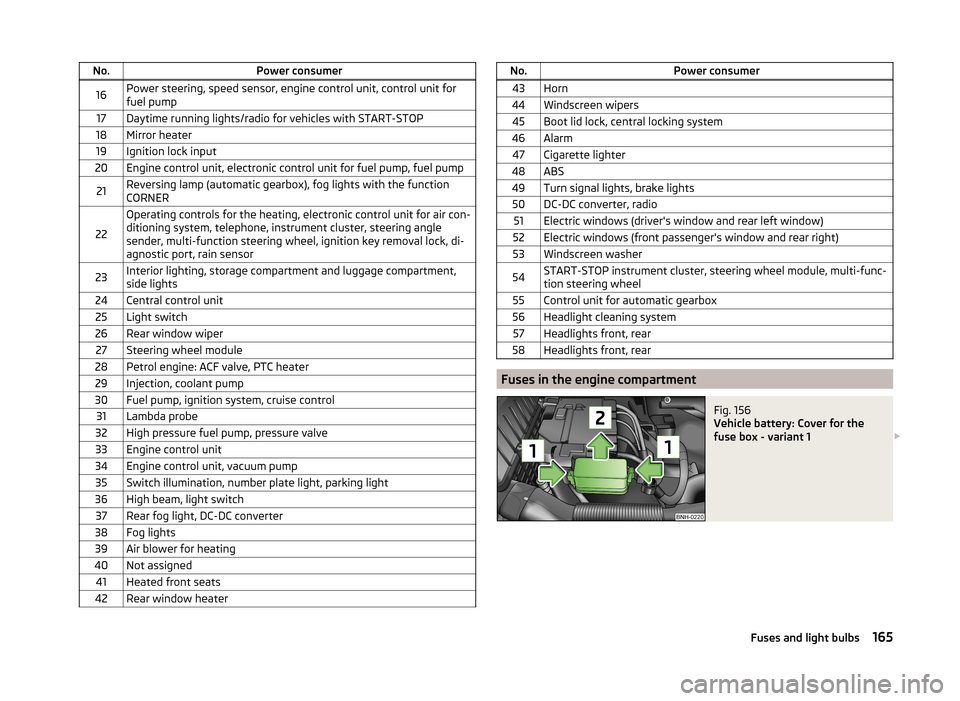
No.Power consumer16Power steering, speed sensor, engine control unit, control unit for
fuel pump17Daytime running lights/radio for vehicles with START-STOP18Mirror heater19Ignition lock input20Engine control unit, electronic control unit for fuel pump, fuel pump21Reversing lamp (automatic gearbox), fog lights with the function
CORNER
22
Operating controls for the heating, electronic control unit for air con-
ditioning system, telephone, instrument cluster, steering angle
sender, multi-function steering wheel, ignition key removal lock, di-
agnostic port, rain sensor23Interior lighting, storage compartment and luggage compartment,
side lights24Central control unit25Light switch26Rear window wiper27Steering wheel module28Petrol engine: ACF valve, PTC heater29Injection, coolant pump30Fuel pump, ignition system, cruise control31Lambda probe32High pressure fuel pump, pressure valve33Engine control unit34Engine control unit, vacuum pump35Switch illumination, number plate light, parking light36High beam, light switch37Rear fog light, DC-DC converter38Fog lights39Air blower for heating40Not assigned41Heated front seats42Rear window heaterNo.Power consumer43Horn44Windscreen wipers45Boot lid lock, central locking system46Alarm47Cigarette lighter48ABS49Turn signal lights, brake lights50DC-DC converter, radio51Electric windows (driver's window and rear left window)52Electric windows (front passenger's window and rear right)53Windscreen washer54START-STOP instrument cluster, steering wheel module, multi-func-
tion steering wheel55Control unit for automatic gearbox56Headlight cleaning system57Headlights front, rear58Headlights front, rear
Fuses in the engine compartment
Fig. 156
Vehicle battery: Cover for the
fuse box - variant 1
165Fuses and light bulbs
Page 168 of 193
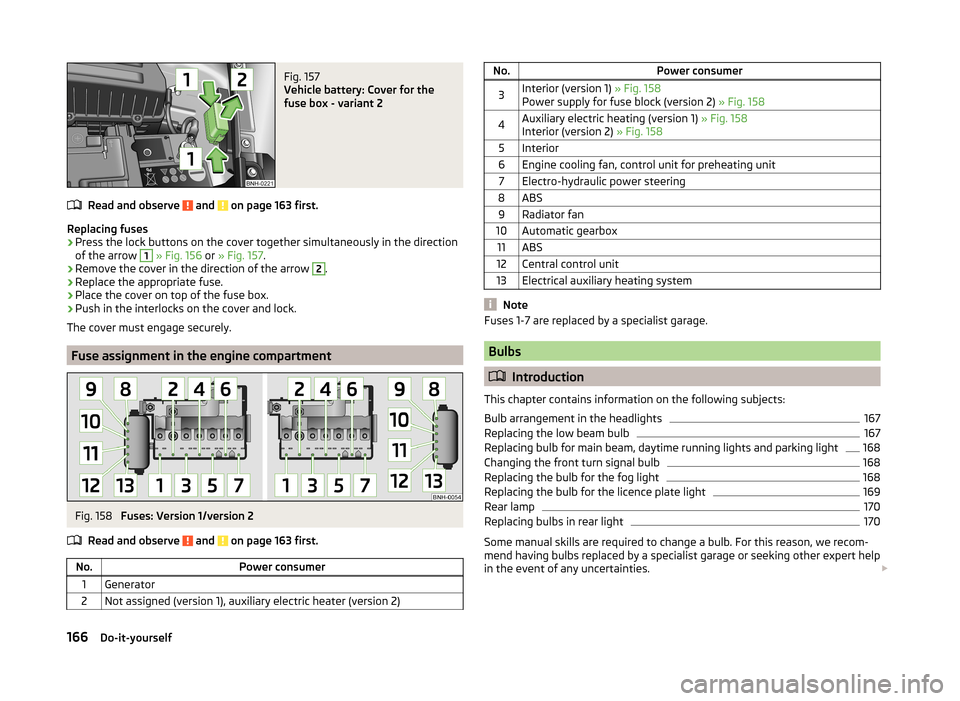
Fig. 157
Vehicle battery: Cover for the
fuse box - variant 2
Read and observe and on page 163 first.
Replacing fuses
›
Press the lock buttons on the cover together simultaneously in the direction
of the arrow
1
» Fig. 156 or » Fig. 157 .
›
Remove the cover in the direction of the arrow
2
.
›
Replace the appropriate fuse.
›
Place the cover on top of the fuse box.
›
Push in the interlocks on the cover and lock.
The cover must engage securely.
Fuse assignment in the engine compartment
Fig. 158
Fuses: Version 1/version 2
Read and observe
and on page 163 first.
No.Power consumer1Generator2Not assigned (version 1), auxiliary electric heater (version 2)No.Power consumer3Interior (version 1) » Fig. 158
Power supply for fuse block (version 2) » Fig. 1584Auxiliary electric heating (version 1) » Fig. 158
Interior (version 2) » Fig. 1585Interior6Engine cooling fan, control unit for preheating unit7Electro-hydraulic power steering8ABS9Radiator fan10Automatic gearbox11ABS12Central control unit13Electrical auxiliary heating system
Note
Fuses 1-7 are replaced by a specialist garage.
Bulbs
Introduction
This chapter contains information on the following subjects:
Bulb arrangement in the headlights
167
Replacing the low beam bulb
167
Replacing bulb for main beam, daytime running lights and parking light
168
Changing the front turn signal bulb
168
Replacing the bulb for the fog light
168
Replacing the bulb for the licence plate light
169
Rear lamp
170
Replacing bulbs in rear light
170
Some manual skills are required to change a bulb. For this reason, we recom-
mend having bulbs replaced by a specialist garage or seeking other expert help
in the event of any uncertainties.
166Do-it-yourself
Page 169 of 193
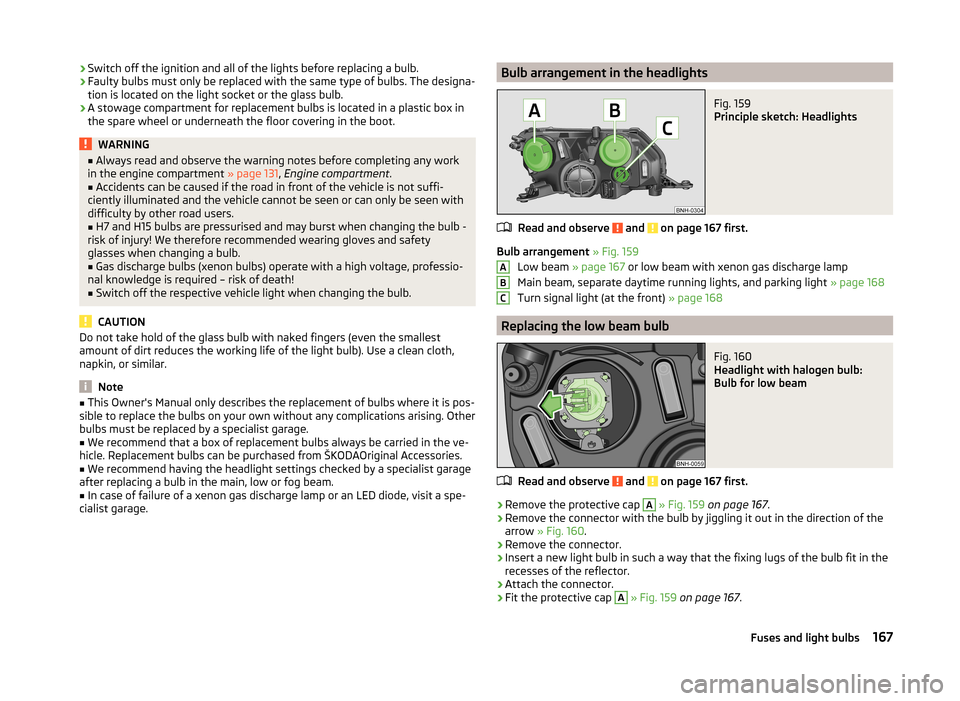
›Switch off the ignition and all of the lights before replacing a bulb.
› Faulty bulbs must only be replaced with the same type of bulbs. The designa-
tion is located on the light socket or the glass bulb.
› A stowage compartment for replacement bulbs is located in a plastic box in
the spare wheel or underneath the floor covering in the boot.WARNING■ Always read and observe the warning notes before completing any work
in the engine compartment » page 131, Engine compartment .■
Accidents can be caused if the road in front of the vehicle is not suffi-
ciently illuminated and the vehicle cannot be seen or can only be seen with
difficulty by other road users.
■
H7 and H15 bulbs are pressurised and may burst when changing the bulb -
risk of injury! We therefore recommended wearing gloves and safety
glasses when changing a bulb.
■
Gas discharge bulbs (xenon bulbs) operate with a high voltage, professio-
nal knowledge is required – risk of death!
■
Switch off the respective vehicle light when changing the bulb.
CAUTION
Do not take hold of the glass bulb with naked fingers (even the smallest
amount of dirt reduces the working life of the light bulb). Use a clean cloth,
napkin, or similar.
Note
■ This Owner's Manual only describes the replacement of bulbs where it is pos-
sible to replace the bulbs on your own without any complications arising. Other
bulbs must be replaced by a specialist garage.■
We recommend that a box of replacement bulbs always be carried in the ve-
hicle. Replacement bulbs can be purchased from ŠKODAOriginal Accessories.
■
We recommend having the headlight settings checked by a specialist garage
after replacing a bulb in the main, low or fog beam.
■
In case of failure of a xenon gas discharge lamp or an LED diode, visit a spe-
cialist garage.
Bulb arrangement in the headlightsFig. 159
Principle sketch: Headlights
Read and observe and on page 167 first.
Bulb arrangement » Fig. 159
Low beam » page 167 or low beam with xenon gas discharge lamp
Main beam, separate daytime running lights, and parking light » page 168
Turn signal light (at the front) » page 168
Replacing the low beam bulb
Fig. 160
Headlight with halogen bulb:
Bulb for low beam
Read and observe and on page 167 first.
›
Remove the protective cap
A
» Fig. 159 on page 167 .
›
Remove the connector with the bulb by jiggling it out in the direction of the
arrow » Fig. 160 .
›
Remove the connector.
›
Insert a new light bulb in such a way that the fixing lugs of the bulb fit in the
recesses of the reflector.
›
Attach the connector.
›
Fit the protective cap
A
» Fig. 159 on page 167 .
ABC167Fuses and light bulbs
Page 170 of 193

Replacing bulb for main beam, daytime running lights and parking
lightFig. 161
Bulbs for main beam, daytime running lights, and parking light
Read and observe
and on page 167 first.
Removing/replacing the bulb for main beam and separate daytime running
lights
›
Remove the protective cap
B
» Fig. 159 on page 167 .
›
Turn the bulb holder
A
» Fig. 161 as far as it goes in the direction of the ar-
row and remove it.
›
Replace the bulb, insert the bulb holder with the new bulb and turn in the
opposite direction to that of the arrow as far as it goes.
›
Fit protective cap
B
» Fig. 159 on page 167 Insert.
Removing/replacing the bulb for the parking light
›
Remove the protective cap
B
» Fig. 159 on page 167 .
›
Remove the bulb holder with the bulb by jiggling it out in the direction of the
arrow
1
» Fig. 161 .
›
Remove the faulty bulb from the holder in the direction of the arrow
2
.
›
Insert a new bulb in the bulb holder up to the stop.
›
Replace the bulb holder in the headlamp with the bulb.
›
Fit protective cap
B
» Fig. 159 on page 167 Insert.
Changing the front turn signal bulbFig. 162
Principle sketch: Bulb for indica-
tor
Read and observe and on page 167 first.
›
Turn the socket with the bulb » Fig. 162 as far as it will go in the direction of
the arrow and then remove it.
›
Remove the bulb, insert the new bulb into the socket and turn in the oppo-
site direction to that of the arrow to the stop.
Replacing the bulb for the fog light
Fig. 163
Front bumper: Protective grille/removing the fog light
168Do-it-yourself