open bonnet SKODA RAPID SPACEBACK 2015 1.G User Guide
[x] Cancel search | Manufacturer: SKODA, Model Year: 2015, Model line: RAPID SPACEBACK, Model: SKODA RAPID SPACEBACK 2015 1.GPages: 208, PDF Size: 29.2 MB
Page 152 of 208
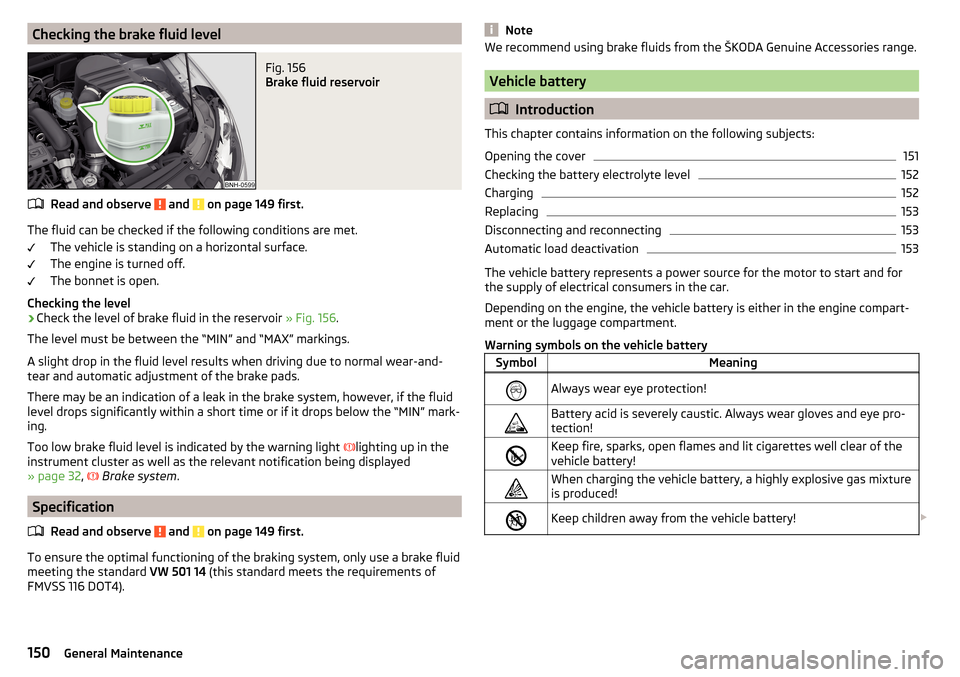
Checking the brake fluid levelFig. 156
Brake fluid reservoir
Read and observe and on page 149 first.
The fluid can be checked if the following conditions are met.The vehicle is standing on a horizontal surface.
The engine is turned off.
The bonnet is open.
Checking the level
›
Check the level of brake fluid in the reservoir » Fig. 156.
The level must be between the “MIN” and “MAX” markings.
A slight drop in the fluid level results when driving due to normal wear-and-
tear and automatic adjustment of the brake pads.
There may be an indication of a leak in the brake system, however, if the fluid
level drops significantly within a short time or if it drops below the “MIN” mark-
ing.
Too low brake fluid level is indicated by the warning light lighting up in the
instrument cluster as well as the relevant notification being displayed
» page 32 ,
Brake system
.
Specification
Read and observe
and on page 149 first.
To ensure the optimal functioning of the braking system, only use a brake fluid
meeting the standard VW 501 14 (this standard meets the requirements of
FMVSS 116 DOT4).
NoteWe recommend using brake fluids from the ŠKODA Genuine Accessories range.
Vehicle battery
Introduction
This chapter contains information on the following subjects:
Opening the cover
151
Checking the battery electrolyte level
152
Charging
152
Replacing
153
Disconnecting and reconnecting
153
Automatic load deactivation
153
The vehicle battery represents a power source for the motor to start and for
the supply of electrical consumers in the car.
Depending on the engine, the vehicle battery is either in the engine compart-
ment or the luggage compartment.
Warning symbols on the vehicle battery
SymbolMeaningAlways wear eye protection!Battery acid is severely caustic. Always wear gloves and eye pro-
tection!Keep fire, sparks, open flames and lit cigarettes well clear of the
vehicle battery!When charging the vehicle battery, a highly explosive gas mixture
is produced!Keep children away from the vehicle battery! 150General Maintenance
Page 154 of 208
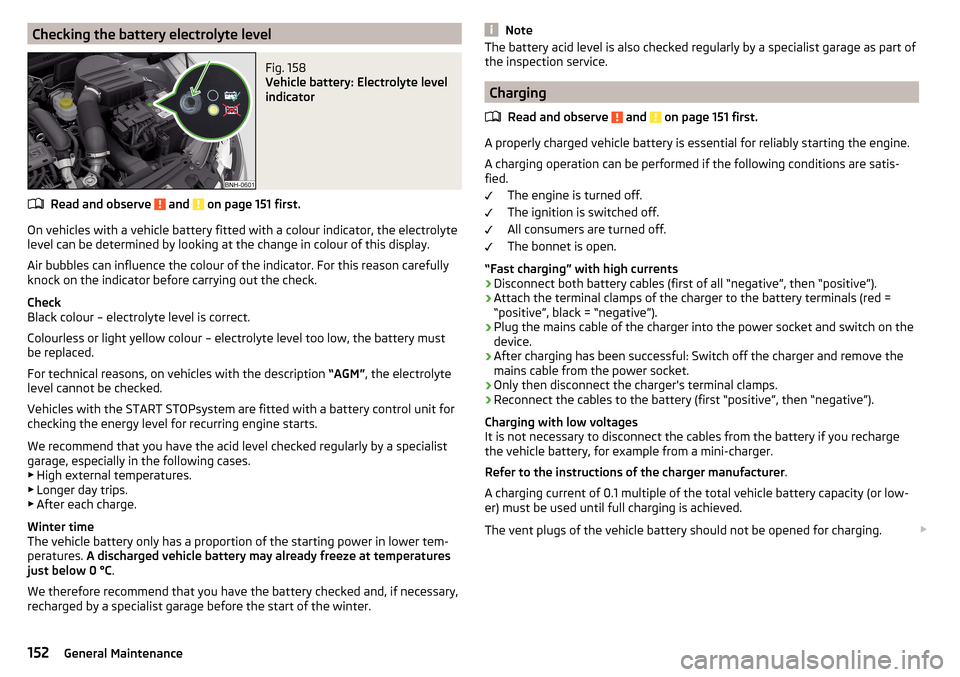
Checking the battery electrolyte levelFig. 158
Vehicle battery: Electrolyte level
indicator
Read and observe and on page 151 first.
On vehicles with a vehicle battery fitted with a colour indicator, the electrolyte
level can be determined by looking at the change in colour of this display.
Air bubbles can influence the colour of the indicator. For this reason carefully
knock on the indicator before carrying out the check.
Check
Black colour – electrolyte level is correct.
Colourless or light yellow colour – electrolyte level too low, the battery must
be replaced.
For technical reasons, on vehicles with the description “AGM”, the electrolyte
level cannot be checked.
Vehicles with the START STOPsystem are fitted with a battery control unit for
checking the energy level for recurring engine starts.
We recommend that you have the acid level checked regularly by a specialist
garage, especially in the following cases. ▶ High external temperatures.
▶ Longer day trips.
▶ After each charge.
Winter time
The vehicle battery only has a proportion of the starting power in lower tem-
peratures. A discharged vehicle battery may already freeze at temperatures
just below 0 °C .
We therefore recommend that you have the battery checked and, if necessary,
recharged by a specialist garage before the start of the winter.
NoteThe battery acid level is also checked regularly by a specialist garage as part of
the inspection service.
Charging
Read and observe
and on page 151 first.
A properly charged vehicle battery is essential for reliably starting the engine.
A charging operation can be performed if the following conditions are satis-
fied.
The engine is turned off.
The ignition is switched off.
All consumers are turned off.
The bonnet is open.
“Fast charging” with high currents
›
Disconnect both battery cables (first of all “negative”, then “positive”).
›
Attach the terminal clamps of the charger to the battery terminals (red =
“positive”, black = “negative”).
›
Plug the mains cable of the charger into the power socket and switch on the
device.
›
After charging has been successful: Switch off the charger and remove the
mains cable from the power socket.
›
Only then disconnect the charger's terminal clamps.
›
Reconnect the cables to the battery (first “positive”, then “negative”).
Charging with low voltages
It is not necessary to disconnect the cables from the battery if you recharge
the vehicle battery, for example from a mini-charger.
Refer to the instructions of the charger manufacturer .
A charging current of 0.1 multiple of the total vehicle battery capacity (or low-
er) must be used until full charging is achieved.
The vent plugs of the vehicle battery should not be opened for charging.
152General Maintenance
Page 192 of 208
Index
A
abroad lead-free petrol
141
Abroad Headlights
63
ABS Operation
110
Warning light33
Acceptance and recycling of used vehicles133
Accessories130
Adjusting Exterior mirror
68
head restraints69
Seat69
Steering wheel9
Adjusting the seats8
Adjustment Beam range
59
Advance warning/emergency braking Warning light
38
Air-conditioning system Air outlet vents
94
Airbag14
Deactivating18
Deactivating the front passenger airbag18
Deployment15
Front airbag15
Head airbag17
Modifications and damage to the airbag system 132
Side airbag
16
Warning light34
Airbag system14
Air conditioning90
Air distribution control93
Climatronic92
Manual air conditioning91
Air distribution control93
Air outlet vents94
Alarm Enable/disable
54
Switch off54
Trailer128
Triggering54
Alcantara cleaning
139
Anodized parts Refer to vehicle maintenance
136
Anti-lock braking system (ABS)110
Anti-theft alarm system Enable/disable
54
Trailer128
Anti-theft wheel bolts163
Armrest Front
71
Rear71
artificial leather139
Ashtray75
Assembling the tow bar, Step 1
123
tow bar, Step 2124
Assist systems109
Auto-check control39
Automatic driving lamp control61
Automatic gearbox104
Selector lever-emergency unlocking172
Selector lever lock105
Starting-off and driving106
Tiptronic105
Using the selector lever104
Automatic gearbox modes104
Automatic load deactivation153
automatic transmission selector lever lock defect
105
Automatic transmission Kick-down
106
Malfunctions36
Selector lever lock105
Warning light36
Warning messages36
AUX80
Avoiding damage to your vehicle108
B
Bags on the backs of the front seats
79
Ball head Check fitting
124
Ready position122, 123
Battery In the remote control key
171
Belts11
Belt tensioners13
Bonnet Closing
144
Opening144
Boot Cargo element
85
Class N1 vehicles86
Hooks83
See Boot lid55
Storage compartments85
Boot cover Parking position
84
Boot lid automatic locking
55
Closing55
Opening55
Brake Assist (HBA)111
Brake booster102
brake fluid specification
150
Brake fluid149
Checking150
Information messages32
190Index