Time SKODA ROOMSTER 2007 1.G Owner's Guide
[x] Cancel search | Manufacturer: SKODA, Model Year: 2007, Model line: ROOMSTER, Model: SKODA ROOMSTER 2007 1.GPages: 248, PDF Size: 46.44 MB
Page 50 of 248
Lights and Visibility49
Using the systemSafetyDriving TipsGeneral MaintenanceBreakdown assistancePraktikTechnical Data
Lighting of storage compartment on the front passenger side
– When opening the flap of the storage compartment on the front
passenger side the lighting in the storage compartment comes on.
– The light switches on automatically when the parking light is switched
on and goes out when the flap is closed.
The interior light is switched on for abou t 20 seconds when a vehicle with a central locking system is unlocked, when a door is opened or when the ignition key is removed. The requirement for this is that the switch is in the door contact position. The inner light goes out out immediately after the ignition is switched on.
A time delay switch* causes the inner lighti ng on vehicles without a central locking system stays on for a few seconds after the doors have been closed. The inner light goes out out immediately after the ignition is switched on.
The interior lighting is switched off af ter about 30 minutes when a door has been left open in order to avoid discharging the battery of the vehicle.
Rear interior lighting*
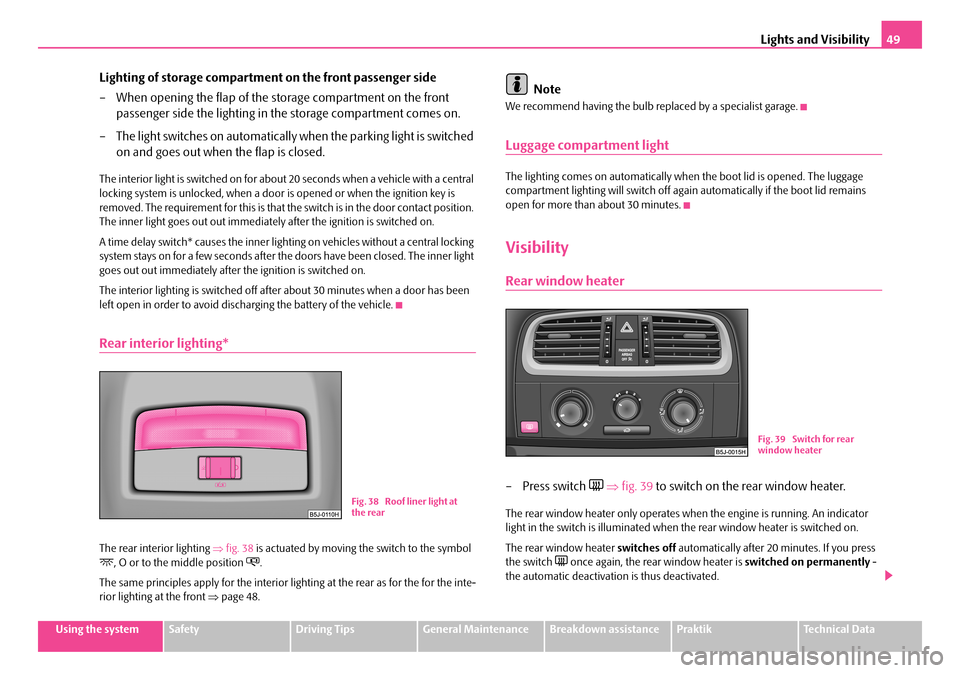
The rear interior lighting ⇒fig. 38 is actuated by moving the switch to the symbol , O or to the middle position .
The same principles apply for the interior lighting at the rear as for the for the inte- rior lighting at the front ⇒page 48.
Note
We recommend having the bulb replaced by a specialist garage.
Luggage compartment light
The lighting comes on automatically when the boot lid is opened. The luggage compartment lighting will switch off again automatically if the boot lid remains open for more than about 30 minutes.
Visibility
Rear window heater
– Press switch ⇒fig. 39 to switch on the rear window heater.
The rear window heater only operates when the engine is running. An indicator light in the switch is illuminated when the rear window heater is switched on.
The rear window heater switches off automatically after 20 minutes. If you press the switch once again, the rear window heater is switched on permanently - the automatic deactivation is thus deactivated.
Fig. 38 Roof liner light at the rear
Fig. 39 Switch for rear window heater
NKO A05R 20 MR08.book Page 49 Wednesday, March 28, 2007 9:42 AM
Page 52 of 248
Lights and Visibility51
Using the systemSafetyDriving TipsGeneral MaintenanceBreakdown assistancePraktikTechnical Data
Fast wipe
– Position the lever up into position .
Automatic wipe/wash for windscreen
– Pull the lever towards the steering wheel into position and the
widescreen wiper and wash system wi ll operate - in the sprung posi-
tion.
– Release the lever. The windscreen wash system stops and the wiper
continues for another 1 - 3 wiper stro kes (depending on the period of
spraying of the windscreen).
Wiping the rear window pane*
– Push the lever away from the steering wheel into position
⇒ page 50, fig. 41, the widescreen wiper will operate every 6 seconds.
Automatic wipe/wash for the rear window pane*
– Push the lever away from the steering wheel into position - the
widescreen wiper and wash system wi ll operate - in the sprung posi-
tion.
– Letting go of the lever will cause the windscreen wash system to stop
and the wiper to continue for another 1 - 3 wiper strokes (depending
on the period of spraying of the windscreen). The lever will stay in
position after releasing it .
Switching windscreen wipers off
– Move the lever back into its home position .
The windscreen wipers and the windscreen washer system only operate if the igni- tion is switched on.
The rear window will be wiped again if the front window wipers are on when reverse gear is selected.
The windscreen washer nozzles are heated* when the ignition is switched on.
Top up with wash liquid ⇒page 186.
WARNING
•Properly maintained windscreen wiper blades are essential for clear visi- bility and safe driving ⇒page 52.
•Do not use the windscreen washer system at low temperatures, without heating the windscreen beforehand. Otherwise the window cleaner could freeze on the windscreen and restrict the view to the front.
•In the event of a freezing up of the wi ndscreen, first of all eliminate the ice ⇒ page 166 and then operate the windscreen wiper otherwise the wind- screen wiper blades could be damaged.
Caution
In frosty weather, please first of all check whether the windscreen wiper blades are not frozen to the windscreen before switching them on. Switching on windscreen wipers when the blades are frozen to the windscreen may result in damage both to the blades and the motor of the windscreen wipers!
Headlight cleaning system*
The headlights are being cleaned after the windscreen washer system has been operated for the fifth time, the low beam or main beam are switched on as well as the windscreen wiper lever is held in the position ⇒page 50, fig. 41 for about 1 second.
You should remove stubborn dirt (such as insect residues) from the headlight lenses at regular intervals, for example when refuelling. Please refer to the following guidelines ⇒page 166, “The headlight lenses”.
You should remove any snow from the fixtures of the washer nozzles and clear ice in winter with a de-icing spray in order to ensure proper operation of the cleaning system.
A3
A5
A6
A7
A6
A0
A5
NKO A05R 20 MR08.book Page 51 Wednesday, March 28, 2007 9:42 AM
Page 54 of 248
Lights and Visibility53
Using the systemSafetyDriving TipsGeneral MaintenanceBreakdown assistancePraktikTechnical Data
Attaching a wiper blade
– Position the wiper blade onto th e wiper arm and lock the locking
button .
– Check whether the wiper blade is correctly attached.
The same remarks apply here as for ⇒page 52.
Rear mirror
You can adjust the exterior mirrors electrically*.
Adjust the rear mirror before commencing to drive so that there is a clear
view to the rear.
Dimming the interior mirror
– Pull the lever on the bottom edge of the mirror toward rear (the lever
on the interior mirror must point forwards in it home position).
Heating of the external mirror*
– Turn the rotary knob to position ⇒fig. 44.
Adjusting the left-hand exterior mirror*
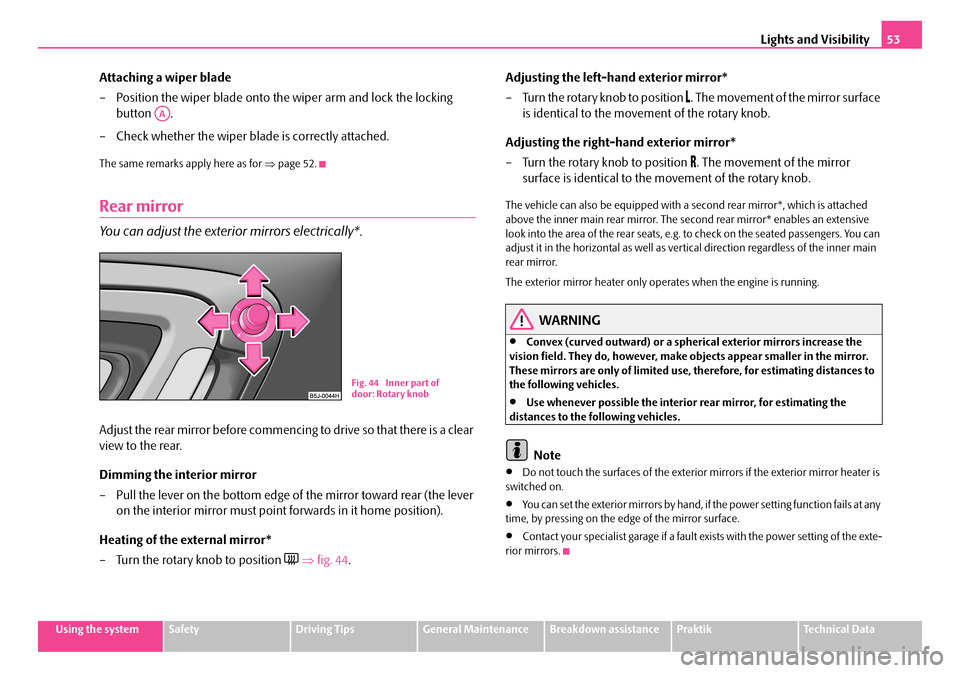
– Turn the rotary knob to position . The movement of the mirror surface
is identical to the movement of the rotary knob.
Adjusting the right-hand exterior mirror*
– Turn the rotary knob to position . The movement of the mirror
surface is identical to the movement of the rotary knob.
The vehicle can also be equipped with a se cond rear mirror*, which is attached above the inner main rear mirror. The second rear mirror* enables an extensive look into the area of the rear seats, e.g. to check on the seated passengers. You can adjust it in the horizontal as well as vertical direction regardless of the inner main rear mirror.
The exterior mirror heater only operates when the engine is running.
WARNING
•Convex (curved outward) or a spherical exterior mirrors increase the vision field. They do, however, make objects appear smaller in the mirror. These mirrors are only of limited use, therefore, for estimating distances to the following vehicles.
•Use whenever possible the interior rear mirror, for estimating the distances to the following vehicles.
Note
•Do not touch the surfaces of the exterior mirrors if the exterior mirror heater is switched on.
•You can set the exterior mirrors by hand, if the power setting function fails at any time, by pressing on the ed ge of the mirror surface.
•Contact your specialist garage if a fault exists with the power setting of the exte- rior mirrors.
AA
Fig. 44 Inner part of door: Rotary knob
NKO A05R 20 MR08.book Page 53 Wednesday, March 28, 2007 9:42 AM
Page 63 of 248
Seats and Stowage62
Pedals
You should use only footmats which do not obstruct the movement of the pedals and have an anti -slip protection.
We recommend only to use footmats from Škoda genuine accessories offered by your Škoda dealer.
Operation of the pedals must not be hindered!
WARNING
•Greater pedal distances may be needed when there is a fault in the brake system.
•Do not place any footmats or other additional floor coverings in the area of the pedals in order to ensure that all the pedals can be fully depressed and are able to return unobstructed to their initial position - risk of accident!
•There must be no objects on the floor which could roll under the pedals. You would then no longer be able to apply the brakes, operate the clutch or accelerator - risk of accident!
luggage compartment
Loading the luggage compartment
Please observe the following in the inte rest of having good handling char-
acteristics of your vehicle:
– Distribute the items of luggage as evenly as possible.
– Place heavy objects as far forward as possible.
– Attach the items of luggage to the lashing eyes or the safety net*
⇒ page 63.
In the event of an accident, there is such a high kinetic energy which is produced by small and light objects that they can caus e severe injuries. The magnitude of the
kinetic energy depends on the speed at which the vehicle is travelling and on the weight of the object. The speed at which the vehicle is travelling is in this case the more significant factor.
Example: In the event of a frontal collision at a speed of 50 km/h, an unsecured object with a weight of 4.5 kg produces an energy, which corresponds to 20 times its own weight. This means that it results in a weight of approx. 90 kg. You can imagine the injuries that can occur, if this “bullet” is flying through the interior compartment and hits an occupant.
WARNING
•Store the objects in the luggage compartment and attach them to the lashing eyes.
•Loose objects in the passenger compartment can be thrown forward during a sudden manoeuvre or in case of an accident and can injure the occupants or other oncoming traffic. This risk is still increased, if the objects which are flying around are hit by a depl oyed airbag. In this case, the objects which are thrown back can injure the occupants - hazard.
•Please note that the handling properti es of your vehicle may be affected when transporting heavy objects as a result of the displacement of the centre of gravity. The speed and style of driving must be adjusted accord- ingly.
•The items carried in the luggage compar tment should be stored in such a way that no objects are able to slip forward if there are any sudden driving or braking manoeuvres undertaken - risk of injury!
•When transporting fastened objects which are sharp and dangerous in the luggage compartment enlarged by folding the rear seats forward or removing the rear seats, ensure the safety of the passengers transported on the other rear seats ⇒page 120, “Correct seated position for the occupants on the rear seats”.
•If the rear seats next to the folded forward seat are occupied, ensure maximum safety, e.g. by placing the goods to be transported in such a way that a folding back of the seat is pr evented in case of a rear collision.
•Never drive with the boot lid fully opened or slightly ajar otherwise exhaust gases may get into the interior of the vehicle - risk of poisoning!
NKO A05R 20 MR08.book Page 62 Wednesday, March 28, 2007 9:42 AM
Page 79 of 248
Heating and air conditioning system78
Heating and air conditioning system
Heating
Using the system
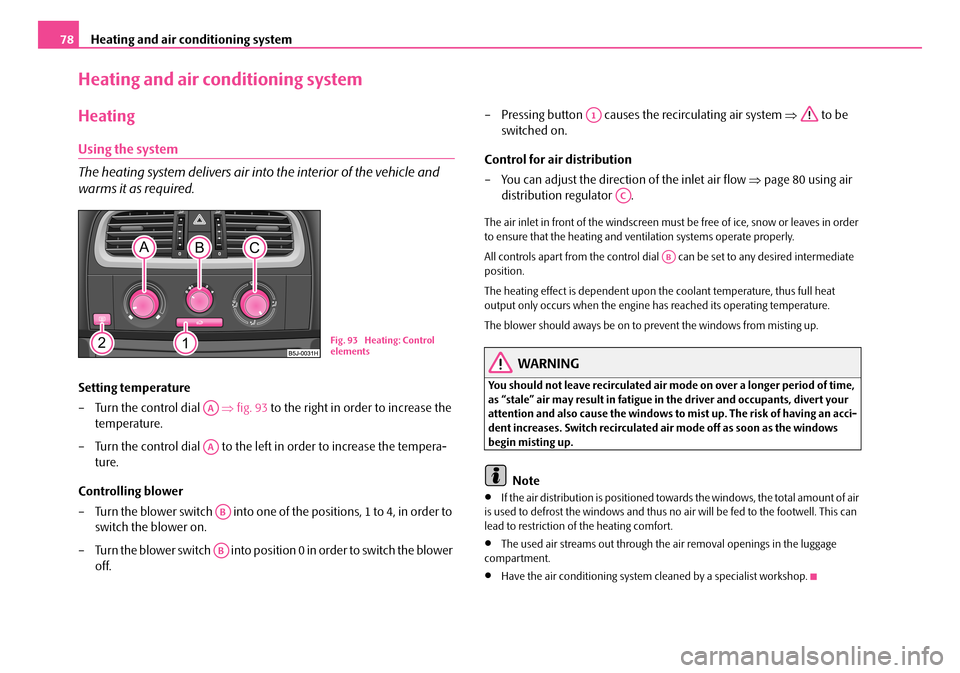
The heating system delivers air into the interior of the vehicle and
warms it as required.
Setting temperature
– Turn the control dial ⇒fig. 93 to the right in order to increase the
temperature.
– Turn the control dial to the left in order to increase the tempera-
ture.
Controlling blower
– Turn the blower switch into one of the positions, 1 to 4, in order to
switch the blower on.
– Turn the blower switch into position 0 in order to switch the blower
off.
– Pressing button causes the recirculating air system ⇒ to be
switched on.
Control for air distribution
– You can adjust the direction of the inlet air flow ⇒page 80 using air
distribution regulator .
The air inlet in front of the windscreen must be free of ice, snow or leaves in order to ensure that the heating and ventilation systems operate properly.
All controls apart from the control dial can be set to any desired intermediate position.
The heating effect is dependent upon th e coolant temperature, thus full heat output only occurs when the engine has reached its operating temperature.
The blower should aways be on to prevent the windows from misting up.
WARNING
You should not leave recirculated air mode on over a longer period of time, as “stale” air may result in fatigue in the driver and occupants, divert your attention and also cause the windows to mist up. The risk of having an acci- dent increases. Switch recirculated air mode off as soon as the windows begin misting up.
Note
•If the air distribution is positioned towa rds the windows, the total amount of air is used to defrost the window s and thus no air will be fed to the footwell. This can lead to restriction of the heating comfort.
•The used air streams out through the air removal openings in the luggage compartment.
•Have the air conditioning system cleaned by a specialist workshop.
Fig. 93 Heating: Control elements
AA
AA
AB
AB
A1
AC
AB
NKO A05R 20 MR08.book Page 78 Wednesday, March 28, 2007 9:42 AM
Page 81 of 248
Heating and air conditioning system80
WARNING
You should not leave recirculated air mode on over a longer period of time, as “stale” air may result in fatigue in the driver and occupants, divert your attention and also cause the windows to mist up. The risk of having an acci- dent increases. Switch recirculated air mode off as soon as the windows begin misting up.
Air outlet vents
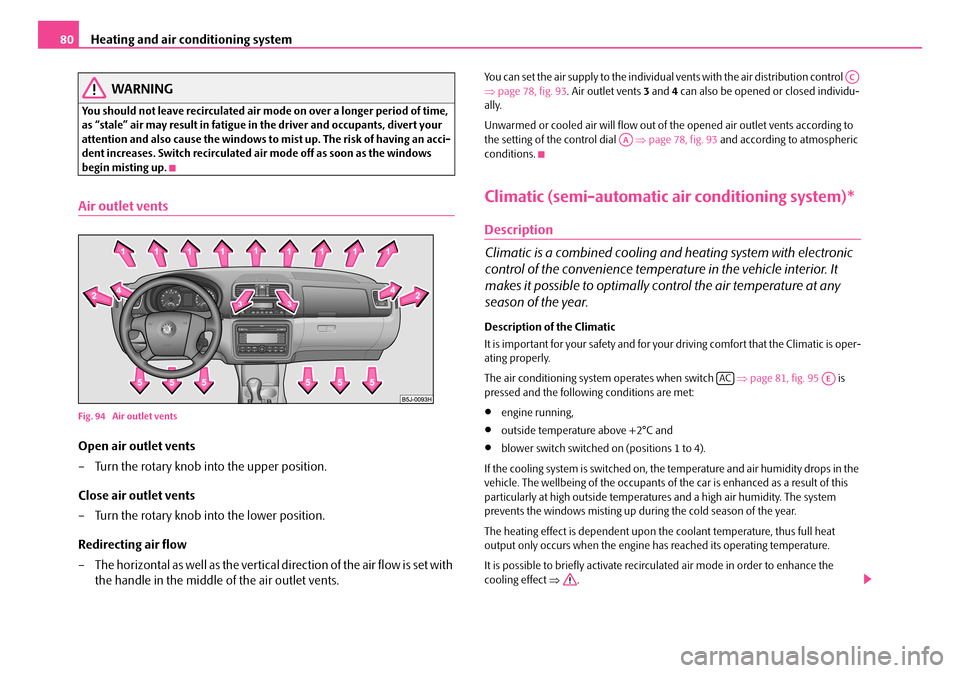
Fig. 94 Air outlet vents
Open air outlet vents
– Turn the rotary knob into the upper position.
Close air outlet vents
– Turn the rotary knob into the lower position.
Redirecting air flow
– The horizontal as well as the vertical direction of the air flow is set with
the handle in the middle of the air outlet vents.
You can set the air supply to the individual vents with the air distribution control ⇒ page 78, fig. 93. Air outlet vents 3 and 4 can also be opened or closed individu- ally.
Unwarmed or cooled air will flow out of the opened air outlet vents according to the setting of the control dial ⇒page 78, fig. 93 and according to atmospheric conditions.
Climatic (semi-automatic air conditioning system)*
Description
Climatic is a combined cooling an d heating system with electronic
control of the convenience temperat ure in the vehicle interior. It
makes it possible to optimally co ntrol the air temperature at any
season of the year.
Description of the Climatic
It is important for your safety and for your driving comfort that the Climatic is oper- ating properly.
The air conditioning system operates when switch ⇒page 81, fig. 95 is pressed and the following conditions are met:
•engine running,
•outside temperature above +2°C and
•blower switch switched on (positions 1 to 4).
If the cooling system is switched on, the temperature and air humidity drops in the vehicle. The wellbeing of the occupants of the car is enhanced as a result of this particularly at high outside temperatures and a high air humidity. The system prevents the windows misting up during the cold season of the year.
The heating effect is dependent upon th e coolant temperature, thus full heat output only occurs when the engine has reached its operating temperature.
It is possible to briefly activate recirculated air mode in order to enhance the cooling effect ⇒.
AC
AA
ACAE
NKO A05R 20 MR08.book Page 80 Wednesday, March 28, 2007 9:42 AM
Page 82 of 248
Heating and air conditioning system81
Using the systemSafetyDriving TipsGeneral MaintenanceBreakdown assistancePraktikTechnical Data
Air at a temperature of about 5°C may flow out of the vents under certain circum- stances when the cooling system is operating. Lengthy and uneven distribution of the air flow out of the vents (in particular at the leg area) and large differences in temperature, for example when getting out of the vehicle, can result in chills in sensitive persons.
The air inlet in front of the windscreen must be free of ice, snow or leaves in order to ensure that the heating and cooling systems operate properly.
After switching on the cooling Condensation from the evaporator of the air condi- tioning may drip down and form a puddle below the vehicle. This is quite normal and not an indication of a leak!
WARNING
•For your own safety and that of other road users, ensure that all the windows are free of ice, snow and mistin g. Please familiarize yourself about how to correctly operate th e heating and ventilation systems, how to demist and defrost the windows, as well as with the cooling mode.
•You should not leave recirculated air mode on over a longer period of time, as “stale” air may result in fatigue in the driver and occupants, divert your attention and also cause the windows to mist up. The risk of having an accident increases. Switch recirculated air mode off as soon as the windows begin misting up.
Note
•We recommend that you do not smoke in the vehicle when the recirculating air mode is operating since the smoke which is drawn at the evaporator from the inte- rior of the vehicle forms deposits in the evaporator of the air conditioning system. This produces a permanent odour when the Climatic is operating which can only be eliminated through considerable effort and expense (replacement of compressor).
Using the system
Setting temperature
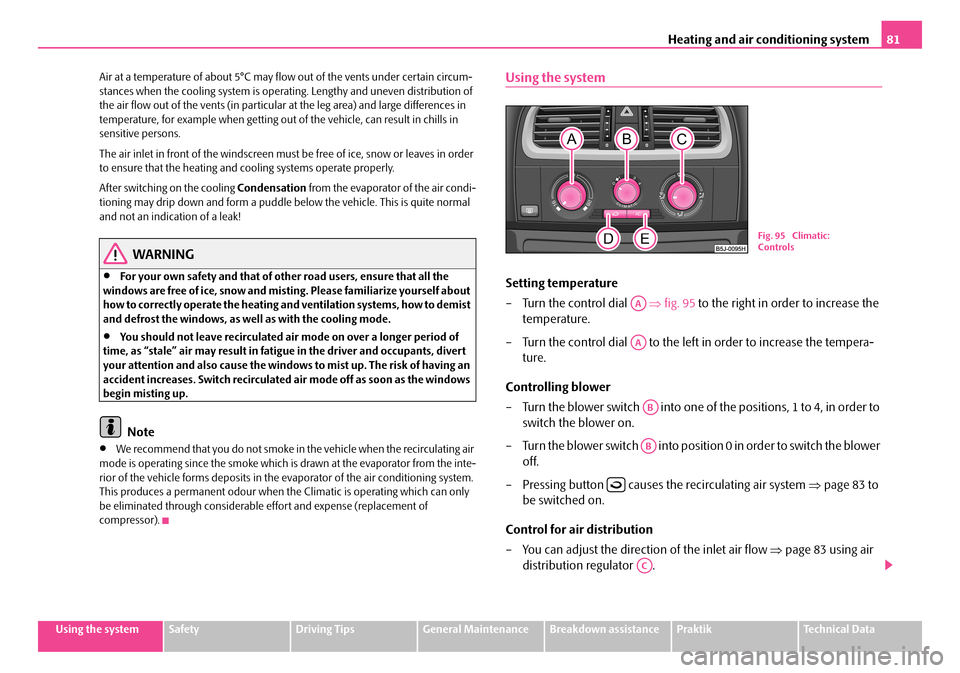
– Turn the control dial ⇒fig. 95 to the right in order to increase the
temperature.
– Turn the control dial to the left in order to increase the tempera-
ture.
Controlling blower
– Turn the blower switch into one of the positions, 1 to 4, in order to
switch the blower on.
– Turn the blower switch into position 0 in order to switch the blower
off.
– Pressing button causes the recirculating air system ⇒page 83 to
be switched on.
Control for air distribution
– You can adjust the direction of the inlet air flow ⇒page 83 using air
distribution regulator .
Fig. 95 Climatic: Controls
AA
AA
AB
AB
AC
NKO A05R 20 MR08.book Page 81 Wednesday, March 28, 2007 9:42 AM
Page 83 of 248
Heating and air conditioning system82
switching cooling on and off
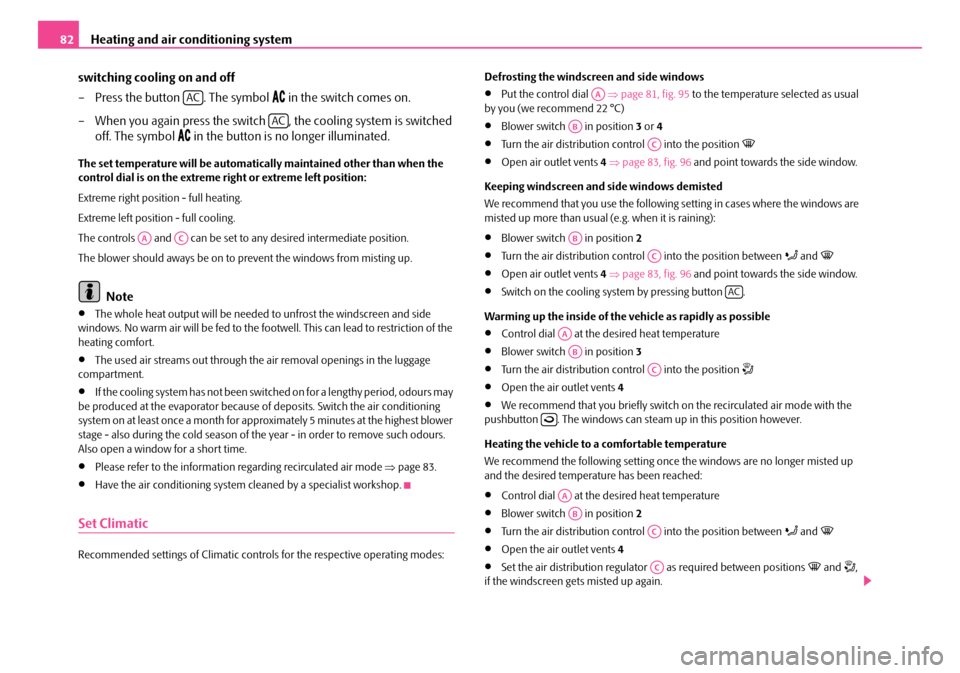
– Press the button . The symbol in the switch comes on.
– When you again press the switch , the cooling system is switched
off. The symbol in the button is no longer illuminated.
The set temperature will be automatically maintained other than when the control dial is on the extreme right or extreme left position:
Extreme right position - full heating.
Extreme left position - full cooling.
The controls and can be set to any desired intermediate position.
The blower should aways be on to prevent the windows from misting up.
Note
•The whole heat output will be needed to unfrost the windscreen and side windows. No warm air will be fed to the footwell. This can lead to restriction of the heating comfort.
•The used air streams out through the air removal openings in the luggage compartment.
•If the cooling system has not been switched on for a lengthy period, odours may be produced at the evaporator because of deposits. Switch the air conditioning system on at least once a month for appr oximately 5 minutes at the highest blower stage - also during the cold season of th e year - in order to remove such odours. Also open a window for a short time.
•Please refer to the information regarding recirculated air mode ⇒page 83.
•Have the air conditioning system cleaned by a specialist workshop.
Set Climatic
Recommended settings of Climatic controls for the respective operating modes:
Defrosting the windscreen and side windows
•Put the control dial ⇒page 81, fig. 95 to the temperature selected as usual by you (we recommend 22 °C)
•Blower switch in position 3 or 4
•Turn the air distribution control into the position
•Open air outlet vents 4 ⇒page 83, fig. 96 and point towards the side window.
Keeping windscreen and side windows demisted
We recommend that you use the following setting in cases where the windows are misted up more than usual (e.g. when it is raining):
•Blower switch in position 2
•Turn the air distribution control into the position between and
•Open air outlet vents 4 ⇒page 83, fig. 96 and point towards the side window.
•Switch on the cooling system by pressing button .
Warming up the inside of the vehicle as rapidly as possible
•Control dial at the desired heat temperature
•Blower switch in position 3
•Turn the air distribution control into the position
•Open the air outlet vents 4
•We recommend that you briefly switch on the recirculated air mode with the pushbutton . The windows can stea m up in this position however.
Heating the vehicle to a comfortable temperature
We recommend the following setting once the windows are no longer misted up and the desired temperature has been reached:
•Control dial at the desired heat temperature
•Blower switch in position 2
•Turn the air distribution control into the position between and
•Open the air outlet vents 4
•Set the air distribution regulator as required between positions and , if the windscreen gets misted up again.
AC
AC
AAAC
AA
AB
AC
AB
AC
AC
AA
AB
AC
AA
AB
AC
AC
NKO A05R 20 MR08.book Page 82 Wednesday, March 28, 2007 9:42 AM
Page 84 of 248
Heating and air conditioning system83
Using the systemSafetyDriving TipsGeneral MaintenanceBreakdown assistancePraktikTechnical Data
Cooling down the inside of the vehicle as rapidly as possible
•close all windows
•Control dial at the desired heat temperature
•Blower switch in position 4
•Turn the air distribution control into the position
•Open the air outlet vents 3 and 4
•Switch on the cooling system by pressing button
•We recommend that you briefly switch on the recirculated air mode with the pushbutton .
Optimum cooling
•Control dial at the desired heat temperature. This temperature will be main- tained automatically.
•Blower switch in position 1, 2 or 3
•Turn the air distribution control into the position
•Open the air outlet vents 3 and 4
•Switch on the cooling system by pressing button
•We recommend setting the air outlet vents 3 and 4 in such a way that the air flows to the rear over the heads of the occu pants. Do not switch to recirculated air mode.
Recirculated air mode
In recirculated air mode air is sucked out of the interior of the vehicle
and then fed back into the interior.
Recirculated air mode prevents polluted air outside the vehicle from
getting into the vehicle, for example when driving through a tunnel or
when standing in a traffic jam.
Switching recirculated air mode on
– Press switch ⇒page 81, fig. 95 the switch symbol lights up.
Switching recirculated air mode off
– Press button again, the button symbol goes out.
The recirculated air mode is switched off au tomatically if the air distribution control is in position ⇒page 81, fig. 95. You can also switch recirculated air mode on again from this setting by repeatedly pressing button .
WARNING
You should not leave recirculated air mode on over a longer period of time, as “stale” air may result in fatigue in the driver and occupants, divert your attention and also cause the windows to mist up. The risk of having an acci-dent increases. Switch recirculated air mode off as soon as the windows begin misting up.
Air outlet vents
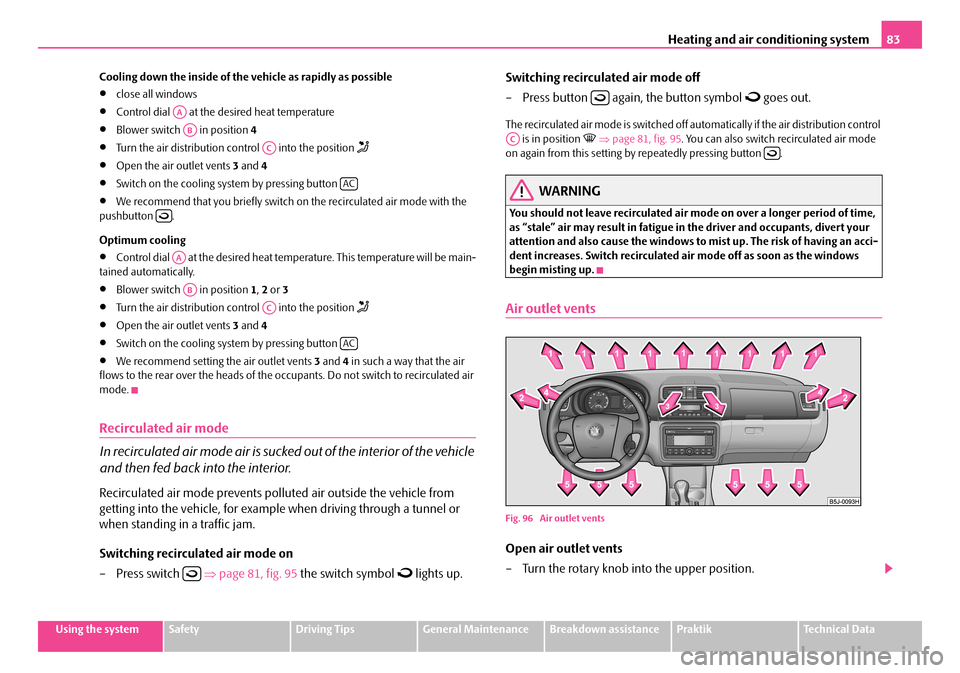
Fig. 96 Air outlet vents
Open air outlet vents
– Turn the rotary knob into the upper position.
AA
AB
AC
AC
AA
AB
AC
AC
AC
NKO A05R 20 MR08.book Page 83 Wednesday, March 28, 2007 9:42 AM
Page 85 of 248
Heating and air conditioning system84
Close air outlet vents
– Turn the rotary knob into the lower position.
Redirecting air flow
– The horizontal as well as the vertical direction of the air flow is set with
the handle in the middle of the air outlet vents.
You can set the air supply to the individual vents with the air distribution control ⇒ page 81, fig. 95. Air outlet vents 3 and 4 can also be opened or closed individu- ally:
Unwarmed or cooled air will flow out of the air outlet vents according to the setting of control dial ⇒page 81, fig. 95 and the atmospheric conditions.
Using the air conditioning system economically
The compressor on the Climatic uses power from the engine when in cooling mode which will effect the fuel consumption.
It recommended to open the windows or th e doors of a vehicle for which the inte- rior has been strongly heated through the ef fect of direct sunlight in order to allow the heated air to escape.
The cooling system should not be switched on while travelling when the window is open.
The desired interior temperature can also be achieved without switching in the cooling system just by switching to fresh air mode.
For the sake of the environment
When you economize on fuel, you also reduce pollutant emissions.
Operational problems
If the cooling system does not operate at outside temperatures higher than +2 °C, there is a problem in the system. The reasons for this may be:
•The fuse of the Climatic is defective. Check the fuse, replace it if necessary ⇒ page 207.
•The cooling system has switched off automatically for a short time because the coolant temperature of the engine is too hot ⇒page 10.
If you are not able to rectify the operat ional problem yourself, or if the cooling capacity decreases, switch the cooling sy stem off. Contact a specialist garage.
If there is a fault at the Climatronic, all symbols on the display flash after switching on the ignition for 15 seconds. Contact a specialist garage.
Climatronic (automatic air conditioning)*
Description
The Climatronic system is a combination of an automatic heating,
fresh air and cooling system which provides optimal comfort for the
occupants of the car.
The Climatronic maintains a constant temper ature fully automatically, once it has been set. This is achieved by automa tically varying the temperature of the outflowing air, the blower stages and the air distribution. The system also takes into account sunlight which eliminates the ne ed to alter the settings manually. The automatic mode ⇒page 86 ensures maximum wellbeing of the occupants at all times of the year.
Description of Climatronic system
The cooling operates only if the following conditions are met:
•engine running,
•outside temperature above +2 °C,
•the button is not pressed.
If the cooling system is switched on, the temperature and air humidity drops in the vehicle. The wellbeing of the occupants of the car is enhanced as a result of this particularly at high outside temperatures and a high air humidity. The system prevents the windows misting up during the cold season of the year.
AC
AA
ECON
NKO A05R 20 MR08.book Page 84 Wednesday, March 28, 2007 9:42 AM