fuel SKODA ROOMSTER 2008 1.G Owner's Guide
[x] Cancel search | Manufacturer: SKODA, Model Year: 2008, Model line: ROOMSTER, Model: SKODA ROOMSTER 2008 1.GPages: 248, PDF Size: 46.44 MB
Page 93 of 248
Starting-off and Driving92
•Contact the nearest specialist garage to obtain professional assistance.
Starting the engine after fuel tank has run dry
It may take longer than normal to start the engine after refuelling if the fuel tank has run completely dry - up to one minute. This is because the fuel system must first of all be filled while the attempting to start the engine.
Switching off the engine
– The engine can be swit ched off by turning the ignition key from posi-
tion ⇒page 90, fig. 101 into position .
WARNING
•Never switch off the engine before the vehicle is stationary - risk of acci- dent!
•The brake booster only operates when the engine is running. Greater physical effort for braking is required when engine is switched off. Because if you do not stop as normal, this can cause an accident and severe injuries.
Caution
you should not switch the engine off right away at the end of your journey after the engine has been operated fo r a lengthy period at high loads but should be allowed it to run at idling speed for about 2 minutes . This prevents any accumulation of heat when the engine is switched off.
Note
•The radiator fan may continue running fo r a further 10 minutes or so after the engine and the ignition have been switched off. The coolant fan may, however, also switch on again after some time if the coolant temperature rises because of an accumulation of heat in the engine or if the engine is warm and the engine compartment is additionally heated by strong sunlight.
•This is why particular care is required when carrying out any work in the engine compartment ⇒page 174, “Working in the engine compartment”.
Shifting (manual gearbox)
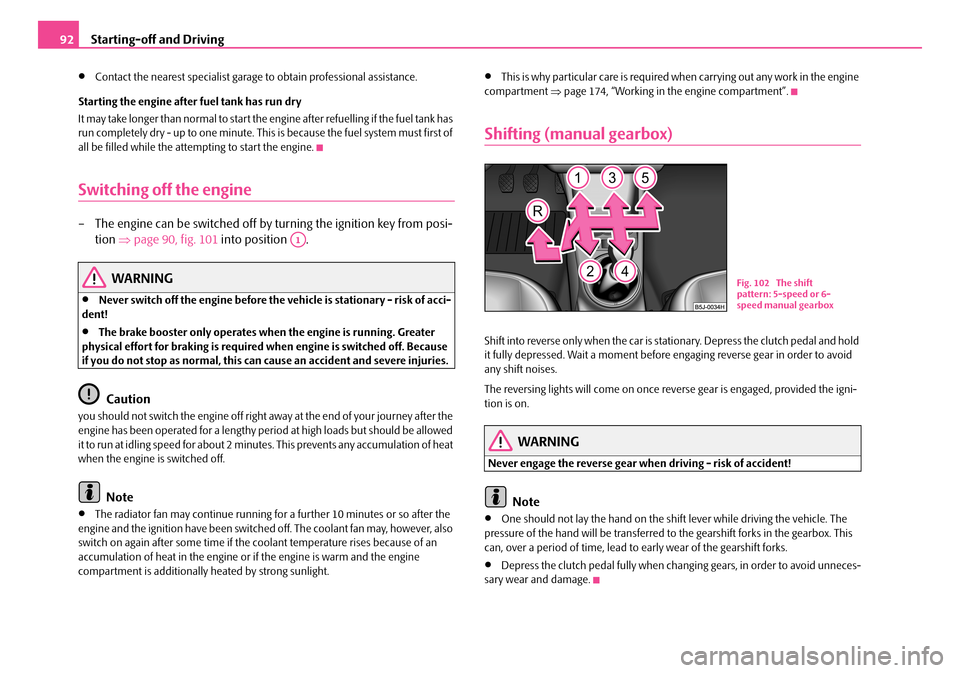
Shift into reverse only when the car is stationary. Depress the clutch pedal and hold it fully depressed. Wait a moment before engaging reverse gear in order to avoid any shift noises.
The reversing lights will come on once reverse gear is engaged, provided the igni- tion is on.
WARNING
Never engage the reverse gear when driving - risk of accident!
Note
•One should not lay the hand on the shift lever while driving the vehicle. The pressure of the hand will be transferred to the gearshift forks in the gearbox. This can, over a period of time, lead to early wear of the gearshift forks.
•Depress the clutch pedal fully when changing gears, in order to avoid unneces- sary wear and damage.
A1
Fig. 102 The shift pattern: 5-speed or 6-speed manual gearbox
NKO A05R 20 MR08.book Page 92 Wednesday, March 28, 2007 9:42 AM
Page 98 of 248
Automatic gearbox97
Using the systemSafetyDriving TipsGeneral MaintenanceBreakdown assistancePraktikTechnical Data
Automatic gearbox
6-speed automatic gearbox*
Introduction
Your car is equipped with an electronically controlled 6-speed automatic gearbox. Shifting up and also down through the gears is performed automatically.
At the same time this is a conventional automatic gearbox. The maximum speed is reached in the 5th gear. The 6th gear serves as an economic driving programme, which is intended to reduce the fuel consumption.
Information for driving with an automatic gearbox
Shifting up and down through the gears is performed automatically.
You can also, however, switch the gearbox over into the Tiptronic mode.
This mode makes it possible for you to also shift gears manually
⇒ page 100.
Starting-off and Driving
– Depress the brake pedal and hold it depressed.
– Press the Shiftlock button (button in handle of the selector lever),
move the selector lever into the desired position, e.g. D ⇒page 98,
and then release the Shiftlock button.
– Wait a moment until the gearbox ha s shifted (a slight engagement
nudge can be felt).
– Release the brake pedal and depress the accelerator ⇒.
Stopping for a short time
– The selector lever position N does not have to be selected when stop-
ping just for a short time, such as at a cross roads. It is sufficient to hold
the vehicle stationary using the foot brake. The engine can, however,
be allowed just to idle.
Parking
– Depress the brake pedal and hold it depressed.
– Apply the handbrake firmly.
– Press and Shiftlock button in the selector lever, move the selector
lever to P and then release the Shiftlock button.
The engine can only be started when the selector lever is in position P or N ⇒ page 90.
It is sufficient to engage selector lever position P when parking on a flat surface. When parking on a slope you should first apply the handbrake firmly and then move the selector lever into position P. This is to ensure that there is no excessive pressure acting on the lock mechanism and that it is easier to subsequently move the selector lever out of position P.
If the selector lever position N is selected by accident while driving it is first neces- sary to release pressure on the accelerato r pedal and wait for idling speed of the engine to be reached before engaging a drive position in the selector lever.
WARNING
•Do not depress the accelerator when changing the position of the selector lever if the car is stationary an d the engine is running - risk of acci- dent!
•Never move the selector lever into position R or P when driving - risk of an accident!
NKO A05R 20 MR08.book Page 97 Wednesday, March 28, 2007 9:42 AM
Page 101 of 248
Automatic gearbox100
gearbox does not shift up into the highest gear until the engine has reached its maximum revolutions for this gear range.
WARNING
Please note that using the kickdown fu nction can result in the driven wheels spinning on a smooth or slippery road surface - risk of skidding!
Dynamic shift programme
The automatic gearbox of your vehicle is controlled electronically. Shifting up and down through the gears is performed auto matically on the basis of pre-defined driving programmes.
Adopting a moderate style of driving will cause the gearbox to select the most economical driving programme. Shifting up into a higher gear as soon as possible and shifting down as late as possible will have a favourable effect on your fuel consumption.
Adopting a sporty style of driving with rapid movements of the accelerator pedal combined with sharp acceleration and frequent changes in speed, exploiting the top speed of the car or depressing the a ccelerator pedal (kickdown function), will cause the gearbox to switch over to this style of driving and shift down earlier with frequent changes in gears in comparison to the moderate style of driving.
Selecting the most appropriate driving programme for the particular style of driving is a continuous process. Irrespective of this it is, however, possible to switch or shift down into a dynamic shift programme by depressing the accelerator rapidly. The gearbox shifts down into a lower gear matc hing the speed of the car and this allows you to accelerate rapidly (e.g. when ov ertaking) without having to depress the accelerator pedal fully into the kickdown range. The original programme will be reactivated to match your part icular style of driving once the gearbox has shifted up again.
When driving in hilly regions, the gears are selected to match uphill and downhill sections. This avoids the ge arbox frequently shifting up and down when negotiating an uphill stretch. When driving downhill, it is possible to shift down into the Tiptronic position, in order to exploit the engine brake torque.
Tiptronic
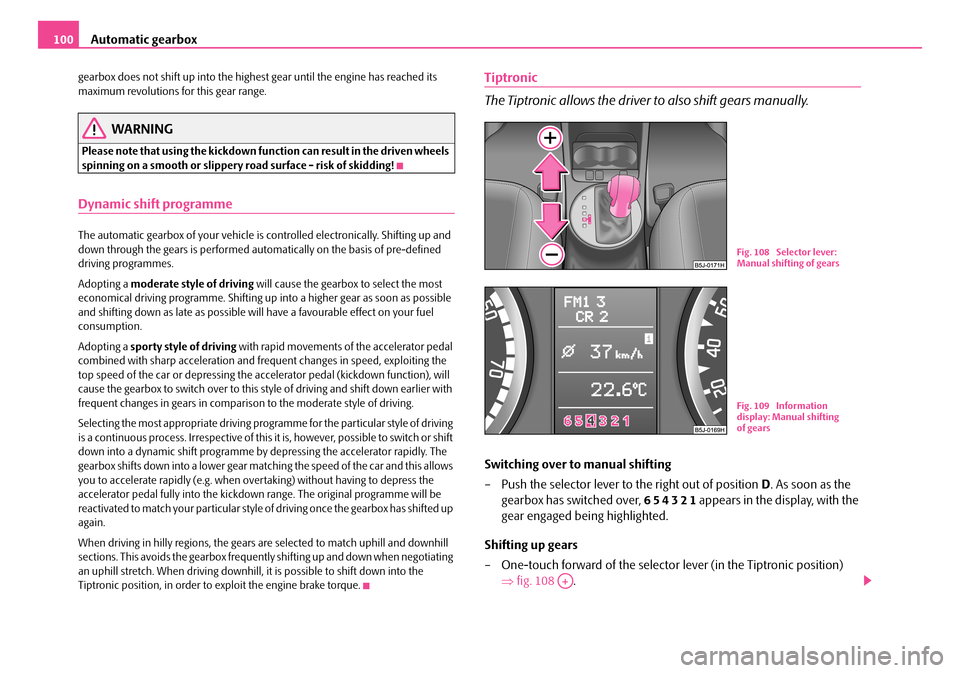
The Tiptronic allows the driver to also shift gears manually.
Switching over to manual shifting
– Push the selector lever to the right out of position D. As soon as the
gearbox has switched over, 6 5 4 3 2 1 appears in the display, with the
gear engaged being highlighted.
Shifting up gears
– One-touch forward of the selector lever (in the Tiptronic position)
⇒ fig. 108 .
Fig. 108 Selector lever: Manual shifting of gears
Fig. 109 Information display: Manual shifting of gears
A+
NKO A05R 20 MR08.book Page 100 Wednesday, March 28, 2007 9:42 AM
Page 153 of 248
Intelligent Technology152
Diesel particle filter* (diesel engine)
In the diesel particle filter the resulting soot particles are collected
and burnt during the combustion of diesel fuel.
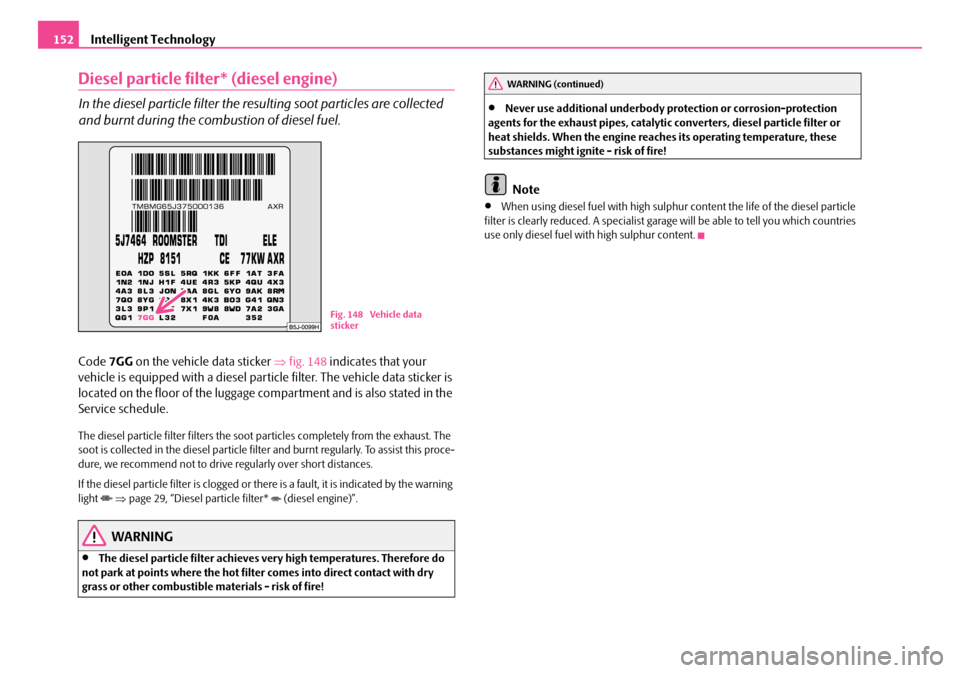
Code 7GG on the vehicle data sticker ⇒fig. 148 indicates that your
vehicle is equipped with a diesel partic le filter. The vehicle data sticker is
located on the floor of the luggage compartment and is also stated in the
Service schedule.
The diesel particle filter filters the soot particles completely from the exhaust. The soot is collected in the diesel particle filter and burnt regularly. To assist this proce-dure, we recommend not to drive regularly over short distances.
If the diesel particle filter is clogged or there is a fault, it is indicated by the warning light ⇒page 29, “Diesel particle filter* (diesel engine)”.
WARNING
•The diesel particle filter achieves very high temperatures. Therefore do not park at points where the hot filter comes into direct contact with dry grass or other combustible materials - risk of fire!
•Never use additional underbody protection or corrosion-protection agents for the exhaust pipes, catalytic converters, diesel particle filter or heat shields. When the engine reaches its operating temperature, these substances might ignite - risk of fire!
Note
•When using diesel fuel with high sulphur content the life of the diesel particle filter is clearly reduced. A specialist garage will be able to tell you which countries use only diesel fuel wi th high sulphur content.
Fig. 148 Vehicle data sticker
WARNING (continued)
NKO A05R 20 MR08.book Page 152 Wednesday, March 28, 2007 9:42 AM
Page 155 of 248
Driving and the Environment154
Catalytic converter
Proper operation of the emission control system (catalytic converter)
is of major significance for drivin g your vehicle in an environmen-
tally conscious way.
Please refer to the following guidelines:
– For vehicles with petrol engine only refuel with unleaded petrol
⇒ page 170, “Grades of petrol”.
– Never run the fuel tank completely empty.
– Do not switch off the ignition while you are driving the vehicle.
– Do not pour too much oil into the engine ⇒page 178, “Replenishing
engine oil”.
– Do not tow-start the vehicle over a distance of more than 50 metres
⇒ page 205, “Tow-starting a vehicle”.
If you drive your vehicle in a country in which unleaded petrol is not available, you must have the catalytic converter replaced later when driving the vehicle into a country in which use of a cata lytic converter is mandatory.
WARNING
•In view of the high temperatures which may be produced in the catalytic converter, one should always park a vehicle in such a way that the catalytic converter cannot come into contact with easily flammable materials below the vehicle - a risk of fire!
•Never use additional underbody protection or corrosion-protection agents for the exhaust pipes, catalyti c converters or heat shields. Such substances might ignite when driving - risk of fire!
Caution
•Vehicles fitted with catalytic converter should never be allowed to let the fuel tank to run completely empty. An irregular fuel supply can result in poor ignition or
misfiring. Unburnt fuel may get into the exhaust system and damage the catalytic converter.
•Filling the tank even only once with le aded petrol will result in the catalytic converter being destroyed.
•If you detect misfiring, a drop in perf ormance or irregular engine running when driving, reduce your speed immediately and have the vehicle inspected by the nearest specialist garage. The symptoms described may be caused by a fault in the ignition system. Unburnt fuel may get in to the exhaust system and damage the catalytic converter.
For the sake of the environment
Even if the exhaust system is operating properly, a sulphur-like exhaust odour may be produced under certain operating condit ions of the engine. This depends on the sulphur content of the fuel. It is often su fficient to refuel with unleaded premium- grade petrol of a different brand or at a different filling station.
Driving in an economical and environmentally
conscious manner
General
Your personal style of driving is a major factor.
Your fuel consumption, any pollution of the environmental and the wear-and-tear to the engine, brakes and tyres, depend essentially on three factors:
•your personal style of driving,
•the conditions under which your vehicle is operated,
•technical aspects.
You can easily improve your fuel economy by 10 - 15 percent by driving in an economical way with foresight. This section is intended to provide you with a number of tips on how to protect the en vironment and at the same time save money.
NKO A05R 20 MR08.book Page 154 Wednesday, March 28, 2007 9:42 AM
Page 156 of 248
Driving and the Environment155
Using the systemSafetyDriving TipsGeneral MaintenanceBreakdown assistancePraktikTechnical Data
The fuel consumption can naturally also be influenced by factors which are beyond the driver's control. It is, for example, normal for the fuel consumption to increase in winter and under worsened conditions such as poor road conditions, towing a trailer, etc.
The technical requirements for low fuel usage and economic efficiency of the vehicle have already been built into the ve hicle at the works. Special attention has been given to minimising ne gative effects on the environment. It is necessary to take note of the guidelines given in this chapter in order to make best use of these characteristics and to maintain their effectiveness.
Looking ahead when driving
A vehicle's highest fuel consumption occurs it accelerates.
Avoid accelerating and brakin g unnecessarily. If you drive with forsight you will not need to brake so often and will also then not have to accelerate so much. Let your vehicle coast to a stop, for example, if this is possible, when you see that the next set of traffic lights is at red.
Shifting gears and saving energy
Shifting up early saves on fuel.
Manual gearbox
– Drive no more than about one length of your vehicle in first gear.
Always shift up into the next higher gear at approx. 2 000 to 2 500 revs.
Automatic gearbox
– Depress the accelerator pedal slowly. Do not depress it beyond the
kickdown position, however.
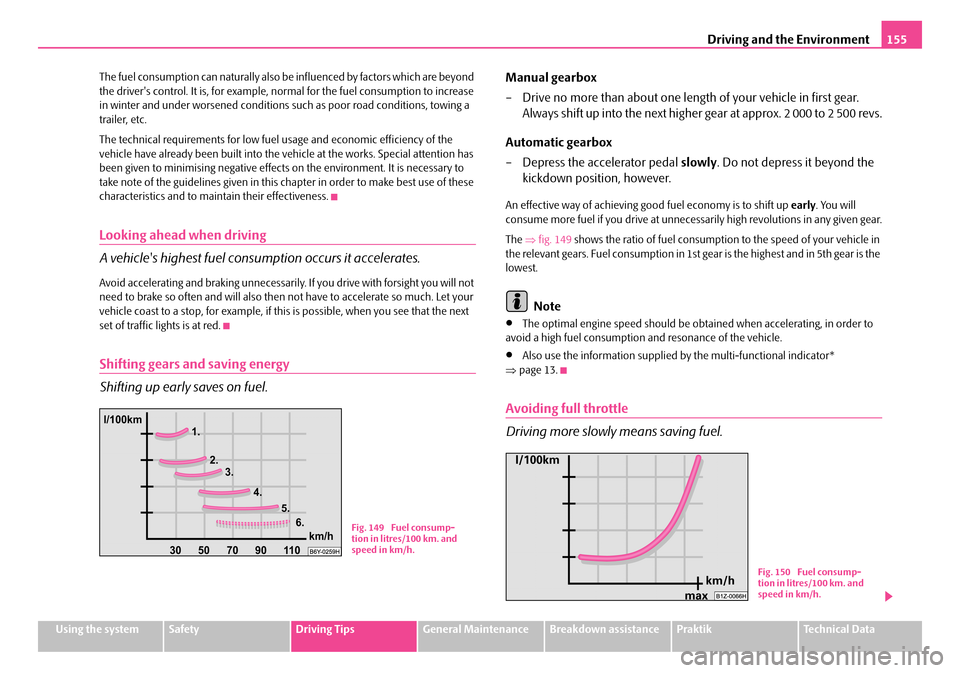
An effective way of achieving good fuel economy is to shift up early. You will consume more fuel if you drive at unnecessa rily high revolutions in any given gear.
The ⇒fig. 149 shows the ratio of fuel consumption to the speed of your vehicle in the relevant gears. Fuel consumption in 1st gear is the highest and in 5th gear is the lowest.
Note
•The optimal engine speed should be obtained when accelerating, in order to avoid a high fuel consumption and resonance of the vehicle.
•Also use the information supplied by the multi-functional indicator* ⇒ page 13.
Avoiding full throttle
Driving more slowly means saving fuel.
Fig. 149 Fuel consump- tion in litres/100 km. and speed in km/h.
Fig. 150 Fuel consump-tion in litres/100 km. and speed in km/h.
NKO A05R 20 MR08.book Page 155 Wednesday, March 28, 2007 9:42 AM
Page 157 of 248
Driving and the Environment156
Sensitive use of the accelerator will not only significantly reduce fuel consumption but also positively influence environmen tal pollution and wear of your vehicle.
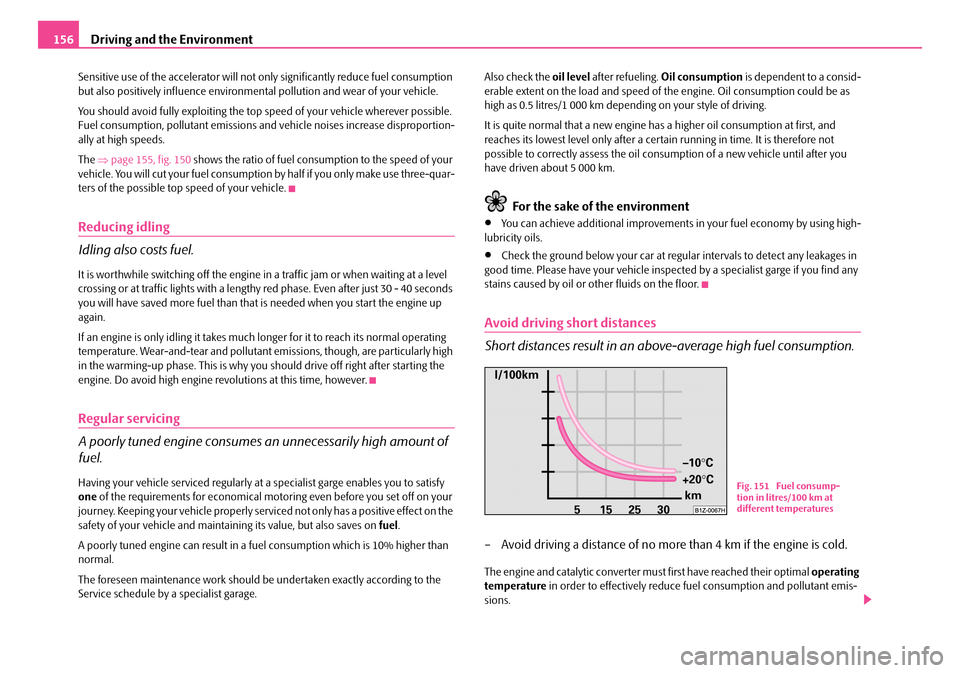
You should avoid fully exploi ting the top speed of your vehicle wherever possible. Fuel consumption, pollutant emissions and vehicle noises increase disproportion- ally at high speeds.
The ⇒page 155, fig. 150 shows the ratio of fuel consumption to the speed of your vehicle. You will cut your fuel consumption by half if you only make use three-quar- ters of the possible top speed of your vehicle.
Reducing idling
Idling also costs fuel.
It is worthwhile switching off the engine in a traffic jam or when waiting at a level crossing or at traffic lights with a length y red phase. Even after just 30 - 40 seconds you will have saved more fuel than that is needed when you start the engine up again.
If an engine is only idling it takes much longer for it to reach its normal operating temperature. Wear-and-tear and pollutant em issions, though, are particularly high in the warming-up phase. This is why you should drive off right after starting the engine. Do avoid high engine revolutions at this time, however.
Regular servicing
A poorly tuned engine consumes an unnecessarily high amount of
fuel.
Having your vehicle serviced regularly at a specialist garge enables you to satisfy one of the requirements for economical motoring even before you set off on your journey. Keeping your vehicle properly servic ed not only has a positive effect on the safety of your vehicle and maintaining its value, but also saves on fuel.
A poorly tuned engine can result in a fu el consumption which is 10% higher than normal.
The foreseen maintenance work should be undertaken exactly according to the Service schedule by a specialist garage.
Also check the oil level after refueling. Oil consumption is dependent to a consid- erable extent on the load and speed of the engine. Oil consumption could be as high as 0.5 litres/1 000 km depending on your style of driving.
It is quite normal that a new engine ha s a higher oil consumption at first, and reaches its lowest level only after a certain running in time. It is therefore not possible to correctly assess the oil cons umption of a new vehicle until after you have driven about 5 000 km.
For the sake of the environment
•You can achieve additional improvements in your fuel economy by using high- lubricity oils.
•Check the ground below your car at regula r intervals to detect any leakages in good time. Please have your vehicle inspected by a specialist garge if you find any stains caused by oil or other fluids on the floor.
Avoid driving short distances
Short distances result in an above-average high fuel consumption.
– Avoid driving a distance of no more than 4 km if the engine is cold.
The engine and catalytic converter mu st first have reached their optimal operating temperature in order to effectively reduce fuel consumption and pollutant emis- sions.
Fig. 151 Fuel consump- tion in litres/100 km at different temperatures
NKO A05R 20 MR08.book Page 156 Wednesday, March 28, 2007 9:42 AM
Page 158 of 248
Driving and the Environment157
Using the systemSafetyDriving TipsGeneral MaintenanceBreakdown assistancePraktikTechnical Data
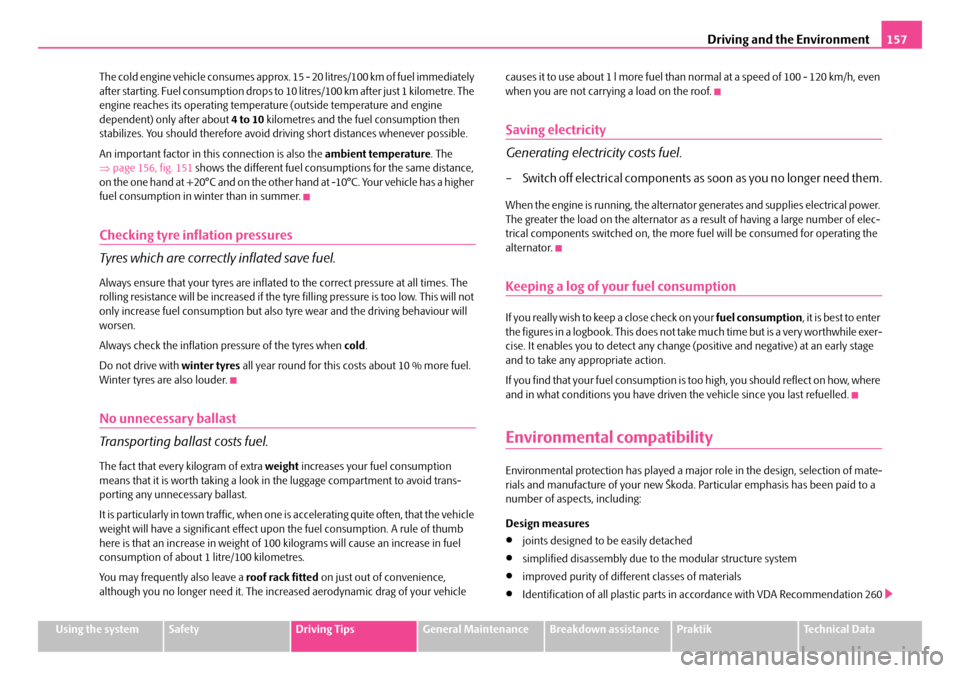
The cold engine vehicle consumes approx. 15 - 20 litres/100 km of fuel immediately after starting. Fuel co nsumption drops to 10 litres/100 km after just 1 kilometre. The engine reaches its operating temperat ure (outside temperature and engine dependent) only after about 4 to 10 kilometres and the fuel consumption then stabilizes. You should therefore avoid driving short distances whenever possible.
An important factor in this connection is also the ambient temperature. The ⇒ page 156, fig. 151 shows the different fuel consumptions for the same distance, on the one hand at +20°C and on the other hand at -10°C. Your vehicle has a higher fuel consumption in winter than in summer.
Checking tyre inflation pressures
Tyres which are correctly inflated save fuel.
Always ensure that your tyres are inflated to the correct pressure at all times. The rolling resistance will be increased if the tyre filling pressure is too low. This will not only increase fuel consumpt ion but also tyre wear and the driving behaviour will worsen.
Always check the inflation pressure of the tyres when cold.
Do not drive with winter tyres all year round for this costs about 10 % more fuel. Winter tyres are also louder.
No unnecessary ballast
Transporting balla st costs fuel.
The fact that every kilogram of extra weight increases your fuel consumption means that it is worth taking a look in the luggage compartment to avoid trans- porting any unnecessary ballast.
It is par ticularly i n town tra ffi c, whe n one is accelerating quite often, that the vehicle weight will have a significant effect upon the fuel consumption. A rule of thumb here is that an increase in weight of 100 kilograms will cause an increase in fuel consumption of about 1 litre/100 kilometres.
You may frequently also leave a roof rack fitted on just out of convenience, although you no longer need it. The incr eased aerodynamic drag of your vehicle
causes it to use about 1 l more fuel than normal at a speed of 100 - 120 km/h, even when you are not carrying a load on the roof.
Saving electricity
Generating electricity costs fuel.
– Switch off electrical components as soon as you no longer need them.
When the engine is running, the alternator generates and supplies electrical power. The greater the load on the alternator as a result of having a large number of elec-trical components switched on, the more fuel will be consumed for operating the alternator.
Keeping a log of your fuel consumption
If you really wish to keep a close check on your fuel consumption, it is best to enter the figures in a logbook. This does not take much time but is a very worthwhile exer-cise. It enables you to detect any change (positive and negative) at an early stage and to take any appropriate action.
If you find that your fuel consumption is too high, you should reflect on how, where and in what conditions yo u have driven the vehicle since you last refuelled.
Environmental compatibility
Environmental protection has played a major role in the design, selection of mate- rials and manufacture of your new Škoda. Particular emphasis has been paid to a number of aspects, including:
Design measures
•joints designed to be easily detached
•simplified disassembly due to the modular structure system
•improved purity of different classes of materials
•Identification of all plastic parts in accordance with VDA Recommendation 260
NKO A05R 20 MR08.book Page 157 Wednesday, March 28, 2007 9:42 AM
Page 159 of 248
Driving and the Environment158
•Reduced fuel consumption and exhaust emission CO2
•Minimum fuel leakage during accidents
•Reduced noise
Choice of materials
•extensive use of recyclable material
•Air conditioning filled wi th CFC-free refrigerant
•no cadmium
•no asbestos
•Reduction in the “vaporisation” of plastics
Manufacture
•solvent-free cavity protection
•solvent-free protection of the vehicle for transportation from the production plant to the customer
•The use of solvent-free adhesives
•No CFCs used in the production process
•without use of mercury
•Use of water-soluble paints
Trade-in and recycling of old cars
Škoda Auto meets the requirements of the brand and its products regarding envi- ronment and ressource protection. All new Škoda vehicles can be utilized up to 95 % and always 4) be returned. In a lot of countries sufficient trade-in networks have been created, where you can trade-in your vehicle. After you trade-in your vehicle, you will receive a confirmation stating the recycling in accordance with environmental regulations.
Vehicles with special built-on types
Technical documents regarding changes carried out on the vehicle must be kept by the vehicle user, in or der to hand over later to the old car user. This ensures the recycling in accordance with environmental regulations.
Note
Detailed information about the trade-in and recycling of old cars is available from your Škoda Service Partner.
Motoring abroad
General
Other circumstances may exist abroad.
It is also possible, in ce rtain countries, that the Škoda Service Partner network is limited or has not been established yet. This is the reason why obtaining certain spare parts may be somewhat complicate d and specialist garage personnel may only be able to ma ke li mite d re pa irs. Škoda Auto a.s. i n the Czech Republic and rele - vant importers are happy to provide info rmation about technical aspects of the vehicle, required maintenance work and possibilities for getting repairs done.
Unleaded petrol
A vehicle fitted with a petrol engine must always be refuelled with unleaded petrol ⇒ page 154. The automobile associations can provide you with information regarding the locations of filling stations which offer unleaded petrol.
Headlights
The low beam of your headlights is set asym metrically. It illuminates the side of the road on which you are driving to a greater extent. If you drive abroad on the other side of the road, you wi ll dazzle oncoming traffic.
It is necessary in order to avoid dazzling oncoming traffic to stick a sticker over a certain part of the headlights.
Headlight stickers can be obtained as a spare part from the Skoda Service Partners.
Headlights with module are designed for driving in countries with traffic on the right or on the left. Have this done always at a Škoda Service Partner.4)subject to fulfilment of the national legal regulations
NKO A05R 20 MR08.book Page 158 Wednesday, March 28, 2007 9:42 AM
Page 169 of 248
Taking care of your vehicle and cleaning the vehicle168
Engine compartment
Good corrosion protection is very important, particularly in winter when one often drives over its salt-strewn roads. One should therefore clean the entire engine compartment before and after the salt spreading period, in order to prevent the salt from being destructive.
Škoda Service Partners have the cleani ng agents recommended by the manufac- turer and also the required equipment.
WARNING
•It is necessary to observe the guidelines given in the chapter before working on the engine compartment ⇒page 174.
•Let the engine cool down before cleaning the engine compartment.
Caution
•Engine cleaning may be only be undertaken when the ignition is off.
•It is recommended to cover the generator before washing the engine compart- ment.
For the sake of the environment
The dirty water produced by washing the engine has washed away petrol, and resi- dues of grease and oil and should therefor e be cleaned by an oil separator. This is why engine washing should only be undertaken in a garage or at a fueling station (when these are fitted with the required equipment).
Care of the interior of vehicle
Plastic parts, artificial leather and cloths
You can clean plastic parts and artificial leather with a moist cloth. You should only treat such parts with special solvent-free plastic cleaning and care products it does prove to be adequate.
Upholstery cloth and cloth trim on the doors, luggage compartment cover, head- liner etc. are best treated with special cleaning products, using if necessary a dry foam and a soft sponge or brush.
We recommend using a cleaning product from Škoda genuine accessories offered by your Škoda dealer.
Caution
Solvent-free cleaners attack the material and can damage it.
Fabric covers of electrically heated seats
Do not clean the seat covers moist as this may result in damage to the seat heating system.
Clean such covers using special agents, for example dry foam.
Natural leather
Natural leather requires quite particular care and attention.
Leather should be treated from time to time according the following
guidelines depending on how much it is used.
Normal cleaning
– Clean soiled areas of the leather with slightly moistened cotton or
woollen cloth.
Severe soiling
– Clean severely soiled areas with a cloth dipped in a mild soapy solu-
tion (2 spoonfuls of natural soap to 1 litre of water).
– Ensure that the leather is not soaked through at any point and that no
water gets into the stitching of the seams.
– Dry off the leather with a soft, dry cloth.
NKO A05R 20 MR08.book Page 168 Wednesday, March 28, 2007 9:42 AM