key SKODA ROOMSTER 2008 1.G Owner's Guide
[x] Cancel search | Manufacturer: SKODA, Model Year: 2008, Model line: ROOMSTER, Model: SKODA ROOMSTER 2008 1.GPages: 248, PDF Size: 46.44 MB
Page 92 of 248
Starting-off and Driving91
Using the systemSafetyDriving TipsGeneral MaintenanceBreakdown assistancePraktikTechnical Data
•Let go of the key as soon as the engine starts otherwise there may be damage to the starter.
The engine running noises may louder at first be louder for a short time after starting the cold engine until oil pressure can be built up in the hydraulic valve clearance compensation. This is quite normal and is not an operating problem.
If the engine does not start ...
You can use the battery of anothe r vehicle as a jump-start aid ⇒page 202.
It is only possible to tow-start vehicl es fitted with a manual gearbox. The tow- starting distance must not be more than 50 metres ⇒page 205.
WARNING
•Never run the engine in non ventilated or enclosed areas. The exhaust gases of the engine contain besides the odorless and colourless carbon monoxide a poisonous gas - hazard! Carbon monoxide can cause uncon- sciousness and death.
•Never leave your vehicle unattended with the engine running.
Caution
•The starter may only be operated (ignition key position ), if the engine is not running. If the starter is immediately oper ated after switching off the engine, the starter or the engine can be damaged.
•Avoid high engine revolutions, full throttle and high engine loads as long as the engine has not yet reached its normal oper ating temperature - risk of damaging the engine!
•Vehicles which are fitted wi th an exhaust gas catalytic converter should not be tow-started over a distance of more than 50 metres.
For the sake of the environment
Never warm up the engine when the vehicle is standing. Drive off right away. When driving the engine reaches its operating temperature more rapidly and the pollutant emissions are lower.
Petrol engines
These engines are fitted with a starter system which selects the correct fuel/air mixture for every external air temperature.
•Do not operate accelerator before and when starting engine.
•Interrupt the attempt at starting after 10 seconds if the engine does not start right awayand wait for about 30 seconds before repeating the attempt.
•It is possible that the fuse on the electric al fuel pump is defect if the engine still does not start. Check the fuse and replace it if necessary ⇒page 207.
•If the engine does not start, contact the nearest specialist garage to obtain professional assistance.
It may be necessary, if the engine is very hot, to slightly depress the accelerator after the engine has started.
Diesel engines
Glow plug system
Diesel engines are equipped with a glow plug system, the preglow period being controlled automatically in line with the coolant temperature and outside temper- ature.
The preglow indicator light comes on after the ignition has been switched on.
You should not switch on any major electrical components during the heating period otherwise the vehicle battery will be drained unnecessarily.
•You should start the engine immediately after the glow plug warning light has gone out.
•The glow plug warning light will come on for about one second if the engine is at a normal operating temperature or if the outside temperature is above +5°C. This means that you can start the engine right away.
•Interrupt the attempt at starting after 10 seconds if the engine does not start right awayand wait for about 30 seconds before repeating the attempt.
•It is possible that the fuse on the diesel preglow system is defect if the engine still does not start. Check the fuse and replace it if necessary ⇒page 207.
A3
NKO A05R 20 MR08.book Page 91 Wednesday, March 28, 2007 9:42 AM
Page 93 of 248
Starting-off and Driving92
•Contact the nearest specialist garage to obtain professional assistance.
Starting the engine after fuel tank has run dry
It may take longer than normal to start the engine after refuelling if the fuel tank has run completely dry - up to one minute. This is because the fuel system must first of all be filled while the attempting to start the engine.
Switching off the engine
– The engine can be swit ched off by turning the ignition key from posi-
tion ⇒page 90, fig. 101 into position .
WARNING
•Never switch off the engine before the vehicle is stationary - risk of acci- dent!
•The brake booster only operates when the engine is running. Greater physical effort for braking is required when engine is switched off. Because if you do not stop as normal, this can cause an accident and severe injuries.
Caution
you should not switch the engine off right away at the end of your journey after the engine has been operated fo r a lengthy period at high loads but should be allowed it to run at idling speed for about 2 minutes . This prevents any accumulation of heat when the engine is switched off.
Note
•The radiator fan may continue running fo r a further 10 minutes or so after the engine and the ignition have been switched off. The coolant fan may, however, also switch on again after some time if the coolant temperature rises because of an accumulation of heat in the engine or if the engine is warm and the engine compartment is additionally heated by strong sunlight.
•This is why particular care is required when carrying out any work in the engine compartment ⇒page 174, “Working in the engine compartment”.
Shifting (manual gearbox)
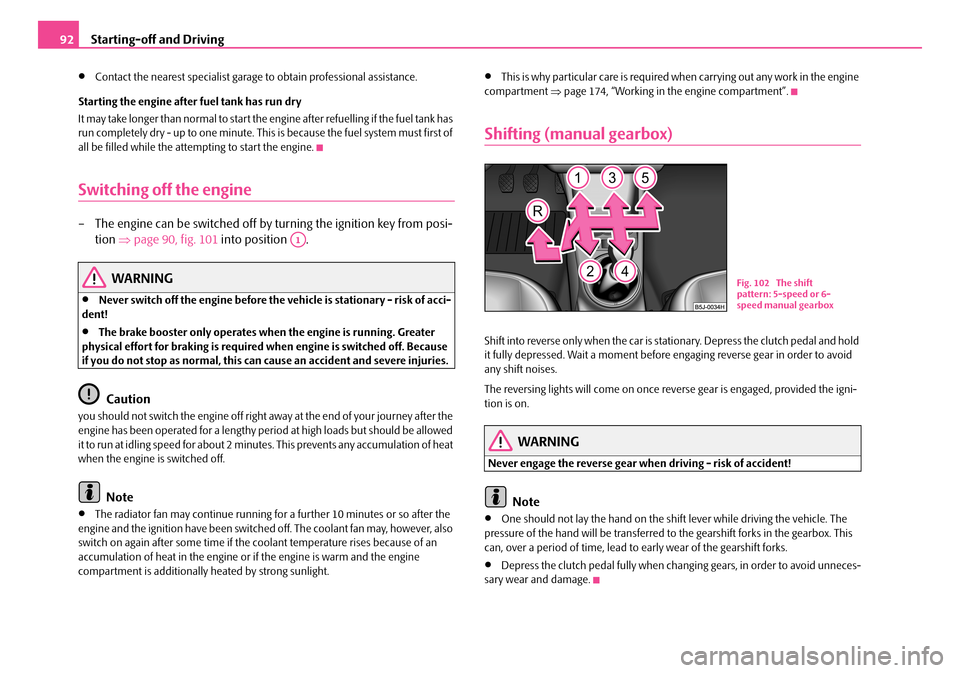
Shift into reverse only when the car is stationary. Depress the clutch pedal and hold it fully depressed. Wait a moment before engaging reverse gear in order to avoid any shift noises.
The reversing lights will come on once reverse gear is engaged, provided the igni- tion is on.
WARNING
Never engage the reverse gear when driving - risk of accident!
Note
•One should not lay the hand on the shift lever while driving the vehicle. The pressure of the hand will be transferred to the gearshift forks in the gearbox. This can, over a period of time, lead to early wear of the gearshift forks.
•Depress the clutch pedal fully when changing gears, in order to avoid unneces- sary wear and damage.
A1
Fig. 102 The shift pattern: 5-speed or 6-speed manual gearbox
NKO A05R 20 MR08.book Page 92 Wednesday, March 28, 2007 9:42 AM
Page 100 of 248
Automatic gearbox99
Using the systemSafetyDriving TipsGeneral MaintenanceBreakdown assistancePraktikTechnical Data
You must depress the brake pedal ⇒ if you wish to move the selector lever into position D from N when the vehicle is travelling at less than 5 km/hour or is stationary.
In certain circumstances (e.g. when driving in mountainous regions or when towing a trailer) it may be beneficial to select the manual shift programme ⇒page 100 for a short time in order to adapt the gearbox ratios manually to the driving situations.
S - Position for sporty style of driving
Shifting up later into a higher gear makes it possible to fully exploit the power potential of the engine. The gearbox also then shifts down at higher engine speeds as in the position D.
The gearbox does not shift into the 6th gear in the position S, because the maximum speed is achieved with the 5th gear.
The Shiftlock on the selector lever grip must be pressed when moving the selector lever out of the position D into the position S.
WARNING
•Never move the selector lever into position R or P when driving - risk of an accident!
•When the engine is running and the vehicle is stationary, it is necessary to hold the car with the brake pedal in all the positions of the selector lever (except P and N) since the power transmission is never completely inter-rupted, also not when the engine is idling - the vehicle "creeps".
•You must on no account unintentionally operate the throttle (e.g. by hand from the engine compartment) if a drive position is engaged when the car is stationary. The vehicle would ot herwise immediately start off - also when the handbrake is firmly applied - risk of an accident!
•You must move the selector lever into position P and firmly apply the handbrake first before you or any other person opens the bonnet and starts working on the engine when it is running - risk of accident! It is also essential to observe all warnings ⇒page 174, “Working in the engine compartment”.
Selector lever lock
Automatic selector lever lock
With the ignition on, the selector lever is locked when it is in the positions P and N. You must first of all depress the brake pedal in order to move the selector lever out of this position. The warning light ⇒page 27 lights up in the instrument cluster as a reminder for the driver when the selector lever is in position P and N:
A time delay element ensures that the sele ctor lever is not blocked when rapidly switching over the position N (e.g. from R to D). This does, for example, allow one to seesaw out a stuck vehicle. The selector lever lock will click into place if the lever is in the N position for more than 2 seconds without the brake pedal being pressed.
The selector lever lock is only active if th e vehicle is stationary or moving at speed of less than 5 km/hour. The lock is switched off automatically into position N when the car is travelling at a higher speed.
Shiftlock button
The Shiftlock button in the handle of sele ctor lever prevents certain selector lever positions being engaged inadvertently. The selector lever lock is cancelled when you press the Shiftlock button.
Note
For vehicles fitted with manual gearbox, yo u can withdraw the ignition key in each selector lever position after switching off the ignition.
Kickdown function
The kickdown function provides you with maximum acceleration
power.
Depressing the accelerator pedal allows th e kickdown function to be activated in the desired driving program. This function has precedence over the driving programme and serves for maximum accelera tion of the vehicle when exploiting the maximum power potential of the engine without taking into account the current selector lever position ( D, S or Tiptronic). The gearbox shifts down to one or several gears in line with the driving state and the vehicle accelerates. The
NKO A05R 20 MR08.book Page 99 Wednesday, March 28, 2007 9:42 AM
Page 109 of 248
Communication108
•When entering an incorrect PIN code, the system indicates “The PIN is incor- rect ”.
•If the incorrect PIN code has been entered three times consecutively, the card is blocked. With the aid of the person al unblocking code PUK (Personal Unblock Key), the SIM card can be unblocked. The unblocking code can only be entered via the phone keypad and not through the voice control.
Example for entering the PIN code
You can interrupt the dialogue at any time by pressing the PTT button or with the voice command CANCEL.
Select number
– Press the PTT button.
– Give the command DIAL NUMBER after the signal tone.
After giving this command, the system requests the entry of a telephone number. The telephone number can be entered as an interconnected spoken row of digits (complete number), in the form of order of digits (separation through a brief voice pause) or through individually spoken digits. After each order of digits (separation through brief voice pause) the detected digits are repeated.
The digits zero to nine are permitted. The system detects no continuous digit combinations such as twenty-three, but only individually spoken digits (two, three).
When entering more than 20 digits, the system answers with voice response “ The number is too long ”.
Additionally for international calls a Plus (+) has to be entered in front of the 20 digits.
Example when entering a telephone number
You can interrupt the dialogue at any time by pressing the PTT button or with the voice command CANCEL.
Repeat last call
– Press the PTT button.
– Give the command REDIAL after the signal tone.
After giving this command, the last number selected via voice input is selected again.
Voice commandAnnouncement
ENTER PIN/PIN CODE“ The PIN please”
e.g. ZERO ONE TWO THREE“Zero One Two Three”
If no entry is put in, the following announcement is made after about 5 sec- onds.
“ Possible commands are: store, repeat, back, delete or more digits ”
STORE“The PIN is saved” (end of dialogue)
Voice commandAnnouncement
DIAL NUMBER“ The number please”
e.g. ZERO SIX ZERO THREE“Zero Six Zero Three”
If no entry is put in, the following announcement is made after about 5 sec- onds.
“ Possible commands are: dial, repeat, back, delete or more digits ”
FIVE SEVEN TWO“Five Seven Two”
DIAL“The number is being dialed”
NKO A05R 20 MR08.book Page 108 Wednesday, March 28, 2007 9:42 AM
Page 113 of 248

Communication112
In the modern business world as well as within the private sector the mobile communication gains increasi ngly on importance. Mobile phones from different manufacturers can be connected with the hands-free system by means of Blue- tooth. During the connecting procedure, no other mobile phone may be connected via Bluetooth with the hands-free system.
Up to four mobile phones can be connected to the hands-free system by means of Bluetooth, whereby only one mobile ph one can communicate via Bluetooth with the hands-free system. If a fifth mobile phone is connected to the handsfree- system, then the telephone, which has not been used together with the handsfree system for the longest period, is disconnected.
Establishing the Bluetooth connection
After switching on the ignition, the Blue tooth connection is automatically estab- lished for the already adapted mobile phone 3). You can hear an increasing tone sequence from the loudspeakers of the vehicle.
Disconnecting the Bluetooth connection
After withdrawing the ignition key, the Bluetooth connection is disonnected. You can hear an increasing tone sequence from the loudspeakers of the vehicle.
WARNING
•Pay attention primarily to the traffic situation! As the driver you are fully responsible for the traffic safety. Use the telephone system only to such an extent, so that you are in full control of your vehicle at any time - risk of acci- dent!
•In the event of air transport, the Bluetooth function of the handsfree- system must be switched off by a specialist garage.
Caution
Taking the mobile phone out of the adapter during the call can lead to interruption of the connection. When taking out th e mobile phone, the connection to the factory-fitted antenna is interrupted, this reduces the quality of the transmitting and receiving signal. This might result additionally in harmful radiation from the mobile phone in the interior of the ve hicle and the charging of the telephone battery is interrupted.
Note
•Not valid for all mobile phones which enable a communication via Bluetooth.
•Please operate your mobile phone exclusively with a suitable adapter, in order to keep a low radiation in the vehicle.
•Inserting the mobile phone into the adapter ensures an optimal sending and receiving power and offers at the same time the advantage of the battery charging.
•If you insert the mobile telephone in to the adapter, the connection is estab- lished via the interface in the adapter set and the Bluetooth connection is discon-nected. You can hear an incr easing tone sequence from the loudspeakers of the vehicle.
•Note that the range of the Bluetooth connection to the handsfree-system is limited to the vehicle interior. The range is dependent on local factors, e.g. obstacles between the devices and interferences with other devices. If your mobile phone is e.g. in a jacket pocket, this can lead to difficulties when establishing the Bluetooth connection with the handsfree-sy stem or the data transfer.
•If you have set the Portuguese language in the information display, it is used automatically for the mobile phone operat ion, as this is the language, which was entered during coding of the handsfree-system.
•On certain mobile phones with operating system, it is necessary to install on the mobile phone an application of the mobi le phone manufacturer, which enables the take-over of the phone phonebook via Bluetooth.
Mobile phones and tw o-way radio systems
We recommend that you have the installation of a mobile phone and two-way radio system in a vehicle carried out by a Škoda Service Partner.
Škoda Auto a.s. permits the operation of mobile phones and two-way radio systems with a professionally installed external aerial and a maximum transmission power of up to 10 watts.
Our Škoda Service Partners are also happy to inform you about the possibilities available for installing and operating mo bile telephones and radio transmitters which have an output greater than 10 watt s. The Škoda Service Partners can provide
NKO A05R 20 MR08.book Page 112 Wednesday, March 28, 2007 9:42 AM
Page 125 of 248
Seat belts124
•No two persons (also not children) should ever use a single seat belt together.
•The maximum protection which seat belts can offer is only achieved if you are correctly seated ⇒page 119, “Correct seated position”.
•The belt webbing must not run across solid or fragile objects (e.g. spec- tacles, ball-point pens, keys etc.) as this may be a cause of injuries.
•Bulky, loose clothing (e.g. a winter coat over a jacket) does not allow you to be correctly seated and impairs proper operation of the seat belts.
•It is prohibited to use clamps or other objects to adjust seat belts (e.g. for shortening the belts for smaller persons).
•The lock tongue should only be insert ed into the lock which is the correct one for your seat. Wrong use of the safety belt will reduce its capacity to protect and the risk of injury increases.
•The backrests must not be tilted too far to the rear otherwise the seat- belts can lose their effectiveness.
•The belt webbing must always be ke pt clean. Soiled belt webbing may impair proper operation of the inertia reel ⇒page 169, “Seat belts”.
•The slot of the belt tongue must not be blocked by paper or similar objects otherwise the belt tongue will not lock in place properly.
•Inspect the seat belts regu larly to ensure they are in good condition. If you find seat belts which have damage to the seat belt webbing, seat belt connections, to the inertia reels or to the lock, the relevant safety belt must be replaced by a specialist garage.
•The seat belts must not be removed or changed in any way. Do not make an attempt to repair the seat belts yourself.
•Damaged seat belts which have been subjected to stress in an accident and were therefore stretched, must be replaced - this is best done by a specialist garage. The anchorage points of the belts must also be inspected. The anchorage points for the be lts should also be checked.
•In certain countries it is possible to use seat belts which differ in terms of their operation from the seat belts wh ich are described on the pages which follow.
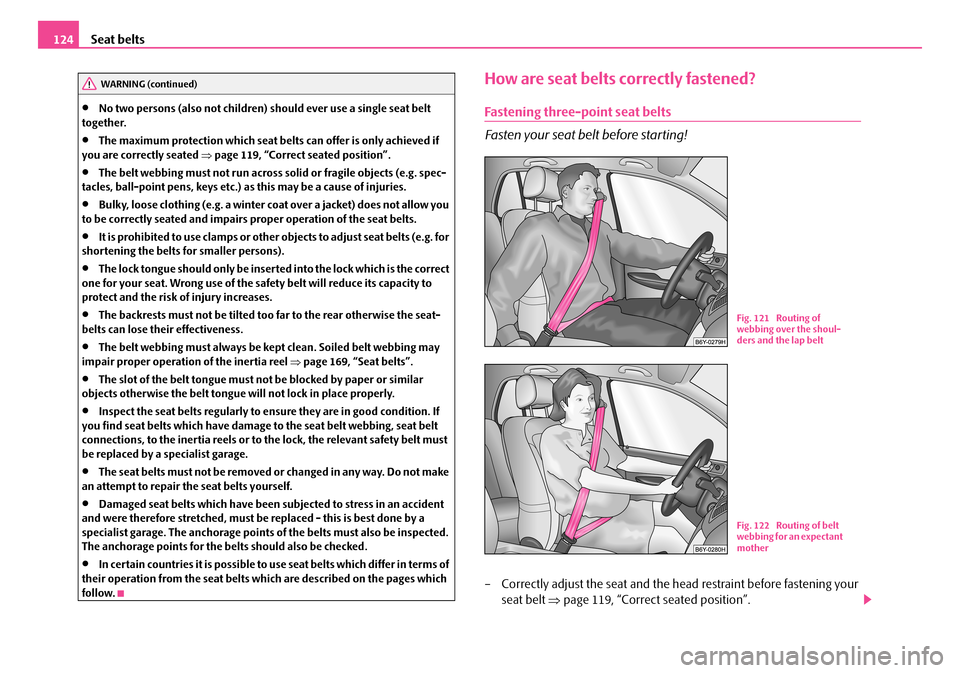
How are seat belts correctly fastened?
Fastening three-point seat belts
Fasten your seat belt before starting!
– Correctly adjust the seat and the head restraint before fastening your
seat belt ⇒page 119, “Correct seated position”.
WARNING (continued)
Fig. 121 Routing of webbing over the shoul-ders and the lap belt
Fig. 122 Routing of belt webbing for an expectant mother
NKO A05R 20 MR08.book Page 124 Wednesday, March 28, 2007 9:42 AM
Page 137 of 248
Airbag system136
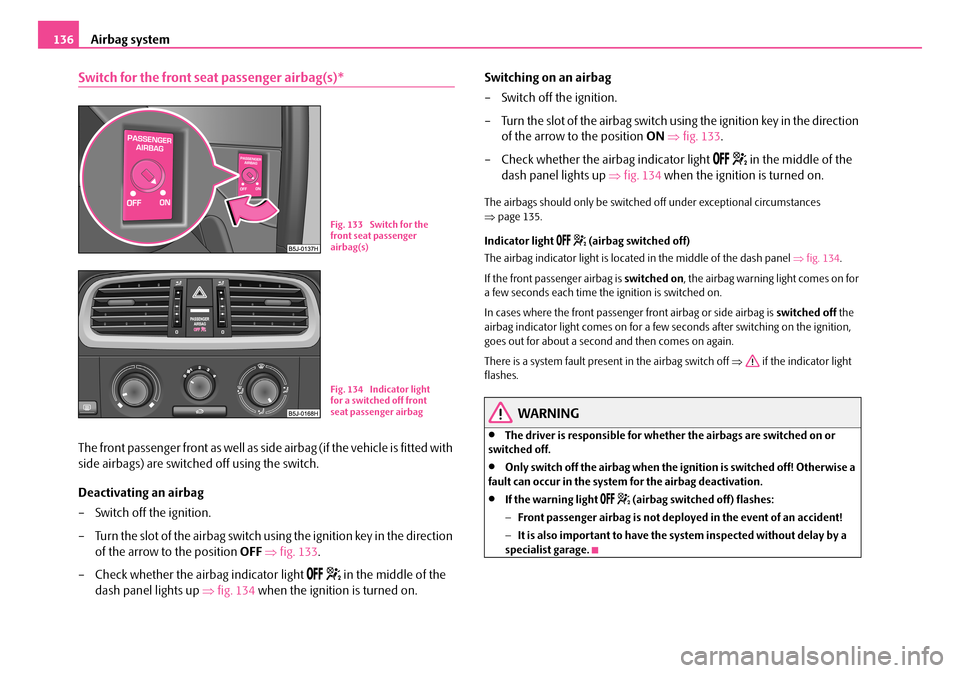
Switch for the front seat passenger airbag(s)*
The front passenger front as well as side airbag (if the vehicle is fitted with
side airbags) are switched off using the switch.
Deactivating an airbag
– Switch off the ignition.
– Turn the slot of the airbag switch using the ignition key in the direction
of the arrow to the position OFF ⇒fig. 133.
– Check whether the airbag indicator light in the middle of the
dash panel lights up ⇒fig. 134 when the ignition is turned on.
Switching on an airbag
– Switch off the ignition.
– Turn the slot of the airbag switch us ing the ignition key in the direction
of the arrow to the position ON ⇒fig. 133.
– Check whether the airbag indicator light in the middle of the
dash panel lights up ⇒fig. 134 when the ignition is turned on.
The airbags should only be switched off under exceptional circumstances ⇒ page 135.
Indicator light (airbag switched off)
The airbag indicator light is locate d in the middle of the dash panel ⇒fig. 134.
If the front passenger airbag is switched on, the airbag warning light comes on for a few seconds each time the ignition is switched on.
In cases where the front passenger front airbag or side airbag is switched off the airbag indicator light comes on for a few seconds after switching on the ignition, goes out for about a second and then comes on again.
There is a system fault presen t in the airbag switch off ⇒ if the indicator light flashes.
WARNING
•The driver is responsible for whether the airbags are switched on or switched off.
•Only switch off the airbag when the ignition is switched off! Otherwise a fault can occur in the system for the airbag deactivation.
•If the warning light (airbag switched off) flashes:
− Front passenger airbag is not deployed in the event of an accident!
− It is also important to have the system inspected without delay by a specialist garage.
Fig. 133 Switch for the front seat passenger airbag(s)
Fig. 134 Indicator light for a switched off front seat passenger airbag
NKO A05R 20 MR08.book Page 136 Wednesday, March 28, 2007 9:42 AM
Page 172 of 248
Fuel171
Using the systemSafetyDriving TipsGeneral MaintenanceBreakdown assistancePraktikTechnical Data
•Your vehicle is not adapted for use of biofuel (RME), therefore this fuel must not be refuelled and driven. Using this fuel (RME) can lead to damage to the engine or the fuel system.
Operation in winter
Winter-grade diesel fuel
A different grade of diesel fuel is available at filling stations in winter than during the summer. Using “summer-grade diesel fuel” at temperatures below 0°C can result in operational problems because the diesel be comes viscous as a result of paraffin separation.
It is therefore the case that DIN EN 590 prescribes diesel fuel class for certain periods of the year which can also be pu rchased at the corresponding time during the year. “Winter-grade diesel fuel” will still operate properly even at a temperature of -20°C.
It is often the case in countries with diff erent climatic conditions that diesel fuels available have a different temperature characteristic. Škoda Service Partners and filling stations in the count ry concerned will be able to provide you with informa- tion regarding the diesel fuels available.
Prewarming fuel
The vehicle is fitted with a fuel filter prewarming system. This secures operation of a vehicle using diesel fuel down to an environmental temperature of -25°C.
Caution
It is not permitted to add the various fuel additives on the market, including petrol, to diesel fuel in order to improve its flow properties.
Refuelling
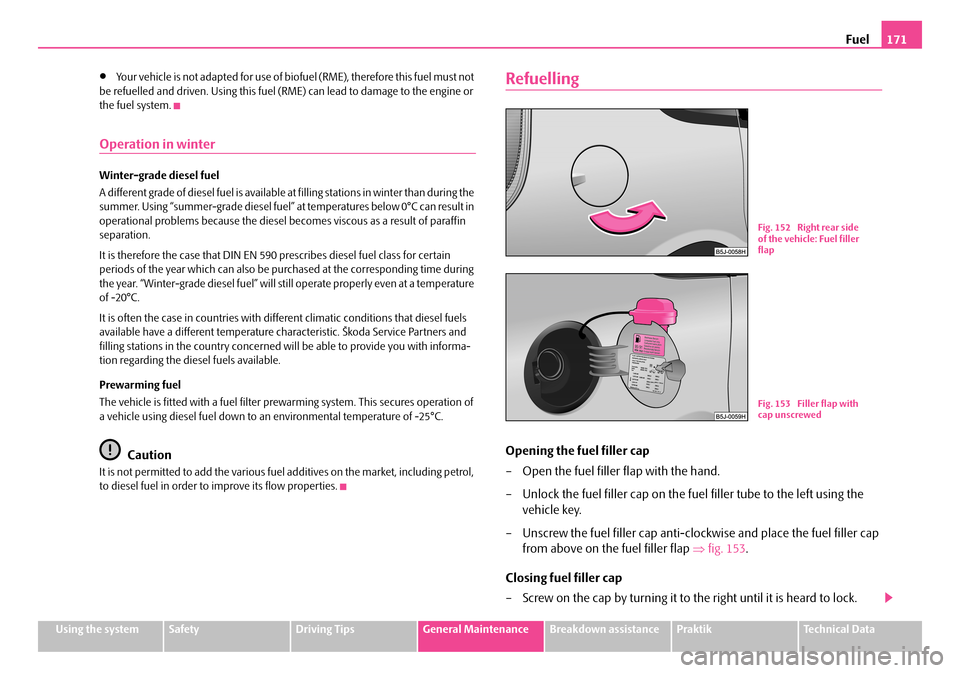
Opening the fuel filler cap
– Open the fuel filler flap with the hand.
– Unlock the fuel filler cap on the fuel filler tube to the left using the
vehicle key.
– Unscrew the fuel filler cap anti-clo ckwise and place the fuel filler cap
from above on the fuel filler flap ⇒fig. 153.
Closing fuel filler cap
– Screw on the cap by turning it to the right until it is heard to lock.
Fig. 152 Right rear side of the vehicle: Fuel filler flap
Fig. 153 Filler flap with cap unscrewed
NKO A05R 20 MR08.book Page 171 Wednesday, March 28, 2007 9:42 AM
Page 173 of 248
Fuel172
– Lock the fuel filler cap on the fuel filler tube to the right using the
vehicle key.
– Press the fuel tank flap closed.
The correct grades of fuel for your vehicle are stated on a sticker affixed to the inside of the fuel filler flap. Further information on fuel ⇒page 170.
The fuel tank has a capacity of about 55 litres.
WARNING
Pay attention to any legal requirements if you do carry a spare canister in the vehicle. We do not recommend carrying any fuel canisters in your vehicle for safety reasons. The canister can be da maged in the event of an accident and fuel may leak out.
Caution
•Remove any fuel which has spilled onto the paintwork of your vehicle immedi- ately - risk of paint damage!
•Vehicles fitted with catalytic converter should never be allowed to let the fuel tank to run completely empty. An irregular supply of fuel to the engine can result in misfiring and unburnt fuel may get into the exhaust system, which may result in overheating and damage to the catalytic converter.
•Make sure that the valve is not pressed into the filler tube when inserting the pump nozzle into the filler tube. Otherwis e you are unintentionally filling up the volume, which in case of heat can cause an expansion of the fuel. This can lead to an overflow of fuel or damage to parts of the fuel reservoir.
•The fuel tank is full just as soon as the pump nozzle switches off for the first time, provided the nozzle has been operated properly. Do not continue refuelling - otherwise the expansion volume is filled up.
NKO A05R 20 MR08.book Page 172 Wednesday, March 28, 2007 9:42 AM
Page 175 of 248
Inspecting and Replenishing174
– Grip the bonnet and lift it up.
– Take the bonnet support out of its holder and set it in the opening
designed for it ⇒page 173, fig. 156.
Closing the bonnet
– Lift the bonnet slightly and unhook the bonnet support. Press the
bonnet support into the hold er designed to hold it.
– Allow the bonnet to drop from a height of about 30 cm into the lock -
bonnet do not press down on it!
WARNING
•Never open the bonnet if you see that steam or coolant is flowing out of the engine compartment - risk of scaldi ng! Wait long enough until the steam or coolant has stopped escaping.
•For safety reasons, the bonnet must always be properly closed when driving. One should therefore check that the lock has in fact engaged prop- erly after closing the bonnet.
•Stop your vehicle i mmediately while driving if you notice that the lock is not properly engaged and close the bonn et properly - risk of an accident!
Caution
•Before opening the bonnet, ensure that the arms of the windscreen wipers are correctly in place against the windscreen. Otherwise, there is a risk of damage to the paintwork.
Working in the engine compartment
Particular care is required when ca rrying out any work in the engine
compartment!
There is a risk of injuries, scalding, accidents and fire when working in the engine compartment, e.g. inspecting an d replenishing oil and other fluids. For
this reason, it is essential to comply with the warning instructions stated below and with the general applicable rules of safety. The engine compart-ment of your car is a hazardous area ⇒.
WARNING
•Never open the bonnet if you see that steam or coolant is flowing out of the engine compartment - risk of scaldi ng! Wait long enough until the steam or coolant has stopped escaping.
•Switch off the engine and pull out the ignition key.
•Apply the handbrake firmly.
•If your vehicle is fitted with a manual gearbox, move the gearshift lever into Neutral, or if it is fitted with automatic gearbox, move the selector lever into position P.
•Allow the engine to cool down.
•Keep children clear of the engine compartment.
•Do not touch any hot engine parts - risk of burns!
•Never spill oil and other fluids over the hot engine. Such fluids (e.g. the antifreeze contained in the coolant) may ignite!
•Avoid short circuits in the electrical system - particularly on the battery.
•Never place your hand into the radiator fan as long as the engine is still warm. The fan might suddenly start running!
•Never open the cap of the coolant expa nsion bottle as long as the engine is still warm. The cooling system is pressurized!
•Cover over the cap of the coolant expansion reservoir with a large cloth when opening it as protection for your face, hands and arms from hot steam or hot coolant.
•Do not let objects, such as e.g cleaning cloth or tools lie in the engine compartment.
•If you wish to work under the vehicl e, you must secure the vehicle from rolling away and support it with suitable supporting blocks: the car jack is not sufficient for this - risk of injury!
•In cases where it be necessary to carry out inspection work when the engine is running there is an additional risk from rotating parts (e.g. the V-
NKO A05R 20 MR08.book Page 174 Wednesday, March 28, 2007 9:42 AM