technical data SKODA ROOMSTER 2010 1.G Owner's Manual
[x] Cancel search | Manufacturer: SKODA, Model Year: 2010, Model line: ROOMSTER, Model: SKODA ROOMSTER 2010 1.GPages: 231, PDF Size: 12.91 MB
Page 200 of 231
Fuses and light bulbs199
Using the system
Safety
Driving Tips
General Maintenance
Breakdown assistance
Praktik
Technical Data
– Take out the fog light.
– Turn the socket with the bulb for daylight driving light or the socket with the
bulb of the fog light to the left up to stop and take it out.
– Replace the lamp, insert the connector with the new lamp and turn to the right up
to the stop.
– For the installation, first of all insert the fog light with the interlock to the side far
away from the marking of the vehicle.
– Press into place the headlight onto the side facing the marking.
– First of all put the grille with the latch in place on the side opposite the marking.
– Press into place the protective grille onto the side facing the marking.
Cover of fog lights - Roomster ScoutRemoving the cover - Roomster Scout– Switch the ignition and all lights off.
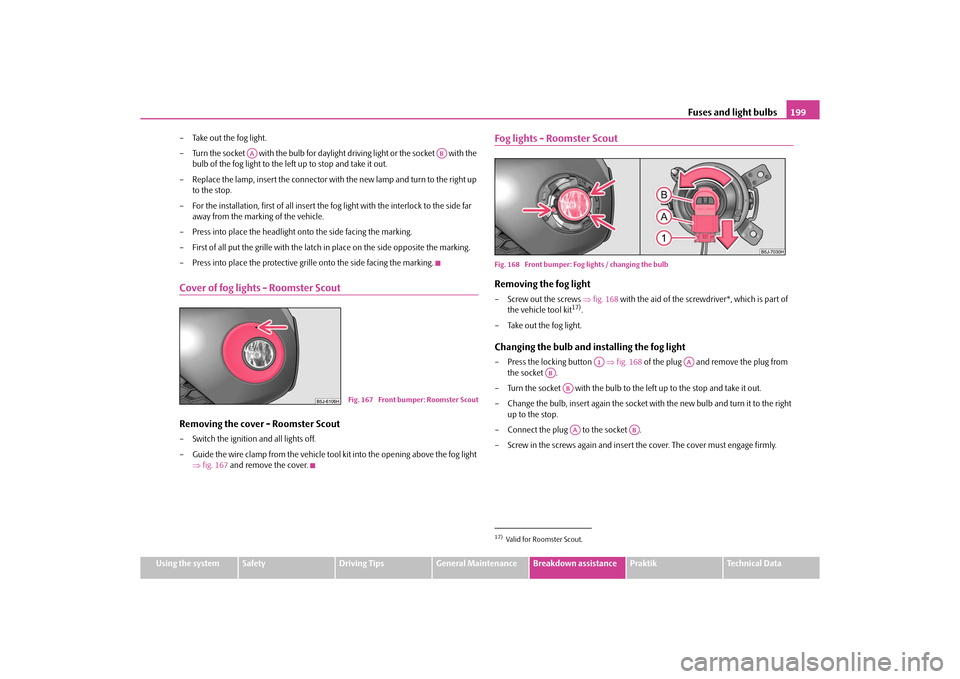
– Guide the wire clamp from the vehicle tool kit into the opening above the fog light
fig. 167 and remove the cover.
Fog lights - Roomster ScoutFig. 168 Front bumper: Fog lights / changing the bulbRemoving the fog light– Screw out the screws fig. 168 with the aid of the screwd river*, which is part of
the vehicle tool kit
17).
– Take out the fog light.
Changing the bulb and installing the fog light– Press the locking button fig. 168 of the plug and remove the plug from
the socket .
– Turn the socket with the bulb to the left up to the stop and take it out.
– Change the bulb, insert again the socket wi th the new bulb and turn it to the right
up to the stop.
– Connect the plug to the socket .
– Screw in the screws again and insert th e cover. The cover must engage firmly.
AA
AB
Fig. 167 Front bumper: Roomster Scout
17)Valid for Roomster Scout.
A1
AA
AB
ABAA
AB
s16g.4.book Page 199 Wednesday, February 10, 2010 3:53 PM
Page 202 of 231
Fuses and light bulbs201
Using the system
Safety
Driving Tips
General Maintenance
Breakdown assistance
Praktik
Technical Data
Luggage compartment light– Open the boot lid.
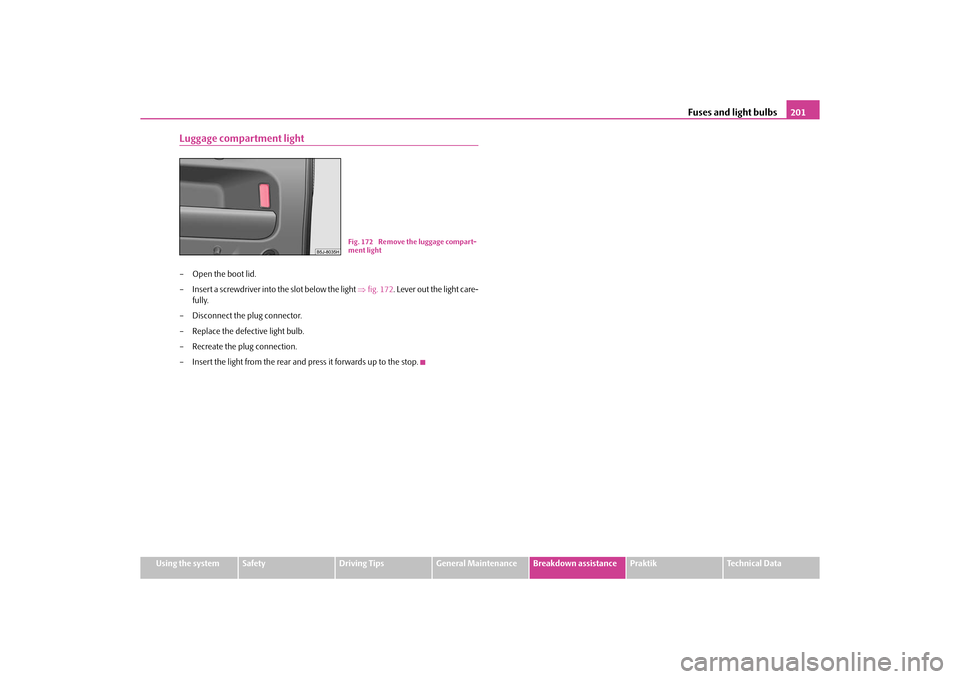
– Insert a screwdriver into the slot below the light fig. 172 . Lever out the light care-
fully.
– Disconnect the plug connector.
– Replace the defective light bulb.
– Recreate the plug connection.
– Insert the light from the rear and press it forwards up to the stop.
Fig. 172 Remove the luggage compart-
ment light
s16g.4.book Page 201 Wednesda y, February 10, 2010 3:53 PM
Page 204 of 231
Praktik203
Using the system
Safety
Driving Tips
General Maintenance
Breakdown assistance
Praktik
Technical Data
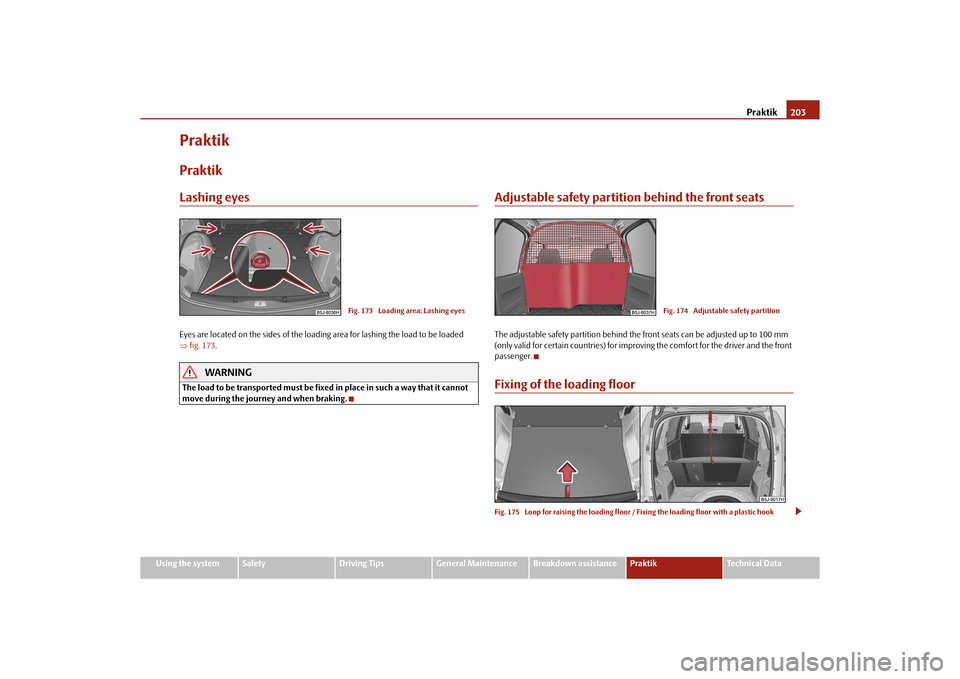
PraktikPraktikLashing eyesEyes are located on the sides of the loading area for lashing the load to be loaded
fig. 173 .
WARNING
The load to be transported must be fixed in place in such a way that it cannot
move during the journey and when braking.
Adjustable safety partition behind the front seatsThe adjustable safety partition behind the front seats can be adjusted up to 100 mm
(only valid for certain countries) for improving the comfort for the driver and the front
passenger.Fixing of the loading floorFig. 175 Loop for raising the loading floor / Fixing the loading floor with a plastic hook
Fig. 173 Loading area: Lashing eyes
Fig. 174 Adjustable safety partition
s16g.4.book Page 203 Wednesday, February 10, 2010 3:53 PM
Page 206 of 231
Technical Data205
Using the system
Safety
Driving Tips
General Maintenance
Breakdown assistance
Praktik
Technical Data
Te c h n i c a l D a t aTechnical DataGeneral informationThe details given in the official vehicle regi stration documents always take precedence
over the details in the Owner's Manual. Please refer to the official vehicle registration
documents or consult a specialist garage concerning the engine with which your
vehicle is equipped.Used abbreviations
PerformancesThe listed performance values were de termined without performance-reducing
equipment, e.g. air conditioning system.WeightThe loading capacity is reduced in line with the range of the special equipment. The
unloaden weight contains a fuel tank topped up to 90%. A driver with a weight of 75
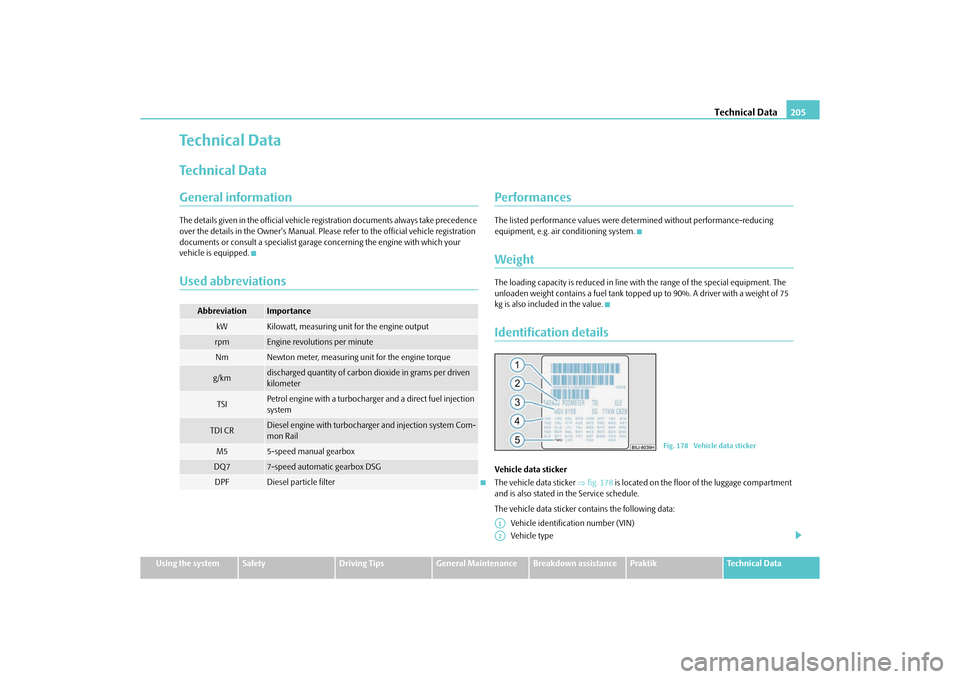
kg is also includ ed in the value.Identification detailsVehicle data sticker
The vehicle data sticker fig. 178 is located on the floor of the luggage compartment
and is also stated in the Service schedule.
The vehicle data sticker co ntains the following data:
Vehicle identification number (VIN)
Vehicle type
Abbreviation
Importance
kW
Kilowatt, measuring unit for the engine output
rpm
Engine revolutions per minute
Nm
Newton meter, measuring unit for the engine torque
g/km
discharged quantity of carbon dioxide in grams per driven
kilometer
TSI
Petrol engine with a turbocharger and a direct fuel injection
system
TDI CR
Diesel engine with turbocharger and injection system Com-
mon Rail
M5
5-speed manual gearbox
DQ7
7-speed automatic gearbox DSG
DPF
Diesel particle filter
Fig. 178 Vehicle data sticker
A1A2
s16g.4.book Page 205 Wednesda y, February 10, 2010 3:53 PM
Page 207 of 231
Technical Data
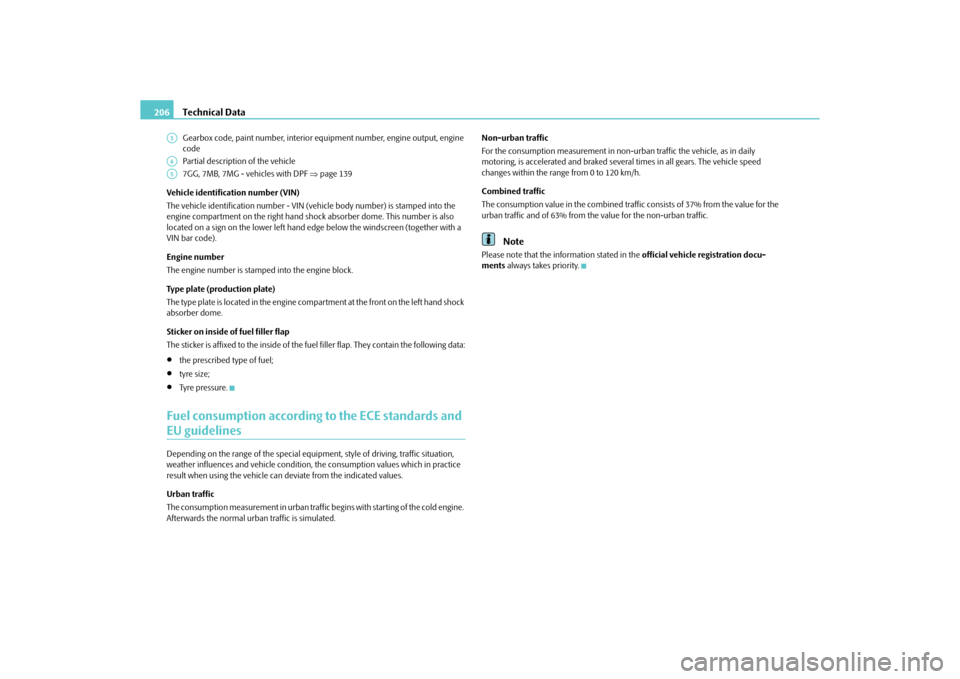
206Gearbox code, paint number, interior eq uipment number, engine output, engine
code
Partial description of the vehicle
7GG, 7MB, 7MG - vehicles with DPF page 139
Vehicle identification number (VIN)
The vehicle identification number - VIN (veh icle body number) is stamped into the
engine compartment on the right hand sh ock absorber dome. This number is also
located on a sign on the lowe r left hand edge below the windscreen (together with a
VIN bar code).
Engine number
The engine number is stam ped into the engine block.
Type plate (production plate)
The type plate is located in the engine compartment at the front on the left hand shock
absorber dome.
Sticker on inside of fuel filler flap
The sticker is affixed to the inside of the fuel filler flap. They contain the following data:
the prescribed type of fuel;
tyre size;
Tyre pressure.
Fuel consumption according to the ECE standards and EU guidelinesDepending on the range of the special equipment, style of driving, traffic situation,
weather influences and vehicl e condition, the consumption values which in practice
result when using the vehicle can deviate from the indicated values.
Urban traffic
The consumption measurement in urban traffic begins with starting of the cold engine.
Afterwards the normal ur ban traffic is simulated. Non-urban traffic
For the consumption measurement in non-ur
ban traffic the vehicle, as in daily
motoring, is accelerated and braked severa l times in all gears. The vehicle speed
changes within the range from 0 to 120 km/h.
Combined traffic
The consumption value in the combined traffic consists of 37% from the value for the
urban traffic and of 63% from th e value for the non-urban traffic.
Note
Please note that the information stated in the official vehicle registration docu-
ments always takes priority.
A3A4A5s16g.4.book Page 206 Wednesda y, February 10, 2010 3:53 PM
Page 208 of 231
Technical Data207
Using the system
Safety
Driving Tips
General Maintenance
Breakdown assistance
Praktik
Technical Data
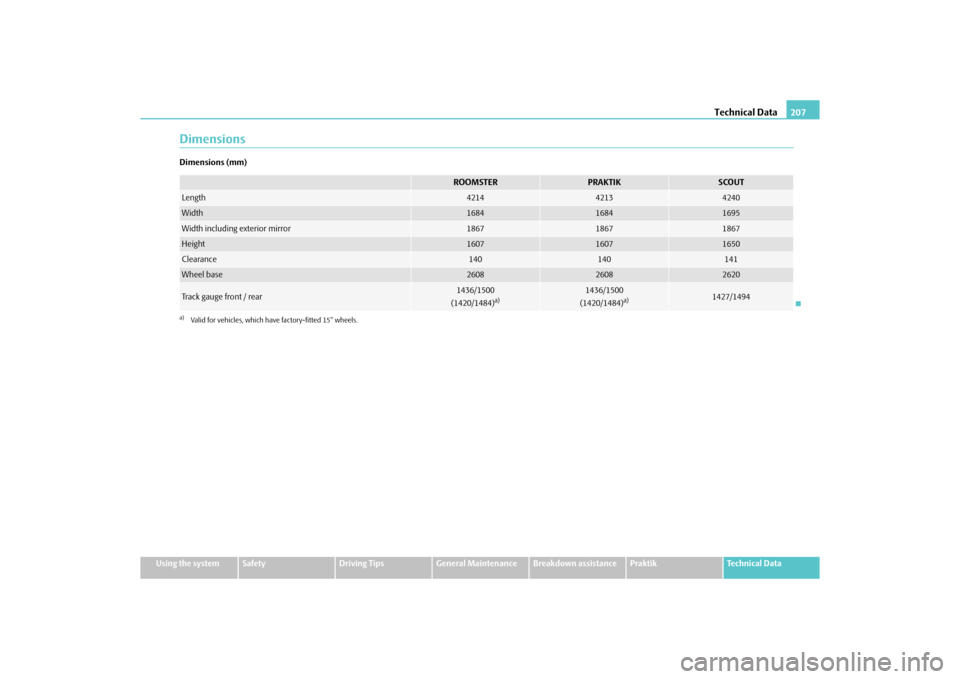
DimensionsDimensions (mm)
ROOMSTER
PRAKTIK
SCOUT
Length
4214
4213
4240
Width
1684
1684
1695
Width including exterior mirror
1867
1867
1867
Height
1607
1607
1650
Clearance
140
140
141
Wheel base
2608
2608
2620
Track gauge front / rear
1436/1500
(1420/1484)
a)
a)Valid for vehicles, which ha ve factory-fitted 15" wheels.
1436/1500
(1420/1484)
a)
1427/1494
s16g.4.book Page 207 Wednesda y, February 10, 2010 3:53 PM
Page 209 of 231
Technical Data
208
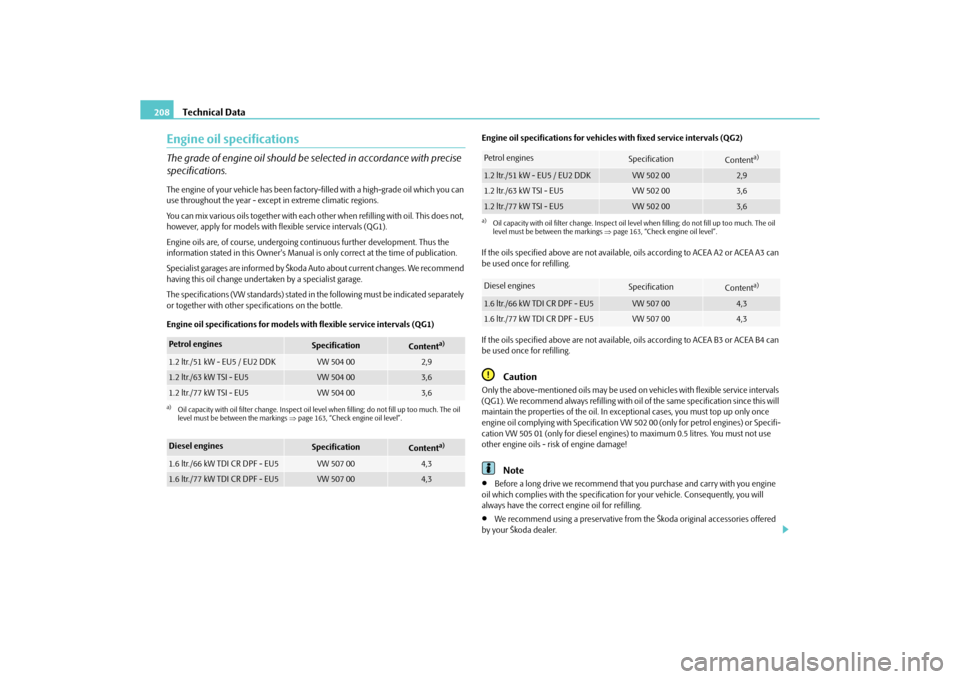
Engine oil specificationsThe grade of engine oil should be se lected in accordance with precise
specifications.The engine of your vehicle has been factory-filled with a high-grade oil which you can
use throughout the year - except in extreme climatic regions.
You can mix various oils together with each other when refilling with oil. This does not,
however, apply for models with flexible service intervals (QG1).
Engine oils are, of course, undergoing co ntinuous further development. Thus the
information stated in this Owner's Manual is only correct at the time of publication.
Specialist garages are informed by Škoda Auto about current changes. We recommend
having this oil change undertaken by a specialist garage.
The specifications (VW standards) stated in the following must be indicated separately
or together with other specifications on the bottle.
Engine oil specifications for models with flexible service intervals (QG1) Engine oil specifications for vehicles with fixed service intervals (QG2)
If the oils specified above are not available, oils according to ACEA A2 or ACEA A3 can
be used once for refilling.
If the oils specified above are not available, oils according to ACEA B3 or ACEA B4 can
be used once for refilling.
Caution
Only the above-mentioned oils may be used on vehicles with flexible service intervals
(QG1). We recommend always refilling with oi
l of the same specification since this will
maintain the properties of the oil. In exce ptional cases, you must top up only once
engine oil complying with Specification VW 50 2 00 (only for petrol engines) or Specifi-
cation VW 505 01 (only for diesel engines) to maximum 0.5 litres. You must not use
other engine oils - risk of engine damage!
Note
Before a long drive we recommend that you purchase and carry with you engine
oil which complies with the specification for your vehicle. Consequently, you will
always have the correct engine oil for refilling.
We recommend using a preservative from the Škoda original accessories offered
by your Škoda dealer.
Petrol engines
Specification
Content
a)
a)Oil capacity with oil filter change. Inspect oil leve l when filling; do not fill up too much. The oil
level must be between the markings page 163, “Check engine oil level”.1.2 ltr./51 kW - EU5 / EU2 DDK
VW 504 00
2,9
1.2 ltr./63 kW TSI - EU5
VW 504 00
3,6
1.2 ltr./77 kW TSI - EU5
VW 504 00
3,6
Diesel engines
Specification
Content
a)
1.6 ltr./66 kW TDI CR DPF - EU5
VW 507 00
4,3
1.6 ltr./77 kW TDI CR DPF - EU5
VW 507 00
4,3
Petrol engines
Specification
Content
a)
a)Oil capacity with oil filter change. Inspect oil le vel when filling; do not fill up too much. The oil
level must be between the markings page 163, “Check engine oil level”.1.2 ltr./51 kW - EU5 / EU2 DDK
VW 502 00
2,9
1.2 ltr./63 kW TSI - EU5
VW 502 00
3,6
1.2 ltr./77 kW TSI - EU5
VW 502 00
3,6
Diesel engines
Specification
Content
a)
1.6 ltr./66 kW TDI CR DPF - EU5
VW 507 00
4,3
1.6 ltr./77 kW TDI CR DPF - EU5
VW 507 00
4,3
s16g.4.book Page 208 Wednesda y, February 10, 2010 3:53 PM
Page 210 of 231
Technical Data209
Using the system
Safety
Driving Tips
General Maintenance
Breakdown assistance
Praktik
Technical Data
For further information - see Service shedule.
s16g.4.book Page 209 Wednesda y, February 10, 2010 3:53 PM
Page 211 of 231
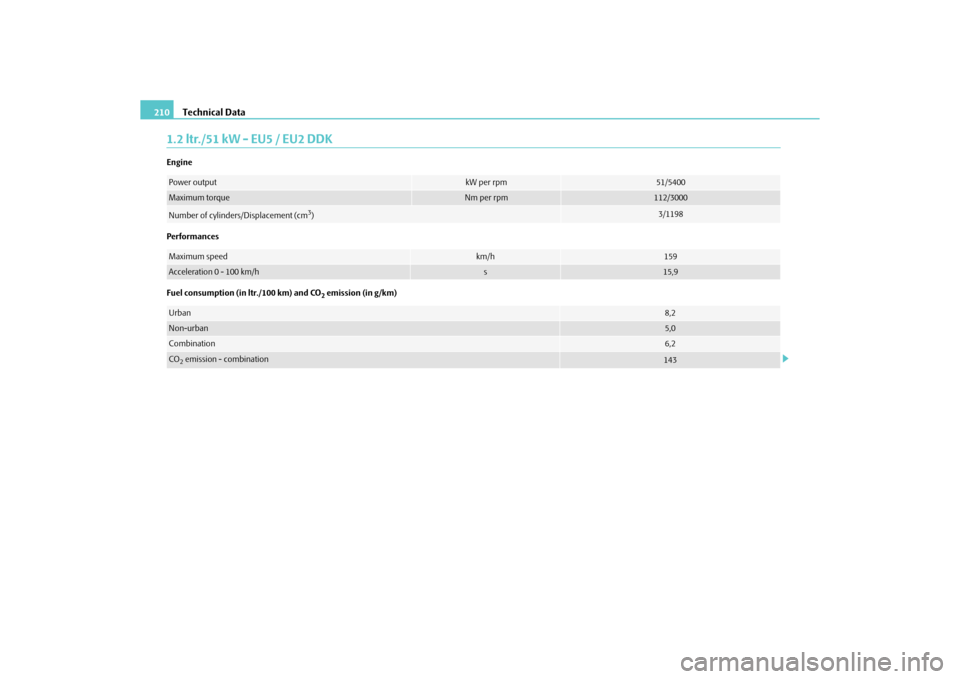
Technical Data
210
1.2 ltr./51 kW - EU5 / EU2 DDKEngine
Performances
Fuel consumption (in ltr./100 km) and CO
2 emission (in g/km)
Power output
kW per rpm
51/5400
Maximum torque
Nm per rpm
112/3000
Number of cylinders/Displacement (cm
3)
3/1198
Maximum speed
km/h
159
Acceleration 0 - 100 km/h
s
15,9
Urban
8,2
Non-urban
5,0
Combination
6,2
CO2 emission - combination
143
s16g.4.book Page 210 Wednesda y, February 10, 2010 3:53 PM
Page 212 of 231
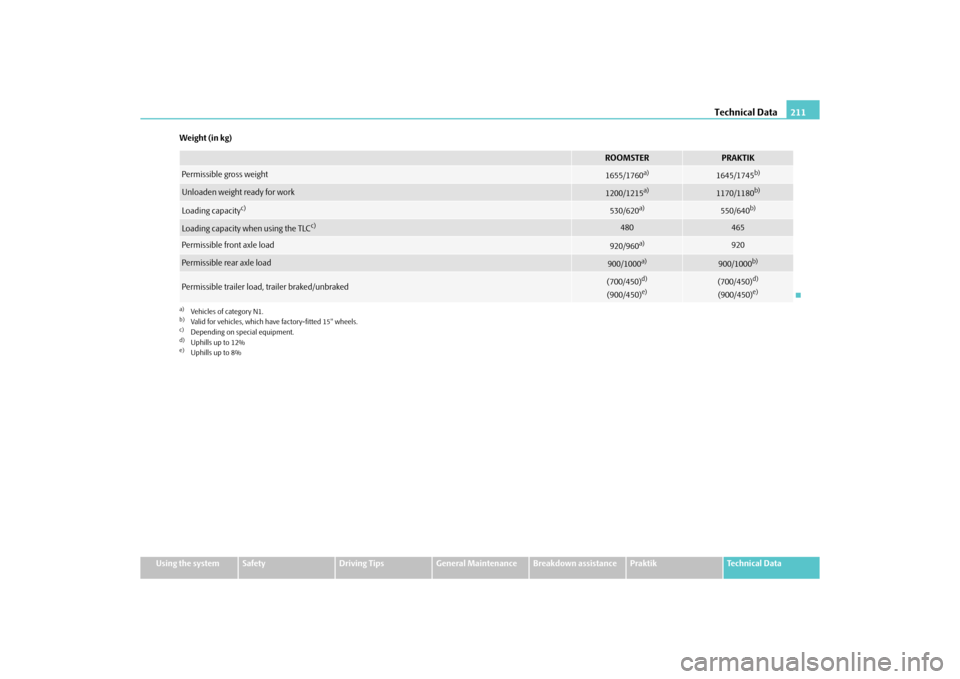
Technical Data211
Using the system
Safety
Driving Tips
General Maintenance
Breakdown assistance
Praktik
Technical Data
Weight (in kg)
ROOMSTER
PRAKTIK
Permissible gross weight
1655/1760
a)
a)Vehicles of category N1.
1645/1745
b)
b)Valid for vehicles, which ha
ve factory-fitted 15" wheels.Unloaden weight ready for work
1200/1215
a)
1170/1180
b)
Loading capacity
c)
c)Depending on special equipment.
530/620
a)
550/640
b)
Loading capacity when using the TLC
c)
480
465
Permissible front axle load
920/960
a)
920
Permissible rear axle load
900/1000
a)
900/1000
b)
Permissible trailer load, trailer braked/unbraked
(700/450)
d)
(900/450)e)
d)Uphills up to 12%e)Uphills up to 8%
(700/450)
d)
(900/450)
e)
s16g.4.book Page 211 Wednesda y, February 10, 2010 3:53 PM