engine SKODA ROOMSTER 2010 1.G Manual PDF
[x] Cancel search | Manufacturer: SKODA, Model Year: 2010, Model line: ROOMSTER, Model: SKODA ROOMSTER 2010 1.GPages: 231, PDF Size: 12.91 MB
Page 175 of 231
Wheels and Tyres
174
The tyre pressure should be at the highest pressure specified for your vehicle at all
times.
Always check the inflation pressure of tyres when cold. Do not reduce the higher pres-
sure of warm tyres. Adapt the inflation pressure of the tyres accordingly if your vehicle
is carrying a significantly higher payload.
Tyre inflation pressure - Tyre size 185/55 R15
The same inflation pressure values apply to ty res of the tyre size 195/55 R15 as to tyres
of the tyre size 185/55 R15 which are intended to be used with snow chains, see the
inside of the fuel filler flap.
The tyres of the tyre size 185/55 R15, which are intended to be used with snow chains
and are fitted on models Roomster Scout, have the following inflation pressure values
in kPa.
Driving style
Fast cornering, sharp acceleration and brak ing (squealing tyres) increase wear-and-
tear on your tyres.
Balancing wheels
The wheels of a new vehicle are balanced. There are a wide range of influences when
driving which may result in an imbalance and which makes themselves felt through
vibration in the steering. You should have the wheels rebalanced si
nce any imbalance increases wear-and-tear
on the steering, the suspension and tyres. A wheel must also be rebalanced when a
new tyre is fitted and each time a tyre is repaired.
Wheel alignment errors
Incorrect wheel alignment at the front and rear will not only increase wear-and-tear on
the tyres but will also has an adverse effect on vehicle safety. Contact your specialist
garage if you notice any unusual tyre wear.
WARNING
If the inflation pressure is too low, the tyre must perform a greater flexing
work. At higher speeds the tyre will warm up as a result of this. This can result
in tread separation and even a tyre blowout.
Immediately replace the damaged rims or tyres.
Tyres which are 6 years old or more should only be fitted in exceptional
cases and when adopting an appropriately cautious style of driving.For the sake of the environment
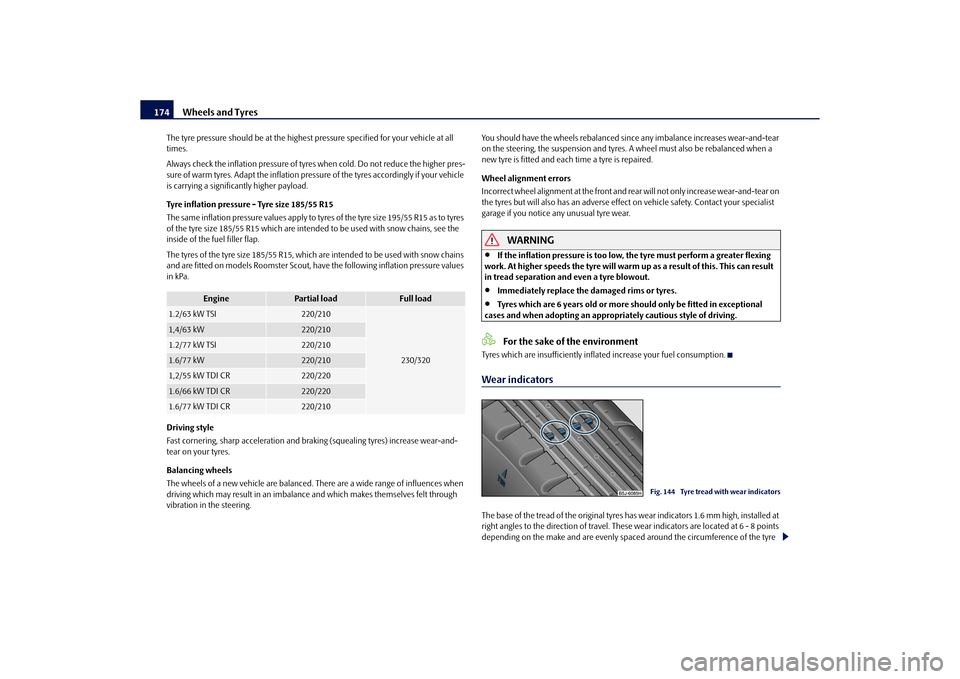
Tyres which are insufficiently inflated increase your fuel consumption.Wear indicatorsThe base of the tread of the original tyres has wear indicators 1.6 mm high, installed at
right angles to the direction of travel. These wear indicators are located at 6 - 8 points
depending on the make and are evenly spaced around the circumference of the tyre
Engine
Partial load
Full load
1.2/63 kW TSI
220/210
230/320
1,4/63 kW
220/210
1.2/77 kW TSI
220/210
1.6/77 kW
220/210
1,2/55 kW TDI CR
220/220
1.6/66 kW TDI CR
220/220
1.6/77 kW TDI CR
220/210
Fig. 144 Tyre tread with wear indicators
s16g.4.book Page 174 Wednesda y, February 10, 2010 3:53 PM
Page 184 of 231
Breakdown assistance183
Using the system
Safety
Driving Tips
General Maintenance
Breakdown assistance
Praktik
Technical Data
Changing a wheelPreliminary workThe following steps should be carried ou t before actually changing the wheel.
– If it is necessary to change a wheel, park the vehicle as far away as possible from
the traffic flow. The place you choose should be level.
– Have all the occupants get out. While changing a wheel, the occupants of the
vehicle should not stand on the road (e.g. behind a crash barrier).
– Apply the handbrake firmly.
–Engage 1st gear or if your vehicle is fitted with an automatic gearbox, position the
selector lever into position P .
– If a trailer is coupled, uncouple it.
– Take the vehicle tool kit and the spare wheel page 181 out of the luggage
compartment.
WARNING
If you find yourself in flowing traffic switch on the hazard warning lights
system and place the warning triangle on the side of the road at the prescribed
distance from your vehicle while observing all national legal provisions. In this
way you are protecting not only yourself but also other road users.
Never start the engine with the vehicle si tting on the raised jack - danger of
suffering injury.Caution
If you have to change a wheel on a slope first block the opposite wheel with a stone or
similar object in order to secure the vehicle from unexpectedly rolling away.
Note
Comply with the national legal regulations.
Always change a wheel on a level surface as far as possible.
– Take off the full wheel trim* page 184 or the caps page 184.
– Slacken the wheel bolts page 185.
– Jack up the vehicle until the wheel to be changed is clear of the ground
page 185.
– Unscrew the wheel bolts and place them on a clean surface (cloth, paper etc.).
– Take off the wheel.
– Fit on the spare wheel* and tighten the wheel bolts slightly.
– Lower the car.
– Tighten the wheel bolts firmly, alternatel y and diagonally using the wrench (cross-
wise) page 185.
– Mount the full wheel trim/wheel trim cap or the caps.
Note
All bolts must be clean and must turn easily.
You must never grease or oil the wheel bolts!
When fitting on unidirectiona l tyres, ensure that the tyres rotate in the correct
direction page 173.
Subsequent stepsAfter changing the wheel, you mu st perform the following steps.
– Stow the vehicle tool kit in the space provided.
– Stow the replaced wheel in the luggage compartment.
– Check the tyre pressure on the spare wheel just mounted as soon as possible.
– Have the tightening torque of the wheel bolts checked with a torque wrench as
soon as possible. Steel and light alloy wheels must be tightened to a tightening
torque of 120 Nm.
s16g.4.book Page 183 Wednesda y, February 10, 2010 3:53 PM
Page 187 of 231
Breakdown assistance
186
Not positioning the lifting jack at the specified points can result in damage
to the vehicle. The jack can also slip off if it does not have sufficient grip - risk of
injury!
Never start the engine if the vehicle is lifted - risk of accident.
Never lie under the vehicle if the vehicle is only lifted with the vehicle lifting
jack.
It is important to support the vehicle with suitable supporting blocks if you
wish to work under the lifted vehicle - risk of injury!
Securing wheels against being stolen*
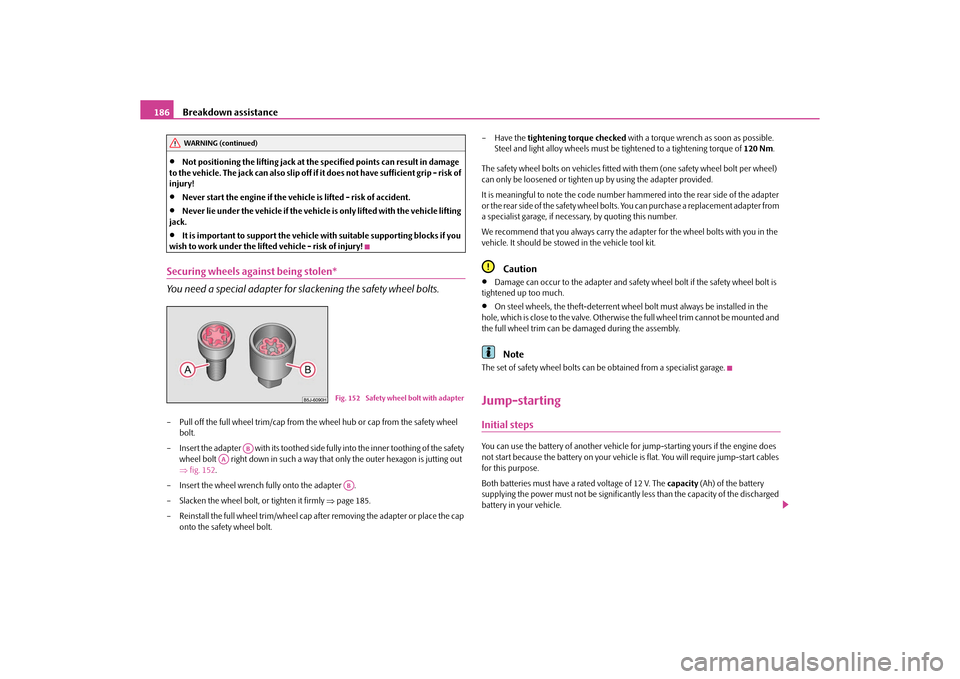
You need a special adapter for sl ackening the safety wheel bolts.– Pull off the full wheel trim/cap from the wheel hub or cap from the safety wheel
bolt.
– Insert the adapter with its toothed side fully into the inner toothing of the safety wheel bolt right down in such a way th at only the outer hexagon is jutting out
fig. 152 .
– Insert the wheel wrench fully onto the adapter .
– Slacken the wheel bolt, or tighten it firmly page 185.
– Reinstall the full wheel trim/wheel cap afte r removing the adapter or place the cap
onto the safety wheel bolt. – Have the
tightening torque checked with a torque wrench as soon as possible.
Steel and light alloy wheels must be tightened to a tightening torque of 120 Nm.
The safety wheel bolts on vehicles fitted with them (one safety wheel bolt per wheel)
can only be loosened or tighten up by using the adapter provided.
It is meaningful to note th e code number hammered into the rear side of the adapter
or the rear side of the safety wheel bolts. You can purchase a replacement adapter from
a specialist garage, if necessary, by quoting this number.
We recommend that you always carry the ad apter for the wheel bolts with you in the
vehicle. It should be stow ed in the vehicle tool kit.
Caution
Damage can occur to the adapter and safety wheel bolt if the safety wheel bolt is
tightened up too much.
On steel wheels, the theft-deterrent wheel bolt must always be installed in the
hole, which is close to the valve. Otherwise the full wheel trim cannot be mounted and
the full wheel trim can be damaged during the assembly.Note
The set of safety wheel bolts can be obtained from a specialist garage.Jump-startingInitial stepsYou can use the battery of another vehicle fo r jump-starting yours if the engine does
not start because the battery on your vehicle is flat. You will require jump-start cables
for this purpose.
Both batteries must have a rated voltage of 12 V. The capacity (Ah) of the battery
supplying the power must not be significantly less than the capacity of the discharged
battery in your vehicle.
WARNING (continued)
Fig. 152 Safety wheel bolt with adapter
AB
AA
AB
s16g.4.book Page 186 Wednesda y, February 10, 2010 3:53 PM
Page 188 of 231
Breakdown assistance187
Using the system
Safety
Driving Tips
General Maintenance
Breakdown assistance
Praktik
Technical Data
Jump-start cables
Only use jump-start cables which have an
adequately large cross-section and insu-
lated terminal clamps. Plea se pay attention to the manufacturer's instructions.
Positive cable - colour coding in the majority of cases red.
Negative cable - colour coding in the majority of cases black.
WARNING
A discharged battery may already freeze at temperatures just below 0°C. In
case of frozen battery carry out no jump-starting - risk of explosion! Also after
thawing of the battery there is a risk of caustic burns due to leaking acid.
Replace the frozen battery.
Please pay attention to the warning instructions relating to working in the
engine compartment page 162.Note
There must not be any contact between the two vehicles otherwise current may
flow as soon as the negati ve terminals are connected.
The discharged battery must be properly connected to the system of the vehicle.
Switch off any installed telephone and also pay attention to the instructions for use
of the telephone in such a situation.
We recommend that you purchase the jump-starting cable in the specialist shops
of the battery manufacturers.
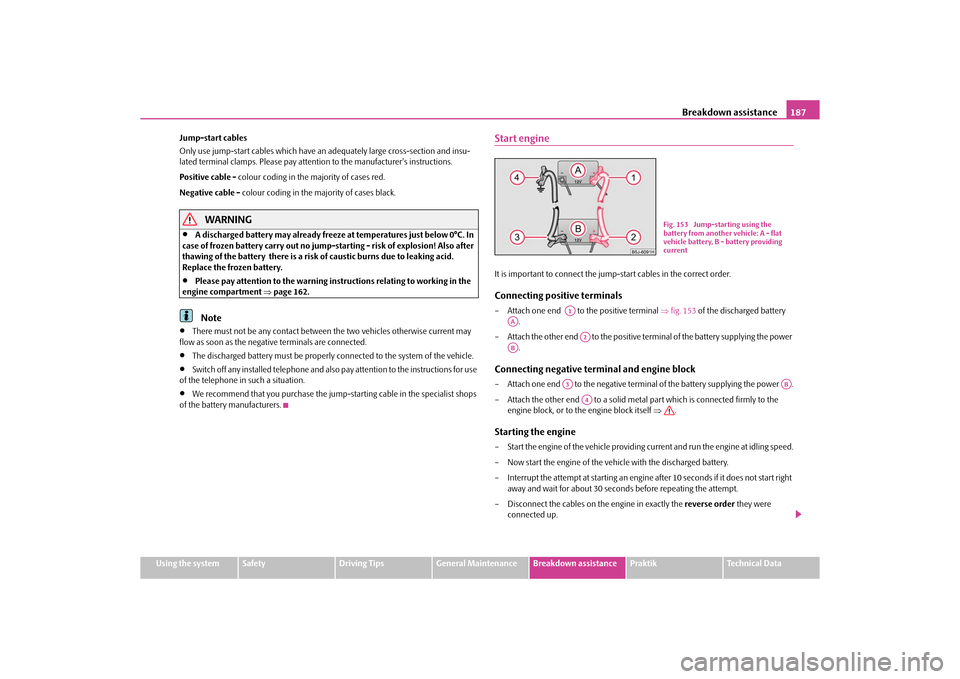
Start engineIt is important to connect the jump-start cables in the correct order.Connecting positive terminals– Attach one end to the positive terminal fig. 153 of the discharged battery
.
– Attach the other end to the positive te rminal of the battery supplying the power
.Connecting negative term inal and engine block– Attach one end to the negative termin al of the battery supplying the power .
– Attach the other end to a solid metal part which is connected firmly to the
engine block, or to the engine block itself .Starting the engine– Start the engine of the vehicle providing current and run the engine at idling speed.
– Now start the engine of the vehicle with the discharged battery.
– Interrupt the attempt at starting an engine after 10 seconds if it does not start right away and wait for about 30 seconds before repeating the attempt.
– Disconnect the cables on the engine in exactly the reverse order they were
connected up.
Fig. 153 Jump-starting using the
battery from another vehicle: A - flat
vehicle battery, B - battery providing
current
A1
AA
A2
AB
A3
AB
A4
s16g.4.book Page 187 Wednesda y, February 10, 2010 3:53 PM
Page 189 of 231
Breakdown assistance
188WARNING
The non-insulated parts of the terminal clamps must never make contact
with each other. Furthermore, the cable connected to the positive terminal of
the battery must not come into contact with electrically conducting parts of the
vehicle - risk of a short circuit!
Do not affix the jump starting cables to the negative terminal of the
discharged battery. There is the risk of detonating gas seeping out the battery
being ignited by the strong spark which results from the engine being started.
Do not affix the cable end to parts of the fuel and brake system.
Run the jump-start cables so that they cannot be caught by any rotating
parts in the engine compartment.
Do not bend over the batteries - risk of caustic burns!
The vent screws of the battery cells must be tightened firmly.
Keep any sources of ignition (naked flame, smouldering cigarettes etc.)
away from the battery - risk of an explosion!
Never jump-start the batteries which have a too low electrolyte level - risk
of explosion and caustic burns!
Tow-starting and towing vehicleGeneralPlease pay attention to the following instru ctions if you are going to use a tow rope:Driver of the towing vehicle– Do not drive off until the tow rope is taught.
– Release the clutch particularly gently when starting off.Driver of the towed vehicle– Switch the ignition on so that the steering wheel is not blocked and you can also operate the turn signal lights, the headlight flasher, the windscreen wipers and
windscreen washer system. – Take the vehicle out of gear or move the selector lever into position
N if your
vehicle is fitted with an automatic gearbox.
– Note that the brake servo unit and power steering only operate if the engine is running. You will require significantly greater physical force to depress the brake
pedal and to steer the vehicle if the engine is not running.
– Ensure that the tow rope is always kept taught.
Tow rope or tow bar
A tow bar is safest way of towing a vehicle and also minimizes any shocks. You can use
a tow rope only if a suitable tow bar is not available.
The tow rope must be elastic to protect the vehicle. Thus one should only use plastic
fibre rope or a rope made out of a similarly elastic material.
Attach the tow rope or the tow bar only to the towing eyes provided for this purpose
page 189, “Front towing eye” and page 189, “Rear towing eye”.
Driving style
Towing another vehicle requires a certain am ount of practice. Both drivers should be
familiar with the particular points about to wing a vehicle. Unskilled drivers should not
attempt to tow in another vehicle or to be towed in.
One should be constantly vigilant not to allow impermissibly high towing forces or
jerky loadings. There is always a risk of excessive stresses and damage resulting at the
points to which you attach the tow rope or tow bar when you attempt to tow a vehicle
which is not standing on a paved road.
Caution
If the gearbox of your vehicle no longer contains any oil because of a defect, your
vehicle must only be towed in with the driven wheels raised clear of the ground, or on
a special vehicle transporter or trailer.
Note
Please comply with any national legal provisions particularly regarding the
switched on signal systems, when towi ng in or tow-starting another vehicle.
The tow rope must not be twisted as it may in certain circumstances result in the
front towing eye being unscrewed out of your vehicle.
A4
s16g.4.book Page 188 Wednesda y, February 10, 2010 3:53 PM
Page 190 of 231
Breakdown assistance189
Using the system
Safety
Driving Tips
General Maintenance
Breakdown assistance
Praktik
Technical Data
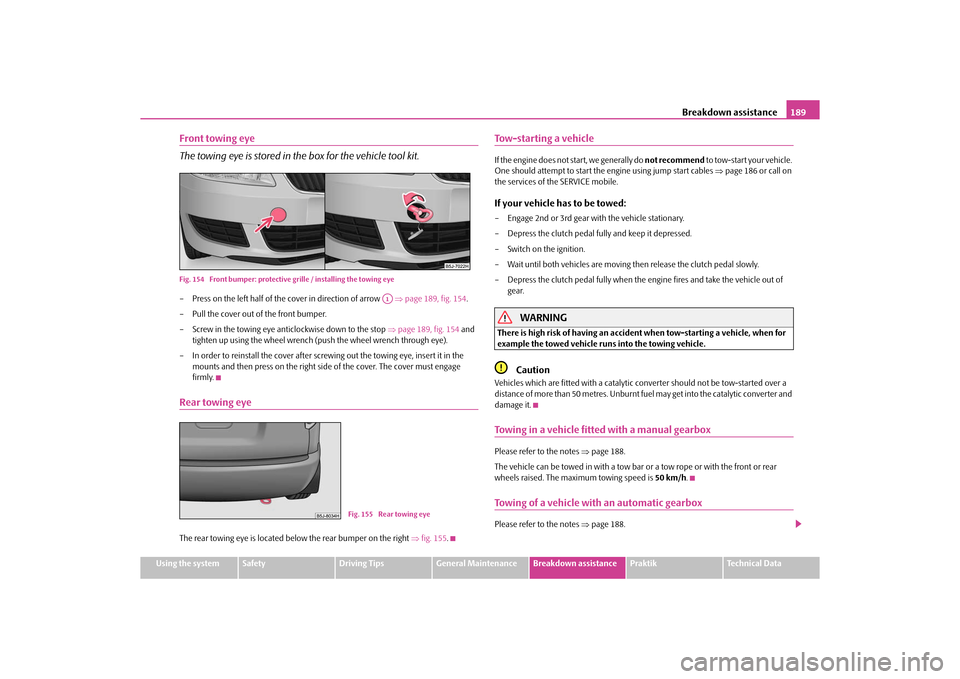
Front towing eye
The towing eye is stored in the box for the vehicle tool kit.Fig. 154 Front bumper: protective gr ille / installing the towing eye– Press on the left half of the cover in direction of arrow page 189, fig. 154 .
– Pull the cover out of the front bumper.
– Screw in the towing eye anticlockwise down to the stop page 189, fig. 154 and
tighten up using the wheel wrench (push the wheel wrench through eye).
– In order to reinstall the cover after screwing out the towing eye, insert it in the mounts and then press on the right side of the cover. The cover must engage
firmly.Rear towing eyeThe rear towing eye is located be low the rear bumper on the right fig. 155 .
Tow-starting a vehicleIf the engine does not start, we generally do not recommend to tow-start your vehicle.
One should attempt to start the engine using jump start cables page 186 or call on
the services of the SERVICE mobile.If your vehicle has to be towed:– Engage 2nd or 3rd gear with the vehicle stationary.
– Depress the clutch pedal fu lly and keep it depressed.
– Switch on the ignition.
– Wait until both vehicles are moving then release the clutch pedal slowly.
– Depress the clutch pedal fully when the engine fires and take the vehicle out of
gear.
WARNING
There is high risk of having an accident when tow-starting a vehicle, when for
example the towed vehicle runs into the towing vehicle.
Caution
Vehicles which are fitted with a catalytic converter should not be tow-started over a
distance of more than 50 metres. Unburnt fuel may get into the catalytic converter and
damage it.Towing in a vehicle fitted with a manual gearboxPlease refer to the notes page 188.
The vehicle can be towed in with a tow bar or a tow rope or with the front or rear
wheels raised. The maximum towing speed is 50 km/h.Towing of a vehicle with an automatic gearboxPlease refer to the notes page 188.
A1
Fig. 155 Rear towing eye
s16g.4.book Page 189 Wednesda y, February 10, 2010 3:53 PM
Page 191 of 231
Breakdown assistance
190
The car can be towed in with a tow bar or a tow rope. Refer at the same time to the
following guidelines:
Move selector lever into N .
The maximum towing speed is 50 km/h.
The maximum permissible towing distance is 50 km. The gear oil pump does not
operate when the engine is not running; th e gearbox would not be adequately lubri-
cated at higher speeds and ov er longer towing distance.Caution
If the vehicle is towed in by a recovery vehicle, it should only be towed in with the front
wheels raised. If the vehicle is raised at rear, the automatic gearbox is damaged!
Note
The vehicle must be transported on a special vehi cle or trailer if it is not possible to tow
in the vehicle in the way described or if the towing distance is greater than 50 km.s16g.4.book Page 190 Wednesday, February 10, 2010 3:53 PM
Page 193 of 231
Fuses and light bulbs
192
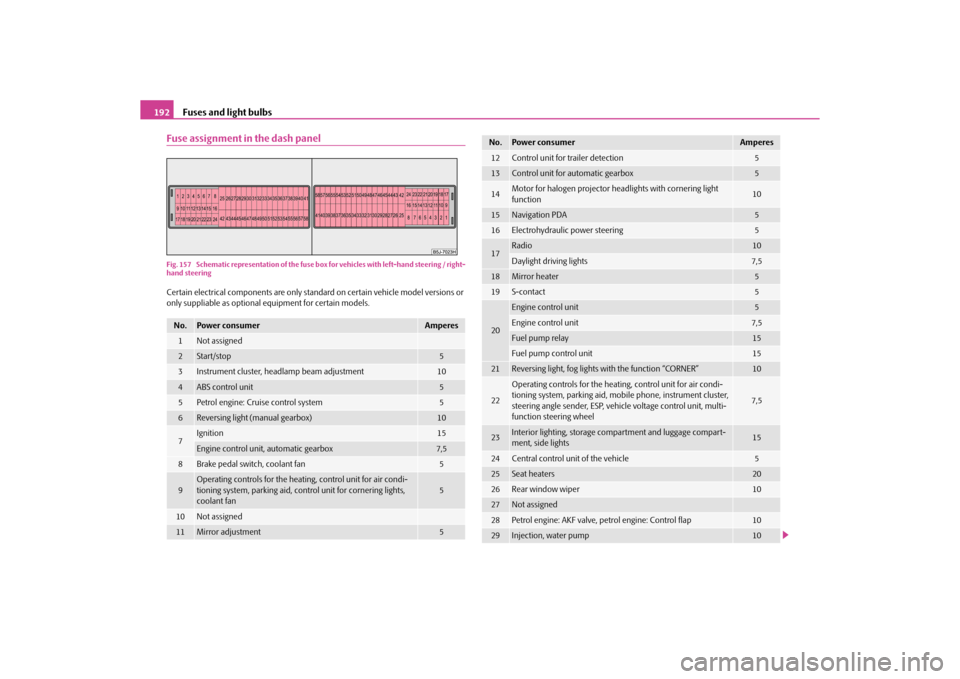
Fuse assignment in the dash panelFig. 157 Schematic representation of the fuse box for vehicles with left-hand steering / right-
hand steeringCertain electrical components are only standard on certain vehicle model versions or
only suppliable as optional equipment for certain models.No.
Power consumer
Amperes
1
Not assigned
2
Start/stop
5
3
Instrument cluster, headlamp beam adjustment
10
4
ABS control unit
5
5
Petrol engine: Cruise control system
5
6
Reversing light (manual gearbox)
10
7
Ignition
15
Engine control unit, automatic gearbox
7,5
8
Brake pedal switch, coolant fan
5
9
Operating controls for the heating, control unit for air condi-
tioning system, parking aid, control unit for cornering lights,
coolant fan
5
10
Not assigned
11
Mirror adjustment
5
12
Control unit for trailer detection
5
13
Control unit for automatic gearbox
5
14
Motor for halogen projector headlights with cornering light
function
10
15
Navigation PDA
5
16
Electrohydraulic power steering
5
17
Radio
10
Daylight driving lights
7,5
18
Mirror heater
5
19
S-contact
5
20
Engine control unit
5
Engine control unit
7,5
Fuel pump relay
15
Fuel pump control unit
15
21
Reversing light, fog lights with the function “CORNER”
10
22
Operating controls for the heating, control unit for air condi-
tioning system, parking aid, mobi le phone, instrument cluster,
steering angle sender , ESP, vehicle voltage control unit, multi-
function steering wheel
7,5
23
Interior lighting, storage compartment and luggage compart-
ment, side lights
15
24
Central control unit of the vehicle
5
25
Seat heaters
20
26
Rear window wiper
10
27
Not assigned
28
Petrol engine: AKF valve, petrol engine: Control flap
10
29
Injection, water pump
10
No.
Power consumer
Amperes
s16g.4.book Page 192 Wednesda y, February 10, 2010 3:53 PM
Page 194 of 231
Fuses and light bulbs193
Using the system
Safety
Driving Tips
General Maintenance
Breakdown assistance
Praktik
Technical Data
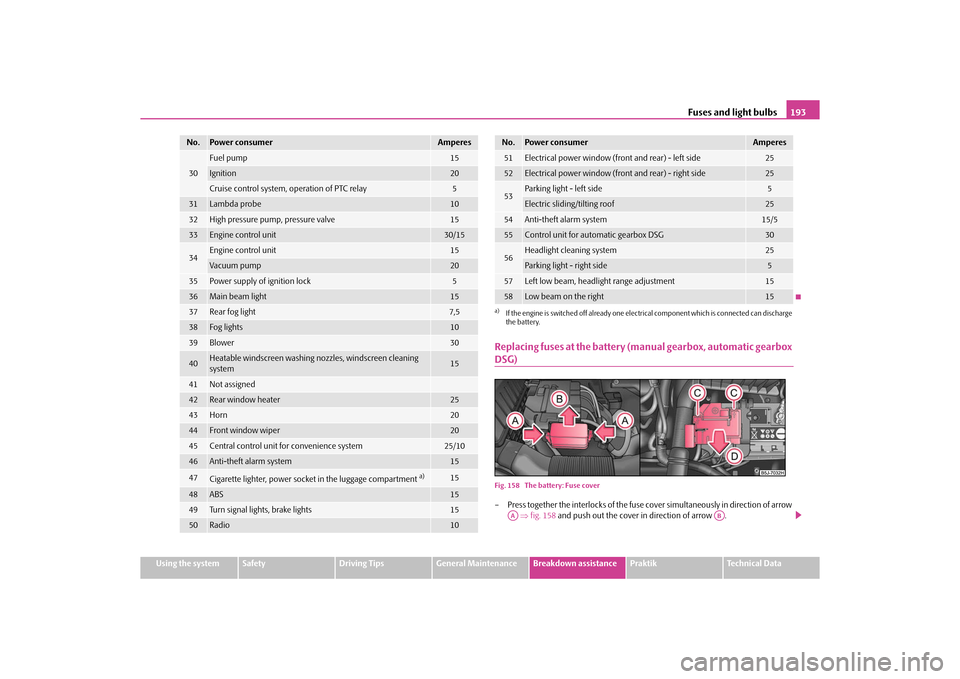
Replacing fuses at the battery (manual gearbox, automatic gearbox DSG)Fig. 158 The battery: Fuse cover– Press together the interlocks of the fuse cover simultaneously in direction of arrow
fig. 158 and push out the cover in direction of arrow .
30
Fuel pump
15
Ignition
20
Cruise control system, operation of PTC relay
5
31
Lambda probe
10
32
High pressure pump, pressure valve
15
33
Engine control unit
30/15
34
Engine control unit
15
Vacuum pump
20
35
Power supply of ignition lock
5
36
Main beam light
15
37
Rear fog light
7,5
38
Fog lights
10
39
Blower
30
40
Heatable windscreen washing nozzles, windscreen cleaning
system
15
41
Not assigned
42
Rear window heater
25
43
Horn
20
44
Front window wiper
20
45
Central control unit fo r convenience system
25/10
46
Anti-theft alarm system
15
47
Cigarette lighter, power socket in the luggage compartment
a)
15
48
ABS
15
49
Turn signal lights, brake lights
15
50
Radio
10
No.
Power consumer
Amperes
51
Electrical power window (front and rear) - left side
25
52
Electrical power window (front and rear) - right side
25
53
Parking light - left side
5
Electric sliding/tilting roof
25
54
Anti-theft alarm system
15/5
55
Control unit for automatic gearbox DSG
30
56
Headlight cleaning system
25
Parking light - right side
5
57
Left low beam, headlight range adjustment
15
58
Low beam on the right
15
a)If the engine is switched off already one electr ical component which is connected can discharge
the battery.No.
Power consumer
Amperes
AA
AB
s16g.4.book Page 193 Wednesda y, February 10, 2010 3:53 PM
Page 197 of 231
Fuses and light bulbs
196Caution
Observe the following guidelines in “Replace fuses at the battery (automatic
gearbox)”.BulbsReplacing bulbsThe relevant lamp must always be switch ed off before a light bulb is replaced.
Do not take hold of the glass bulb with naked fingers (even the smallest amount of dirt
reduces the working life of the light bulb). Use a clean cloth, serviette or something
similar.
Defect light bulbs should only be replaced with light bulbs of the same type. The desig-
nation is located on the ligh t socket or the glass bulb.
Changing certain bulbs is not something whic h you can do yourself, but requires to be
done by a specialist. Other parts of the vehicle must be removed in order to change the
light bulbs. This applies, in particular, to bulbs which can only be reached from the
engine compartment.
We therefore recommend that you have any bulbs changed by a specialist garage or,
in exceptional cases, by calling on other professional assistance.
Please note that the engine compartment is a hazardous area page 162, “Working
in the engine compartment”.
We recommend that you always have a small box of replacement bulbs in your vehicle.
You can obtain replacement bulbs from Škoda original accessories or from a specialist
garage
16).
A stowage place for the bulbs is located in the box in the spare wheel.
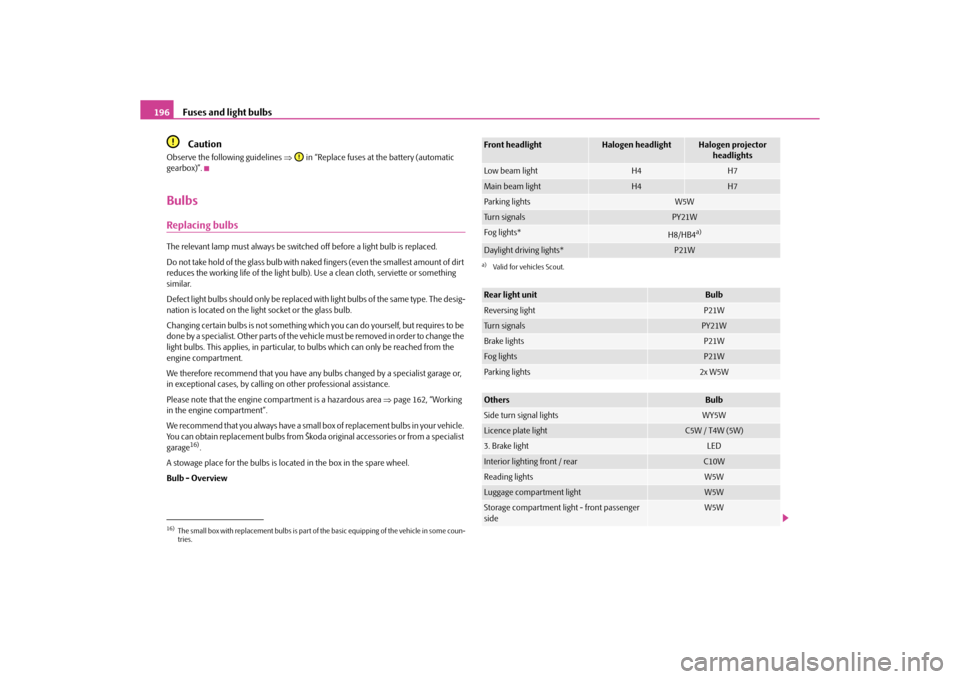
Bulb - Overview
16)The small box with replacement bulbs is part of the basic equipping of the vehicle in some coun-
tries.
Front headlight
Halogen headlight
Halogen projector
headlights
Low beam light
H4
H7
Main beam light
H4
H7
Parking lights
W5W
Turn signals
PY21W
Fog lights*
H8/HB4
a)
a)Valid for vehicles Scout.Daylight driving lights*
P21W
Rear light unit
Bulb
Reversing light
P21W
Turn signals
PY21W
Brake lights
P21W
Fog lights
P21W
Parking lights
2x W5W
Others
Bulb
Side turn signal lights
WY5W
Licence plate light
C5W / T4W (5W)
3. Brake light
LED
Interior lighting front / rear
C10W
Reading lights
W5W
Luggage compartment light
W5W
Storage compartment light - front passenger
side
W5W
s16g.4.book Page 196 Wednesda y, February 10, 2010 3:53 PM