open bonnet SKODA ROOMSTER 2012 1.G User Guide
[x] Cancel search | Manufacturer: SKODA, Model Year: 2012, Model line: ROOMSTER, Model: SKODA ROOMSTER 2012 1.GPages: 194, PDF Size: 4.8 MB
Page 143 of 194

Checking the coolant level
Fig. 117
Engine compartment: Coolant
expansion reservoir
First read and observe the introductory information and safety warn-
ings on page 136.
The coolant expansion bottle is located in the engine compartment.
› Switch off the engine.
› Open the bonnet
» page 138.
› Check the level of coolant in the coolant expansion bottle
» Fig. 117. The coolant
level when the engine is cold must lie between the B
(MIN) and A
(MAX) mark-
ings. The level may also rise slightly above the A
(MAX) marking when the en-
gine is warm.
If the coolant level in the coolant expansion tank is too low, this is indicated by
the warning light lighting up in the instrument cluster » page 19, Coolant tem-
perature/coolant level . We still recommend inspecting the coolant level di-
rectly at the reservoir from time to time.
Loss of coolant
A loss of coolant is first and foremost an indication of a leak in the system. Do
not merely top up the coolant. Have the cooling system checked by a
ŠKODA spe-
cialist garage immediately. CAUTION
If a fault causes the engine to overheat, we recommend visiting a ŠKODA Service
Partner immediately, otherwise serious engine damage may occur. Ð
ä Replenishing the coolant
First read and observe the introductory information and safety warn-
ings on page 136.
›
Switch off the engine.
› Allow the engine to cool.
› Place a cloth over the cap of the coolant expansion reservoir
» Fig. 117 on
page 141 and unscrew the cap carefully.
› Replenish the coolant.
› Turn the cap until it clicks into place.
Do not use an alternative additive if the specified coolant is not available in an
emergency. In this case, just use water and have the correct mixing ratio of water
and the coolant additive restored by a ŠKODA
specialist garage as soon as possi-
ble.
Only use new coolant to top up the system.
Do not fill the coolant above the mark A
(max.)
» Fig. 117 on page 141! Excess
coolant heats up and then is forced out of the cooling system through the pres-
sure relief valve in the cap. WARNING
■ The coolant additive and thus all of the coolant is harmful to your health.
Avoid contact with the coolant. Coolant vapours are also harmful to health.
Therefore always safely store the coolant additive in its original container out
of the reach of children - risk of poisoning!
■ If any coolant splashes into your eyes, immediately rinse out your eyes with
clear water and contact a doctor as soon as possible.
■ You should also consult a doctor without delay if you have inadvertently
swallowed coolant. CAUTION
Do not continue your journey, if it is not possible to top up the coolant under
the prevailing conditions . Contact a
ŠKODA Service Partner to avoid the risk of
serious engine. Ð
ä
141
Inspecting and replenishing
Page 144 of 194
Radiator fan
First read and observe the introductory information and safety warn-
ings on page 136.
The radiator fan is driven by an electric motor and controlled according to the
coolant temperature.
After switching off the ignition, the radiator fan can intermittently continue to op-
erate for approx. 10 minutes. ÐChecking the brake fluid
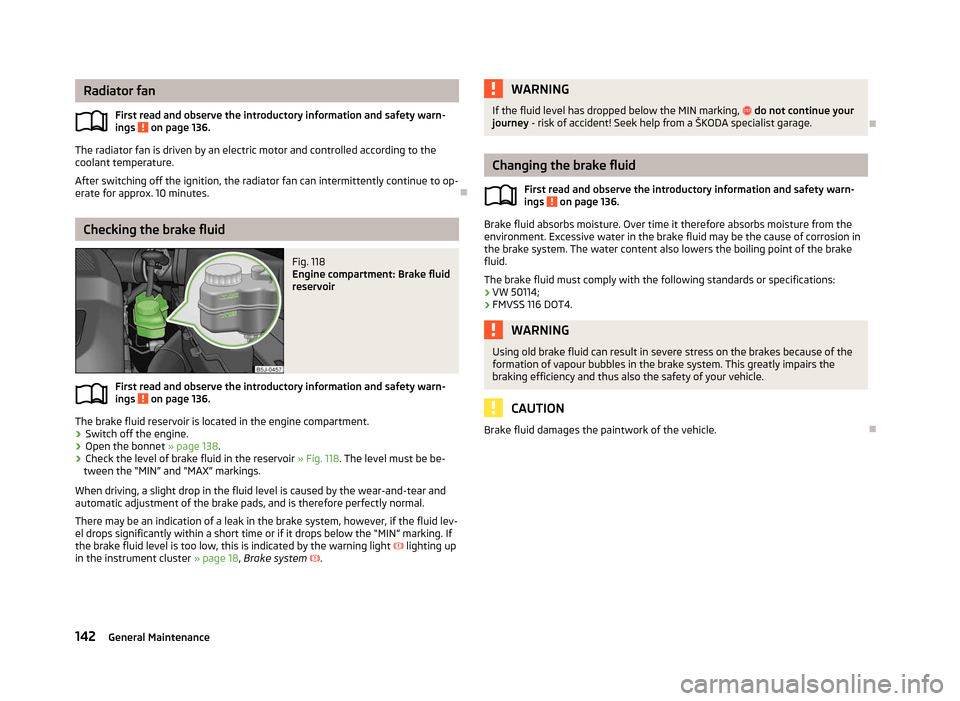
Fig. 118
Engine compartment: Brake fluid
reservoir
First read and observe the introductory information and safety warn-
ings on page 136.
The brake fluid reservoir is located in the engine compartment.
› Switch off the engine.
› Open the bonnet
» page 138.
› Check the level of brake fluid in the reservoir
» Fig. 118. The level must be be-
tween the “MIN” and “MAX” markings.
When driving, a slight drop in the fluid level is caused by the wear-and-tear and
automatic adjustment of the brake pads, and is therefore perfectly normal.
There may be an indication of a leak in the brake system, however, if the fluid lev-
el drops significantly within a short time or if it drops below the “MIN” marking. If
the brake fluid level is too low, this is indicated by the warning light lighting up
in the instrument cluster » page 18, Brake system .
ä
ä WARNING
If the fluid level has dropped below the MIN marking, do not continue your
journey - risk of accident! Seek help from a
ŠKODA specialist garage.Ð Changing the brake fluid
First read and observe the introductory information and safety warn-
ings on page 136.
Brake fluid absorbs moisture. Over time it therefore absorbs moisture from the
environment. Excessive water in the brake fluid may be the cause of corrosion in
the brake system. The water content also lowers the boiling point of the brake
fluid.
The brake fluid must comply with the following standards or specifications:
› VW 50114;
› FMVSS 116 DOT4. WARNING
Using old brake fluid can result in severe stress on the brakes because of the
formation of vapour bubbles in the brake system. This greatly impairs the
braking efficiency and thus also the safety of your vehicle. CAUTION
Brake fluid damages the paintwork of the vehicle. Ð
ä
142 General Maintenance
Page 186 of 194

Index
A
ABS 81
Warning light 21
Accessories 155
Adjusting Exterior mirror 45
Adjusting seats 101
Adjustment Seat 47
Aerial 128
see Radio reception 130
Airbag 109
Deployment 109
Front airbag 110
Head airbag 112
Side airbag 111
Airbag system 109
Air conditioning system Air outlet vents 68
Climatronic 73
Manual air conditioning system 70
Alarm 30
Anti-theft alarm system 30
Antilock brake system 81
Armrest 64
Ashtray 60
Assistance systems ESC 80
Assist systems ABS 21, 81
Cruise control systems (CCS) 83
EDL 81
ESC 20
Parking aid 82
START/STOP 85
TCS 21, 81Auto Check Control 16
Automatic gearbox 87
Dynamic shift programme 90
Emergency programme 90
Information for driving 87
Kickdown 90
Manual shifting of gears 89
Parking 88
Selector lever-emergency unlocking 91
Selector lever lock 89
Selector lever positions 88
Starting off 88
Stopping 88
Tiptronic 89
Automatic load deactivation 147
AUX-IN 99
Avoiding damage to your vehicle 123
B
Before setting off 100
Belts 104
Belt tensioners 107
Bicycle carrier 56
Bonnet Closing 138
Opening 138
Boot Class
N1 vehicles 52
Cover 53
Emergency unlocking 33
Fastening elements 52
Fixing nets 53
Folding hooks 53
Light 41
see Boot lid 32
Unlocking the boot lid 33
Variable loading floor 55
Boot lid 32
Automatic locking 32
Brake assist 80Brake booster 80
Brake fluid Checking 142
Brakes Brake booster 80
Handbrake 80
Running in 119
Warning light 18
Braking Brake fluid 142
Breakdown kit 160
Bulbs Replacing 169
Button in the driver's door Electrical power windows 33
C
Car computer see Multifunction display 12
Car jack 156
Carrier 58
Catalytic converter 119
Central locking button 28
Central locking system 27
lock 28
unlock 28
Changes 155
Changing Engine oil 140
Wheel 157
Charging a vehicle battery 146
Checking Battery electrolyte level 145
Brake fluid 142
Coolant level 141
Engine oil 139
Oil level 139
Windscreen washer fluid 143
Children and safety 115
184 Index