weight SKODA ROOMSTER 2012 1.G Owner's Manual
[x] Cancel search | Manufacturer: SKODA, Model Year: 2012, Model line: ROOMSTER, Model: SKODA ROOMSTER 2012 1.GPages: 194, PDF Size: 4.8 MB
Page 53 of 194
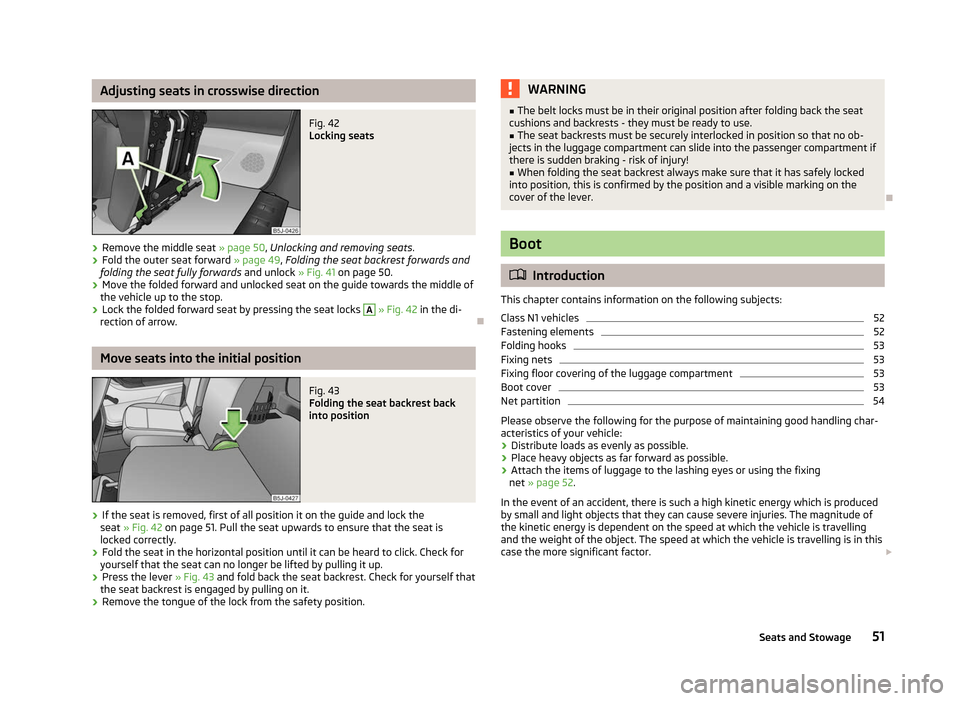
Adjusting seats in crosswise direction
Fig. 42
Locking seats
› Remove the middle seat
» page 50, Unlocking and removing seats .
› Fold the outer seat forward
» page 49, Folding the seat backrest forwards and
folding the seat fully forwards and unlock » Fig. 41 on page 50.
› Move the folded forward and unlocked seat on the guide towards the middle of
the vehicle up to the stop.
› Lock the folded forward seat by pressing the seat locks A
» Fig. 42 in the di-
rection of arrow. ÐMove seats into the initial position
Fig. 43
Folding the seat backrest back
into position
› If the seat is removed, first of all position it on the guide and lock the
seat » Fig. 42 on page 51. Pull the seat upwards to ensure that the seat is
locked correctly.
› Fold the seat in the horizontal position until it can be heard to click. Check for
yourself that the seat can no longer be lifted by pulling it up.
› Press the lever
» Fig. 43 and fold back the seat backrest. Check for yourself that
the seat backrest is engaged by pulling on it.
› Remove the tongue of the lock from the safety position. WARNING
■ The belt locks must be in their original position after folding back the seat
cushions and backrests - they must be ready to use.
■ The seat backrests must be securely interlocked in position so that no ob-
jects in the luggage compartment can slide into the passenger compartment if
there is sudden braking - risk of injury! ■ When folding the seat backrest always make sure that it has safely locked
into position, this is confirmed by the position and a visible marking on the
cover of the lever. Ð Boot
ä
Introduction
This chapter contains information on the following subjects:
Class
N1 vehicles 52
Fastening elements 52
Folding hooks 53
Fixing nets 53
Fixing floor covering of the luggage compartment 53
Boot cover 53
Net partition 54
Please observe the following for the purpose of maintaining good handling char-
acteristics of your vehicle:
› Distribute loads as evenly as possible.
› Place heavy objects as far forward as possible.
› Attach the items of luggage to the lashing eyes or using the fixing
net »
page 52 .
In the event of an accident, there is such a high kinetic energy which is produced
by small and light objects that they can cause severe injuries. The magnitude of
the kinetic energy is dependent on the speed at which the vehicle is travelling
and the weight of the object. The speed at which the vehicle is travelling is in this
case the more significant factor. £
51
Seats and Stowage
Page 54 of 194

Example: In the event of a frontal collision at a speed of 50 km/h, an unsecured
object with a weight of 4.5 kg produces an energy, which corresponds to 20 times
its own weight. This means that it results in a weight of approx. 90 kg
“ ”. You can
imagine the injuries that can occur, if this “object” flies through the interior com-
partment and hits an occupant. WARNING
■ Store the objects in the boot and attach them to the lashing eyes.
■ Loose objects in the passenger compartment can be thrown forward during
a sudden manoeuvre or in case of an accident and can injure the occupants or
other oncoming traffic. This risk is still increased, if the objects which are fly-
ing around are hit by a deployed airbag. In this case, the objects which are
thrown back can injure the occupants - hazard. ■ Please note that the handling properties of the vehicle may be affected
when transporting heavy objects as the centre of gravity can be displaced -
risk of accident! The speed and style of driving must be adjusted accordingly.
■ If the items of luggage or objects are attached to the lashing eyes with un-
suitable or damaged lashing straps, injuries can occur in the event of braking
manoeuvres or accidents. To prevent items of luggage from being thrown for-
ward, always use suitable lashing straps which must be firmly attached to the
lashing eyes. ■ The items carried in the boot must be stored in such a way that no objects
are able to slip forward if any sudden driving or braking manoeuvres are un-
dertaken - risk of injury!
■ When transporting fastened objects which are sharp and dangerous in the
boot that has been enlarged by folding the rear seats forward, ensure the
safety of the passengers transported on the other rear seats » page 102, Cor-
rect seated position for the occupants on the rear seats .
■ If the rear seat next to the folded forward seat is occupied, ensure maxi-
mum safety, e.g. by placing the goods to be transported in such a way that the
seat is prevented from folding back in case of a rear collision.
■ Never drive with the boot lid fully opened or slightly ajar otherwise exhaust
gases may get into the interior of the vehicle - risk of poisoning!
■ Under no circumstances, should the permissible axle loads and permissible
gross weight of the vehicle be exceeded - risk of accident!
■ Never transport people in the boot! CAUTION
Please ensure that the heating elements for the rear window heater are not dam-
aged as a result of abrasive objects. Note
Tyre pressure must be adjusted to the load »
page 149, Service life of tyres. Ð Class N1 vehicles
First read and observe the introductory information and safety warn-
ings on page 51.
On class N1 vehicles, which are not fitted with a protective grille, a lashing set
which complies with the standard EN
12195 (1 - 4) must be used for fastening the
load. Ð Fastening elements
Fig. 44
Boot: Lashing eyes and fasten-
ing elements
First read and observe the introductory information and safety warn-
ings on page 51.
The boot provides the following fastening elements
»
Fig. 44.
Lashing eyes for fastening items of luggage and fixing nets.
Fastening elements for fastening fixing nets. CAUTION
The maximum permissible load of the lashing eyes is 3.5 kN (350 kg). Ð
ä
ä
A
B
52
Using the system
Page 56 of 194
›
Unhook the support straps 1
» Fig. 47.
› Fold the luggage compartment cover forwards a little.
› Remove the cover from the holders 2
by pulling towards the rear, or by lightly
knocking on the underside of the cover in the area between the holders.
› To reinstall, first of all push the luggage compartment cover into the holders 2
and then hook the support straps 1
on the boot lid.
The luggage compartment cover can also be put into the lower position on the
supporting elements » Fig. 47 - .
The procedure of installing or removing is identical.
In this position you can store smaller objects up on the luggage compartment
cover up to a total weight of 2.5 kg. WARNING
No objects should be placed on the boot cover, the vehicle occupants could be
endangered if there is sudden braking or the vehicle collides with something. CAUTION
Please ensure that the heating elements for the rear window heater are not dam-
aged as a result of objects placed in this area. Note
When opening the boot lid, the luggage compartment cover is lifted up at the
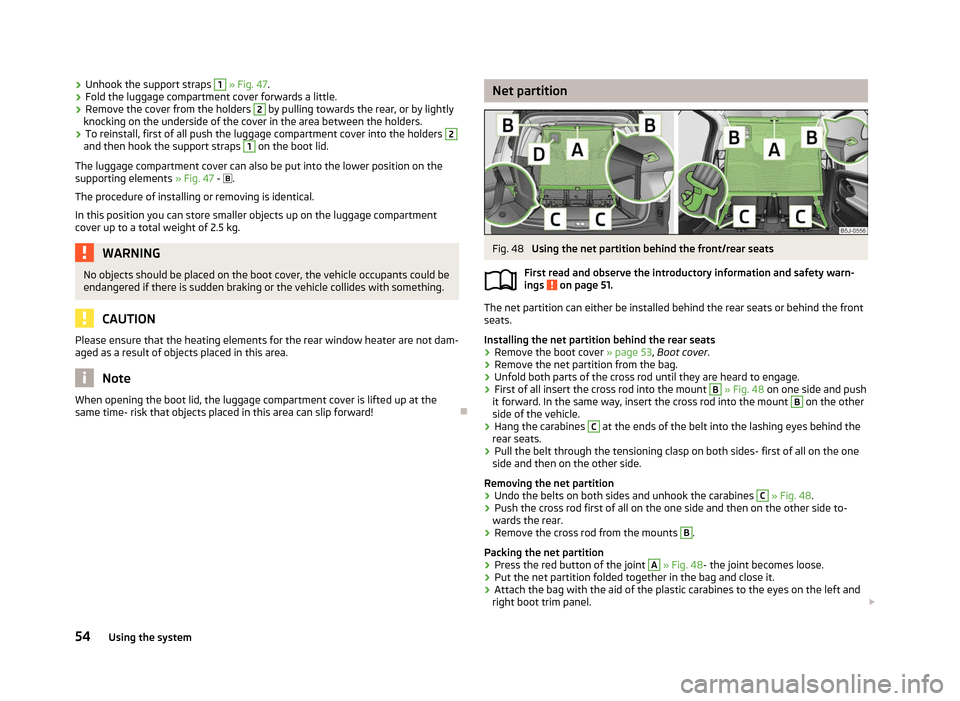
same time- risk that objects placed in this area can slip forward! Ð Net partition
Fig. 48
Using the net partition behind the front/rear seats
First read and observe the introductory information and safety warn-
ings on page 51.
The net partition can either be installed behind the rear seats or behind the front
seats.
Installing the net partition behind the rear seats
›
Remove the boot cover » page 53, Boot cover.
› Remove the net partition from the bag.
› Unfold both parts of the cross rod until they are heard to engage.
› First of all insert the cross rod into the mount B
» Fig. 48
on one side and push
it forward. In the same way, insert the cross rod into the mount B
on the other
side of the vehicle.
› Hang the carabines C
at the ends of the belt into the lashing eyes behind the
rear seats.
› Pull the belt through the tensioning clasp on both sides- first of all on the one
side and then on the other side.
Removing the net partition
› Undo the belts on both sides and unhook the carabines C
» Fig. 48.
› Push the cross rod first of all on the one side and then on the other side to-
wards the rear.
› Remove the cross rod from the mounts B
.
Packing the net partition
› Press the red button of the joint A
» Fig. 48
- the joint becomes loose.
› Put the net partition folded together in the bag and close it.
› Attach the bag with the aid of the plastic carabines to the eyes on the left and
right boot trim panel. £
ä
54 Using the system
Page 60 of 194
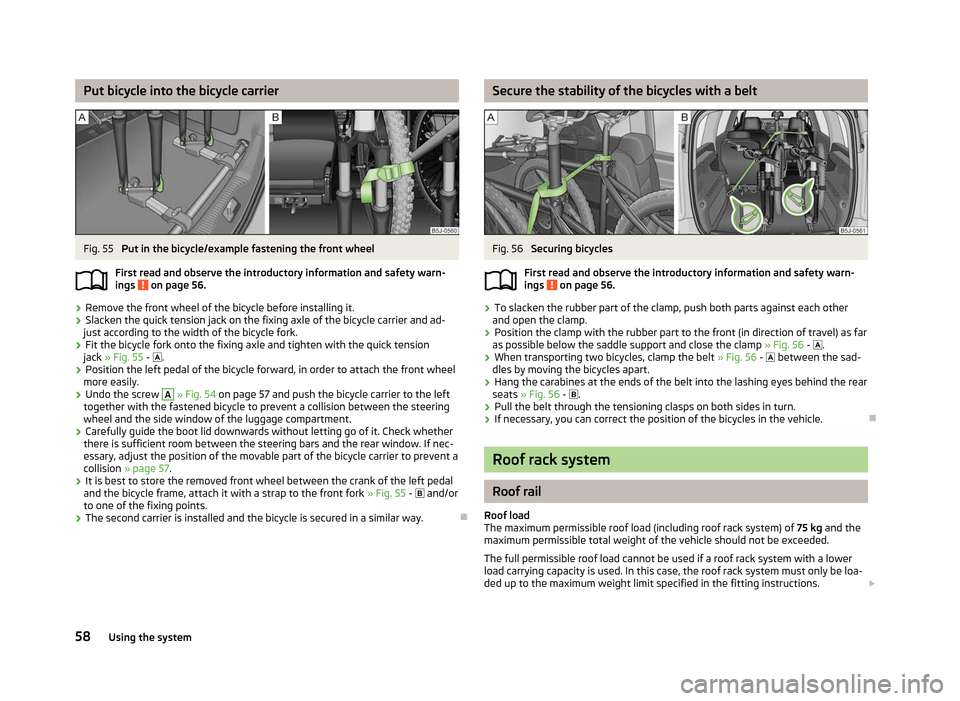
Put bicycle into the bicycle carrier
Fig. 55
Put in the bicycle/example fastening the front wheel
First read and observe the introductory information and safety warn-
ings on page 56.
›
Remove the front wheel of the bicycle before installing it.
› Slacken the quick tension jack on the fixing axle of the bicycle carrier and ad-
just according to the width of the bicycle fork.
› Fit the bicycle fork onto the fixing axle and tighten with the quick tension
jack »
Fig. 55 - .
› Position the left pedal of the bicycle forward, in order to attach the front wheel
more easily.
› Undo the screw A
» Fig. 54 on page 57
and push the bicycle carrier to the left
together with the fastened bicycle to prevent a collision between the steering
wheel and the side window of the luggage compartment.
› Carefully guide the boot lid downwards without letting go of it. Check whether
there is sufficient room between the steering bars and the rear window. If nec-
essary, adjust the position of the movable part of the bicycle carrier to prevent a
collision » page 57 .
› It is best to store the removed front wheel between the crank of the left pedal
and the bicycle frame, attach it with a strap to the front fork » Fig. 55 - and/or
to one of the fixing points.
› The second carrier is installed and the bicycle is secured in a similar way. Ð
ä Secure the stability of the bicycles with a belt
Fig. 56
Securing bicycles
First read and observe the introductory information and safety warn-
ings on page 56.
›
To slacken the rubber part of the clamp, push both parts against each other
and open the clamp.
› Position the clamp with the rubber part to the front (in direction of travel) as far
as possible below the saddle support and close the clamp » Fig. 56
- .
› When transporting two bicycles, clamp the belt
» Fig. 56 - between the sad-
dles by moving the bicycles apart.
› Hang the carabines at the ends of the belt into the lashing eyes behind the rear
seats » Fig. 56 - .
› Pull the belt through the tensioning clasps on both sides in turn.
› If necessary, you can correct the position of the bicycles in the vehicle. Ð Roof rack system
Roof rail
Roof load
The maximum permissible roof load (including roof rack system) of 75 kg and the
maximum permissible total weight of the vehicle should not be exceeded.
The full permissible roof load cannot be used if a roof rack system with a lower
load carrying capacity is used. In this case, the roof rack system must only be loa-
ded up to the maximum weight limit specified in the fitting instructions. £
ä
58 Using the system
Page 61 of 194
WARNING
■ The items which you transport on the roof bar system must be reliably at-
tached - risk of accident!
■ Always secure the load with appropriate and undamaged lashing straps or
tensioning straps. ■ Distribute the load evenly over the roof rack system.
■ The handling properties of your vehicle change when you transport heavy or
bulky items on the roof bar system as a result of the displacement of the cen-
tre of gravity and the increased wind attack area - risk of accident! The style
of driving and speed must therefore be adapted to the current circumstances. ■ Avoid abrupt and sudden driving/braking manoeuvres.
■ Adjust the speed and driving style to the visibility, weather, road and traffic
conditions. ■ The permissible roof load, permissible axle loads and gross permissible
weight of your vehicle must not be exceeded under any circumstances - risk
of accident! CAUTION
■ Only use roof rack systems approved by ŠKODA.
■ If other roof rack systems are used or if the roof bars are not fitted correctly,
any resulting damage to the vehicle is not covered by the warranty. It is therefore
essential that the supplied fitting instructions for the roof rack system are ob-
served.
■ Ensure that the boot lid does not hit the roof load when opened.
■ The height of the vehicle changes after mounting a roof luggage rack system
and the load that is secured to it. Compare the vehicle height with available clear-
ances, such as underpasses and garage doors. ■ Always remove the roof luggage rack system before entering an automated car
wash.
■ Ensure the roof aerial is not impaired by the secured load. For the sake of the environment
The increased aerodynamic drag results in a higher fuel consumption. Note
If the vehicle is not factory-equipped with a roof rack, it can be purchased from
the
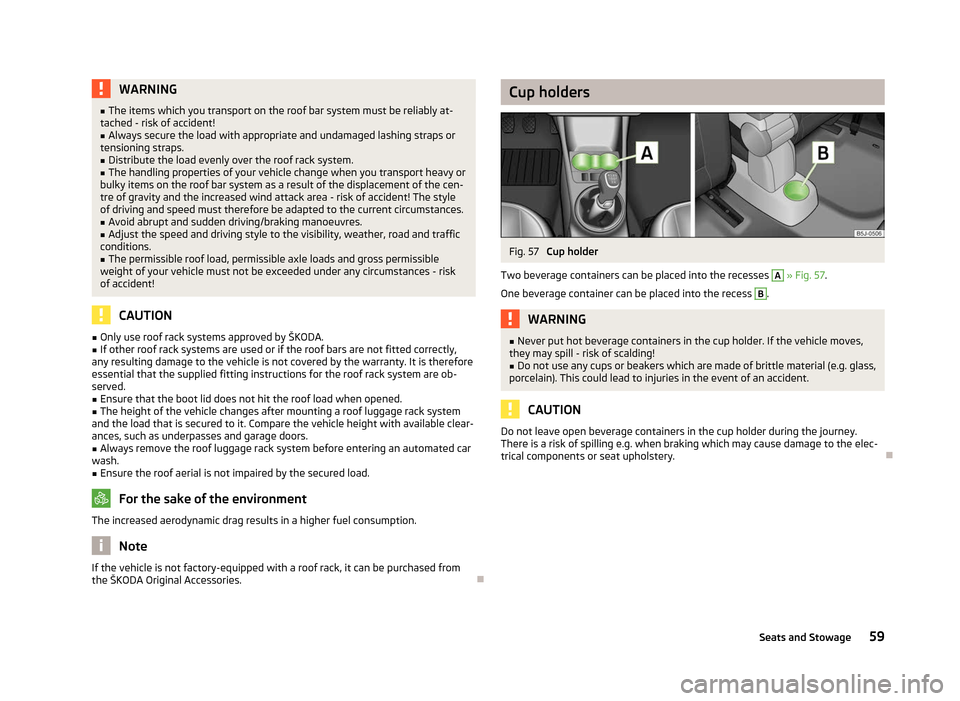
ŠKODA Original Accessories. Ð Cup holders
Fig. 57
Cup holder
Two beverage containers can be placed into the recesses A
» Fig. 57.
One beverage container can be placed into the recess B
.
WARNING
■ Never put hot beverage containers in the cup holder. If the vehicle moves,
they may spill - risk of scalding!
■ Do not use any cups or beakers which are made of brittle material (e.g. glass,
porcelain). This could lead to injuries in the event of an accident. CAUTION
Do not leave open beverage containers in the cup holder during the journey.
There is a risk of spilling e.g. when braking which may cause damage to the elec-
trical components or seat upholstery. Ð
59
Seats and Stowage
Page 65 of 194
CAUTION
Do not put any large items such as bottles or sharp objects into the map pockets,
as the pockets and the seat covers could be damaged. ÐGlasses storage box
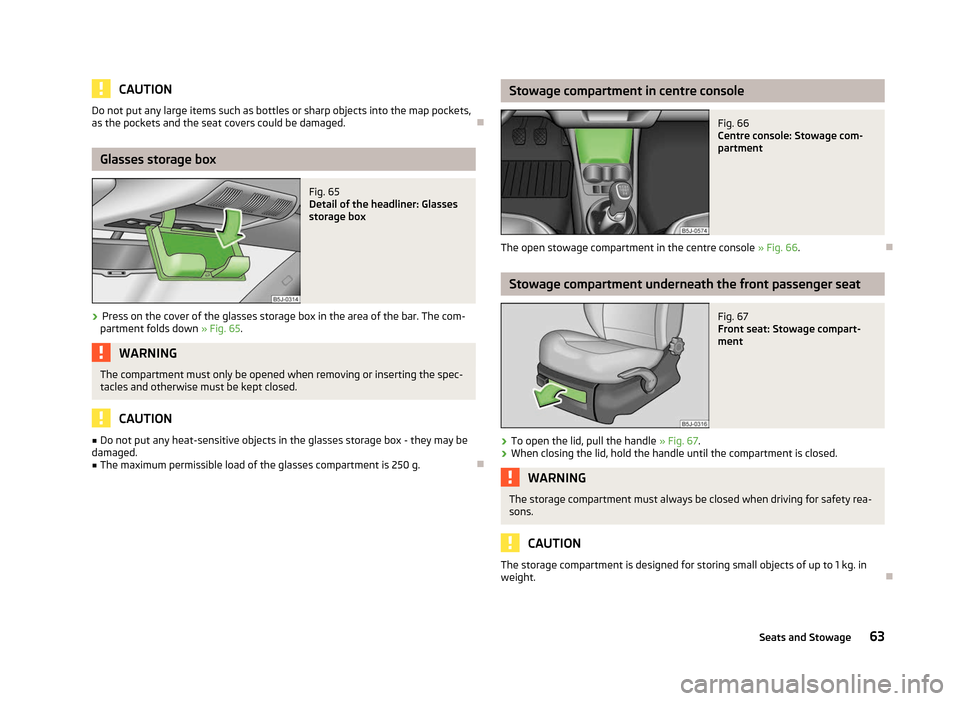
Fig. 65
Detail of the headliner: Glasses
storage box
› Press on the cover of the glasses storage box in the area of the bar. The com-
partment folds down » Fig. 65. WARNING
The compartment must only be opened when removing or inserting the spec-
tacles and otherwise must be kept closed. CAUTION
■ Do not put any heat-sensitive objects in the glasses storage box - they may be
damaged.
■ The maximum permissible load of the glasses compartment is 250 g. Ð Stowage compartment in centre console
Fig. 66
Centre console: Stowage com-
partment
The open stowage compartment in the centre console » Fig. 66. Ð Stowage compartment underneath the front passenger seat
Fig. 67
Front seat: Stowage compart-
ment
› To open the lid, pull the handle
» Fig. 67.
› When closing the lid, hold the handle until the compartment is closed. WARNING
The storage compartment must always be closed when driving for safety rea-
sons. CAUTION
The storage compartment is designed for storing small objects of up to 1 kg. in
weight. Ð
63
Seats and Stowage
Page 67 of 194
WARNING
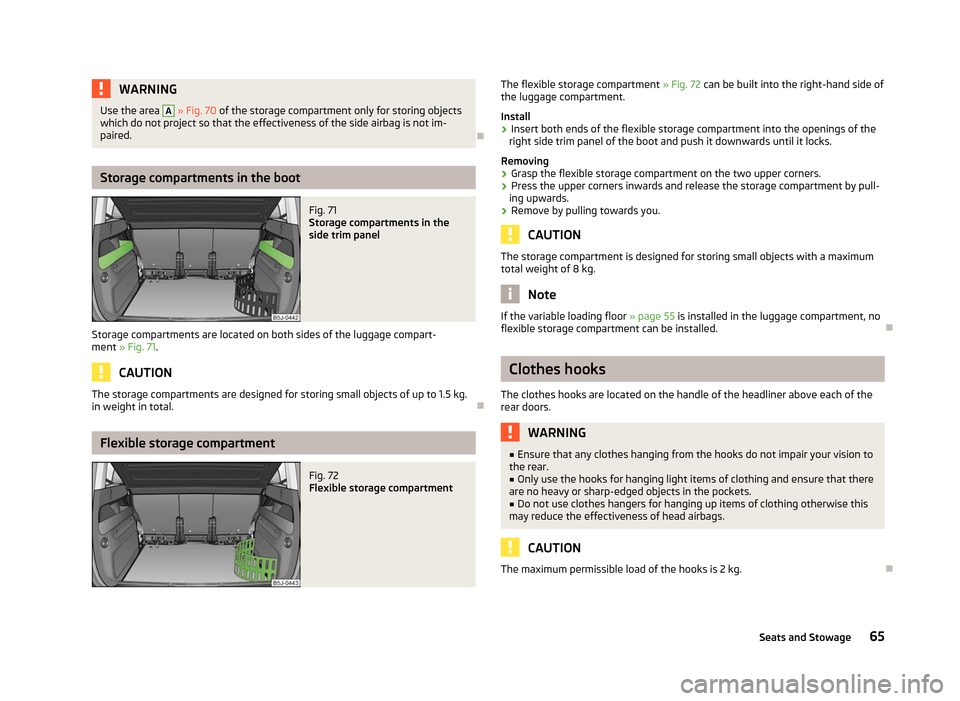
Use the area A
» Fig. 70 of the storage compartment only for storing objects
which do not project so that the effectiveness of the side airbag is not im-
paired. ÐStorage compartments in the boot
Fig. 71
Storage compartments in the
side trim panel
Storage compartments are located on both sides of the luggage compart-
ment » Fig. 71. CAUTION
The storage compartments are designed for storing small objects of up to 1.5 kg.
in weight in total. ÐFlexible storage compartment
Fig. 72
Flexible storage compartment The flexible storage compartment
» Fig. 72 can be built into the right-hand side of
the luggage compartment.
Install
› Insert both ends of the flexible storage compartment into the openings of the
right side trim panel of the boot and push it downwards until it locks.
Removing
› Grasp the flexible storage compartment on the two upper corners.
› Press the upper corners inwards and release the storage compartment by pull-
ing upwards.
› Remove by pulling towards you. CAUTION
The storage compartment is designed for storing small objects with a maximum
total weight of 8 kg. Note
If the variable loading floor » page 55 is installed in the luggage compartment, no
flexible storage compartment can be installed. Ð Clothes hooks
The clothes hooks are located on the handle of the headliner above each of the
rear doors. WARNING
■ Ensure that any clothes hanging from the hooks do not impair your vision to
the rear.
■ Only use the hooks for hanging light items of clothing and ensure that there
are no heavy or sharp-edged objects in the pockets.
■ Do not use clothes hangers for hanging up items of clothing otherwise this
may reduce the effectiveness of head airbags. CAUTION
The maximum permissible load of the hooks is 2 kg. Ð
65
Seats and Stowage
Page 85 of 194
Activating/deactivating the parking aid
The parking aid is activated automatically when
reverse gear is engaged and the
ignition is turned on. This is confirmed by a brief audible signal.
The parking aid is deactivated by removing the reverse gear. WARNING
■ The parking aid is not a substitute for the driver paying proper attention and
it is always the driver's responsibility to take care when reversing the vehicle
or carrying out similar manoeuvres. Pay particular attention to small children
and animals as they are not recognised by the parking aid sensors.
■ Before reversing or parking, check that there is no small obstacle, such as a
rock, thin post, trailer drawbar etc., in front of or behind the vehicle. Such ob-
stacles may not be recognised by the parking aid sensors.
■ Under certain circumstances, surfaces of certain objects and types of cloth-
ing cannot reflect the signals from the parking aid. Thus, these objects or peo-
ple who wear such clothing are not recognised by the parking aid sensors.
■ External sound sources can have a detrimental effect on the parking aid.
Under unfavourable conditions, objects or people may not be recognised. Note
■ If a warning signal sounds for about 3 seconds after activating the system and
there is no obstacle close to your car, this indicates a system fault. Have the fault
rectified by a ŠKODA specialist garage. ■ The sensors must be kept clean (free of ice, etc.) to enable the parking aid to
operate properly.
■ If the parking aid is activated and the selector lever of the automatic gearbox is
in the position P, the warning signal is interrupted (the vehicle cannot move). ÐCruise control system (CCS)
ä
Introduction
This chapter contains information on the following subjects:
Storing a speed 84
Changing a stored speed 84
Switching off the cruise control system temporarily 84
Switching off the cruise control system completely 84The cruise control system (CCS) maintains a constant speed, more than 30 km/h,
once it has been set, without you having to depress the accelerator pedal. This is
only possible within the range which is permitted by the power output and brak-
ing power of the engine.
The warning light
illuminates in the instrument cluster when the cruise control
system is activated. WARNING
■ For safety reasons, the cruise control system must not be used in dense
traffic or on unfavourable road surfaces (such as icy roads, slippery roads,
loose gravel) - risk of accident!
■ The saved speed may only be resumed if it is not too high for the current
traffic conditions.
■ Always switch off the cruise control system after use to prevent uninten-
tional use of the system. CAUTION
■ Always depress the clutch pedal if switching to the neutral position (vehicle
with a manual gearbox) when the cruise control system is switched on! Otherwise
the engine can rev up unintentionally.
■ The cruise control system is not able to maintain a constant speed when driving
in areas with steeper gradients. The weight of the vehicle increases the speed at
which it travels. Therefore, shift to a lower gear in good time or slow the vehicle
down by applying the foot brake. Note
It is not possible on vehicles fitted with an automatic gearbox to switch on the
cruise control system if the selector lever is in the position P, N or R. Ð
83
Starting-off and Driving
Page 107 of 194
WARNING (Continued)
■ The seat belts for the rear seats can only fulfil their function reliably when
the seat backrests are correctly locked into position » page 49, Folding the
seat backrest forwards and folding the seat fully forwards .
■ The belt webbing must always be kept clean. Soiled belt webbing may im-
pair proper operation of the inertia reel » page 133, Seat belts.
■ The seat belts must not be removed or changed in any way. Do not attempt
to repair the seat belts yourself.
■ Check the condition of all the seat belts on a regular basis. If any damage to
the seat belts, seat belt tongue, inertia reel or the lock is detected, the rele-
vant seat belt must be replaced by a specialist garage.
■ Damaged seat belts which have been subjected to stress in an accident and
were therefore stretched, must be replaced - this is best done by a specialist
garage. The anchorage points of the belts must also be inspected. The an-
chorage points for the belts should also be checked. Note
The national legal requirements must be observed when using seat belts. ÐThe physical principle of a frontal collision
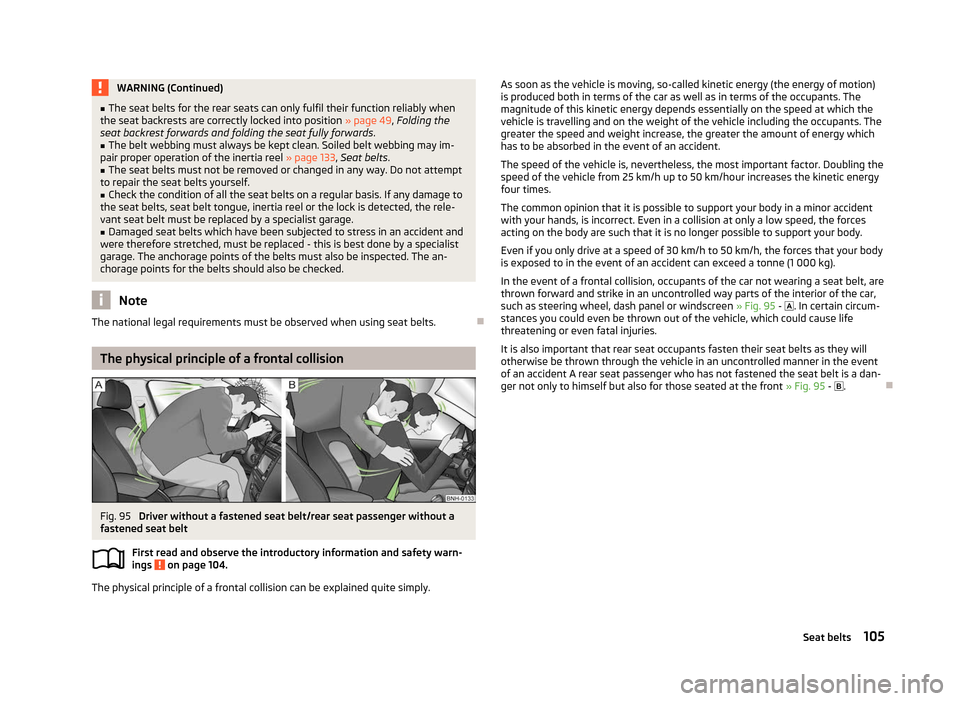
Fig. 95
Driver without a fastened seat belt/rear seat passenger without a
fastened seat belt
First read and observe the introductory information and safety warn-
ings on page 104.
The physical principle of a frontal collision can be explained quite simply.
ä As soon as the vehicle is moving, so-called kinetic energy (the energy of motion)
is produced both in terms of the car as well as in terms of the occupants. The
magnitude of this kinetic energy depends essentially on the speed at which the
vehicle is travelling and on the weight of the vehicle including the occupants. The
greater the speed and weight increase, the greater the amount of energy which
has to be absorbed in the event of an accident.
The speed of the vehicle is, nevertheless, the most important factor. Doubling the
speed of the vehicle from 25 km/h up to 50 km/hour increases the kinetic energy
four times.
The common opinion that it is possible to support your body in a minor accident
with your hands, is incorrect. Even in a collision at only a low speed, the forces
acting on the body are such that it is no longer possible to support your body.
Even if you only drive at a speed of 30
km/h to 50 km/h, the forces that your body
is exposed to in the event of an accident can exceed a tonne (1 000 kg).
In the event of a frontal collision, occupants of the car not wearing a seat belt, are
thrown forward and strike in an uncontrolled way parts of the interior of the car,
such as steering wheel, dash panel or windscreen » Fig. 95 - . In certain circum-
stances you could even be thrown out of the vehicle, which could cause life
threatening or even fatal injuries.
It is also important that rear seat occupants fasten their seat belts as they will
otherwise be thrown through the vehicle in an uncontrolled manner in the event
of an accident A rear seat passenger who has not fastened the seat belt is a dan-
ger not only to himself but also for those seated at the front » Fig. 95 - . Ð
105
Seat belts
Page 118 of 194
The following guidelines must be observed when using a child safety seat in
which the child is seated with its back facing the direction of travel on the front
passenger seat.
›
Switch off the front passenger airbag
» page 113, Deactivating airbags .
› Slide the front passenger seat all the way back.
› Move the front passenger seat backrest into the vertical position.
› Set the height-adjustable front passenger seat as high up as possible.
› Set the front passenger seat belt as high up as possible.
› Place and fasten the child seat on the seat and the child in the child seat ac-
cording to the specifications in the manufacturer's user manual of the child
seat . WARNING
■ It is essential to always switch off the front passenger airbag when attach-
ing a child safety seat to the front passenger seat where the child is seated
with its back facing in direction of travel » page 113 , Deactivating airbags.
■ Never use a child safety seat in which the child is seated with its back facing
the direction of travel on the front passenger seat if the airbag is switched on.
This child safety seat is positioned in the deployment area of the front pas-
senger airbag. The airbag may cause the child severe, or even fatal injuries, in
the event of it being deployed. ■ This is also clearly stated on the sticker which is located on the B column on
the front passenger side » Fig. 104 or on the front passenger's sun visor.
■ If a child safety seat in which the child faces in the direction of travel is used
on the front passenger seat, the front passenger seat must be moved back
and to the top fully. Move the backrest into the vertical position.
■ The front passenger airbag must be reactivated as soon as you no longer
use a child seat on the front passenger seat. Ð Child safety and side airbag
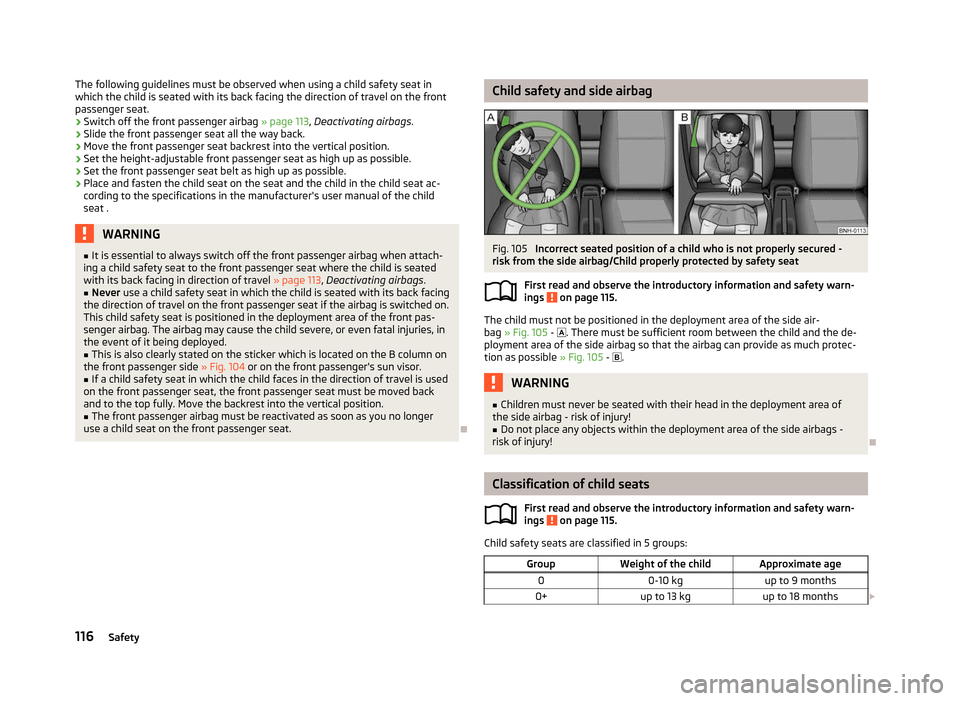
Fig. 105
Incorrect seated position of a child who is not properly secured -
risk from the side airbag/Child properly protected by safety seat
First read and observe the introductory information and safety warn-
ings on page 115.
The child must not be positioned in the deployment area of the side air-
bag » Fig. 105
- . There must be sufficient room between the child and the de-
ployment area of the side airbag so that the airbag can provide as much protec-
tion as possible » Fig. 105 - . WARNING
■ Children must never be seated with their head in the deployment area of
the side airbag - risk of injury!
■ Do not place any objects within the deployment area of the side airbags -
risk of injury! Ð Classification of child seats
First read and observe the introductory information and safety warn-
ings on page 115.
Child safety seats are classified in 5 groups:
Group Weight of the child Approximate age
0 0-10 kg up to 9 months
0+ up to 13 kg up to 18 months£ ä
ä
116 Safety