cooling SKODA SUPERB 2007 1.G / (B5/3U) User Guide
[x] Cancel search | Manufacturer: SKODA, Model Year: 2007, Model line: SUPERB, Model: SKODA SUPERB 2007 1.G / (B5/3U)Pages: 259, PDF Size: 14.71 MB
Page 92 of 259

Heating and air conditioning system91
Using the systemSafetyDriving TipsGeneral MaintenanceBreakdown assistanceTechnical Data
•Close the air outlet vents 3,
•Open air outlet vents 4 and point towards the side window,
•Switch on the cooling system by pressing button .
Warming up the inside of the vehicle as rapidly as possible
•Turn control dial to the right up to the stop,
•Blower switch in position 3 or 4,
•Turn the air distribution control into the position ,
•Open the air outlet vents 3 and 4,
•We recommend that you briefly switch on the recirculated air mode with the
pushbutton . The windows can steam up in this position however.
Heating the vehicle to a comfortable temperature
We recommend the following setting once the windows are no longer misted up
and the desired temperature has been reached:
•Control dial at the desired heat output,
•Blower switch in position 1 or 2,
•Turn the air distribution control into the position ,
•Close the air outlet vents 3,
•Open the air outlet vents 4,
•Set the air distribution regulator between positions and , if the wind-
screen gets misted up again, as required.
Cooling down the inside of the vehicle as rapidly as possible
•close all windows and the sliding/tilting roof,
•Turn the control dial to the left up to the stop
•Blower switch in position 4,
•Turn the air distribution control into the position ,
•Open the air outlet vents 3 and 4,
•Switch on the cooling system by pressing button ,
•We recommend that you briefly switch on the recirculated air mode with the
pushbutton . Optimum cooling
•Turn the control dial to the left up to the stop and the temperature can then
be increased by turning the regulator to th e right according to the prevailing condi-
tions,
•Blower switch in position 1, 2 , or 3;
•Turn the air distribution control into the position ,
•Open the air outlet vents 3 and 4,
•Switch on the cooling system by pressing button ,
•We recommend setting the air outlet vents 3 and 4 in such a way that the air
flows to the rear over the heads of the occupants. Do not press button - recir-
culated air mode.
Fresh air mode - ventilation
•Turn the control dial ⇒page 90, fig. 106 to the left up to the stop,
•Blower switch in the desired position,
•Turn the air distribution control into the position ,
•Open air outlet vents 3 and 4 ⇒ page 92, fig. 107 ,
•Switch off the cooling by pressing button ,
•Switch off the recirculated ai r mode by pressing button .
Fresh air is also supplied to the rear footwell if you select air outlet vents 5 with the
aid of the air dist ribution control .
Recirculated air mode
In recirculated air mode air is sucked out of the interior of the vehicle
and then fed back into the interior.
Recirculated air mode prevents polluted air outside the vehicle from
getting into the vehicle, for example when driving through a tunnel or
when standing in a traffic jam.
Switching recirculated air mode on
– Press switch ⇒page 90, fig. 106 the switch symbol
lights up.
AE
AA
AB
AC
AD
AA
AB
AC
AC
AA
AB
AC
AE
AD
AA
AB
AC
AE
AD
AA
AB
AC
AE
AD
AC
NKO B5 20.book Page 91 Friday, March 2, 2007 1:46 PM
Page 94 of 259

Heating and air conditioning system93
Using the systemSafetyDriving TipsGeneral MaintenanceBreakdown assistanceTechnical Data
Using the air conditioning system economically
The compressor on the air conditioning system uses power from the engine when
in cooling mode which will effect the fuel consumption.
It recommended to open the windows or th e doors of a vehicle for which the inte-
rior has been strongly heated through the ef fect of direct sunlight in order to allow
the heated air to escape.
The cooling system should not be switched on while travelling when the window is
open.
The desired interior temperature can also be achieved without switching in the
cooling system just by switching to fresh air mode.
For the sake of the environment
When you economize on fuel, you also reduce pollutant emissions.
Operational problems
If the cooling system does not operate at outside temperatures higher than +5 °C,
there is a problem in the system. The reasons for this may be:
•The fuse of the air conditioning system is defective ⇒page 220. Check the fuse,
replace it if necessary.
•The cooling system has switched off automatically for a short time because the
coolant temperature of the engine is too hot.
If you are not able to rectify the operat ional problem yourself, or if the cooling
capacity decreases, switch the cooling sy stem off. Contact a specialist garage.
Climatronic* (automatic air conditioning)
Description
The Climatronic system is a combination of an automatic heating, fresh air and
cooling system which provides optimal comfort for the occupants of the car.
The Climatronic maintains a constant temper ature fully automatically, once it has
been set. This is achieved by automa tically varying the temperature of the
outflowing air, the blower stages and the air distribution. It is not necessary to
manually alter the settings. The automatic mode ⇒ page 95 ensures maximum
wellbeing of the occupants at all times of the year.
Description of Climatronic system
The Climatronic can only operate if the following conditions are met:
•engine running,
•outside temperature above +5 °C,
•the button is not pressed.
If the Climatronic system is switched on, the temperature and air humidity drops in
the vehicle. The wellbeing of the occupants of the car is enhanced as a result of this
particularly at high outside temperatur es and a high air humidity. The system
prevents the windows misting up during the cold season of the year.
It is possible to briefly activate recirc ulated air mode in order to enhance the
cooling effect ⇒.
The heating effect is dependent upon th e coolant temperature, thus full heat
output only occurs when the engine has reached its operating temperature.
Puddle of water below car
After switching on the cooling Condensation from the evaporator of the air condi-
tioning may drip down and form a puddle below the vehicle. This is quite normal
and not an indication of a leak!
Switching over between degrees Celsius and degrees Fahrenheit
First of all press and hold the button ⇒page 94, fig. 109 and then press the
button . The temperature measur ing unit appears in the display.ECON
ECONAUTO
NKO B5 20.book Page 93 Friday, March 2, 2007 1:46 PM
Page 95 of 259

Heating and air conditioning system
94
An acoustic signal for depressed buttons
Simultaneous pressing of buttons and can be used to de-activate or
activate this function.
A higher tone is heard when switching on this function, when increasing the blower
speed or when increasing the temperature.
A lower tone is heard when switching off this function, when decreasing the blower
speed or when decreasing the temperature.
Aeration of the vehicle when ignition is switched off*
On models fitted with power sliding/tilting roof with sollar cells, the fresh air blower
is automatically switched over to “solar mode ” if the sun ray's are sufficient after
switching off the ignition. The solar cells on the sliding/tilting roof deliver power for
the fresh air blower. This supplies the interior of the car with fresh air.
For an optimum ventilation, the air outlet vents 3 and 4 must be opened
⇒ page 97.
The ventilation functions only when the sliding/tilting roof is closed.
WARNING
•For your own safety and that of other road users, ensure that all the
windows are free of ice, snow and mistin g. Please familiarize yourself about
how to correctly operate th e heating and ventilation systems, how to demist
and defrost the windows, as well as with the cooling mode.
•You should not leave recirculated air mode on over a longer period of
time, as “stale” air may result in fatigue in the driver and occupants, divert
your attention and also cause the windows to mist up. The risk of having an
accident increases. Switch recirculated air mode off as soon as the windows
begin misting up.
Note
•If the cooling system has not been switched on for a lengthy period, odours may
be produced at the evaporator because of deposits. Switch the air conditioning
system on at least once a month for appr oximately 5 minutes at the highest blower stage - also during the cold season of the year - in order to remove such odours.
Also open a window for a short time.
•We recommend that you do not smoke in the vehicle when the recirculating air
mode is operating since the smoke which is drawn at the evaporator from the inte-
rior of the vehicle forms deposits in the evaporator of the air conditioning system.
This produces a permanent odour when th e air conditioning system is operating
which can only be eliminated through co nsiderable effort and expense (replace-
ment of compressor).
•Using the air conditio ning economically ⇒page 93.
•Operational faults ⇒page 93.
Overview of the control elements
Fig. 109 Climatronic: Control elements
The buttons
Defrosting the windscreen
The displays Display of blower stages
Display of outside temperature, here: +11 °C
Defrosting the windscreen
ECON
A1
A2
A3
A4
NKO B5 20.book Page 94 Friday, March 2, 2007 1:46 PM
Page 96 of 259

Heating and air conditioning system95
Using the systemSafetyDriving TipsGeneral MaintenanceBreakdown assistanceTechnical Data
Recirculated air mode
Direction of air flow
Display of selected inside temperature, here:
+22 °C
Display for:
− Automatic mode ( AUTO) or
− Cooling system switched off ( ECON) or
− Climatronic switched off ( OFF)
The buttons Automatic mode
Recirculated air mode
Button for:
−Reducing blower speed or
− Switching off Climatronic (OFF )
Increasing blower speed button or switching Climatronic on
Air flow button to chest (ventilation mode)
Air flow button to footwell at front and rear (heating mode)
Button for decreasi ng temperature
Button for increasing temperature
Button for switching off cooling system
The sensor Interior temperature sensor
Buttons , and can also be pressed in combination.
Automatic mode
The automatic mode is used in orde r to maintain a constant temper-
ature and to demist the windows in the interior of the car.
Switching automatic mode on
– Set a temperature between + 18°C (64°F) and +29°C (86°F).
– Move the air outlet vents 3 and 4 ⇒ page 97, fig. 110 upwards –Press the button .
When the automatic mode is operating,
AUTO appears in the display. Automatic
mode operates only within the control temperature range from +18°C (64°F) up to
29°C (86°F). If you select the temperature below +18°C (64°F), LO appears in the
display. If you select a temperature higher than + 29°C (86°F), HI appears in the
display. In both limit positions the Clim atronic operates at maximum cooling or
heating capacity, respectively. The temper ature is not controlled in this case.
If you press when the automatic mode is operating a desi red button (except
buttons 15 and 16), the automatic mode is switched off.
ECON mode
The cooling system is switched o ff in the ECON mode - heating and
ventilation are regulated automatically.
Switching ECON mode on
–Press the button .
– Set a temperature between +18° C (64°F) and +29 °C (86 °F).
Recirculated air mode in ECON mode
–Press the button .
– After this, press the button .
When the ECON mode is operating, ECON appears in the display. ECON mode
operates only within the control temperature range from +18 °C (64 °F) up to +29
°C (86 °F).
Once a temperature has been set, it is main tained constant fully automatically. This
is achieved by auto matically varying the temperature of the outflowing air, the
blower stages and the air distribution. Th e system also takes into account bright
sunlight which eliminates the need to alter the settings manually.
The ECON mode is switched off when pressing button , or .
A5
A6
A7
A8
A9AUTO
A10
A11
A12
A13
A14
A15
A16
A17ECON
A18
A1A13A14
AUTO
ECON
ECON
AUTO
NKO B5 20.book Page 95 Friday, March 2, 2007 1:46 PM
Page 97 of 259

Heating and air conditioning system
96
Please note that, in the ECON mode, the interior temperature cannot be lower than
the outside temperature. The interior is not cooled and the air is not dehumidified.
If you select the temperature below +18 °C (64 °F), LO appears in the display. If you
select a temperature higher than + 29 °C (86 °F), HI appears in the display. In the
position LO the recirculated air is not warmed up. In the HI position, the system
operates continuously with maximum heating capacity.
Please refer to the information regarding recirculated air mode ⇒page 96.
Recirculated air mode
In recirculated air mode air is sucked out of the interior of the vehicle
and then fed back into the interior.
Recirculated air mode prevents polluted air outside the vehicle from
getting into the vehicle, for example when driving through a tunnel or
when standing in a traffic jam.
Switching recirculated air mode on
– Press button , the symbol
lights up on the display.
Switching recirculated air mode off
– Once again press the button or the button , the symbol
goes out on the display.
WARNING
You should not leave recirculated air mode on over a longer period of time,
as “stale” air may result in fatigue in the driver and occupants, divert your
attention and also cause the windows to mist up. The risk of having an acci-
dent increases. Switch recirculated air mode off as soon as the windows
begin misting up.
Note
If the windscreen is misted up, first of all press the button and then the
button . After the windscreen has been demisted, once again press the button
.
Setting temperature
– Press the button or ⇒page 94, fig. 109 and continue pressing
until the desired temperature is set.
You can set the interior temperature betw een +18°C (64°F) and +29°C (86°F). The
interior temperature is regulated automatically within this range. If you select the
temperature below 18°C (64°F), “LO” appear s in the display. If you select the
temperature higher than 29 °C (86 °F), “HI” appears in the display. In both limit posi-
tions the Climatronic operates at maximu m cooling or heating capacity, respec-
tively. The temperature is no t controlled in this case.
Lengthy and uneven distribution of the air flow out of the vents (in particular at the
leg area) and large differences in temperature, for example when getting out of the
vehicle, can result in chills in sensitive persons.
Controlling blower
There are a total of seven blower stages available.
The Climatronic system controls the bl ower stages automatically in line
with the interior temperature. You can also, however, adapt the blower
stages manually to suit your particular needs.
Setting blower stages
– Press the button or the button to set the blower stage.
The number of dashes in the display ⇒page 94, fig. 109 indicates the blower
stage.
AUTO
AUTOAUTO
A15A16
A2
NKO B5 20.book Page 96 Friday, March 2, 2007 1:46 PM
Page 170 of 259
Towing a trailer169
Using the systemSafetyDriving TipsGeneral MaintenanceBreakdown assistanceTechnical Data
Towing a trailer
Towing a trailer
Technical requirements
The towing device must satisfy certain technical requirements.
Your vehicle is designed primarily for tran sporting persons and luggage. It can,
however, also be used for towing a trailer - provided certain technical equipment is
fitted.
If your vehicle has alre ady been supplied with a factory-fitted towing device then
everything that is necessary for towing a tr ailer in technical terms, and in terms of
the law, has already been taken into account.
Your vehicle is fitted with a 13-pin powe r socket for the electrical connection
between the vehicle and trailer. If the trailer which you wish to tow has a 7-pin
connector , you can use a suitable adapter
4) from Škoda original accessories.
This work must be carried out in accordan ce with the manufacturer's specifications
if a towing device is retrofitted.
Škoda Service Partners are familiar with details relating to retrofitting a towing
device and for any necessary modi fications to the cooling system.
WARNING
We recommend that you have the towing device from Škoda original acces-
sories installed by a Škoda Service Partner. H e is fa m il ia r wit h al l the re le v a nt
details relating to retrofitting such equipment. There is a risk of an accident
if the towing device is not properly fitted!
General Maintenance
There are a number of points to pay attention to when towing a
trailer.
Trailer load
The permissible trailer load must on no account be exceeded.
You can negotiate appropriately steeper incl ines and descents if you do not make
full use of the permissible trailer load.
The trailer loads specified only apply for altitudes up to 1 000 metres above mean
sea level. The fact that the engine power ou tput drops with increasing height due to
a lowering of air pressure and thus the abil ity to climb, means that the towed weight
must be reduced by 10% for every further increase of 1 000 metres in height above
sea level. The towed weight is the weight of the (laden) vehicle and the (laden)
trailer together. One should take this into account before driving up to higher alti-
tudes.
The trailer and drawbar load information on the type plate of the towing
device are merely test data for the towi ng device The data relating to your
vehicle, which is often less than this test data, can be found in your vehicle
registration documents.
Distribution of the load
Distribute the load in the trailer in such a way that any heavy items are located as
close as possible to the axle. Secure the items to prevent them slipping.
Tyre pressure
Select the tyre inflation pressure on yo ur vehicle for that of “fully laden”,
⇒ page 200. The inflation pressure of the tyres fitted to the trailer adjust in accord-
ance with the manufacturer's recommendation.
Exterior mirrors
You have to have additional exterior mirr ors fitted if you are not able to see the
traffic behind the trailer with the standard rear-view mirrors. Both exterior mirrors
4)In some countries the adapter is supplied with the towing device.
NKO B5 20.book Page 169 Friday, March 2, 2007 1:46 PM
Page 171 of 259

Towing a trailer
170
should be attached to folding arms. Adjust the mirrors so that they provide you with
an adequate field of view to the rear.
Headlights
Before starting off with a hitched trailer, also check the setting of the headlights.
Alter the setting as necessary with the aid of the headlight beam adjuster
⇒ page 48.
Detachable ball head
The ball rod is detachable on vehicles wh ich feature a factory-fitted towing device.
It is stowed together with separate fitting instructions in the spare wheel well in the
luggage compartment of the vehicle.
Further information on the towing device ⇒page 171.
Note
•We recommend that you also have yo ur vehicle inspected between service
intervals if you tow a trailer frequently.
•The handbrake on the towing vehicle must be put on when coupling and
decoupling the trailer.
Driving Tips
Particular caution is required when towing a trailer.
– Do not, as far as possible, drive with your vehicle unladen and the
trailer laden.
– Do not make full use of the legal maximum speeds. This applies in
particular to downhill sections.
– Apply the brakes in good time.
– Keep a check on the coolant temper ature gauge if the outside temper-
ature is high.
Distribution of weight
The distribution of the weight is very poor if your vehicle is unladen and the trailer
is laden. Maintain a particularly low speed if you cannot avoid driving with this
combination.
Driving speed
Do not drive faster than 80 km/h for safety reasons. This also applies for countries
in which higher speeds are allowed.
The fact that the driving stability of the vehicle + trailer combination reduces with
increasing speed means that the legally allowed speed should not be used when
there are unfavourable road, weather or wind conditions, particularly near accident
black spots.
You must always reduce your speed immedi ately as soon as you detect even just
the slightest swaying of the trailer. On no account attempt to stop the trailer from
“swaying” by accelerating.
Apply the brakes in good time! If the trailer is fitted with a trailer brake, apply the
brakes gently at first and then brake firmly. This will avoid brake jolts resulting from
the trailer wheels locking. Shift down gears in good time before negotiating a down-
hill section to allow the engine to also act as a brake.
Engine overheating
Please keep a check on the coolant temperature gauge if you have to negotiate a
lengthy slope in a low gear at a high engi ne speed when the outside temperature is
very high ⇒page 12.
If the needle of the coolant temperature gauge moves into the right-hand area or
even the red area of the scale, reduce yo ur speed immediately. Stop and switch off
the engine if the warning light
in the instrument cluste r begins flashing. Wait a
few minutes and check the level of coolant in the coolant expansion bottle
⇒ page 190, “Inspecting the coolant level”.
Please refer to the following guidelines ⇒page 26, “Coolant temperature, Coolant
quantity ”.
The coolant temperature can be reduced by switching on the heating.
Any increase in the cooling effect of the coolant fan through shifting down a gear
and increasing the engine speed is not possible since the fan speed is independent
NKO B5 20.book Page 170 Friday, March 2, 2007 1:46 PM
Page 186 of 259
Inspecting and Replenishing185
Using the systemSafetyDriving TipsGeneral MaintenanceBreakdown assistanceTechnical Data
WARNING
•Never open the bonnet if you see that steam or coolant is flowing out of
the engine compartment - risk of scaldi ng! Wait long enough until the steam
or coolant has stopped escaping.
•For safety reasons, the bonnet must always be properly closed when
driving. One should therefore check that the lock has in fact engaged prop-
erly after closing the bonnet.
•Stop your vehicle immediately while driv ing if you notice that the lock is
not properly engaged and close the bonne t properly - risk of an accident!
Caution
•Before opening the bonnet, ensure that the arms of the windscreen wipers are
correctly in place against the windscreen. Otherwise, there is a risk of damage to the
paintwork.
Working in the engine compartment
Particular care is required when carrying out any work in the engine
compartment!
There is a risk of injuries, scalding, accidents and fire when working in the
engine compartment, e.g. inspecting and replenishing oil and other fluids. For
this reason, it is essential to comply with the warning instructions stated
below and with the general applicable rules of safety. The engine compart-
ment of your car is a hazardous area ⇒ .
WARNING
•Never open the bonnet if you see that steam or coolant is flowing out of
the engine compartment - risk of scaldi ng! Wait long enough until the steam
or coolant has stopped escaping.
•Switch off the engine and pull out the ignition key.
•Apply the handbrake firmly.
•If your vehicle is fitted with a ma nual gearbox, move the gearshift lever
into Neutral, or if it is fitted with automatic gearbox, move the selector lever
into position P.
•Allow the engine to cool down.
•Keep children clear of the engine compartment.
•Do not touch any hot engine parts - risk of burns!
•Never spill oil and other fluids over the hot engine. Such fluids (e.g. the
antifreeze contained in the coolant) may ignite!
•Avoid short circuits in the electrical system - particularly on the battery.
•Never place your hand into the radiator fan as long as the engine is still
warm. The fan might suddenly start running!
•Never open the cap of the coolant expa nsion bottle as long as the engine
is still warm. The cooling system is pressurized!
•Cover over the cap of the coolant expansion reservoir with a large cloth
when opening it as protection for your face, hands and arms from hot steam
or hot coolant.
•Do not let objects, such as e.g cleaning cloth or tools lie in the engine
compartment.
•If you wish to work under the vehicle, you must secure the vehicle from
rolling away and support it with suitable supporting blocks: the car jack is
not sufficient for this - risk of injury!
•In cases where it be necessary to carry out inspection work when the
engine is running there is an additional risk from rotating parts (e.g. the V-
ribbed belt, alternator, radiator fan) and from the high-voltage ignition
system. Please observe in addition the following:
−Never touch the electrical cabl es of the ignition system.
− Absolutely avoid any jewellery, loose items of clothing or long hair
from getting into the rotating parts of the engine - Hazard! Therefore
remove any jewellery beforehand, tie up your hair and wear tight fitting
clothing.
WARNING (continued)
NKO B5 20.book Page 185 Friday, March 2, 2007 1:46 PM
Page 190 of 259
Inspecting and Replenishing189
Using the systemSafetyDriving TipsGeneral MaintenanceBreakdown assistanceTechnical Data
Changing engine oil
The engine oil must be changed at the intervals stated in the Service schedule or
according to the service interval indicator ⇒page 14.
WARNING
•Only carry out the engine oil change, if you have the required profes-
sional knowledge!
•Read and observe the warning notes ⇒page 185, “Working in the engine
compartment” before working in the engine compartment.
•Let the engine cool down - risk of burning from hot oil.
•Wear an eye protection - risk of caustic burns due to oil splashes.
•Oil is toxic! Store old oil in a safe place out of the reach of children and
unauthorized persons until you dispose of it properly.
Caution
You must not pour any additives into th e engine oil - risk of engine damage!
Damage, which results from such produc t, are excluded from the warranty.
For the sake of the environment
•You must on no account pour oil into the ground or into the sewage system.
•In view of the problems involved in prop erly disposing of old oil, the material,
equipment and the knowledge required for such work, we recommend that you
have the oil and oil filter change carried out by your Škoda Service Partner.
Note
After your skin has come in contact with the oil, you must thoroughly wash your
skin.
Cooling system
Coolant
The job of the coolant is to cool the engine.
The cooling system does not require an y maintenance under normal operating
conditions. The coolant consist s of water with a concentration of coolant additive
of 40 %. This mixture not only provides antifreeze protection down to -25°C but
also protects the cooling and heating system from corrosion. It also prevents the
formation of scale and significantly increases the boiling point of the coolant.
You must therefore not reduce the concentration of antifreeze agent in the coolant
by adding water, also not during the su mmer months or in countries with a warm
climate. The concentration of coolant additive in the coolant must be at least
40%.
You can increase the amount of antifreeze in the coolant if a higher concentration
of antifreeze is necessary for climatic reasons but only up to 60% (antifreeze
protection down to approx. -40°C). The an tifreeze protection tails off above that
concentration.
Vehicles exported to countries with a co ld climate (e.g. Sweden, Norway, Finland)
are already factory-filled with a coolant which offers antifreeze protection down to
about -35°C. In these countries the concentr ation of coolant additive should be at
least 50 %.
Coolant
The cooling system is filled at the works with coolant (purple in colour), which
complies with the specification TL-VW 774 F.
We recommend that you use the antifreeze agent - G12 PLUS (purple in colour).
Please contact your Škoda Se rvice Partner if you have any questions regarding the
coolant or if you wish to fill up with a different coolant.
Your Škoda Service Partner can also suppl y you with the correct coolant additives.
NKO B5 20.book Page 189 Friday, March 2, 2007 1:46 PM
Page 191 of 259
Inspecting and Replenishing
190
Caution
•Other coolant additives may cause operational problems which, in partic-
ular, involves significantly reducing the anticorrosion effect.
•Any faults or problems resulting from corrosion may cause a loss of
coolant and, as a consequence of th is, result in major engine damage.
Inspecting the coolant level
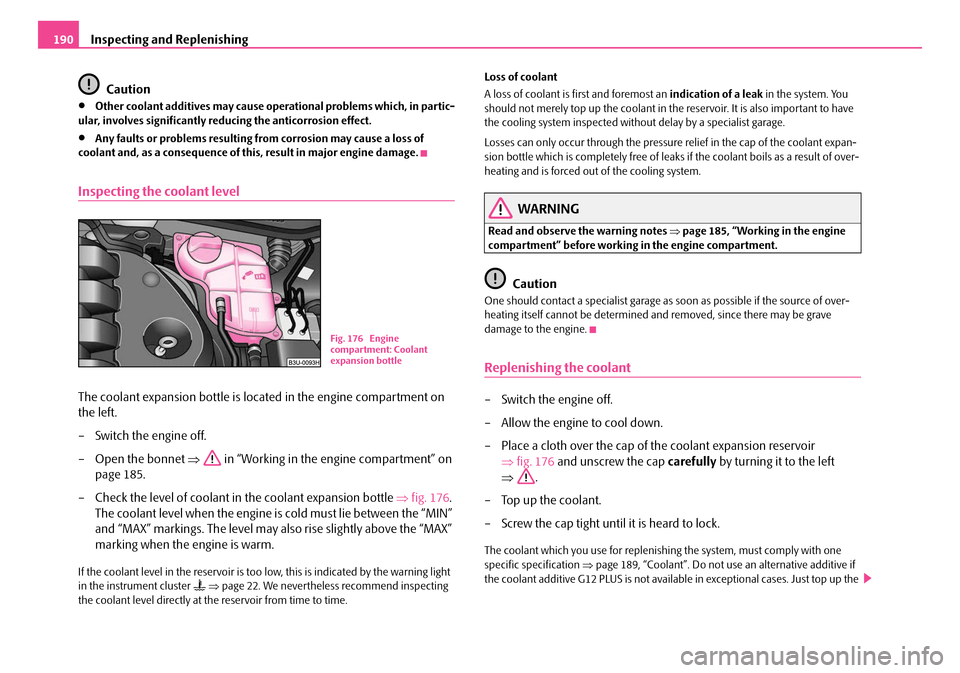
The coolant expansion bottle is located in the engine compartment on
the left.
– Switch the engine off.
– Open the bonnet ⇒ in “Working in the engine compartment” on
page 185.
– Check the level of coolant in the coolant expansion bottle ⇒fig. 176 .
The coolant level when the engine is cold must lie between the “MIN”
and “MAX” markings. The level may also rise slightly above the “MAX”
marking when the engine is warm.
If the coolant level in the reservoir is too low, this is indicated by the warning light
in the instrument cluster ⇒ page 22. We nevertheless recommend inspecting
the coolant level directly at th e reservoir from time to time. Loss of coolant
A loss of coolant is first and foremost an
indication of a leak in the system. You
should not merely top up the coolant in the reservoir. It is also important to have
the cooling system inspected without delay by a specialist garage.
Losses can only occur through the pressure relief in the cap of the coolant expan-
sion bottle which is completely free of leaks if the coolant boils as a result of over-
heating and is forced out of the cooling system.
WARNING
Read and observe the warning notes ⇒page 185, “Working in the engine
compartment” before working in the engine compartment.
Caution
One should contact a specialist garage as soon as possible if the source of over-
heating itself cannot be determined and removed, since there may be grave
damage to the engine.
Replenishing the coolant
– Switch the engine off.
– Allow the engine to cool down.
– Place a cloth over the cap of the coolant expansion reservoir ⇒fig. 176 and unscrew the cap carefully by turning it to the left
⇒ .
– Top up the coolant.
– Screw the cap tight until it is heard to lock.
The coolant which you use for replenishing the system, must comply with one
specific specification ⇒page 189, “Coolant”. Do not use an alternative additive if
the coolant additive G12 PLUS is not available in exceptional cases. Just top up the
B1Z-0042HB1Z-0042H
Fig. 176 Engine
compartment: Coolant
expansion bottle
NKO B5 20.book Page 190 Friday, March 2, 2007 1:46 PM