deactivate passenger airbag SKODA SUPERB 2007 1.G / (B5/3U) User Guide
[x] Cancel search | Manufacturer: SKODA, Model Year: 2007, Model line: SUPERB, Model: SKODA SUPERB 2007 1.G / (B5/3U)Pages: 259, PDF Size: 14.71 MB
Page 152 of 259
Transporting children safely151
Using the systemSafetyDriving TipsGeneral MaintenanceBreakdown assistanceTechnical Data
travel (in some countries also when the
child is facing the direction of travel)
⇒ page 144.
•In certain countries national legal provisions require that besides the
front airbag also the side or head ai rbags are deactivated. Please comply
with any differing national legal regula tions regarding the use of child safety
seats.
•If this is not done, a child seated on the front passenger seat may suffer
severe or even fatal injuries if the front passenger airbag or airbags are
deployed.
•You should have the front passenger airbag (or airbags) reactivated just
as soon as you no longer use a child sa fety seat on the front passenger seat.
Child safety seats in Group 2
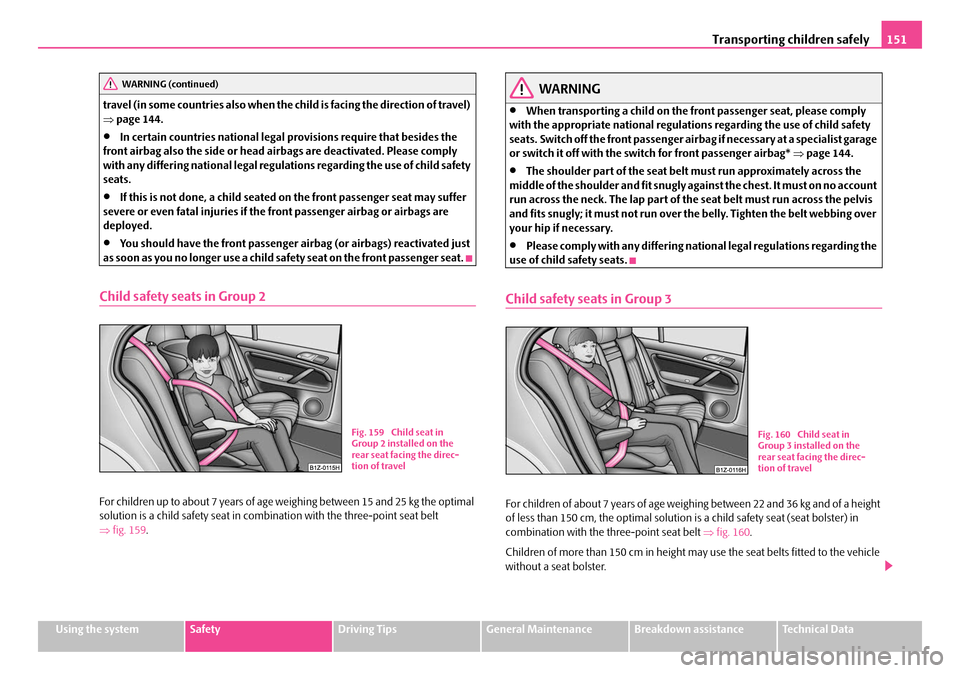
For children up to about 7 years of age weighing between 15 and 25 kg the optimal
solution is a child safety seat in comb ination with the three-point seat belt
⇒ fig. 159 .
WARNING
•When transporting a child on the fr ont passenger seat, please comply
with the appropriate national regulati ons regarding the use of child safety
seats. Switch off the front passenger airb ag if necessary at a specialist garage
or switch it off with the switch for front passenger airbag* ⇒page 144.
•The shoulder part of the seat belt must run approximately across the
middle of the shoulder and fit snugly agai nst the chest. It must on no account
run across the neck. The lap part of the seat belt must run across the pelvis
and fits snugly; it must not run over the belly. Tighten the belt webbing over
your hip if necessary.
•Please comply with any differing nati onal legal regulations regarding the
use of child safety seats.
Child safety seats in Group 3
For children of about 7 years of age weighing between 22 and 36 kg and of a height
of less than 150 cm, the optimal solution is a child safety seat (seat bolster) in
combination with the three-point seat belt ⇒fig. 160 .
Children of more than 150 cm in height may use the seat belts fitted to the vehicle
without a seat bolster.
WARNING (continued)
Fig. 159 Child seat in
Group 2 installed on the
rear seat facing the direc-
tion of travelFig. 160 Child seat in
Group 3 installed on the
rear seat facing the direc-
tion of travel
NKO B5 20.book Page 151 Friday, March 2, 2007 1:46 PM
Page 153 of 259
Transporting children safely
152
WARNING
•When transporting a child on the fr ont passenger seat, please comply
with the appropriate national regulations regarding the use of child safety
seats. Switch off the front passenger airbag if necess ary at a specialist garage
or switch it off with the switch for front passenger airbag* ⇒page 144.
•The shoulder part of the seat belt must run approximately across the
middle of the shoulder and fit snugly agai nst the chest. It must on no account
run across the neck. The lap part of the seat belt must run across the pelvis
and fits snugly; it must not run over th e belly. Tighten the belt webbing over
your hip if necessary.
•Please comply with any differing nati onal legal regulations regarding the
use of child safety seats.
Attaching child safety seat
Child seat protection
You can block the three-point seat belt in order to attach a child
safety seat.
You can permanently block the three-poin t seat belt in order to attach a
child safety seat. Blocking the belt in this way ensures that the child seat
is held firmly in position in the car.
Activating child seat protection
– Attach the child safety seat with the three-point seat belt as stated in the instructions of the manufacturer of the child seat.
– Now, pull the shoulder part of the belt out fully.
– Insert the tongue of the lock into the seat belt buckle belonging to the seat until it is heard to lock in place.
– Reel up the belt webbing until it is fitted snugly against the child seat. When the belt is reeled up, this can be detected by a “clicking” noise. – Pull on the belt in order to check that it is no longer possible to pull out
the webbing. The child seat protection is now switched on.
Deactivating child seat protection
– Press the red button on the seat belt buckle. The tongue of the lock jumps out of the buckle as a result of the spring force when this is
done.
– Guide the belt back with your hand to enable the inertia reel to wind up the belt webbing more easily. Th e child safety lock is deactivated
after the full reeling up of the belt.
WARNING
It is essential to always switch off ⇒page 144 the airbag (airbags) when
attaching a child safety seat on the fr ont passenger seat where the child is
seated with its back facing in direction of travel (in some countries also when
the child is facing the direction of travel). If this is not done, there is a risk of
the child suffering severe or even fatal injuries if the front passenger airbag
is deployed. In certain countries national legal provisions also require that
the side and head airbags be deactivated. When transporting a child on the
front passenger seat, please comply wi th the appropriate national regula-
tions regarding the use of child safety seats.
NKO B5 20.book Page 152 Friday, March 2, 2007 1:46 PM